Introduction
Inhabitants of the Early Natufian site of Wadi Hammeh 27 in Jordan (12,000–12,500 cal. bc) collected interesting curios such as fossils, semi-precious stones, tortoise shells and oddly shaped pieces of rock (Edwards et al. Reference Edwards, Webb, Glaisher and Edwards2013a). Here we provide contextual evidence to suggest that patterns on a variety of these objects were used by artisans at the site as geometric motifs which were applied to portable artworks. The idea that interesting natural designs may have prompted ancient artisans to reproduce or abstract them has been recognized for centuries (Hodgson & Pettitt Reference Hodgson and Pettitt2018, 597). Yet it is less common to find examples of art objects and similar natural prototypes in contemporaneous and secure archaeological contexts, located close to each other. This article presents three plausible cases from Wadi Hammeh 27.
Like other peoples, Natufian-period artisans were drawn to a variety of interesting natural objects. The practice of collecting or lightly modifying natural forms reflects a widespread phenomenon that Marshack (Reference Marshack1997a) believed is ubiquitous in our species. Indeed, the ability to recognize animate forms in inanimate objects may be an integral part of the human condition (Marshack Reference Marshack1997a; Onians Reference Onians2007). Evidence for this capability appears widely in time and space; for example, the subtle modifications made to European cave walls and stalagmites in the Upper Palaeolithic to enhance their representational value (Bahn & Vertut Reference Bahn and Vertut1997, 105–6) and the embellishment of elongated stone objects to elaborate their phallic form by Indigenous Australians (McCarthy Reference McCarthy1976, 70; Mountford Reference Mountford1939; Reference Mountford1960).
The earliest example of this type from the Levant is the Acheulian ‘figurine’ (c. 230,000 years ago) from Berekhat Ram on the Golan Heights (d’Errico & Nowell Reference d'Errico and Nowell2000). Unmodified, coloured pebbles were also collected at Qesem Cave during the late Lower Palaeolithic period (c. 420,000–200,000 years ago: Assaf Reference Assaf2018). Much later, a Geometric Kebaran chert nodule from Wadi Mataha (c. 16–17,000 years ago) was smoothed and incised to enhance its anatomical likeness to a seated human figure (Gregg et al. Reference Gregg, Chazan and Janetski2011, fig. 3; Stock et al. Reference Stock, Pfeiffer, Chazan and Janetski2005). Perhaps the most striking example of the Natufian interest in found objects is another anthropomorphic cobble from Wadi Mataha, minimally shaped to emphasize its likeness to a seated human figure (Gregg Reference Gregg2002, fig. 35).
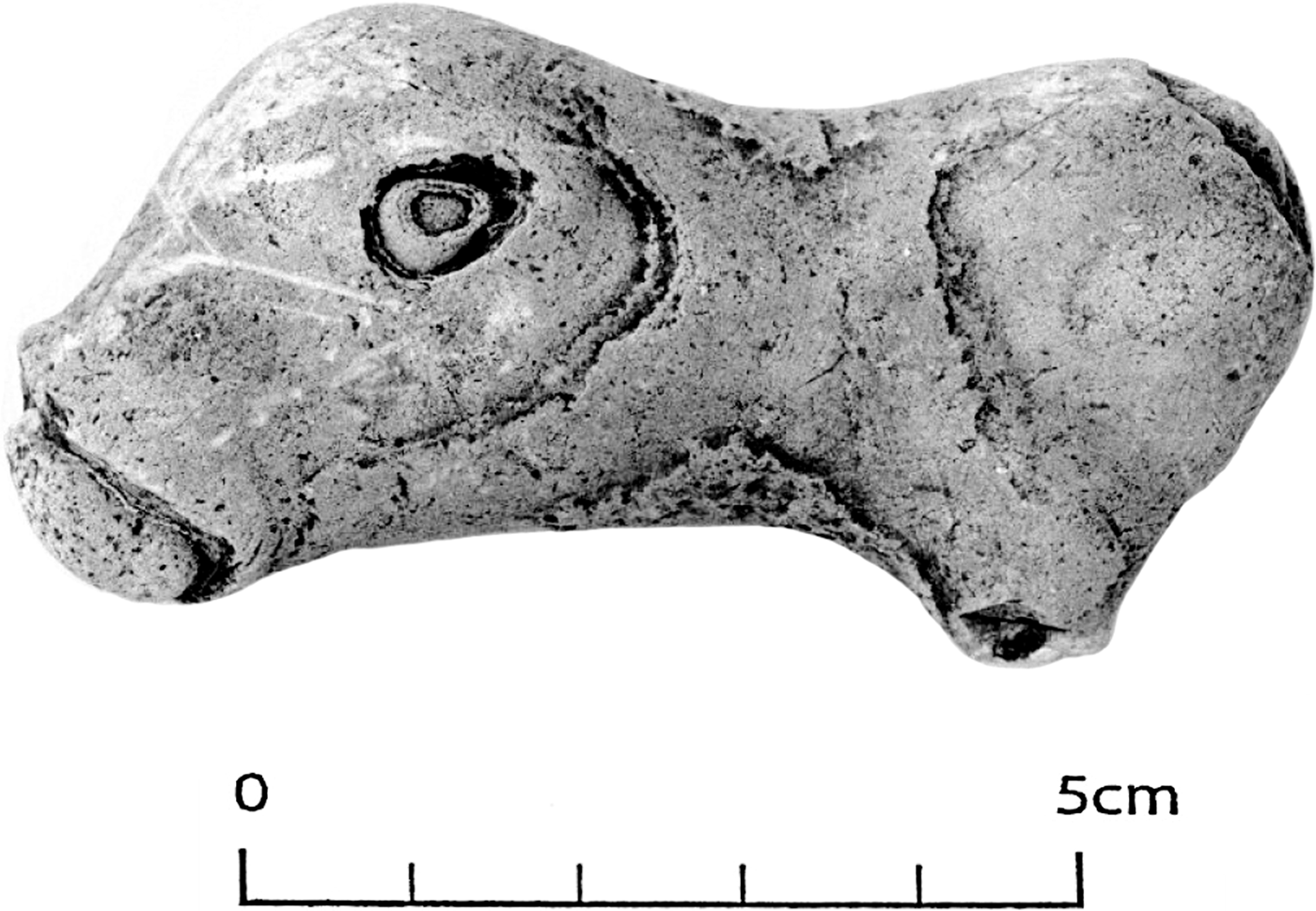
Natufian artisans from Wadi Hammeh 27 also took inspiration from natural forms, such as the exfoliating cobble RN (Registered Number) 80153 (Fig. 1), which suggests an animal's head with a large eye. This example is echoed by a zoomorphic flint nodule from the site of El Wad with a strategically placed ‘eye’ (Weinstein-Evron Reference Weinstein-Evron1998, 104). Moreover, elongated flint nodules from El Wad were transformed into phallic representations by the strategic addition of grooves representing the prepuce and urethral opening. The shape of a pestle also naturally suggests a phallic form, and this was sometimes accentuated by the application of ‘urethral’ and radial grooves added to the end, as in examples from El Wad (Weinstein-Evron Reference Weinstein-Evron1998, 96–7) and Hayonim Cave (Belfer-Cohen Reference Belfer-Cohen, Bar-Yosef and Valla1991, 575). A phalliform representation at Wadi Hammeh 27 (RN 80024) was effected on the longest pestle found at the site (Edwards Reference Edwards and Edwards2013a, 316), and also more naturalistically on the smaller pestle, RN 140053 (Edwards et al. Reference Edwards, Shewan and Webb2018; Robertson Reference Robertson2016).
Exfoliating cobble (RN 80153), Phase 3, Wadi Hammeh 27.

This examination is directed at the more premeditated and calculated use of natural objects as templates for geometric motifs applied to portable artworks. Before proceeding to examine the cases, we first review the Natufian period of the Levant, Wadi Hammeh 27 and its art, and then review approaches to the study of geometric art in the late Pleistocene.
The Natufian culture and the site of Wadi Hammeh 27
The Natufian period (13,000–10,300 cal. bc) in the Levant is considered a crucial juncture in human settlement history because it marks the transition between the mobile hunter-gatherers of earlier Epipalaeolithic phases (20,000–13,000 cal. bc) and the sedentary, agrarian villagers of the Early Neolithic (10,300–8300 cal. bc: Bar-Yosef & Valla Reference Bar-Yosef and Valla2011; Grosman & Munro Reference Grosman, Munro, Enzel and Bar-Yosef2017). The Natufian settlement system has been claimed as an example of inter-annual, pre-agricultural sedentism, and while this level of settlement permanence has yet to be demonstrated, there is broad consensus that the large, open-air Early Natufian sites, termed ‘base-camps’ (Bar-Yosef & Goren Reference Bar-Yosef and Goren1973), represent a more intensive residential system than had previously existed in the Mediterranean zone of the southern Levant (Boyd Reference Boyd2006; Byrd Reference Byrd1989; Edwards Reference Edwards1989). However, it is not clear as to whether fully inter-annual, year-on-year sedentism is demonstrated, rather than intensified occupations per se (Valla Reference Major2018).
Natufian base-camps are important novelties in the archaeological record and represent the foundations of the Neolithic village in the Middle East. They include the first agglomerations of round and oval huts, constructions which were rebuilt over many generations, with occupation persisting for hundreds or even thousands of years. The earliest of the large base-camp settlements in the Mediterranean zone of the southern Levant were located in caves or rock-shelters, such as at El Wad at Mount Carmel, founded around 13,000 cal. bc (Caracuta et al. Reference Caracuta, Weinstein-Evron, Yeshurun, Kaufman, Tsatskin and Boaretto2016; Eckmeier et al. Reference Eckmeier, Yeshurun, Weinstein-Evron, Mintz and Boaretto2012; Garrod & Bate Reference Garrod and Bate1937). Despite the provision of a natural shelter, the Natufian occupation at El Wad, as at several other Natufian cave sites, was equipped with a variety of stone features such as hearths, post-holes and pavements. Around 12,500 cal. bc, base-camp sites were founded in open-air locations, in the Jordan Valley at Wadi Hammeh 27 (Edwards et al. Reference Edwards, Bocquentin, Colledge, Bar-Yosef and Valla2013b) and in the Galilee region shortly afterwards at ‘Ain Mallaha (Valla et al. Reference Valla, Khalaily and Valladas2007, 146). At around the same time, it is now apparent that a settlement of similar complexity had emerged at Shubayqa 1 in northeast Jordan (Richter et al. Reference Richter, Arranz-Otaegui, Yeomans and Boaretto2017). These open-air settlements remained unconstrained by the limits of natural shelters and grew to larger sizes up to 0.5 ha in area, with cultural deposits accumulating up to several metres in thickness. Wadi Hammeh 27 (Edwards Reference Edwards2013b; Edwards et al. Reference Edwards, Bocquentin, Colledge, Bar-Yosef and Valla2013b) is the earliest and only the third major, open-air Early Natufian base-camp excavated extensively in the Mediterranean region of the southern Levant over the past 70 years (after Mallaha and Jericho). The site yielded four major occupational phases, comprising three sets of superimposed housing structures (Phases 1–3) overlying a phase with burials dug into bedrock (Phase 4). The uppermost occupation (Phase 1) contains one of the largest, most complex pre-Neolithic buildings yet discovered in the Middle East (Structure 2). The site is well preserved, yielding dozens of artefact caches and activity areas. Material culture includes many artefact types in flint (Edwards Reference Edwards and Edwards2013c), limestone (Edwards Reference Edwards and Edwards2013d), basalt (Edwards & Webb Reference Edwards, Webb and Edwards2013) and animal bone (Edwards & Le Dosseur Reference Edwards, Hardy-Smith and Edwards2013); ochre and shell fragments (Edwards et al. Reference Edwards, Martin and Edwards2013); and taxonomically diverse faunal and botanical remains. Subsistence was based on broad-spectrum hunting of large and small mammals, birds and reptiles (Edwards & Martin Reference Edwards, Martin and Edwards2013) and the gathering of small-seeded plants, including wild barley, lentils and pistachios (Colledge Reference Colledge and Edwards2013). The earlier excavations at Wadi Hammeh 27 (between 1983 and 1990) were directed at a broad exposure of the uppermost Phase 1, with a small sounding reaching the base of the site. They yielded a significant corpus of images, incised on stone and carved into animal bone (Edwards Reference Edwards and Edwards2013a; Major Reference Major2012; Reference Major, Bar-Yosef and Valla2013; Reference Major2018). Many of the pieces involve geometric or schematic renderings on small limestone plaques and fragments. Depending on the criteria for inclusion—as it is difficult in some cases to decide between formal patterning, manufacture marks, ad hoc doodlings or pieces in preparation—the assemblage numbers 57 pieces, according to Edwards (Reference Edwards and Edwards2013a), or alternatively 69 objects, according to the detailed analysis carried out by Major (Reference Major2018, table 6.1).
A further 15 portable art objects (73 per cent geometric, 27 per cent representational) were discovered in the new series of excavations undertaken at Wadi Hammeh 27 between 2014 and 2016 (Edwards et al. Reference Edwards, Shewan and Webb2018; Robertson Reference Robertson2016; Robertson et al. Reference Robertson, Edwards and Coates2019). This project explored the lower phases of the site over a broader area.
Geometric motifs in Palaeolithic art
The very first visual images that might be definable as art (Bahn Reference Bahn2016, 21) feature geometric designs. Some of the earliest examples are not limited to simple strokes or lines, but also feature complex schemes involving zigzags, chevrons and cross-hatched panels. Such an intricate composition occurs on an incised ochre fragment from Blombos Cave, South Africa (Henshilwood et al. Reference Henshilwood, d'Errico and Watts2009). The Blombos Cave example dates between 75,000 and 100,000 years ago and is considered to have been made by early modern humans. An even earlier example (540,000–450,000 years ago) is an incised freshwater mussel from Trinil, Indonesia, with a zigzag motif, probably produced by a Homo erectus individual (Joordens et al. Reference Joordens, d'Errico and Wesselingh2015). To what extent geometric motifs were discovered in the natural world, experienced under the influence of plant derivatives with hallucinogenic properties, or conceived internally through neurophysiological processes has remained a matter for conjecture. Internally generated sources include innate ‘phosphene forms’, or natural images which are seen behind the eyelids (Bahn Reference Bahn2016, 288). It has been speculated that similarly fragmented visions of reality might also have been stimulated by the ingestion of psychotropic substances in the past (Davis Reference Davis1986; Lewis-Williams & Dowson Reference Lewis-Williams and Dowson1988).
If geometric motifs seem more at home in our modern world with its mathematical foundations, and filled as it is with rectilinear shapes, there are nevertheless abundant natural models that could have been utilized as geometric designs in the remote past. The subject of the natural origins of geometric art items is not expansively considered in the literature (cf. Bahn Reference Bahn2016, 90; Petzinger Reference Petzinger2016, 188), because it is often difficult to go beyond the general observation that natural forms were probably noticed and interpreted by prehistoric artisans. An extensive array of potential sources would have been available: lightning strikes, crystals, jointed rock formations, water ripples, ferns and leaves, honeycomb, fossils, molluscs and other invertebrates, patterning in animal skins, imprints of animal hooves, and imprints of human anatomy in soft ground. Such spurs to creativity are plausible, but establishing inspirations in the prehistoric milieu entails more than a general possibility; it requires evidence from specific archaeological settings.
Palaeolithic art and Natufian art
The quantification of Palaeolithic art objects from various regions is often an uncertain task, given the variable nature of excavations and their publication, the histories of the items themselves and debates about what constitutes purposeful image making (Bahn Reference Bahn2016). The well-known galleries of figurative art in late Pleistocene France and Spain are outnumbered by thousands of geometric art pieces, the majority incised or painted on plaques and pebbles (Bahn Reference Bahn2016, 135).
The general equation is the same for Natufian art, which has no parietal cave-art tradition, and in which geometrically decorated pieces make up 69 per cent of the repertoire (Major Reference Major2018, 145). The most rigorous compilation given by Major (Reference Major2012, 36) involves 296 art objects derived from 30 sites (cf. Shaham & Belfer-Cohen Reference Shaham, Belfer-Cohen, Borrell, Ibáñez and Molist2013). There are also the 15 new objects from our recent excavations, described above, and new pieces that emerge from excavations of other Natufian sites, such as Nahal Ein Gev II (Grosman et al. Reference Grosman, Shaham and Valletta2017). Major's estimate is certainly an underestimate, given indications of incomplete cataloguing for several excavations and unquantified references to art objects in the literature (e.g. Turville-Petre Reference Turville-Petre1932, 276). Three-quarters of the examples come from several major habitation sites located in the core Natufian areas of Mount Carmel, Galilee and the Upper Jordan Valley, and nearly 70 per cent are from the largest, most complex base-camp settlements of ‘Ain Mallaha, El-Wad, Hayonim Cave, Hayonim Terrace, Kebara Cave and Wadi Hammeh 27.
The Natufian tradition is entirely portable in type. Apart from a few large, decorated rock slabs set up at the base of house walls, which might be considered as parietal or pseudo-parietal (cf. Bahn Reference Bahn2016, 157), most pieces are engraved on small stone plaques (or ‘plaquettes’: cf. Bahn & Vertut Reference Bahn and Vertut1997, 90) and pebbles, with a smaller number of groundstone vessels such as basaltic mortars and pestles decorated in relief. Representational and geometric motifs are also whittled and engraved on animal bones. Some of these examples are carved in the round, especially those adorning tools such as sickle hafts. Unlike the situation in Europe, with its impressive art panels in caves and rock-shelters, all Natufian art pieces are found in habitation sites.
Although a few images occur sporadically in the Upper Palaeolithic of the southern Levant, and even in the Middle and Lower Palaeolithic periods (Belfer-Cohen Reference Belfer-Cohen and Otte1988), the first regular series of carved and incised images occur prior to the Natufian, in the Early and Middle Epipalaeolithic periods (c. 21,000–13,000 cal. bc). There are a dozen or so pieces spanning some 5000 years. They occur at Ein Qashish South in the Jezreel Valley (Yaroshevich et al. Reference Yaroshevich, Bar-Yosef, Boaretto, Caracuta, Greenbaum, Porat and Ruskin2016), Ohalo II in Galilee (Rabinovich & Nadel Reference Rabinovich and Nadel1994) and Urkan-e-Rubb in the Jordan Valley (Hovers Reference Hovers1990), all in Israel; in Lebanon at Jiita (Copeland & Hours Reference Copeland and Hours1977) and Ksar Akil (Tixier Reference Tixier1974); and in Jordan at Wadi Madamagh (Byrd & Reese Reference Byrd, Reese, Finlayson and Makarewicz2014), Kharaneh IV (Maher et al. Reference Maher, Richter and Stock2012) and Wadi Hisban 5 (Edwards et al. Reference Edwards, Head and Macumber1999). Only one of these items (from Ein Qashish South) is figurative, rendering the pre-Natufian art corpus almost entirely geometric (c. 92 per cent). But if the report of up to 50 incised bone pieces from Kharaneh IV (Maher et al. Reference Maher, Richter and Stock2012) is correct, then the percentage of pre-Natufian figurative art becomes vanishingly small, while the presence of images and symbols in that period is substantially augmented. Pre-Natufian art has thus emerged as reasonably widespread, with only one, two, or occasionally a few items recovered from each site. Some of these motifs—not only the rows of short notches, but also the more complex ladder patterns—have been conjectured as notational devices (Yaroshevich et al. Reference Yaroshevich, Bar-Yosef, Boaretto, Caracuta, Greenbaum, Porat and Ruskin2016: cf. d’Errico Reference d'Errico, Renfrew and Scarre1998; d’Errico & Cacho Reference d'Errico and Cacho1994; Marshack Reference Marshack1972; Reference Marshack, Conkey, Soffer, Stratmann and Jablonski1997b).
Pre-Natufian art is significant for this discussion because some geometric motifs continue from the Early and Middle Epipalaeolithic into the Natufian, and even beyond. For example, the so-called ‘ladder-pattern’ on a piece from Ein Qashish South (dated to the Early Epipalaeolithic), comprising vertical incised bands pendant from upper horizontal bands, is strikingly paralleled on a Natufian plaque from Wadi Khawwan 1 (Edwards et al. Reference Edwards, Macumber and Green1998). Similar designs occur on later plaques from the Pre-Pottery Neolithic A period sites Netiv Hagdud (Gopher Reference Gopher, Bar-Yosef and Gopher1997, 171) and Zahrat adh-Dhra’ 2 in the Jordan Valley (Edwards Reference Edwards2007). The circular pebble with circumscribed incised line from Middle Epipalaeolithic Wadi Hisban 5 in the Jordan valley (Edwards et al. Reference Edwards, Head and Macumber1999) finds several close parallels from Wadi Hammeh 27. Lastly, an ovoid limestone piece incised with a cross-hatched motif from Middle Epipalaeolithic Wadi Madamagh in southern Jordan shows similarities to one of the natural objects from Wadi Hammeh 27. The implications of these cases are discussed below.
Mobiliary art becomes much more abundant during the Natufian period, occurring at a rate (calculated roughly by numbers over time) nearly 50 times higher than previously. This concurrence has led to the suspicion that the florescence of mobile art was related to the advent of sedentary life and intensified food procurement during the Early Natufian period (Belfer-Cohen Reference Belfer-Cohen and Otte1988). The increased numbers might also have to do with the likelihood that the persistently occupied Natufian base-camps have concentrated art items to a greater extent than the smaller sites of the earlier Epipalaeolithic.
Cauvin (Reference Cauvin2000, 25) characterized Natufian art as essentially zoomorphic. It is true that the genre includes some memorable images of animals, yet the Natufian tradition—just as in Palaeolithic Europe—is proportionally dominated by geometric pieces (Major Reference Major2018, table 7.5; Uribe Reference Uribe1994, 62). They are mainly formed on limestone plaques and pebbles, with a few made on large rock slabs. Most of the zoomorphic representations occur on tools such as sickles, mortars and pestles. Although we can often recognize the intent to portray an animal in Natufian art, the species depicted is never easy to identify and we do not gain the sense of immediate recognition that is possible with the horses, bison and lions of European Palaeolithic cave art. There are numerous anthropomorphic images, and also phallic representations.
Representational images in the Natufian are always rendered in the round, rather than engraved on flat surfaces. In four cases, geometric decorative schemes also adorn the surface of carved figurative pieces (which number 21, and include images of people, animals and phalli: Major Reference Major2018, 146). This statistic excludes engraved or relief features ostensibly intended to convey anatomical details, such as nostrils, eyes or musculature. One example is a sickle haft from El Wad (Garrod & Bate Reference Garrod and Bate1937, pl. XXIII1, 1A; Major Reference Major2018, 146), decorated with a carving of a small ruminant, with patterns of four strokes on the legs. The second piece is an incised calcite figurine from ‘Ain Mallaha, interpreted as a ‘tortoise’ (Major Reference Major2018, 147; Perrot Reference Perrot1974, 485; Valla Reference Valla and Levy1998, 177), with its carapace decorated by a nested-square motif. This case provides critical evidence for this discussion and is revisited below. The final two instances come from Wadi Hammeh 27 and both feature the same surface pattern of rectangular panels.
In an attempt to maintain consistency with previous works, Major (Reference Major2018) used a classificatory system to describe motifs and design elements based on the International Federation of Rock Art Organisation's (IFRAO 2003) terminology for parietal art, and also in part on Uribe's (Reference Uribe1994) system. The quantification for Wadi Hammeh 27 is more accurate than for most other published Natufian assemblages because its sediments were sieved in a fine-scale manner and all potential art items were retrieved and documented. According to Major (Reference Major2018, table 6.2), 80 per cent of the repertoire are geometric art pieces and 20 per cent are representational (the latter category comprising 14 per cent zoomorphic, 3 per cent anthropomorphic and 3 per cent phallic images).
The results give a useful overview; however, it is impossible to compartmentalize artefacts entirely within a series of mutually exclusive categories in any typological scheme. Some pieces may include more than one categorical type. For example, a few Natufian art objects have geometric motifs applied to the surfaces of representational images made in the round. More pertinently, some items which must be classified as ‘geometric’ from an etic perspective may have been logographic in intent, conceived as symbols of aspects of the natural world. They may have represented important stories or concepts (Petzinger Reference Petzinger2016, 223). We believe that the nested-square motif we present below is likely to have functioned in this way. More basically, any faithful copy of a real geometric motif is by its nature both geometric and representational.
Case studies from Wadi Hammeh 27
Three cases are presented below in order to argue that patterns on specific manuports imported to Wadi Hammeh 27 were imitated to produce symbolic designs on portable art pieces. The examples come from well-documented archaeological contexts. In each case, the natural object occurs in a layer contemporary to the analogously decorated artefact(s), or else it is earlier than the latter, establishing appropriate temporal links between the sets. In two cases, our argument is strengthened by the existence of a natural prototype which has been directly modified to form an artefact, directly demonstrating interest in the natural object. Ultimately, the resemblances we raise lie in the eye of the beholder. Before continuing, it is important to note that we do not mean to impute that Natufian artisans were committed to a form of naturalism, slavishly searching for novel patterns to convert into art (cf. Abadía et al. Reference Abadía, Morales and Pérez2012). As Gombrich (Reference Gombrich1968, 304) put the matter, ‘the question is not whether nature “really looks” like these pictorial devices but whether pictures with such features suggest a reading in terms of natural objects’.
Given the recurrence of similar motifs across the prehistoric world, and the resilience of particular motifs in the Levant over long timespans, we also need to ask: is it likely that any of the natural patterns reported here were really ‘discovered’ by Natufian communities? This issue is revisited below after presentation of the Wadi Hammeh 27 cases.
Case 1: Fossil sea-urchin—zoomorphic plaques
The first instance involves a fossil echinoid (sea-urchin) bearing distinctive suture impressions, which form a geometric pattern of rectangular panels. It is here compared to two representational figurines, each decorated with a similar motif.
1. Fossil echinoid cf. Leioechinus sp. (RN 160138) (Phase 4 – Plot XX F, Locus 9.1, Square D4-1)
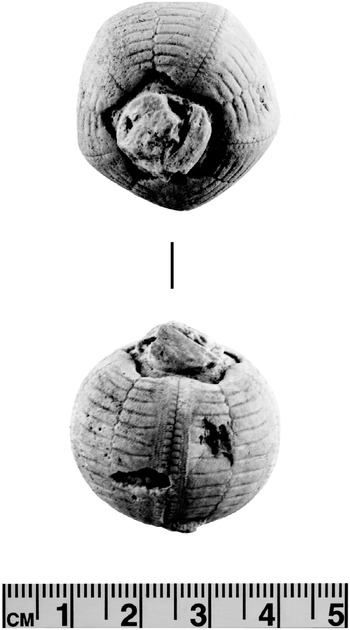
A fossil echinoid, 30 mm in diameter (Fig. 2), was found on an exterior Lower Phase 3 floor (Plot XX F, Locus 9.1, Square D4-1). It is probably a stomechinid example and possibly belongs to the genus Leioechinus, which has been described from the Middle Jurassic of Saudi Arabia (Kier Reference Kier1972). This taxon is widespread and ranges in age from the Jurassic to the Cretaceous periods (c. 201.3–65.5 million years ago). This specimen represents the first example of its type to be recovered from Wadi Hammeh 27, or any secure Natufian archaeological context, although echinoids have been previously unearthed from the Natufian site of El Wad (below).
Fossil echinoid, cf. Leioechinus (RN 160138), Lower Phase 3, Wadi Hammeh 27.

RN 160138 is relatively worn by natural processes. Like all echinoids, the animal's test (shell) is composed of five double columns of large plates (the interambulacra), alternating with five columns of small plates that are pierced by a pair of pores (the ambulacra). The abrasion suffered by the fossil has resulted in many of the surface features of the plates, especially the tubercles that in life bore spines, having been worn away. A few residual tubercles occur on some ambulacral plates. The wear has emphasized the specimen's patterning by highlighting the sutures between the plates.
2. Zoomorphic bone figurine (RN 140226) (Phase 2 – Locus 2.5, Square E6–1)
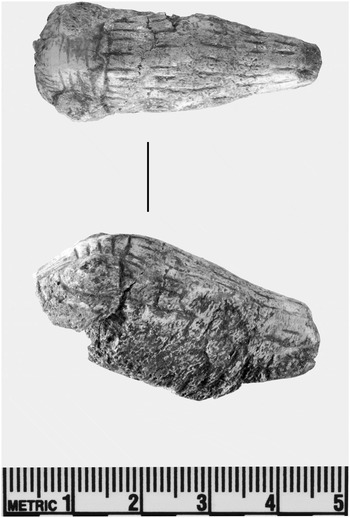
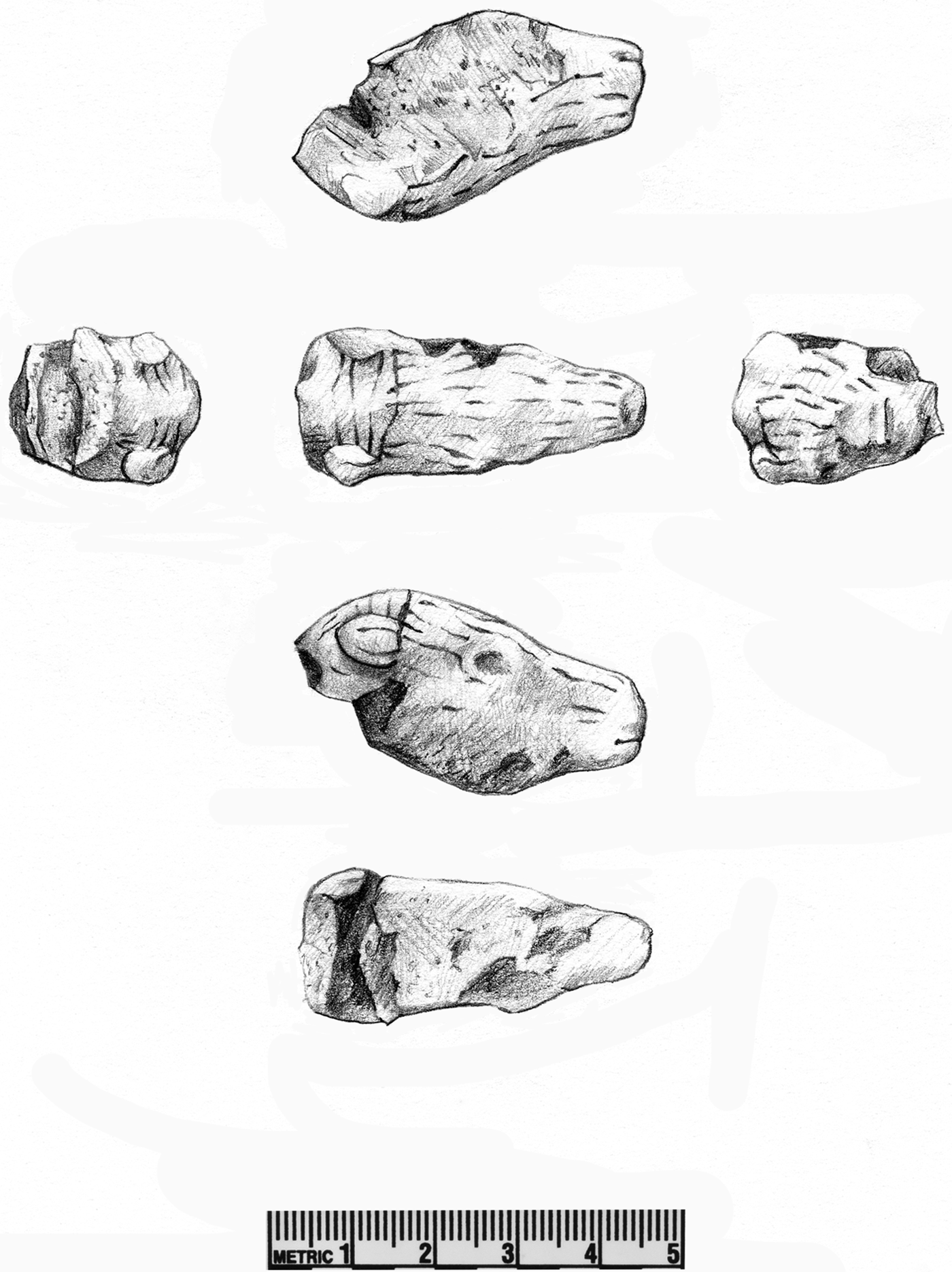
RN 140226 (Figs. 3–4) is carved from bone to represent an animal head and the surface of the image is augmented with a pattern of strokes that resemble rectangular panels (Edwards et al. Reference Edwards, Shewan and Webb2018; Robertson et al. Reference Robertson, Edwards and Coates2019). The head is broken at the ‘neck’ and is evidently a fragment of a larger object. The presence of some broken pieces of calcined bone found lying distal to the head indicate that the object was originally more extensive. These observations, and two parallel objects from the Mount Carmel region, indicate that the piece was originally the decorative terminal of a bone sickle haft.
Zoomorphic bone figurine (RN 140226), Phase 2, Wadi Hammeh 27.

Six views of the zoomorphic bone figurine (RN 140226), Phase 2, Wadi Hammeh 27.

Calcination has resulted in breakage and extensive exfoliation at its base and along the left and right lateral margins. Despite the extensive damage, the fine modelling of the piece is evident and the form of the head of an ungulate, probably a gazelle, is clear. The frontal region of the head is marked between the ears by opposed sets of short strokes, the left set comprising four strokes and the right one, five. Distally, the face is demarcated from the frontal region by a deeply incised line that runs across and cuts through the distal margin of the left ear. Surface damage truncates the line before it reaches the right ear. The muzzle is marked by five rows of longitudinal, incised strokes running all the way to the snout (Fig. 3). The rows comprise sets of ten, seven, six, eight and five short lines, respectively. The strokes were originally more extensive laterally, but fire damage has erased some of them.
3. Zoomorphic limestone plaque (RN 120146) (Surface find, westerly cliff section)
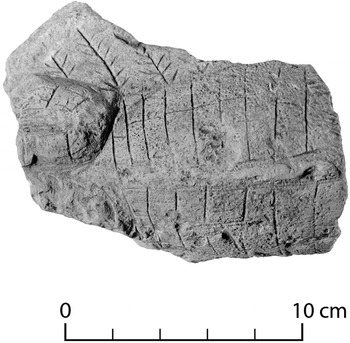
The zoomorphic limestone plaque RN 120146 (Fig. 5) was recovered from the westerly erosion cliff zone, where many other Natufian artefacts and human remains were noted (Edwards Reference Edwards, Bar-Yosef and Valla1991). Although less secure in its attribution than the excavated objects, the locale of Wadi Hammeh 27, embedded atop an inselberg, with cliffs truncating the main body of the site on three sides, naturally leads to the continual shedding of cultural material from its edges.
Zoomorphic limestone plaque (RN 120146), surface find, Wadi Hammeh 27.

RN 120146 is 13 cm long. The body is decorated by a pattern of rectangular panels. Cross-hatching and herringbone motifs are also used on the piece (Edwards Reference Edwards and Edwards2013a, 312). The item has been shaped into a biconvex ‘body’ with two rear ‘legs’ partially preserved. The left rear ‘leg’ is folded back at the knee and splays laterally from the body. This attribute, and the dorsal crest running centrally along the preserved section of the ‘body’, suggest the piece is a portrayal of a reptile, perhaps one of the agamid lizards that inhabit the region. Parallel grooves run transversally from the dorsal crest, nine on one flank and seven on the other. Both grooves are scored longitudinally with lighter incised lines creating a series of rectangular compartments.
On the obverse face, the piece has a raised band or central ‘spine’ that bisects the ‘body’ along the long axis. On each side of the central ‘spine’, the ‘body’ is incised with an irregularly spaced cross-hatched motif, which is obscured in part due to erosion (Major Reference Major2018, 338). Incisions oriented on the short axis are continuous and deep compared to those on the long axis that are discontinuous and shallow. Incisions transverse to the ‘spine’ vary in distance from each other from 4 mm to 8 mm.
The preserved ‘leg’ is also incised with Y-shaped motifs. Similar motifs intersect the lower rear body and underside of the ‘leg’. They comprise three long grooves augmented with V-shaped strokes, perhaps intended to signify barbed projectiles striking the animal. The longest, which is augmented with six pairs of barbs, probes the junction of the ‘leg’ and the ‘body’; a similar groove with four pairs of barbs contacts the lower body; and another with three barb-pairs thrusts at the rear leg. Alternatively, the herringbone motif recalls interpretations of marks on plaques from Wadi Hammeh 27 and European Magdalenian examples (RN 80151 and RN 110012: cf. Bahn & Vertut Reference Bahn and Vertut1997, 156, fig. 10.26) described as ‘plant-like’. In this case, the image might represent the animal amongst vegetation. In either scenario, if the two areas, figure and background, are considered as independent components of the same ‘story’, the item depicts a scene and contains a narrative.
Comments
We draw attention to the resemblances between the decorative patterns both on the bone head (RN 140226) and the zoomorphic limestone plaque (RN 120146), and the surface pattern of the fossil echinoid (RN 160138). The art items are rare in this regard. Moreover, they are unusual in that they constitute two of only a few Natufian art items which combine figurative representation with surface geometric patterning. The interpretation of the decorative patterns added to these objects is complex. The pattern on the plaque (RN 120146) might have been intended to represent the patterned skin of a lizard. It also seems clear, too, that incised lines on the El Wad ‘gazelle head’ mark anatomical features such as the eyes and the nostrils. However, it is unlikely that the stroke-pattern on the Wadi Hammeh 27 gazelle head was intended as a naturalistic feature. Further afield, a pebble from ‘Ain Mallaha (Major Reference Major2018, fig. 7.87; Valla et al. Reference Valla, Bocquentin and Plisson1999, fig. 15.1) incised with a series of panels also closely resembles the Leioechinus echinoid from Wadi Hammeh 27.
As we have argued elsewhere (Robertson et al. Reference Robertson, Edwards and Coates2019), the Mountain Gazelle (Gazella gazella) was the most likely subject for RN 140226. The animal's muzzle is marked by a longitudinal light-coloured stripe with a blackish lower margin, extending from the eye to the mouth (Mendelssohn et al. Reference Mendelssohn, Yom-Tov and Groves1995). It is possible to make a connection between this and the geometric design applied to RN 140226, but there is no obvious correlation between the restricted longitudinal markings on the actual antelope and the sets of strokes distributed all over the bone head. Another factor counting against the equation is that the stroke-pattern is turned perpendicular on the occipital region of RN 140226, where it consists of sets of opposed strokes. Therefore, the geometric motif applied to RN 140226 seems to have been a concept developed separately from observation of the gazelle; the pattern evident on the fossil echinoid seems a good candidate for its inspiration.
In Phase 1, Wadi Hammeh 27 displays close cultural links to other Natufian sites along the Jordan Valley (Edwards Reference Edwards2015). One of the shared forms is the ‘miniature bowl’, usually made from basaltic rock but also from limestone. Wadi Hammeh 27 is the only Natufian site that has yielded numerous ‘miniature bowls’ and ‘miniature plates’, with 28 examples in basaltic rock (Edwards & Webb Reference Edwards, Webb and Edwards2013, 212) and 10 examples made from limestone (Edwards Reference Edwards and Edwards2013d, 236). These enigmatic artefacts are scarcely known elsewhere. There are a couple of instances from Salibiya XII, located further south in the Jordan Valley than Wadi Hammeh 27, and a few from Kebara Cave and El Wad Cave at Mount Carmel (Belfer-Cohen & Goring-Morris Reference Belfer-Cohen, Goring-Morris, Bar-Yosef and Valla2013). In Phase 2, two recent finds from Wadi Hammeh 27 indicate close links with Natufian sites to the west, at Mount Carmel and in western Galilee. They include the bone ‘gazelle head’ representation described above (RN 140226) and a basalt pestle with a hoof-shaped terminal (RN 140049; Edwards et al. Reference Edwards, Shewan and Webb2018). The bone item finds a strong parallel to a bone sickle haft with a zoomorphically rendered terminal, fashioned to resemble an ungulate, found at Kebara Cave (Layer B, Plot XXVII: Turville-Petre Reference Turville-Petre1932). The Kebara piece is complete and its form provides an important clue to the likely original configuration of the Wadi Hammeh 27 piece. The decorative pestle (RN 1400049) has parallels with objects from El Wad (Garrod & Bate Reference Garrod and Bate1937, pl. XV: 4; Major Reference Major2018, 146) and Hayonim Cave (Belfer-Cohen Reference Belfer-Cohen, Bar-Yosef and Valla1991, figs 7:1, 3, 5).
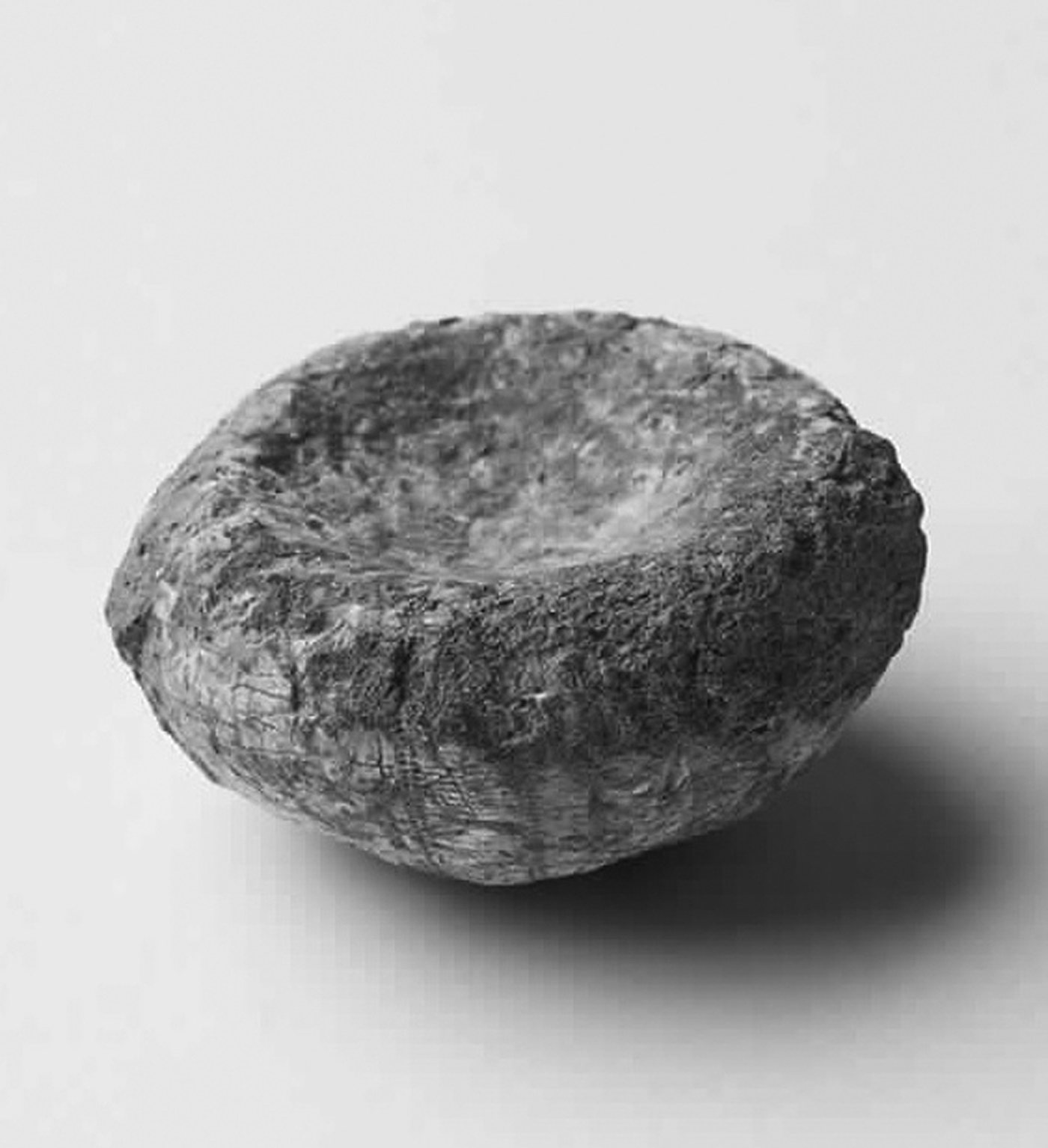
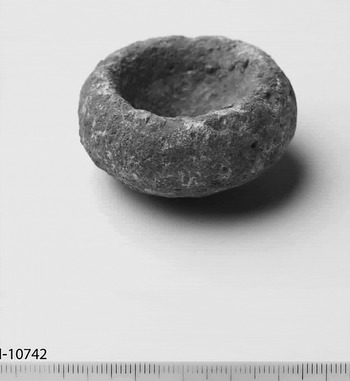
A pair of unpublished items from El Wad, held in the Rockefeller Museum, Jerusalem, provide a wider perspective on this discussion. The first (I-10834) is a worked fossil echinoid, identified as a specimen of Heterodiadema lybica (Fig. 6). The second is a miniature limestone bowl (I-10742: Fig. 7). Heterodiadema normally exhibits a concave profile on its aboral surface (the upper surface in Figure 6), where the animal's mouth is located. On a well-preserved fossil, the aboral surface is also usually well marked by test material (Bandel & Geys 1984). Neither of these features is present on the concave surface of specimen I-10834, demonstrating that it has been deliberately hollowed out. The result is that the piece looks like—in fact has been transformed into—one of the characteristic Natufian miniature bowls that are normally reduced from a block of basaltic rock, or, less commonly, from a piece of limestone.
Worked fossil echinoid, Heterodiadema lybica, I-10834, from El Wad Natufian layers. (Rockefeller Museum.)

Miniature limestone bowl, I-10742, from El Wad Natufian layers. (Rockefeller Museum.)

El Wad and Wadi Hammeh 27 are now uniquely linked in that both sites contain miniature bowls and fossil echinoids. It is possible, although not necessarily the case, that the morphology of Heterodiadema lybica prompted the creation of the miniature bowl type, or else it might have just been viewed as an expedient pre-form for an already existing type. The El Wad echinoid also demonstrates the Natufian interest in a natural object as a template for artefact production. This attitude was also evidently in play in the following case.
Case 2: Modified patterned stone—grooved pebble with complex geometric motif
While the second pair of objects are both artefactual, the design on one (RN 80087) is entirely anthropogenic, whereas a broad groove on the other (RN 100008) has been added to modify and augment a naturally existing pattern.
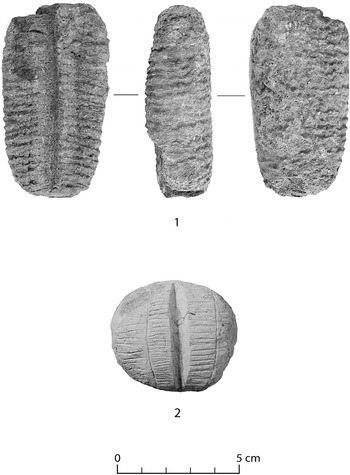
a. Modified patterned stone (RN 100008) (Phase 1 – Plot XX E, Locus 5.2, Square Ib-1)
This is a shaped travertine piece (7.2 cm long) marked by a series of up to 20 undulating lateral bands which encircle the piece (Fig. 8.1). They result from natural weathering of the stone. A broad, vertical groove has been applied down the middle of the piece. The effect, when looking at the obverse face, is to form a complex geometric motif in which the groove is framed by bands emanating laterally from both of its margins.
(1) Incised travertine fragment (RN 100008), Phase 1, Wadi Hammeh 27; (2) grooved limestone pebble with complex geometric motif (RN 80087), Phase 1, Wadi Hammeh 27.

b. Limestone pebble with complex incised motif (RN 80087) (Phase 1 – Plot XX F, Locus 2.2)
This is a limestone pebble (5.5 cm long) with a broad V-shaped central groove framed by a pair of longitudinally incised lines (Fig. 8.2). A series of transverse horizontal strokes fill the spaces between these outer lines and the central groove. Finer striations from preliminary smoothing occur across the obverse surface. They are truncated by the decorative incisions, demonstrating the preparation of the surface prior to the application of the motif. A few incised transverse lines superimpose the vertical framing lines, showing that the bounding frame was created first. The reverse surface is crudely worked with coarse grinding after the initial pecking.
Comments
The items occur in contemporary deposits, so no temporal priority can be assigned to one or the other. Manufactured from friable travertine and soft limestone respectively, both types appear to be symbolic or ornamental versions of utilitarian grooved stones, many examples of which occur in Natufian sites. There are 16 grooved stones at Wadi Hammeh 27, with over 80 per cent made on basaltic rock and the remainder on limestone. The grooved stones are oval plaques of lenticular or plano-convex cross-section with a broad, deep, V-sectioned groove oriented along the longitudinal axis of one face (Fig. 9). They have sometimes been referred to as ‘shaft straighteners’ (Edwards & Webb Reference Edwards, Webb and Edwards2013, 226; Wright Reference Wright1992, 73) with the idea being that they were used to straighten bone or wooden shafts, perhaps when heated. This function is unlikely, however, given direct observations of traditional artisans and experimental reconstructions of these objects’ use. Wooden spears or shafts are usually straightened by hand while being held over a fire (Cosner Reference Cosner1951). Alternatively, the grooved stones were probably used to abrade softer materials such as Phragmites reeds, while drawing shafts back and forth through the cavity formed by binding two stones tied together with the grooves opposed (Wilke & Quintero Reference Wilke, Quintero, Gebel, Kafafi and al-Ghul2009). It is probably for this reason that pairs of grooved stones are found in situ at three Natufian sites: one at ‘Ain Mallaha (Valla Reference Valla1988), two at the Late Natufian site of Rosh Zin (Henry Reference Henry and Marks1976) and a pair at Wadi Hammeh 27, the latter with one grooved stone found overlapping the other (Edwards & Hardy-Smith Reference Edwards, Hardy-Smith and Edwards2013, 118). Rather than being a direct case of inspiration from a natural object to a cultural artefact, this is more a case of decorative or symbolic versions of a utilitarian tool, where one of the copies utilizes a natural occurring pattern as a shortcut. A further refrain on this theme comes from the Natufian layers of Moghr al-Ahwal in Lebanon, where an unbaked clay model of a grooved stone, certainly not utilitarian, was retrieved (Garrard & Yazbeck Reference Garrard, Yazbeck, Bar-Yosef and Valla2013, 24).
Basaltic grooved plaques (1) RN 100033; (2) RN 100034; (3) RN 110075; (4) RN 120244. Phase 1, Wadi Hammeh 27.

There are also other dimensions of similarity to be noted. RN 80087 bears strong comparison with the Leioechinus specimen, particularly if we consider the fossil as a series of dissociable patterns. Thus, the central groove of RN 800787 is reminiscent of the narrower ambulacra of the echinoid. The parallel, thin incisions either side resemble the longitudinal partition between the two sets of interambulacral plates (cf. Fig.2), and the outer transverse create the effect of interambulacral plates. Just as striking a parallel is a pebble from ‘Ain Mallaha with an incised pattern of rectangular panels (Major Reference Major2018, fig. 7.87; Valla et al. Reference Valla, Bocquentin and Plisson1999).
Case 3: Tortoise carapace—large stone slabs and small plaques with nested-square/concentric-line motifs
This case involves the copying of a naturally existing, nested-square pattern to decorate large stone slabs and a variety of small plaques and other objects. In turn, the large slabs that constitute the main interest in this discussion are positioned near the centre of an architectural construction which itself appears to be a representation of the nested-square motif.
a. Tortoise carapace fragments (Phases 1– 4; various loci)
Large numbers of scutes belonging to the Spur-thighed tortoise (Testudo graeca) were recovered from Wadi Hammeh 27. Specimens numbered 169, along with small numbers of humerus and scapula fragments. It seems clear from the evidence of bone disarticulation, cut-marks on the bones, burnt specimens and the abundance of disarticulated scutes throughout the site that the tortoise was a habitual prey target (Edwards & Martin Reference Edwards, Martin and Edwards2013).
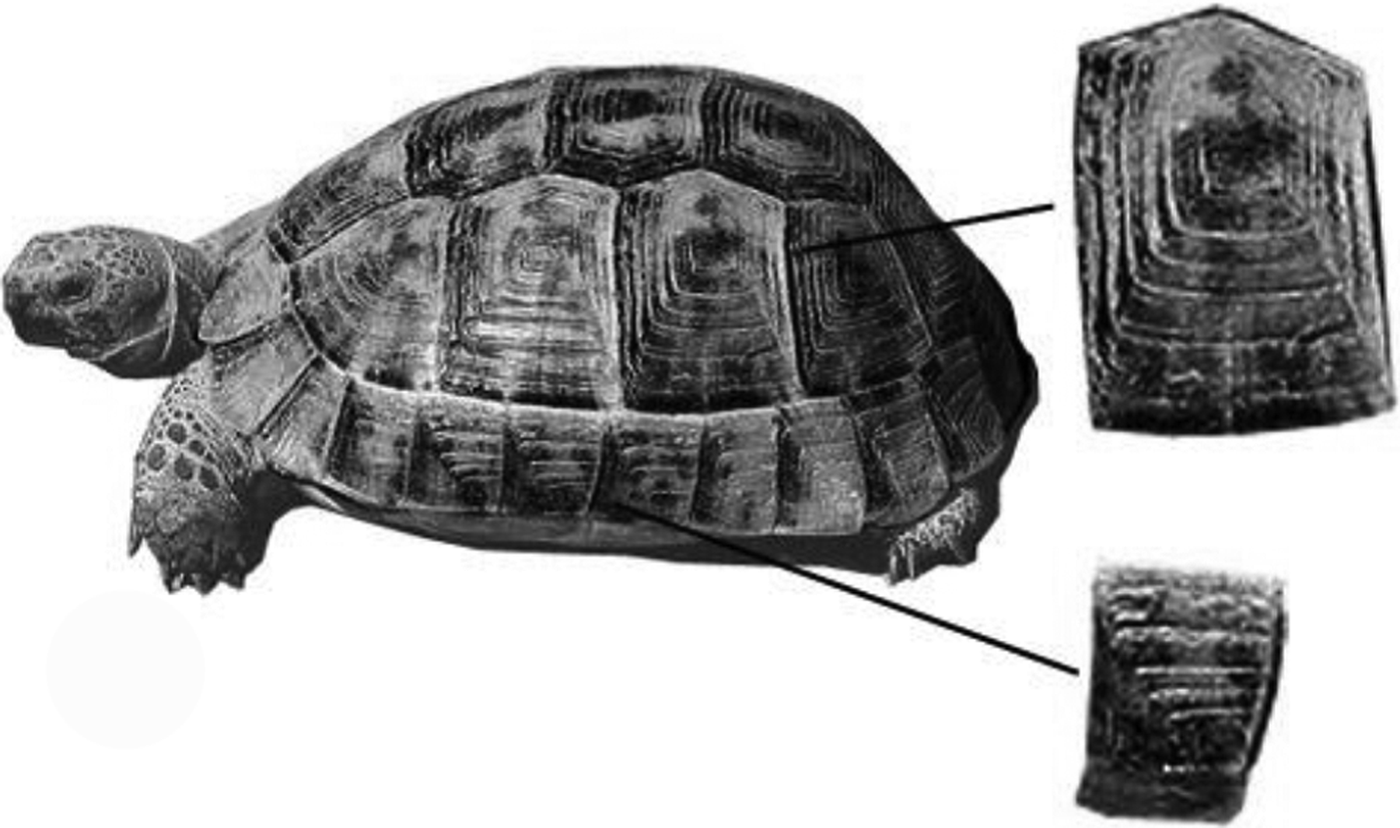
The tortoise carapace is composed of scutes which form concentric annuli (Lambert Reference Lambert1982). The annuli reflect yearly growth and thus differ according to the age of an animal. In profile, they appear as closed concentric shapes that overlie similar shapes along the distal margin of the carapace (Fig. 10). The patterning on the scutes along the distal margin is truncated, making a series of slightly off-set concentric U-shapes. In profile, the carapace thus consists of two rows of closed concentric shapes overlying a truncated series that is aligned along and open toward the distal margin of the carapace.
Carapace of the Spur-thighed tortoise (Testudo graeca).

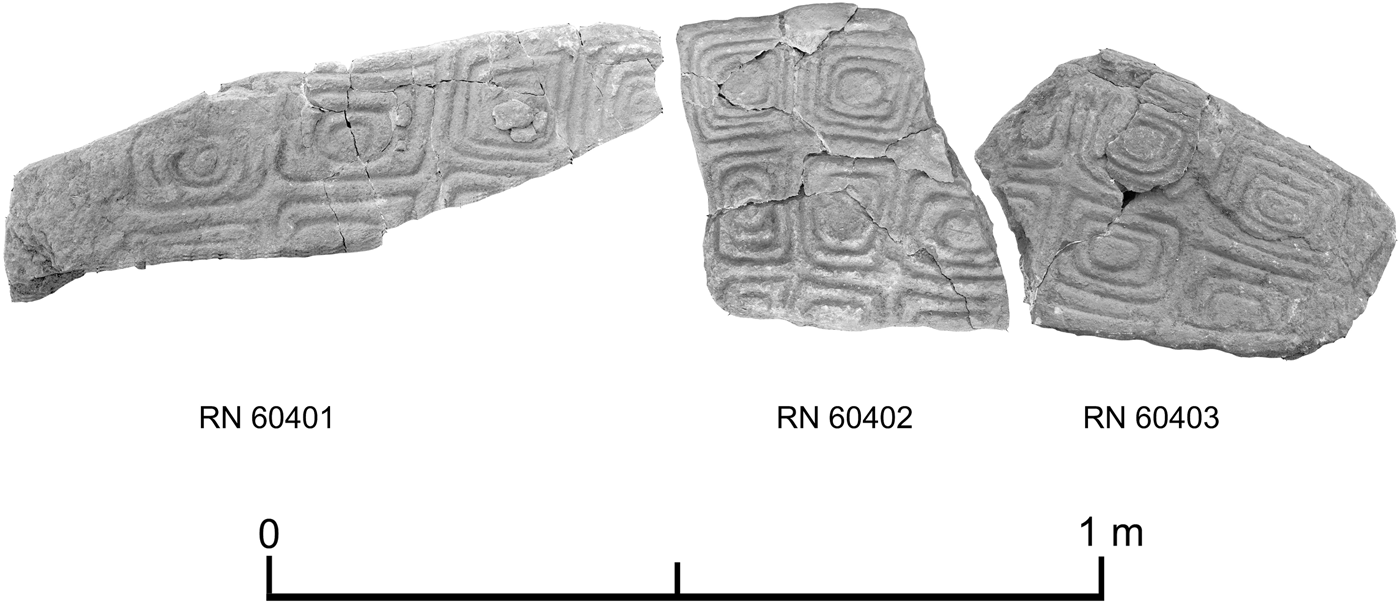
b. Three incised slabs decorated with nested-square motifs (RN 60401, RN 60402, RN 603403) (Phase 1, Plot XX D, Locus 1.5)
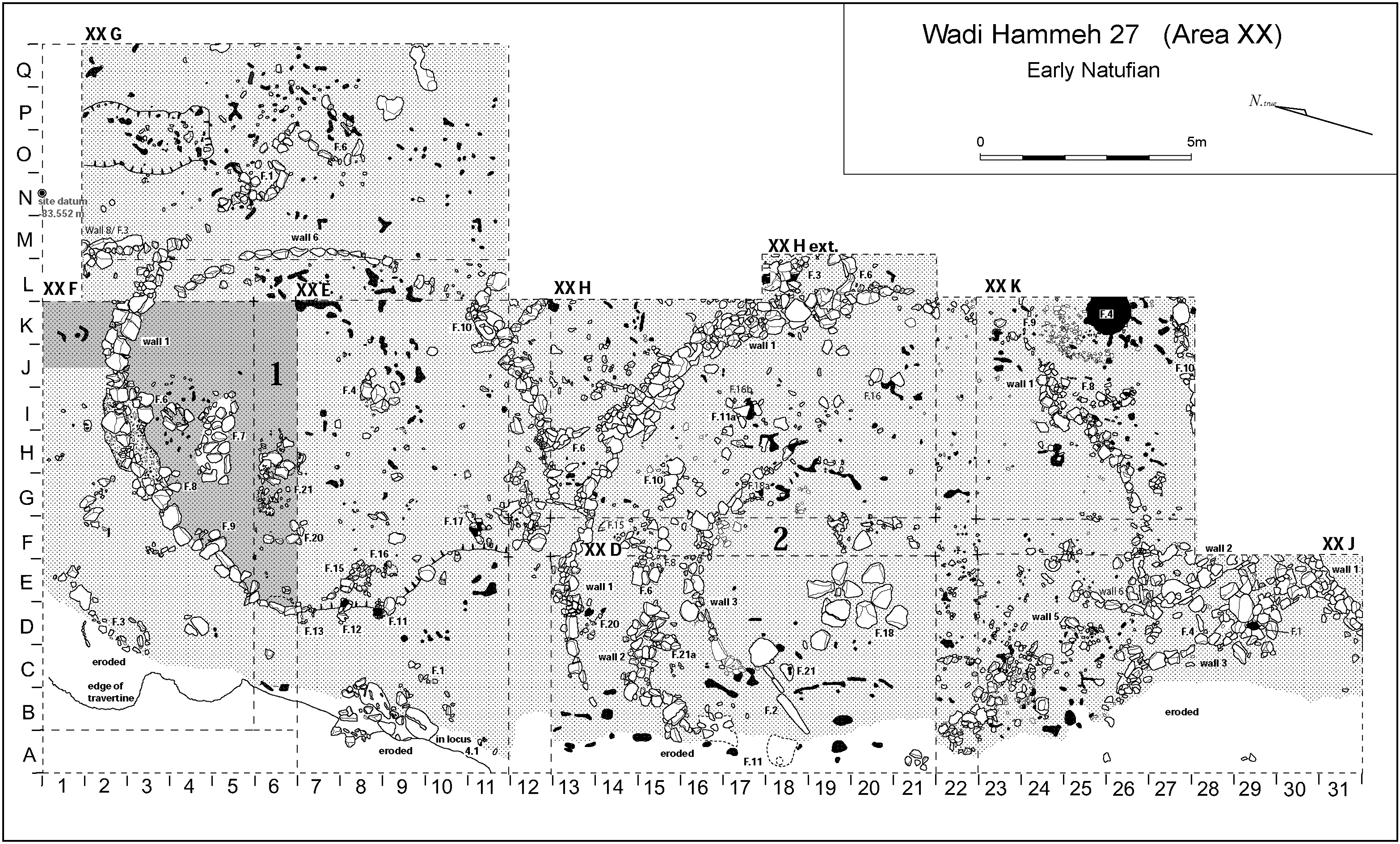
Structure 2 at Wadi Hammeh 27 has yielded considerable evidence of its use as a domestic residence. As well as scattered fragments of burnt human crania, there are several features which raise the possibility that it also functioned as a ritual space. The most arresting of these is a line of large, decorated stone stelae (RN 60401, RN 60402 and RN 60403: Fig. 11) incorporated into Wall 3 (Fig. 12). Together, the assembly of decorated stones measured 2 m long and attained a maximum height of 34 cm. The three slabs were placed together, supported by a backing of rubble, with their carved panels facing southeast in the direction of a group of boulders (Feature 18). The latter form the focal point of Structure 2.
Three incised stone slabs comprising Feature 2, in their relative positions as found. Phase 1, Wadi Hammeh 27.

The uppermost occupation phase (Phase 1) at Wadi Hammeh 27 (light grey shading) with areas excavated to Phase 4 indicated by darker grey shading. The three incised slabs (RN 60401-60403) are indicated as F. 2 in Structure 2.

The decorated face of RN 60401 is incised with a repeated array of nested-squares. Each element consists of a central rounded boss, formed in relief, which is circumscribed by lines of grooves and raised ridges that form a series of approximate squares. Four of these elements are aligned in an upper register, and were evidently placed to fit within the margins of the slab. Three concentric lines and grooves surround the central boss in each of them. The lower register of three squares are preserved only at their tops, and the bases are truncated by the slab's lower margin. Each of the motifs in the lower register consist of only two concentric ridges and grooves.
The limestone slab RN 60402 was erected as the middle member of the trio. Its decorated face is incised with three rows of the concentric design element described for RN 60401, each row consisting of three squares. Whereas the well-preserved squares of the upper row were formed with three concentric ridges and grooves, those of the two lower rows have only two, like the bottom row of RN 60401. The squares appear to have been finished to fit with the upper and left-hand margins, but are truncated by the right-hand, oblique margin, which forms a diagonal break across them, and the lower margin of the slab. It is evident that RN 60402 and RN 60403 were originally parts of a single larger slab which had subsequently broken.
The right-hand member RN 60403 displays the same format, with the upper row of squares containing three concentric ridges and grooves, whereas those in the middle row have only two. The bottom row, truncated by the lower margin of the slab, consists of only the top of the outer line. The bottom right-hand square of the middle row is unique, with the concentric lines extending only beside and above the central boss, but not below it. This may be because the design element was fitted into the available space.
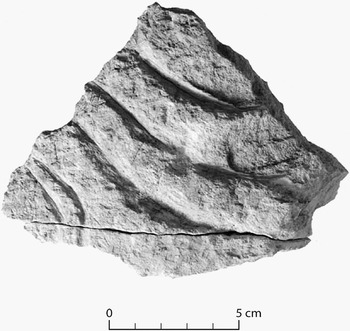
c. Limestone fragment with concentric line motifs (RN 80042) (Phase 1, Plot XX D, Locus 7.1)
This broken fragment (11 cm long) bears two sets of concentric line motifs; the first of three curved, incised grooves and the second of two more finely incised lines (Fig. 13). The piece is similar in conception to the three large slabs described above.
Incised limestone fragment (RN 80042), Phase 1, Wadi Hammeh 27.

d. Structure 2 – elaborate architectural complex (Phase 1, Plot XX D, various loci)
It is possible—that is to say, it appears that—the layout of Structure 2 (Fig. 11) was intended as a representation of the concentric motifs applied to the decorated slabs RN 60401–60403. Structure 2 is the largest and most elaborate architectural complex known from the Natufian culture. It has an oval layout, with a major (north–south) axis of 14 m and a minor one of at least 11 m. This is probably an underestimate, since the western part of the structure was truncated by erosion. The building's three concentric walls, disposed about the central focus of large boulders (Feature 18), echo the motif of grooves circumscribing a central boss. The walls were each cut against a step in Plot XX D, and so terracing occurs between Walls 1, 2 and 3, but this is not the case in Plot XX H, where the walls merge onto a common sloping surface. The occupation surface slopes gently down from the perimeter Wall 1 to the group of large boulders. The concentric walls disappear altogether in the southeastern sector of Structure 2, but appear to return, if in a disordered state, in the southwestern sector. The plan of Structure 2 is unparalleled in the Natufian architectural tradition.
The focal area of Structure 2 is further distinguished by the presence of five of six small decorated stone fragments found at the site, bearing parallel band/meander motifs (similar to the motif repeated on the three stelae). These were found in the central part of Structure 2, between the slabs and Feature 18 (Fig. 11). Four are fragments of decorated basalt vessels and the fifth is the fragment RN 80042, described above (Fig. 13). RN 80042 recalls the repeated stelae, but it is not part of them. The location of these similar objects in the focal centre could not be a result of post-depositional disturbance, and indeed there is little indication of any significant lateral disturbance of objects at Wadi Hammeh 27 (Hardy-Smith & Edwards Reference Hardy-Smith and Edwards2004).
Comments
Major (Reference Major2018, 349–50) has noted the remarkable correspondence between the natural design elements on the Spur-thighed tortoise (Testudo graeca) carapace and the geometric pattern on the decorated slabs at Wadi Hammeh 27. On each are two series of closed concentric shapes that overlie a truncated series of open concentric shapes along the distal margin (Fig. 10). The parallels between the tortoise carapace and the slabs is further emphasized if the decorated slabs are considered in their original state, whereby the proximal margins formed a cohesive arch. They may have been conceived as representative of one image with a plano-convex profile; the same profile created by the plastron and carapace of a tortoise. The similarity in these complex compositions raises the possibility that Testudo graeca, a tortoise species local to Wadi al-Hammeh, provided the inspiration for the composition featured on the trio of slabs.
An evocative figurine from ‘Ain Mallaha suggests that the nested-square pattern may have indeed symbolized the tortoise. The item has a convex dorsal surface, plausibly representing a tortoise carapace, as Jean Perrot thought (Reference Bandel and Geys1974, 484), although Valla (Reference Valla and Levy1998, 177) considered that it might represent a scarab. The curved surface bears a series of nested-square motifs that are not bounded at the lateral margins, perhaps intended to represent the marginal scutes of the Testudo carapace, which are also unbounded.
Discussion
The examples presented here demonstrate the close attention paid by Natufian artisans to natural objects as stimuli for their artistic representations. Their interest in natural patterns is reflected by their habit of collecting eye-catching curios: fossil invertebrates including licinid bivalves, ammonites, gastropods such as Strombus sp. and Turritella sp. (Edwards et al. Reference Edwards, Webb, Glaisher and Edwards2013a, 285), and fossil echinoids. The fossils were available from Mesozoic to Tertiary limestone outcrops at the head of Wadi al-Hammeh, and as objects washed into the valley's stream channels. There are several shiny, semi-precious stones, and odd, suggestively shaped stones such as RN 80153 (Fig. 1) and RN 120150.
The carapace of the Spur-thighed tortoise seems to have been an important symbol, acting as a representation of aspects of the animal itself. Its nested-square motif was incised into large stelae which formed the focus of an elaborate architectural representation of the same motif. It fulfils the criterion of the ‘attention-focusing device’ suggested by Renfrew (Reference Renfrew, Renfrew and Zubrow1994) as one of the hallmarks of a ritual structure. The motif was part of a wider tradition, and is evident in parallel forms elsewhere, particularly at the Natufian base-camp of ‘Ain Mallaha. The tortoise also featured in a grave at Hayonim Terrace. Here, three individuals were accompanied by two dogs and two tortoise carapaces (Valla Reference Valla2012). These examples hail from west of the Jordan Valley, in the Galilee region, and suggest that the symbolic importance of the tortoise was expressed variably in different regional traditions. Tortoise remains appear to have held intrinsic ritual significance in a Late Natufian burial at Hilazon Tachtit. Here, an elderly woman was buried with accompanying grave goods that included up to 50 complete tortoise shells (Grosman & Munro Reference Grosman and Munro2007; Grosman et al. Reference Grosman, Munro and Belfer-Cohen2008). Grosman and Munro (Reference Grosman and Munro2007) interpret them as being involved with feasting rituals at the site.
As we know, geometric or other motifs in ancient art are polyvalent (Farbstein Reference Farbstein2013, 24). Even if the nested-square motif arose as a referent for the tortoise, it may not have always meant this to Natufian groups. For example, in the Late Natufian period at Nahal Ein Gev II (c. 10,000 cal. bc), Grosman and colleagues (Reference Grosman, Munro, Enzel and Bar-Yosef2017) see a schematic human face, carved on a limestone pebble, as being stylistically derivable from a version of the nested-square motif found at ‘Ain Mallaha. Such temporal changes can be readily understood as a consequence of the Natufian artisan's restless play with motifs. Designs (and presumably also concepts) were not only transferred across different media; they were also cycled through different genres of expression, from artefact to art object, and even into architectural space.
The nested-square pattern derived from the tortoise scute first appears in the imagery of the Natufian period, but it is a natural feature that was observed for thousands of years previously. A familiar creature on the Mediterranean landscape, the slow-moving Spur-thighed tortoise was exploited through the Early and Middle Epipalaeolithic periods (Bar-Oz Reference Bar-Oz2004, 37). Its characteristics must have been intimately known to pre-Natufian hunter-gatherers, but only Natufian artisans deemed it interesting enough to portray, for unknown cultural reasons.
So, the situation is more complex than simple discovery and inevitable copying. A different scenario involves the rectangular panels on the echinoid and incised pieces described in ‘Case 1’ above. This motif does appear beforehand in earlier Levantine geometric art. Most notable is an ‘egg-shaped’ cobble from the Geometric Kebaran layers of Wadi Madamagh (Byrd & Reese Reference Byrd, Reese, Finlayson and Makarewicz2014, 49) with a cross-hatched pattern incised on it. Both the form of the piece and the surface decoration recall the fossil echinoid (RN 160138) deposited later at Wadi Hammeh 27. A chance encounter with a patterned ornate fossil such as RN 160138 might have reminded a Natufian artisan of a motif already known in the cultural repertoire, perhaps even one generated from internal cognitive processes. Its material manifestation in the natural world, or even—as it could have been interpreted—from the supernatural realm, might then have been welcomed as a kind of external validation of a traditionally important design concept.
In this paper we have drawn attention to sets of linked geometrically decorated art objects and similar naturally patterned objects at the Early Natufian site of Wadi Hammeh 27, indicating that these objects were important as templates for artistic representations. In two of the cases, the natural objects had themselves been modified as art objects or to function as artefacts, at Wadi Hammeh 27 as at other Natufian sites. The phenomenon is a particular example of a broad interest in raw materials, animals and plant resources held by the inhabitants of Wadi Hammeh 27. Of all the many kinds of cherts available in the rocky outcrops overlooking the Jordan Valley, the Wadi Hammeh 27 knappers targeted a yellow flint, available from the banks of the nearby Wadi Jirm (Delage in Edwards et al. Reference Edwards, Shewan and Webb2018). They also used an unusual type of phosphatic quartz sandstone as a type of red ochre pigment (Edwards et al. Reference Edwards, Webb, Glaisher and Edwards2013a). Basaltic rock was procured from as far away as the Dead Sea region, 150 km to the south (Edwards & Webb Reference Edwards, Webb and Edwards2013). As a preliminary to the making of art, Natufian artists well knew the types of stones and bones available for selection and modification as canvases. In making art, they were intimately familiar with the patterns of the natural world. They co-opted some of them as symbols in order to express their artistic and ritual conceptions.
Acknowledgements
Thanks are due to Alegre Savariego and the Israel Antiquities Authority for permission to reproduce the images in Figures 6 and 7 (credited to photographer Meidad Suchowolski).