Prologue: 27 August 2018
In the headlines this morning: ‘Attacks on Migrants: Horror in Chemnitz’.Footnote 1 A fatal stabbing, for which two men – one Syrian and one Iraqi – have been arrested, has sparked xenophobic riots. Yesterday, up to 1,000 far-right demonstrators marched from Chemnitz's Karl Marx monument in the direction of the city centre chanting slogans such as ‘Wir sind das Volk’ (‘We are the people’), ‘Ausländer raus’ (‘Foreigners out’), and ‘Das ist unsere Stadt’ (‘This is our city’). According to journalist Johannes Grunert, the mob charged ‘on anyone who didn't look German’.Footnote 2 Such outbursts of extremist violence are by no means unique to the east of Germany or indeed to Germany itself – the rise of far-right extremism is one of the more disturbing phenomena currently facing Europe. What was once the German Democratic Republic (GDR) has, however, proved particularly fertile grounds for xenophobia. From the neo-Nazi riots in the Lichtenhagen suburb of Rostock in August 1992, which culminated in an apartment block housing Roma asylum seekers being set alight while onlookers applauded,Footnote 3 to the recent rise of the anti-Islamic movement Pegida in Dresden, hostility to foreigners has been an ongoing problem in the region. The reasons for this are multiple and complex. They include the economic depression, loss of identity, and sudden influx of immigration that followed the collapse of the GDR. Yet the seeds of the current extremism can also be traced to the GDR itself. The slogan ‘Wir sind das Volk’, which features prominently in far-right protests and has become synonymous with Pegida, notably had its origins in the peaceful Monday Demonstrations in Leipzig that precipitated the fall of the Berlin Wall in 1989.
International solidarity in the GDR: ideology versus practice
A fundamental tenet of Marxist thought is the construct of an international proletariat that transcends national and, by implication, racial divides. As Engels claimed in 1845: ‘The great mass of proletarians are, by their very nature, free from national prejudices and their whole disposition and movement is essentially humanitarian, anti-nationalist.’Footnote 4 From the mid-1950s onwards, this ideal was channelled in the Soviet Bloc through the prism of international solidarity. The concept, which was given shape by Nikita Khrushchev, was largely strategic in intent. Sensitive to the growing power of the non-aligned countries in the escalating Cold War, Khrushchev offered friendship and solidarity aid to the developing world in a bid to present socialist modernism as a desirable alternative to Western capitalism.Footnote 5 In the GDR, international solidarity took on additional functions. It was a way for the state to cast off the legacy of the Third Reich and fashion itself on the international stage as a new and socially responsible incarnation of the German nation. It also served as a vital vehicle for winning allies in the face of the Federal Republic of Germany's (FRG) isolationist Hallstein Doctrine, which demanded that countries with diplomatic ties to the FRG refuse to recognize the GDR.Footnote 6
No less important was the role that solidarity played within the borders of the GDR itself, where it featured prominently in the construction of the collective socialist identity. Throughout the 1960s and early 1970s, as the state upped its bid for diplomatic recognition and engaged with causes such as the Vietnam War and the anti-apartheid movement in South Africa, solidarity became a ubiquitous part of everyday life. Donation funds were established in workplaces; schools and the Freie Deutsche Jugend (Free German Youth) organized endless events to raise money and awareness; the media was saturated with accounts of the GDR's international solidarity programmes; and solidarity was a recurring theme across the arts.Footnote 7 Engagement with solidarity causes was, in theory, a voluntary affair. In reality, however, the external compulsion to devote time and money to proletarian counterparts in the developing world was strong; a commitment to international solidarity was synonymous with being a good socialist citizen. The Kleines Politisches Wörterbuch notably defined ‘solidarity’ as a ‘basic principle of the working class and all progressive forces’.Footnote 8
One of the glaring flaws of the socialist project as it was realized in East Germany, and indeed across the Soviet Bloc, was the extent to which it fostered nationalism at the expense of a more inclusive worldview. The GDR's projection of itself as an anti-fascist and anticolonialist utopia was decidedly at odds with the exclusive construct of East German identity that was fostered by the politics of the state. Thus, the enthusiasm for solidarity in the abstract did not translate into a particularly warm reception for people of colour residing in the GDR itself. The experiences of minorities in East Germany were often far from positive. Migrant workers, for example, who were brought in from Namibia, Mozambique, Cuba, and Vietnam in the 1980s to shore up the GDR's ailing economy were confronted with systemic and casual racism on a daily basis. Forced to stay in primitive living compounds that were often located far from their places of work, they were segregated from the local population and subject to exploitative conditions. Some mixing with East Germans did occur but harsh measures were in place to ensure that the immigration status of these workers remained temporary. Vietnamese workers who became pregnant, for instance, were faced with the choice of deportation or forced abortion, while marriages between foreign workers and GDR citizens were made difficult if not impossible. Meanwhile, racially motivated attacks were a common occurrence.Footnote 9 The reasons for this xenophobia are various. The low-level racism that was meted out to African workers, for example, was borne at least in part from the economic conditions of late socialism and the resentment that arose from widespread assumptions that migrant workers had readier access than East Germans to much sought-after consumer goods.Footnote 10 Meanwhile, the Socialist Unity Party of Germany (SED), eager to maintain a tight control on its population, sought to retain the homogeneity of the state and prevent infiltration of alternative political ideals and socialist models from beyond the Soviet Bloc.Footnote 11 That such a disjunction could exist between the exclusive construct of socialist identity that prevailed in the state and the idealistic rhetoric of international solidarity reflects the extent to which the latter reflected back to East Germans their own, unmediated perceptions of the developing world.
The music that was produced in the name of solidarity offers some useful insights into how East Germans conceived of the world beyond their state. Many composers and performers were deeply committed to the anti-imperialist campaigns of the 1960s and 1970s. Paul Dessau, for example, wrote a number of works in protest against the Vietnam War, including the score to Walter Heynowski and Gerhard Scheumann's short film 400 cm3 (1966) and songs such as ‘Klein Li möchte schlafen’ (‘Little Li would like to sleep’, 1969) for voice and guitar. Moreover, as Martin Brady and Carola Nielinger-Vakil have detailed, he complemented these efforts with significant monetary donations to the cause.Footnote 12 The roles assigned to music in the context of international solidarity were various. Music was often intended to function as an expression of solidarity in and of itself. It was also harnessed to raise money for the solidarity fund (through solidarity concerts and publications) and to galvanize citizens into engaging with solidarity campaigns; Heynowski and Scheumann conceived 400 cm3, for example, as an explicit call for East Germans to donate blood to the North Vietnamese.Footnote 13 Less explicit but no less important was the function that music played in reinforcing the notions of the self and other in the discourse of solidarity. In what follows, I unpick some facets of this discourse by focusing on two quite contrasting musical outputs: the compilation album Kämpfendes Vietnam (Fighting Vietnam), which was released in 1967 by Amiga, the popular music label of the GDR's state record company Deutsche Schallplatten,Footnote 14 and Ernst Hermann Meyer's opera Reiter der Nacht, an anti-apartheid work that premiered in a production by Joachim Herz, at the Deutsche Staatsoper in 1973. In the album and the opera the intended recipients of solidarity are ostensibly to the fore. In both cases, however, these recipients are ultimately objects rather than subjects. As such, the works emphasize the extent to which solidarity was, as Toni Weis has observed, a monologue rather than a dialogue with the developing world.Footnote 15
Solidarity for Vietnam
Kämpfendes Vietnam, as the title suggests, is a compilation of songs about the Vietnam War, which is billed in the liner notes as ‘an expression of brotherly solidarity’. Arranged by the composer and conductor Gerd Natschinski and accompanied by his orchestra, the album boasts a high-profile line-up, featuring Gisela May, Horst Schulze, Gerry Wolff, and Angelica Domröse. May was the doyenne of the East German cabaret scene and synonymous with Bertolt Brecht's Berliner Ensemble, of which Schulze and Domröse were also members at the time. Wolff was a prominent film actor and singer, and Domröse was fast emerging as one of the GDR's most popular film stars (she later went on to star in Heiner Carow's iconic film Die Legende von Paul und Paula in 1973). Reflecting the broad remit of the Amiga label, the songs on the album are eclectic in style, spanning the gamut from cabaret through folk music and Schlager to light popular music. They are also diverse in origin (see Table 1 for a list of the album's contents). Some are by prominent East German composers such as Kurt Schwaen, André Asriel, and Ruth Zechlin.Footnote 16 Others are drawn from the repertoires of anti-war movements in the West. For instance, Broadside, the folk-song magazine published by Agnes Cunningham and Gordon Friesen in New York, appears to have served as the source for ‘Saigoner Kinder’, ‘Partisanen’, and ‘Pauls Traum’. ‘Saigoner Kinder’ is an arrangement of US folk-singer Malvina Reynolds's ‘The Saigon Children’, which appeared in the May 1966 issue of Broadside.Footnote 17 ‘Partisanen’ was published as ‘The Hunters’ by British duo Eric Winter (music) and Terry Gould (lyrics) in the August 1966 issue,Footnote 18 and ‘Pauls Traum’ is a setting by Reiner Schöne of a song by Manfred Mann frontman Paul Jones, the lyrics of which were published without music as ‘Paul's Dream’ in the March 1966 issue of Broadside.Footnote 19 The album also includes a cover of ‘Vielleicht wird die Bombe schon scharf gemacht’ (‘Perhaps the bombs will soon be activated’) by the Düsseldorf-based protest group Die Conrads, and a setting by Natschinski of a poem by the West German activist and writer Günther Weisenborn entitled ‘Mekong-Ballade’.
Kämpfendes Vietnam (Amiga, 1967), track list

Contrary to initial appearances, Kämpfendes Vietnam is far from a ragtag assemblage of protest songs. A review in the Berliner Zeitung described it as ‘a beautiful expression of solidarity from the artists of our Republic for the support of the whole peace-loving world for the fighting people of Vietnam’.Footnote 20 A closer look at the album, however, indicates that it was intended to do more than simply convey a message of support. Its narrative trajectory suggests careful curation aimed at inspiring a spirit of socialist solidarity in the East German population. The predominant focus of the A side of the album is the victims of the Vietnam War, who include both the Vietnamese themselves and the US soldiers who were sent to Vietnam. Notably, it is the latter group whose predicament is deemed hopeless. ‘Dschungellied’, a biting cabaret number by Schwaen and Fritz Kracheel, describes with ironic detachment the fates of ‘Jim from Texas’ and ‘John from Detroit’, both pawns of the ‘Wall Street hyenas’:
Der Jim starb gestern, der John fiel heut. Den Joe trifft es schon morgen, der Dschungel ist wild und Amerika weit. Was hatten sie hier zu besorgen?
(Jim died yesterday, John fell today. Joe will be hit tomorrow, the jungle is wild and America far away. What were they doing here?)Footnote 21
The Vietnamese victims that feature on the album, in contrast, while also presented in tragic terms, are not helpless; they are imbued with a fighting spirit that is redolent of the qualities of the socialist personality. Reynolds's ‘Saigon Children’ have been involuntarily militarized but are militarized nonetheless: ‘We needed rice and you gave us a stone / Say the Saigon children / Stone in the hand is easy thrown / Say the Saigon children.’ ‘Partisanen’, meanwhile, offers an evocative musical depiction of Viet Cong soldiers creeping through the jungle to attack the enemy. Such portrayals of active resistance reflected a basic of tenet of international solidarity as it was conceived in Marxist–Leninist thought: countries such as Vietnam would be able to liberate themselves from their imperialist oppressors with the help of positive intervention and comradely support. In this vein, the A side of Kämpfendes Vietnam closes with a statement of hope from the imagined Vietnamese side. The final song ‘So wie der Regen vom Himmel fällt’ (‘Just as the rain falls from the sky’) culminates in a rousing chorus of ‘So werden wir siegen’ (‘So we will be victorious’).
This optimism stood at odds with the disillusionment that often prevailed in anti-war movements in the West. These grassroots movements had a certain currency for the GDR's official solidarity platform. One can reasonably speculate, for instance, that the decision to introduce ‘Paul's Dream’ to GDR listeners was prompted by the institutional resistance with which the song had met in the United Kingdom. Accompanying the lyrics in Broadside is a short article detailing how Jones had written the song for Manfred Mann to perform on an episode of the television programme Gadzooks! on New Year's Eve in 1965. The band were apparently prevented from doing so by the BBC, however, on the grounds that the song was not ‘light-hearted’ enough.Footnote 22 Yet if the basic oppositional tendencies of this repertoire lent it to appropriation by GDR artists, the passive despondency with which it was often imbued did not. Jones's lyrics, for example, relate a dream in which he converses with Lyndon Johnson and Harold Wilson and takes them to task for their involvement in the Vietnam War. Ho Chi Minh then appears in the final verse and tells Johnson and Wilson to ‘get out of my country / Leave it for my people and me.’ This bombastic display of resistance is deflated entirely by the song's chorus, in which Jones confirms his flights of fancy as just that: ‘It was a dream, a dream I had last night / I dreamed I solved all the problems / And set the world to rights.’ In order to align such songs with the East German ideology of solidarity amendments were needed. Consequently, the German translation that was prepared by Heinz Kahlau for Reiner Schöne to sing omits the chorus altogether; instead Schöne simply repeats the final line of each verse.Footnote 23 Other Western songs on the album necessitated changes of a similar nature. ‘Partisanen’, for example, offers a faithful translation of ‘The Hunters’ with the exception of the final two lines. Whereas the original closes with the image of Viet Cong soldiers ‘searching for a land at peace / For lives and hopes forever gone’, in the German version the soldiers remain militant to the end: they are ‘fighting for a land at peace / where hope awakens’ (‘Kämpfen für ein Land in Frieden / wo die Hoffnung neu erwacht’).
There is a notable shift in focus from the A to the B side of the album. While the A side imagines a hope-filled and as-yet-undefeated Vietnamese population, the B side turns the spotlight on to East German listeners and places the onus on them for victory against the United States in Vietnam. Asriel and Kahlau's disconcertingly catchy number ‘Willst du, daß wir weinen?’ (‘Do you want us to cry?’) warns that the war cannot be dismissed as something that is happening in a distant land:
Subsequently, the final song of the album, ‘Reisbauern, Kämpfer, Genossen’ (‘Rice Farmers, Fighters, Comrades’), calls on GDR citizens to act. It begins by charting the destruction being wrought by US bombs in Vietnam, from burning hospitals and schools to mothers bleeding to death holding their children. Gisela May declaims the text with urgency and the musical accompaniment is a disjointed palette of stabbing piano chords and harsh brass fanfares. As a vision of US defeat begins to coalesce, however, the music settles into an uplifting march. May admonishes listeners not to close their eyes to the bloody pictures of war, and declares that the Vietnamese will be victorious despite the wounds that have been inflicted on them by the United States. The key to this victory is international solidarity; the spirited closing lines call for East Germans to sing, to remember their friends, curse their enemies, and unite in solidarity with ‘Reisbauern, Kämpfer, Genossen’.
A striking feature of Kämpfendes Vietnam is the extent to which it avoids conspicuous aural signifiers of Vietnam. In ‘Mekong-Ballade’, Natschinski emphasizes with some obvious signposting the poem's disconcerting juxtaposition of a murdered Vietnamese mother and a man in Ohio who is rushing from his family breakfast table to his job at an ammunitions factory.Footnote 24 The musical evocation of the mother involves devices typically associated with Orientalism – a descending pentatonic scale, and a pseudo-Oriental accompaniment of plucked strings and piano. The evil banality of the Ohio breakfast table, meanwhile, is emphasized by the deployment of a jazz noir soundworld. Such stereotyping is the exception rather than the norm. Music written in the name of solidarity did not, as a rule, make significant recourse to exoticism. Dessau's solidarity compositions are a case in point. Brady and Nielinger-Vakil describe his Vietnam works as being utterly personal: ‘taut, aphoristic, and characterized by febrile instrumental outbursts, complex rhythms, and the use of extended vocal techniques including Sprechgesang’.Footnote 25 This is not to say, however, that more subliminal processes of othering were not at work. In the case of Kämpfendes Vietnam, the heroic Vietnamese are both conceived in the image of and help to define the socialist self.
Performing black South Africa in Ernst Hermann Meyer's Reiter der Nacht
Processes of othering play out prominently in Reiter der Nacht. The opera is based on the novel The Path of Thunder by the black South African writer Peter Abrahams, which Meyer read shortly after it was published in 1948 and turned to again when searching for a topic for his first opera in the mid-1960s.Footnote 26 The libretto, by Günther Deicke, is both a tragic love story and a call to arms against imperialist impression. Over the course of eleven scenes or ‘pictures’ (Bilder), it narrates the ill-fated love affair between Lanny Swartz, a black school teacher, and Sarie Claasen, the niece of an Afrikaner land owner. Lanny, having completed his university education in Cape Town, returns to his home village of Stilleveld to set up a school for black children. Despite having a girlfriend, Celia, back in Cape Town, he falls in love with Sarie as soon as he meets her. Their relationship is inevitably doomed. The Afrikaners, already outraged by Lanny's refusal to play the subservient role that is expected of him as a black man, are out for blood once they discover the affair. Lanny and Sarie plan to escape over the border to what is now Mozambique, but are murdered before they can get away. Yet, their deaths are not in vain. Lanny's determination to fight for what he believes in – Sarie, but also his basic right to live as a free man – sparks something in the villagers, and when they hear about the murders, they rise up in revolt.Footnote 27
The GDR was one of the first countries in the 1960s to recognize the legitimacy of and extend official solidarity to the African National Congress (ANC) in the face of apartheid, and in 1972 the ANC and the South African Communist Party established a diplomatic mission in exile in East Berlin.Footnote 28 Herz's production of Reiter der Nacht at the Deutsche Staatsoper placed the opera explicitly in the context of this relationship. As a piece of solidarity art, the production played out on two levels. The action on stage aimed to foster empathy with the plight of black South Africans. The programme booklet meanwhile provided a political context for the anti-apartheid movement and served as a call to action. In addition to essays by Meyer, Deicke, and Herz on the opera itself, it contains an excerpt from the speech given by ANC leader Albert Luthuli upon receipt of his Nobel Peace Prize in 1961, and an article on the history of apartheid by exiled South African activist Eric Singh, who was resident in East Berlin from 1967 and oversaw the publication and worldwide distribution of the official ANC newspaper Sechaba from there.Footnote 29 The booklet also includes a wealth of facts and statistics about apartheid and the South African economy, characteristically classifying apartheid as an issue of class rather than race.
The discourse of international solidarity held fast to the Marxist–Leninist analysis of capitalist imperialism as a class rather than race-based struggle. Calls from movements such as the Black Panther Party to place race at the centre of Marxist revolutionary thought had little impact in the GDR; the SED persisted with the theory that the problems facing people of colour in both the United States and the developing world were but a subset of the wider international class struggle.Footnote 30 This premise played a prominent role in the conception of Reiter der Nacht. Meyer explained that the only people in the GDR with first-hand experience of racial discrimination were those born before 1935; for the younger generation, he claimed, racism was just a theoretical concept, ‘whereas they all have an insight into forms of class struggle’. ‘That means’, he argued, ‘an opera audience in the GDR will comprehend Reiter der Nacht as a call for international solidarity with oppressed people. Performed under capitalist conditions, the work can demonstrate the necessity of a determined, and responsibly organized liberation struggle.’Footnote 31
Meyer's desire to contextualize apartheid in terms of the international class struggle can be observed in the opera's music, which as with Kämpfendes Vietnam and Paul Dessau's extensive solidarity repertoire, avoids excessive ethnic colour. There are certain aural references to the South African setting. The opera opens with an ostinato drum beat to which a guitar ostinato is added, an evocation of a ‘Zulu minstrel’ playing at a Capetown railway station. At the start of the sixth scene, a solo oboe plays a quotation from what Meyer describes as an ‘African love song’,Footnote 32 and when Lanny's former girlfriend Celia arrives in Stilleveld in the ninth scene, the village children welcome her with a very muted version of the Zulu greeting song ‘Sanibonani’. These isolated citations are contained; they make little incursion into the overall sound world of the opera, which is grounded firmly in Meyer's neo-romantic socialist realist idiom. East German reviewers responded positively to this approach. Writing in the SED's official newspaper Neues Deutschland, Hansjürgen Schaefer described the ‘highly artful’ way in which Meyer integrates South African folk music ‘not in the sense of cheap folklorising, but instead as an additional opportunity to profile the characters of the piece’.Footnote 33 Manfred Schubert, meanwhile, detailed Meyer's use of folk melodies but noted approvingly that ‘folklore doesn't play such a serious role in this score, which in my opinion is right, because – one thinks of the reverse case of Porgy and Bess – the fundamental aesthetic problem of the work, the composition of African material by a European composer, would not be resolved differently in this sense’.Footnote 34
If Meyer avoided the route of cultural appropriation in terms of musical language, the opera nevertheless exposed some of the GDR's more problematic attitudes to race. The downplaying of racism in the discourse of East German solidarity did not preclude the division of the world into distinct racial categories. The universal brotherhood of socialist internationalism as it was perceived in the GDR encompassed what Quinn Slobodian has described as a ‘racial rainbow’, comprising a ‘visual repertoire’ of ‘lightly stylized facial features, skin color, and traditional costume’.Footnote 35 This ‘socialist chromaticism’, to draw on Slobodian again, was placed in sharp relief with the supposedly monochrome world of the imperialist West. Yet the markers of race that were deployed in the GDR were generally one-dimensional, mediated through historical racial stereotypes. The everyday racism experienced by people of colour was frequently countered in solidarity art by what Peggy Piesche has termed ‘positive racism’.Footnote 36 Depictions of people of colour on stage, on screen, and in print were generally sympathetic. From the Native Americans in the GDR's ‘Indianer’ films to the framing of real-life black icons such as Patrice Lumumba, Paul Robeson, and Angela Davis, people of colour were presented in opposition to white imperialism. They were imbued with qualities associated with the socialist personality, chief among them heroic resistance and quiet dignity. Evan Torner, for example, describes how the Native American characters in DEFA westerns are ‘clever, well-groomed, skilled, non-violent – unless of course they are forced to defend themselves – and willing to act as martyrs for a revolutionary (i.e. anti-white expansionist) cause’.Footnote 37 At the same time, the way in which these heroes, both real and imagined, were constructed often served to reinforce racial stereotypes. Exoticized notions of simplistic goodness and monodimensional markers of ‘redness’, ‘yellowness’, and ‘blackness’ resulted in portrayals that recalled the exotic tropes associated with the mythology of the noble savage.
Positive racism certainly played a role in Meyer's conception of Reiter der Nacht. As he explained: ‘The friendliness of simple men and women among the black inhabitants of Africa, the gracefulness and lyricism of their experience, the gentleness of their feelings – all of these traits move us directly.’Footnote 38 Similar sentiments were evident in the programme booklet produced by the Deutsche Staatsoper. Here, the first image of blackness with which audiences were presented was a full-page photograph of a black tribal woman breastfeeding her baby. The woman is holding her bare breast to the infant and staring stoically out at the viewer; the baby, meanwhile, is naked apart from waist beads and a necklace.Footnote 39 This representation of exotic otherness was undoubtedly compounded by the extent to which it diverged from East Germany's actual black population, which at this point was overwhelmingly male, consisting of students and migrant workers from countries such as Mozambique and Zambia.Footnote 40
On the stage itself, the ‘otherness’ of blackness took a different form. In the programme booklet, Deicke explained that the opera did not address the three racial categories of apartheid – black, coloured, and white – despite the prominence assigned to this system of segregation in Abrahams's novel. Such nuance, Deicke, claimed, would have rendered the action too complicated. It was also, he deemed, unnecessary since the distinctions between ‘black’ and ‘coloured’ are ‘of little importance in the social practice of the class struggle in South Africa, both strata of the population are treated equally brutally by the whites’.Footnote 41 This conflation of South Africa's non-white population into a blanket signifier of oppression was compounded by the casting of the production: notably, the black characters were all played by white East German singers sporting racial make-up and wigs. The roles of Lanny and Celia were taken by Siegfried Vogel and Heidrun Halx respectively. Lanny's friend Mako was played by Reiner Goldberg, Lanny's mother by Gertraud Prenzlow, Fieta by Gisela Schröter, and the preacher by Fritz Hübner.
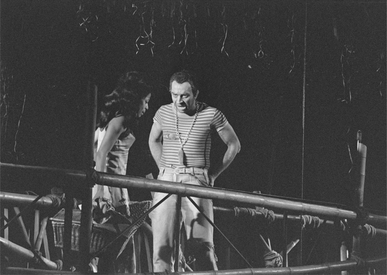
There were black opera singers who performed in East Germany in the 1960s and 1970s. The African-American singer Cullen Maiden joined the Komische Oper in the late 1960s and notably starred alongside fellow African-American Carolyn Smith-Meyer in Götz Friedrich's 1970 staging of Porgy and Bess.Footnote 42 Smith-Meyer also featured in other East German productions; she played the role of Konstanze, for example, in Harry Kupfer's 1977 realization of Die Entführung aus dem Serail with the Semperoper in Dresden.Footnote 43 Despite this, the use of blackface in Reiter der Nacht was far from exceptional; both on stage and on screen, non-white characters were invariably played by white singers or actors.Footnote 44 The figure of the heroic Native American was synonymous, for example, with the Yugoslavian actor Gojko Mitić, who starred wearing red make-up and a long black-haired wig in many of DEFA's ‘Indianer’ films.Footnote 45 Götz Friedrich's Porgy and Bess, meanwhile required Maiden and Smith-Meyer to sing alongside an otherwise all-white cast in blackface, the disconcerting effects of which can be observed in Figure 1. The juxtaposition of Smith-Meyer as Bess and Manfred Krug in blackface as Sportin’ Life, far from obliterating race from the notion of a universal proletariat, serves to emphasize the otherness of Smith-Meyer's blackness.
Carolyn Smith-Meyer as Bess and Manfred Krug as Sportin’ Life in Götz Friedrich's 1970 production of Porgy and Bess at the Komische Oper. Image reproduced by permission of SLUB Dresden / Deutsche Fotothek / Abraham Pisarek.

As Loren Kruger has observed in her study of the reception in the GDR of South African playwright Athol Fugard, those involved with the production of solidarity theatre do not appear to have found the practice of performing in blackface unduly problematic.Footnote 46 It also generally passed without remark in press reviews. The largely positive reception of Reiter der Nacht was offset by some criticism about the production's overly simplistic portrayal of the white oppressors.Footnote 47 Schubert, for example, noted that, ‘the characterization of the coloured characters . . . was more impressive than the portrayal of the whites’.Footnote 48 The issue of white actors playing black roles was not mentioned. This was the case even in the review of the opera that was published in Sechaba. Here, exiled South African novelist Alex La Goma reported that: ‘So good is the production that South Africans attending the premiere felt as if they were transported into the midst of a typically Coloured rural community in their motherland.’ Somewhat ironically, as with Schubert it was the depiction of the Afrikaner characters that La Goma found problematic. He observed that: ‘Unfortunately the few White characters were however costumed throughout in the neat bush-jackets and riding breeches with which colonialists are usually caricatured so that those who have seen the real Afrikaner farmers are apt to smile at this portrayal of the “Baas”.’Footnote 49
While the editors of Sechaba were beholden to SED support for the production of their journal, the wider race blindness that accompanied the reception of Reiter der Nacht was perhaps rationalized, as Deicke implied in his justification for simplifying South African's racial landscape, in terms of the construct of a post-racial socialist world. Yet the practice of blackface clearly emphasizes racial difference. It relies on and reinforces racial stereotyping; as Katrin Sieg observes, the exclusion of ‘material bodies of cultural Other . . . reiterates the symbolics of colonial histories’.Footnote 50 The practice was, of course, not unique to the GDR. As Sieg has demonstrated, the concept of ‘ethnic drag’ was equally prevalent in the FRG, and has continued with remarkable tenacity in unified Germany. In January 2012, a production of Herb Gardner's play I am not Rappoport was staged by the Schlosspark Theater in Berlin with the role of the African-American character Midge Carter played by white actor Joachim Bliese in blackface. This was followed several weeks later by a production at the Deutsches Theater of Dea Loher's Unschuld (Innocence), with two white actors in minstrel-style blackface taking the roles of the play's two black characters.Footnote 51 Defenders of such episodes have excused the continued use of blackface in German theatres on budgetary grounds, claiming an inability to find suitable black actors to play black roles.Footnote 52 They assert that it has nothing in common with the American minstrelsy tradition, arguing that the mocking stereotypes of the latter have had no traction in Germany given the supposed absence there of race-based social structures.Footnote 53 Some even go so far as to claim that blackface can facilitate a critical stance on race.Footnote 54 In an otherwise penetrating critique of race problems in German theatre, Nele Obermueller observes of the Deutsches Theater's Unschuld production that: ‘The intention is to engage the audience into a reflection about otherness, the condition of “looking” different, hence feeling alien and rejected – ultimately a reflection on and against racism.’Footnote 55
The persistence of blackface performances in Germany says much about the invisible status of the other in modern German society. In the case of the GDR, this invisibility was accentuated by the compulsion for citizens to conform to a normative ideal of the socialist personality. In the context of solidarity art, black and Asian heroes could be imagined as preterm incarnations of the fully developed socialist being. There was little scope, however, for more complex or embodied realizations of the other. Part of the difficulty in dealing with works such as Kämpfendes Vietnam and Reiter der Nacht is that they were doubtless well intentioned. They evince an unambiguous commitment to anti-imperialism and to the support of oppressed peoples. They also, however, betray a view of the world that has more in common with colonialism than postcolonialism. This reflects the problems that were inherent in the GDR's unquestioning positioning of itself as the anti-fascist and anticolonialist other to the FRG. Characteristic is Walther Ulbricht's claim that:
The German Democratic Republic follows a different tradition of the German people vis-à-vis countries and peoples that are languishing under colonial repression and waging a struggle for their national liberation – the tradition of the German working class and of German humanists, who always despised and fought against colonial oppression and exploitation; who always defended the sacred right for oppressed peoples to live in freedom and human dignity, the right for all peoples to live happily in independent nation-states.Footnote 56
The resulting evasion of responsibility for Germany's problematic past meant that East Germans were never confronted with the unpalatable legacy of German colonialism. The subscription to the Marxist–Leninist theory of societal development compounded this problem. Its inherently paternalistic view of the Third World as a less developed iteration of the Soviet Bloc allowed for many of the prejudices and stereotypes that had taken hold in colonial Germany not only to continue unchallenged but also to be incorporated unchecked into the discourse of state socialism.