


%20--%3e%3c!DOCTYPE%20svg%20PUBLIC%20'-//W3C//DTD%20SVG%201.0//EN'%20'http://www.w3.org/TR/2001/REC-SVG-20010904/DTD/svg10.dtd'%3e%3csvg%20version='1.0'%20id='Layer_1'%20xmlns='http://www.w3.org/2000/svg'%20xmlns:xlink='http://www.w3.org/1999/xlink'%20x='0px'%20y='0px'%20width='64px'%20height='64px'%20viewBox='5.5%20-3.5%2064%2064'%20enable-background='new%205.5%20-3.5%2064%2064'%20xml:space='preserve'%3e%3cg%3e%3ccircle%20fill='%23FFFFFF'%20fill-opacity='0'%20cx='37.785'%20cy='28.501'%20r='28.836'/%3e%3cpath%20fill='%23595959'%20d='M37.441-3.5c8.951,0,16.572,3.125,22.857,9.372c3.008,3.009,5.295,6.448,6.857,10.314%20c1.561,3.867,2.344,7.971,2.344,12.314c0,4.381-0.773,8.486-2.314,12.313c-1.543,3.828-3.82,7.21-6.828,10.143%20c-3.123,3.085-6.666,5.448-10.629,7.086c-3.961,1.638-8.057,2.457-12.285,2.457s-8.276-0.808-12.143-2.429%20c-3.866-1.618-7.333-3.961-10.4-7.027c-3.067-3.066-5.4-6.524-7-10.372S5.5,32.767,5.5,28.5c0-4.229,0.809-8.295,2.428-12.2%20c1.619-3.905,3.972-7.4,7.057-10.486C21.08-0.394,28.565-3.5,37.441-3.5z%20M37.557,2.272c-7.314,0-13.467,2.553-18.458,7.657%20c-2.515,2.553-4.448,5.419-5.8,8.6c-1.354,3.181-2.029,6.505-2.029,9.972c0,3.429,0.675,6.734,2.029,9.913%20c1.353,3.183,3.285,6.021,5.8,8.516c2.514,2.496,5.351,4.399,8.515,5.715c3.161,1.314,6.476,1.971,9.943,1.971%20c3.428,0,6.75-0.665,9.973-1.999c3.219-1.335,6.121-3.257,8.713-5.771c4.99-4.876,7.484-10.99,7.484-18.344%20c0-3.543-0.648-6.895-1.943-10.057c-1.293-3.162-3.18-5.98-5.654-8.458C50.984,4.844,44.795,2.272,37.557,2.272z%20M37.156,23.187%20l-4.287,2.229c-0.458-0.951-1.019-1.619-1.685-2c-0.667-0.38-1.286-0.571-1.858-0.571c-2.856,0-4.286,1.885-4.286,5.657%20c0,1.714,0.362,3.084,1.085,4.113c0.724,1.029,1.791,1.544,3.201,1.544c1.867,0,3.181-0.915,3.944-2.743l3.942,2%20c-0.838,1.563-2,2.791-3.486,3.686c-1.484,0.896-3.123,1.343-4.914,1.343c-2.857,0-5.163-0.875-6.915-2.629%20c-1.752-1.752-2.628-4.19-2.628-7.313c0-3.048,0.886-5.466,2.657-7.257c1.771-1.79,4.009-2.686,6.715-2.686%20C32.604,18.558,35.441,20.101,37.156,23.187z%20M55.613,23.187l-4.229,2.229c-0.457-0.951-1.02-1.619-1.686-2%20c-0.668-0.38-1.307-0.571-1.914-0.571c-2.857,0-4.287,1.885-4.287,5.657c0,1.714,0.363,3.084,1.086,4.113%20c0.723,1.029,1.789,1.544,3.201,1.544c1.865,0,3.18-0.915,3.941-2.743l4,2c-0.875,1.563-2.057,2.791-3.541,3.686%20c-1.486,0.896-3.105,1.343-4.857,1.343c-2.896,0-5.209-0.875-6.941-2.629c-1.736-1.752-2.602-4.19-2.602-7.313%20c0-3.048,0.885-5.466,2.658-7.257c1.77-1.79,4.008-2.686,6.713-2.686C51.117,18.558,53.938,20.101,55.613,23.187z'/%3e%3c/g%3e%3c/svg%3e)
%20--%3e%3c!DOCTYPE%20svg%20PUBLIC%20'-//W3C//DTD%20SVG%201.0//EN'%20'http://www.w3.org/TR/2001/REC-SVG-20010904/DTD/svg10.dtd'%3e%3csvg%20version='1.0'%20id='Layer_1'%20xmlns='http://www.w3.org/2000/svg'%20xmlns:xlink='http://www.w3.org/1999/xlink'%20x='0px'%20y='0px'%20width='64px'%20height='64px'%20viewBox='5.5%20-3.5%2064%2064'%20enable-background='new%205.5%20-3.5%2064%2064'%20xml:space='preserve'%3e%3cg%3e%3ccircle%20fill='%23FFFFFF'%20fill-opacity='0'%20cx='37.637'%20cy='28.806'%20r='28.276'/%3e%3cg%3e%3cpath%20fill='%23595959'%20d='M37.443-3.5c8.988,0,16.57,3.085,22.742,9.257C66.393,11.967,69.5,19.548,69.5,28.5c0,8.991-3.049,16.476-9.145,22.456%20C53.879,57.319,46.242,60.5,37.443,60.5c-8.649,0-16.153-3.144-22.514-9.43C8.644,44.784,5.5,37.262,5.5,28.5%20c0-8.761,3.144-16.342,9.429-22.742C21.101-0.415,28.604-3.5,37.443-3.5z%20M37.557,2.272c-7.276,0-13.428,2.553-18.457,7.657%20c-5.22,5.334-7.829,11.525-7.829,18.572c0,7.086,2.59,13.22,7.77,18.398c5.181,5.182,11.352,7.771,18.514,7.771%20c7.123,0,13.334-2.607,18.629-7.828c5.029-4.838,7.543-10.952,7.543-18.343c0-7.276-2.553-13.465-7.656-18.571%20C50.967,4.824,44.795,2.272,37.557,2.272z%20M46.129,20.557v13.085h-3.656v15.542h-9.944V33.643h-3.656V20.557%20c0-0.572,0.2-1.057,0.599-1.457c0.401-0.399,0.887-0.6,1.457-0.6h13.144c0.533,0,1.01,0.2,1.428,0.6%20C45.918,19.5,46.129,19.986,46.129,20.557z%20M33.042,12.329c0-3.008,1.485-4.514,4.458-4.514s4.457,1.504,4.457,4.514%20c0,2.971-1.486,4.457-4.457,4.457S33.042,15.3,33.042,12.329z'/%3e%3c/g%3e%3c/g%3e%3c/svg%3e)
Introduction
Healthcare-associated infections (HAIs) are infections acquired while receiving healthcare that threaten patient safety and are associated with significant morbidity and mortality. Reference Glance, Stone, Mukamel and Dick1,2 HAIs prolong hospitalizations and cause excess healthcare spending. Reference Gidey, Gidey, Hailu, Gebreamlak and Niriayo3 In 2013, HAIs were estimated to cost the US healthcare system $9.9 billion annually. Reference Zimlichman, Henderson and Tamir4 Given the negative impact that HAIs have on patient outcomes, efforts to prevent HAIs have become the standard of care. In the US, the Centers for Medicare and Medicaid tied HAI rates to healthcare reimbursement in addition to leveling penalties for high rates, providing additional motivation to keep HAI rates low. 5–7
Chlorhexidine, an antiseptic with broad-spectrum antimicrobial activity, has become a popular tool for preventing a wide range of HAIs. Based on favorable results from several clinical trials, guidelines recommend chlorhexidine bathing for patients over 2 months old in the ICU to prevent bloodstream infections, Reference Buetti, Marschall and Drees8 for skin preparation before central catheter insertion, Reference Buetti, Marschall and Drees8 and as part of universal decolonization in adult ICU patients to prevent methicillin-resistant Staphylococcal Aureus (MRSA) infections. Reference Popovich, Aureden and Ham9 Chlorhexidine is also routinely used preoperatively in decolonization protocols to decrease the risk of surgical site infections. Reference Schweizer, Perencevich and McDanel10
Yet, many of the clinical trials that form the evidence basis for chlorhexidine in these guidelines have financial ties to the pharmaceutical industry, which raises questions about the impact that industry involvement has on clinical trial outcomes. Reference Nelson and McNeill11 Numerous studies have shown that clinical trials sponsored by industry are more likely to have favorable results and conclusions compared to trials that are not sponsored by industry. Reference Etter, Burri and Stapleton12–Reference Killin, Russ, Starr, Abrahams and Della Sala14 However, it is unknown if industry ties are associated with favorable outcomes in clinical trials evaluating chlorhexidine. In this study, we examined whether industry funding and investigator conflicts of interest (COI) are associated with favorable outcomes in randomized-controlled trials (RCTs) evaluating chlorhexidine for the prevention of HAIs.
Methods
We conducted a cross-sectional study of RCTs evaluating chlorhexidine for HAI prevention from January 2000 to March 2024. This study followed the Strengthening the Reporting of Observational Studies in Epidemiology (STROBE) reporting guideline for observational studies. The protocol of the study was registered with PROSPERO before data extraction. Reference Goodhope, Alpern and Kaka15
Search strategy and study selection
On March 11, 2024, we conducted a search in MEDLINE(R)ALL (via OVID) using the terms “chlorhexidine,” “anti-infection agents,” and “antiseptics.” We translated the search to Embase, Embase Classic (via Ovid), Scopus, and Web of Science Core Collection (SCI-Expanded, SSCI, AHCI, CPCI-S, BKCI-S, BKCI-SSH, ESCI, CCR-Expanded, IC). We filtered the search for RCTs using a Cochrane filter by Lefebvre et al. 16 (MEDLINE) and Beynon et al. Reference Beynon, Leeflang and McDonald17 (Embase). We conducted the search after January 2000 to account for the lack of uniform financial disclosure polices in journals prior to 2000. 18–Reference Krimsky and Rothenberg20 We excluded trials evaluating chlorhexidine for treating dental infections or COVID-19, since our aim was to focus on trials evaluating chlorhexidine for HAI prevention. The literature search was developed by a health science librarian (BO) and was developed using natural language and controlled vocabulary.
Identifying articles
After removing duplicates, one author (NRG) independently reviewed all titles and abstracts to assess for initial eligibility, and a second author (JDA) reviewed a subset of the excluded trials for quality control. If the abstract was determined to be eligible, two authors (NRG and JDA) then independently assessed each full-text article for eligibility. We applied the following inclusion criteria: (1) original RCT in humans, (2) chlorhexidine was listed as an intervention or comparator, and (3) the primary outcome of the RCT was prevention of a clinical HAI or a surrogate outcome in infection prevention. We included products that were chlorhexidine-impregnated or coated (ie, chlorhexidine-impregnated dressings). We defined HAI as any infection acquired in a healthcare facility or from a procedure performed in a healthcare facility (eg surgical site infections). We included studies with multiple intervention arms and excluded trials not available in English or if there was no associated published manuscript. We also excluded trials that only evaluated oral formulations of chlorhexidine, dosing trials of chlorhexidine, and trials evaluating chlorhexidine as treatment.
Data extraction
Two authors (JDA and NRG) independently extracted the following information from text in each RCT and resolved disagreements by consensus.
Dependent variables
-
1. The primary result of the RCT favors chlorhexidine: We considered a primary result to be favorable if chlorhexidine was statistically superior to the comparator (either more efficacious or less harmful) or if chlorhexidine was non-inferior to an active comparator in non-inferiority trials. For co-primary results, we considered the trial to have a favorable result if any result was statistically superior. All other results were considered not favorable. For trials with multiple arms, we only included results in arms involving chlorhexidine.
-
2. The conclusion of the RCT favors chlorhexidine: We considered a study conclusion to be favorable if the study authors indicated a preference for chlorhexidine over the other arms or equivalent for non-inferiority studies.
-
3. Concordance between the result and conclusion: We determined concordance between the statistical outcomes of the RCT and the conclusion reached by the study authors. We considered a result that was not statistically significant in favor of chlorhexidine and a conclusion favorable to chlorhexidine to be discordant. By contrast, we considered a statistically insignificant result and conclusion not favorable to chlorhexidine to be concordant.
Independent variables
-
4. The presence of investigator COI: We considered a study to have investigator COI if any study investigator disclosed a relationship with a chlorhexidine manufacturer. Because a first or last author is more likely to have control over the study design, we further categorized investigator COI as (a) involving the first or last author or (b) not involving either the first or last author.
-
5. Study funding source: Study funding was determined by reviewing the study authors’ disclosures. We used the Food and Drug Administration’s Orange Book database and internet searches to determine whether a company was a manufacturer of chlorhexidine. We categorized study funding as (a) funded by a chlorhexidine manufacturer, (b) funded by a manufacturer that does not make chlorhexidine, (c) other funding (i.e. NIH or foundation), (d) unfunded, or (e) undisclosed. We defined funding by a chlorhexidine manufacturer as “industry funding” and all other categories as “non-industry funding.”
Covariates
-
6. Primary outcome measure of the RCT: We categorized the primary outcome measure as a clinical or surrogate outcome.
-
7. Sample size: We determined the number of patients or devices analyzed in each trial that were included in the primary intention-to-treat analysis and categorized these into tertiles.
-
8. Number of sites in the study: We categorized study sites as being single or multi-center.
-
9. Type of comparator: We identified study comparators and categorized these as: (a) chlorhexidine vs active comparator, (b) chlorhexidine vs inactive comparator/placebo, or (c) chlorhexidine vs both. We considered any active compound to be an active comparator and an inactive compound (ie, unmedicated dressing) to be an inactive comparator.
-
10. Superiority or non-inferiority trial.
-
11. Journal Impact Factor: We determined the journal impact factor at the time of data collection (2024) for each study using the Clarivate database and categorized these into quartiles.
-
12. HAI outcome: We categorized the HAI outcome for each trial as central line-associated bloodstream infection (CLABSI), catheter-associated urinary tract infection (CAUTI), surgical site infection (SSI), or other.
-
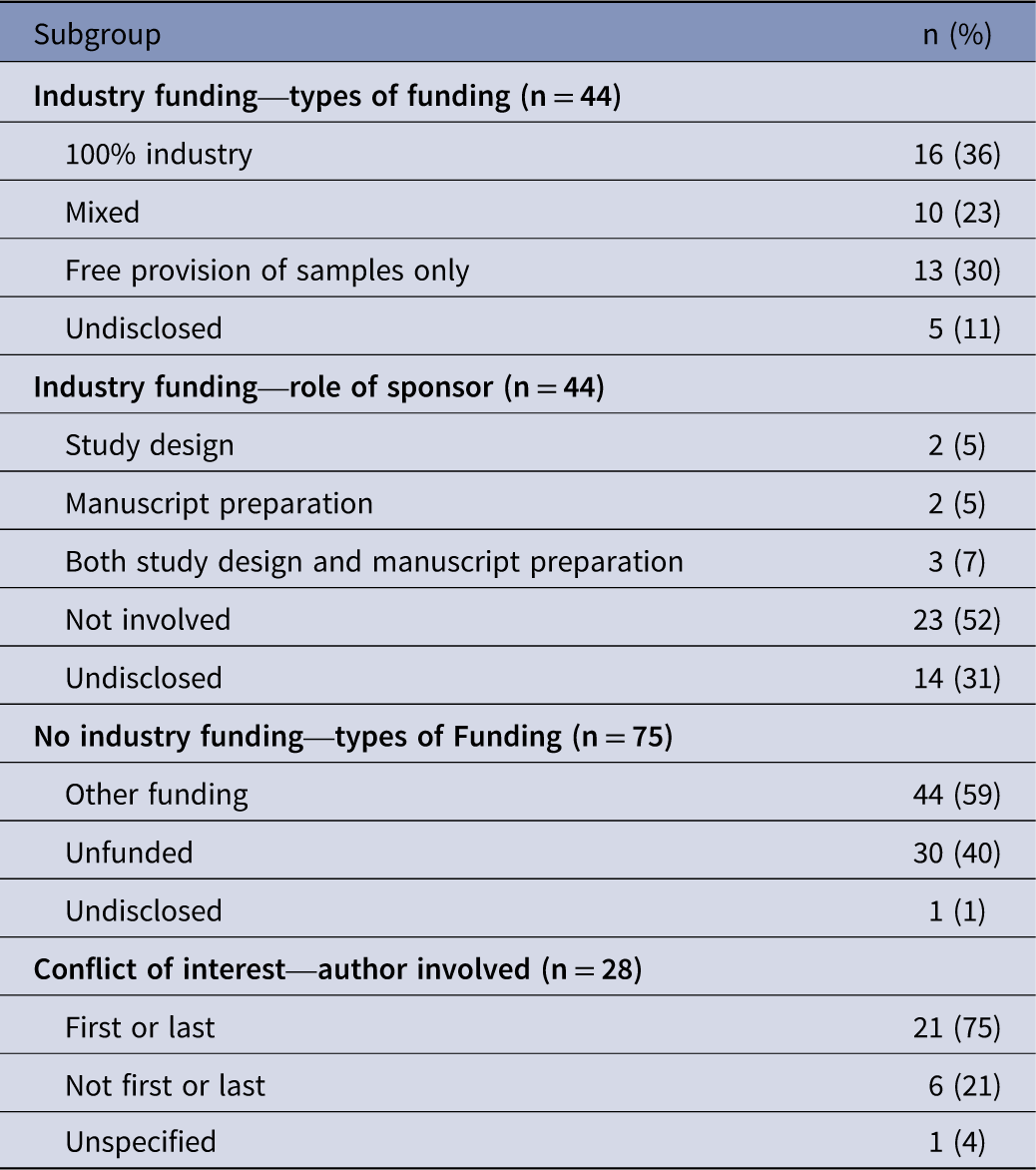
13. Types of industry funding (Table 3): Based on study author disclosures, we further categorized industry funding into subgroups as (a) 100% industry funded, (b) partial funding, (c) free provision of chlorhexidine only, or (d) undisclosed.
-
14. Role of the sponsor in the study (Table 3): We categorized the role of the sponsor into subgroups as (a) sponsor involved in the study design or analysis, (b) sponsor involved in manuscript writing or review, (c) sponsor not involved, or (d) role of the sponsor not disclosed.
Statistical analysis
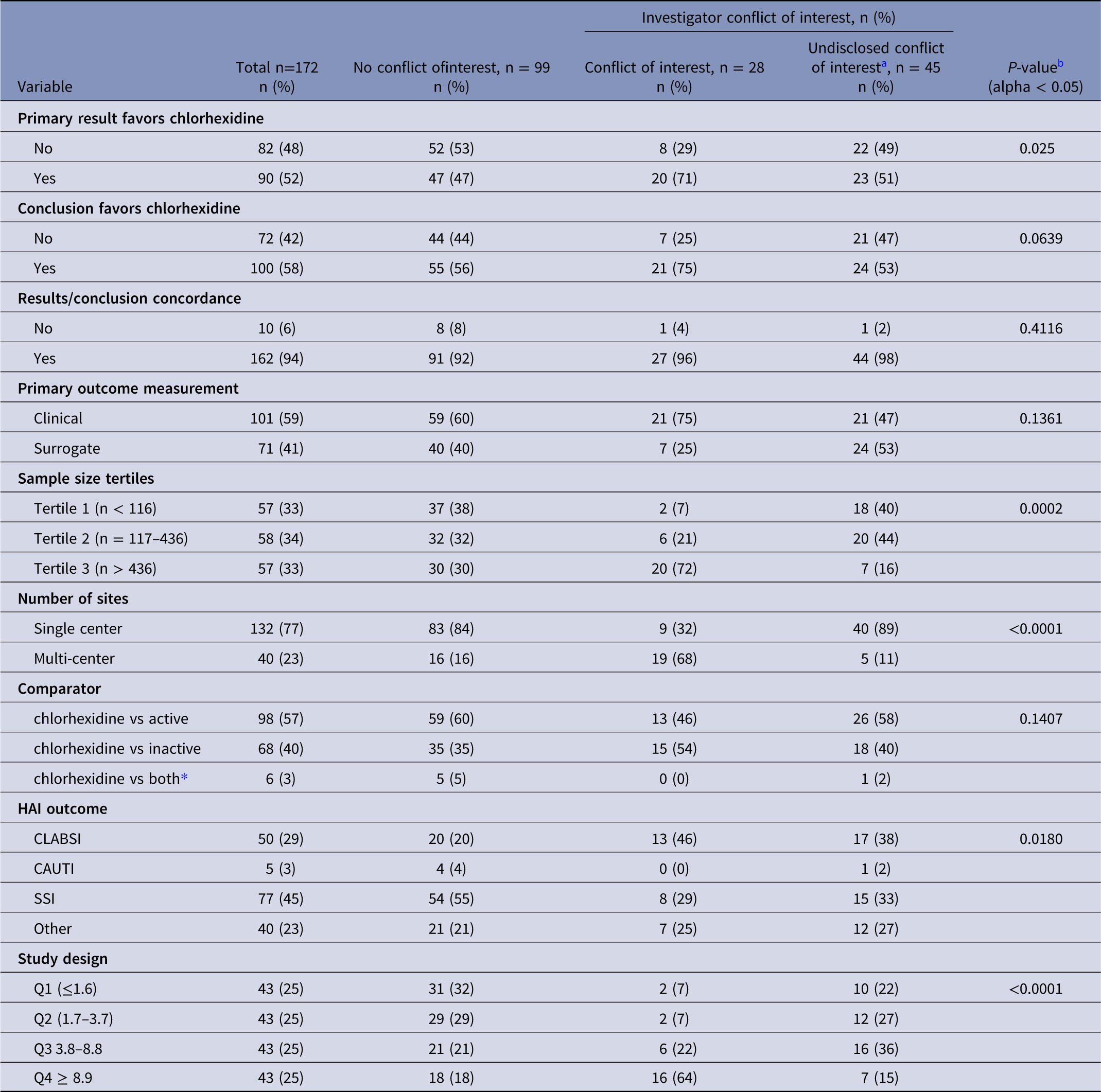
There are two main dependent variables of interest in this study (1) Primary Result Favors Chlorhexidine (yes vs no) and (2) Primary conclusion favors chlorhexidine (yes vs no) which are analyzed separately. There are two main independent variables of interest: (1) industry funding and the presence of investigator COI. Covariates include the number of sites, sample size, comparator type, type of outcome measure, results/conclusion concordance, HAI outcome, study design and impact factor, as shown in both Tables 1 and 2. Utilizing logistic regression, we ran a total of 8 models with a P value <.05 was considered statistically significant. Of note, studies that did not disclose the presence of industry funding and/or investigator COI were not included in the respective logistic regression analysis (see Supplementary Materials). First, we examined the univariate relationship between industry funding and primary result favors chlorhexidine. For any covariate that showed statistical significance in Table 1, we included that in a multivariate regression. We then did the same to examine the relationship between conflict of interest and primary result favors chlorhexidine including any covariate in multivariate regression that showed significance in Table 2. Since sample size and number of sites were collinear we chose to use one of these variables in the multivariate models. Tables 1 and 2 include descriptive statistics and χ2 tests of independence. SAS (SAS Institute), version 9.4 was used for statistical analysis.
Characteristics of trials evaluating chlorhexidine by funding source

Table 1. Long description
The table presents characteristics of trials evaluating chlorhexidine, categorized by funding source. It includes 172 trials divided into four columns: Total, No industry funding, Industry funding, and Undisclosed industry funding. The table has 20 rows and 5 columns, with row labels such as Primary result favors chlorhexidine, Conclusion favors chlorhexidine, Result/conclusion concordance, Primary outcome measure, Sample size tertiles, Number of sites, Comparator, HAI outcome, Study design, and Impact factor. Each row contains percentages and counts for each funding source category. Notable trends include variations in primary results and conclusions favoring chlorhexidine across different funding sources, with P-values indicating statistical significance for certain variables.
HAI = healthcare-associated infection.
CLABSI = central line-associated bloodstream infection.
CAUTI = catheter-associated urinary tract infection.
SSI = surgical site infection.
a Excluded from statistical analysis.
b Pearson’s χ2.
c Common examples of surrogate outcomes include colony counts (eg of a catheter) or bacterial culture growth of a surface after antisepsis.
* refers to a trial that compared chlorhexidine to both an active and inactive comparator.
Characteristics of trials evaluating chlorhexidine by investigator conflict of interest

Table 2. Long description
The table presents data on 172 trials evaluating chlorhexidine, categorized by investigator conflict of interest into three groups: no conflict, conflict, and undisclosed conflict. It includes variables such as primary result favoring chlorhexidine, conclusion favoring chlorhexidine, results/conclusion concordance, primary outcome measurement, sample size tertiles, number of sites, comparator, HAI outcome, and study design. Each variable is broken down by the three conflict of interest categories, with counts and percentages provided for each. P-values are included to indicate statistical significance.
HAI = healthcare-associated infection.
CLABSI = central line-associated bloodstream infection.
CAUTI = catheter-associated urinary tract infection.
SSI = surgical site infection.
a Excluded from statistical analysis.
b Pearson’s χ2.
* refers to a trial that compared chlorhexidine to both an active and inactive comparator.
Characteristics of trials by type of funding, role of sponsor, and authorship

Table 3. Long description
A table categorizing trials by funding type, sponsor role, and authorship. The table has 13 rows and 2 columns. The columns are labeled ‘Subgroup’ and ‘n (%)’. The rows are grouped into four main categories: Industry funding—types of funding, Industry funding—role of sponsor, No industry funding—types of Funding, and Conflict of interest—author involved. Each category has several subgroups with corresponding values. For example, under Industry funding—types of funding, the subgroups are 100% industry, Mixed, Free provision of samples only, and Undisclosed, with values 16 (36), 10 (23), 13 (30), and 5 (11) respectively. The table provides a detailed breakdown of the different types of funding, the role of sponsors, and the involvement of authors in conflicts of interest.
Results
We screened 4,135 studies, of which 342 reached full-text review. One hundred and seventy-two RCTs met inclusion criteria (Figure 1). For 14 studies (8%), there were disagreements in one or more variables which were discussed and resolved by consensus. A full list of included articles is available in the Supplementary Appendix.
PRISMA flowchart of study selection.

Figure 1. Long description
The flowchart details the study selection process for a review on healthcare-associated infections. It begins with the identification of studies from databases and registers, totaling 6594 studies. These are sourced from Embase (2084), MEDLINE (1784), Scopus (1531), and Web of Science (1195). References removed include 2459 duplicates identified manually (121) and by Covidence (2338). The remaining 4135 studies are screened, with 3793 studies excluded. Of the 342 studies sought for retrieval, none are not retrieved. These 342 studies are assessed for eligibility, with 170 studies excluded for reasons such as being a poster/abstract (45), wrong study design (38), pilot/feasibility/post-hoc (21), wrong intervention (21), wrong outcomes (16), full text not in English (13), full text not available (8), wrong patient population (3), wrong setting (3), wrong indication (1), and retracted article (1). Finally, 172 studies are included in the review.
Characteristics of included RCTs
Study characteristics based on funding sources and investigator COI are shown in Tables 1 and 2, respectively. Surgical site infections were the most common HAI outcomes studied (77/172, 45%) followed by CLABSI (50/172, 29%). Ninety studies (52%) had a primary outcome favoring chlorhexidine and 100 studies (58%) had a primary conclusion favoring chlorhexidine. An industry funding statement was present in 119 (69%) studies, of which 44 (37%) received industry funding (Table 1). An investigator COI statement was present in 127 (74%) studies, of which 28 (22%) disclosed investigator COI (Table 2). Among these, 21 (75%) involved the first or last author (Table 3).
Characteristics of RCTs based on industry funding and investigator COI
The characteristics of studies that received industry funding and had investigator COI are shown in Tables 1 and 2 respectively. Table 3 shows further information regarding types of funding and degree of sponsor involvement.
Factors associated with the primary result favoring chlorhexidine
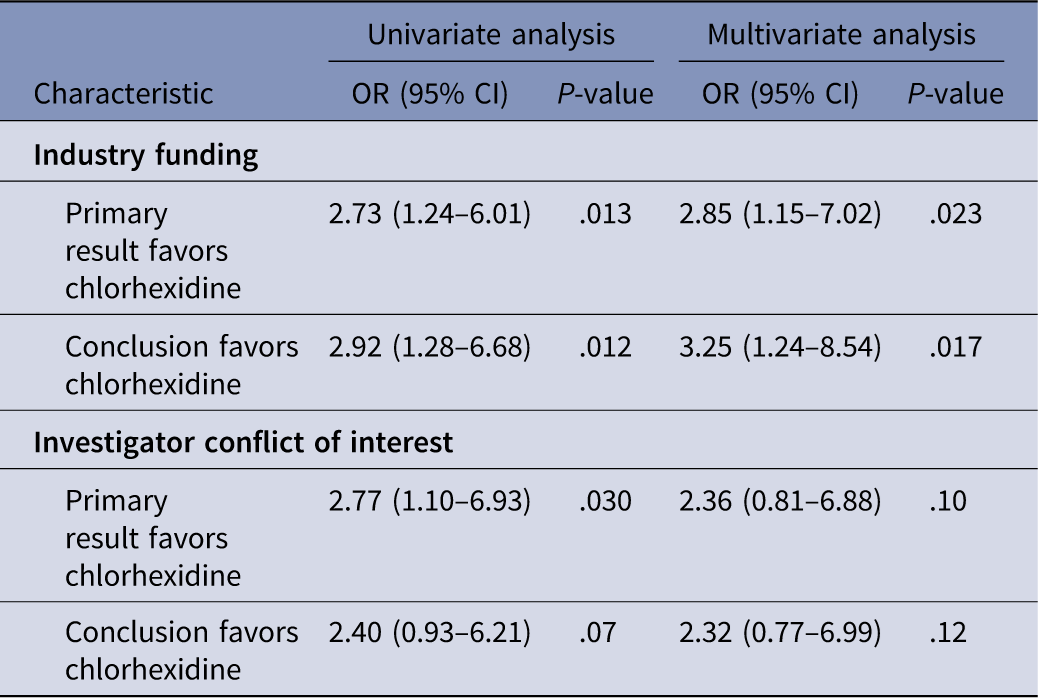
The primary result favored chlorhexidine in 68% (30/44) of studies reporting industry funding while studies that reported no funding had 44% (33/75) finding favorable results (Table 1). Industry funding was associated with the primary result favoring chlorhexidine on univariate analysis (OR = 2.73 [95% CI 1.24–6.01], P = .13) and multivariate analysis (controlling for variables including sample size, type of HAI, journal impact factor, and number of trial sites) (OR 2.85 [95% CI 1.15–7.02], P = .023). Investigator COI was associated with the primary result favoring chlorhexidine on the univariate analyses (OR = 2.77 [95% CI 1.10–6.93], P = .03), however, the result did not remain statistically significant in the multivariate analysis (OR = 2.36 [95% CI 0.81–6.88], P = .10) (Table 4).
Associations between industry funding and investigator conflict of interest and trial outcomes

Table 4. Long description
A table with four rows and three columns comparing the impact of industry funding and investigator conflict of interest on trial outcomes. The columns are labeled ‘Characteristic’, ‘Univariate analysis’, and ‘Multivariate analysis’. The ‘Univariate analysis’ column has sub-columns ‘OR (95% CI)’ and ‘P-value’. The ‘Multivariate analysis’ column has sub-columns ‘OR (95% CI)’ and ‘P-value’. The rows are grouped under ‘Industry funding’ and ‘Investigator conflict of interest’. Under ‘Industry funding’, the first row shows ‘Primary result favors chlorhexidine’ with OR 2.73 (1.24-6.01) and P-value .013 for univariate analysis, and OR 2.85 (1.15-7.02) and P-value .023 for multivariate analysis. The second row shows ‘Conclusion favors chlorhexidine’ with OR 2.92 (1.28-6.68) and P-value .012 for univariate analysis, and OR 3.25 (1.24-8.54) and P-value .017 for multivariate analysis. Under ‘Investigator conflict of interest’, the first row shows ‘Primary result favors chlorhexidine’ with OR 2.77 (1.10-6.93) and P-value .030 for univariate analysis, and OR 2.36 (0.81-6.88) and P-value .10 for multivariate analysis. The second row shows ‘Conclusion favors chlorhexidine’ with OR 2.40 (0.93-6.21) and P-value .07 for univariate analysis, and OR 2.32 (0.77-6.99) and P-value .12 for multivariate analysis.
Factors associated with the conclusion favoring chlorhexidine
In studies with industry funding, 75% (33/44) had a favorable conclusion compared to 51% (38/75) of unfunded studies (Table 1). Industry funding was associated with the conclusion favoring chlorhexidine on the univariate analysis (OR = 2.92 [95% CI 1.28–6.68], P = .012) and the multivariate analysis (OR = 3.25 [95% CI 1.24–8.65], P =.017). Investigator COI was associated with the conclusion favoring chlorhexidine on the univariate analysis (OR = 2.40 [95% CI 0.93–6.21], P = .07); however, this did not remain significant on multivariate analysis (OR = 2.32 [95% 0.77–6.99], P = .12). (Table 4).
Factors associated with results/conclusion concordance
There was no significant difference in results/conclusion concordance between studies with and without investigator COI (investigator COI, N = 27, 96% concordant; no investigator COI present, N = 91, 92% concordant; P = .41), and studies with and without industry funding (industry funding, N = 41, 93% concordant; no industry funding, N = 70, 93% concordant)
Discussion
In this cross-sectional study of 172 RCTs evaluating chlorhexidine for HAI prevention from the last 20 years, we found that trials funded by chlorhexidine sponsors were more likely to report favorable primary results and conclusions compared to trials funded by other sources and unfunded trials. Investigator COI also showed an association with favorable primary results in the univariate analysis but was not statistically significant in multivariate analysis. Industry involvement was also associated with publication in a higher impact factor journal, which has been found previously.Reference Khan, Lombeida, Singh, Spencer and Torralba 21 Our findings suggest that industry bias may play a role in the evidence supporting chlorhexidine for HAI prevention. This is the first study, to our knowledge, that assesses the impact of industry involvement on clinical trial outcomes in the field of infection prevention and control.
There are several possible explanations for our findings. First, the chlorhexidine industry has substantial resources. 22 Thus, it is well positioned to fund higher-quality clinical trials with population sizes that provide the necessary statistical power to identify potential differences. Industry is also likely to invest in products with a greater likelihood of being successful, which may explain why industry funded trials in our study were published in journals with a higher impact factor. However, we controlled for sample size when investigating the association between industry funding and favorable outcomes, and the association held, suggesting this was not a contributing factor. Other possible explanations include that financial incentives may lead chlorhexidine sponsors to preferentially publish trials with statistical significant favorable results (‘publication bias’) Reference de Benedictis23,Reference Sismondo24 or selectively sponsor trials they feel are more likely to lead to a statistically favorable result. Reference Lundh, Lexchin, Mintzes, Schroll and Bero25,26 Industry bias due to selective reporting of outcomes Reference Lundh, Lexchin, Mintzes, Schroll and Bero25,26 or other strategic approaches in study design (ie, choice or dosing of comparator drugs) is another possibility that seems likely. Supporting this theory is a previous Cochrane review, which found that industry funding is associated with outcomes favoring industry-sponsored products, suggesting an industry bias that cannot be explained by traditional risk of bias measures. Reference Lundh, Lexchin, Mintzes, Schroll and Bero25
Industry bias is not detected using traditional risk of bias tools, Reference Bero27 which raises questions about if and how clinical practice guideline (CPG) authors assess for industry bias when evaluating chlorhexidine trials—many of which are cited as evidence in CPGs. Although the Grading of Recommendations Assessment, Development, and Evaluation (GRADE) framework used by CPGs considers risk of bias and specific factors such as publication bias when assessing a study, Reference Prasad28 GRADE does not incorporate a formal assessment of industry bias. To improve transparency, CPG authors could disclose which studies were industry-sponsored Reference Djulbegovic, Kumar and Miladinovic29 and consider assessing industry bias as a separate risk of bias domain by incorporating specific funding elements of a study to inform this risk, such as if the sponsor had an active role in the study design. Reference Stegeman, Schep, Kuijpers and Hofstede30 Barring these changes, clinicians and other healthcare decision makers should be aware of the challenges in detecting industry bias and the importance of critically reviewing the body of evidence when making decisions that impact clinical care.
Lastly, our finding that approximately one-quarter of studies did not include either an industry funding statement or investigator COI disclosure is concerning and warrants further study. That only 1% of trials lacked a funding statement in a recent study of highly cited clinical trials Reference Siena, Papamanolis, Siebert, Bellomo and Ioannidis31 suggests there may be variations in journal disclosure requirements and enforcement of these policies. Although the International Committee of Medical Journal Editors requires that authors disclose funding sources and potential author COI, 32 our findings suggest that more work is needed to improve transparency.
Our study has several limitations. First, our sample size was small, leading to increased uncertainty in our outcomes. The lack of industry disclosures contributed to this as we excluded approximately one-third of studies in our primary analysis due to studies not disclosing the presence of industry funding or investigator COI. Second, we did not assess for risk of bias, which would allow us to summarize concerns regarding study design, execution, and analysis. Third, we relied on study authors’ self-report of COI, which may have led to underreporting of author COI.
In summary, our findings add to a growing body of literature demonstrating that industry involvement in pharmaceutical trials is associated with favorable outcomes for the sponsored product. Our study is the first to show an association between industry funding and favorable outcomes for chlorhexidine for HAI prevention, raising questions about the strength of evidence for chlorhexidine in healthcare. Further studies are needed to understand the factors underlying this association. Although industry collaboration is necessary to drive innovation, more work is needed to improve our ability to detect industry bias and ensure that clinicians are equipped to make informed decisions regarding the use of chlorhexidine to improve patient outcomes.
Supplementary material
The supplementary material for this article can be found at https://doi.org/10.1017/ash.2026.10833.
Acknowledgements
This material is the result of work supported with resources and the use of facilities at the Minneapolis VA Healthcare System. The contents do not represent the views of the U.S. Department of Veterans Affairs or the United States Government. Data available upon request.
Financial support
The authors received no funding for this work.



 Open access

