Magnesium (Mg) alloys have great potential as structural materials in many applications due to their light weight and high specific strength.[Reference Jones and Kondoh1–Reference Kumar, Sanaska, Ravindra and Suman3] However, Mg and its alloys display poor corrosion resistance and low formability at room temperature, relative to their aluminum counterparts. They also exhibit a tension–compression asymmetry with the compressive strength being significantly less than the tensile strength.[Reference Song and Atrens4–Reference Wagoner, Lou, Li and Agnew6] This greatly inhibits the widespread use of Mg alloys at the industrial scale.
The low formability of Mg at low temperature can be attributed to its hexagonal close-packed (HCP) crystal structure.[Reference Jain and Agnew7] Furthermore, the stress states induced by forming are often complex, which generally necessitate the accommodation of plastic deformation in multiple directions. Although basal slip in Mg provides easy plastic flow, it is not active when the applied load is parallel or perpendicular to the c-axis. As a result, non-basal slip systems (e.g., prismatic and pyramidal) and deformation twinning are the only nonzero Schmid factor systems that can facilitate deformation in these directions. However, the critical resolved shear stresses (CRSS) of non-basal slip systems are relatively high and are hard to activate during deformation at low temperatures. Thus, deformation twinning generally dominates at room temperature. Furthermore, since fracture in Mg typically initiates at double twin boundaries,[Reference Barnett8] the ductility of Mg at room temperature is accordingly low.
The suppression of twinning is generally desirable to improve the formability and ductility of Mg since fracture typically initiates at double twin boundaries.[Reference Barnett8] While the reduction of grain size presents one avenue to improve the formability of Mg, the processing and thermal stability of such ultrafine-grained and/or nanocrystalline Mg is still a challenge. Furthermore, one of the main approaches to improve the formability of Mg alloys is to perform the forming process at elevated temperatures. However, the effect of temperature on the competition between dislocation slip and deformation twinning still remains an open question. Accordingly, the present study aims to characterize the plastic behavior of textured Mg under compression perpendicular to the c-axis texture at room temperature and elevated temperatures.
An as-drawn 99.9% pure polycrystalline Mg cylindrical rod having a c-axis texture with a 25.4 mm diameter was purchased from GoodFellow. A wire electrical discharge machine (EDM) was then used to cut 12 compression specimens that are approximately 5 mm × 5 mm × 10 mm in size (i.e., a length:width aspect ratio of 2:1). Each specimen's length direction was perpendicular to the c-axis texture direction (i.e., parallel to the drawing/axial direction of the rod). The specimens were then chemically polished in a 10% nitric acid (HNO3) solution to remove the oxide layer on the surface and were stored in a vacuum to prevent oxidation of the surface.
All specimens were deformed under compression loading in an MTS Insight testing machine between two tungsten carbide platens with grease for lubrication. The experiments were conducted at a constant displacement rate of 0.060 mm/min (i.e., a nominal strain rate of 10–4 s–4) and all specimens were compressed to 10–12% engineering strain. Each compression loading was perpendicular to the c-axis texture direction (i.e., parallel to the drawing direction). The tests were carried out in a Thermcraft Lab-Temp furnace at 25, 100, 200, and 250 °C. A K-type thermocouple was used to monitor the temperature of the specimen. Each specimen to be tested was first left in the furnace for approximately 2 h after the furnace reached the desired testing temperature to ensure that the temperature of the sample has equilibrated before the compression experiments were started. Three specimens were tested at each temperature to ensure reproducibility of the results.
Electron backscatter diffraction (EBSD) analyses were conducted to characterize the microstructure of the specimens before and after compression. The specimens were electropolished using a Struers LectroPol-5 with a 5% Nital solution in methanol. For each case, the same spot was electropolished several times to remove ~1 mm of material to ensure that the microstructure of the interior of the specimen, rather than the surface, would be characterized. The specimens were then ion milled using a Fischione 1060 SEM Mill at 3.5 kV with 40% focus for 10 min.
In order to calculate the twin area fraction pre- and post-deformation, tensile twins were first identified by their misorientation angle of 86.3° and $\{10\bar{1}2\}$ twin plane. Once a twin boundary was identified, the side of the boundary with the undeformed crystallographic orientation in the loading direction was identified as the parent crystal and the portion that deviates from this original texture identified as the twin. Using these criteria, twins were then isolated using OIM Analysis v7, and ImageJ software was used to calculate the average area fraction of the twins.
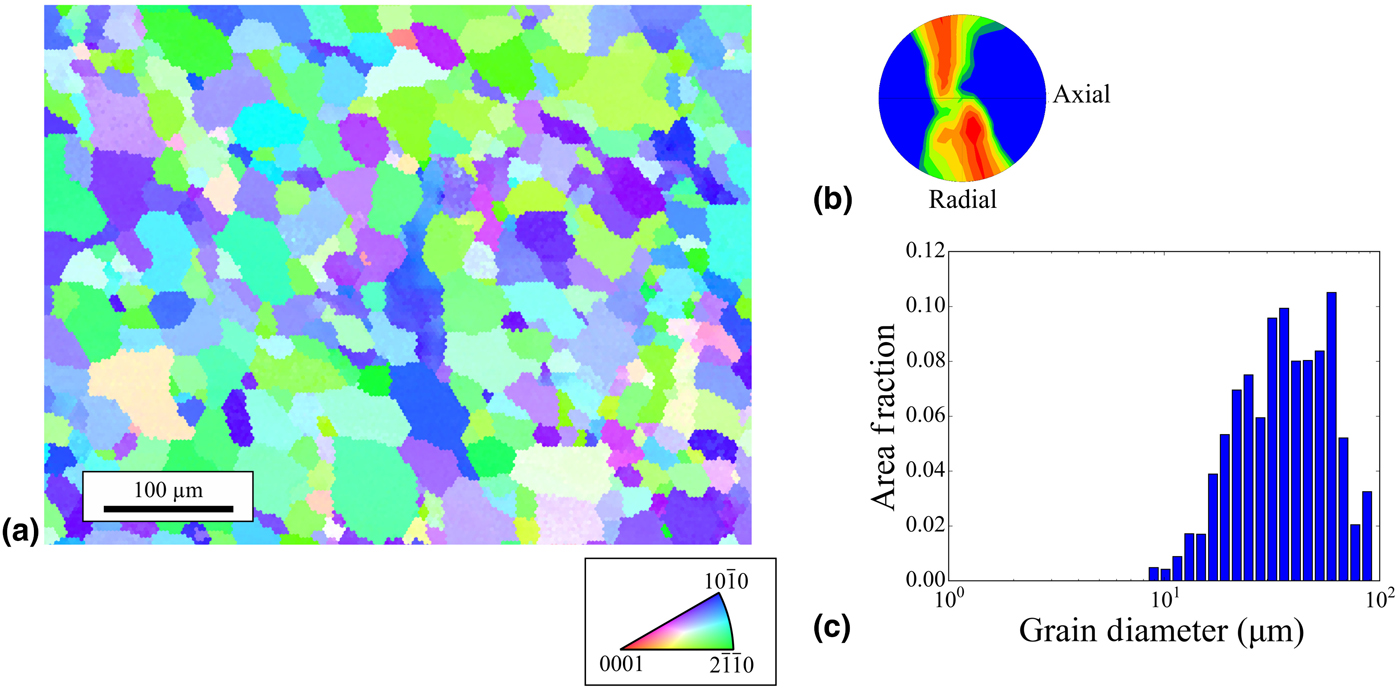
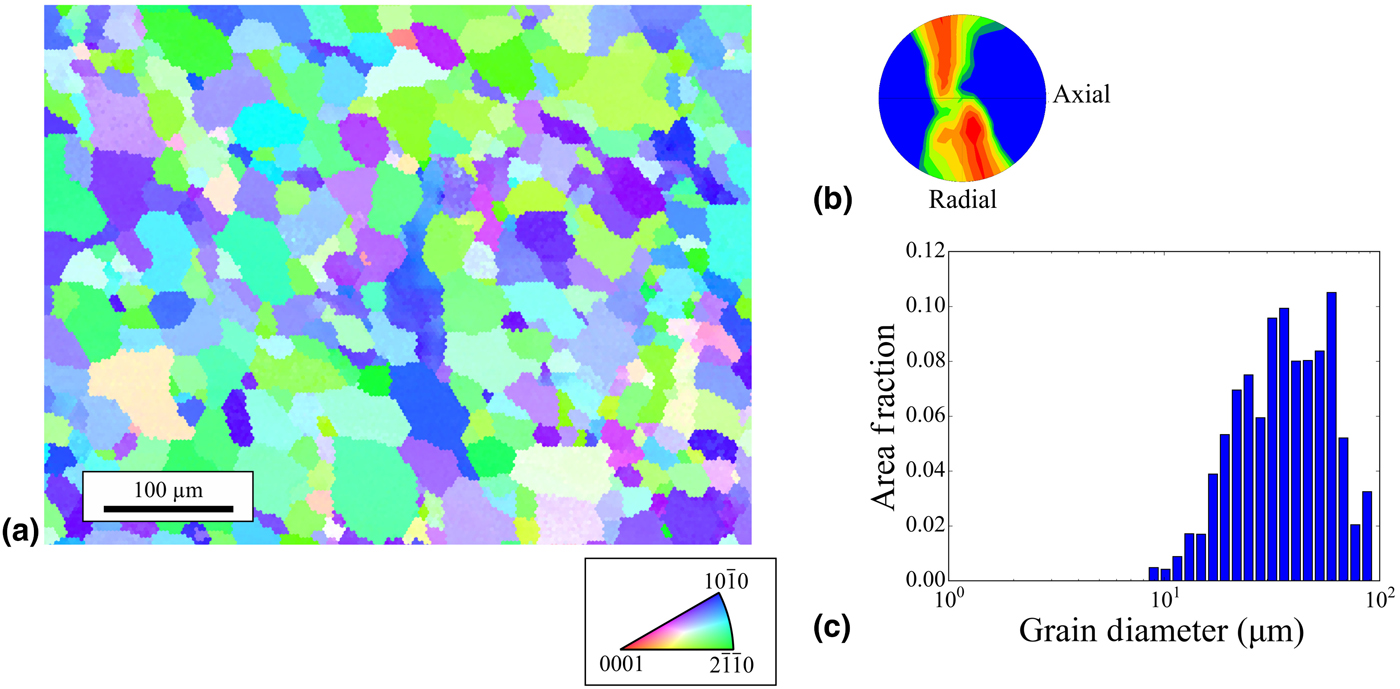
The microstructure for the axial direction along with the grain size distribution before deformation for the pure Mg considered in this study is shown in Fig. 1. An area of 560 µm × 430 µm containing 445 grains was used for the grain size and twin volume fraction statistics. It is clear from Figs. 1(a) and 1(b) that the material shows a strong c-axis texture perpendicular to the direction of loading (i.e., the axial direction). The average grain size (weighted by the grain area) is 38 µm, and the initial twin area fraction for the Mg was 0.002.
Pure Mg polycrystal pre-deformation microstructure characterization: (a) inverse pole figure (IPF) orientation map of the axial direction, (b) corresponding {0001} pole figure (PF), and (c) grain size distribution.
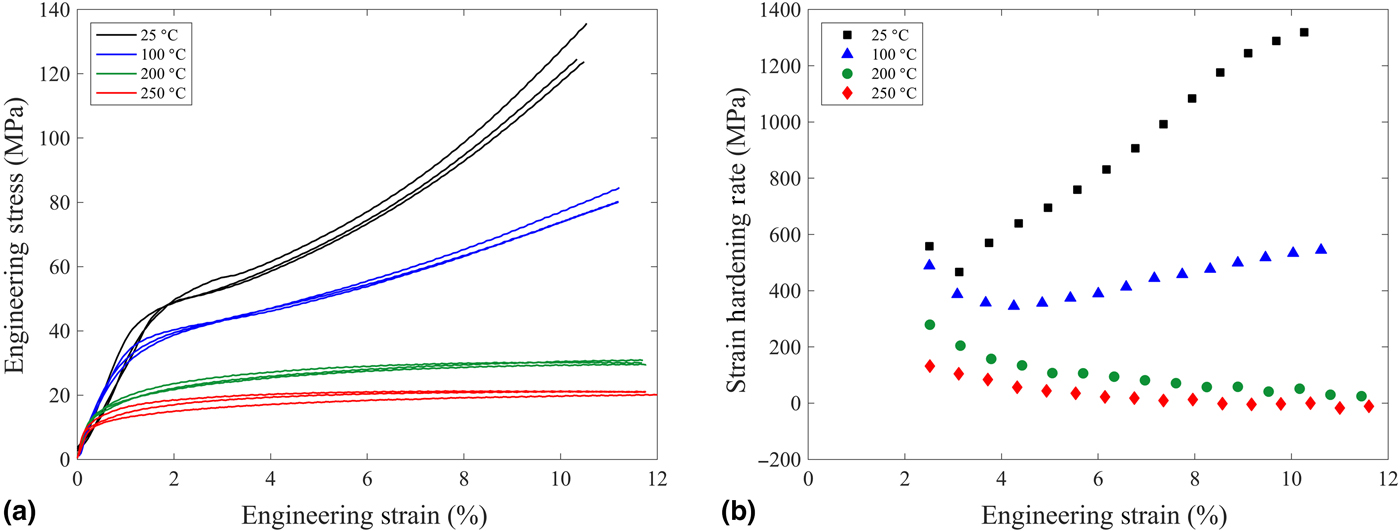
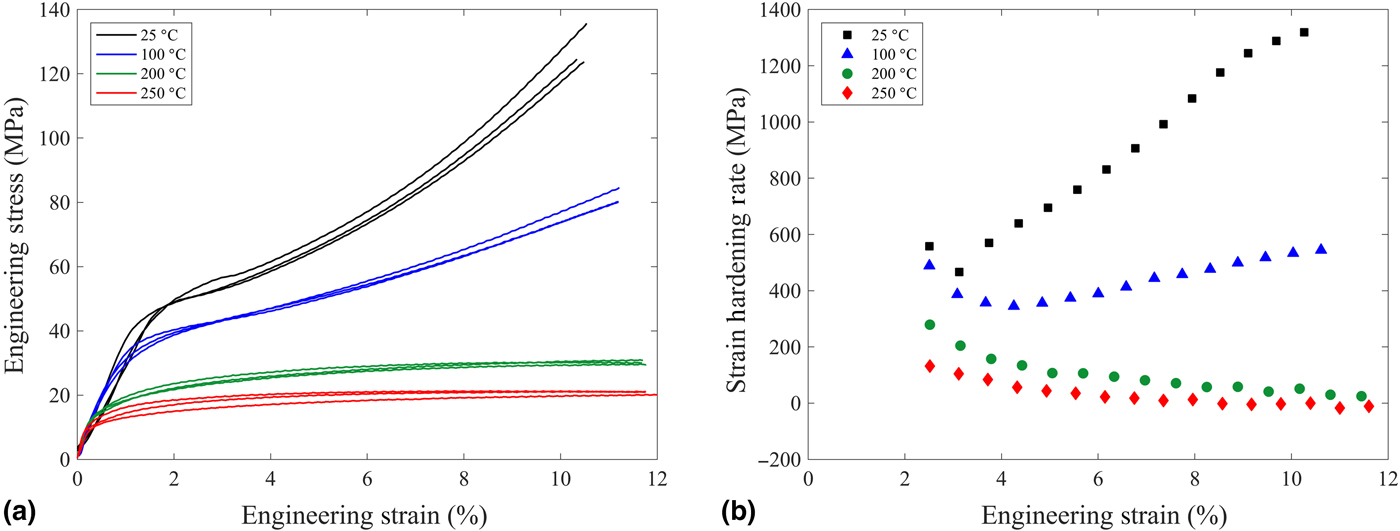
The engineering stress–strain curves and the strain hardening curves for the compression experiments at different temperatures are shown in Fig. 2. The yield strength is observed to drop significantly with increasing temperature, from ~52 MPa at 25 °C to ~12 MPa at 250 °C. At room temperature, the stress–strain curve exhibits the classical concave shape, which is indicative of tensile twinning on the $\{10\bar{1}2\}$ plane along the $\langle10\bar{1}1\rangle$
 direction.[Reference Barnett, Keshavarz, Beer and Atwell9] This concave shape is observed to diminish with increasing temperature until the stress–strain curves exhibit a plastic flow response for experiments conducted at and above 200 °C with negligible hardening for the range of strains reached in this study.
(a) Engineering stress versus engineering strain and (b) the strain hardening rate versus strain, at different temperatures for the compression of c-axis textured pure Mg polycrystals.
The two highest Schmid factors for compression along the $\langle11\bar{2}0\rangle$ direction are 0.433 on the prismatic slip system and 0.374 for tensile twinning on the $\{10\bar{1}2\}$
 plane along the $\langle10\bar{1}1\rangle$
 direction. For compression along the $\langle10\bar{1}0\rangle$
 direction, the corresponding Schmid factors are 0.433 for prismatic slip and 0.499 for tensile twinning. However, the CRSS for prismatic slip has been reported as being up to more than five times higher than that of tensile twinning at room temperature (~39–49 MPa versus 7–11 MPa).[Reference Reed-Hill and Robertson10–Reference Kelley and Hosford13] Thus, at room temperature, twinning is expected to be the dominant deformation mechanism, as evidenced by the concave stress–strain curve in Fig. 2(a). On the other hand, the CRSS for tensile twinning is relatively insensitive to temperature,[Reference Chapuis and Driver12,Reference Kelley and Hosford13] whereas for prismatic slip is strongly temperature dependent. At 100 °C, the CRSS for prismatic slip has been shown to drop to almost half of that at room temperature (from 49 to 27 MPa).[Reference Flynn, Mote and Dorn11] Given that the Schmid factors for prismatic slip are comparable to those for tensile twinning, it is likely that both systems will be simultaneously active. Thus, at 100 °C, twinning is still expected to activate but to a lesser degree with prismatic slip accommodating an increasing share of the overall plastic strain, which is evident by the dramatic drop in the strain hardening as compared with the case at room temperature (see Fig. 2(b)). Furthermore, at 200 °C, the CRSS for prismatic slip is comparable to the CRSS for tensile twinning.[Reference Wonziewicz and Backofen14,Reference Yoshinaga and Horiuchi15] Accordingly, at and above 200 °C, due to the low CRSS of prismatic slip, plasticity is expected to be dominated by the dislocation slip with significantly less, if any, contribution from twinning. This is apparent from the stress–strain curves at these temperatures, which completely loses the characteristic concave shape of the stress–strain curve.
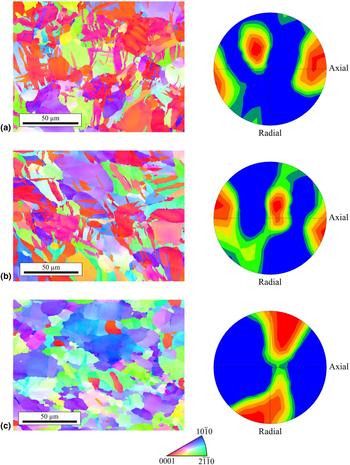
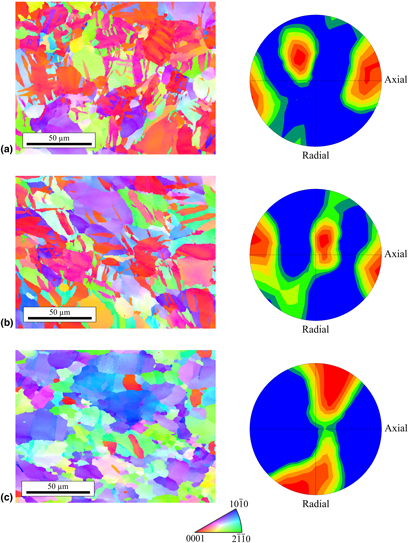
Orientation maps after deformation at different temperatures are shown in Fig. 3. It is clear that the fraction of c-axis-oriented grains decreases with increasing temperature, indicating a suppression of twinning at higher temperatures. These findings are consistent with the stress–strain response discussed above.
Post-deformation IPF orientation map of axial direction with corresponding {0001} PF for compression at (a) 25 °C, (b) 100 °C, and (c) 200 °C.

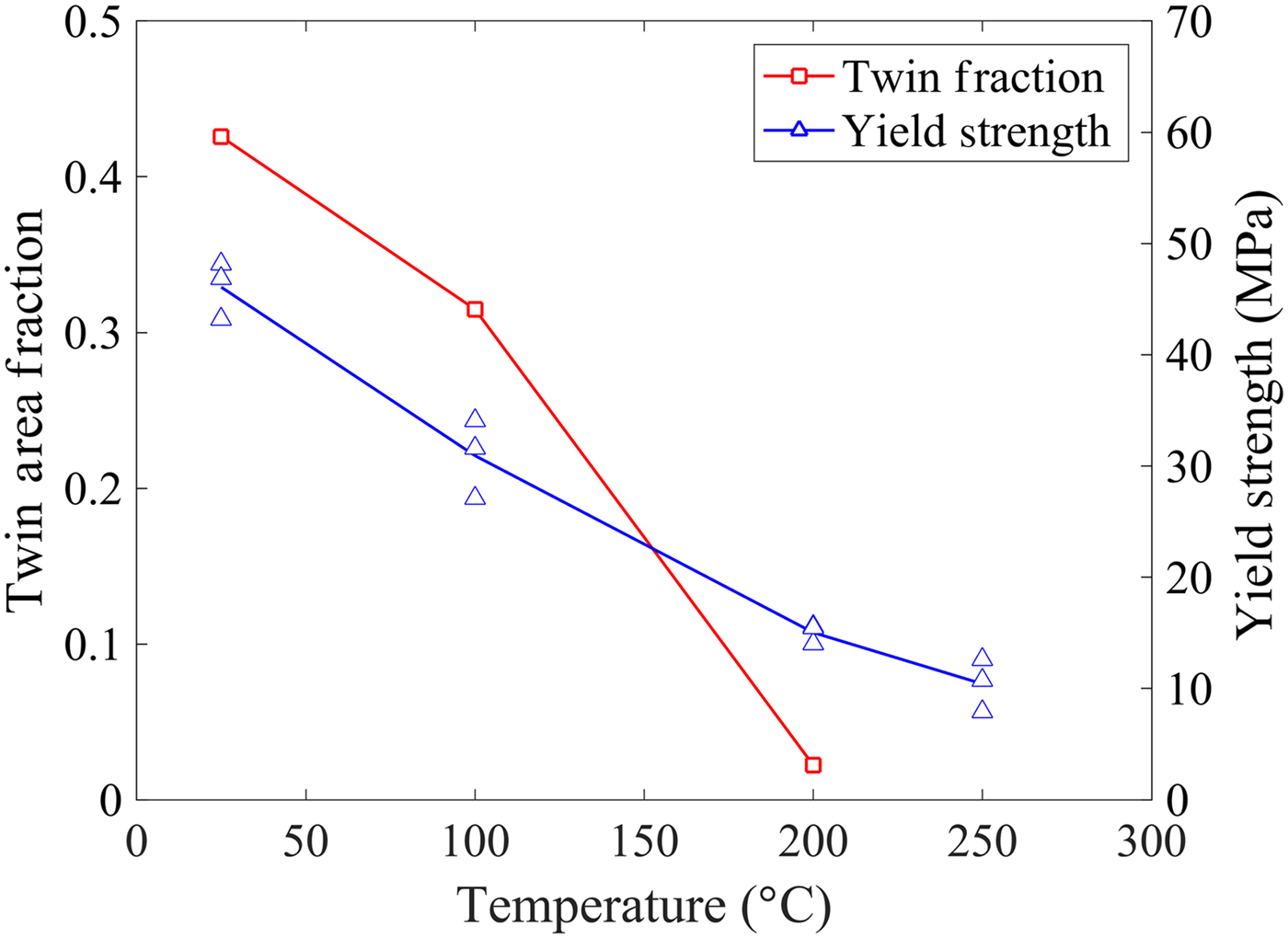
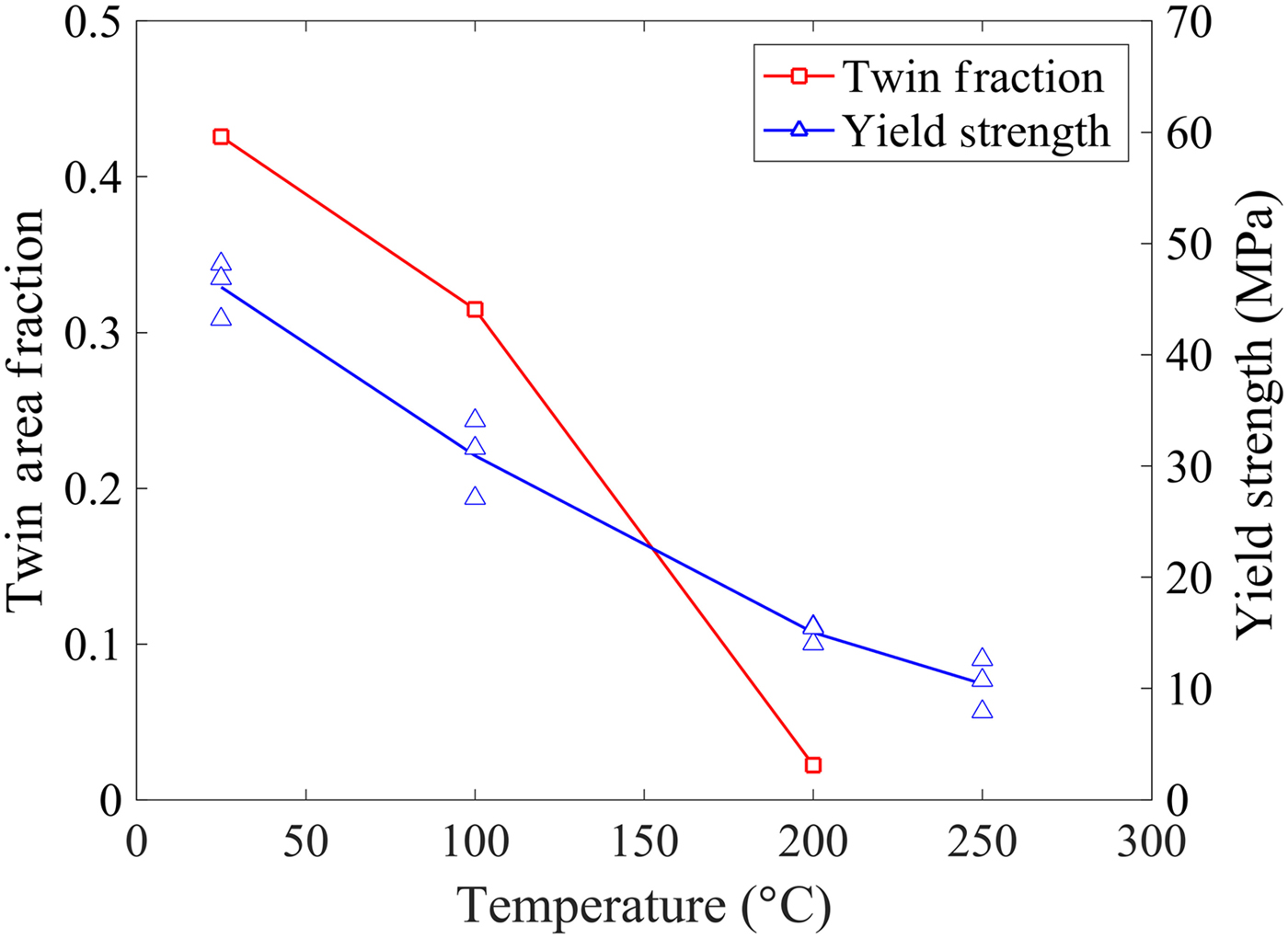
To quantify the competition between tensile twinning and prismatic slip at high temperatures, the average twin area fractions of all deformed Mg specimens at each temperature are summarized in Fig. 4. For these calculations, multiple orientation maps were acquired from each deformed specimen to ensure an accurate twin fraction representation. Consistent with the orientation maps, the average twin area fraction of the deformed specimens decreases significantly with increasing temperature confirming the suppression of twinning at high temperatures. At low temperatures, the average twin area fraction was as high as ~0.4, and as the deformation temperature increased, the average twin area fraction approached that of the pre-deformation specimens at ~0.02.
Average twin area fraction post-deformation and the yield strength (0.2% offset) versus testing temperature.
In summary, the mechanical response of textured pure Mg polycrystals was measured at room temperature and elevated temperatures with compression applied perpendicular to the c-axis texture direction. It was found that Mg exhibits a progressive decrease in yield strength and strain hardening with increasing temperature. This trend is attributed to a decrease in the CRSS of prismatic slip, which subsequently leads to the suppression of deformation twinning. This was confirmed by the post-deformation microstructure, which showed a clear decrease in twinning area fraction with increasing testing temperature. These findings shed light on the mechanisms and stress levels necessary to facilitate formability in Mg and its alloys as a function of temperature. The results of this study also provide quantitative data that can be used to validate crystal plasticity finite element models that incorporate twinning in HCP metals[Reference Ardeljan, Beyerlein, McWilliams and Knezevic16–Reference Cheng, Shen, Mishra and Ghosh19].
Acknowledgment
The authors acknowledge funding support from the National Science Foundation under contract #DMR-1609533.