Introduction
One of the foundational issues in the field of second language acquisition (SLA) is crosslinguistic influence (McManus, Reference McManus2021). A considerable body of research has focused on how the learning of a new language proceeds, given the previous knowledge of and competence in a first language (L1; e.g., Alonso, Reference Alonso2016; Golden et al., Reference Golden, Jarvis and Tenfjord2017; Jarvis & Pavlenko, Reference Jarvis and Pavlenko2008; Odlin, Reference Odlin1989; Ringbom, Reference Ringbom1987; Yu & Odlin, Reference Yu and Odlin2016), and there now exists more than 50 years of research documenting the influence of L1 structures and concepts on production in an additional languageFootnote 1 (Lado, Reference Lado1957). The current study continues with this line of inquiry on crosslinguistic influence by investigating linguistic transfer, or the influence that a learners’ knowledge of a language (in this case, the L1) may have on their linguistic behavior in another language (Jarvis & Pavlenko, Reference Jarvis and Pavlenko2008, p. 61). Specifically, we address the role that the L1 plays in the variable use and development of grammatical gender marking in noun-modifier (i.e., noun-adjective and determiner-noun) pairs in additional-language Spanish. Although the role of L1 influence on gender marking in additional-language Spanish has been investigated previously, findings have been inconclusive (see Franceschina, Reference Franceschina, Foster-Cohen and Nizegorodcew2001, Reference Franceschina, Foster-Cohen, Ruthenberg and Poschen2002; White et al., Reference White, Valenzuela, Kozlowska-Macgregor and Leung2004). This lack of consensus may reflect different ways of operationalizing and ultimately identifying L1 influence. To contribute to this ongoing discussion, we followed the rigorous recommendations set forth by Jarvis (Reference Jarvis2000, Reference Jarvis, Roberts, Howard, Laoire and Singleton2010) in the unified methodological framework (see also Jarvis & Pavlenko, Reference Jarvis and Pavlenko2008), which, importantly, is theory independent, meaning that it can be applied to research in different areas of SLA. The other key components of this framework are the four types of evidence of crosslinguistic influence (intragroup homogeneity, intergroup heterogeneity, cross-language congruity, and intralingual contrasts) and the need to account for other factors, such as language proficiency, that impact acquisition. These components of the unified methodological framework are necessary to reach strong conclusions about the presence of crosslinguistic influence in another language (Jarvis Reference Jarvis2000, Reference Jarvis, Roberts, Howard, Laoire and Singleton2010). In addition to adopting the unified methodological framework, we drew on insights from variationist SLA to conduct analyses in connection with each type of evidence and to account for a range of factors. Our analysis centered on two possible instances of crosslinguistic influence on gender marking in additional-language Spanish by L1 French and L1 English speakers (see “The Current Study” section), allowing us to contribute new insights to this discussion.
Background
Gender marking in Spanish
In Spanish, modifiers agree in gender with the noun they modify, and nouns are either masculine or feminine. The canonical inflectional morphemes for masculine and feminine genders are -o and -a, respectively. Examples of gender marking with canonical nouns are in (1) and (2); examples (3) and (4) illustrate gender marking with nouns that have noncanonical endings.
-
(1) una blusa blanca “aFEM whiteFEM blouseFEM”
-
(2) los perros pequeños “theMASC smallMASC dogsMASC”
-
(3) las universidades prestigiosas “theFEM prestigiousFEM universitiesFEM”
-
(4) un árbol viejo “anMASC oldMASC treeMASC”
Gender marking has received considerable attention in research on additional-language Spanish (Alarcón, Reference Alarcón and Geeslin2014). Due to space constraints and because the current study examines production data, we focus the current review on investigations that have analyzed language use. This body of scholarship has investigated the role that many factors play in marking gender in a targetlike way. Some of the more widely studied factors include noun gender, noun ending, noun class, modifier type, and proficiency. Learners tend to be more targetlike when the noun is masculine compared to feminine (Finnemann, Reference Finnemann1992; Gudmestad et al., Reference Gudmestad, Edmonds and Metzger2019; Montrul et al., Reference Montrul, Foote and Perpiñán2008; White et al., Reference White, Valenzuela, Kozlowska-Macgregor and Leung2004). Various investigations have also found a link between targetlikeness and noun ending, with learners being more targetlike with nouns that end in the canonical -o/-a endings (Alarcón, Reference Alarcón2011; Fernández-García, Reference Fernández-García1999). Regarding noun class, Bruhn de Garavito and White (Reference Bruhn de Garavito, White, Pérez-Leroux and Liceras2002) observed higher rates of targetlike use with nouns that have arbitrary gender (e.g., lápiz “pencilMASC”), as opposed to semantic gender (e.g., mujer “womanFEM”). Other investigations, though, have found the opposite result (Alarcón, Reference Alarcón2010; Fernández-García, Reference Fernández-García1999) or have not found an effect for this variable (Gudmestad et al., Reference Gudmestad, Edmonds and Metzger2019). For modifier type, learners tend to be more targetlike with determiners compared to adjectives (e.g., Alarcón, Reference Alarcón2010, Bruhn de Garavito & White, Reference Bruhn de Garavito, White, Pérez-Leroux and Liceras2002; Fernández-García, Reference Fernández-García1999; Gudmestad et al., Reference Gudmestad, Edmonds and Metzger2019; White et al., Reference White, Valenzuela, Kozlowska-Macgregor and Leung2004). When determiners have been analyzed alone, targetlikeness has been more common with definite articles than other types of determiners (Bruhn de Garavito & White, Reference Bruhn de Garavito, White, Pérez-Leroux and Liceras2002; Gudmestad, Reference Gudmestad, Edmonds, Leclercq and Gudmestad2020). Moreover, research has shown that as learners’ proficiency level increases, rates of targetlike use increase (Alarcón, Reference Alarcón2011; Gudmestad et al., Reference Gudmestad, Edmonds and Metzger2019; Montrul et al., Reference Montrul, Foote and Perpiñán2008). Collectively, these investigations have demonstrated that there is variability in learners’ use of targetlike gender marking in Spanish and that multiple factors are connected to this variability.
L1 influence on gender marking
In addition to the factors identified in the preceding section, a few studies have addressed the possibility of crosslinguistic influence in gender marking in additional-language Spanish.Footnote 2 Although crosslinguistic influence in gender marking can manifest itself as the use of L1 morphemes in the additional language (Jarvis & Pavlenko, Reference Jarvis and Pavlenko2008, p. 92), “learners will usually not transfer inflectional morphemes from one language into another” (Gujord, Reference Gujord, Tracy-Ventura and Paquot2021, p. 348). In the case of gender marking in additional-language Spanish, previous studies have not provided evidence that learners transferred inflectional gender morphemes from one language to another. Instead, the researchers evaluated L1 influence by assessing accuracy or targetlikeness (Franceschina, Reference Franceschina, Foster-Cohen and Nizegorodcew2001, Reference Franceschina, Foster-Cohen, Ruthenberg and Poschen2002; White et al., Reference White, Valenzuela, Kozlowska-Macgregor and Leung2004). According to this research, L1 influence may be visible in lower rates of targetlikeness for learners whose L1 does not show consistent grammatical gender marking (e.g., English). Franceschina (Reference Franceschina, Foster-Cohen and Nizegorodcew2001) investigated L1 English and L1 Italian speakers who had advanced proficiency in additional-language Spanish. She found that in informal conversation, the L1 Italian participants were more accurate with gender marking than the L1 English participants and attributed this difference to the fact that Italian has a grammatical gender system but English does not. In another study, Franceschina (Reference Franceschina, Foster-Cohen, Ruthenberg and Poschen2002) investigated three participant groups: native speakers of Spanish, additional-language learners whose L1 has a grammatical gender system, and additional-language learners whose L1 lacks grammatical gender. The participants completed a guessing game task, in which they had to know the gender assigned to a noun to guess the appropriate noun. The results showed that there was no significant difference between the two additional-language groups. However, the additional-language participants who did not have an L1 with grammatical gender scored significantly lower on the task than the native-speakers, whereas there was no difference between the native speakers and the additional-language participants whose L1s had grammatical gender. She concluded that these findings possibly indicated that learners whose L1s lack grammatical gender might face greater challenges in acquiring gender marking in another language than learners with an L1 that has grammatical gender. In contrast, in an investigation of L1 French and L1 English participants who were learning Spanish, White et al. (Reference White, Valenzuela, Kozlowska-Macgregor and Leung2004) found no difference between the two L1 groups in their production and interpretation of gender marking in Spanish.
Similar to the work on Spanish, research on other additional languages leaves open the question as to whether a learner’s L1 plays a role in the acquisition of gender marking. For example, in a study of two learners of additional-language German (L1 Italian or Turkish), Spinner and Juffs (Reference Spinner and Juffs2008) did not find that the presence of a grammatical gender system in Italian facilitated the acquisition of gender. Ragnhildstveit (Reference Ragnhildstveit, Golden, Jarvis and Tenfjord2017) examined gender marking in the written production of additional-language learners of Norwegian with learners from five L1 backgrounds. The L1 Vietnamese and L1 English participants represented L1s that lacked grammatical gender. The L1 German participants constituted the group whose L1 had a grammatical gender system that was similar to that of Norwegian. Finally, the L1 Dutch and L1 Spanish participants represented L1s with grammatical gender but the system was different from the Norwegian system. Ragnhildstveit’s results did not show that learners with an L1 gender system that was more similar to Norwegian outperformed learners whose L1 system was more different nor did she find differences between learners with or without an L1 gender system.
At the same time, other investigations have indicated that crosslinguistic influence may be important. For instance, Sabourin et al. (Reference Sabourin, Stowe and de Haan2006) investigated grammatical gender in additional-language Dutch among L1 speakers of French, German, and English (see also Sabourin, Reference Sabourin2001). The participants completed an ungrammaticality detection and correction task that focused on sentences with relative pronoun agreement. When accounting for scores that the participants earned on a gender assignment task, they found that the L1 French and L1 German speakers performed better on the ungrammaticality task than the L1 English speakers. These findings demonstrated that the presence of a grammatical gender system in French and German facilitated gender agreement in additional-language Dutch (see Alhawary, Reference Alhawary2009, for similar conclusions with respect to an analysis of oral production data in additional-language Arabic).
In another example, Ellis et al. (Reference Ellis, Conradie and Huddlestone2012) investigated grammatical gender in additional-language German among three L1 groups: Afrikaans, English, and Italian. German and Italian have grammatical gender, but Afrikaans and English do not. They found preliminary evidence that the presence of a grammatical gender system in Italian gave the L1 Italian speakers an advantage in marking gender on a sentence-completion task over the other L1 groups. They also found that the Afrikaans speakers performed better than the English participants. They suggested that the syntactic and lexical similarities between Afrikaans and German “[led] to a ‘lighter burden’ for Afrikaans-speaking learners of German to such an extent that it makes the acquisition of grammatical gender in L2 [second-language] German easier for Afrikaans-speaking than for English-speaking learners” (p. 23). Thus, despite the inconsistent findings in the literature, the fact that there is evidence of L1 influence from work on Spanish and other languages suggests that it may be reasonable to hypothesize that L1 French and L1 English speakers differ in their acquisition of gender marking in additional-language Spanish, given that the former has a grammatical gender system but the latter does not.
Investigating L1 influence
Unified methodological framework
As previously mentioned, research on the role of L1 influence in gender marking, including prior studies on Spanish, has tended to interpret differences in targetlike behavior among learners with different L1 backgrounds as evidence of L1 influence. The current study is similar in that we examine targetlike rates of use of two L1 groups. However, in his extensive work on crosslinguistic influence, Jarvis (Reference Jarvis2000, Reference Jarvis, Roberts, Howard, Laoire and Singleton2010, inter alia) has forcefully argued for the need for a more rigorous approach to identifying crosslinguistic influence. Indeed, although differences in targetlikeness may reflect L1 influence, other factors may also play a role in language behavior. This led Jarvis to propose (and later refine) what he refers to as a unified methodological framework for the study of crosslinguistic influence. In the current investigation, we seek to build on previous research on gender marking in additional-language Spanish by adopting the unified methodological framework.
The unified methodological framework consists of three components. The first is a theory-independent definition of L1 influence, which is “any instance of learner data where a statistically significant correlation (or probability-based relation) is shown to exist between some feature of learners’ IL [interlanguage] performance and their L1 background” (Jarvis, Reference Jarvis2000, p. 252). We adopt this definition in the present investigation.
The second element consists of four types of evidence of crosslinguistic influence: intragroup homogeneity, intergroup heterogeneity, cross-language congruity, and intralingual contrasts (Jarvis, Reference Jarvis, Roberts, Howard, Laoire and Singleton2010; see also Jarvis, Reference Jarvis2000; Jarvis & Pavlenko, Reference Jarvis and Pavlenko2008). According to Jarvis (Reference Jarvis, Roberts, Howard, Laoire and Singleton2010), these four types of evidence together form a comparison-based argument for L1 influence. Comparisons of linguistic behavior are made within a language group (intragroup homogeneity), between language groups (intergroup heterogeneity), between languages (cross-language congruity), and within a language (intralingual contrasts). First, intragroup homogeneity, also called within-group similarities, involves participants who share similar knowledge of the same source and recipient languagesFootnote 3 under investigation and who exhibit comparable linguistic behavior in the recipient language (Jarvis & Pavlenko, Reference Jarvis and Pavlenko2008, p. 41). This kind of evidence “shows that learners from the same L1 background behave as a group with respect to the L1 feature in question, which is often necessary in order to show that the L2 feature exhibits any L1 effects in the first place” (Jarvis, Reference Jarvis2000, p. 254). Second, intergroup heterogeneity, or between-group differences, refers to evidence that shows that the linguistic behavior under investigation diverges among participants of different L1s. Thus, one way to observe intergroup heterogeneity is when participants with different source languages who have comparable knowledge of the recipient language behave differently in the recipient language (Jarvis & Pavlenko, Reference Jarvis and Pavlenko2008, pp. 35, 43). The third kind of evidence is cross-language congruity or between-language similarities, which “involves showing more explicitly what it is in the language users’ source-language knowledge (and performance) that has brought about the observed patterns in their recipient-language performance” (Jarvis & Pavlenko, Reference Jarvis and Pavlenko2008, p. 47). Namely, the expectation with this type of evidence is that researchers can identify a clear link between behavior in the source and recipient languages. Establishing this type of comparison can involve asking the same participants to perform a similar task in their L1 and their additional language or can rely on descriptions of the L1 to characterize general production patterns. The final type of evidence is intralingual contrasts (i.e., within-language differences), which focuses on comparing features of the recipient language. Evidence of crosslinguistic influence is seen when “the learners’ use of the target language is stratified in ways that correspond with source-language-internal differences” (Jarvis, Reference Jarvis, Roberts, Howard, Laoire and Singleton2010, p. 179). This fourth type of evidence is similar to cross-language congruity in that both involve assessing the relationship between the source and recipient languages (Jarvis, Reference Jarvis, Roberts, Howard, Laoire and Singleton2010, p. 175). However, they differ in the comparisons that are made. With cross-language congruity, researchers compare different source-language participant groups, and with intralingual contrasts, the comparisons are within one source-language group and between different language features. Jarvis (Reference Jarvis, Roberts, Howard, Laoire and Singleton2010, Reference Jarvis, Yu and Odlin2016) has acknowledged that all four types of evidence may not be necessary or possible in a single investigation. He has also stressed, however, that thorough investigations of crosslinguistic influence should include various types of evidence because “the more types of evidence one has for transfer, the fewer alternative explanations there will be” (Jarvis, Reference Jarvis, Yu and Odlin2016, p. 41). Furthermore, he has not specified the analyses that must be performed to examine each evidence type; instead, he leaves the door open to a variety of qualitative and quantitative assessments. We explore all four types of evidence in the present investigation.
The third component of the unified methodological framework consists of various external and linguistic variables that researchers should control for when investigating L1 influence. This list is ambitious and consists of factors such as language proficiency, the task the participants complete, language background, and language typology. In the current study, we accounted for some of the factors identified by Jarvis (see the “Method” section), and we contributed to this framework by weighing the role of L1 influence against other internal (linguistic) constraints, such as noun gender and modifier type, that have been shown to impact gender marking.
Variationist SLA
Because the unified methodological framework is theory neutral, we considered whether an existing approach in SLA may not only be compatible with the framework but also provide valuable conceptual and methodological tools for investigating L1 influence on grammatical gender. We identified variationist SLA, a usage-based approach (cf. Gurzynski-Weiss et al., Reference Gurzynski-Weiss, Geeslin, Daidone, Linford, Long, Michalski, Solon, Tyler, Ortega, Uno and Park2018), as one option. Variationism, which began in the field of sociolinguistics, offers detailed explanations of language variation and change and of the complex ways in which linguistic (internal) and social (external) factors work in concert to influence variable language behavior (e.g., Gudmestad, Reference Gudmestad2021). Researchers typically examine language variation and its evolution quantitatively, with statistical analyses that enable them to investigate multiple factors simultaneously (e.g., mixed-effects models). This area of SLA distinguishes between linguistic phenomena that are variable among native speakers (Type II variation) and those that are not (Type I variation; Rehner, Reference Rehner2002). In the case of Type II variation, which has received the most attention in variationist SLA, native-speaker use varies sociolinguistically (i.e., according to both linguistic and extra-linguistic constraints), which also means that the input learners receive and the target of acquisition are both variable. Type I variation concerns linguistic phenomena that are ostensibly categorical (i.e., not variable) among native speakers. However, variability in these cases is present among learners. The variable expression of grammatical gender is one example of Type I variation that has been investigated from the perspective of variationist SLA (Gudmestad et al., Reference Gudmestad, Edmonds and Metzger2019, Reference Gudmestad, Edmonds and Metzger2021). We continue with this line of inquiry and extend our previous work to include two L1 groups.
While a substantial body of variationist scholarship in SLA exists and numerous linguistic and extra-linguistic factors have been investigated, it has been less common for researchers to consider the role of L1 influence in learner variability. However, Bayley (Reference Bayley2005, pp. 3–4) argued that variationist SLA is in a strong position to further the understanding of crosslinguistic influence because it has the ability to determine whether a learner’s L1 influences variability and because it can uncover whether variable patterns of use (i.e., linguistic and extra-linguistic constraints on use) differ according to participants’ L1. Although Bayley did not link these assertions to the unified methodological framework (Jarvis, Reference Jarvis2000, Reference Jarvis, Roberts, Howard, Laoire and Singleton2010), we see three important connections. The first connection pertains to one type of evidence of crosslinguistic influence. Bayley explained that including L1 as an independent factor in a statistical model is a way to test for differences between L1 groups. A significant result for L1 would indicate that learners’ patterns of use vary according to their L1. Thus, he pinpointed a way for variationist SLA to test for one of the types of evidence identified by Jarvis—intergroup heterogeneity. Second, another type of evidence that Bayley discussed is linked to what Jarvis called cross-language congruity: “If speakers of different languages pattern in different ways and if the difference reflects a linguistic difference in their first languages, we might reasonably conclude that the difference is attributable to the effects of the first language” (Bayley, Reference Bayley2005, p. 4, our emphasis). The key here is that the differences in learner behavior are connected to differences in the linguistic features of the L1s, which is precisely what Jarvis classified as cross-language congruity. The third connection between Bayley’s variationist discussion of L1 influence and the unified methodological framework concerns the understanding that the L1 is not the only source of variability in learner behavior. Bayley specified “that other potential sources of inter-learner variability” should be controlled for to draw conclusions about L1 influence (p. 4)—a need that Jarvis also addressed in the third component of the unified methodological framework (Jarvis, Reference Jarvis2000, pp. 260–261). Thus, conceptually, variationist SLA is particularly well suited to address the third component of the unified methodological framework because it does not consider the role of the L1 in isolation but instead investigates the possible role that the L1 plays in relation to other potentially influential factors.
Despite the fact that crosslinguistic influence has not been a central concern of variationist SLA, research in this domain appears to be growing. For example, Ortin and Fernandez-Florez (Reference Ortin and Fernandez-Florez2019) and Picoral and Carvalho (Reference Picoral and Carvalho2020) adopted a variationist approach to examine crosslinguistic influence on third language acquisition. Ortin and Fernandez-Florez investigated subject expression in Spanish (a case of Type II variation) and Picoral and Carvalho studied preposition + article contractions in Portuguese (a case of Type I variation). In these investigations, though they were not explicitly linked to Bayley (Reference Bayley2005) or the unified methodological framework, the researchers tested for intergroup heterogeneity and cross-language congruity and sought to account for other factors that could influence participants’ language use. We thus believe that these studies demonstrate that variationist SLA can be valuable for advancing knowledge of crosslinguistic influence and that there is room for explicit connections to be made between variationist SLA and the unified methodological framework. To this end, in the current study, we apply insights from variationist SLA and adopt the unified methodological framework to investigate the possible role that L1 influence plays in learners’ variable use of gender marking in additional-language Spanish.
The Current Study
The overarching goal of the current study is to assess the extent to which L1 influence plays a role in the development and use of grammatical gender in additional-language Spanish. We extend previous research on crosslinguistic influence on grammatical gender in two important ways. As already discussed, we worked within Jarvis’s (Reference Jarvis2000, Reference Jarvis, Roberts, Howard, Laoire and Singleton2010) unified methodological framework and we applied methodological and conceptual insights from variationist SLA to provide a strong test of crosslinguistic influence. Additionally, while previous studies have focused on potential crosslinguistic influence with respect to grammatical gender by looking at overall rates of targetlikeness, we identified two possible manifestations of crosslinguistic influence in gender marking in additional-language Spanish among learners who are native speakers of French or English. First, whereas all nouns in both French and Spanish have grammatical gender, this is not the case for English (Corbett, Reference Corbett1991). This led to the hypothesis—already addressed in previous research (e.g., White et al., Reference White, Valenzuela, Kozlowska-Macgregor and Leung2004)—that the presence of grammatical gender in French would facilitate the acquisition of gender marking in additional-language Spanish such that the L1 French participants would be more targetlike with grammatical gender than the L1 English participants. Investigating this hypothesis enabled us to consider three pieces of evidence: intragroup homogeneity, intergroup heterogeneity, and cross-language congruity. The second possible manifestation of crosslinguistic influence concerns only the L1 French speakers. We note a clear difference in gender marking between French and Spanish: Whereas most determiners have distinct masculine and feminine forms in Spanish, only singular determiners in French show gender (Ågren, Reference Ågren2008; Bosque & Demonte, Reference Bosque and Demonte1999). The only exception in French is the interrogative adjective quel “which,” which has distinct masculine (quels) and feminine (quelles) forms in the plural in writing, though this difference is not audible in speech. As a means to test for evidence of intralingual contrasts, we hypothesized that the L1 French participants would be more targetlike in marking gender in additional-language Spanish with singular determiners compared with plural ones. To our knowledge, the present study is the first to explore this hypothesis. By investigating both hypotheses, we aim not only to further the understanding of gender marking in additional-language Spanish but also to contribute to discussions of L1 influence in SLA.
Method
Participants and data
The data come from 215 additional-language learners of Spanish. There were two L1 groups: The native speakers of French (n = 102) were studying at a French university, and the native speakers of English (n = 113) were enrolled at a university in the United States. They were at three instructional levels. Eighty participants were taking an undergraduate Spanish course but were not majoring in Spanish (henceforth called nonmajors). The L1 French speakers were in a second-semester course and the L1 English speakers were in a third-semester course. We selected these course levels because they were the earliest point at which participants were able to write an essay in Spanish. The remaining participants (n = 135) were enrolled in courses that formed part of the undergraduate degree program in Spanish and that were more advanced than the nonmajor courses. Sixty-seven participants were taking the first course in the program (hereafter, beginning majors) and 68 were at the end of the degree program (henceforth, end majors). Both undergraduate Spanish degrees are similar in that students take a range of courses in topics such as language, literature, culture, and linguistics. Participants’ mean age was 20.00 (SD = 3.88, range = 17–61). They had spent an average of 7.15 years studying Spanish (SD = 2.95, range = 1–19). Most were women (n = 177) and 37 were men. They varied in terms of the amount of time they had spent in a Spanish-speaking country: no time abroad (n = 74), less than a month (n = 71), one to seven months (n = 59), and more than a year (n = 5).Footnote 4 Many participants had experience with other languages (n = 115): Albanian (n = 1), Arabic (n = 7), Basque (n = 1), Bisaya (n = 1), Bulgarian (n = 1), Catalan (n = 6), Chinese (n = 3), Corsican (n = 1), creole from Guadeloupe (n = 1), Dutch (n = 1), English (n = 88; L1 French participants), French (n = 4; L1 English participants), German (n = 3), Hebrew (n = 1), Italian (n = 9), Japanese (n = 2), Korean (n = 4), Latin (n = 5), Occitan (n = 5), Portuguese (n = 12), and Russian (n = 1).Footnote 5 Seventy-three participants reported that they did not have experience with other languages and 27 did not provide this information.
The participants completed three tasks. The first was an argumentative essay in Spanish, whose topic came from the LANGSNAP corpus (available at http://langsnap.soton.ac.uk/ and https://slabank.talkbank.org/access/Spanish/LANGSNAP.html, e.g., Mitchell et al., Reference Mitchell, Tracy-Ventura and McManus2017). The participants were first presented with the theme (whether gay couples should have the right marry and adopt children) and given 3 minutes to plan. They then had 15 minutes to write the essay. The mean length of their essays was 138.90 words (SD = 58.62, range: 9–284). The next task was a 25-item, multiple-choice grammar test that was contextualized in a Spanish story (Geeslin & Gudmestad, Reference Geeslin and Gudmestad2010). It included various grammatical structures (e.g., verbs, object pronouns, prepositions). Participants had six minutes to complete it. Collectively, their scores ranged from 4 to 23 (M = 13.59, SD = 3.58). In terms of L1, the average score for the L1 English speakers was 12.84 (SD = 3.80, range = 6–23) and for the L1 French speakers, it was 13.09 (SD = 4.48, range = 4–23). For instructional level, the mean score was 9.61 for nonmajors (SD = 2.79, range = 4–18), 13.01 for beginning majors (SD = 3.15, range = 6–20), and 16.84 for end majors (SD = 3.25, range = 8–23). The final instrument, which took up to 10 minutes to complete, was a background questionnaire in which they shared biographic details.
With this research design, we controlled for various characteristics that Jarvis (Reference Jarvis2000) identified in the third component of the unified methodological framework. For one, we attempted to account for proficiency in Spanish by collecting data from specific instructional levels and by administering a grammar test in Spanish. Second, we selected two languages that were appropriate for investigating the role of L1 influence on gender marking: a language with a grammatical gender system (French) and a language without one (English). Third, we insured that all participants were either L1 speakers of French or English. Fourth, although the L1 groups were from different countries, a similarity in their background was that they were all instructed learners at a university. Finally, we controlled for task type, as all participants wrote an essay on the same topic. In addition to these characteristics, we addressed the third component of the unified methodological framework in the data analysis by accounting for various factors that have been shown to influence variability in gender marking (see “Data coding and analysis” section).
Data coding and analysis
Hypothesis 1
For the first hypothesis, we examined targetlikeness of gender marking between all nouns and modifiers that were overtly marked for gender (k = 5,188) as the dependent variable.Footnote 6 Modifiers that were not overtly marked for gender were excluded from the analysis (e.g., tu “your,” alegre “happy”). We used two statistical analyses (Wilcoxon rank-sum test, mixed-effects regression analysis) to examine three types of evidence identified in the unified methodological framework to determine whether L1 influence was present: intragroup homogeneity, intergroup heterogeneity, and cross-language congruity. First, we assessed intragroup homogeneity and intergroup heterogeneity in relative terms (Jarvis, Reference Jarvis2000; Jarvis & Pavlenko, Reference Jarvis and Pavlenko2008). Following Paquot (Reference Paquot2017) and because the data were not normally distributed, we compared the two L1 groups’ frequency of targetlike use through a Wilcoxon rank-sum test. To calculate this test statistic, we used the function wilcox.test from the R package stats (R Core Team, 2020). A significant result is taken to mean that the differences between the two L1 groups were greater than the differences within each group, thus offering evidence of both intragroup homogeneity and intergroup heterogeneity.
Second, to further assess whether there were clear differences between L1 groups (intergroup heterogeneity) and whether our first hypothesis based on the L1 systems was borne out (cross-language congruity), we fit a mixed-effects model, using the lme4 package in R (R Core Team, 2020). Additional evidence of intergroup heterogeneity would be seen if the mixed-effects model revealed a significant difference between the two L1 groups. If the L1 French participants exhibited a higher likelihood of targetlike gender marking than the L1 English participants, we would find evidence of cross-language congruity.
In addition to assessing two types of evidence, this regression allowed us to determine which linguistic factors and individual characteristics impacted variability in targetlike use of gender marking. Notably, this variationist, multivariate analysis did not consider the role of the L1 in isolation. It reflected instead the multidimensional nature of additional-language use and development by assessing whether crosslinguistic influence was at play along with other factors (Bayley, Reference Bayley2005; see also Gries, Reference Gries, Granger, Gilquin and Meunier2015). The mixed-effects model thus allowed us to address the third component of the unified methodological framework because we accounted for various linguistic and individual factors that could impact variability in language behavior.
Beginning with the independent linguistic variables, noun gender distinguished between masculine and feminine nouns. Noun class differentiated between nouns that had semantic gender from those that had arbitrary gender. For noun ending, we considered two categories: Overt endings were masculine nouns that end in -o and feminine nouns that end in -a and non-overt endings were nouns with any other ending. Lastly, modifier type enabled us to explore differences between determiners and adjectives.
The remaining three independent variables were individual characteristics. Level differentiated among nonmajors, beginning majors, and end majors. L1 considered possible differences between L1 French and L1 English speakers. Finally, grammar-test score was the score that each participant earned on the multiple-choice grammar test. Because 27 of the participants (12.56% of participants) did not provide information on other languages they had studied, we were not able to examine the possible influence that other languages may have had on gender marking in their written production in Spanish. We also included in the analysis a random effect for participant to account for individual variability.
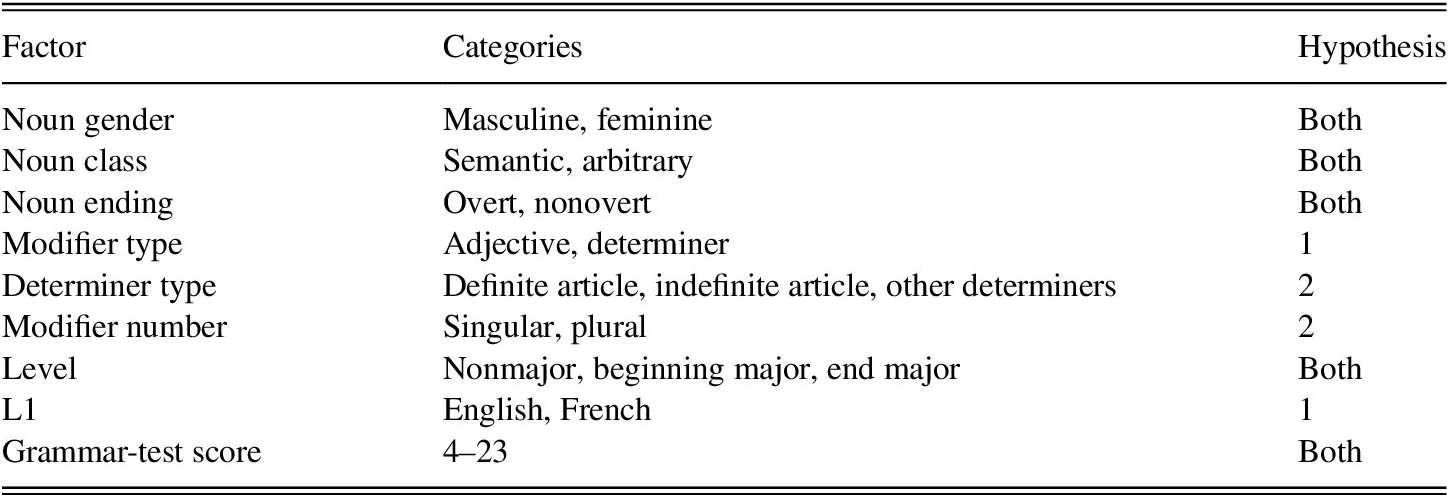
Given the fact that L1 influence can be constrained by additional-language proficiency (e.g., Cenoz, Reference Cenoz, Cenoz, Hufeisen and Jessner2001; Jarvis & Pavlenko, Reference Jarvis and Pavlenko2008), we examined the interaction between L1 and level in the regression model. We also explored interactions between L1 and significant linguistic factors to learn whether the L1 groups differed in their constraints on gender marking. Table 1 lists all of the fixed effects and their categories. An example of the data and coding is available in (5); the noun and modifier that are coded are in bold.
Fixed effects

-
(5) El matrimonio es un asunto complejo en los Estados Unidos “Marriage is a complicatedMASC issueMASC in the United States” (Participant B404)
Targetlikeness of gender marking: Targetlike
Noun gender: Masculine
Noun class: Arbitrary
Noun ending: Overt
Modifier type: Adjective
Level: End major
L1: English
Grammar-test score: 18
Hypothesis 2
For the second hypothesis, the analysis centered on targetlikeness of gender marking as the dependent variable, like the analyses for the first hypothesis. However, in this case, we analyzed the L1 French participants and determiner-noun pairs only. Once again, only determiners that were overtly marked for gender were considered (k = 1,722). This analysis enabled us to assess the fourth kind of evidence—intralingual contrasts—in our examination of L1 influence on grammatical gender marking. We fit a second mixed-effects model on this subset of the data (also using the lme4 package, R Core Team, 2020) to determine whether the L1 French participants were more targetlike in marking gender with singular, compared to plural, determiners. Because French overtly marks gender almost exclusively on singular determiners, a significant effect in this direction would constitute evidence of intralingual contrasts.Footnote 7 Similar to the first mixed-effects model, we applied insights from variationist SLA to model the L1 French participants’ variable use of targetlike gender marking in determiner-noun pairs. This multivariate analysis enabled us to account for other factors that influenced variable use, thus addressing the third component of the unified methodological framework. We examined most of the independent variables that we included in the first mixed-effects model, in addition to two other factors—determiner type and modifier number (Table 1). Determiner type distinguished among three categories of determiners: definite articles, indefinite articles, and other determiners, which included demonstrative (e.g., esta “thisFEM, SING”), indeterminant (e.g., algunas “someFEM, PLURAL”), and possessive (e.g., nuestros, “ourMASC, PLURAL”) determiners. Modifier number identified whether the modifier was singular or plural. To our knowledge, this factor has not been examined previously in studies on gender marking in additional-language Spanish. However, we were motivated to include it in the current study as a means to identify evidence of intralingual contrasts because in French singular determiners, but not plural ones, mark gender. Participant was a random effect in this model. An example of the coding for this analysis is in (6). The determiner-noun pair under examination here is in bold.
-
(6) Los parejas gay … deben tener este derecho “TheMASC gay couplesFEM … should have this right” (Participant FB133)
Targetlikeness of gender marking: Nontargetlike
Noun gender: Feminine
Noun class: Arbitrary
Noun ending: Overt
Determiner type: Definite article
Modifier number: Plural
Level: Beginning major
Grammar-test score: 12
Results
Hypothesis 1
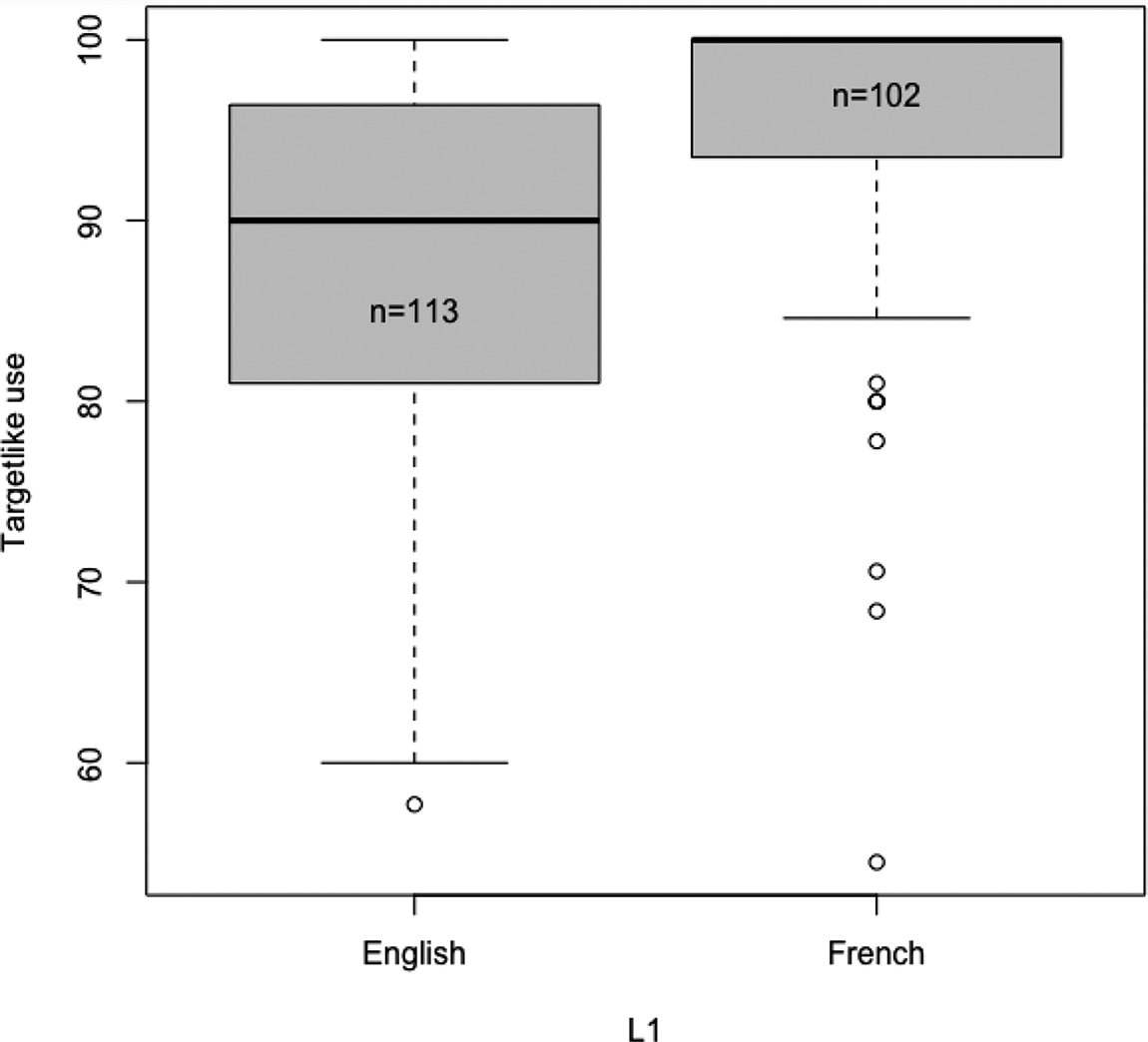
The average rate of targetlike use of gender marking in this dataset was 91.26 percent (SD = 8.87, range = 54.5–100%). For the L1 French participants, the mean rate of targetlike use was 95.06 percent (SD = 7.76, range = 54.5–100%). The average rate of targetlike use for the L1 English participants was lower (M = 87.84, SD = 10.23, range = 57.7–100%). Figure 1 illustrates these results with box plots. These descriptive statistics demonstrate that there is variability within each L1 group. Next, we performed a Wilcoxon rank-sum test to compare the two L1 groups. This test showed that the L1 groups were significantly different from each other in their targetlike use of gender marking (W = 3058, p < 0.0001).
Targetlike rates of use according to L1.

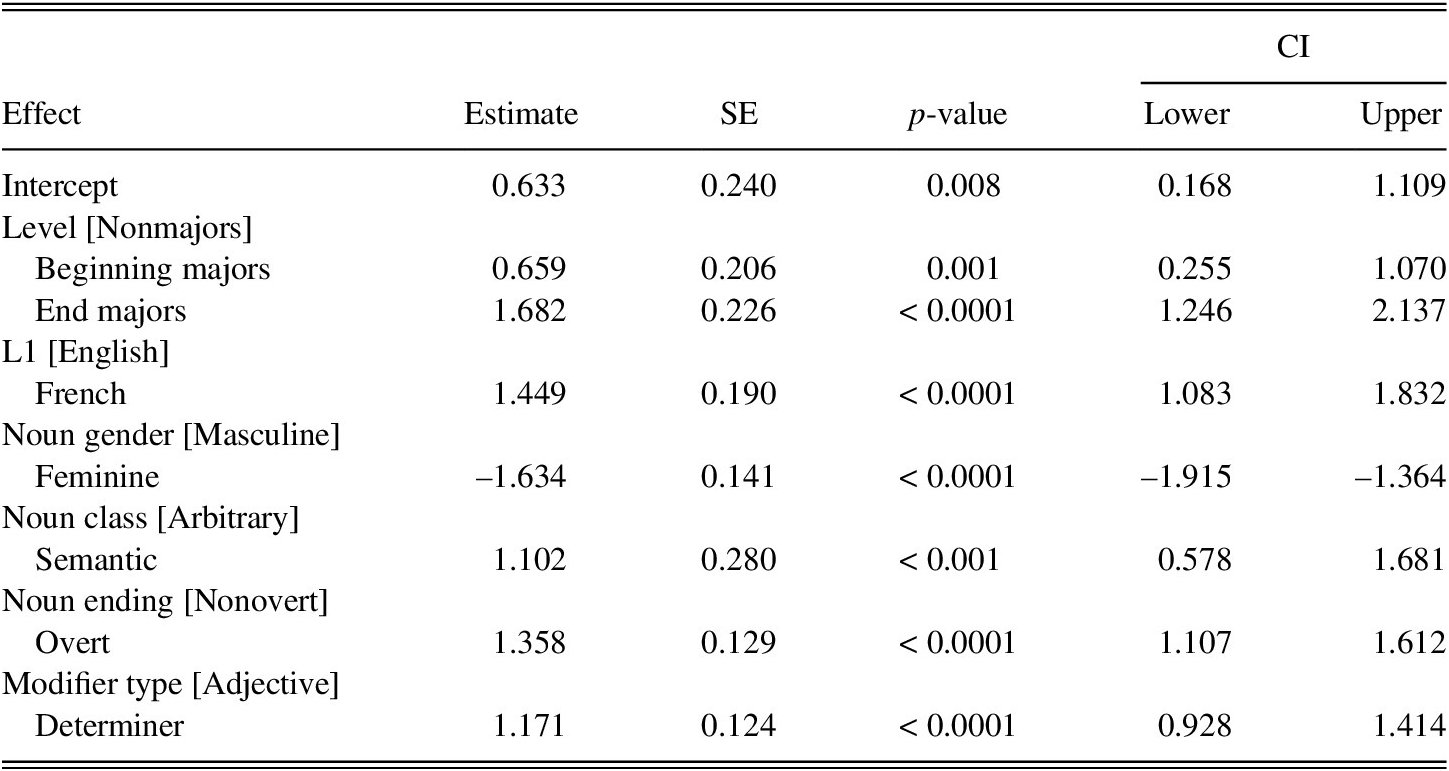
Next, we fit a mixed-effects model. This model (and the one reported in the “Hypothesis 2” subsection) identified the factors that significantly predicted variability in targetlike gender marking. The details of fixed effects included in the regression model are available in Table 2 (see the Supporting Materials for details on the random effect). In the final mixed-effects model, the significant fixed effects were level, L1, noun gender, noun class, noun ending, and modifier type. Level and grammar-test score were highly correlated, which led us to exclude one of these variables.Footnote 8 Because we designed the study to investigate different course levels, we removed grammar-test score. None of the interactions between L1 and other significant fixed effects were retained in the final model because the interactions were strongly correlated with one or both of the concerned fixed effects.
Results for the fixed effects in the regression model for noun-modifier pairs

Note: The model fit the log-odds of targetlike use. The reference points for the independent variables are in brackets.
For the independent variables under consideration (in both mixed-effects models), the model compared a reference-point category to the other category or categories of that variable. For example, the reference point for level was nonmajors, and the model compared this category to the nonreference point categories (i.e., beginning and end majors). A positive estimate in the model indicates that a nonreference point category has a higher likelihood of targetlike use than the reference-point category. A negative estimate means that a nonreference point category has a lower likelihood of targetlike use than the reference point category. Concerning level, both the beginning and end majors were more likely to mark gender in a targetlike way than the nonmajors. There was no overlap in the confidence intervals (CIs) of the beginning and end majors, indicating that these two groups were different from each other and that the end majors were more likely to be targetlike than the beginning majors. The results for L1 indicated that the L1 French participants exhibited a higher likelihood of targetlikeness than L1 English participants. Moreover, the participants were less likely to mark gender in a targetlike way with feminine compared to masculine nouns. They also showed a higher likelihood of targetlike use with semantic noun class, overt endings, and determiners (versus arbitrary noun class, nonovert endings, and adjectives, respectively). The quality of model fit was assessed; we found that the McFadden’s R2 was 0.215 and that the model correctly predicted 92.35 percent of the observations in the dataset, which together indicated a strong model fit (Hemmert et al., Reference Hemmert, Schons, Wieseke and Schimmelpfenning2018).
Hypothesis 2
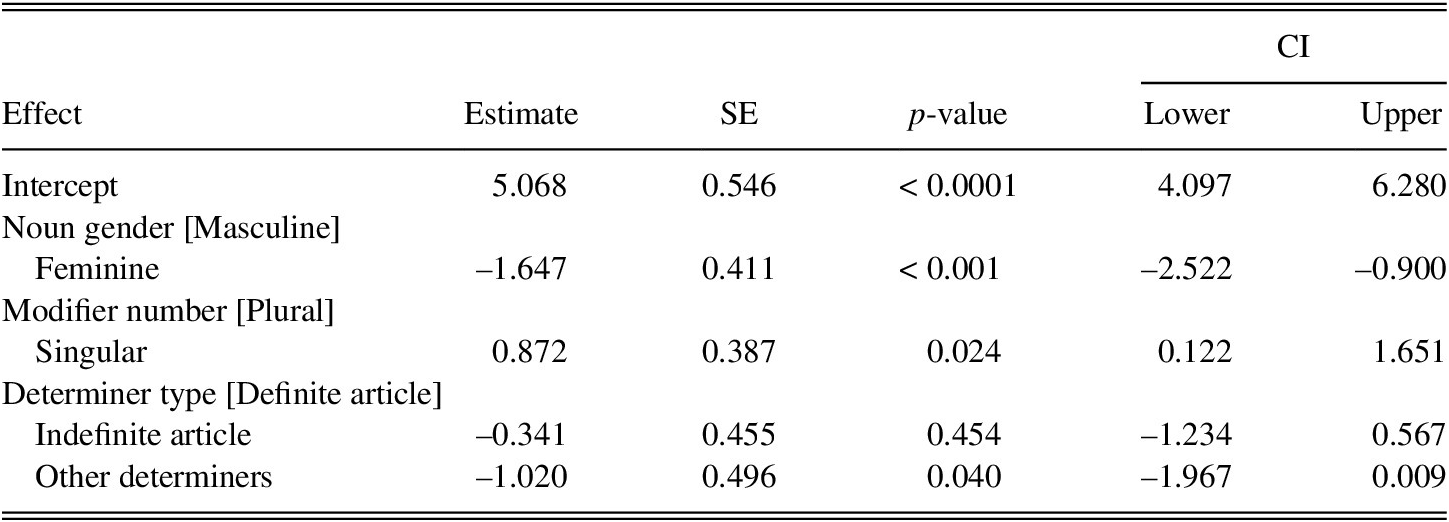
The second mixed-effects model focused on L1 French participants and determiner-noun pairs only (see the Supporting Materials for the details of the random effect). The model presented in Table 3 revealed that noun gender, modifier number, and determiner type impacted L1 French participants’ variable use of targetlike gender marking in determiner-noun pairs. Level, grammar-test score, noun class, and noun ending were not significant. Similar to the previous regression model, the L1 French participants were less likely to mark targetlike gender with feminine nouns, compared to masculine nouns (as indicated by the negative estimate). Furthermore, the positive estimate for modifier number demonstrates that the L1 French participants were more likely to be targetlike with gender marking when the determiner was singular rather than plural. This participant group also exhibited a lower likelihood of targetlike use with other determiners compared to definite articles; the comparison between definite and indefinite articles was not significant. The overlap in the CIs for indefinite articles and other determiners indicates that the L1 French participants’ targetlike gender marking was similar between the two. The McFadden’s R2 (0.111) and the percentage of correctly predicted observations (97.39 %) indicated a strong model fit (Hemmert et al., Reference Hemmert, Schons, Wieseke and Schimmelpfenning2018).
Results for the fixed effects in the regression model for L1 French participants and determiner-noun pairs

Note: The model fit the log-odds of targetlike use. The reference points for the independent variables are in brackets.
Discussion
Gender marking in additional-language Spanish
We now return to the findings concerning L1 influence and the two hypotheses that we investigated. The first hypothesis was that L1 French participants would be more targetlike in marking gender in noun-modifier pairs in additional-language Spanish than L1 English participants because the presence of a grammatical gender system in French, which English lacks (Corbett, Reference Corbett1991), would ease the acquisition challenge. Following Jarvis’s (Reference Jarvis, Roberts, Howard, Laoire and Singleton2010) taxonomy for rigorously identifying the presence of L1 influence, we investigated three types of evidence for this hypothesis: intragroup homogeneity, intergroup heterogeneity, and cross-language congruity. The Wilcoxon rank-sum test revealed a significant difference in targetlike use between the two L1 groups. This test offered evidence of intragroup homogeneity and intergroup heterogeneity in relative terms because it indicated that the differences between the L1 groups were greater than the differences within the groups. The mixed-effects model offered additional evidence of intergroup heterogeneity; it showed that the L1 significantly predicted targetlike gender marking. Moreover, the direction of the effect for the L1 was that the L1 French participants were more likely to be targetlike than the L1 English participants. This result provided evidence of cross-language congruity because it suggested that the grammatical gender system in French facilitated the use of gender marking in Spanish. The second hypothesis centered on L1 French participants and determiner-noun pairs and the final kind of evidence put forth by Jarvis (Reference Jarvis, Roberts, Howard, Laoire and Singleton2010): intralingual contrasts. We hypothesized that the L1 French participants would be more targetlike with singular determiners than plural ones when writing in Spanish. This hypothesis was borne out in a mixed-effects model, in which we found that the L1 French participants showed a higher likelihood of targetlike use with singular determiners compared to plural ones.
To interpret this strong evidence of crosslinguistic influence, we turn to usage-based approaches in SLA more generally. Usage-based research covers a range of approaches and theories, including emergentism, construction grammar, and variationism. They share the belief that language learning occurs through experience with language input and use (Ellis & Collins, Reference Ellis and Collins2009). From a usage-based standpoint, what is crucial about the acquisition of an additional language is that “by the time L2 exposure beings, the minds of L2 learners have already been attuned to linguistic cues, probabilities, and contingencies based on their L1 input” (Jach, Reference Jach2018, p. 274). Furthermore, Ellis and Sagarra (Reference Ellis and Sagarra2011) argue that “prior learning of one cue affects learner attention so that they subsequently attend to that cue more than to others” (p. 607). Applied to the current study, we might expect L1 French speakers to attend to gender cues in additional-language Spanish more than L1 English speakers because grammatical gender is also present in their L1. Moreover, attentional biases associated with gender marking in French, which marks gender on singular but not plural determiners, could lead L1 French participants to be less attuned to gender marking on plural determiners compared to singular ones in additional-language Spanish. Both of these expectations were borne out, aligning with theoretical predictions in usage-based SLA. Although attentional biases may be responsible for the two instances of crosslinguistic influence reported in this study, it remains to be seen to what extent such biases may underlie other examples of transfer.
In addition to testing for the four types of evidence of crosslinguistic influence identified in the unified methodological framework, we took into account other factors that can impact additional-language use and development of gender marking in our variationist analyses of noun-modifier and determiner-modifier pairs (i.e., the third component of the framework). In both mixed-effects models, we examined proficiency (course level and grammar-test score) and a range of linguistic factors. We begin with the results for all noun-modifier pairs. Learners’ higher likelihood to mark gender in a targetlike way with masculine nouns (noun gender), overt endings (noun ending), semantic class (noun class), and determiners (modifier type) and as proficiency (course level) improved aligned with various studies (e.g., Alarcón, Reference Alarcón2010, Reference Alarcón2011; Bruhn de Garavito & White, Reference Bruhn de Garavito, White, Pérez-Leroux and Liceras2002; Fernández-García, Reference Fernández-García1999; Finnemann, Reference Finnemann1992; Gudmestad et al., Reference Gudmestad, Edmonds and Metzger2019; Montrul et al., Reference Montrul, Foote and Perpiñán2008; White et al., Reference White, Valenzuela, Kozlowska-Macgregor and Leung2004). Just as with all noun-modifier pairs, the L1 French participants exhibited a greater likelihood of targetlike use with masculine nouns in determiner-noun pairs. They were also more likely to be targetlike with definite articles than other types of determiners; targetlike use was similar between definite and indefinite articles (cf. Bruhn de Garavito & White, Reference Bruhn de Garavito, White, Pérez-Leroux and Liceras2002; Gudmestad, Reference Gudmestad, Edmonds, Leclercq and Gudmestad2020). Thus, more generally, we see that several factors simultaneously constrained variability in targetlike use (Gudmestad et al., Reference Gudmestad, Edmonds and Metzger2019) and that these findings support prior investigations. Notably, the inclusion of other factors that had been shown to influence variability in gender marking in previous research has strengthened the argument for the presence of crosslinguistic influence in this dataset, as we have demonstrated that learners’ L1 was important even when other factors were accounted for (cf. Jarvis, Reference Jarvis, Yu and Odlin2016).
Thus, the current study adopted the unified methodological framework and employed variationist tools to thoroughly explore the role that the L1 plays in the variable use of gender marking in additional-language Spanish. Our quantitative analyses provided findings that supported the presence of each kind of evidence, demonstrating the effect of L1 influence. In general, we furthered the understanding of crosslinguistic influence by seeking “empirical discoveries that expand our pool of knowledge regarding the nature of this phenomenon, its subsystems, [and] its domains of influence” (Jarvis, Reference Jarvis, Yu and Odlin2016, p. 20, emphasis in original). More specifically, because conclusions in previous research regarding the role of L1 influence on gender marking in Spanish have been inconsistent (Franceschina, Reference Franceschina, Foster-Cohen and Nizegorodcew2001, Reference Franceschina, Foster-Cohen, Ruthenberg and Poschen2002; White et al., Reference White, Valenzuela, Kozlowska-Macgregor and Leung2004), we hope to have contributed to this debate in four important ways. One is that we offer additional evidence to support the observation that the L1 can impact the additional-language use of gender marking in Spanish. The second is that, to our knowledge, the present investigation is the first on additional-language Spanish to consider all four types of evidence in a single study. This was made possible by exploring the role of the L1 in two different and complementary analyses. Third, we accounted for other factors that are connected to gender marking, which enabled us to have more confidence that the L1 effects we observed could not be attributed to other factors. Fourth, by applying conceptual insights from variationist SLA, we have not only shown that the L1 impacts variability in targetlike gender marking but also that crosslinguistic influence is a dynamic phenomenon that works in concert with other factors to condition variable use. By adopting the unified methodological framework and incorporating insights from variationist SLA, the conclusions that L1 influence is important for gender marking and works alongside other constraining factors appear to be strong.
Research on L1 influence
Next, we reflect on the unified methodological framework for research on crosslinguistic influence (Jarvis, Reference Jarvis2000, Reference Jarvis, Roberts, Howard, Laoire and Singleton2010; Jarvis & Pavlenko, Reference Jarvis and Pavlenko2008), and we discuss the ways in which we believe the current study has contributed to this framework. We consider each of the framework’s three components in turn.
The first component of the framework is a theory-neutral definition of L1 influence. In a field as diverse as SLA, this detachment from specific theories is invaluable, as it means that researchers working in different approaches can adopt the framework. To our knowledge, the present investigation is the first to explicitly extend insights from variationist SLA to a study adopting the unified methodological framework. We used variationism to investigate three of the evidence types (intergroup heterogeneity, cross-language congruity, and intralingual contrasts), consequently demonstrating that variationist SLA is compatible with (at least parts of) the unified methodological framework. We elaborate on this specific issue when we discuss the second and third elements of the framework. More generally, though, we believe that a framework that has the ability to cross subdisciplinary boundaries can facilitate discussions and knowledge building among researchers in diverse corners of the field. Mitchell et al. (Reference Mitchel, Myles and Marsden2019) noted that “despite appeals for transdisciplinary integration, for the immediate future it seems that L2 learning will mostly be treated as a modular phenomenon, with different research programmes retaining their autonomy and individual impetus, and addressing different aspects” (p. 402). Ultimately, a theory-independent methodological framework, together with SLA’s widespread interest in crosslinguistic influence (Jarvis & Pavenklo, Reference Jarvis and Pavlenko2008), may be an open door to increased transdisciplinarity in the field.
The second part of the unified methodological framework consists of four kinds of evidence. The value of considering multiple sources of evidence is clear: It helps researchers to rule out other explanations for the observed linguistic behavior and to reach strong conclusions about the presence (or absence) of L1 influence (Jarvis, Reference Jarvis, Roberts, Howard, Laoire and Singleton2010, Reference Jarvis, Yu and Odlin2016). Whereas Jarvis recognized that it may not be possible or essential to include all four types of evidence in a single investigation, we have shown with the current study that it can be feasible to investigate each type quantitatively in one investigation. Moreover, because our analyses offered evidence of intragroup homogeneity, intergroup heterogeneity, cross-language congruity, and intralingual contrasts, we argue that we have been able to make stronger claims about the role of L1 influence in our dataset than had we only compared targetlike rates of use between L1 English and L1 French participants, as has been the case in previous scholarship on the role of L1 in gender marking in additional-language Spanish (Franceschina, Reference Franceschina, Foster-Cohen and Nizegorodcew2001, Reference Franceschina, Foster-Cohen, Ruthenberg and Poschen2002; White et al., Reference White, Valenzuela, Kozlowska-Macgregor and Leung2004). Lastly, we previously noted that researchers have advocated for variationist investigations of crosslinguistic influence (e.g., Bayley, Reference Bayley2005; Ortin & Fernandez-Florez, Reference Ortin and Fernandez-Florez2019; Picoral & Carvalho, Reference Picoral and Carvalho2020). This work did not adopt the unified methodological framework but it did demonstrate that variationist analyses were valuable for testing for intergroup heterogeneity and cross-language congruity. We followed suit in the present investigation by applying insights from variationist SLA to examine these two types of evidence. We also extended the application of this approach to another type of evidence, intralingual contrasts, and we showed that variationist tools can be valuable for making within-language comparisons. In short, bringing together the unified methodological framework and variationist SLA has the added benefit of expanding the horizon of variationist research so that it can more rigorously explore the role of L1 influence.
The final component of the framework is a set of factors that need to be controlled for in an investigation of crosslinguistic influence. While we accounted for some of the factors identified by Jarvis (Reference Jarvis2000) in the selection of the participants and the task we employed, we highlight here a related issue. In Gujord’s (Reference Gujord, Tracy-Ventura and Paquot2021) discussion of the factors put forth by Jarvis, she argued that the key is not necessarily to consider all of the factors identified by Jarvis in one study, but rather to conduct “multifactorial studies that allow for analysis of the influence of various independent variables” (p. 352). Likewise, the understanding that additional-language use and development is multidimensional is at the heart of variationist SLA (Gudmestad et al., Reference Gudmestad, Edmonds and Metzger2019). We were therefore able to consider Gujord’s methodological reflection by conducting a variationist analysis of variable gender marking. We examined a series of linguistic factors and individual characteristics as independent variables in each of the two multivariate analyses (i.e., mixed-effects models). Conceptually, these multifactorial analyses showed that the L1 impacted variability in targetlike use in concert with various factors. Furthermore, the variationist analysis that we conducted on noun-modifier pairs in particular enabled us to consider another important issue in crosslinguistic influence research. McManus (Reference McManus2021) states that “investigating the ways in which L1 knowledge and experience influences the routes and rates of L2 learning” has been central to SLA (p. 15). Regarding the rate of acquisition, the result that the L1 French learners were more likely to be targetlike than the L1 English learners suggested that the presence of grammatical gender in the L1 helped to speed the acquisitional process. As for the route of acquisition, we examined whether interactions between L1 and the other significant effects in the mixed-effects model significantly impacted targetlikeness of gender marking in noun-modifier pairs. These interactions were strongly correlated with L1, so we removed them from the model. The fact that these interactions were not in the final model has led to two observations. One observation concerns the interaction between L1 and course level; the lack of interaction between these factors suggests that L1 influence was stable across the proficiency levels that we investigated. Although crosslinguistic influence has been shown to be mediated by proficiency (e.g., Cenoz, Reference Cenoz, Cenoz, Hufeisen and Jessner2001; Jarvis & Pavlenko, Reference Jarvis and Pavlenko2008), we did not find evidence of this in our data. The second observation is that the two L1 groups did not exhibit differences in their variable use of gender marking that were conditioned by linguistic context (i.e., noun gender, noun class, noun ending, and modifier type). Had a significant interaction between L1 and any of the other significant factors been retained in the final model, this would have indicated that the route of acquisition varied according to L1. Finally, just as Jarvis (Reference Jarvis2000) noted, had we not accounted for linguistic factors shown to be connected to gender marking in previous research (e.g., Alarcón, Reference Alarcón and Geeslin2014), the effect of these factors could have been masked as L1 influence. In other words, because we considered independent linguistic variables along with the L1 factor, we were able to be more confident that the L1 differences we observed were indeed due to crosslinguistic influence and not to other factors.
Conclusion
To our knowledge, the present investigation is the first to apply the unified methodological framework developed by Jarvis (Reference Jarvis2000, Reference Jarvis, Roberts, Howard, Laoire and Singleton2010) to a single study of gender marking in additional-language Spanish and the first to extend this framework to variationist SLA. In our analysis of L1 English and L1 French participants who completed an argumentative essay in Spanish, we adopted Jarvis’s (Reference Jarvis2000) theory-neutral definition of L1 influence, accounted for other factors that have been shown to impact additional-language use and development by employing variationist analyses, and found evidence of intragroup homogeneity, intergroup heterogeneity, cross-language congruity, and intralingual contrasts. We hope the current study has brought renewed rigor to research on L1 influence and gender marking by adopting the unified methodological framework and offering strong support for the conclusion that, at least in the current dataset, L1 influence plays a role in the additional-language use of gender marking in Spanish. Data from participants with L1s other than those investigated here and from other types of tasks are needed to confirm the generalizability of these findings. Regarding the former, in the current investigation, the two languages that mark grammatical gender are both Romance languages. Thus, not only do both French and Spanish show gender marking (and in this respect are like many other languages, such as German, Norwegian, or Russian), but there are also many similarities between the two gender systems, given their historical proximity. It thus may be worth designing a single investigation on gender marking in Spanish that includes three L1 groups: one with a more congruent gender system (e.g., French), one with a less congruent gender system (e.g., German), and one without a gender system (e.g., English). Such a study would allow us to determine whether the similarity in gender systems plays a role in crosslinguistic influence (see Ragnhildstveit, Reference Ragnhildstveit, Golden, Jarvis and Tenfjord2017, for a discussion of the complexities in determining what constitutes a congruent gender system). We also showed that variationist SLA can make a valuable contribution to scholarship on crosslinguistic influence because it offers researchers conceptual and methodological tools for investigating different types of evidence and for considering multiple constraints simultaneously. Future scholarship on L1 influence and other linguistic phenomena may also benefit from this approach.
Supplementary Materials
To view supplementary material for this article, please visit http://doi.org/10.1017/S0272263121000796.