Introduction
The prevalence of type 2 diabetes is predicted to increase in India to ∼7% of the population (79 million) by 2030.1 The increasing prevalence of childhood overweight and obesityReference Lobstein, Baur and Uauy2–Reference Aziz, Noorulain, Zaidi, Hossain and Siddiqui4 is thought to be a contributing factor to this public health problem, as is a reduction in the amount of physical activity children engage in.1, 5–Reference Puyau, Adolph, Vohra and Butte7 There is evidence that decreased activity is partly a result of urbanization and the emergence of an obesogenic environment1 as well as factors operating at the level of the individual.
Animal studies have shown that foetal programming may affect activity levels in later life. Rats born small due to maternal protein restriction were less active than control pups born to adequately nourished mothers.Reference Vickers, Breier, McCarthy and Gluckman8 A recent review concluded that nutritional challenges in utero lead to reduced activity in the offspring as well as hyperphagia and these factors may contribute to increased risk of obesity.Reference Taylor and Poston9 In humans there is evidence that birth weight is positively associated with various aspects of physical performance including muscle strengthReference Inskip, Godfrey and Martin10 and fitnessReference Boreham, Murray, Dedman, Davey Smith, Savage and Strain11 in later life. Indian babies are relatively less muscular, as measured by mid-upper arm circumference (MUAC), and have greater skinfold thickness relative to size at birth than babies born in the United Kingdom.Reference Yajnik, Fall and Coyaji12, Reference Krishnaveni, Hill and Veena13
The objective of the present study was to investigate the association between size and body composition at birth and physical activity measured by accelerometry in a cohort of Indian school children.
Method
Participants
Children were recruited from the Mysore Parthenon study, a birth cohort set up to investigate the long-term cardiovascular risk outcomes associated with maternal gestational diabetes and body composition of the infant at birth. Pregnant women living in the city of Mysore and surrounding rural areas were recruited to the study if they fulfilled the following criteria: non-diabetic before pregnancy; <32-week gestation at time of recruitment; planning to deliver at Holdsworth Memorial Hospital (HMH). Babies were included in the study if they were singletons and had no major congenital anomalies. Full details of the cohort have been published previously.Reference Krishnaveni, Hill and Veena13 In brief, 663 women receiving care at the antenatal clinic of HMH, Mysore, South India gave birth to live singleton babies without major congenital anomalies. Detailed anthropometry of the offspring was obtained within 72 h of birth and children were followed up every 6 months thereafter. At the time of activity monitoring (between the ages of 6 and 10 years) 580 children were being followed up. Of these 449 children agreed to wear an accelerometer.
Measures
Neonatal size and body composition
The following measurements were taken in triplicate by one of four trained measurers on hospital premises: weight; crown–heel length; crown–buttock length; mid upper arm, chest, abdomen and head circumferences; triceps and subscapular skinfolds. Leg length was calculated by subtracting crown–buttock length from crown–heel length. Weight was measured to the nearest 5 g using digital weighing scales (Seca, Germany). Lengths were measured to the nearest 0.1 cm, using a Harpenden neonatal stadiometer (CMS Instruments Ltd, UK) and skinfolds to the nearest 0.1 mm using Harpenden callipers (CMS Instruments Ltd, UK).
Child size and body composition
The following measurements were made within 6 months of physical activity monitoring: weight to the nearest 0.1 kg (Salter digital scales, UK); height to the nearest 0.1 cm (Microtoise, CMS Instruments, UK); triceps and subscapular skinfolds to the nearest 0.1 mm (Harpenden callipers, CMS Instruments, UK). Bio-impedance analysis was carried out using Bodystat Quadscan 4000 and 1500MDD machines (Bodystat, UK). Any metal jewellery was removed and children were asked to lie supine for 5 min before the measurements. After cleaning with surgical spirit, one electrode was attached at the level of the ulnar head at the wrist and the other just behind the knuckles. On the foot, the two electrodes were attached at the level of the medial and lateral malleoli and behind the toes respectively.
Physical activity at 6–10 years
Accelerometers measure accelerations in a vertical plane and yield data as counts. Counts are used as a proxy for the volume of activity the wearer engages in. The volume of activity is the product of intensity and duration of activity. Accelerometers are best able to measure the volume of activities that involve movement of the body in the vertical plane such as walking or running. They are less effective with weight-bearing activities or those with little vertical movement at the hip such as cycling, they are also not able to distinguish between movements on the flat v. those on a gradient.Reference Hendelman, Miller, Baggett, Debold and Freedson14
All children in the cohort were asked to wear the AM7164 or GT1M Actigraph accelerometer (MTI Health Services, Florida, USA) for 7 days, 449 agreed [of these 38 (9%) children wore the GT1M]. The accelerometers weighed ∼38 g and were worn at the right hip attached to an elastic belt, they were not waterproof so had to be removed during bathing and water-based activities. The child put the accelerometer on after getting up in the morning and removed it at night before going to bed. Following the measurement period, the accelerometers were returned and the data downloaded and processed using Mahuffe software (MRC Epidemiology Unit, Cambridge, UK). A correction factor was used to ensure that data from the two types of accelerometer were comparableReference Corder, Brage, Ramachandran, Snehalatha, Wareham and Ekelund15 in terms of total counts and counts per minute (cpm). The mean (s.d.) age at the time of physical activity monitoring was 7.8 (1.1) years.
Demographic data
An interviewer-administered questionnaire was used to collect information about religion, socio-economic status16 and child's access to open space. The respondent was a parent or close relative.
Ethical permission for the study was obtained from the HMH Ethics Committee, Mysore. Parents of the children gave informed consent and children gave assent to take part in the study.
Data analysis
Neonatal anthropometry
All measures were adjusted for gestational age at birth using linear regression (to 40 weeks) and these values were used for further analyses. All birth measures were normally distributed except triceps and subscapular skinfolds, which were log-transformed.
Arm muscle area (AMA) at birth and within 6 months of physical activity monitoring was calculated using the following formula: AMA = (MUAC−π × TSF2)/(4π), where AMA is the arm muscle area (cm2), MUAC the mid-upper arm circumference (cm), TSF the triceps skinfold (cm).Reference Jelliffe and Jelliffe17
Childhood bio-impedance
Fat percentage values from impedance measurements at 50 kHz were generated using the manufacturer's equation, which included terms for sex, age, height and weight. In a validation study using 18O dilution carried out when the children were aged 9 years (n = 58), we found that the bio-impedance equations accurately predicted mean fat % at the group level but performed less accurately at the level of the individual (data not shown).
Physical activity
The accelerometers were programmed to collect data in 1 min epochs. It was assumed that the monitors had been taken off if zero counts were recorded for a period of more than 20 min; therefore, registered time was defined as all time during which counts were recorded with gaps of no more than 20 min of consecutive zero cpm. The first and final days of actigraph wearing were not included in the data analysis. Days with less than 500 min of registered time were considered to be unrepresentative of the children's activity pattern, these days were defined as not valid and were excluded from further analyses. Participants with less than 4 valid days of recorded accelerometer counts (n = 34) were excluded. This left 415 children with complete data for the final analysis. The activity variables were in the form of total counts/day; mean cpm; proportion of time spent at different levels of intensity of activity (sedentary, light, moderate and vigorous).
We multiplied counts/day and cpm derived from the AM7164 device by 0.91 to allow these variables to be comparable with data from the GT1M device.Reference Corder, Brage, Ramachandran, Snehalatha, Wareham and Ekelund15 No correction factor was available for the variables relating to time spent at different intensities of activity. There are several published cut offs for children available for classifying intensity of activity. We present results based on cut offs developed by Evenson et al.Reference Evenson, Catellier, Gill, Ondrak and McMurray18 <100 cpm for ‘sedentary behaviour’; 100–2291 cpm for ‘light activity’; 2292–4008 cpm for ‘moderate activity’; >4008 cpm for ‘vigorous activity’ (V), which have been shown to classify activity more precisely in children than other published cut offs.Reference Trost, Loprinzi, Moore and Pfeiffer19
We used linear regression models to look for the effects of the predictor variables including age, sex, birth size and current size on total counts, cpm and proportion of time spent in moderate and vigorous activity. When looking at birth size and current size as predictors of activity we adjusted for age and sex. SPSS version 15.0 was used for all analyses. A post hoc power calculation was performed to determine the effect size in mean cpm that could be detected given the sample size with 80% power at the 5% level of statistical significance.
Results
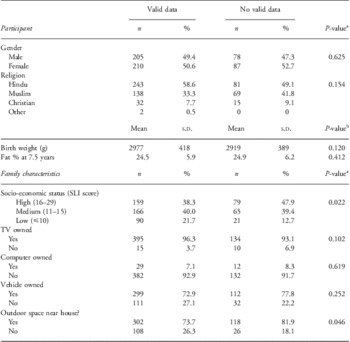
Table 1 shows child and family characteristics. Most children were Hindu or Muslim. The majority of families owned a TV, a vehicle (scooter, motorbike or car) and had space for outside play, few families owned computers. Within the study cohort, there were no statistically significant differences between the children who did and did not participate in the physical activity monitoring in terms of gender, religion, birth weight, body composition at 7.5 years or TV, computer or vehicle ownership (Table 1). Non-participants were significantly more likely to be of higher socio-economic status than participants and were more likely to have a space to play outside.
Participant and family characteristicsFootnote *

SLI, Standard of Living Index.
a P-values are based on chi square statistics.
b P-values are based on t-tests.
* Children with valid data had at least 4 days with >500-min registered activity. Those with non-valid data had less data (n = 34) or did not participate (n = 131).
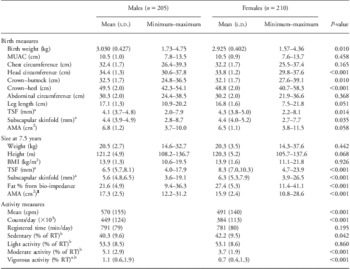
Gestation adjusted birth measures data are shown in Table 2, mean birth weight was ∼3 kg and neonates in the study were on average 0.93 (s.d. 1.03) z scores lighter than the World Health Organization (WHO) reference population. Body mass index (BMI) at birth was −1.09 (s.d. 1.13) z scores lower than the WHO reference.20 There were 34 (8%) babies born small for gestational age (based on a birth weight of <2.5 kg when adjusted to 40-week gestation), 29 (7%) babies were born preterm (<37 weeks). At 7.5 years, the BMI of both boys and girls was 1 s.d. below the WHO reference population.
Gestation-adjusted birth measures (to 40 weeks); activity data measured using accelerometers worn for 1 week between 6 and 10 years; and body composition measurements at 7.5 years

MUAC, mid-upper arm circumference; TSF, triceps skinfold; AMA, arm muscle area; BMI, body mass index; RT, registered time.
aValues are median (inter-quartile range).
bIntensity cut offs are based on Evenson cut offs.Reference Trost, Loprinzi, Moore and Pfeiffer19
‡Measured at 8 years.
Accelerometers were worn for a mean (s.d.) of 7.0 (1.1) days and for a mean (s.d.) of 786 (79) min/day. The activity data in Table 2 show that boys spent more time vigorously and moderately active than girls. Children whose parents owned motor vehicles spent less time moderately active than those whose parents did not (data not shown).
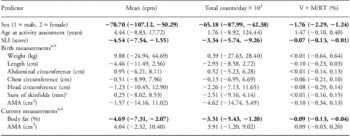
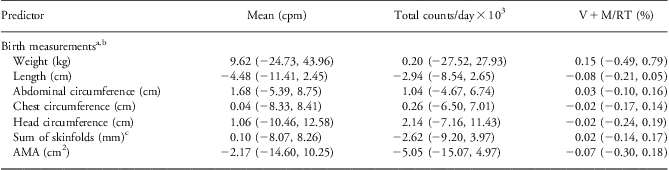
In univariate models, sex was a significant predictor of all activity variables with boys being more active than girls, whereas age was not found to be associated with any of the activity outcomes (Tables 3). Socio-economic status was negatively associated with activity variables. None of the activity variables were predicted by body size or composition at birth when adjusted for age, sex and socio-economic status (Table 4) nor when adjusted for size and body composition within 6 months of activity monitoring (data not shown). Body fat percentage within 6 months of physical activity monitoring was negatively associated with all of the activity variables (Table 3). We performed separate analyses with small for gestational age and preterm children. There was a trend for small for gestational age children to be less active but the differences in activity outcomes were not statistically significant (data not shown).
Regression coefficients with confidence intervals showing association between activity, birth weight and size measurements and current body composition.

RT, registered time; SLI, Standard of Living Index; AMA, arm muscle area.
V, time spent vigorously active; M, time spent moderately active; RT, RT during which actigraph was worn; cpm, accelerometer counts per minute.
Figures in parentheses are confidence intervals. The results in bold were statistically significant at the P = 0.05 level.
aGender and age at accelerometer wearing were included in the model.
bGestation-adjusted birthweight.
cSum of triceps and subscapular skinfolds.
dMeasurements made within 6 months of time of physical activity monitoring.
Regression coefficients with confidence intervals showing association between activity and birth measurements.
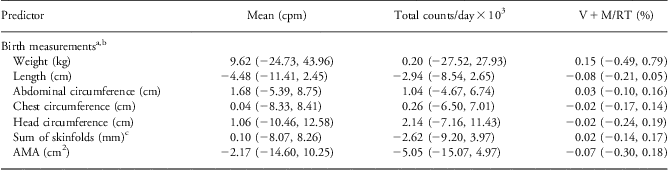
RT, registered time; AMA, arm muscle area.
V, time spent vigorously active; M, time spent moderately active; RT, RT during which actigraph was worn; cpm, accelerometer counts per minute.
aGender, age at accelerometer wearing, socio-economic status and body fat % at time of accelerometer wearing were included in the model.
bGestation-adjusted birthweight.
cSum of triceps and subscapular skinfolds. Figures in parentheses are confidence intervals.
A post hoc power calculation identified the mean cpm/kg of birth weight that could be detected with 80% power given the sample size of 415 children as 49.7 cpm/kg. This corresponds to approximately one-third of an s.d. unit.
Discussion
We collected accelerometer data from Indian schoolchildren and found no associations between activity and birth measurements. Current body fat percentage was negatively associated with volume of activity.
Our results support those of a large cohort study in Bristol, UK, which found that birth weight, ponderal index, head circumference and crown–heel length were not significantly associated with accelerometer counts at 11–12 years when their regression model was adjusted for age, sex, social class and maternal education.Reference Mattocks, Ness and Deere21 A meta-analysis of data from three European studies and one Brazilian study comprising 4170 children aged 9–15 years found that there was no association between birth weight and objectively measured physical activity or sedentary time.Reference Ridgway, Brage and Sharp22 Our study additionally shows that body composition at birth as measured by skinfolds does not predict childhood physical activity. A large prospective cohort study in urban Brazil found the prevalence of self-reported sedentary lifestyle, defined as less than 30 min activity/week, at 10–12 years was 58%.Reference Hallal, Wells, Reichert, Anselmi and Victora23 The authors found no associations between birth weight and any reported activity variables. They did find an inverse association between activity and both family income and maternal education level and concluded that social and behavioural factors were more important than early development in determining later activity.
A study in CanadaReference Rogers, Fay, Whitfield, Tomlinson and Grunau24 compared teenagers with extremely low birth weights (⩽800 g) with controls of normal birth weight (range 3068–4196 g) and found that at 17 years, 87% of controls reported participating in ‘some activity’ compared with 47% of the low birth weight group. The low birth weight group also displayed poorer motor performance including reduced aerobic capacity, strength, endurance and flexibility. We performed sub-analyses in small for gestational age and preterm children but found no differences in the results (data not shown). Such an effect may only be seen at extremes of birth weight and it is possible that a difference was seen because the participants in the Canadian study were considerably older than the children from Mysore. Data from Finland demonstrated that in males of normal birth weight [mean (s.d.): 3445 (458) g], ponderal index and birth weight were positively associated with self-reported intensity and frequency of activity at age 65–75 years.Reference Eriksson, Yliharsila, Forsen, Osmond and Barker25 It was postulated that this was due to ‘survival of the fittest’ as a result of the protective effects of exercise from glucose intolerance. A meta-analysis of data from 13 Nordic cohorts (n = 43,482) found no association between birth weight and reported activity within the normal range of birth weight but did find a U-shaped association between the odds of reporting oneself as active during leisure time and birth weight with those at either extreme of birth weight (<2.75 and >4.25 kg) reporting less activity.Reference Andersen, Angquist and Gamborg26 Although several children in the present study had a birth weight below 2.75 kg only three had a birth weight above 4.25 kg so it is unlikely that any such association in the Indian population would be apparent in our data.
Sub-optimal development of muscle tissue in utero is thought to lead to poor muscle strength in later life, also birth weight has been shown to correlate with muscle mass at birth.Reference Barker27 It is possible that in the Canadian children, the lower muscle mass at birth has led to a lack of development of muscle during childhood and adolescence later manifested as reduced activity and physical performance. However, the lack of a clear association between AMA and activity in the present study does not support this finding.
In relation to current body composition, previous studies have supported our results showing a negative association between activity and body fat percentage.Reference Butte, Puyau, Adolph, Vohra and Zakeri28, Reference Stevens, Murray and Baggett29 It is unsurprising that the association exists but it is unclear whether the association is causal (in either direction) or whether it is mediated by diet or other factors. It should be pointed out that while the results in relation to body fat percentage are as expected, the equations used to calculate body fat percentage from bio-impedance measurements were developed in a Western population and have not been successfully validated in Indian children.
There was little between-child variation in activity level and most children, especially the girls, were inactive compared with European children.Reference Ekelund, Sjostrom and Yngve30, Reference van Sluijs, Skidmore and Mwanza31 South Asian children and adults living in the United Kingdom were found to be less active than those of other ethnicities in 12 separate studies.Reference Fischbacher, Hunt and Alexander32 The children in the present study are mainly urban dwelling, tend not to contribute to tasks around the house and are often encouraged to spend their time outside school in extra tuition classes rather than playing or participating in sport. Children in rural areas of India spend less time on sedentary activities, and have less access to transportation. Data from the World Health Survey show that the prevalence of inactivity for males and females in India was relatively low at 9% and 15%, respectively.Reference Guthold, Ono, Strong, Chatterji and Morabia33 This was based on a sample in which only 10.6% lived in urban areas, there is no similar country level data on the urban population. Collecting such data, along with more information about determinants of activity from children in urban parts of South Asia is likely to be an important step in addressing the growing prevalence of type 2 diabetes.
Low birth weight is associated with chronic disease risk factors in Indian children;Reference Bavdekar, Yajnik and Fall34 however, there appears to be no association between birth measurements and physical activity. It is likely that the effects of foetal programming in this respect are less important than other factors such as time constraints, demographics and the built environment.
One limitation of our study is that the correction factor used to compare counts between the two models of accelerometer was developed in children with a mean (s.d.) age of 15.8 (0.6) years and may not be applicable to younger children due to differences in behaviour pattern. Furthermore it is desirable to use a shorter epoch length than 1 min when measuring activity in young children as their activity bouts tend to be more rapid than older children and adults, this is a limitation of the AM7164 due to data storage capacity. Second, the activity data were collected over a 4-year period due to constraints on accelerometer availability. We recognize that behaviour is likely to change over this period, however, in the context of this study age was not shown to be a predictor of any of the activity variables. Third, the children from the cohort who did not take part in the study had a higher socio-economic status and more access to outdoor space. Overall the cohort were relatively homogenous in terms of standard of living, which is largely due to the fact that all mothers delivered at the same hospital (in India there is large variability in ability to pay for health care). Nevertheless the results indicate that fewer children of higher socio-economic status participated in the study and it is possible that the findings are not generalizable to such children. However, socio-economic status was negatively associated with activity so the children who did not participate are likely to have been less active than those that did. In India there is considerable pressure on children to excel academically and anything that may be seen as distracting children from concentrating on studies might be disapproved of disproportionately by parents of higher socio-economic status. The finding that a higher percentage of non-participant families reported having an outdoor space to play was of borderline significance so could be due to chance but it is also possibly a reflection of the difficulty of following up children in more remote areas, which are more likely to be rural and thus have more open space.
Acknowledgements
The authors would like to thank the study participants and their families for their time, the staff at Holdsworth Memorial Hospital, Mysore, the Medical Research Council, Cambridge and the Medical Research Council Epidemiology Resource Centre in Southampton, UK. This study was funded by the Parthenon Trust and the Medical Research Council.