Introduction
The bilingual lexicon maps concepts onto words in both languages, creating a complex structure of conceptual and lexical links within and between the first language (L1) and the second language (L2). Although much research has investigated directionality of connections between bilinguals' two languages (Kroll, Van Hell, Tokowicz & Green, Reference Kroll, van Hell, Tokowicz and Green2010; Basnight-Brown, Reference Basnight-Brown, Heredia and Altarriba2014), less research has compared the internal connectivity of each of the two languages. The current study examines cross-language directionality and within language-connectivity using repetition, translation and semantic priming.
The two languages of proficient bilinguals rely on shared resources and representations (e.g., French & Jacquet, Reference French and Jacquet2004; Kroll & Tokowicz, Reference Kroll, Tokowicz, Kroll and Groot2005). Numerous studies have shown that conceptual representations are likely shared across the two languages (Duňabeitia, Perea & Carreiras, Reference Duňabeitia, Perea and Carreiras2010; Francis, Reference Francis, Kroll and de Groot2005), though in the early stages of L2 acquisition L2 lexical items might have weaker connectivity to this shared semantic information (Jiang, Reference Jiang2000, Reference Jiang2002; Grainger, Midgley & Holcomb Reference Grainger, Midgley, Holcomb, Kail and Hickmann2010). However, what still remains unclear is the degree to which both languages of proficient bilinguals might access conceptual representations in a parallel manner. Specifically, does the interconnectivity of L1 words and meanings mirror that of their L2 translation equivalents, or are there unique aspects of connectivity for each language? Further, a bilingual's languages might differ not only in the pattern of connectivity, but also in the strength of inter-item links. For example, reduced frequency of use for the less dominant L2 in unbalanced bilinguals might lead to weaker links between words in L2 in comparison to links between words in L1 (Gollan, Montoya, Cera & Sandoval, Reference Gollan, Montoya, Cera and Sandoval2008). In empirical terms, these questions can be investigated using priming methods. Specifically, would semantically related primes in L1 and L2 be equally effective at activating a given target word? Based on previous research and the weaker links hypothesis (Gollan et al., Reference Gollan, Montoya, Cera and Sandoval2008), it is possible that due to the lower frequency of L2 use, prime words in L2 might lead to lower activation of related words in L2.
Current models of the bilingual lexico-semantic system approach this issue from different perspectives. According to the Revised Hierarchical Model (RHM, Kroll & Stewart, Reference Kroll and Stewart1994; see also Kroll et al., Reference Kroll, van Hell, Tokowicz and Green2010), L2 words have weaker connections to concepts than do L1 words. In low proficiency bilinguals, conceptual access for L2 words might be mediated through L1 words. In contrast, according to the Bilingual Interactive Activation model (BIA+, Dijkstra & van Heuven, Reference Dijkstra and van Heuven2002), a model of bilingual visual word recognition, word frequency is the primary underlying processing mechanism. Information is passed up the model, with each node and level being activated on the basis of the frequency of its input. Frequency of use directly affects and determines resting-level activation levels such that less frequently used words have lower resting-level activation than more frequently used words (McClelland & Rumelhart, Reference McClelland and Rumelhart1981). Since unbalanced bilinguals use the L2 less frequently, input coming from L2 takes longer to activate the low resting-level activation nodes. Dijkstra and van Heuven (Reference Dijkstra and van Heuven2002) refer to this as the temporal delay hypothesis. Lexical access for L2 would then be slower not because the L2 word accesses meaning through the L1, as suggested in the original RHM (Kroll & Stewart, Reference Kroll and Stewart1994), but rather because the L2 word has a lower resting-level activation (see also Gollan et al., Reference Gollan, Montoya, Cera and Sandoval2008; Gollan, Slattery, Goldenberg, Van Assche, Duyck & Rayner, Reference Gollan, Slattery, Goldenberg, Van Assche, Duyck and Rayner2011).
Frequency has also been shown to affect resting-level activation of target words in classic priming studies with monolinguals. Specifically, lower frequency target words benefited more from priming than higher frequency targets (Becker, Reference Becker1979; Stone & Van Orden, Reference Stone and Van Orden1992). In the current study we explore whether this idea could be extended to the mechanisms of the BIA+ model.
Lexical priming experiments have shown support for both the RHM and the BIA+ models. Gollan, Forster, and Frost (Reference Gollan, Forster and Frost1997) in a study with Hebrew–English bilinguals, found greater translation priming effects from L1 to L2 than in the reverse direction, despite the marked difference in the orthographies of the two languages. The authors state that these results fit well with the RHM, as the L1-L2 direction is conceptually mediated, which allows for full activation of the concept by the L1 prime, thus providing strong priming for the L2 target. The L2-L1 direction, on the other hand, does not produce strong priming because the L2 prime only partially activates conceptual representations of the word.
Basnight-Brown and Altarriba (Reference Basnight-Brown and Altarriba2007) also found greater translation priming in the L1-L2 direction. In addition, they examined cross-language semantic priming, and found priming only in the L1-L2 direction, and even this disappeared under masked conditions. This finding would seem to indicate that L2 words might activate conceptual representation only to a limited degree, which is insufficiently strong to activate semantically related words across languages. These results were largely replicated by Schoonbaert, Duyck, Brysbaert and Hartsuiker (Reference Schoonbaert, Duyck, Brysbaert and Hartsuiker2009) who reported significant translation and semantic priming in both directions in Dutch–English bilinguals; though semantic priming effects were weaker. In both cases, priming was asymmetric (stronger from L1 to L2 than the reverse), leading the authors to conclude that these differences were of a quantitative and not a qualitative nature. As such, the authors suggest that the Distributed Representation Model (DRM) model (van Hell & de Groot, Reference Van Hell and De Groot1998) best explains the results of their study. The DRM accounts for greater facilitation in translation priming than in semantic priming by specifying a spreading activation mechanism together with shared nodes between prime and target. Translation equivalent primes share more conceptual nodes with the target than do semantically related primes, and as a result translation priming is stronger. The difference in directionality is explained by the proposal that L1 activates more conceptual nodes than does L2 due to its greater integration in the conceptual store, as suggested by the RHM.
Finkbeiner, Forster, Nicol and Nakamura (Reference Finkbeiner, Forster, Nicol and Nakamura2004) further explored this issue, and demonstrated that L2 primes produced significant within-language repetition priming for identical L2 targets. This implies that although L2 words may not activate semantic information strongly enough to consistently prime across languages, they nevertheless have strong enough representations to prime within their own language. However, since the study used repetition priming, it could be argued that facilitation was a result of word form priming and did not necessarily involve semantic activation.
Summarizing, the studies of cross-language priming, reviewed above, report stronger priming from L1 to L2 than from L2 to L1. The explanations for this finding have largely focused on the claim that L1 primes are processed more efficiently than L2 primes and can thus contribute more to the processing of a related target. This increased efficiency of L1 primes has been ascribed either to conceptual links, as in the RHM, or to more efficient lexical access mediated by higher resting-level activation, as in the BIA+.
However, lower frequency of use of the L2 could also impact priming results in two ways. When L2 words act as primes, their lower resting-level activation could cause slower lexical access and reduced priming efficiency. At the same time, this lower resting-level activation when L2 words act as targets may result in a higher potential benefit from a preceding prime. The interplay and relative contribution of resting-level activation in primes and targets can be explored by comparing cross-language priming with within-language repetition and semantic priming. Specifically, if processing efficiency of the prime is the driving force as described in previous studies (Gollan et al., Reference Gollan, Forster and Frost1997; Jiang, Reference Jiang1999), we would expect greater within-language priming in L1 than in L2, due to higher accessibility of L1 over L2 primes. Alternatively, if target resting-level activation also contributes to the results of previous studies (Gollan et al., Reference Gollan, Forster and Frost1997; Jiang, Reference Jiang1999; Basnight-Brown & Altarriba, Reference Basnight-Brown and Altarriba2007; Schoonbaert et al., Reference Schoonbaert, Duyck, Brysbaert and Hartsuiker2009), we would expect within-language L2 priming to be equal to or possibly even greater than within-language L1 priming. Importantly, both the prime and the target resting-level activation contribute to the observed asymmetry in cross-language priming – greater L1-L2 priming (strong prime, highly primeable target) than L2-L1 priming (weak prime, less primeable target). The current study directly compares within-language priming in L1 vs. L2 in order to identify the relative contributions of prime and target resting-level activation and address previous findings of asymmetrical cross-language priming.
The current study sought to further investigate the nature of intra-language and inter-language connections in each of a bilingual's two languages. Because studies of concreteness in cross-language priming have produced mixed results (Jin, Reference Jin1990; Finkbeiner et al., Reference Finkbeiner, Forster, Nicol and Nakamura2004; Schoonbaert et al., Reference Schoonbaert, Duyck, Brysbaert and Hartsuiker2009; Barber, Otten, Kousta & Vigliocco, Reference Barber, Otten, Kousta and Vigliocco2013), we included this variable in the current design. Van Hell and de Groot (Reference Van Hell and De Groot1998) found that concrete words produced more similar associations across languages in bilinguals than did abstract words, leading them to propose the Distributed Representation Model (DRM) of conceptual representation, which claims that concrete translation pairs will share more representational nodes than abstract pairs.
Concreteness effects have been reported in additional studies. Jin (Reference Jin1990) reported larger priming effects in both translation and cross-language semantic priming for concrete than for abstract words. The author attributed this to greater mediation across languages due to a ‘shared imagery system’ in concrete word pairs, similar to the argument put forth in the DRM. An additional study of within-language L2-L2 repetition priming and L2-L1 translation priming in Japanese–English bilinguals (Finkbeiner et al., Reference Finkbeiner, Forster, Nicol and Nakamura2004) found a main effect for concreteness, but no difference in priming. In contrast, two recent studies did not find significant concreteness effects, using translation and cross-language semantic priming (Chen, Liang, Cui & Dunlap, Reference Chen, Liang, Cui and Dunlap2014; Schoonbaert et al., Reference Schoonbaert, Duyck, Brysbaert and Hartsuiker2009). In light of these mixed findings, concreteness was included as a factor in our experimental design to further investigate possible effects of this variable on within- and across-language connectivity.
Finally, studies of translation and cross-language semantic priming in bilinguals have used both unmasked (e.g., Basnight-Brown & Altarriba, Reference Basnight-Brown and Altarriba2007; Kiran & Lebel, Reference Kiran and Lebel2007) and, more prominently, masked priming methodologies (e.g., Duňabeitia et al., Reference Duňabeitia, Perea and Carreiras2010; Dimitripoulou, Duňabeitia & Carreiras, Reference Dimitripoulou, Duňabeitia and Carreiras2011; Schoonbaert et al., Reference Schoonbaert, Duyck, Brysbaert and Hartsuiker2009). Because our main goal in the present study was to compare cross-language and within-language priming, we opted to use unmasked priming, to increase the probability of eliciting both types of priming. Specifically, participants in the current study were unbalanced bilinguals immersed in an L1 environment, and some previous masked priming studies have failed to find L2-L1 priming for such bilinguals (Basnight-Brown & Altarriba, Reference Basnight-Brown and Altarriba2007). Indeed, in a recent meta-analysis of masked translation priming, Wen and Van Heuven (Reference Wen and van Heuven2016) show that only 11 out of 23 studies found priming in the L2-L1 direction that was significantly different from zero, although the overall effect size was significant. Further, the unbalanced bilingual participants in the current study spoke Hebrew and English, languages which use different scripts, further reducing the likelihood of achieving significant masked priming effects (e.g., Nakayama, Ida & Lupker, Reference Nakayama, Ida and Lupker2016, though see Gollan et al., Reference Gollan, Forster and Frost1997). A further consideration was our wish to focus on the contribution of target resting-level activation to any observed priming patterns – and thus we wanted to give sufficient processing opportunities to primes in both L1 and L2.
Importantly, we followed the guidelines recommended by Altarriba and Basnight-Brown (Reference Altarriba and Basnight-Brown2007) in their methodological review paper to reduce expectancy strategies. Thus, the SOA was limited to 200 ms, and there was a low proportion of related pairs (0.3), and a 0.5 nonword proportion. Finally, none of the primes or targets was repeated for any of the participants.
The present study
The current study therefore offers a broad examination of within- and cross-language connectivity using two within-language priming experiments (repetition, semantic) and two cross-language priming experiments (translation, semantic). All experiments made use of a single set of items, and were performed on targets in both the L1 and the L2, by unbalanced bilingual speakers of Hebrew (L1) and English (L2).
In consonance with most previous research (Gollan et al., Reference Gollan, Forster and Frost1997; Jiang, Reference Jiang1999; Basnight-Brown & Altarriba, Reference Basnight-Brown and Altarriba2007; Schoonbaert et al., Reference Schoonbaert, Duyck, Brysbaert and Hartsuiker2009; Wen & van Heuven, Reference Wen and van Heuven2016), we expect to find asymmetric priming in the cross-language experiments (translation, semantic). The within-language priming experiments will allow us to probe the relative importance of prime vs. target resting-level activation: If prime resting-level activation has a stronger impact, we would expect greater priming in the L1-L1 within-language conditions, whereas if resting-level activation of the target largely determines priming effects, we would expect greater priming in the L2-L2 within-language conditions. Because a single set of stimuli was used across all four experiments, we describe the procedure of stimulus selection before describing the individual experiments.
Materials selection
The process for compiling the English stimuli is described first, followed by the Hebrew set. An initial set of concrete and abstract words in English was selected using the MRC psycholinguistic database (Coltheart, Reference Coltheart1981). Concrete items were selected from a rating of 451–695 (M = 557, SD 50.1); abstract items were selected with a rating from 210–450 (M = 337, SD 54.8). In a two-tailed t-test, concrete and abstract stimuli differed significantly on concreteness, (p<.001). Next, semantically related pairs for these words were identified using association strength as a measure for semantic relatedness, based on the University of South Florida Free Association Norms (Nelson, McEvoy & Schreiber, Reference Nelson, McEvoy and Schreiber2004). Following Lucas (Reference Lucas2000), average association strengths were kept low (forward strength <0.10) in order to ensure that the connections between words in the pairs were primarily semantic rather than associative.
These words were then used as stimuli for a norming study to generate their Hebrew translations. Unbalanced Hebrew–English bilinguals with the same language profile as participants in the priming experiment were given lists of 334 English words and asked to provide the first Hebrew translation that came to mind for each item. Each English word was translated by at least 10 bilinguals. The resulting Hebrew lists were given to a second set of at least 10 bilinguals who translated the words back into English. In an effort to control for translation ambiguity, which has been shown to interact with concreteness (Tokowicz & Kroll, Reference Tokowicz and Kroll2007; Prior, MacWhinney & Kroll, Reference Prior, MacWhinney and Kroll2007), only translation pairs with high levels of agreement (>70%) in both directions of translation were selected for this study. No cognates or interlingual homophones were used as stimuli, following the recommendations of Altarriba and Basnight-Brown (Reference Altarriba and Basnight-Brown2007). Following this norming procedure, we selected a final set of 72 abstract and 72 concrete target words in English and their translations in Hebrew, as well as a set of semantically related primes for each target word, again in both languages. Unrelated prime-target pairs were created by randomly pairing primes with other targets from the list.
Abstract and concrete primes and targets were matched for frequency in English (>8 Log per million, Balota, Yap, Cortese, Hutchison, Kessler, Loftis, Neely, Nelson, Simpson & Treiman, Reference Balota, Yap, Cortese, Hutchison, Kessler, Loftis, Neely, Nelson, Simpson and Treiman2007). As a further check of relatedness, the critically related pairs were run through Latent Semantic Analysis (Landauer, Foltz & Laham, Reference Landauer, Foltz and Laham1998) to derive a similarity score (ranging from -1 to 1) for each pair. The concrete pairs had an average similarity score of 0.32 and the abstract pairs stimuli an average similarity score of 0.33, and they did not differ significantly (p =.84).
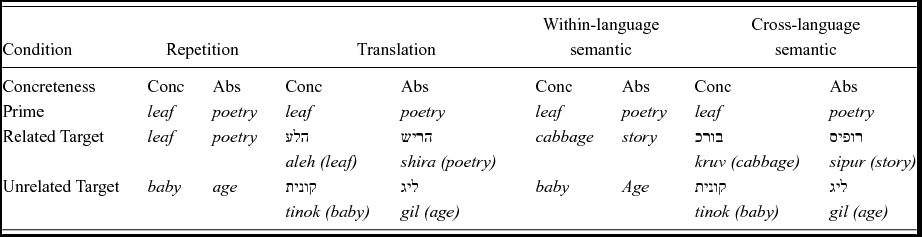
Table 1 presents an example of related and unrelated stimuli with English primes.
Examples of related and unrelated stimuli with English primes.

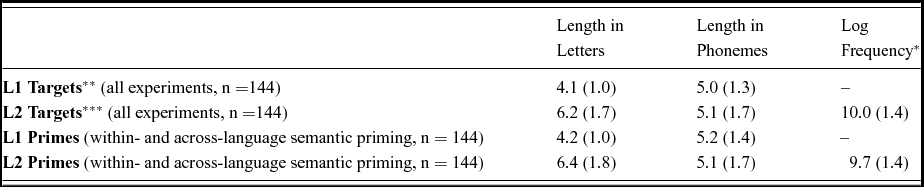
Lexical information such as word frequency, association strengths, and concreteness is generally lacking for Hebrew words. Therefore, we relied on the values generated for the English words. Because Hebrew is written without explicit representation for vowels, word length as measured by number of letters is on average significantly shorter than in English (Frost, Katz & Bentin, Reference Frost, Katz and Bentin1987). To compensate for this difference, we matched the stimuli across languages for number of phonemes as a measure of word length (Frost, Reference Frost1995; Reference Frost1998) (see Table 2 for stimulus characteristics). Primes and targets did not differ significantly from each other in length in phonemes or in frequency (all Ps >.11), for both L1 and L2. Further, targets in L1 and L2 were matched to each other on length in phonemes, and primes in L1 and L2 were also matched to each other on this variable (both t<1).
Prime and Target characteristics, Mean (SD), in L1 and L2.

*Reliable frequency counts were unavailable for Hebrew words.
**L1 targets served as their own primes in the repetition priming experiment, and as primes for L2 targets in the translation priming experiment.
***L2 targets served as their own primes in the repetition priming experiment, and as primes for L1 targets in the translation priming experiment.
English non-words were generated using the ARC non-word database (Rastle, Harrington & Coltheart, Reference Rastle, Harrington and Coltheart2002) and were selected to match English words for orthographic length, number of phonemes, and morphological complexity. Because there is no comparable database of non-words in Hebrew, Hebrew non-words were generated to match the Hebrew words for length in letters, number of phonemes, and morphological structure. Non-words in both languages were phonotactically acceptable for that language and were not real words in the other language. Non-word targets in all experimental conditions were always paired with real words as primes.
In all priming experiments, participants performed a lexical decision task on target words in L1 and in L2 (order counterbalanced across participants). Each language block included 216 word pairs: 36 concrete targets (18 with a related prime and 18 with an unrelated prime), 36 abstract targets (18 related, 18 unrelated), 36 filler pairs (presented with unrelated primes); and 108 pairs with non-word targets. Thus, stimulus lists had a low relatedness proportion of 0.33 and a non-word ratio of 0.50, both of these to discourage participants from developing strategic processing of the critical stimuli (Altarriba & Basnight-Brown, Reference Altarriba and Basnight-Brown2007).
Importantly, each participant saw each target word or its translation only once across the entire experiment. Four lists were created for each experiment, such that across participants each target word was presented to half of the participants in each language (L1 and L2), and within each language half of the participants saw the target with a related prime and half with an unrelated prime.
Experiment 1: Repetition priming
Participants
Twenty-two students at Bar Ilan University and the University of Haifa (mean age 25.2) participated in the study. The study was approved by the university ethics board at both institutions, and all participants gave informed consent for their participation
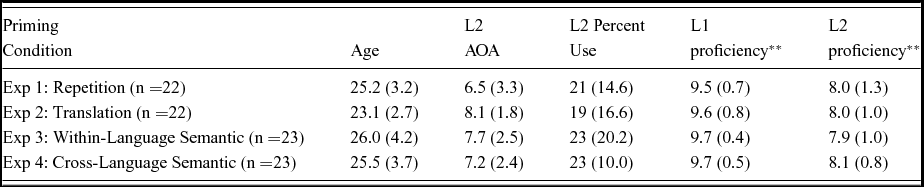
All participants were native speakers of Hebrew who had learned English as a foreign language in school. Participants completed a Hebrew adaptation of the language experience and proficiency questionnaire (LEAP-Q, Marian, Blumenfeld & Kaushanskaya, Reference Marian, Blumenfeld and Kaushanskaya2007). Participants were L1-dominant, using Hebrew an average of 79% of the time in their day-to-day life, with occasional use of English for media consumption and for academic reading. The average age of initial acquisition of English was 6;5. All participants had normal or corrected vision and were right handed. Participants reported no diagnosed learning disabilities. See Table 3 for full participant characteristics.
Participant characteristics by Experiment, Mean (SD)*.

*Across all experiments, three participants who spoke a language other than Hebrew as L1 or had lived for over 2 years in an English speaking country were excluded from the study. Three additional participants with accuracy rates below 90% were also excluded from the study, resulting in a final sample of 89 participants.
**Proficiency was based on self-rating on a 1–10 scale averaged across speaking, listening and reading.
Stimuli and procedure
In the repetition priming experiment, target words in the related conditions (36 items per language) were preceded by an identical prime word, in the same language. Target words in the unrelated conditions (36 items per language) were preceded by an unrelated prime word in the same language.
Experimental scripts were controlled by E-Prime 2 (Schneider, Eschman & Zuccolotto, Reference Schneider, Eschman and Zuccolotto2012), and experimental sessions were conducted in a sound attenuated room. Participants completed both language conditions (Hebrew-L1 and English-L2) in a single session with a short break between language conditions. The order of the languages was counterbalanced across participants. Stimuli in each list were presented in random order to each of the participants. Participants were seated approximately 50cm in front of a 17 inch computer screen and were instructed to complete a lexical decision task on the second word (target) for every word pair presented. Participants responded using a serial response box, pressing a button marked ‘Yes’ with their right index finger if the target was a word in the target language and a button marked ‘No’ with their left index finger if the target was not a word in the target language. Participants were instructed to make their decision as quickly and as accurately as possible.
Each trial began with the display of a fixation point in the center of the screen for 500 milliseconds. This was immediately followed by the prime word, which remained on the screen for 150 milliseconds, followed by a blank screen for 50 milliseconds and then by the target word which remained on the screen until the participant responded or for a maximum of 3 seconds. The resulting stimulus onset asynchrony (SOA) was 200 milliseconds. Primes and targets were presented using different fonts to avoid visual repetition. Font size was 14 point Times New Roman black on a white background for the prime and 14 point Arial black on white for the target. Each language block began with 12 practice items followed by an experimental block of 216 trials. There were two breaks in the course of the experiment. The experiment lasted approximately 20 minutes.
Results
Reaction times for correct responses to critical word targets on the lexical decision task were analyzed. Outlier RTs that deviated from each participant's mean in each condition by 2 standard deviations or more were removed (4.4% of the data). Task performance was highly accurate in all conditions (average 95%), and so accuracy rates are not further analyzed.
Initially, RTs to word targets were submitted to a three-way repeated-measures ANOVA. Within-subject factors were language (Hebrew, English), relatedness (related, unrelated) and concreteness (abstract, concrete). Results for concreteness yielded no main effect for this factor and no significant interactions. Therefore, all further statistical analyses were conducted on data collapsed across concrete and abstract targetsFootnote 1. The lack of results for concreteness is addressed in the general discussion.
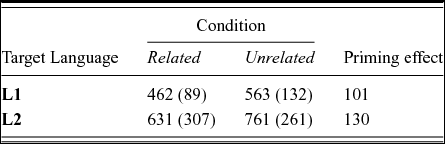
Reaction times were then submitted to a repeated measures ANOVA with target language (L1, L2) and relatedness (Related, Unrelated) as within participant variables over participants (F1). A parallel analyses was conducted over items, in which Language was a between items factor, and relatedness a within items factor (F2). The effect of language was significant, with significantly faster RTs to L1 targets than to L2 targets, F 1(1,21) = 15.3, p < .001, η2 = .42, F2(1,285) = 163, p < .001, n2 = .36 . In addition, RTs were significantly faster to targets preceded by a repetition prime than to targets following an unrelated prime, F 1(1,21) = 62.6, p < .001, η2 =.75; F2(1,285) = 92.3, p < .001, n2 =.25. The interaction between language and relatedness was not significant, F 1(1,21) = 1.70, p = .21, η 2 =.08, F2(1,285) = 1.63, p =.2, n2 =.01, though priming for L2 targets was numerically larger (see Table 4 and Figure 1).
Mean RTs (SD) for related and unrelated primes and priming effects, by target language, in Experiment 1 Repetition priming.

Mean priming effects in milliseconds (SEM) for Hebrew (L1) and English (L2) targets, by priming condition

Discussion
The results demonstrate significant repetition priming effects, of similar magnitude, in both languages. Focusing on the contribution of the prime to the priming effect, these results are puzzling. According to the RHM and the BIA+, L1 primes are both activated faster and are more strongly linked to conceptual representations. Therefore, the L1 primes should have produced greater priming effects than the L2 primes. However, when focusing on the contribution of targets – in particular the lower resting-level activation of the L2 targets – the result here is more explicable. This lower resting-level activation renders the L2 targets more ‘primeable,’ since the RTs have greater room for improvement. Thus, it seems that the current results can best be understood by the suggestion that the two mechanisms balance each other, such that the magnitude of priming is equivalent across the two languages. This finding supports the notion that the lower resting-level activation of L2 targets might be contributing to the asymmetry generally found in cross-language priming conditions.
Experiment 2: Translation priming
Participants
Twenty-two participants from the same population described above completed the translation priming experiment (see Table 3).
Stimuli and procedure
In the translation priming experiment, target words in the related conditions (36 items per language) were preceded by their translation equivalent in the other language. Target words in the unrelated conditions (36 items per language), were preceded by a different prime word, in the other language. All other details of the procedure were identical to those described for Experiment 1.
Results
Data trimming and analyses procedures are as described in Experiment 1. Outlier RTs that deviated from each participant's mean in each condition by 2 standard deviations or more were removed (4.3% of the data). Task performance was highly accurate in all conditions (93%), and so accuracy rates are not further analyzed.
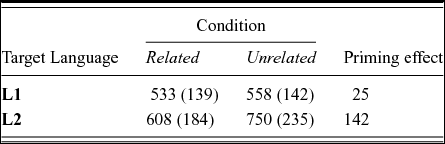
RTs for correct responses to word targets were analyzed using a repeated measures ANOVA with target language (L1, L2) and relatedness (Related, Unrelated) as within participant variables over participants (F1). A parallel analysis was conducted over items, in which Language was a between items factor and relatedness a within items factor (F2). RTs for L1 targets were significantly faster than for L2 targets, F 1(1,21) = 20.6, p < .001, η2 = .50, F2(1,285) = 120.5, p <.001, η2 = .29. Targets preceded by a translation prime were responded to faster than targets following an unrelated prime, F 1(1,21) = 48.9, p < .001, η2 = .70; F2(1,286) = 87.8, p < .001, η2 = .24. In addition, the interaction between language and relatedness was also significant, F 1(1,21) = 32.26, p < .001, η2 = .61 and F2(1,286) = 42.5, p < .001, η2 = .13. Follow up comparisons demonstrated that priming effects in English were larger than in Hebrew, t1(21) = 5.7, p <.001; t2(286) = 6.52, p <.001 (see Table 5 and Figure 1).
Mean RTs (SD) for related and unrelated primes and priming effects, by target language, in Experiment 2 Translation priming.

Discussion
The current results replicate the findings of many previous studies (Gollan et al., Reference Gollan, Forster and Frost1997; Jiang & Forster, 2001; Finkbeiner et al., Reference Finkbeiner, Forster, Nicol and Nakamura2004; Basnight-Brown & Altarriba, Reference Basnight-Brown and Altarriba2007; Schoonbaert et al., Reference Schoonbaert, Duyck, Brysbaert and Hartsuiker2009). Namely, we found significant translation priming in both directions, from L1-L2 and from L2-L1, with significantly larger priming effects in the L1-L2 direction.
These findings fit well with predictions focusing on the resting-level activations of both the primes and the targets. In the L1-L2 condition, a strong prime with its higher resting-level activation acts more effectively to prime the L2 target, which has a lower resting-level activation and thus stands to benefit to a larger extent from the prime. This consequently results in a large prime effect. On the other hand, in the reverse condition in the L2-L1, the weaker L2 prime with its lower resting-level activation is less effective in priming the less primeable L1 target with its higher resting-level activation.
Experiment 3: Within-Language Semantic Priming
Participants
Twenty-three participants from the same population described above completed the within-language semantic priming experiment (see Table 3).
Stimuli and procedure
In the within-language semantic priming experiment, target words in the related conditions (36 items per language) were preceded by a semantically related word in the same language. Target words in the unrelated conditions (36 items per language), were preceded by a semantically unrelated prime word, in the same language. All other details of the procedure were identical to those described for Experiment 1.
Results
Data trimming and analyses procedures are as described in Experiment 1. Outlier RTs that deviated from each participant's mean in each condition by 2 standard deviations or more were removed (4.5% of the data). Task performance was highly accurate in all conditions (94%), and so accuracy rates are not further analyzed.
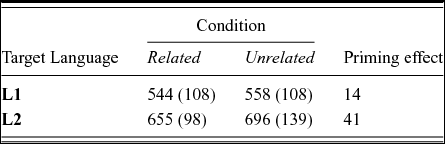
RTs for correct responses to word targets were analyzed using a repeated measures ANOVA with target language (L1, L2) and relatedness (Related, Unrelated) as within participants variables over participants (F1). A parallel analysis was conducted over items, in which language was a between items factor, and relatedness a within items factor (F2). RTs to L1 targets were significantly shorter than to L2 targets, F 1(1,22) = 60.5, p < .001, η2 = .73, F2(1,285) = 198, p <.001, n2 = .41. Targets preceded by a semantically related prime in the same language were responded to significantly faster than targets following a semantically unrelated prime, F 1(1,22) = 9.4, p = .006, η2 = .30, F2(1,286) = 9.90, p = .021, n2 = .03. The interaction between language and relatedness was not significant for either participants, F 1(1,22) = 2.86, p = .1, η2 = .12 or items, F2(1,286) = 1.20, p = .27, n2 = .004, but numerically the effect was much larger for L2 targets (see Table 6 and Figure 1). Because of our specific interest in the priming effect in each language, we conducted follow up analyses despite the marginally significant interaction in the analysis by participants. These analyses revealed that whereas the priming effect in L2 was significantly different from zero t1(22) = 2.7, p<.05; t2(143) = 2.451, p<0.05, the priming effect in L1 was not, t1(22) = 1.7, p = .1;t2(143) = 2.045, p<0.05.
Mean RTs (SD) for related and unrelated primes and priming effects, by target language, in Experiment 3 Within-Language Semantic priming.

Discussion
Experiment 3 tested an additional element of intra-language connectivity. Whereas Experiment 1 (repetition priming) examined the extent to which a word can prime itself, this experiment examined the strength of within-language connectivity in each of the two languages of the bilingual participants. Here again, there was a main effect for target language: reaction times to L1 targets were faster, thus showing greater ease in processing L1 over L2. Within-language semantic priming was significant overall, with the suggestion that this effect was driven mostly by L2 targets.
The fact that the difference between the priming effects of the two languages was not significant (though numerically 3 times larger in L2) sheds further light on the possible role of higher resting-level activation of L1 primes versus lower level resting activation of L2 targets. If the priming effect were solely attributable to features of the prime, we would expect priming within L1 to be significantly larger than within L2. However, the overall statistical analysis did not find a significant difference between the two languages, and the planned comparisons in fact demonstrated the opposite pattern, namely stronger priming within L2 than within L1, despite the presence of a prime that is processed less efficiently. Thus, similarly to the results of Experiment 1 (repetition priming) this experiment also supports the importance of resting-level activation of targets for understanding bilingual priming effects.
Experiment 4: Cross-language semantic priming
Participants
Twenty-two participants from the same population described above completed the translation priming experiment (see Table 3).
Stimuli and procedure
In the cross-language semantic priming experiment, target words in the related conditions (36 items per language) were preceded by a semantically related word in the other language. Target words in the unrelated conditions (36 items per language), were preceded by a semantically unrelated prime word, in the other language as well. All other details of the procedure were identical to those described for Experiment 1.
Results
Data trimming and analyses procedures are as described in Experiment 1. Outlier RTs that deviated from each participant's mean in each condition by 2 standard deviations or more were removed (4.5% of the data). Task performance was highly accurate in all conditions (96%), and so accuracy rates are not further analyzed.
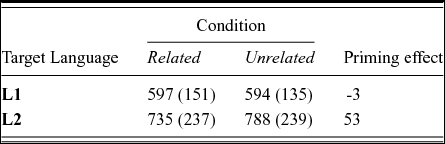
RTs for correct responses to word targets were analyzed using a repeated measures ANOVA with target language (L1, L2) and relatedness (Related, Unrelated) as within participants variables over participants (F1). A parallel analysis was conducted over items, in which language was a between items factor, and relatedness a within items factor (F2). Reaction times for L1 targets were significantly faster than for L2 targets, F 1(1,21) = 14.5 p = .0015, η2 = .41; F2(1,285) = 122.1, p <.001, n2 = .3. Targets preceded by a semantically related cross-language prime were responded to significantly faster than targets following unrelated primes in the participant analysis, F 1(1,21) = 4.9, p = .038, η2 = .19, but not in the item analysis F2(1,285) = 1.71, p = .19, n2 = .006. The interaction between language and relatedness was significant in the participant analysis, F 1(1,21) = 6.9, p < .015, η2 = .25, and follow up comparisons demonstrated significant priming in the L1-L2 language condition (p 1 < .01), but not in the L2-L1 condition (p 1 = .79). However, the interaction was not significant in the item analysis F2(1,285) = 1.92, p = .17, n2 = .007, and follow up comparisons showed no significant priming in either language condition (both ps>.133 – see Table 7 and Figure 1).
Mean RTs (SD) for related and unrelated primes and priming effects by target language, in Experiment 4 Cross-Language Semantic Priming.

Discussion
The results of this experiment align to a certain degree with the results of the translation priming experiment (Experiment 2). Specifically, in the participant analysis we found evidence for asymmetric priming, such that priming was larger in the L1-L2 direction than in the L2-L1 direction, and planned comparisons demonstrated that in fact there was no significant priming in the L2-L1 direction. This stronger priming in the L1-L2 direction can be attributed to both the higher resting-level activation of the prime and the lower resting-level activation of the target. In the opposite direction, L2-L1, the combined effects of a lower resting-level activation of the prime and a higher resting-level activation of the target in fact resulted in the absence of any facilitation, as has been reported in several previous studies (e.g., Basnight-Brown & Altarriba, Reference Basnight-Brown and Altarriba2007).
In comparison to the results of the translation priming experiment, the overall cross-language semantic priming effect was much weaker, and in fact failed to reach significance in the item analysis. Similar findings have been reported in several previous studies, which failed to demonstrate significant cross-language semantic priming (e.g., Basnight-Brown & Altarriba, Reference Basnight-Brown and Altarriba2007; deGroot & Nas, 1991). This finding can be understood by the fact that meaning overlap is necessarily smaller and more variable in semantically related pairs than in translation pairs, leading to reduced effects in the item analysesFootnote 2. Thus, given that the overall priming effect was not significant in the item analysis, it is not surprising that we found no difference between L1 and L2 targets in this analysis.
Therefore, the results of Experiment 4 support previous findings of asymmetry in cross-language priming, though not as strongly as the results of the translation priming experiment.
Comparison across experiments
To compare the results across the four experiments, we calculated a priming effect (PE) for each participant for each language by subtracting RTs to targets preceded by related primes from RTs to targets preceded by unrelated primes (see Figure 1). These data were then submitted to a two-way repeated measures ANOVA with Experiment (repetition, translation, within-language semantic, cross-language semantic) as a between-subjects factor and Language (L1, L2) as a within-subjects factor.
Overall, priming effects were larger for L2 than for L1 targets, showing a main effect of target language, F(1,85) = 32.3, p < .001, η2 = .28. The main effect for experiment was also significant, F(3,83) = 14.0, p < .001, η2 = .33, indicating significant differences in the magnitude of priming effects across the four experiments. Finally, the interaction between language and experiment was also significant F(3,85) = 4.30, p = .007, η2 = .13.
Tukey HSD Post hoc analyses showed that PEs in repetition and translation priming conditions did not differ significantly from each other (p = .253), but were larger than priming effects in the within- and cross-language semantic experiments (all ps < .01), which again did not differ significantly from each other (p = .99). In order to directly compare within-language and cross-language priming for the two target languages, we compared translation with repetition priming and within-language and cross-language semantic priming, for each target language separately. Tukey HSD Post hoc analyses showed that English targets were equally primed by within- and cross-language semantic primes (p = .969), and repetition and translation primes (p = .968). Hebrew targets were also equally primed by within- and cross-language semantic primes (p = .645), but were more strongly primed by repetition than by translation primes (p < 0.001).
General discussion
The present study examined directionality and connectivity in the bilingual mental lexicon of Hebrew–English bilinguals in four priming experiments (repetition, translation, within-language semantic and cross-language semantic). As expected, the participants, who were unbalanced bilinguals, responded faster in L1 than in L2. Additionally, all priming conditions were effective in facilitating performance, but to various degrees (cross-language semantic priming was notably weak). Of particular note was the fact that despite the faster response times overall for L1 targets, the priming effects were generally larger for L2 targets.
The current results align well with previous findings of asymmetric cross-language priming, namely greater facilitation in the L1-L2 direction than in the L2-L1 direction in both translation priming (Gollan et al., Reference Gollan, Forster and Frost1997; Jiang & Forster, Reference Jiang and Forster2001; Finkbeiner et al., Reference Finkbeiner, Forster, Nicol and Nakamura2004; Basnight-Brown & Altarriba, Reference Basnight-Brown and Altarriba2007; Schoonbaert et al., Reference Schoonbaert, Duyck, Brysbaert and Hartsuiker2009; Wen & van Heuven, Reference Wen and van Heuven2016) and cross-language semantic priming (e.g., Duyck, 2005; Basnight-Brown & Altarriba, Reference Basnight-Brown and Altarriba2007; Schoonbaert et al., Reference Schoonbaert, Duyck, Brysbaert and Hartsuiker2009). Thus, in the current study priming effects were significantly larger from L1/Hebrew to L2/English in translation priming and more weakly so in cross-language semantic priming. As presented in the introduction, two converging mechanisms have been put forth to explain this pattern, both of which refer to the reduced efficiency of L2 primes. The RHM (Kroll & Stewart, Reference Kroll and Stewart1994; see also Kroll et al., Reference Kroll, van Hell, Tokowicz and Green2010) cites less efficient conceptual access from L2 primes as the reason for reduced priming in the L2-L1 direction. The BIA+ model (Dijkstra & van Heuven, Reference Dijkstra and van Heuven2002) describes the temporal lag in lexical access for L2 primes, due to their lower frequency of exposure resulting in lower resting-level activation, which would again lead to reduced L2-L1 priming.
In the current study, we wished to examine the possibility that lower resting activation of L2 targets might contribute to asymmetric cross-language priming as well. This mechanism is partly motivated by a comparison with the monolingual priming literature, in which low frequency words have been shown to benefit more from priming than high frequency words (Becker, Reference Becker1979; Stone & Van Orden, Reference Stone and Van Orden1992). The participants in the current study were unbalanced bilinguals, who reported using their L2 significantly less often than their L1, leading to a lower resting-level activation for L2 lexical items compared to L1 items (see Gollan et al., Reference Gollan, Montoya, Cera and Sandoval2008). Thus, L2 target words stand to benefit more from priming than L1 target words, given their overall lower resting-level activation. However, in cross-language priming, both the larger effectiveness of L1 primes and the higher ‘primeability’ of L2 targets influence performance in the same direction – namely, stronger priming in the L1-L2 direction than in the L2-L1 direction.
Because both prime and target differences in resting-level activation between L1 and L2 predict asymmetric priming in cross-language conditions, we made use of within-language priming in an attempt to better differentiate between them. The most straightforward way to describe the prediction that lower resting-level activation of L2 target words will lead to greater priming is because L2 targets leave more room to benefit from priming. Specifically, if lower target resting activation contributes to enhanced L1-L2 priming, we should also see stronger L2-L2 than L1-L1 priming. Alternatively, if the main factor which drives asymmetric priming in cross-language conditions is more efficient lexical access of L1 primes due to higher resting-level activation, as suggested by the BIA+ model, we would expect stronger priming effects within L1 than within L2, namely in priming conditions with L1 primes.
The results of the current study do not align easily with either prediction, because priming of L1 and L2 targets did not differ significantly in repetition priming, and only marginally so in within-language semantic priming. However, in both cases priming for L2 targets was numerically larger, and in the case of within-language semantic priming, follow-up comparisons demonstrated significant priming in L2, but not in L1. This pattern strongly suggests that it is not only the strength of L1 primes that is responsible for the asymmetry in cross-language priming results. Thus, we suggest that resting-level activation of both the prime and the target are at play and can be argued to concurrently influence performance, leading to similar priming effects within L1 and L2 and asymmetric priming in cross-language conditions.
The current study also allowed us to compare connections between lexical items within and across languages by focusing on the two semantic priming conditions. We tested the hypothesis claiming that within-language connections might be stronger than cross-language connections. Using a specific example to illustrate, if within-language connections were stronger, we would expect a within-language prime such as table-chair (L2-L2) to produce greater priming than a cross-language prime, shulxan-chair (L1-L2). The same would be true for L1 targets, namely, we would expect a within-language prime shulxan-kisei (L1-L1) to produce greater priming than a cross-language prime table-kisei (L2-L1). However, the results show that in the current study, within-language and cross-language semantically related primes were equally effective in priming targets in both L1 and L2.
Taken together, this pattern does not seem to support the notion that within-language connections are necessarily stronger than cross-language connections in bilingual lexical priming. Instead, the current results can be better understood by the mechanism of resting-level activation – namely, that L1 primes are processed more efficiently due to higher resting-level activation, and that L2 targets stand to benefit more from priming, due to lower resting-level activation. To summarize, the current results show that the lower resting-level activation of L2 lexical items in unbalanced bilinguals contributes to asymmetrical cross-language priming via lower resting-level activation of targets and not only via less efficient lexical activation of primes, as highlighted by the BIA+ model.
An interesting direction for future research would be an attempt to parcel out the relative contributions of resting-level activation of targets versus primes by directly manipulating the lexical frequency of the stimuli. For instance, an investigation of L1-L2 priming pairs where the L1 prime is of lower frequency than the L2 target and/or L2-L1 priming pairs where the L2 prime is of higher frequency than the L1 target, would allow us to evaluate the relative contribution of prime versus target accessibility. A similar comparison could be made for within-language priming pairs, where again the L1-L1 pairs are of lower frequency than the L2-L2 pairs.
Finally, the current study was initially designed to investigate the possible impact of concreteness on within- and cross-language priming patterns, but results of this manipulation were not as instructive. Although we did find a main effect for concreteness across experiments, it was qualified by an interaction with language. Specifically, whereas for L2 there was no difference in processing of concrete and abstract targets, in L1 the effect of concreteness was reversed – abstract words were recognized faster than concrete words. Further, concreteness did not interact with any of the priming manipulations, and the magnitude of priming was equal for concrete and abstract items. At the very least, the current results echo those of several recent studies (e.g., Chen et al., Reference Chen, Liang, Cui and Dunlap2014) and suggest that concreteness effects may be less stable and pervasive than has previously been assumed in the literature on lexical decisions in visual word processing, both monolingual (e.g., Yap & Balota, Reference Yap, Balota, Pollatsek and Treiman2015) and bilingual (e.g., Jin, Reference Jin1990).
Conclusion
The current study investigated within and between language connectivity and directionality in bilingual lexical representation by implementing a comprehensive design including repetition, translation, within-language semantic, and cross-language semantic priming. The study mostly replicated previous findings of asymmetric priming in cross-language conditions, while at the same time demonstrating similar within-language priming in L1 and L2, with some indication of stronger effects within L2. This pattern of results supports our novel hypothesis that lower resting-level activation of L2 targets in unbalanced bilinguals might be an additional mechanism contributing to asymmetric cross-language priming. Further, within-language semantic connections were comparable for L1 and L2. Taken together, the results align well with the BIA+ model, by demonstrating that frequency-driven resting-level activation is a critical mechanism for understanding bilingual lexical representation and processing. Importantly, the current study identifies the unique importance of L1-L2 differences in target resting-level activation, whereas most previous literature focused on effects stemming from L1-L2 differences in prime resting-level activation.
Appendix A: Full list of stimuli for the four experiments
Critical Stimuli

Filler pairs:

Non-word stimuli