Introduction
On September 11, 2001, the United States (US) suffered a coordinated terrorist attack prompting the global “War on Terror,” an on-going US-led international military campaign against extremist terrorist groups. While much focus remains on extremist religious groups around the world, in recent years, there has been a significant uptick in US domestic terrorism, primarily white supremacist and political extremist related events, Reference Jones, Doxsee, Harrington, Hwang and Suber1 including the January 6, 2021 attack on the US Capitol (Washington, DC USA).
Historically, terrorism methodologies have been more imitative than innovative. However, a more socially connected terrorist organization, with accessible modern-day technology such as drones and relatively accessible black market chemical weapons and drugs, could potentially pose a new threat with novel or unfamiliar attack methodologies. 2–Reference Yaacoub, Noura, Salman and Chehab4 These could result in mass-casualty events, including potential harm to frontline health care workers. Disaster Medicine specialists have identified this as an area of significant vulnerability and recently established a Counter-Terrorism Medicine (CTM) sub-specialist working group to specifically target research and education on intentional man-made events. Reference Court, Edwards, Issa, Voskanyan and Ciottone5,Reference Tin, Hertelendy and Ciottone6
This study aims to provide an epidemiological description of all terrorism-related fatalities and injuries in the US sustained from 2008-2018, including the historical attack strategies and modalities used to understand methodologies, allowing responders to be better informed about the injury types they are likely to be called upon to treat. These data will be useful for the development of training programs in CTM.
Methods
Data collection was performed using a database search through retrospective data from the Global Terrorism Database (GTD). 7 This database is open-access, with publicly available data collection methodology utilizing artificial intelligence that identifies events from news media around the world daily, as well as human evaluation of the events by the National Consortium for the Study of Terrorism and Responses to Terrorism (College Park, Maryland USA). 8 The GTD contains no personal identifiers for victims and links specific events to open-source news articles. For the purpose of this study, GTD defined and fixed search terms were used: all “weapon types” were selected. The GTD was searched using the internal database search functions for all US events which occurred from January 1, 2008 - December 31, 2018. Years 2019 and 2020 were not yet available at the time of the study. The GTD defines terrorist attacks as: The threatened or actual use of illegal force and violence by a non-state actor to attain a political, economic, religious, or social goal through fear, coercion, or intimidation. The GTD database does not include acts of state terrorism.
Results were exported into an Excel spreadsheet (Microsoft Corp; Redmond, Washington USA) for analysis. Attacks met inclusion criteria if they fulfilled the following three terrorism-related criteria, as set by the GTD. Ambiguous events were excluded when there was uncertainty as to whether the incident met any of the criteria for inclusion as a GTD terrorist incident. Attacks that were attempted but not successfully carried-out were included. These criteria are determined within the database and not by the authors:
-
1. Criterion I: The act must be aimed at attaining a political, economic, religious, or social goal.
-
2. Criterion II: There must be evidence of an intention to coerce, intimidate, or convey some other message to a larger audience (or audiences) than the immediate victims.
-
3. Criterion III: The action must be outside the context of legitimate warfare activities (ie, the act must be outside the parameters permitted by international humanitarian law, particularly the admonition against deliberately targeting civilians or non-combatants).
In addition to GTD listed events, the grey literature was searched to ensure no major events meeting these criteria were missed.
Results
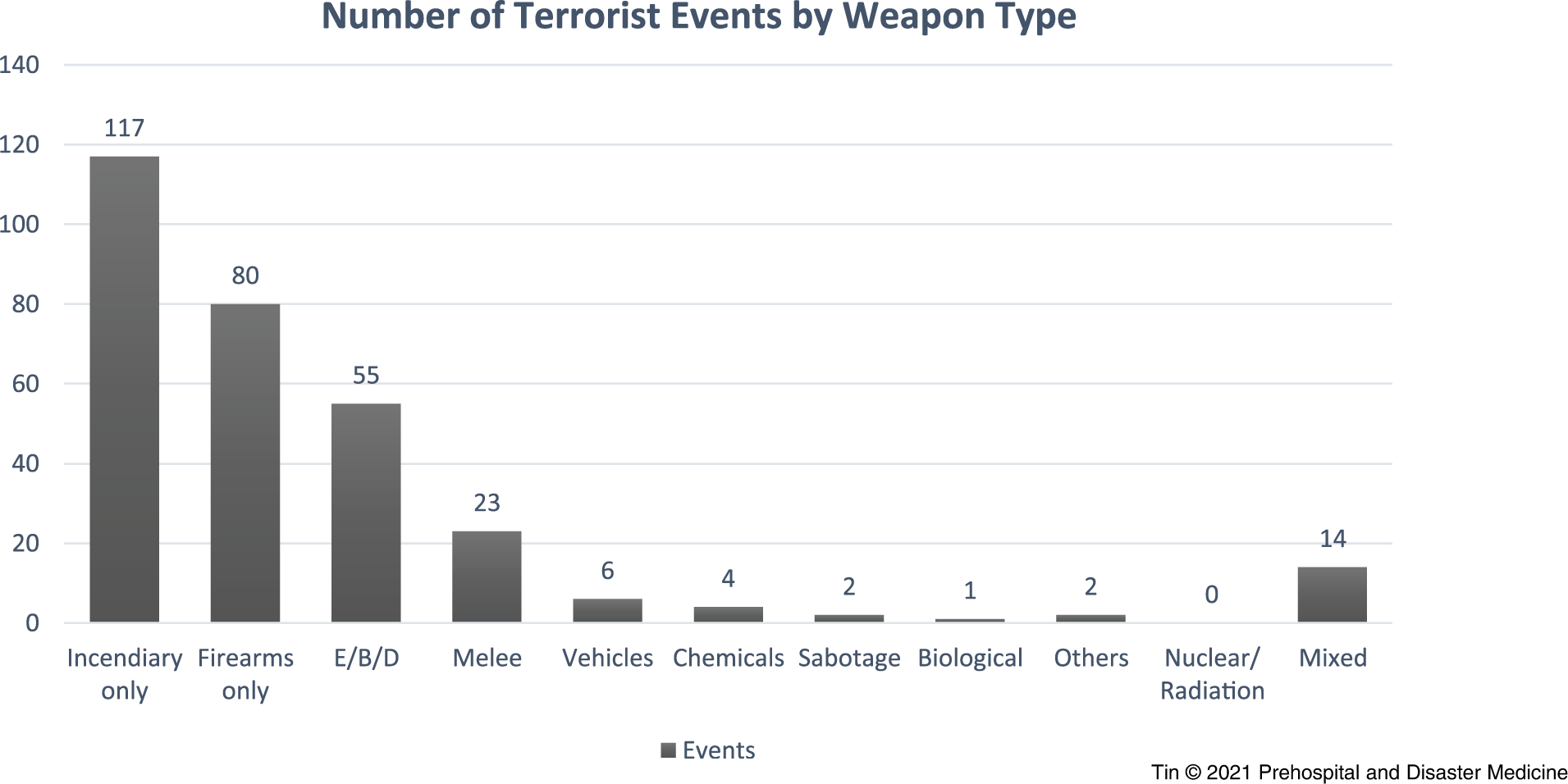
In total, 304 terrorist events were identified in the study period. Of the 304 events, 117 (38.5%) used incendiary-only weapons, 80 (26.3%) used firearms as their sole weapon, 55 (18.1%) used explosives, bombs, or dynamite (E/B/D), 23 (7.6%) were melee-only, six (2.0%) used vehicles-only, four (1.3%) were chemicals-only, two (0.7%) used sabotage equipment, two (0.7%) were listed as “others” (a metal wire booby trap and a flashing GIF sent to a journalist with known epilepsy which subsequently triggered a seizure), and one (0.3%) used biological weapon. There was no recorded nuclear or radiation weapon use. In addition, 14 (4.6%) events used a mix of weapons (Figure 1).
Number of Terrorist Events by Weapon Type.
Abbreviation: E/B/D, explosives/bombs/dynamite.

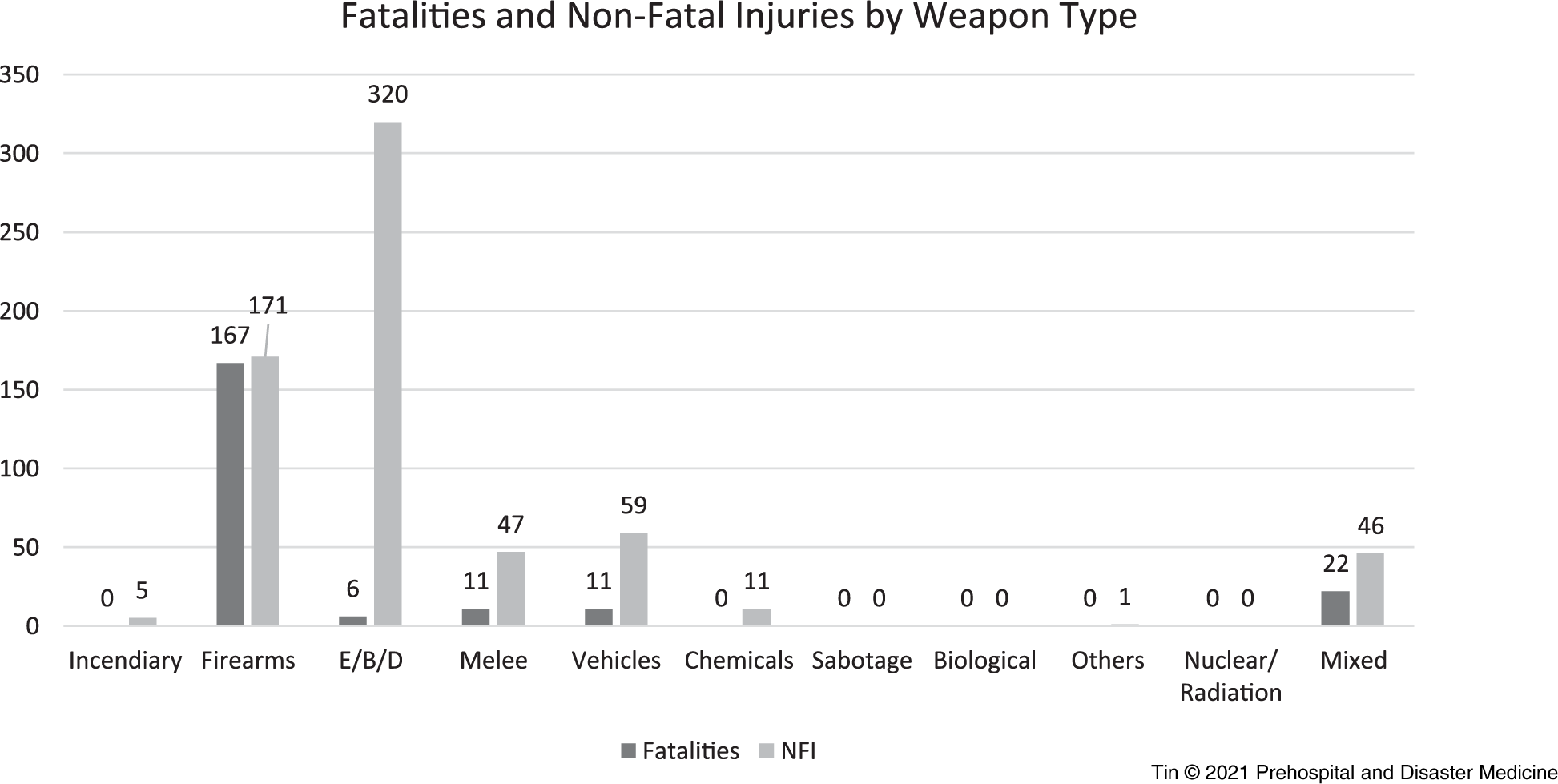
Out of the 304 events, a total of 217 fatal injuries (FI) were recorded, as well as 660 non-fatal injuries (NFI). Incendiary events caused zero (0.0%) FI and five (0.8%) NFI. Firearm events caused 167 (77.0%) FI and 171 (25.9%) NFI. Events with E/B/D caused six (2.8%) FI and 320 (48.5%) NFI. Melee events caused 11 (5.1%) FI and 47 (7.1%) NFI. Vehicle-only events caused 11 (5.1%) FI and 59 (8.9%) NFI. Chemical attacks caused zero (0.0%) FI and 11 (1.7%) NFI. The two equipment sabotage events caused zero (0.0%) FI and zero (0.0%) NFI. The one biological attack caused zero (0.0%) FI and zero (0.0%) NFI. “Other” events caused zero (0.0%) FI and one (0.2%) NFI. Mixed events caused 22 (10.1%) FI and 46 (6.7%) NFI (Figure 2).
Fatal Injuries and Non-Fatal Injuries by Weapon Type.
Abbreviation: E/B/D, explosives/bombs/dynamite.

Discussion
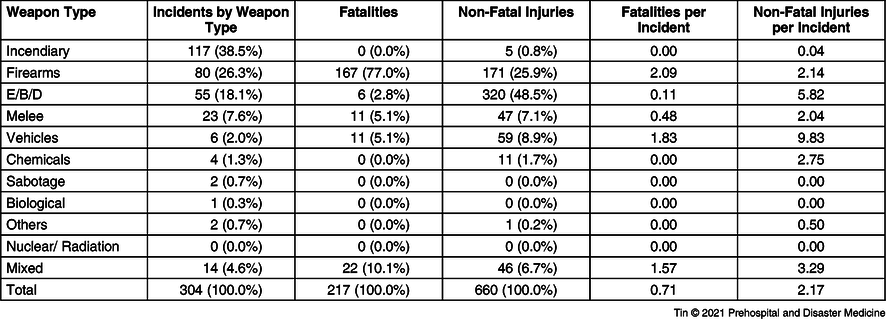
Firearm events caused a disproportionately high death toll with the highest fatality per event ratio (Table 1), consistent with other studies reflecting the high lethality of such weapons. Reference Tessler, Mooney and Witt9 Firearm-related events are of particular concern in countries such as the US, where high-grade assault weapons are readily accessible by the general population. The Orlando Pulse night club shooting in 2016 (Orlando, Florida USA) saw a single assailant, armed with an assault rifle and a handgun, kill 49 people and injure 52 more. Reference Straub, Cambria and Castor10 While there is much debate around the classification of the Las Vegas (Nevada USA) shooting of 2017, it did not fulfil the Federal Bureau of Investigation’s nor the GTD’s criteria for a terrorism event. Reference Gessen11
Breakdown of Events by Weapon Type, Fatalities, and Non-Fatal Injuries and Relative Ratios

Abbreviation: E/B/D, explosives/bombs/dynamite.
Firearms events in the US are in stark contrast to countries such as Australia where gun access is highly regulated. Australia has seen fewer than 10 terrorism-related gun deaths in the same study period. Reference Tin, Hart, Hertelendy and Ciottone12 Around the world and in the US, there has been increasing focus in training civilian Emergency Medical Services in managing firearm injuries using training courses such as Tactical Emergency Casualty Care. Reference Callaway13
Incidents related to E/B/D accounted for disproportionally high numbers of NFI. The 2013 Boston (Massachusetts USA) marathon bombing saw 264 injuries as a result of two homemade bombs detonating, accounting for 40% of all NFI sustained during the study period. Vehicle events accounted for the highest NFI per incident ratio (Table 1).
The substances involved in the four chemical attacks include acid, abrasive industrial cleaning chemicals, pepper spray, and an unknown noxious substance which caused nausea and vomiting in 11 people. Reference Dalrymple14–Reference Press16 Of note, pepper spray is defined as a chemical weapon in the GTD criteria. The sole biological attack incident involved the use of HIV contaminated razor blades. Reference Martinez17
Despite accounting for over 38% of events, incendiary incidents caused no deaths and minimal injuries. Incendiary events such as arson, however, tend to cause infrastructure damage resulting in financial losses.
2018 saw the emergence of Pro-Trump extremism (as classified by the GTD) associated with a series of letter bomb threats to various critics of President Trump around the US. Reference Wootson and Horton18,Reference Stanglin19 Older, historically white supremacist organizations such as the Ku Klux Klan have been in steady decline over the past decade, but newer hate groups are on the rise and have become much more visible, vocal, brazen, and connected through both online and offline communities. Reference Palmer20,Reference Jones, Doxesee and Harrington21 Counter-terrorism experts anticipate a significant rise in attacks as a result of the current COVID-19 pandemic and the increase in anti-government sentiment, as people socially isolated by lockdown become increasingly susceptible to radicalization by extremist groups. Reference Jones, Doxesee and Harrington21–Reference Kruglanski, Gunaratna, Ellenberg and Speckhard23
Health care involvement in terrorist events has historically been confined to attending to casualties. The emergence of CTM as a sub-specialty aims to mitigate and prepare for the unique health care consequences of intentional mass casualties. Specialists in CTM also intend to rethink health care vulnerabilities and plan for the response to novel attack methodologies. Reference Court, Edwards, Issa, Voskanyan and Ciottone5,Reference Kruglanski, Gunaratna, Ellenberg and Speckhard23–Reference Tin, Hart and Ciottone25
While understanding past methodologies provides important educational value, policymakers need to be forward looking in anticipating the new or unexpected. The health care complexities within CTM necessitate round table discussions with disaster medicine, counter terrorism, tactical medicine, and law enforcement specialists and experts to ensure streamlined, coordinated strategies in dealing with future terrorist events. Reference Tin, Hart and Ciottone24
Limitations
The GTD is a comprehensive record of global events. It is maintained by the National Consortium for the Study of Terrorism and Responses to Terrorism and is the basis for other terrorism-related measures, such as the Global Terrorism Index (GTI). Reliance wholly on the GTD is partially mitigated by confirmation with other lay sources, and searches for other online searches, but if there are incidents not reported in the GTD, this could limit the veracity of the findings. Furthermore, injuries and fatalities were cross-matched with news records rather than formal hospital or coroner reports, and so rely on the completeness and accuracy of these sources.
Conclusion
In the decade from 2008 to 2018, 304 terrorist attacks on US soil were recorded, causing 217 FI and 660 NFI. Incendiary weapons were the most commonly chosen methodology, followed by firearms and E/B/D attacks. Firearm events contributed to a disproportionality high fatality count and E/B/D events contributed to a disproportionally high NFI count. Transnational and domestic terrorism remain a threat in the US with potentially significant health care repercussions, and this analysis may support the educational needs for US responders in CTM.
Conflicts of interest/funding
none