Hospital infection prevention programs attempting to reduce surgical site infections, which can have an incidence of up to 31%,Reference Revolus and Tetrokalashvilli 1 may consider interventions such as operating room (OR) check-lists, specific attire policies, and novel strategies for surgical skin preparation. The purpose of this study was to examine healthcare provider perceptions and barriers to infection prevention practices in an academic obstetrics and gynecology (OB/GYN) center.
An institutional review board–approved, anonymous survey addressing attitudes and practices regarding hand hygiene/universal gloving (UG), methicillin-resistant Staphylococcus aureus (MRSA) or methicillin-sensitive S. aureus screening and decolonization, surgical site preparation, and OR/labor and delivery apparel was distributed to OB/GYN faculty and housestaff. Descriptive and comparative analyses using Pearson χ2 tests (alpha level=.05) were conducted using SAS, version 9.2 (SAS Institute).
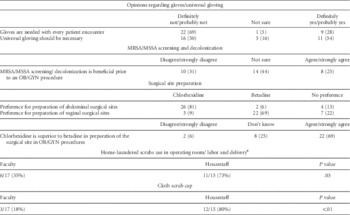
Of 46 surveys distributed, 32 were collected (17 faculty,15 housestaff) (response rate, 70%). Opinions varied regarding the necessity of UG and perceived implementation barriers. Twenty-two respondents (69%) felt gloves were unnecessary for each patient encounter (Table 1). Sixteen respondents (50%) considered UG for patient care to be unnecessary while 5 (16%) remained unsure. Fourteen respondents (44%) listed interference with doctor-patient relationship as the greatest barrier to UG implementation. Four of 8 respondents were unfamiliar with UG efficacy data. Sixteen respondents (50%) felt that gloves were needed for breast exams and 16 (50%) felt otherwise. There was no difference based on gender (P=.3).
Summary of Questionnaire Responses

NOTE. Data are no. (%) of respondents unless otherwise indicated. OB/GYN, obstetrics and gynecology; MRSA, methicillin-resistant Staphylococcus aureus; MSSA, methicillin-sensitive S. aureus.
a Any use was included, including a response of always, most of the time, some of the time, and rarely.
Fourteen respondents (44%) were unsure whether MRSA/methicillin-sensitive S. aureus screening/decolonization would be beneficial before OB/GYN procedures (Table 1). For surgical site preparation, 26 respondents (81%) preferred chlorhexidine for abdominal surgical site preparation, and 22 (69%) preferred betadine for vaginal surgical site preparation.
With regard to attitudes on hospital apparel, 15 (47%) of the 32 respondents never wore home-laundered scrubs for OR or labor and delivery procedures, and 12 (38%) wore home-laundered scrubs always/most of the time. Housestaff were more likely to launder their scrubs at home (P=.03) and to don cloth scrub caps (P<.01) than faculty surgeons.
Our goal was to investigate beliefs and practices regarding infection prevention measures in OB/GYN. There were opposing opinions regarding the necessity of UG. The American Congress of Obstetrics and Gynecology emphasizes double gloving in its surgical curriculum for residents but a definitive statement regarding UG in all clinical settings is not available; thus, variability in gloving practices will likely continue.
Fourteen respondents (44%) were unsure whether MRSA/methicillin-sensitive S. aureus screening/decolonization would be beneficial. The American Congress of Obstetrics and Gynecology currently has no recommendation for universal screening. In pregnant and postpartum women, most MRSA infections are mastitis.Reference Beigi, Bunge, Song and Lee 2 MRSA genital tract colonization affects approximately 3.5% of pregnant women.Reference Sherer, Dalloul, Salameh and Abulafia 3 Although MRSA is an important emerging pathogen in this population, recent investigations highlight that universal screening is not yet cost-effective. Although MRSA screening/decolonization is advocated in select orthopedic populations, data to support a similar approach in OB/GYN are lacking.Reference Chen, Wessel and Rao 4
Respondents’ practices regarding surgical site preparation are in accordance with American Congress of Obstetrics and Gynecology recommendations. Preoperative skin treatment with chlorhexidine in abdominal surgery is superior to betadine for surgical site infection prevention.Reference Darouiche, Wall and Itani 5 While chlorhexidine is more effective in reducing bacterial colony counts in vaginal operative fields,Reference Culligan, Kubik, Murphy, Blackwell and Snyder 6 the American Congress of Obstetrics and Gynecology notes that there is still reluctance to use chlorhexidine for vaginal preparation on the basis of product labeling. 7 Solutions with lower chlorhexidine concentration may be superior to betadine for vaginal fields. More randomized trials are needed.
Proper apparel practices are important for infection prevention. Our study unveiled an interesting difference in apparel practices between faculty and housestaff. The 15 respondents who never wore home-laundered scrubs were faculty, and 15 of the 17 who at least “rarely” wore home-laundered scrubs in OR/labor and delivery procedures were housestaff. Reasons for use of home-laundered scrubs included difficulty in accessing machines and proper sizes. However, home-laundered OR apparel may not meet the specified measures to achieve reduction in antimicrobial levels in soiled surgical attire, and it is increasingly important to comply with the standards set forth by the Association of Perioperative Nurses for surgical apparel. 8
We discovered a variety of practices and beliefs regarding infection prevention measures at our institution. UG remains controversial. Some investigators have demonstrated that UG may be a suitable alternative to contact precautions in intensive care units.Reference Bearman, Rosato and Duane 9 No such studies have been reported in OB/GYN. While all respondents reported consistent glove use for pelvic exams, there was variation, notably in breast exams. Use of home-laundered scrubs appears common despite policies stressing use of facility-laundered scrubs. This importantly underscores the need for easily accessible scrub attire.
Our study raises questions about how to best address knowledge and practice gaps for infection prevention best practices. To our knowledge, our study is the first to investigate infection prevention beliefs, practices, and barriers in OB/GYN. Our study is limited by small sample size and conductance at a single center. The results may thus not be generalizable. Our questionnaire tool was standardized and anonymous, with a high response rate, likely accurate in capturing current infection prevention practices at our institution.
By investigating attitudes and opinions of our colleagues in OB/GYN we hope to define new strategies to improve compliance with existing policies and patient safety. Immediate first steps include development of a robust infection prevention curriculum summarizing current data on hand hygiene, glove use, staphylococcal decolonization, operative skin preparation, and OR attire standards. Additionally, hospitals should assess barriers to optimal compliance with accepted infection prevention standards with emphasis on addressing any apparel access concerns.
ACKNOWLEDGMENTS
Financial support. None reported.
Potential conflicts of interest. All authors report no conflicts of interest relevant to this article.