1. Introduction
Land is an essential factor of production for agriculture and forestry as well as other land-related activities. In many developing countries, the inefficient use or exploitation of land reduces the amount of resource rent that can be collected, while lowering available future resource rents as land resources degrade over time. Consequently, poverty combined with a lack of appropriate institutionsFootnote 1 governing land use causes peasants to invest too little in land improvements. A cycle of land degradation occurs because, as forests are mined, people turn to grasses, crop residues and livestock dung for fuel, which decreases the productive capacity of the land further (Pearce and Warford, Reference Pearce and Warford1993).
Land in Ethiopia is publicly owned with farmers having usufruct rights.Footnote 2 Except for trees on backyards and farmlands on which farmers have use rights to the land, forests/trees and grazing lands remain largely free access resources within their respective communities. Under such an institutional setting or an unrestricted access condition, agents would maximize their own benefits by putting in effort to the extent that average revenue equals marginal cost, instead of marginal revenue being equal to marginal cost (van Kooten and Bulte, Reference van Kooten and Bulte2000). Under open access, no agent will have an incentive to delay harvest, as doing so would only enhance the harvest opportunities of others. The outcome is excess depletion and dissipation of the resource rent.Footnote 3 Rural communities in Ethiopia depend considerably on common property resources for their livelihoods, including for irrigation water, fuelwood, construction material and livestock grazing (Gebremedhin et al., Reference Gebremedhin, Pender and Tesfay2003, Reference Gebremedhin, Pender and Tesfay2004; McCarthy, Reference McCarthy2004). However, population pressure, market and government failure, tenure insecurity and particularly the absence or ineffectiveness of use regulations of common property resources have resulted in the severe degradation of the resources (Hagos et al., Reference Hagos, Pender and Gebreselassie1999). Therefore, it would indeed be of public interest to enhance tenure security and alter this situation. An extreme case of this would be enforcing a private property institution. An interesting question here is how a public policy aiming at altering the status quo would affect total welfare or the welfare of private agents. What would be an optimal institutional arrangement worth doing in terms of addressing the problem? By and large, there appear to be two opposing views with regard to land use/ownership in the country. One view favors the status quo, i.e., state stewardship of land, and the other favors a private property institution. Although these policy options on land ownership are contemplated on different grounds such as efficiency, equity and sustainability, they are not without welfare costs at an individual household level. Therefore, it would be of great interest to empirically evaluate the welfare effect of completely enforcing a private property institution to forest and grazing lands that are not privately held.
Alemu (Reference Alemu1999) analyzed the perceptions of farmers of the land tenure system prevailing in Ethiopia as well as their willingness to pay for institutionalizing more secured tenure. He found that a large proportion of the sample households are willing to pay for a change in the existing tenure arrangements towards private property. In a study of the attitude of farmers towards the complete ownership of land, Semie (Reference Semie2010) found that about 85 per cent of sample households favored complete ownership of farmland. Gebeyehu (Reference Gebeyehu2000) also investigated the impact of the type of tenure on the technical efficiency of farmers, i.e., by considering owner-operators vs. tenants. He concluded that type of tenure did not bring about an observable difference in mean technical efficiency across the two groups.
The purpose of the current study is to examine the welfare impact of the policy of assigning a private property institution to communal forest and grazing lands using a data set covering a cross-section of 200 households in Tigrai region, northern Ethiopia. More specifically, in this paper we examine the welfare effects from the consumer's perspective of a change in the institutional setting to communal forest and grazing lands. Such a change in the institutional setting could be envisaged to counter the dissipation of the resource rent and hence the degradation of forest and grazing lands. We also draw implications from our findings. We begin in the next section with the theory on institutions and resource degradation. Land use in Tigrai is presented in section 3. In section 4 we present the theoretical model of the household's maximization problem along with a framework for analyzing/capturing the welfare effects of the change in the institutional setting. In section 5 we outline the empirical model. Section 6 presents results and discussion. We conclude by drawing some policy/research implications in section 7.
2. Institutions and resources degradation: review of theories
Renewable natural resources such as forests, grazing lands and fisheries constitute a significant part of our planet. Rural communities in developing countries depend primarily on these resources for fuelwood, construction material and livestock grazing. These resources are also important sources of livelihood elsewhere in the world. However, due to unrestricted access by users or in the absence of effective use regulations (rule structures), these resources are subject to overexploitation on a first-come, first-served basis. Alternative theories have been developed to explain the common pool resources problem. Three alternative theories are quite apparent in the literature. The structure of these theories ranges from a simple decision framework involving the interactions of economic and biological factors (e.g., Gordon, Reference Gordon1954) to a more complex game theoretic framework involving strategic interaction among multi-agents (e.g., Cheung, Reference Cheung1970; Runge, Reference Runge1981).
The first line of theory ascribes the common pool resource problem to a self-centered behavior or ‘the free-rider problem’ (Hume, Reference Hume1740; Brubaker Reference Brubaker1975; Smith, Reference Smith1981). According to this theory, motivated by narrow self-interest, each individual would tend to choose and/or behave independently to utilize the resource at an exploitative level in the expectation that others will do the same, leading to a situation in which all are made worse off. Because part of the cost is borne by the entire group involved in using the resource, the social cost of harvesting an additional unit of a common pool resource exceeds the private cost. This is presumed to give individual agents an incentive to enjoy free-riding, which finally ends up in overexploitation. Often, a simple prisoner's dilemma game model is used to explain the situation. Therefore, the implication is that the incentive for free-riding or narrow self-centered behavior could be avoided through completely defined private property rights to the resources.
The second line of theory attributes the common property problem as an enforcement problem. For those like Hardin (Reference Hardin1968) and Johnson (Reference Johnson1972), the problem of common property externality, i.e., ‘the tragedy of the commons’ can only be resolved through imposition and enforcement of use rules by an external enforcer, the government. Hardin sees ‘mutual coercion, mutually agreed upon by the majority of the people affected’, and an external authority, the ‘custodians’, by which restrained access can be enforced, as the only viable option. According to this line of theory, when a group of people is placed in a setting where upon all adopting a rule of restrained use of a common pool resource they could mutually benefit, they will not do so in the absence of an external enforcer of agreements. This is because each agent has an incentive to ignore the social cost of his harvest for fear that other agents will capture the benefits ahead of him.
The third line of theory belongs to the cooperative or conditional cooperative view. This view gives much importance to what is called ‘assurance and uncertainty’ in predicating the behavior patterns of actors and argues that the institutional rules innovated by the users that help to reduce uncertainty and coordinate expectations are the best solutions to resolve the problem (Runge, Reference Runge1981). This line of argument emphasizes the idea that individuals are interdependent because of the non-separability of the cost functions that face them, and thus each individual bases her decisions on the expected actions of others. For them, the problem of the common property externality is uncertainty, and some kind of institutional solution which can confirm assurance can easily solve it (Wade, Reference Wade1986). Indeed, Runge argues that no player has an incentive to defect in a situation where everybody cooperates; it is possible for the players to assure each other that everybody chooses to cooperate and thus reach a stable cooperative Nash equilibrium.
Provencher and Burt (Reference Provencher and Burt1994) document a set of evidence where the central control of water resources (be it surface or groundwater deliveries) offers virtually no gain over the common property arrangements. Provencher and Burt compare the social welfare of pumping groundwater under central (optimal) control to that obtained under a private property rights regime in Madera County, California using a stochastic dynamic programming model. In this case, a private property rights regime is a market setting where firms/agents are granted transferable/tradable permits to the in situ groundwater stock. They find that when agents are risk averse, both regimes are suboptimal. In contrast, when agents are risk neutral, central control dominates the private property rights regime, but they argue that the private property rights regime is a promising alternative and may yield greater welfare because markets for permits provide opportunities for risk management not available under central control. Adhikari et al. (Reference Adhikari, di Falco and Lovett2004) also cast doubts on the grand optimism observed in much of the common literature on the viability of community-based resource management regimes and the idea that they can ensure egalitarian access and equitable distribution among its co-owners.
On the other hand, Wade (Reference Wade1987) argues that both private property regimes and state control regimes are expensive to make effective and that villagers can sustain locally based rules and avert the tragedy through restrained access to common property resources. This is simply because the already overstretched states in developing countries may not be able to provide the necessary resources to make them work across myriad micro-locations. Sterner (Reference Sterner2003) also notes that in some circumstances the productivity of the land may be too low to cover the basic costs of enforcing private property institutions, for example when the services provided by a certain ecosystem are meager, such as pasture in extremely dry areas. Wade also outlines the likelihood of successful organization being dependent on the nature of the resource, the technology, the relationship between resources and user group, the characteristics of the user group, noticeability and the relationship between users and the state. According to Ostrom (Reference Ostrom1990), seven conditions considered essential for stable common property resources management are: the boundaries are clear and outsiders can be excluded; rules of provision and appropriation are adapted to site-specific conditions; decision making is participatory or democratic; locally designated agents monitor resources; a local court or other arena is available to resolve conflicts; graduated sanctions are used to punish infringements; and outside government respects the common property institutions. Runge (Reference Runge1986) argues that widespread attempts to privatize forests, rangelands and water resources, because of the mismanagement of natural resources caused by common property arrangements, have failed to stop overuse, and have contributed to inequality in resource distribution. Runge describes a number of reasons why common property may continue to be both efficient and equitable and posits that complementing and combining with private rights in a way consistent with the resource endowments of village economies is better than substituting it.
In conclusion, the following issues turn out to be quite apparent from the foregoing review. Firstly, although alternative theories have been postulated to explain the common pool resources problem, it still remains unresolved. In fact Ostrom (Reference Ostrom2009) argues that developing a coherent theory of collective action related to the use of common property resources has proved to be a real challenge. In addition, the implications/predictions of these alternative theories in terms of the proposed solution to the problem have been quite variable and no compelling evidence exists as yet in favor of or against either of these postulations. Moreover, apart for some experimental evidence on the common pool problem that originates mainly from experiments in laboratory settings of Western countries, empirical evidence that attempted to test these alternative postulations, particularly in the context of developing countries, is extremely scanty. Therefore, there is a need for more careful empirical research into the welfare implications of institutional alternatives in common pool resources management.
3. Land use in Tigrai
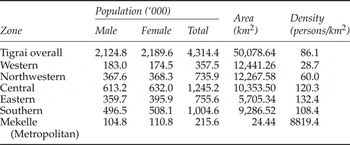
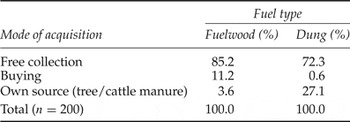
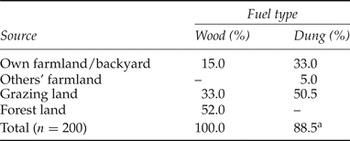
The Tigrai region covers a total land area of about 50,000 km2 (table 1). Of this total landmass about 25 per cent is cultivated, and forest/grazing lands constitute about 37 per cent (Gebreegziabher, Reference Gebreegziabher2007). Historically, institutions/property rights to land in Ethiopia were vested in either the rist system, the gult system/private land holding, or the church. The rist Footnote 4 system was the dominant type of land tenure in Tigrai before the 1975 land reform. It was a communal land tenure in which the right to land was not exclusive but shared. Under this system, an individual had usufruct rights to land (rist rights) in a given community only if she was able to establish a direct line of descent from the recognized original holder of the land. Nevertheless, the individual's usufruct rights to land were not transferable to others through sale or mortgage, though there was room for temporary lease. Moreover, as the right to land under the rist system did not imply a right to any specific parcel, land redistribution was undertaken periodically to ensure that new entrants/family members were granted access. This resulted in land fragmentation. In addition, the fact that any person's land parcels might be reallocated to distant kinsmen/women and that no one could sell them for a profit or leave them to an heir reduced a farmer's incentive to invest in long-term land improvements and hence resulted in land quality deterioration (Hoben, Reference Hoben1995; Hagos et al., Reference Hagos, Pender and Gebreselassie1999). The gult system was characterized by absentee owners, as it was the royal kinsmen/women who had the gult holdings (Hussein, Reference Hussein2004). With the 1975 land reform (Proclamation No. 31, 1975), these previous systems of tenancy were abolished (Nickola, Reference Nickola and Penrose1988).Three distinctions are now made regarding rights to trees/forests in the country at large and Tigrai in particular (Gebreegziabher, Reference Gebreegziabher2007). These are private/individual tree holdings, community forests (woodlots) and state forests. The private/individual tree holdings include trees privately grown around homesteads and cultivated land for various purposes which fall under the category technically referred to as agro/farm forestry. It also includes indigenous trees kept/managed on privately held land for various purposes. Arguably, property rights here are vested in the individual farmer/holder. That is, the holder (farmer) is free to make use of, sell or rent the yield, berries or exudes of such trees found on his/her land, except for the policy restrictions that the land cannot be sold or mortgaged. The community forests (woodlots) are area enclosures and community plantations where the rights are vested in the respective communities. State forests constitute natural forests preserved for biodiversity conservation and other purposes where the property rights are vested in the state. It could be either national forest priority areas (NFPAs) or regional forest priority areas (RFPAs). Cross-boundary forest areas also fall within the category of state forests. Grazing lands in the region also remain largely common property resources used under different management regimes where respective communities collectively own and exercise control over a clearly delineated section of the entire resource.However, population pressure, market and government failure, tenure insecurity, and lack of effectiveness in internal governance, particularly the absence or ineffectiveness of use regulations of common property resources, have resulted in severe degradation of the resources (Hagos et al., Reference Hagos, Pender and Gebreselassie1999; Gebremedhin et al., Reference Gebremedhin, Pender and Tesfay2003, Reference Gebremedhin, Pender and Tesfay2004). In addition, the erosion of common property institutions for various reasons as well as the non-recognition of common property systems are also among the threats to these resources. It appears that it was after the 1975 land reform which made land public property in Ethiopia that common property institutions came to be seriously threatened (Gebreegziabher, Reference Gebreegziabher1999). This is mainly because, firstly, the land reform brought about the sentiment that ‘land belongs to everybody’, that ‘land is the property of the state’, and this sentiment resulted in increased outsiders' pressure on the common pool resources. Secondly, as a result of subsequent changes in the political and administrative system, there was a reorganization and merger of two or more villages into one in which owners of a common pool resource were merged with other villages with no original claim over the resource. This, in some contexts, resulted in the erosion of common property institutions. But, more importantly, as explained in the preceding section, common pool resources may be subject to externalities and these externalities open up the possibility that these resources are not managed efficiently (McCarthy, Reference McCarthy2004).Moreover, fuelwood and dung remain largely free access resources. For example, free collection accounted for the dominant part of all household fuel uses in our sample (table 2). Natural forests and grazing lands were found to be the major sources of freely collected fuels with private sources constituting a lesser proportion (table 3). As a result of the free and uncontrolled grazing system that is prevalent in the region, livestock stay outside for most of the day both grazing/browsing and searching for feed. Eventually, the animals leave their manure/dung, which is free for use by anyone and there is no defined ownership right to it. For instance, dung collected from rural hinterlands accounts for a significant portion of total household cooking fuel in some towns in Tigrai (Newcombe, Reference Newcombe, Schramm and Warford1989). This degrades the land further. As is clear from the preceding section, alternative solutions have been proposed to solve this problem, including the privatization, imposition and enforcement of use rules by external forces such as the government, or state ownership of the resources. Often privatization, i.e., enforcing a private property institution, is seen as a panacea to the common pool resources problem. Therefore, we here examine consumer welfare effects of enforcing a private property institutionFootnote 5 on common property resources and contribute to the debate.

Distribution of sample households by method of acquiring fuel

Distribution of sample households by source of collected fuels by fuel type

a The remaining are households not using dung at all.
4. Theoretical model
4.1. Households' maximization problem
Consider the case of a consumer who is assumed to behave as if maximizing a well-behaved utility function defined over the quantities of commodities consumed q and environmental and household characteristics z, subject to budget constraint m. Let the household's utility function be specified as (Sadoulet and de Janvry, Reference Sadoulet and de Janvry1995):

Solving for the Lagrangian function of the household's utility maximization problem in the usual procedure and assuming the second-order conditions are satisfied gives us the ordinary (observed) demand function:

Substituting the demand function derived from this constrained maximization into u in (1) gives us the indirect utility function:

The indirect utility function v(·) is the maximum utility that the household can reach for given prices p and income m.
4.2. Welfare effects of change in an institutional setting
Now consider a change in price of the ith good, p i, from p i0 to p i1 resulting from some public policy. For instance, such a public policy might emanate from the intention to change the existing institutional setting governing communal forest and grazing lands, e.g., fuelwood and dung, to alter the open access condition and curb the devastation. Before proceeding, it is important to note that we assume weak separability among the vector of commodities or goods q in equation (1). Specifically, we assume separability between these two goods of interest and the rest of the commodities in q so that we can concentrate our analysis on the two goods of interest (Deaton and Muellbauer, Reference Deaton and Muellbauer1980). It could be envisaged that welfare depends not only on fuelwood and dung but also on other products of common pool resources such as timber and fodder/grass. However, we are focusing only on fuelwood and dung because of data limitations. Specifically, we assume that price of wood and dung change with all other things remaining unchanged. We assume all others remain unchanged, firstly because the rest of the variables are not directly/significantly affected by the envisaged change in institutional setting. Or, put differently, they change so slowly relative to the changes in the variables of interest that they can be taken as practically constant at any point in time. Secondly, holding all the other factors constant allows us to focus on the unique effects of the variables of interest by simplifying the complexity of the causal setting.
Now, imagine a public scheme aimed at enforcing a private property institution to forest/wood resources and grazing lands. Three policy alternatives could be envisaged at the disposal of a policy maker: (1) completely defining/enforcing a private property institution only for wood resources with grazing lands left intact; (2) completely defining a private property institution only for grazing lands with forest/wood resources left intact; and, (3) defining a private property institution both on forest/wood resources and grazing lands simultaneously. For tractability of the problem at hand we make the following simplifying assumptions: (i) the cost of completely defining private property rights is zeroFootnote 6; (ii) to circumvent the skepticism that a private property institution might lead to imperfect competition and guarantee that harvests are socially optimal, we assume that the privatization scheme is reasonably fair and does not result in imperfect competition; (iii) households will separate (discriminate) into buyers and sellers (resource owners) in fuel and face the same equilibrium priceFootnote 7; (iv) as wood and dung are no longer freely collected, privatization ultimately translates itself into increased prices.Footnote 8 Nonetheless, in general, the extent to which prices increase cannot be determined a priori.
The mechanism for operationalizing a private property institution is that agents are granted an endowment of tradable/transferable permits/deeds to the in situ resources, which they control over time. Specifically, individuals, in our case the landless and youth, are assigned parcels of communal forest/grazing lands for which they will have title deeds. These deeds carefully define/specify the boundaries, as boundaries are so important in resolving disputes. Deeds are distributed in lots through a lottery method, as experienced in the previous redistribution or reallocation of cultivated land. And each lot has fair share, both in quality and quantity, of the present communal natural resource stock. The role of the regulator is confined to choosing the initial allocation of the endowments of permits/deeds and developing the rule governing the game.
Suppose that (p i0, m 0) and (p i1, m 1) measure the prices and incomes that our representative consumer would face under the two (different) policy regimes for i = f, d, respectively standing for wood and dung as in above. (p i0, m 0) represents the status quo where p 0 and m 0 denote initial prices and income levels while (p i1, m 1) represents the proposed change with the new levels of prices and income respectively. How would, then, such price (policy) change affect the agents' wellbeing? Following Sadoulet and de Janvry (Reference Sadoulet and de Janvry1995), the welfare change involved in moving from (p i0, m 0) to (p i1, m 1) can be expressed as the difference in indirect utility function:

The intuition is that if the utility difference in equation (4), as far as our agent is concerned, turns out to be positive, the change in institutional setting would be worth doing; it is not worth doing if it turns out to be negative. However, note that utility theory/measure as in equation (4) is purely ordinal, but our interest is to quantify the utility/welfare change in monetary terms. Therefore, we need a convenient monetary measure of changes in our agent's welfare. We considered the equivalent variation (EV) as the motivation to get a reasonable indicator of the likely welfare effects of price (policy) change being examined.Footnote 9 Moreover, the EV is quite straightforward in that it uses current prices as the base and asks what income change at the current price would be equivalent to the proposed change in terms of its impact on utility. As noted by Freeman (Reference Freeman1993), the EV measure will consistently rank two or more policy changes provided that society is indifferent as to the distribution of gains and losses across individuals. Therefore, we specify the EV as follows:

where u 1 stands for utility level with changed prices.Footnote 10 Given initial prices and income, equation (5) could be computed for individual or simultaneous price (policy) changes. Apart from the magnitude, the direction of change as implied by the sign of the outcome is also important.
5. Empirical model and data
5.1. Empirical model
Essentially equation (5) is the relationship that enables us to measure/capture the effects of price (policy) change in some monetary form. Note that the first term in (5), e(p 0, u 1), is the income level at which our representative agent achieves utility level u 1 at prices p 0. And e(p 0, u 1) − m 0 is the net change in income that causes our agent to get utility u 1 at prices p 0. Assuming a Cobb–Douglas utility function, starting from the indirect utility function, equation (2), and making use of the expenditure function, we computed the welfare effects using a money metric indirect utility function. More specifically, for numerical computation of the welfare changes we used the following money metric indirect utility function:Footnote 11
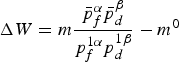
where W stands for welfare and Δ for change.Three things appear quite important for the numerical computation of welfare change using equation (6): numerical estimates/values of the substitution elasticities, i.e., α and β parameters; prices (shadow), p i0 and p i1; and income/expenditure on fuel, m. Free collection accounts for the majority of the fuels consumed in the study area. The households considered use family labor in fuel collection. Though fuelwood is traded in the towns in the vicinity of the study sites, a lesser proportion of the households were involved in fuelwood buying (table 2). Almost none of the sample households was involved in buying dung. Moreover, hiring labor for fuel collection is not common practice. Hence, it was clear that hired labor and family labor are not perfect substitutes and market wage rate cannot be taken as an appropriate measure of the opportunity cost of family labor used in fuel collection. Therefore, under such imperfect/missing market conditions, ‘virtual (shadow) prices'Footnote 12 are appropriate measures (Singh et al., Reference Singh, Squire and Strauss1986) and we used these prices in our analysis. The shadow prices were computed from the data set following the standard procedure in the literature.Footnote 13 And their average values were taken as initial prices in the welfare change calculations. Assuming the utility function associated with wood and dung is of the formFootnote 14:
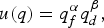
where q f and q d are quantities of wood and dung consumed by a household with α, β ∈ (0,1) and α + β < = 1. To find the parameter values/numerical estimates of the substitution elasticities α and β, we estimated the transformed form of (7).Footnote 15 Hence, given initial prices and expenditure on the two fuels, and parameter values, α and β, we can now calculate the welfare effects for three different scenarios: independent price (policy) change for ith good holding the other constant and simultaneous price (policy) change for both goods.
5.2. Data and sampling design
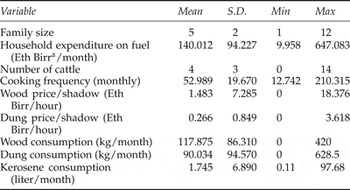
The data used in this paper come from a survey of 200 cross-section households conducted in 2000 in Tigrai region, northern Ethiopia. Two-stage sampling was used to select the sample households. First 50 tabias/kebeles – the smallest administrative unit in the region – were randomly selected from a total of 600 available tabias, and then a random sample of 200 households was selected from these tabias. A survey method was employed in this research for data collection. A questionnaire that can generate the desired data was designed and pre-tested at field level for verification and further modifications. The survey was administered in Tigrigna (the local language) using two enumerators who were trained for the data collection. Both quantitative and qualitative data were collected on the cooking/baking frequencies of households, household's production (collection) and consumption of various biomass fuel types, and issues regarding household income, demographic characteristics of the household including age, sex and literacy level of the household head, and household size. Responses on the amount of the different fuel types consumed by the household were collected in local units. Every local unit was measured for each household to facilitate conversion into metric units and minimize error. Qualitative data collected included reasons for preference of particular fuel type, mode of acquisition of the various fuels used, sources of collected fuels, etc. Also obtained from the survey were family resource endowments including total time endowment and labor allocation to various activities, total land holding, land area cultivated, and livestock holdings of households, village level factors including agro-ecological conditions or altitude range and distance traveled (time spent) to collect different fuels. Summary statistics of the variables considered in the analysis are presented in table 4.
Summary statistics of variables considered in the analysis (n = 200)

a Eth Birr is the Ethiopian currency: US$ 1 = 13.49 Eth Birr as of 12 March 2010.
Data on cooking/baking frequencies of households was weighted for respective end use share in the total household fuel (EESRC, 1995).
6. Results and discussion
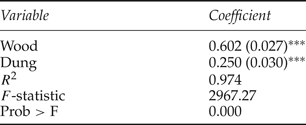
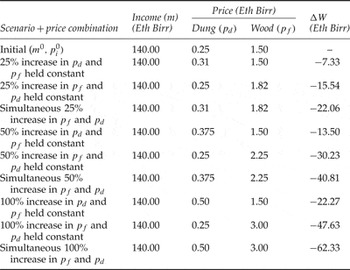
First, empirical estimates of parameters of substitution elasticities between the two goods were obtained using the Cobb–Douglas utility function. All the coefficients/parameters turned out to be highly significant, i.e., at the 1 per cent level (table 5). Having estimated parameters α = 0.6, β = 0.25; and considering p f0 = 1.50 Ethiopian Birr (Eth Birr), p d0 = 0.25, and m 0 = 140.00 as initial prices and expenditure on fuel we analyzed the likely effect(s) of price change, say from p i0 to p i1, resulting from change in institutional setting that could be envisaged to alter the open-access conditions of the fuel resources, on the wellbeing of a representative agent/consumer. The respective average values in the data set were taken as initial prices and expenditure on fuel for our representative agent. Effects on the agent's wellbeing were analyzed numerically under three alternative scenarios: first, price of dung (p d) changes while wood price is held unchanged; second, price of wood (p f) changes and price of dung is held unchanged; and, third, simultaneous change in both prices. Because the extent to which the change in policy increases prices cannot be determined a priori, we computed the welfare effects of the policy change for alternative price levels. Three different levels of prices, i.e., 25, 50 and 100 per cent increase in price were considered. Our findings reveal there are private welfare costs involved, be it an independent price (policy) change in the ith good or a simultaneous price (policy) change in both goods. Results show that an independent 25 per cent increase in price of the ith good would lead to a welfare loss of some one-twentieth of our agent's monthly expenditure on fuel, whereas a simultaneous price increase of a similar amount would increase the welfare loss to two-twentieths. We found that a simultaneous 25 per cent increase in the prices of wood and dung results in welfare loss equivalent to an independent 50 per cent increase in wood price, with dung price held constant or 100 per cent increase in dung price, with wood price held constant. On the whole, we found that the loss in wellbeing is some 7.33–62.33 (Eth Birr), or about 5–40 per cent of a household's average monthly expenditure on the two fuels. A possible explanation for this is that a number of people including the poor are dependent on unregulated communal forest and grazing land and privatization of such land affects these beneficiaries negatively. The details are provided in table 6.
Estimation results (S.E. in parenthesis) of substitution elasticities (parameters)/Cobb–Douglas utility function (n = 200)
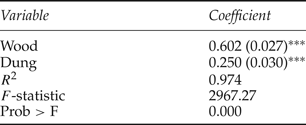
***indicates significance at the 1% level.
Welfare effects of price (policy) change for a representative household under alternative scenarios and price levels (for α = 0.6, β = 0.25)

Theoretically, open or uncontrolled access leads to rent dissipation. This implies that if land is privatized, rent would be captured (maximized) which, according to economic theory, is welfare-improving. That is, when price increases, income of the resource owner increases. Hence, the welfare impact of privatization for those who sell fuelwood could be expected to increase. However, if there is any land to be given, the current policy allows the land to be given or redistributed to the landless and youth. Unfortunately, we don't have landless in our data set and cannot work out the welfare effects or gains on the producer side. Therefore, the results presented here represent only the consumer side of the problem.
7. Conclusions and implications
In Ethiopia all land is publicly owned and traditional fuels are collected mostly freely from the commons under uncontrolled community access conditions. Such an institutional setting has resulted in the major degradation of Ethiopia's land resources and dissipation of the resource rent, as available forest and grazing lands are used sub-optimally. An alternative to the current institutional setting is to enforce a private property institution. Using a data set from 200 cross-section households in Tigrai province, northern Ethiopia, this paper estimates substitution elasticities between two fuel goods, wood and dung. We then use these to derive estimates of the potential consumer welfare costs of implementing a private property institution on communal forest and grazing lands.
We use average values in the data set as initial prices and income for our representative consumer to numerically analyze the effects on our agent's wellbeing of the policy of enforcing a private property institution under three alternative scenarios: (1) price of dung changes while wood price is held unchanged; (2) price of wood changes and price of dung is held unchanged; and (3) simultaneous change in both prices. Because we cannot determine a priori the extent to which the change in policy increases prices, we considered three different price levels. Our findings suggest that privatization of the currently common pool resources of forest and grazing lands might indeed be consumer welfare reducing. The findings hold for an independent price (policy) change in one good or a simultaneous price (policy) change in both goods and for different price levels. The loss in wellbeing is some 7.33–62.33 Eth Birr, or about 5–40 per cent of households’ average monthly expenditure on the two fuels. A possible explanation for this substantial loss in wellbeing is that a number of people including the poor are dependent on unregulated communal forest and grazing land and privatization of such land incurs consumer consumption cost to them. Considering the welfare loss to consumers only, our results support the status quo and might justify the government's reluctance to impose a private property institution on communal forest and grazing lands. However, analysis of producer welfare implications need to be conducted before firm conclusions can be drawn.
Our results show that, as far as consumer welfare is concerned, private management is not preferred, raising the question of how these communal resources should be managed in order to ensure sustainability. Centralized management by public agencies is one option. However, major difficulties with centralized control of resource management relating to informational problems, problems of enforcement of government rules, corruption and reluctance to punish violations or at least non-cooperation on the part of resource users have been observed throughout the developing world (Baland and Platteau, Reference Baland and Platteau1996). Therefore, a community management system could be a better option, since it allows for the alignment of incentives for conservation by transferring management of the resources to parties with the greatest economic stake in their management. Several researchers have documented the effectiveness of community resource management and the conditions under which it may work better.
Gebremedhin et al. (Reference Gebremedhin, Pender and Tesfay2004) posit that collective action in relation to grazing land management may be more beneficial and more effective in areas with intermediate population, higher social capital, and lower heterogeneity in oxen ownership which are far from marketplaces. In a related study, Gebremedhin et al. (Reference Gebremedhin, Pender and Tesfay2003) found that community woodlot management may be more effective and beneficial if done at a more local level, when the role of external organizations is demand-driven, and when promoted in intermediate population density, and in communities more distant from marketplaces. Other studies showed that community resource management would be effective in situations where the resource is vital to the livelihood of the people, when the resource has clear boundaries and outsiders are excluded, provision and appropriation rules are adapted to site-specific situations, decision making is participatory (democratic), monitoring is done by agents that are designated locally, some form of local court or other conflict resolution arena exists, graduated sanctions for infringements are used, and outside government respects CPR institutions (Ostrom, Reference Ostrom1990). In the context of communal pastoral range lands, McCarthy et al. (Reference McCarthy, Kamara and Kirk2001) also found that cooperation is positively related to factors that increase the profitability of livestock, but negatively related to the total number of households, the use of community pastures by non-community members, and the heterogeneity of wealth within the community. They suggest that, given the importance of mobility and the poor suitability of most land for cropping in such communities, measures to offset the increasing densities should focus on improving the capacity of communities to cooperate and mitigate the impact of heterogeneity on that capacity, and on improving market access to improve cooperation and increase incentives to sell stock in good as well as bad years. Pender and Scherr (Reference Pender and Scherr1999) also identify moderate or lower population density, distance from urban market, and literacy level as factors positively associated with local organizational development for resource management.

 , and gives the income required to reach the utility level v(p, m) when prices are
 .