Pervasive antibiotic use and frequent episodes of acute-care hospitalization in older adults make nursing homes (NHs) important reservoirs of multidrug-resistant (MDR) bacteria.Reference Lim, Cheng and Kennon 1 , Reference van Buul, van der Steen and Veenhuizen 2 Frequent, close contact with staff and proximity to other NH residents provide multiple opportunities for MDR bacteria transmission.Reference Lim, Cheng and Kennon 1 , Reference van Buul, van der Steen and Veenhuizen 2 MDR infections are more costly to treat and lead to frequent hospitalizations.Reference van Buul, van der Steen and Veenhuizen 2 , Reference O’Fallon, Pop-Vicas and D’Agata 3 Although most studies of MDR bacteria among NHs have focused on methicillin-resistant Staphylococcus aureus and vancomycin-resistant Enterococcus,Reference Lim, Cheng and Kennon 1 , Reference LeDell, Muto, Jarvis and Farr 4 Escherichia coli, the most common cause of urinary tract infection, and commonly found in the groin, wounds, and medical devices,Reference Smith, Seip, Schaefer and Bell-Dixon 5 – Reference Fisch, Lansing and Wang 10 is increasingly MDR. A 2014 Pennsylvanian study of 3 NHs estimated the incidence of fluoroquinolone-resistant E. coli acquisition as 47.5% within a median of 57 days, with increased risks associated with urinary catheter use and fecal incontinence.Reference Han, Maslow and Han 11 More than one-third (34%) of E. coli isolated in a 2011 Michigan study of 14 NHs were ciprofloxacin-resistant E. coli (CipREc); CipREc occurred twice as frequently among isolates from residents with medical devices (50% vs 26%).Reference Dommeti, Wang, Flannery, Symons and Mody 12
CipREc often occurs together with extended-spectrum beta-lactamase (ESBL) production; many ESBL isolates belong to the multilocus sequence type (ST) 131.Reference Nicolas-Chanoine, Bertrand and Madec 13 – Reference Coque, Novais and Carattoli 15 Twenty-eight (13%) of 208 urinary E. coli isolates from asymptomatic residents in 5 Dutch NHs were MDR; 19 were ciprofloxacin resistant and 14 were ST131.Reference van der Donk, Schols, Driessen, Hagenouw, Meulendijks and Stobberingh 16 A 2015 Minnesotan study in 2 NHs found 24% of residents carried fluoroquinolone-resistant E. coli of the ST131 lineage in their stool.Reference Burgess, Johnson and Porter 17
We contribute to and expand on existing estimates of the incidence, reacquisition, and duration of carriage of CipREc among NH residents by following high-risk NH residents over time, evaluating colonization at multiple anatomic sites, and comparing estimates by strain type and by membership in the O25b-ST131 lineage. We hypothesized that E. coli strain and membership in the O25b-ST131 lineage would be associated with incidence, reacquisition, and duration of carriage.
METHODS
Study Setting and Patient Population
We included 246 high-risk NH residents from 5 of 12 Michigan NHs participating in the Targeted Infection Prevention study between 2010 and 2013.Reference Mody, Krein and Saint 18 Briefly, the goal of the cluster-randomized trial was reducing antibiotic resistance and infections in residents with indwelling devices. NHs were stratified by ownership (for profit vs not for profit)Reference Harrington, Woolhandler, Mullan, Carrillo and Himmelstein 19 , Reference Hillmer, Wodchis, Gill, Anderson and Rochon 20 and the intervention randomly assigned. Residents from 3 intervention and 2 control NHs with sufficient numbers of CipREc isolates for meaningful analysis were included here. The intervention included preemptive barrier precautions, active surveillance for MDR bacteria and infections, hand hygiene promotion, and NH staff education; non-enrolled residents in intervention NH as well as control NH staff followed existing standard precautions for MDR bacteria. Surveillance for MDR bacteria and infections was passive in control NH.Reference Mody, Krein and Saint 18 Eligible, consenting residents had an indwelling urinary catheter and/or enteral nutrition tube for more than 72 hours. Residents were excluded if receiving end-of-life care. Participants were followed up from enrollment to 1 year or to their discharge from the NH, death, or device removal, whichever occurred first. Participants were sampled up to 14 times during this period: on days 0, 14, and 30, and subsequently every 30 days from enrollment through the follow-up period. Antibiotic history was assessed for the 30 days prior to first isolation of CipREc for those with CipREc or at enrollment for all others.
The University of Michigan and Veterans Affairs Ann Arbor Healthcare System institutional review boards approved the study protocol.
Sample Collection and Qualitative Resistance Testing
Microbiologic samples from the nares, oropharynx, groin, perianal area, enteral nutrition tube insertion site, suprapubic device site, and/or wounds (if present) were obtained for all participants at each visit. Samples were then screened for resistance using standard microbiologic methods. Samples were streaked on selective MacConkey agar plates (BD) containing ciprofloxacin at a concentration of 1 µg/mL u. Only CipREc isolates were included in this study; if present, 1 resistant colony per morphology per site was identified to the species level using API 20E strips (bioMérieux). The 227 ciprofloxacin-resistant isolates were selected for further testing.
DNA Isolation
Genomic DNA was obtained from boiled lysates of isolated colonies from samples grown overnight on brain heart infusion agar plates and emulsified in 50 µL of elution buffer, then heated for 10 minutes at 95°C in an S1000 thermal cycler (Bio-Rad), and centrifuged at maximum speed for 1 min; and the supernatants were used immediately as polymerase chain reaction (PCR) templates.
Repetitive Element Palindromic–PCR Amplification
Repetitive element palindromic (REP)–PCR amplification was performed using (GTG)5 primers (5′-GTGGTGGTGGTGGTG-3′; Invitrogen) following a previously described protocolReference Mohapatra and Mazumder 21 but with slight modifications. The reaction volume consisted of 12.5 µL GoTaq Green Master Mix (Promega), 2.5 µL of template DNA from the boiled bacterial lysate, 1.9 µL of 10 µM primer, and 8.1 µL of nuclease-free PCR water to make a 25 µL amplification reaction. Nuclease-free PCR water was used as a negative control and genomic DNA of E. coli K-12 strain as a positive control. The PCR amplification was performed in an S1000 thermal cycler (Bio-Rad), with the following conditions: an initial denaturation step at 95°C for 2 min, followed by 30 cycles of denaturation at 94°C for 3 sec and 92°C for 30 sec, annealing at 40°C for 1 min, and a single final extension step at 65°C for 8 min with a 4°C hold step. Following this, amplified DNA fragments were separated by electrophoresis on 1.5% agarose gel with a nucleic acid stain, GelRed (Biotium), using a 1 Kb Plus DNA ladder (Fisher Scientific) as a marker. The banding patterns were visualized and photographed under ultraviolet light (300 nm wavelength) and strains with at least 1-band difference were considered a different REP-type.
Multiplex PCR Detection of O25b-ST131 E. coli Isolates
We detected strains of the O25b-ST131 lineage by a multiplex PCR amplification using O25pabBspe.F (5′-TCCAGCAGGTGCTGGATCGT-3′), O25pabBspe.R (5′-GCGAAATTTTTCGCCGTACTGT-3′), trpA.F (5′-GCTACGAATCTCTGTTTGCC-3′), and trpA2.R (5′-GCAACGCGGCCTGGCGGAAG-3′) primer pairs (Invitrogen) to amplify the 347-base-pair fragment of the pabB gene and the 427-base-pair fragment of the trpA gene. This assay was developed and validated in 2009 by testing known representatives and nonrepresentatives of the O25b-ST131 lineage.Reference Clermont, Dhanji and Upton 22 Slight modifications were made to the previous protocol and we validated this by testing known ST131 and non-ST131 isolates previously determined by multilocus sequence typing. Our reaction volume consisted of 12.5 µL GoTaq Green Master Mix (Promega), 2.5 µL of template DNA from the boiled bacterial lysate, 2.5 µL each of 10 µM pabBspe (forward and reverse) and trpA (forward and reverse) primers, and 5 µL of nuclease-free PCR water to make a 25-µL amplification reaction. Three controls were included in each PCR: nuclease-free PCR water as a negative control, genomic DNA of E. coli K-12 strain as an O25b-non-ST131 strain positive only for the trpA gene product, and genomic DNA of a previously determined (using multilocus sequence typing) O25b-ST131 strain, positive with both PCR products. The PCR amplification was performed in an S1000 thermal cycler (Bio-Rad), with the following conditions: an initial denaturation step at 94°C for 4 min, followed by 30 cycles of denaturation at 94°C for 5 sec, annealing at 65°C for 10 sec, extension at 72°C for 1 min, and a single final extension step at 72°C for 5 min with a 4°C hold step. Amplified DNA fragments were then separated by electrophoresis on 1.5% agarose gel with a nucleic acid stain, GelRed (Biotium), using a 100-base-pair DNA ladder (Fisher Scientific) to serve as a marker. The banding patterns were visualized and photographed under ultraviolet light (300 nm wavelength).
Analysis of Duration of Carriage and Recolonization Risk
We estimated the mean duration of carriage directly as well as from estimated incidence and prevalence. For directly observed duration our decision rule was as follows: if a resident missed or had a negative culture bookended by the same REP-type (eg, month 3 positive, month 4 negative, month 5 positive), we considered the resident to be continuously colonized; negative cultures for 2 or more consecutive periods were considered truly negative and subsequent positive cultures within the follow-up period were identified as recolonizations. This is similar to the definition established by Muder et alReference Muder, Brennen and Wagener 23 and applied by Fisch et alReference Fisch, Lansing and Wang 10 for prospective studies in the NH setting. For 2 individuals in this group, there was 1 negative and 1 or more missing culture prior to reacquisition; we conservatively included these as reacquisition. Total carriage time by REP-type and by NH was calculated (1) with each resident contributing the longest consecutive period of carriage and (2) with each resident contributing all consecutive periods of carriage as single observations. The mean duration of carriage for both estimates was calculated by dividing by the total number of residents in each category. For duration estimates using incidence and prevalence, we used the observed period prevalence with the assumption that the incidence rates and duration were stable over time.Reference Rothman 24 Person-time at risk was used to estimate the incidence, which accounts for the different durations of follow-up.
We estimated the probability of a second acquisition occurring during the follow-up period for residents who were not colonized with CipREc on the first day of the study, were colonized for at least 1 period, had 4 or more sampling visits, and had at least 2 sampling periods where no CipREc was isolated. A more stringent definition of reacquisition was used because of the possibility of misclassification of those previously infected as reacquisitions; their continued colonization might have been missed owing to sampling or laboratory error.
Statistical Analyses
All statistical analyses were performed using SAS, version 9.3 (SAS Institute). For comparisons among residents with and without CipREc, we used the Fisher exact test (2-tailed) for categorical variables and the t test for continuous variables. We tested for differences between NHs using generalized linear models and pairwise t tests. To detect differences in the rate of occurrence by NH, frequency data were analyzed using an unadjusted Poisson regression model comparing incidence rates by NH.
RESULTS
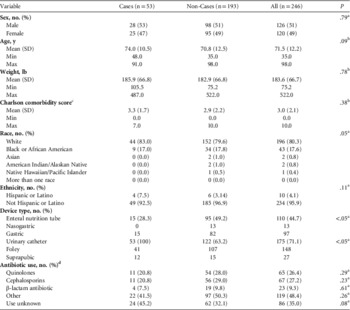
The 246 participants from 5 NHs averaged 71.5 years of age; 51% were male, 80.3% were white, and 17.6% were African American (Table 1). Overall, 71.1% had urinary catheters and 44.7% had enteral nutrition tubes; 16% had both devices. CipREc was isolated at least once from 53 (21.5%) of the 246 participants. Among the 3,813 specimens obtained, 227 (5.9%) were positive for CipREc; most were from the rectum (53%) and the groin (34%).
Baseline Characteristics of Participants in a Study of Ciprofloxacin-Resistant Escherichia coli (CipREc) Colonization From 5 Nursing Homes in Ann Arbor, Michigan

NOTE. Race and ethnicity information were missing for 2 non-cases.
a Comparison of frequencies between cases and non-cases was analyzed using the Pearson χ2 test or Fisher exact test.
b Comparison of variable means between cases and non-cases was analyzed using the independent sample t test.
c Number score, 0–37.
d Antibiotic use in 30 days prior to first isolation of CipREc (cases) or at time of enrollment (non-cases). Data on antibiotic use were available for 29 cases and 131 non-cases; categories are not mutually exclusive.
All residents with CipREc had a urinary catheter compared with 63.2% of noncolonized residents, and residents with CipREc were more likely to have a suprapubic catheter (22.6% vs 12.3%). However, CipREc positive residents were significantly less likely to have an enteral nutrition tube (28.3% vs 49.2%). Demographic variables, Charlson comorbidity score, and antibiotic use did not differ by CipREc colonization (Table 1).
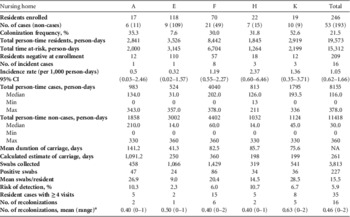
The period prevalence of CipREc colonization was not statistically significantly different by NH (Table 2). The average number of swabs per resident varied from 9.0 (NH E) to 28.5 (NH K), the NHs with the lowest and highest frequency of CipREc. However, NHs A and H had the highest risk of detection, 10.3% and 10.7%, respectively (Table 2). Among the 209 residents (85%) negative at enrollment, 16 (7.7%) acquired CipREc during follow-up, a rate of 1.05 cases/1,000 person-days. There were no statistically significant differences in incidence by intervention assignment.
Detection, Incidence, and Reinfection Estimates in a Study of Ciprofloxacin-Resistant Escherichia coli Colonization From 5 Nursing Homes in Ann Arbor, Michigan

NOTE. No significant differences were observed in the analyses of incidence, prevalence, and number of residents enrolled by nursing home.
a Mean number of recolonizations with any repetitive element palindromic–type, per resident, by nursing home; includes only residents with at least 1 colonization cleared by the previously stated rule and with ≥4 sequential sampling visits; mean number of recolonizations occurring during the follow-up period once colonized.
Strain Types
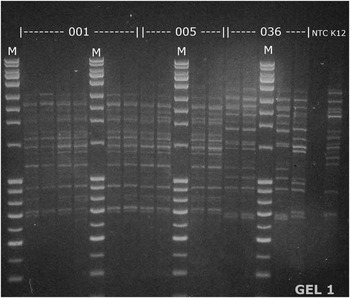
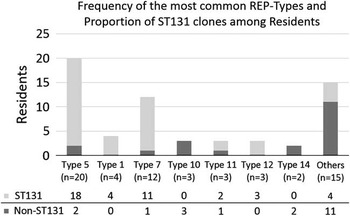
We observed 18 unique REP-types. REP-types were assigned arbitrary numbers to differentiate each genetically unique strain. Shown in Figure 1 are isolates of 2 residents who carried the same REP-type in different anatomic sites, and of a third resident who carried 2 different REP-types in different anatomic sites. Two REP-types (5 and 7) occurred in 60% of the CipREc colonized residents. REP-5 occurred in 38% of residents (n=20), REP-7 in 23% (n=12), and all other REP-types in less than 10% of residents. The predominance of 2 REP types suggests there may be ongoing transmission of these strains. Forty-four (83%) of the 53 CipREc-positive residents were intermittently colonized with the same REP-type throughout follow-up, independent of body site; further, 9 (17%) were intermittently colonized with more than 1 REP-type, independent of body site.
Comparison of repetitive element palindromic–polymerase chain reaction fingerprint patterns of 14 ciprofloxacin-resistant Escherichia coli isolates from 3 residents. Strains were collected from different body sites and at different times during follow-up. NTC, negative template control; K12 lab strain, positive control; M, molecular weight marker, 1 Kb Plus DNA ladder. Residents 001 and 005 are shown with identical strains during the follow-up period while resident 036 carried 2 different strains.

Incidence of Recolonization
Of the 246 residents, 37 (15%) were colonized at enrollment; and of the 209 residents negative at enrollment, 16 (7.7%) acquired CipREc during follow-up. Considering those with negative or missing cultures for 2 or more consecutive periods as negative, we identified 35 (66%) of these 53 residents with 4 or more sequential follow-up visits, allowing us to estimate risk of recolonization. There were 0.46 recolonizations/person/year (range, 0–2) (Table 2); recolonizations were highest for REP-type 11 (0.67), REP-type 12 and REP-type 1 (0.5 each), REP-type 10 (0.33), REP-type 5 (0.27), and REP-type 7 (0.25). Only one recolonization was with a REP-type different than the initial colonizing strain.
Duration of Carriage
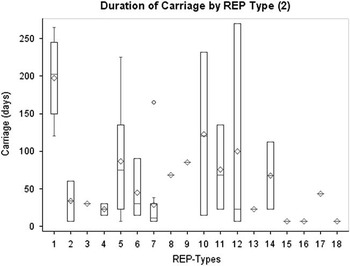
The mean observed duration of carriage of a single REP-type was 71 days (range, 7–270 days), and of multiple REP-types was 114 days (range, 15–255 days). Strains isolated from the perirectal area had the highest mean duration of carriage. Carriage duration varied by REP-type (Figure 2) and was longest for REP-type 1 (197 days; range, 120–265 days) and shortest for REP-types 15, 16, and 18, which were observed only once. Carriage duration did not differ by the presence of enteral nutrition tubes, urinary catheters, or both.
Average duration of carriage for each repetitive element palindromic (REP)–type with each resident contributing all consecutive periods of carriage as single observations.

Duration estimate calculated using incidence and period prevalence was longer: 261 days for all NHs (Table 2). By this method, REP-types 5, 1, and 7 had a mean duration of 78, 383, and 156 days/resident, respectively. There were no statistically significant differences in duration estimates by intervention assignment.
Clustering of Strains by Time and Space
Using a Poisson regression model, we could not reject the hypothesis that CipREc detection occurred at random and that no outbreaks occurred during the study (data not shown). REP-types 5, 7, 11, and 14 occurred in more than 1 NH and among 20, 13, 3, and 2 residents respectively, suggesting possible transmission across NHs and between residents.
Presence of O25b-ST131 E. coli Isolates
Most CipREc strains collected (62.2%) were of the O25b-ST131 lineage. Strains of the O25b-ST131 lineage were isolated from 74% of the 53 CipREc-colonized residents. The most common REP-types (REP-types 5, 1, and 7) were mostly of the pabB-based lineage of O25b-ST131 E. coli (Figure 3). These REP-types also had the longest total duration of carriage. Incidence of O25b-ST131 E. coli acquisition was slightly lower than that of other lineages (0.64 vs 0.68/1,000 person-days) but the prevalence was significantly higher (16% vs 6%). Thus, although the directly observed duration of carriage was similar by O25b-ST131 lineage (69.9 vs 66.5 days), the estimated duration of carriage using incidence and prevalence was much longer (297.6 vs 93.9 days).
Frequency of unique repetitive element palindromic–types found across all 5 nursing homes. Area of the bar is proportional to the relative abundance of the particular genotype among the 53 residents testing positive for ciprofloxacin-resistant Escherichia coli; the proportion of ST131 clones relative to each genotype is shown in lighter shade.

DISCUSSION
Among 246 Michigan NH residents, we found a high period prevalence of CipREc colonization (21.5%), high rates of recolonization following clearing (0.46 times), average duration of carriage of 6 months, and an incidence of 1.05 cases/1,000 person-days. Almost three-quarters of colonized residents carried strains in the O25b-ST131 E. coli lineage. O25b-ST131 strains were carried significantly longer (10 vs 3 months). Two of the observed 18 REP-types occurred in 55% of the colonized residents and in multiple NHs.
Our period prevalence of CipREc is similar to the 16%–18% found in 2 Dutch studies of NH residents.Reference van der Donk, Schols, Driessen, Hagenouw, Meulendijks and Stobberingh 16 , Reference Hoogendoorn, Smalbrugge, Stobberingh, van Rossum, Vlaminckx and Thijsen 25 As found in the study of urinary E. coli from 5 Dutch NHs, CipREc colonization varied by NH,Reference van der Donk, Schols, Driessen, Hagenouw, Meulendijks and Stobberingh 16 underscoring the possibility that interventions can reduce the occurrence and spread. Indeed, in the parent study for this analysis, there was a 23% decrease in the prevalence of all MDR bacteria among NHs assigned to a multimodal intervention by Mody et al,Reference Mody, Krein and Saint 18 although we found no statistically significant differences in mean CipREc carriage duration or acquisition rate between the 3 intervention and 2 control homes included here. Although our cumulative incidence of 7.7% was much lower than the 47.5% found in a study of 3 Pennsylvanian NHs,Reference Han, Maslow and Han 11 our incidence rate was only slightly lower: 1.05/1,000 versus 1.7/1,000 person-days (estimated).
By contrast, ESBL-producing E. coli transmission from Swiss hospital cases (infected or colonized) to hospital roommates or household contacts was 0.12/1,000 person-days,Reference Hilty, Betsch and Bögli-Stuber 26 an order of magnitude lower than our estimates. However, our enrollment criteria included presence of an indwelling device, which increases risk.Reference Mody, Maheshwari, Galecki, Kauffman and Bradley 9 – Reference Dommeti, Wang, Flannery, Symons and Mody 12 Further, we obtained specimens from multiple body sites and cultured specimens from the NH residents more frequently than in the other study. Our duration estimates are consistent with those from a Thai tertiary care facility of ESBL-producing E. coli: 98 days (range, 14–182 days),Reference Apisarnthanarak, Bailey and Fraser 27 and those from a Swedish study of 61 patients with ESBL-producing E. coli or Klebsiella pneumoniae where 43% were still carriers after 12 months.Reference Titelman, Hasan and Iversen 28
Although the identification of the same REP-type in multiple NHs suggests there may be ongoing transmission between NHs, alternative explanations are possible. Without additional epidemiologic information, we cannot rule out the presence of a common reservoir in an acute care facility or a high prevalence of these REP-types in the community.
The ST131 prevalence was similar to the 2011 surveillance study of 24 Veterans Affairs Medical Centers,Reference Colpan, Johnston and Porter 29 where 78% of the 236 clinical extraintestinal fluoroquinolone-resistant isolates were ST131. Unlike in the VA study, our isolates were colonizing rather than clinical and were primarily isolated from rectal swabs. We found no previous estimates in the literature of the incidence or duration of CipREc of the ST131 lineage. But, in our study, risk of acquiring CipREc did not vary significantly by ST131 lineage, although ST131 strains were carried for longer duration. Our estimates of risk of acquiring CipREc by ST131 lineage are much lower than the overall risk of acquiring CipREc because a person carrying non-ST131 CipREc is still at risk for ST131 CipREc and vice versa so the time at risk increases, necessarily decreasing the incidence.
Isolates from the same individual are likely the same strain, so if a different REP-type is observed within an individual the isolates are probably different strains. However, REP-typing is not as discriminatory as pulsed-field gel electrophoresis or whole genome sequencing, and thus the same REP-type from different individuals might actually be different strains. To minimize these limitations, all isolates from a single individual were run on a single gel, and isolates with the same REP-type from different individuals were re-run on the same gel. Our detection method for the O25b-ST131 has a reported sensitivity and specificity of 100% relative to multilocus sequence typing.Reference Clermont, Dhanji and Upton 22
Although we found a high probability of recolonization following clearance, we cannot rule out that recolonization was missed, because only 1 resident had de novo colonization with a genetically distinct resistant REP-type after clearance. Further, only 1 resistant colony was selected from a plate for testing, therefore we might have missed carriage of multiple REP-types. However, these limitations primarily affect estimates by REP-type and do not negate the importance of the estimates of CipREc period prevalence, incidence, and duration and the high frequency observed of the O25b-ST131 lineage.
Routine surveillance of CipREc transmission patterns serves as an important first step towards facilitating more-targeted infection control and prevention strategies to minimize transmission in NHs. Further studies with a sample size large enough to evaluate significant risk factors for CipREc and with additional epidemiologic data are required to better inform interventions targeting high-risk residents.
Members of the Targeted Infection Prevention Study Team
In addition to the authors, the Targeted Infection Prevention Study Team includes Suzanne Bradley, MD; Kay Cherian, MSc; Jay Fisch, MSc; James T. Fitzgerald, PhD; Andrzej Galecki, MD; Mohammed Kabeto, MS; Carol A. Kauffman, MD; Sarah L. Krein, PhD; Lillian Min, MD; Ana Montoya, MD; Tisha Moore, BA; Russell Olmsted, MPH; Ruth Anne Rye, BS; Sanjay Saint, MD; Kathleen Symons, BA; and Linda Wang, BS.
ACKNOWLEDGMENTS
We thank Carl Marrs, Emily Martin, and Victoire De Lastours for technical and editing assistance. We also thank the leadership and healthcare personnel at all participating NH facilities and all the members of the Targeted Infection Prevention Study Team.
Financial support. National Institute on Aging (grant ROI AG041780 to L.M. and B.F.; and grants K24 AG050685, ROI AG032298, and R18 HS019979 to L.M.); the National Institutes of Health (grant L23 AG028943 to L.M.); the University of Michigan Claude D. Pepper Older Americans Independence Center funding from the National Institute on Aging (grant NIA P30 AG024824 to L.M.); and the Veterans Affairs Healthcare System Geriatric Research Education and Clinical Center (to L. M.).
Potential conflicts of interest. All authors report no conflicts of interest relevant to this article.