Introduction
The echinostome Echinoparyphium recurvatum, an ubiquitous parasite of freshwater snails and birds in the UK, has been studied extensively in both the field (Evans et al., Reference Evans, Whitfield and Dobson1981; Morley et al., Reference Morley, Lewis and Adam2004a) and the laboratory (Evans, Reference Evans1982; McCarthy, Reference McCarthy1999a; Morley et al., Reference Morley, Crane and Lewis2002, Reference Morley, Crane and Lewis2003). In particular, several laboratory studies have focused on the transmission of cercariae into a range of molluscan species, which act as the second intermediate host, elucidating in particular transmission dynamics (Evans & Gordon, Reference Evans and Gordon1983a, Reference Evans and Gordonb; McCarthy, Reference McCarthy1990, Reference McCarthy1999b; Adam & Lewis, Reference Adam and Lewis1992) and the impact of pollutants (Evans, Reference Evans1982; Morley et al., Reference Morley, Crane and Lewis2002, Reference Morley, Leung, Morritt and Crane2004b, Reference Morley, Crane and Lewisc).
Echinostome metacercariae are known to encyst in a range of organs in second intermediate snail hosts, e.g. Toledo et al. (Reference Toledo, Munoz-Antoli, Perez and Esteban1999). Adam & Lewis (Reference Adam and Lewis1992) established that E. recurvatum metacercariae encyst primarily on the surface of the mantle cavity, secondarily in the pericardium, and least of all in the kidney. However, although the effects of temperature on transmission efficiency have been established for a number of echinostome cercariae, including E. recurvatum (Evans, Reference Evans1985; McCarthy, Reference McCarthy1999b), little is known about how temperature may influence the sites of encystment chosen by metacercariae in the snail second intermediate host.
The aim of the present study was to establish how temperature influences the distribution of E. recurvatum metacercariae in the second intermediate host snail, Lymnaea peregra. An initial investigation of cercarial survival and infectivity was undertaken over the experimental temperature range to provide transmission efficiency data to complement the studies on metacercarial distribution. To distinguish these preliminary studies from the previous work of McCarthy (Reference McCarthy1999b) significantly lower densities of cercariae were used to infect snails, thereby providing a more ecologically realistic data set.
Materials and methods
Cercariae of Echinoparyphium recurvatum were obtained from naturally infected Lymnaea peregra collected from Bushy Park, Hampton, Middlesex, UK (National Grid reference TQ160694). The experimental snail second intermediate host used was also L. peregra, which was laboratory bred from a breeding stock originally obtained from Bushy Park.
Survival of E. recurvatum cercariae was investigated at temperatures of 5, 10, 14, 17, 21, 25 and 29°C. At each temperature survival was examined by introducing pairs of freshly emerged cercariae into 40 glass tubes containing 50 ml of filtered stream water. The tubes were maintained in a thermostatically controlled water bath and four replicates were undertaken at each temperature. Cercariae were observed at intervals of time (1–7 h, dependent on temperature) until all were dead. Death was pronounced when cercariae failed to respond to mechanical stimulation with a fine needle.
Cercarial survival data were analysed using the Anderson & Whitfield (Reference Anderson and Whitfield1975) age-dependent survival model with the computer software MUCALC and MUTOFIT, kindly provided by Professor P.J. Whitfield (Kings College, London), which gave the mean instantaneous per capita death rate of cercariae,  at any given temperature, further details of which are provided by Evans & Gordon (Reference Evans and Gordon1983b) and McCarthy (Reference McCarthy1999b).
The establishment and distribution of metacercariae was investigated at the same temperatures as survival. At each temperature, four laboratory-bred L. peregra, 8.5–10 mm in size, were individually exposed to cercariae, which had been aged at 2-hourly intervals from 0 to 12 h and at 4-hourly intervals from 12 to 24 h. Snails were individually placed in glass tubes containing 50 ml of filtered stream water and transferred to a thermostatically controlled water bath. Snails were gradually acclimatized over several days to the required temperature to avoid thermal shock. Following acclimatizaton, 10 cercariae of appropriate age were added to the contents of each tube and the snails exposed for 1 h, before being transferred to a clean tube containing filtered stream water for a minimum period of 24–30 h to allow the completion of metacercarial cyst formation. Snails were individually dissected and the soft tissues (mantle surface, pericardium and kidney) examined for metacercariae.
The establishment of metacercariae, i.e. the infectivity of cercariae, was initially calculated as the parameter β, the instantaneous per capita rate of infection, as described in detail by Evans (Reference Evans1985) and McCarthy (Reference McCarthy1999b), and the infectivity life span of cercariae at each temperature determined and infection curves drawn. To provide a single summary statistic of infectivity at each temperature, the mean instantaneous rate of infection, , was calculated, according to Evans (Reference Evans1985), by dividing the area under each infection curve, obtained using the ‘Fortran program area’ computer program (Royal Holloway Computer Centre), by the corresponding maximum cercarial infective life span. A measure of cercarial transmission, which takes into account the impact of cercarial death rate on infectivity, was provided by the ratio (H 0) (May & Anderson, Reference May and Anderson1978) and its modified form (1/H 0) (Evans, Reference Evans1985) which varies inversely with transmission efficiency.
The distribution of metacercariae in the snail soft tissues was determined by combining data from cercariae of different ages (0–20 h) to give mean numbers and variances for establishment in the mantle, pericardium and kidney of L. peregra at each temperature, and analysed using Student's t-test.
Results
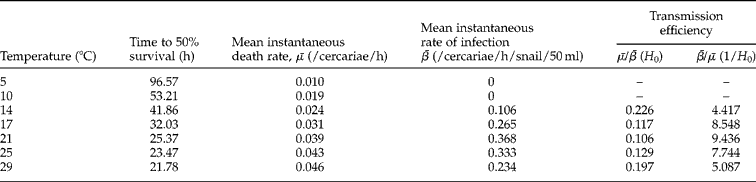
The survival of E. recurvatum cercariae was clearly influenced by the temperature of the water (table 1). Increasing temperature resulted in an increase in the mean instantaneous death rate of cercariae and a reduction in the time to 50% survival. Cercariae were actively swimming most of the time, mainly near the bottom of the container. Towards the end of the survival period cercariae declined and this was accompanied by an increase in the frequency of crawling on the bottom with the aid of suckers. Only a small number of cercariae lost their tails before death.
The effect of temperature on the transmission characteristics of Echinoparyphium recurvatum cercariae; H 0 after May & Anderson (Reference May and Anderson1978); 1/H 0 modified after Evans (Reference Evans1985).
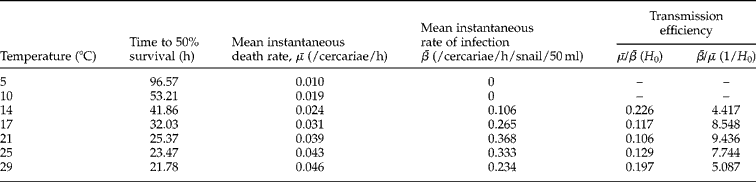
The infectivity of cercariae was also temperature dependent (table 1). At both 5°C and 10°C no metacercariae were recovered from exposed L. peregra. At these temperatures snails withdrew their soft tissues into the shell and demonstrated little locomotory activity. Between 14°C and 29°C infectivity increased, with the mean instantaneous rate of infection peaking at 21°C. Transmission efficiency (1/H 0) was also optimal at 21°C, nevertheless the degree of efficiency was relatively stable over a wide range of temperatures, i.e. 17–25°C (table 1). This is due to differences in the optima achieved for cercarial survival and infectivity at different temperatures, i.e. a low cercarial infection rate is offset by a low death rate at reduced temperatures and vice versa.
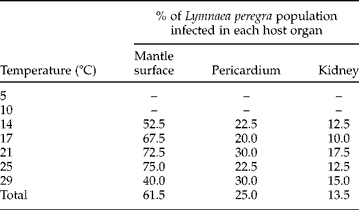
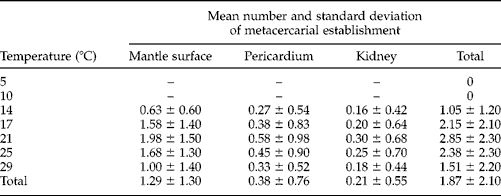
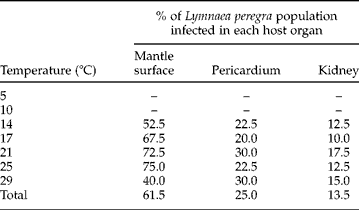
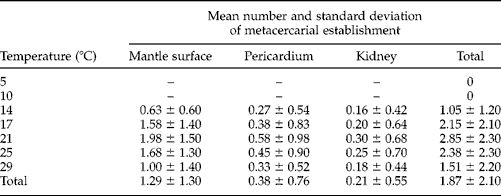
Metacercariae encyst in certain organs of L. peregra and, according to the most utilized, these include the surface of the mantle cavity, pericardium and kidney (table 2). No cysts occur in any other organ. In all snails examined no deformed or dead metacercariae were found. Within the infected snail population the surface of the mantle cavity always contained metacercariae (table 2). Changes in temperature did not significantly affect the distribution of metacercariae in the proportion of snails infected (table 2). However, the mean number of metacercariae recovered from each organ was dependent on temperature and peaked at 21°C for all organs (table 3). Encystment on the mantle surface significantly increased between 14 and 17°C (t-test, P < 0.01, t = 3.276) and significantly decreased between 25 and 29°C (t-test, P < 0.05, t = 2.202) with a relatively stable mean number of cysts between 17 and 25°C. In contrast, encystment in the pericardium and kidney did not significantly change over the temperature range 14–29°C (t-test, P>0.05, t ≤ 0.980). There were significant differences between mantle encystment and pericardium encystment in the temperature range 17–29°C (t-test, P < 0.01, t ≥ 2.813) but not at 14°C (t-test, P>0.05, t = 1.742), and between mantle encystment and kidney encystment in the temperature range 14–29°C (t-test, P ≤ 0.05, t ≥ 2.360). However, there was no significant difference between the pericardium and kidney encystment in the temperature range 14–29°C (t-test, P>0.05, t ≤ 1.476). In most organs across the entire temperature range, variances were greater than the mean number of encystments, indicating an aggregated distribution of metacercariae. Only on the mantle surface at 29°C was the mean greater than the variance, indicating a more even distribution of metacercariae on the mantle lobes of infected snails. The overall mean number of metacercarial cysts per snail at all temperatures was 1.87 ± 2.1 (table 3).
The effect of temperature on the prevalence (%) of Echinoparyphium recurvatum metacercariae in the mantle, pericardium and kidney of the experimental population of Lymnaea peregra (n=40 at each temperature).
The effect of temperature on the distribution of Echinoparyphium recurvatum metacercariae in the mantle, pericardium and kidney of Lymnaea peregra (n=4, each snail exposed to 10 cercariae).
Discussion
The present study has demonstrated that temperature can influence the transmission and establishment of E. recurvatum in L. peregra. The transmission efficiency (1/H 0) of cercariae over the temperature range of 5–29°C in the present study is low compared to that on E. recurvatum undertaken by McCarthy (Reference McCarthy1999b) over a similar temperature range. In the latter study a peak of 41.36 1/H 0 was achieved at 20°C whereas in the present study only 9.44 1/H 0 was managed at 21°C. These differences are likely to be associated mainly with the cercarial densities used. To expose a single snail, McCarthy (Reference McCarthy1999b) used densities of 5 cercariae in 3 ml of water (1.67 cercariae/ml) whereas in the present study the density was 10 cercariae in 50 ml of water (0.2 cercariae/ml). Although the exposure period used by McCarthy (Reference McCarthy1999b) was 20 min compared to 1 h, the density of either the host or parasite appears to be a decisive factor in parasite transmission. Evans & Gordon (Reference Evans and Gordon1983b) demonstrated that the relationship between cercarial density and establishment success was linear at low densities, while Meyrowitsch et al. (Reference Meyrowitsch, Christensen and Hindsbo1991) showed that snail-finding by Echinostoma caproni was temperature independent at low snail densities. Although the densities of echinostome cercariae in natural habitats are not known, studies on schistosome cercariae indicate that densities fluctuate with locality, parasite species or strain and time of day (Aoki et al., Reference Aoki, Sato, Muhoho, Noda and Kimura2003). For E. recurvatum the changing photo- and geotactic behaviour over time (McCarthy, Reference McCarthy1999c; Morley et al., Reference Morley, Crane and Lewis2003) will also lead to an accumulation of cercariae in different parts of the water column, particularly in areas associated with potential second intermediate hosts, although the exact densities of cercariae remain to be determined. Field studies by Morley et al. (Reference Morley, Lewis and Adam2004a) indicate a gradual accumulation of metacercariae over the summer, with a mean intensity of 49.0 metacercariae/snail recorded in July and a peak mean intensity of 274.1 metacercariae/snail by September. This suggests that at any hourly time period a low cercarial density rather than a high density is more likely in the aquatic medium.
The present study has shown that the use of low, more realistic, parasite densities in infectivity studies is important, especially at low temperatures as no transmission of E. recurvatum cercariae took place at 10°C. On the contrary, McCarthy (Reference McCarthy1999b), at this temperature, recorded a transmission efficiency of 26.33, which greatly exceeds the transmission efficiency achieved at any temperature in the present study. Such a high 1/H 0 is also in stark contrast to either the complete inhibition or the extremely low daily number of cercariae emerging from the first intermediate host at 10°C (McCarthy, Reference McCarthy1989; Adam, Reference Adam1991). In addition, at a temperature range of 17–25°C in the present study 1/H 0 does not change significantly, suggesting that at these temperatures, commonly encountered in many freshwater habitats in the UK during the summer, transmission is relatively stable and generally independent of temperature fluctuations.
McCarthy (Reference McCarthy1989) demonstrated that chemotaxis plays a large part in the host location of E. recurvatum cercariae, with penetration into the snail occurring through natural openings (Adam & Lewis, Reference Adam and Lewis1992). For encystment in the pericardium or kidney, cercariae enter via the nephridiopore, which opens directly into the kidney lumen and is connected to the pericardium via the renopericardial canal, whereas for encystment on the mantle cavity surface entry occurs through the pneumostome. In the present study, the relative proportion of successful encystments, following entry through these two openings, was relatively constant at approximately 70% via the pneumostome and 30% through the nephridiopore, only changing at the more extreme temperatures in favour of entry through the nephridiopore. Chemical cues that attract cercariae to enter the host through these two openings are not known, although the changing nature of cercarial choice of encystment site with extreme temperatures suggests that these attractants may be associated with changes in the physiological functioning of snails. In particular, changes in chemical cues emitted by the mantle appear to determine encystment site choice as there was no significant change in metacercarial establishment in either the kidney or pericardium over the experimental temperature range.
The mantle cavity is a prime source of encystment for E. recurvatum metacercariae. Lymnaea peregra uses the mantle cavity as a ‘lung’ for respiration, which may either contain a gas bubble or, more commonly, is water-filled (Russell-Hunter, Reference Russell-Hunter1953). Studies on cercarial chemotaxis in other species indicate that a range of chemicals may attract cercariae, including CO2 (Haas, Reference Haas1994). It is possible that one of the chemical cues in attracting E. recurvatum cercariae to the snail may be CO2, as it is produced through both respiration and urine excretion (Jones, Reference Jones1961; De With & van der Schors, Reference De With and van der Schors1984). In Lymnaea spp. the pericardium is considered the source of filtration for primary urine (Andrews, Reference Andrews1976) and increased encystment in this organ compared to the kidney, which cercariae must pass through to reach it, may be due to cercariae following a chemical gradient.
Echinoparyphium recurvatum can utilize a wide range of molluscs as its second intermediate host (Evans et al., Reference Evans, Whitfield and Dobson1981), although it is not known if the distribution of metacercariae within host tissues follows a similar pattern in all molluscs as that found in L. peregra, as wide differences in susceptibility of individual molluscan species are known to occur (Evans & Gordon, Reference Evans and Gordon1983a). Nevertheless, studies by Toledo et al. (Reference Toledo, Munoz-Antoli, Perez and Esteban1999) on the infectivity of the echinostome Hypoderaeum conoideum in a number of molluscan species found that although prevalence between host species was similar, there was a significant difference in intensity. Yet the distribution of metacercariae within individual organs always followed the same pattern. It seems likely therefore that the distribution of E. recurvatum metacercariae is similar regardless of which molluscan species becomes infected and any potential differences in the emission of chemical cues.
Although chemotaxis may play a large part in the encystment of cercariae on the surface of the snail's mantle cavity, it is possible that such behaviour has evolved to increase the chance of parasite transmission. Large numbers of metacercariae encysting on the surface of the mantle cavity are likely to interfere with oxygen diffusion across the respiratory epithelium. Changes in oxygen availability affect the geotactic orientation behaviour of pulmonate snails, leading to an increased negative geotaxis (Janse, Reference Janse1981). If respiration becomes more difficult, snails will spend more time at the water surface thereby increasing the chances of predation by the target bird host. Establishing whether metacercarial distribution within the second intermediate host aids subsequent transmission to the definitive host would be a suitable subject for further study.