Introduction
Pulmonary oedema frequently complicates paediatric cardiac surgery, leading to significant morbidity. Reference Sampaio, O’Hearn, Reddy and Menon1 Currently, clinicians use chest X-ray as the standard for screening pulmonary complications in these patients, exposing patients to the effects of ionising radiation. This diagnostic method also demonstrates limited sensitivity for diagnosing pulmonary oedema. Reference Girona-Alarcón, Cuaresma-González and Rodríguez-Fanjul2–Reference Gargani and Picano4
Lung ultrasound has emerged as a well-established tool for the diagnosis of pulmonary oedema, Reference Volpicelli, Elbarbary and Blaivas5–Reference Picano and Pellikka7 gaining significant prominence in the paediatric population. Its non-invasive, portable nature, and the absence of ionising radiation facilitate rapid, safe, and accurate bedside diagnosis. Reference Burton, Bhargava and Kong8 Lung ultrasound findings have been demonstrated to predict outcomes in paediatric patients, including duration of mechanical ventilation, extubation failure, postoperative pulmonary complications, and mortality. Reference Kaskinen, Martelius, Kirjavainen, Rautiainen, Andersson and Pitkänen3,Reference Vitale, Ricci, Gaddi, Testa, Toma and Cogo9–Reference Abdel Rahman, Saber and El-Maghraby11
Several authors have evaluated ultrasonography as a tool for diagnosing pulmonary complications in the subpopulation of CHD patients undergoing cardiac surgery. Reference Vitale, Ricci, Gaddi, Testa, Toma and Cogo9,Reference Cantinotti, Giordano and Volpicelli12–Reference Cantinotti, Marchese and Giordano14 The use of lung ultrasound as a complementary tool for pulmonary assessment in this context is becoming established, demonstrating added value compared to chest X-ray by aiding in the differentiation of common post-surgical conditions such as pulmonary oedema, pleural effusion, and atelectasis. Reference Cantinotti, Ait Ali and Scalese15 Moreover, lung ultrasound has shown prognostic potential. Reference Cantinotti, Giordano and Scalese10 Lung ultrasound has also been shown to diagnose pulmonary oedema earlier and more accurately than chest X-ray after cardiac surgery. Reference Ghotra, Kumar, Niyogi, Gandhi and Mishra13
This study primarily aims to investigate the association between pulmonary oedema severity by a lung ultrasound B-lines score and ventilatory outcomes after paediatric cardiac surgery.
Materials and methods
This is a prospective, single-centre cohort study conducted at a quaternary paediatric hospital serving as a reference centre for paediatric cardiac surgery in southern Brazil. The institution houses a 40-bed paediatric ICU and performs an average of 300 paediatric cardiac surgeries annually.
All patients 0–18 years who underwent cardiac surgery for CHD between April and November 2022 were included in the study. Patients with a previous diagnosis of chronic pulmonary disease, those who died before the first 24-hour postoperative assessment, and children extubated in the operating room were excluded. The study protocol received approval from the Institutional Ethics Committee, and informed consent was obtained from patients and/or from their legal guardians.
The primary outcome was extubation failure, and mechanical ventilation duration was the secondary outcome. Extubation failure was defined as the need for reintubation within 48 hours of initial extubation. For this study, prolonged mechanical ventilation was characterised by a length of mechanical ventilation support exceeding the sample median. Patient characteristics, cardiopulmonary bypass data, fluid balance, and mechanical ventilation parameters were collected. The Paediatric Index of Mortality 2 and the Risk Adjustment in Congenital Heart Surgery scores were employed to estimate the illness severity.
Pulmonary assessment was conducted using a Xario 100G ultrasound system (Canon Medical Systems Europe B.V.) equipped with a linear 4–11 MHz transducer and a portable wireless Mobissom MDUO 7.5–10 MHz ultrasound device. The choice of the ultrasound machine was randomly defined, according to availability. Both transducers were linear, with similar footprint sizes, and the device adjustment was optimised for the highest possible frequency to penetrate the region of interest. Measurements were obtained preoperatively (maximum 72 hours before surgery) and at three postoperative time points (between 0 and 24 hours, between 48 and 72 hours post-cardiac surgery, and on the day of extubation).
Lung ultrasound assessments were conducted at the bedside with patients in a supine position. Three regions were evaluated in both hemithoraces: parasternal, anterior axillary, and posterior axillary (Fig 1). Reference Girona-Alarcón, Cuaresma-González and Rodríguez-Fanjul2,Reference Rodríguez-Fanjul, Llop, Balaguer, Bautista-Rodriguez, Hernando and Jordan16,Reference Kaskinen, Martelius, Kirjavainen, Rautiainen, Andersson and Pitkänen3 Pulmonary B-lines were defined as uninterrupted vertical echogenic artefacts arising from the pleura, traversing the sliding transverse A-lines, and continuing to the edge of the screen. Based on this assessment, each region was classified on a five-point scale: 0 = no artefacts, 1 = B-lines in <25% of the scanned region, 2 = B-lines between 25%, and <50%, 3 = B-lines between 50 and 75%, and 4 = B-lines in >75% (Fig 1). A five-level scale was chosen to quantify B-lines because, when confluent and broad, they extensively cover the surface area, underestimating the score if only the number of B-lines is counted. For each patient and time point, the sum of the six fields was calculated to produce the final B-line score. Reference Kaskinen, Martelius, Kirjavainen, Rautiainen, Andersson and Pitkänen3
Three regions evaluation in both hemithoraces: parasternal, anterior axillary, and posterior axillary. The B-lines was scored according to a five-step scale: 0 = no artifacts, 1 = B-lines in <25% of the scanned region, 2 = B-lines between 25% and <50%, 3 = B-lines between 50% and 75%, and 4 = B-lines in >75%.

Ultrasound examinations were conducted by a team of two paediatric intensivists with advanced training in point-of-care lung ultrasound for paediatric and neonatal patients. Inter-rater reliability was established through the calculation of prevalence-adjusted bias-adjusted Kappa for A-lines (0.93, almost perfect agreement) and B-lines (0.72, substantial agreement).
To determine the sample size required to estimate the Pearson correlation coefficient between the B-lines score and mechanical ventilation time, the PSS Health software (version 0.1.6) was employed. Considering a 95% confidence level, a confidence interval width of 0.3, and an expected correlation of 0.5 based on Kaskinen et al.’s reference Reference Kaskinen, Martelius, Kirjavainen, Rautiainen, Andersson and Pitkänen3 , a sample size of 99 subjects was calculated. To account for potential losses and refusals, a 10% increase was added, resulting in a target sample size of at least 110 patients. Data collection and storage were performed using REDCap, followed by data export to electronic spreadsheets for analysis using SPSS version 18.0.
Categorical variables were presented as absolute and relative frequencies. Continuous variables were described using median and interquartile range. Normality of continuous variables was assessed visually and through the Kolmogorov–Smirnov test. Comparisons were made using the Mann–Whitney U test. Associations were examined using Pearson’s test and linear regression analysis. A Poisson regression model with robust variance was used to assess the relationship between the score and failure, adjusting for participants’ age.
Results
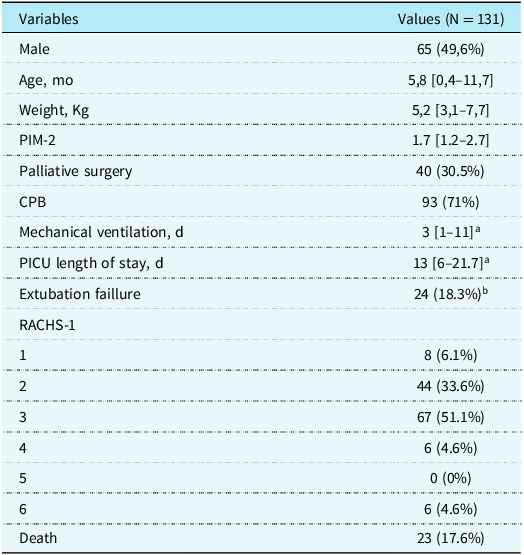
Of the 153 initially eligible patients, 22 were excluded due death before the first ultrasound evaluation in the paediatric ICU or were extubated in the operating room. Of the 131 patients included, 49.6% were male with a median age of 5.8 months (interquartile range: 0.4–11.7). Most cardiac surgeries were categorised as Risk Adjustment in Congenital Heart Surgery 1 (51.1%) or 2 (33.6%). Additionally, 70.1% of patients required cardiopulmonary bypass, and 30.5% underwent palliative procedures. The overall mortality rate was 17.6% (Table 1).
Demographic and clinical profile of the pediatric cardiac surgery cohort

Values are n (%), or median [interquartile range]. a N = 108 survivors; b N = 116 extubated patientes. CPB = cardiopulmonary bypass; PICU = Pediatric Intensive Care Unit; PIM-2 = Pediatric Index Mortality 2.
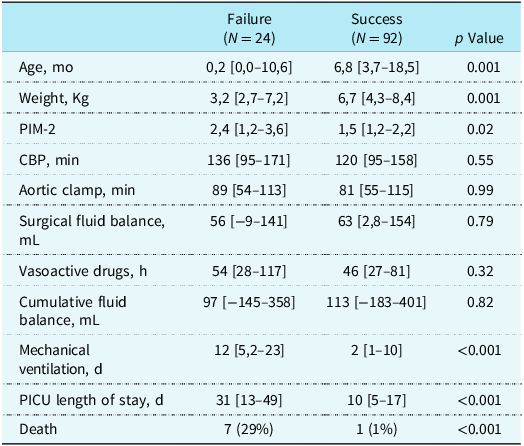
Among the 131 patients initially included, 116 were proceed to extubation, while 15 died before extubation could be attempted. The rate of extubation failure was 18.3%. Patients who failed extubation were significantly more likely to die compared to those who were successfully extubated (risk ratio 26.83, 95% confidence interval 3.4–207).
Patients who failed extubation were younger (median age 0.2 months, interquartile range 0.0–10.6) and lighter (median weight 3.2 kg, interquartile range 2.7–7.2) than patients successfully extubated (median age 6.8 months, interquartile range 3.7–18.5; median weight 6.7 kg, interquartile range 4.3–8.4). Additionally, patients who failed extubation had higher Paediatric Index of Mortality 2 scores (median 2.4, interquartile range 1.2–3.6) compared to those who succeeded (median 1.5, interquartile range 1.2–2.2). Due to high collinearity between age and weight, a linear regression was performed excluding weight and confirmed that younger age was associated with increased extubation failure risk (p = 0.002).
Patients who failed extubation required longer mechanical ventilation support (median 12 days, interquartile range 5.2–23) and longer paediatric ICU stays (median 31 days, interquartile range 13–49) compared to those who succeeded (median 2 days, interquartile range 1–10; median 10 days, interquartile range 5–17, respectively). Although length of mechanical ventilation support and paediatric ICU length of stay were highly correlated, analysis excluding paediatric ICU length of stay did not demonstrate a association between longer mechanical ventilation support and extubation failure (p = 0.094) (Table 2).
Comparison of clinical characteristics between patients with successful and failed extubation

Values are n (%), or median [interquartile range]. PICU = Pediatric Intensive Critical Unit; PIM-2 = Pediatric Index Mortality 2.
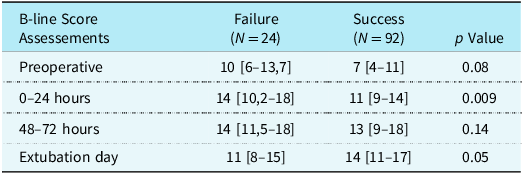
Patients who experienced extubation failure exhibited higher total B-line scores within the first 24 postoperative hours (median 14, interquartile range 10.2–18) compared to those who were successfully extubated (median 11, interquartile range 9-14; p = 0.009). After adjusting for age, patients with higher Score B scores in the first 24 hours had a significantly increased risk of extubation failure (risk ratio = 1.08, 95% confidence interval 1.01–1.16; p = 0.040). No significant differences in total B-line scores were observed at the other evaluations. The B-line score obtained within the first 24 hours demonstrated moderate predictive ability for extubation failure, with an area under the receiver operating characteristic curve of 0.67 (95% confidence interval 0.551–0.794; p = 0.009).
Analysis revealed a positive correlation between total B-line score and length of mechanical ventilation support. This correlation was evident preoperatively (r = 0.519, p < 0.01), within the first 24 hours postoperatively (r = 0.439, p < 0.01), and on the day of extubation (r = 0.379, p < 0.01). No correlation was found between length of mechanical ventilation support and total B-line score at the 48–72 hours assessment. (Table 3)
B-line scores at different time points in patients with successful vs. failed extubation

Values are median [interquartile range].
Considering the median of mechanical ventilation support in this sample (three days) as the threshold to define prolonged postoperative mechanical ventilation, the preoperative B-line score demonstrated good predictive ability for this outcome, with an area under the receiver operating characteristic curve of 0.79 (95% confidence interval 0.723–0.875, p < 0.01). Similarly, the B-line score obtained within the first 24 hours postoperatively also showed moderate predictive value for prolonged ventilation (area under the receiver operating characteristic curve 0.733, 95% confidence interval 0.648–0.818, p < 0.01).
Discussion
In this study enrolling children underwent cardiac surgery, we demonstrate an association between higher B-line lung ultrasound scores observed on the first postoperative day and subsequent extubation failure.
Extubation failure is a complex event influenced by multiple factors, necessitating a cautious approach during the ventilator weaning process. A comprehensive assessment incorporating objective data is essential to complement clinical judgement. Reference Abu-Sultaneh, Iyer and Fernández17 Lung ultrasound has emerged as a valuable tool for predicting extubation success in general paediatric populations. Reference Poletto, Cavagnero, Pettenazzo, Visentin, Zanatta and Zoppelletto18 In children undergoing extubation readiness testing, a Lung Ultrasound Score greater than 12 demonstrated strong predictive ability (area under the receiver operating characteristic curve 0.934, sensitivity 85.7%, specificity 81.2%, p < 0.001). Patients who failed extubation exhibited significantly higher Lung Ultrasound Score values compared to those successfully extubated (18 versus 10). Reference Abdel Rahman, Saber and El-Maghraby11
Extubation failure after paediatric heart surgery has specific characteristics and negatively impacts length of hospital stay and mortality rates. In this regard, our results are in accordance with current literature. Reference Byrnes, Bailly and Werho19 The early identification of patients at risk for extubation failure is crucial for optimising postoperative outcomes. It is known that pulmonary changes related to heart surgery occur early, and pulmonary oedema can develop within hours. Reference Kaskinen, Martelius, Kirjavainen, Rautiainen, Andersson and Pitkänen3 Ghotra et al. reported a high incidence of pulmonary complications, particularly pulmonary congestion, within the first 24 postoperative hours in paediatric cardiac surgery patients undergoing ultrasound evaluation. Reference Ghotra, Kumar, Niyogi, Gandhi and Mishra13
Our study demonstrated a positive correlation between the total B-line score and length of mechanical ventilation support, with a stronger correlation observed preoperatively. The B-line score was a better predictor of prolonged mechanical ventilation in the preoperative period, with an area under the receiver operating characteristic curve of 0.79. Other studies have also shown that preoperative and early postoperative ultrasound changes are associated with worse outcomes. Findings from a small cohort of paediatric patients undergoing cardiac surgery with cardiopulmonary bypass revealed significant differences as early as the first postoperative day. Patients with a B-line pattern on ultrasound had longer mechanical ventilation and paediatric ICU stays. Reference Vitale, Ricci, Gaddi, Testa, Toma and Cogo9 Furthermore, when using a lung ultrasound score to predict any postoperative pulmonary complications in paediatric cardiac surgery, Ghotra et al. found AUC-ROC values of 0.92 preoperatively and 0.95 within the first 24 hours, decreasing to 0.7 at 72 hours. Reference Ghotra, Kumar, Niyogi, Gandhi and Mishra13
Ultrasound enables real-time diagnosis of lung abnormalities, allowing for rapid decision-making process. It is a tool that is easy to learn for non-radiologist physicians and offers high applicability and reproducibility. Reference Arbelot, Neto and Gao20 Therefore, data supporting the utility of ultrasound are invaluable for clinical practice.
This study has limitations related to data heterogeneity, primarily due to its single-centre design, limiting external validity. Additionally, extrapolating findings to other age groups is restricted by the low median age of the sample. It should be noted that the lung ultrasound assessment was limited by the subjectivity in the visual estimation of the percentage of B-lines, which was influenced by probe position and transducer size. Furthermore, while B lines are a valuable tool for detecting pulmonary congestion, it is important to recognise that they are not pathognomonic and other factors could contribute to their presence, which were not examined in this study. We also observed a discrepancy between the observed mortality rate and that predicted by the Paediatric Index of Mortality 2 score. Although used in our institution, the Paediatric Index of Mortality 2 has been shown to perform poorly in specific subpopulations, such as CHD patients. Reference Czaja, Scanlon, Kuhn and Jeffries21 A study conducted at the same institution demonstrated that the Paediatric Index of Mortality 2 effectively discriminates between survivors and non-survivors, but it lacks calibration for CHD patients. Reference Rezende, Ricachinevsky, Botta, Angeli and DaSilva Nogueira22
Point-of-care lung ultrasound is a promising tool for identifying high-risk patients after paediatric cardiac surgery. Our findings suggest that early detection of severe pulmonary oedema on the first postoperative day presents good accuracy to predict extubation failure and prolonged mechanical ventilation.
Acknowledgements
None.
Financial support
This work was supported by Research Support Foundation of the State of RS—FAPERGS (J.P.P, grant number 21/2551-0002063-6).
Competing interests
None.