INTRODUCTION
Among biotic interactions competition and predation are by far the most studied and their role in determining population dynamics and community structure is clearly evidenced (e.g. Chesson, Reference Chesson2000; Bachelot et al., Reference Bachelot, Uriarte and McGuire2015). Recently, more complex processes have been identified such as facilitation (Bruno et al., Reference Bruno, Stachowicz and Bertness2003). Facilitation corresponds to positive interactions between organisms where at least one of the participants is benefited without any harm for the others. One interesting facilitation output is the positive density dependence at high population densities that contradicts dogmas stating that there is a negative relationship between population density and individual fitness (Bruno et al., Reference Bruno, Stachowicz and Bertness2003). Among the different life histories taking place in marine systems (Bulleri, Reference Bulleri2009), we investigate here a case of intraspecific facilitation where host density could negatively affect parasite abundance through a dilution effect. The dilution effect theory suggests that a community with high diversity presents a lower parasitism rate. Even though it has been formulated based on microparasite patterns, usually related with contagious diseases (reviewed in Service, Reference Service1991), the same assumptions are also valid for macroparasites with complex life cycles that actively search for their hosts (Johnson & Thieltges, Reference Johnson and Thieltges2010). This theory predicts that a community characterized by a greater fraction of unsuitable hosts or parasite predators, i.e. higher diversity, presents a lower individual disease risk (e.g. Keesing et al., Reference Keesing, Holt and Ostfeld2006; Thieltges et al., Reference Thieltges, Bordalo, Hernandez, Prinz and Jensen2008a, Reference Thieltges, Jensen and Poulinb). However, concerning the target-host density effect on individual parasitism rate, it is hard to find unanimous assumptions. In the case of contagious diseases, the fact that crowding can increase the transmission rates is empirical and many authors have shown positive correlations between host density and parasite prevalence (reviewed in Patterson & Ruckstuhl, Reference Patterson and Ruckstuhl2013). On the other hand, the host density effect is different for parasites with more complex life cycles, for example the case of mites parasitizing lizards (Sorci et al., Reference Sorci, de Fraipont and Clobert1997), flies parasitizing reindeers (Fauchald et al., Reference Fauchald, Rodven, Bardsen, Langeland, Tveraa, Yoccoz and Ims2007) or sea lice parasitizing Atlantic salmon (Samsing et al., Reference Samsing, Oppedal, Johansson, Bui and Dempster2014). It has been suggested that these highly vagile and social host species tend to aggregate in dense assemblages resulting in lower parasite loads, thus applying in a different way the dilution effect theory, termed as encounter-dilution effect by Mooring & Hart (Reference Mooring and Hart1992) and Hart (Reference Hart1994). The similar effect of population density on individual infection level remains poorly studied for non-social host species. For bivalves, some studies are already published on population density effect on individual parasite abundance, one performed in two sites with no replication (Mouritsen et al., Reference Mouritsen, McKechnie, Meenken, Toynbee and Poulin2003) and another with an in situ experimental approach (Thieltges & Reise, Reference Thieltges and Reise2007). In the present study, we propose to combine in situ experimental and long-term field monitoring approaches.
Molluscs are favourite first and second intermediate hosts for trematode parasites, the most abundant and prevalent clade of macroparasites in coastal waters (Lauckner, Reference Lauckner and Kinne1983). Trematodes have a complex life cycle with alternation of free-living and parasitic stages, generally including three host species. They use a mollusc as first intermediate host (sporocyst or rediae stage), an invertebrate or vertebrate as second intermediate host (metacercariae stage) and a vertebrate as final host (adult stage). Among first and second intermediate hosts, bivalves get easily infected by free-living propagules through their suspension-feeding activity and provide different tissue niches for parasites (de Montaudouin et al., Reference de Montaudouin, Thieltges, Gam, Krakau, Pina, Bazairi, Dabouineau, Russell-Pinto and Jensen2009). The impact of trematode infection on host population will depend on species-specific pathogenicity (usually related to parasitic stage) and/or abundance (i.e. number of parasites per individual host). Generally, metacercariae infection displays high prevalence but, under standard environmental conditions, the pathogenicity is reported as low, with little interaction between parasite and host (e.g. Wegeberg & Jensen, Reference Wegeberg and Jensen1999; de Montaudouin et al., Reference de Montaudouin, Bazairi and Culloty2012). Occasionally, metacercariae abundance can reach relatively high values, disrupting bivalve basic functions such as growth (de Montaudouin et al., Reference de Montaudouin, Bazairi and Culloty2012), burying capacity (Babirat et al., Reference Babirat, Mouritsen and Poulin2004) or even causing mortality (Desclaux et al., Reference Desclaux, de Montaudouin and Bachelet2002, Reference Desclaux, de Montaudouin and Bachelet2004; Gam et al., Reference Gam, de Montaudouin and Bazairi2009). For these reasons, it is important to recognize processes that can enhance metacercariae abundance leading to disease risk.
The edible cockle, Cerastoderma edule (Linnaeus, 1758) is infected by several trematode parasites using cockles as second intermediate hosts (de Montaudouin et al., Reference de Montaudouin, Thieltges, Gam, Krakau, Pina, Bazairi, Dabouineau, Russell-Pinto and Jensen2009). Cerastoderma edule is a dominant bivalve in coastal waters, found along the north-eastern coast of the Atlantic Ocean, from the Barents Sea to Mauritania (Tebble, Reference Tebble1966; Honkoop et al., Reference Honkoop, Berghuis, Holthuijsen, Lavaleye and Piersma2008). Cockles play a crucial role in the ecosystem, as they are an important food source and a link within food webs (key species) (Rakotomalala et al., Reference Rakotomalala, Grangere, Ubertini, Foret and Orvain2015) and also responsible for different ecosystem services (e.g. carbon storage and cycling energy; Morgan et al., Reference Morgan, O'Riordan and Culloty2013).
Based on this host–parasite system, the present work aims to evaluate the effect of bivalve host density on individual parasite infection (metacercariae abundance). The tested hypothesis is that a high host density has its cost in terms of competition that could be compensated by a lower parasitism pressure mediated by parasite dilution processes. Conversely, the alternate hypothesis is that high cockle density facilitates the trematode life cycle by attracting different necessary hosts (e.g. predators and scavengers), and higher cockle density would induce higher density of other different potential hosts emitting cercariae, and consequently higher metacercariae abundance would be reflected in each cockle infection.
In order to achieve this goal, field monitoring and field experiment studies were conducted. A 17-year analysis provided data allowing comparison of cockle density and trematode abundance in cockles from Arcachon Bay (France) and a field experiment aimed to manipulate cockle density and to observe consequent metacercariae infection.
MATERIALS AND METHODS
Study area
Cockles were collected in Banc d'Arguin (44.60°N 1.25°W), Arcachon Bay, France. Arcachon Bay is a 156-km2 macrotidal lagoon situated on the Atlantic south-west coast of France. It connects with the Atlantic Ocean by a wide 24-km2 channel, characterized by the presence of a series of sand banks, one of them (Arguin) emerging also at high tide. Cockles are spread in the semi-sheltered intertidal part of this bank, classified as a national reserve since 1972. A part of Banc d'Arguin is a protected reserve with no access allowed and without direct anthropogenic pressure including fishing, which supports several trematode final hosts preying on cockles, including shorebirds (particularly oystercatchers, Haematopus ostralegus) and various fish species, e.g. the European seabass (Dicentrarchus labrax). Therefore, sampling was performed in this area under strict authorization.
Field monitoring
Field monitoring was conducted between 1998 and 2014 (17 years), on a monthly basis. Data on five different variables were collected and analysed: cockle density, cockle shell length, metacercariae abundance (per cockle), metacercariae density (per square metre) and sediment temperature. Cockles were collected using six quadrats (0.25 m2 each) by sieving sediment through a 1-mm mesh. Shell length (SL) was measured to the nearest mm, with a caliper. Number of cockles per square metre (density) and per cohort was estimated. The cohorts were separated using Modal class Progression Analysis (MPA) – Bhattacharya method (Reference Bhattacharya1967). This subroutine (FISAT II (FAO – ICLARM stock assessment tool)) identifies cohorts by decomposing the polymodal size distribution into their normal distribution components. Cohorts were assumed to be single with a separation index greater than 2 (Gayanilo et al., Reference Gayanilo, Sparre and Pauly2005). For metacercariae abundance (per cockle) and density (per m2) calculation, 10 cockles per cohort were monthly dissected and squeezed, between two glass slides, under a stereomicroscope. All digenean trematodes were identified to species level following several authors' descriptions (Bowers, Reference Bowers1969; Bowers et al., Reference Bowers, Bartoli, Russell-Pinto and James1996; Bartoli et al., Reference Bartoli, Jousson and Russell-Pinto2000; Desclaux et al., Reference Desclaux, Russell-Pinto, de Montaudouin and Bachelet2006; de Montaudouin et al., Reference de Montaudouin, Thieltges, Gam, Krakau, Pina, Bazairi, Dabouineau, Russell-Pinto and Jensen2009). Because water temperature potentially is an important driver of trematode transmission, e.g. via its positive effect on cercarial emergence from the first intermediate host (de Montaudouin et al., Reference de Montaudouin, Blanchet, Desclaux-Marchand, Lavesque and Bachelet2015), sediment temperature was measured (Probe HOBO® Water Temp Pro v2 – U22-001) as proxy during the whole study (except for 1998).
Field experiment
In parallel and in the same study area as the monitoring work, a field experiment was conducted between March and November 2005 (9 months). Eight enclosures were settled in a single row parallel to the shoreline, 1 m vertically above mean low water level. The enclosures were regularly spaced with 2 m access paths between them, each consisting of a 50 × 50 × 25 cm metal frame meshed with 10-mm plastic net, buried 20 cm and projecting 5 cm above the sediment surface. After removing all natural large bivalves (>10 mm) by hand, enclosures were assigned to two treatments: low cockle density (50 cockles per enclosure corresponding to 200 cockles m−2) and high cockle density (200 cockles per enclosure corresponding to 800 cockles m−2). Four enclosure replicates for each treatment were established following an alternate design. Cockles from the same area were sampled and belonged to the 2003 cohort. Their mean shell length at the experiment beginning was 24 ± 1 (SD) mm. In order to maintain constant density pressure, cockle mortality was verified every month by collecting empty cockle shells at the sediment surface and by checking for buried shells with fingers. Tagged cockles substitutes of the same shell size were added. Tag consisted in a spot of nail varnish on each valve, each month corresponding to a new colour or pattern. Considering also that no recruits were found inside the enclosures, the density of cockles in enclosures was considered constant during the experiment. Before the beginning of the experiment, 30 cockles were dissected for trematode count and identification, with the same methodology as for field monitoring. After 9 months, all enclosures were removed from the field and the entire surface sediment in the enclosures was sieved through a 1-mm mesh and cockles present from the beginning of the experiment were dissected for trematode count and identification.
STATISTICAL ANALYSIS
Field monitoring
In order to correlate cockle density and metacercariae abundance per cockle from the 17 year database, the period between August and September (2 months) of each year was chosen. This is the period after recruitment season (Magalhães et al., Reference Magalhães, Freitas and de Montaudouin2016), when the new cohort is already established, with recruits having reached a size highly vulnerable to trematode infection (>10 mm) and also corresponding to the optimal annual metacercariae infection period (de Montaudouin et al., Reference de Montaudouin, Blanchet, Desclaux-Marchand, Lavesque and Bachelet2015).
Multiple linear regression analysis was performed to find the significant predictors of cockle metacercariae mean abundance at August–September period. The dependent variable was the mean number of metacercariae per cockle (mean abundance log-transformed), the independent variables were mean cockle density, mean cockle shell length, mean sediment temperature and mean number of metacercariae settled during this period (metacercariae density, per m2). Metacercariae density at August–September period of each year was calculated assuming random mortality across cohorts and infection levels. For the younger cohort, mean infection of the dissected cockles (N = 10 per cohort) was multiplied by the cockles cohort mean density (ind. m−2). Regarding adult cockles (the ≥1+-cohorts), only new infection was considered, and was calculated by subtracting mean August–September metacercariae abundance of the dissected cockles (N = 10) to the mean metacercariae abundance of the two former months (June–July). Finally, prior to multilinear regression analysis, we checked if independent variables were correlated with each other.
In order to determine a threshold of cockle density below which there is a significant increase of mean metacercariae abundance per cockle, a classification analysis was performed using software PRIMER v.6. Variables were normalized, the Euclidean distance between samples calculated and an agglomerative hierarchical clustering performed, using the unweighted pair-group mean average (UPGMA) algorithm. To verify the existence of confounding factors influencing the cockles density groups separation, Student's t-tests were performed to compare mean cockle shell length (cohort 0+), sediment temperature and metacercariae density (as a proxy of cercariae input) between both cockle density groups. This threshold was also checked for the four most abundant trematode species by performing a two-way ANOVA with repeated measures testing the influence of metacercariae cockle−1 (abundance) and trematode species on cockle density groups.
Field experiment
A Student's t-test was performed to assess the effect of cockle density on mortality. Mortality rates in enclosures were (arcsin
 $\sqrt p $
) transformed.
Three two-way nested ANOVAs were performed with cockle density as fixed factor (two levels: 200 and 800 cockles m−2), enclosure as random factor nested in density factor and metacercariae abundance as dependent variable. This test was used for mean cockle shell length and both dominant parasite species, Himasthla interrupta and Parvatrema minutum.
For all parametric statistics performed, homogeneity of variance was verified with Cochran test while normality was assumed.
RESULTS
Field monitoring
Mean cockle density at August–September period fluctuated between 19 and 756 ind. m−2 from 1998 to 2014. Four years were left out of our analysis (2001, 2008, 2013 and 2014) because of the absence of 0+-cohort.
Sampled cockles were infected by two trematode species at sporocyst stage, Bucephalus minimus (Prevalence = 8.3%) and Monorchis parvus (Prevalence = 1.0%), and 10 different trematode species at metacercariae stage: Curtuteria arguinae, Diphterostomum brusinae, Himasthla continua, H. elongata, H. interrupta, H. quissetensis, Parvatrema fossarum, P. minutum, Psilostomum brevicolle and Renicola roscovita. Four of these species represented 97% of the total metacercariae abundance: C. arguinae (37%), H. interrupta (27%), H. quissetensis (21%) and P. minutum (12%).
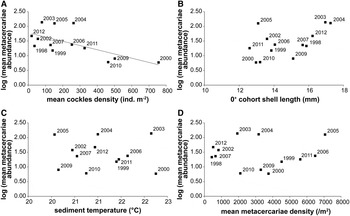
Multiple regression analysis used to find the significant predictors of cockle metacercariae mean abundance at August–September period, revealed a significant negative relationship between metacercariae mean abundance (M) of the newly settled cockles and cockle mean density (C) (Figure 1A, Table 1). No relationship (P > 0.05) was found between metacercariae mean abundance and cockle shell length (SL), sediment temperature (T) and metacercariae density (D) (Figure 1B, C and D). The model:
 $${\rm log}M = - 0.001\; C + 0.161\; SL - 0.001 \; T + 0.000 \; D - 0.840$$
Field monitoring. Relationship between log transformed mean metacercariae (all species combined) abundance of the newly settled cockles at August–September period (y-axis) and (A) Cerastoderma edule density (ind m−2, x-axis) with negative linear regression line representation, (B) 0+-cohort shell length (mm, x-axis), (C) sediment temperature (°C, x-axis) and (D) metacercariae density (metacercariae m−2, x-axis).

Multiple linear regression analysis used to find the significant predictors (Cerastoderma edule density (ind. m−2), C. edule shell length (mm), sediment temperature (°C) and metacercariae density (m−2)) of cockle metacercariae mean abundance (dependent variable, log-transformed) during the reference period (August–September) between 1998 and 2014.

SE, standard error.
P is the P-value related to partial correlation coefficient.
explained 72% of the decrease of metacercariae in cockles among different investigated years (Table 1).
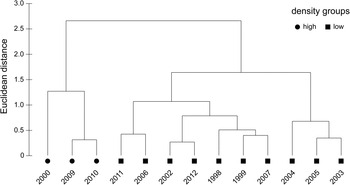
The cluster analysis grouped the different years in two affinity groups according to cockle density and individual metacercariae abundance (Figure 2). These groups were separated by a 400-cockles m−2 density threshold (Figure 1A). When density of cockles was higher than 400 ind. m−2, mean metacercariae abundance was 6.6 ± 0.7 (SE), and when cockles density was lower than 400 ind. m−2, mean metacercariae abundance was 57.9 ± 16.3 (SE) (Table 2). Conversely, these two groups of years, i.e. groups of cockle density, presented similar characteristics in terms of mean cockle shell length, sediment temperature during the August–September period and total metacercariae density (Table 2).
Field monitoring. Classification analysis identifying the cockle density affinity groups in terms of metacercariae individual abundance.

Four Student's t-tests results performed to check differences in terms of cockle density, mean shell length, mean sediment temperature and mean metacercariae density between the two cockle density groups (separated by the 400 cockles m−2 threshold).

df, degrees of freedom.
Mean and standard error are indicated by cockle density group and for each variable.
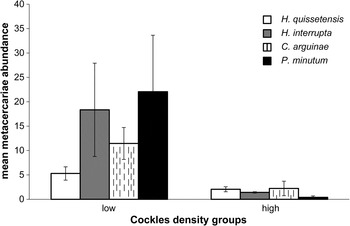
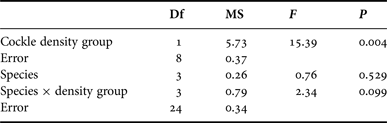
Two-way ANOVA with repeated measures showed the same pattern for the four most abundant trematode species (Figure 3, Table 3). Metacercariae abundance per cockle was higher for lower cockle density. Besides, there was no significant interaction between both factors (‘cockle density’ and ‘parasite species’), i.e. the effect of cockle density on metacercariae abundance was similar for the four dominant trematode species.
Field monitoring. Newly settled cockles mean metacercariae abundance (metacercaraie cockle−1) for the most abundant trematode species (Curtuteria arguinae, Himasthla interrupta, H. quissetensis and Parvatrema minutum) according to Cerastoderma edule density groups (high density: >400 cockles m−2 and low density: <400 cockles m−2).

Two-way ANOVA with repeated measures testing the influence of trematode species and cockle density groups on metacercariae abundance (metacercariae cockle−1).

df, degrees of freedom; MS, Mean square.
Field experiment
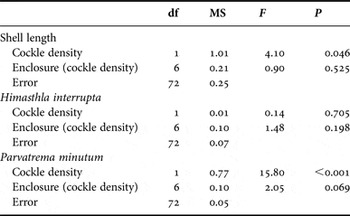
At experiment completion, cockle shell length was slightly different (P = 0.046, Table 4) between treatments, 27.4 ± 0.5 (SD) and 27.6 ± 0.5 (SD) mm for 200 and 800 ind. m−2 respectively. Mortality rate of cockles initially introduced in enclosures (65% in 9 months) was not influenced by density treatment (Student's t-test: t(6) = −0.66, P = 0.53).
Field experiment. Three two-ways nested ANOVAs results for shell length and both dominant parasite species, Himasthla interrupta and Parvatrema minutum. Cockle density used as fixed factor (two levels: low and high density (200 and 800 cockles m−2 respectively), enclosure as nested factor and metacercariae abundance as dependent variable.

df, degrees of freedom; MS, Mean square.
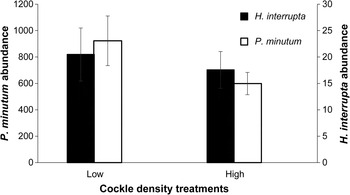
At the end of the experiment, cockles were infected by seven different trematode species at metacercariae stage: Curtuteria arguinae, Diphterostomum brusinae, Himasthla interrupta, H. quissetensis, Parvatrema minutum, Psilostomum brevicolle and Renicola roscovita. Only two parasite species dominated: H. interrupta and P. minutum, representing 99.6% of the total number of metacercariae. For H. interrupta the mean metacercariae abundance per cockle decreased significantly between March (64 ± 14 (SE) metacercariae cockle−1) and November, for high (18 ± 2 (SE) metacercariae cockle−1, Student's t-test: t(48) = 5.99, P < 0.001) and low (20 ± 3 (SE) metacercariae cockle−1, Student's t-test: t(48) = 5.08, P < 0.001) cockle density treatments (Figure 4). Furthermore, there were no significant differences between low and high cockle density treatments (Table 4). Conversely, there was a significant increase of P. minutum during the experiment period, starting with 134 ± 8 (SE) metacercariae per cockle in March and reaching 599 ± 42 (SE) metacercariae cockle−1 (Student's t-test: t(48) = −5.46, P < 0.001) in high density enclosures and 923 ± 94 (SE) metacercariae cockle−1 (Student's t-test: t(48) = −4.17, P < 0.001) in low density ones (Figure 4, Table 4). For both species there was no enclosure (nested factor) effect.
Field experiment. Metacercarial abundance in cockles Cerastoderma edule individuals (mean metacercariae ind.−1 ± SE) at low (50 cockles enclosure−1, 200 cockles m−2) and high (200 cockles enclosure−1, 800 cockles m−2) host density treatments for the two dominant trematode species, Himasthla interrupta and Parvatrema minutum.

DISCUSSION
The effect of biodiversity on mollusc target-host individual infection has been explored by several authors. Mouritsen & Poulin (Reference Mouritsen and Poulin2003b), for example, demonstrated that the non-obligate mutualistic relationship between the intertidal cockle Austrovenus stutchburyi and a mud flat anemone significantly depress the rate by which cockles accumulate parasites. In mesocosm experiments, Johnson et al. (Reference Johnson, Preston, Hoverman, Henderson, Paull, Richgels and Redmond2012) found a strong negative effect of the non-host species richness on the transmission success of Ribeiroia ondatrae (trematode) to Helisoma trivolvis (snail). Welsh et al. (Reference Welsh, van der Meer, Brussaard and Thieltges2014), with the Himasthla elongata (trematode) – Littorina littorea (snail) parasite-host system, proved the existence of several dilutors on a trematode life cycle, i.e. non-host species that interfere with cercariae transmission and consequently reduce the individual host parasite infection. Similarly, Thieltges et al. (Reference Thieltges, Reise, Prinz and Jensen2009) showed experimentally that both the presence of two invasive species (Crassostrea gigas and Crepidula fornicata) and also the density of Mytilus edulis reduces (in a lower rate than the invasive species) the native host risk to become infected. On the other hand, the effect of mollusc target-host density on individual infection has been poorly explored. Hence, the present study showed both with an in situ experimental approach and, for the first time, with bivalve natural population long-term monitoring that density (cockles m−2) and mean infection per cockle (metacercariae abundance per cockle) are negatively correlated. Our study suggests a 400-cockle m−2 density threshold below which there is a significant increase of individual infection. This finding supports our first hypothesis: high host density is correlated to lower individual infection, suggesting a dilution effect.
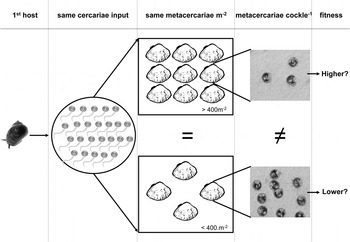
However, knowing that several factors can influence metacercariae infection success, we tested possible confounding factors which could also vary among both cockle density groups and influence cockle infection. Firstly, the mean shell length of the sampled cockles (recently settled) was tested between both cockle density groups. It is known that older and consequently larger cockles may be more heavily infected because they have had a longer life period to encounter and accumulate parasites, and also because larger cockles present higher filtration rate which is the main way of infection (Wegeberg et al., Reference Wegeberg, de Montaudouin and Jensen1999; Mouritsen et al., Reference Mouritsen, McKechnie, Meenken, Toynbee and Poulin2003). However, mean shell length of sampled cockles was not significantly different between cockle density groups and thus did not explain observed differences on individual infection. Sediment temperature also drives cercariae emission and influences metacercariae infection success (de Montaudouin et al., Reference de Montaudouin, Blanchet, Desclaux-Marchand, Lavesque and Bachelet2015). Although, in the present case, sediment temperature was similar in both density groups (corresponding to groups of years and respective summer period) and cannot explain cockle mean metacercariae abundance differences. A third possible confounding factor was cercariae abundance in the ecosystem. It was not possible to directly measure cercariae density, as it is a free-living stage very difficult to sample and quantify (de Montaudouin et al., Reference de Montaudouin, Blanchet, Desclaux-Marchand, Lavesque and Bachelet2015). However, employing metacercariae density (metacercariae m−2) as a proxy of cercariae input allowed the inference that metacercariae density was similar among both density groups (Figure 5). Therefore, cockle population density remains the only addressed factor explaining different individual infections (mean metacercariae per cockle).
Schematic representation of Cerastoderma edule individual metacercariae abundance in two different host density scenarios. With the hypothesis of a similar pool of trematode cercariae in the water, higher density of cockles (top of the figure) would induce a lower infection and consequently a better host fitness than in the case of a low cockle density (bottom of the figure) where the host would share more parasites and could be less healthy, if a certain parasite threshold is reached.

The 400-cockles m−2 density threshold found conceded a clear distinction between two main groups: a high cockle density group, presenting fewer metacercariae in each organism, and a low cockle density group characterized by higher individual metacercariae infection. According to the literature, this value is also consistent with the threshold beyond which intraspecific competition impairs individual growth, recruitment and survivorship (André & Rosenberg, Reference André and Rosenberg1991; de Montaudouin & Bachelet, Reference de Montaudouin and Bachelet1996; Beukema & Dekker, Reference Beukema and Dekker2015).
The present findings suggested that the negative aspect related to intraspecific competition (and high density) could be balanced by lower parasite infection and consequently better fitness. Although it is necessary to increase knowledge in terms of the real effect of metacercariae on hosts' fitness, it has been now established that high metacercariae numbers induce reductions in growth, condition index and burying capacity (e.g. Babirat et al., Reference Babirat, Mouritsen and Poulin2004; de Montaudouin et al., Reference de Montaudouin, Bazairi and Culloty2012; O'Connell-Milne et al., Reference O'Connell-Milne, Poulin, Savage and Rayment2016) and are correlated with higher mortality rates, namely for trematode species that were observed in this study, i.e. C. arguinae (Desclaux et al., Reference Desclaux, Russell-Pinto, de Montaudouin and Bachelet2006), H. interrupta (de Montaudouin et al., Reference de Montaudouin, Bazairi and Culloty2012), H. quissetensis (Desclaux et al., Reference Desclaux, de Montaudouin and Bachelet2004) and Parvatrema minutum (Gam et al., Reference Gam, de Montaudouin and Bazairi2009).
The field experiment strengthens the 17-year survey result: individual infection was higher in cockles living at lower densities. This is in agreement with Mouritsen et al. (Reference Mouritsen, McKechnie, Meenken, Toynbee and Poulin2003) for Austrovenus stutchburyi, the New Zealand cockle (although comparing different sites with no replicates) and Thieltges & Reise (Reference Thieltges and Reise2007) in the Wadden Sea, with field experiments, who concluded that low parasitism rate is a consequence of much higher C. edule densities. More in detail, P. minutum, the most abundant trematode species found in the field experiment, showed significantly higher infection in cockles in lower density treatments. In this treatment, P. minutum infection reached on average 923 metacercariae cockle−1, which is over the threshold causing mortality for gymnophalids (>500 metacercariae cockle−1) described by Gam et al. (Reference Gam, de Montaudouin and Bazairi2009). The fact that metacercariae abundance is multiplied by two whereas cockle density is decreased by a four-fold factor suggests that the relationship between both variables is not linear. The reason of non-linearity could be that cercariae were not available ad libitum, i.e. that even if cockle density becomes low the number of infecting cercariae is not infinite. Conversely, the second most abundant trematode species found in the field experiment (H. interrupta) showed no significant differences between density treatments. In fact, this parasite abundance even declined during the experiment, suggesting that either there was parasite mortality, e.g. parasite lifespan can be shorter than its host (de Montaudouin et al., Reference de Montaudouin, Bazairi and Culloty2012) or cockle mortality was parasite-dependent as already demonstrated with a congeneric species (Desclaux et al., Reference Desclaux, de Montaudouin and Bachelet2004). The fact that mortality and growth rates were similar between both treatments could be in favour of the hypothesis that high host density would be compensated by low parasite abundance and vice versa.
The present study demonstrated the positive effect for cockles to be at high density (dilution for parasites), but we did not observe negative effects either on cockle mortality (field experiment) or on shell growth (field experiment and monitoring). These results contradict many previous studies describing the negative density-dependent interactions in terms of cockle population dynamics (Jensen, Reference Jensen1992; de Montaudouin & Bachelet Reference de Montaudouin and Bachelet1996). The absence of negative effects of intraspecific competition on growth could be due to the fact that, at the beginning of the experiment, cockles were already large (SL = 24 mm) which gave them less potential for growth. Another reason could also be that the trophic resource is non-limiting at this cockle density. Indeed, our monitoring and experiment site is characterized by a high concentration of chlorophyll-a (Gam et al., Reference Gam, de Montaudouin and Bazairi2010). Previous experiments performed close to this area and among different suspension feeder species (Crepidula fornicata and Crassostrea gigas) also showed no manifestation of competition (de Montaudouin et al., Reference de Montaudouin, Audemard and Labourg1999), like in artificial systems where food is provided ad libitum (Kamermans et al., Reference Kamermans, Vanderveer, Karczmarski and Doeglas1992).
CONCLUSIONS
The present field long-term monitoring and field experiment study showed that the encounter-dilution effect can also be applied to natural bivalve populations. This study emphasizes the role of parasitism on host population dynamics leading to implications in decision-making, related to cockle larvae settling within the intertidal zone. Settlement in areas supporting high densities of adult cockles is associated with a high mortality risk, but with this new insight, the fact that high densities will provide safety not only against predators but also parasites was demonstrated, at least those with a complex life cycle. This process may be selectively advantageous because, as mentioned before, high metacercariae abundance is known to affect cockle growth, reducing fitness, and can impair the mobility of the cockle foot. As a result, the re-bury capacity handicap dislodges cockles to the sediment surface (Babirat et al., Reference Babirat, Mouritsen and Poulin2004) making them 7-fold more susceptible to bird predation risk than their buried conspecifics (Thomas & Poulin, Reference Thomas and Poulin1998) or easily predated by non-target hosts (Mouritsen & Poulin, Reference Mouritsen and Poulin2003a). However, density can also stimulate some density-dependent pathologies where parasites are horizontally transmitted (i.e. with no need for intermediate hosts). Thus, the ‘ideal’ host density to reach the highest production remains a difficult issue and the answer certainly depends on the local environment.
ACKNOWLEDGEMENTS
Many thanks to the staff of the Natural Reserve of Banc d'Arguin (SEPANSO) and to the INSU for logistic help (sailors and Planula 4 ship). The authors are grateful to the students who contributed to this long-term survey, among them I. Kisielewski, C. Desclaux, H. Blanchet, N. Lavesque, A. Palvadeau, M. C. Sajus, H. Raigné, G. Lassalle, I. Paul-Pont, C. Dang, M. Gam, S. Dubois, L. Lanceleur, T. Do, C. Binias, H. Guyard. The authors are indebted to anonymous reviewers for pertinent suggestions and improvement of the manuscript and also to Anthony Moreira for correcting the English.
FINANCIAL SUPPORT
Luísa Magalhães benefited from a PhD grant (grant reference: PD/BD/52570/2014) and Rosa Freitas a post-doc grant (grant reference: SFRH/BPD/92258/2013), both awarded by the Portuguese Foundation for Science and Technology (FCT – Fundação para a Ciência e Tecnologia). Annabelle Dairain benefited from a PhD grant from the French Ministry of Research.