Antibiotic resistance has been identified as one of the greatest threats to public health, resulting in 2 million illnesses and 23,000 deaths each year.Reference Spellberg, Bartlett and Gilbert 1 , 2 Both the Centers for Disease Control and Prevention and the Infectious Diseases Society of America have emphasized the importance of improved antibiotic prescription practices to combat antimicrobial resistance. 2 , Reference Spellberg and Blaser 3 The National Action Plan for Combating Antibiotic-Resistant Bacteria proposed goals to reduce infections and adverse events caused by resistant organisms. 4 In response, many pediatric hospitals across the country have implemented antimicrobial stewardship programs (ASPs) to minimize inappropriate and unnecessary antibiotic prescribing.Reference Hersh, Lurgio and Thurm 5 , Reference Newland, Gerber and Weissman 6 Using strategies such as guideline development, formulary restriction, provider education, and audit and feedback, ASPs have led to increased guideline adherence, have reduced the incidence of antibiotic-resistant bacterial infections, and have produced substantial institutional cost savings.Reference Newland, Gerber and Weissman 6 – Reference Fishman 11
Traditionally, antimicrobial stewardship committees have been composed of specialists in infectious diseases, clinical pharmacology, and clinical providers from inpatient settings.Reference Newland, Gerber and Weissman 6 Therefore, ASP activities have typically been limited to inpatient services, intensive care units, and surgical settings. Methods of antimicrobial stewardship, including audit and feedback, have been evaluated in the pediatric office setting, with encouraging results.Reference Gerber, Prasad and Fiks 12 However, of the antibiotic prescriptions given to 49 million children from ambulatory settings each year, approximately 10 million prescriptions are written in emergency departments (EDs).Reference Fleming-Dutra, Hersh and Shapiro 13 – Reference Mistry, Dayan and Kuppermann 15 However, methods of antimicrobial stewardship in the ED setting have not been adequately studied. ASP implementation for EDs can be challenging because of the unique approach to antibiotic prescribing in this fast-paced clinical setting, where need for empiric antibiotic therapy in the absence of a confirmatory diagnosis is common.Reference May, Cosgrove and L’Archeveque 16
To better understand the need and potential for ASP implementation in the pediatric ED setting, we aimed to determine the current involvement of EDs within children’s hospitals in ASPs and the resources available for appropriate antibiotic prescribing in EDs. We also aimed to identify beliefs regarding ED-based ASPs and to determine preferred methods for ASP implementation in the ED.
METHODS
Study Design, Subjects, and Setting
We conducted a cross-sectional survey of institutions belonging to the Sharing Antimicrobial Reports for Pediatric Stewardship (SHARPS) collaborative.Reference Zachariah, Newland and Gerber 17 The SHARPS collaborative comprises 37 children’s hospitals across the United States that share best practices and relevant data for pediatric antimicrobial stewardship. SHARPS institutions include free-standing pediatric hospitals and designated children’s hospitals within general hospitals. Cumulatively, these hospitals receive an estimated 2.2 million ED visits annually, in which cared is provided by more than 900 certified practitioners in pediatric emergency medicine.
We solicited participation from 2 respondents in each SHARPS institution: 1 hospital ASP leader and 1 clinical or medical director within the institution’s ED. Because ASPs often involve joint leadership from infectious diseases specialists and clinical pharmacists, either was permitted to serve as the hospital ASP respondent. There were no specific exclusion criteria. Consent for participation was implied via completion of the survey. The study was granted exemption from written informed consent by our hospital’s institutional review board.
Survey Items
The survey items assessed antimicrobial stewardship activities and ED involvement within the ASPs. Accordingly, we generated several items specifically for hospital ASP leaders and others for ED medical directors. We used branching logic at the start of the survey to direct respondents to the appropriate set of questions for their positions. Specific aspects of ASPs addressed included specialty member composition, current infections and clinical care settings monitored, and currently available ED antibiotic prescribing resources. ED medical directors were asked to report on the presence of current prescribing guidelines as well as capabilities for delivery of prescribing recommendations (eg, ability to embed recommendations into the electronic health record [EHR]).
For both ASP leaders and ED directors, we used 5-point Likert scales (1 to 5; 5=strongly agree) to assess the level of agreement with statements regarding ED-based antibiotic prescribing practices and potential antimicrobial stewardship. Responses of 4 or 5 on the Likert scale were considered “in agreement.” ASP leaders and ED directors also ranked, in order of preference, 4 common methods for ED implementation of antimicrobial stewardship: EHR clinical decision support (EHR CDS), posting of clinical care guidelines, direct provider education, and provider audit and feedback.
Survey Development
The principal investigator (R.D.M.) developed survey items in conjunction with experts in the field of pediatric infectious diseases (J.G.N., J.S.G., A.L.H.), pediatric emergency medicine (R.D.M., P.S.D., N.K.), and general emergency medicine (L.M., S.M.P.). The initial iteration of the survey consisted of 47 items. Study investigators first assessed each item for importance and applicability. Based on this assessment, the items were then revised. Following item generation and reduction, each remaining survey item was rated for usefulness using a modified Delphi method. An independent, noninvestigator panel of 3 experts in pediatric infectious diseases and 2 in pediatric emergency medicine rated each survey item on 5-point scale (1 to 5; 5=very useful). We retained items rated as useful or very useful (4 or 5) by all panelists. Any item rated as a 3 was revised and retained based on feedback; items with a score below 3 were removed.
The final survey consisted of 41 items. The survey was then adapted for electronic administration using REDCap software (Vanderbilt University Medical Center, Nashville, TN). After electronic development, the survey was piloted for functionality and then finalized for distribution.
Data Analysis
Study data were summarized using standard descriptive statistics: continuous variables were described according to their parametric distributions, while categorical variables were described using frequencies and proportions. We performed all data analyses using the Statistical Package for the Social Sciences (SPSS) version 23.0 (College Station, TX).
RESULTS
SHARPS Hospital Characteristics
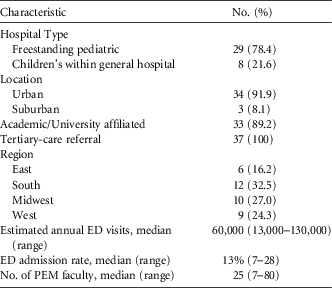
All 37 SHARPS hospitals had at least 1 of the 2 potential respondents complete a survey. Of the 74 surveys distributed, 68 (91.9%) were completed, including 36 of 37 (97.3%) from hospital ASP leaders and 32 of 37 (86.5%) from ED medical directors. All participating SHARPS hospitals were tertiary referral centers and most were in urban settings, were free-standing pediatric hospitals, and were academic and/or university affiliated (Table 1).
Participating Hospital Characteristics (N=37)

NOTE. ED, emergency department; PEM, pediatric emergency medicine.
Beliefs and Methods of ED Antimicrobial Stewardship
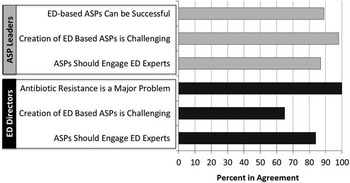
Although ASP leaders and ED directors agreed that implementation of ED-based antimicrobial stewardship is challenging, there was a consistent belief that antimicrobial resistance represents a threat to public health and that ED involvement in ASPs is necessary (Figure 1). Both ED and ASP respondents believed that ED experts should be included on ASP committees. Furthermore, 28 of 32 ED medical directors (87.5%) believed that implementation of ASPs are cost-effective for their healthcare institutions.
Beliefs regarding ED antimicrobial stewardship by ED medical directors and ASP leaders. Bars represent proportion in agreement; agreement defined as response of 4 or 5 of 5 on 5-point Likert scale. ASP, antimicrobial stewardship program; ED, emergency department.

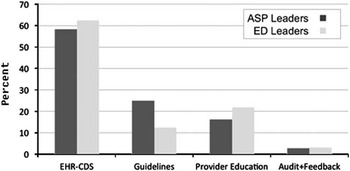
Figure 2 presents the preferred methods of implementation of ED-based antimicrobial stewardship. Both ED medical directors and ASP leaders favored the use of EHR CDS over other methods. More than 80% of respondents ranked EHR CDS first or second, compared to alternative methods such as guideline development and enforcement, direct provider education, and audited ED prescribing.
Preferred methods for ED-based antimicrobial stewardship as ranked by ED and ASP leadership. Bars represent proportion who ranked that method first. ED, emergency department; ASP, antimicrobial stewardship.

Current ASP Activities in SHARPS Institutions
Among the 37 SHARPS hospitals, 36 (97.3%) had functional ASPs; 1 hospital had yet to develop their ASP and was excluded from the remaining analyses. Data were, therefore, available for 36 institutions. Among SHARPS hospital ASPs, 19 ASPs (52.8%) were in the first 3 years of activity, 8 ASPs (22.2%) had been active between 3 and 5 years, and 9 ASPs (25.0%) had been active for >5 years.
The specialty composition of the 36 ASPs varied. Within the SHARPS collaborative, outpatient pediatric specialists were infrequently represented in ASPs: the ED was only represented in only 3 ASPs (8.3%) and outpatient pediatricians in just 1 ASP (2.8%). Representation of other specialties on ASPs were as follows: pediatric infectious diseases were represented in 34 ASPs (94.4%), microbiology laboratory specialists in 20 ASPs (55.6%), clinical pharmacology and/or pharmacists in 15 ASPs (41.7%), inpatient pediatricians in 9 ASPs (25.0%), and pediatric critical care specialists in 11 ASPs (30.6%).
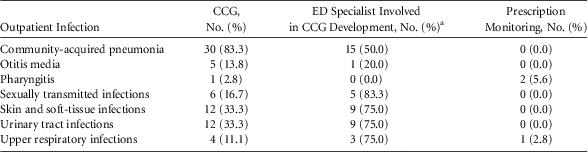
Among current ASP activities, 35 programs (97.2%) created general institutional clinical care guidelines for antibiotic prescribing. Table 2 lists the ASP guidelines created for common outpatient infections. Guidelines for community-acquired pneumonia (83.3%) were most frequently created among participating institutions, followed by urinary tract infections (33.3%) and skin infections (33.3%). Table 2 also demonstrates the infrequent involvement of ED specialists in clinical care guideline development. No ASPs monitored outpatient antibiotic prescribing for children discharged from the ED. Active monitoring of antibiotic prescribing in outpatient clinical settings was uncommon among ASPs; only 3 hospitals (8.3%) reported monitoring antibiotic use in the outpatient general pediatric clinic setting.
Frequency and Characteristics of Antimicrobial Stewardship Program (ASP) Clinical Care Guidelines Developed and Proportion of ASPs Monitoring Prescribing at SHARPS Hospitals (n=36)

NOTE. CCG, clinical care guideline; ED, emergency department.
a Expressed as percentage of those with CCG for each infection, as reported in column 1.
Integration of ASP Recommendations into ED Practice
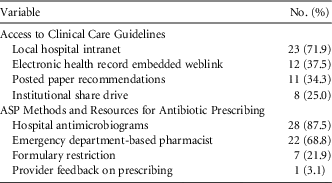
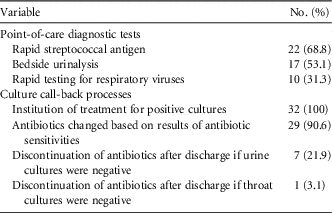
Among the 32 responding SHARPS hospital EDs, access to institutional clinical care guideline recommendations occurred via several methods (Table 3). Overall, 29 of 32 EDs (90.6%) reported current use of computerized resources and/or EHRs to access local antibiotic prescribing recommendations. Furthermore, 7 ASPs (21.8%) incorporated formulary restrictions to common antimicrobials in EDs using order sets or limiting medication availability to providers by hospital pharmacists. The use of ED provider feedback for prescribing was uncommon; only 1 site (2.8%) reported this ASP mechanism currently being used at their institution. Methods to optimize antibiotic use through rapid diagnostic testing at the point-of-care were also limited at participating SHARPS EDs (Table 4).
Access to Clinical Care Guidelines and Resources for Emergency Department Antibiotic Prescribing in SHARPS Institutions (n=32)

Other Methods of Antimicrobial Stewardship Currently Present in SHARPS Institution Emergency Departments (n=32)

Many participating EDs (26; 81.3%) had ongoing internal quality improvement (QI) activities related to antibiotic prescribing. For outpatient infections, 22 EDs (68.8%) had ongoing QI projects related to community-acquired pneumonia, and 12 EDs (37.5%) had QI activities regarding both skin and soft-tissue infections and urinary tract infections. Pediatric ED experts were involved in more than half of ongoing QI activities (18; 56.2%) related to antibiotic prescribing in SHARPS hospitals.
DISCUSSION
Our findings demonstrate that programmatic involvement of the ED in ASPs was very limited in this sample of pediatric hospitals. Pediatric emergency medicine specialists were rarely engaged in ASP committees, and resources to enhance ED antibiotic prescribing, such as the development of institutional clinical care guidelines and prescription monitoring, were infrequent. Nonetheless, leaders from both hospital ASPs and EDs consistently recognized a need for ED engagement in and implementation of ED-based antimicrobial stewardship. Each year, approximately 250 million antibiotic prescriptions are written from the ED; as many as 30% of antibiotics prescribed in the ED are considered either inappropriate or unnecessary.Reference Fleming-Dutra, Hersh and Shapiro 13 , Reference Hicks, Bartoces and Roberts 18 Therefore, the pediatric ED setting represents a great opportunity for antibiotic stewardship.Reference Fleming-Dutra, Hersh and Shapiro 13 , Reference Hersh, Shapiro, Pavia and Shah 19 Our results suggest that initial efforts should include instituting stewardship through EHR-CDS, which is well-suited for the ED clinical environment. Moreover, we found that pediatric EDs were well equipped for incorporation into ASP activities, as most institutions already utilized typical tools for antibiotic stewardship, such as clinical care guidelines and QI processes.
We found that the components of preferred and previously successful ASPs existed in most children’s hospitals. Prior studies have noted that EHRs, the preferred vehicle for ASP implementation in EDs, are present in nearly all US hospitals. 20 , Reference Wright, Henkin and Feblowitz 21 Furthermore, there are precedents for effective CDS interventions for antibiotic prescribing CDS in UTI and viral respiratory infections using varying forms of delivery (eg, paper, posters).Reference Lutters, Harbarth and Janssens 10 , Reference Jenkins, Knepper and Sabel 22 – Reference Hecker, Fox and Son 29 However, several studies have noted that presentation of antibiotic prescribing recommendations at the point-of-care is possible using the EHR.Reference Mistry, Dayan and Kuppermann 15 , Reference Kullar, Goff and Schulz 30 , Reference Sintchenko, Coiera and Gilbert 31 Integration of the EHR carries great potential for intervention on outpatient antibiotic prescribing. 20 , Reference Sintchenko, Coiera and Gilbert 31 , Reference Shebl, Franklin and Barber 32 In a promising trial, Gerber et alReference Gerber, Prasad and Fiks 12 implemented EHR-based automated provider audit and feedback for office pediatricians, demonstrating reductions in prescribing broad-spectrum antimicrobials over time. However, when feedback mechanisms were removed after the completion of this trial, effectiveness was not sustained.Reference Gerber, Prasad and Fiks 33 Therefore, leveraging prescription monitoring and provider feedback capabilities in the ED setting hold promise for effective antimicrobial stewardship.
Although we found that several additional methods are being used to regulate antibiotic prescribing in pediatric EDs, including review by ED-based pharmacists, use of hospital antibiograms, and development of clinical care guidelines, the effectiveness of these ASP interventions in the pediatric ED remains unclear.Reference May, Cosgrove and L’Archeveque 16 Moreover, each of these methods poses limitations for ED ASP implementation. While ED-based pharmacists have the ability to recommend antibiotic choices and provide dosing recommendations, the personnel costs are substantial for around-the-clock coverage. Although hospital antibiograms may be relatively easy to produce, they are rarely ED specific and they require active interpretation by the ED provider. Nonetheless, creation of ED-specific antibiograms is important in the creation of accurate ED-specific guidelines. ED guideline uptake appears to be limited if it is not tailored to the unique ED clinical setting.Reference Mistry, Dayan and Kuppermann 15 , Reference Dellit, Owens and McGowan 34
Accurate identification of specific infections via ED point-of-care testing has also been suggested to reduce antibiotic use.Reference May, Cosgrove and L’Archeveque 16 Although point-of-care testing has proven effective for numerous outpatient infections, education regarding proper use of point-of-care testing in the ED is necessary, and cost-effectiveness must be considered.Reference Bonner, Monroe and Talley 35 – Reference Shaw, McGowan, Gorelick and Schwartz 39 In the present study, we identified variable use of point-of-care testing in the SHARPS EDs.
Finally, culture call-back systems were common among the EDs studied; typically, they were used to initiate antibiotics for missed infections in the ED. Discontinuation of antibiotics when cultures are negative represents an important opportunity for reducing unnecessary antibiotic exposure; however, discontinuation rarely occurred in the institutions surveyed.Reference Burchett, Harpin, Petersen-Smith and Emery 40 , Reference Roberts 41
The results of our study have implications for the creation of ED-based ASPs. The need for novel and unique approaches to antimicrobial stewardship tailored for the ED is clear. Our findings are also consistent with the guiding principles of “Core Elements of Outpatient Antibiotic Stewardship”Reference Sanchez, Fleming-Dutra, Roberts and Hicks 42 produced by the Centers for Disease Control and Prevention. These include tailored antibiotic treatment recommendations, use of clinical decision support, and prescription tracking and reporting; many of these proposed methods can be implemented using EHRs. Moreover, the widespread implementation of EHRs in EDs facilitates the generalizability of EHR-CDS for ED-based ASPs. These methods for ED stewardship can be applied to other high-priority outpatient infectious diseases, including pharyngitis, otitis media, pneumonia, and upper respiratory tract infections.Reference Sanchez, Fleming-Dutra, Roberts and Hicks 42
Our study has several limitations. First, we sampled only participants in the SHARPS collaborative, which is restricted to academic pediatric hospitals. Therefore, the data collected and opinions expressed by respondents may not be representative of hospitals in other settings. However, querying this group allowed for a cohesive ASP leader–ED medical director dyad for this study. In addition, the relative lack of ED involvement at hospitals with substantial ASP investment is quite striking. Second, use of a survey mechanism for data collection assumes that responses are accurate, without verification. Finally, we were unable to obtain responses from 5 ED medical directors, though we were able to achieve an overall high response rate.
In conclusion, despite the large number of antibiotic prescriptions written each year by ED providers, antimicrobial stewardship efforts in pediatric EDs are limited. Although ASP and ED leaders agree that implementation of antimicrobial stewardship in the ED setting is feasible and necessary, there is a clear lack of ED presence in pediatric hospital–based ASPs with respect to the creation of recommendations, prescription monitoring, and regulation of ED antibiotic prescribing. The single most preferred method for ED ASP implementation was via the EHR using clinical decision support.
ACKNOWLEDGMENTS
Financial support: No financial support was provided relevant to this article.
Potential conflicts of interest: All authors report no conflicts of interest relevant to this article.