Introduction
Cultivated lentil (Lens culinaris Medik. subsp. culinaris) is a nutritious pulse crop and an important source of protein, carbohydrates and micronutrients in the human diet. In 2018, global lentil production was 6.38 Mt from an estimated 6.12 M ha, with an average yield of 1.05 t/ha (FAOSTAT, 2018). Consumption of lentil is increasing much faster than that of other major pulse crops (Khazaei et al., Reference Khazaei, Subedi, Nickerson, Martinez-Villaluenga, Frias and Vandenberg2019).
Stemphylium blight is a foliar disease responsible for large-scale and rapid defoliation of lentil plants, resulting in severe loss of yield in conducive environments. The disease has been associated most commonly with Stemphylium botryosum Wallr. Once thought of as a minor disease of lentil with local significance in south Asia (Sharma, Reference Sharma, Erskine, Muehlbauer, Sarker and Sharma2009), stemphylium blight now affects many of the world's major production regions including Bangladesh, India, Nepal, the USA and Canada (Erskine and Sarker, Reference Erskine and Sarker1996; Bayaa and Erskine, Reference Bayaa, Erskine, Allen and Lenne1998; Morrall et al., Reference Morrall, Vandenberg and Banniza2004). In Canada, S. botryosum has been detected frequently on lentil seeds tested for fungal infections in commercial seed testing laboratories (Morrall et al., Reference Morrall, Carriere, Ernst, Pearse, Schmeling and Thomson2006). The highest prevalence (88%) of stemphylium blight in Saskatchewan was recorded in 2016 (Ziesman et al., Reference Ziesman, Peru, Jacob, Ippolito, Kindrachuk, Chant, Robberts and Banniza2019). Late season disease infection can lead to reduced milling quality (Subedi, Reference Subedi2018).
The use of crop wild relatives to widen the genetic base of cultivated crops is a fundamental strategy for crop improvement (Tanksley and McCouch, Reference Tanksley and McCouch1997; Haussmann et al., Reference Haussmann, Parzies, Presterl, Susic and Miedaner2004; Hajjar and Hodgkin, Reference Hajjar and Hodgkin2007; Maxted et al., Reference Maxted, Kell, Ford-Lloyd, Maxted, Ford-Lloyd, Kell, Iriondo, Dulloo and Turok2008; Tester and Langridge, Reference Tester and Langridge2010; Ford-Lloyd et al., Reference Ford-Lloyd, Schmidt, Armstrong, Barazani, Engels, Hadas, Hammer, Kell, Kang, Khoshbakht, Li, Long, Lu, Ma, Nguyen, Qiu, Ge, Wei, Zhang and Maxted2011; McCouch et al., Reference McCouch, Baute, Bradeen, Bramel, Bretting, Buckler, Burke, Charest, Cloutier, Cole, Dempewolf, Dingkuhn, Feuillet, Gepts, Grattapaglia, Guarino, Jackson, Knapp, Langridge, Lawton-Rauh, Lijua, Lusty, Michaels, Myles, Naito, Nelson, Pontarollo, Richards, Rieseberg, Ross-Ibarra, Rounsley, Hamilton, Schurr, Stein, Tomooka, van der Knaap, van Tassel, Toll, Valls, Varshney, Ward, Waugh and Zamir2013; Prescott-Allen and Prescott-Allen, Reference Prescott-Allen and Prescott-Allen2013; Warschefsky et al., Reference Warschefsky, Penmetsa, Cook and von Wettberg2014; Perrino and Perrino, Reference Perrino and Perrino2020) and shows promise for improving both disease resistance and productivity of the lentil crop (Bayaa et al., Reference Bayaa, Erskine and Hamdi1994; Ferguson and Robertson, Reference Ferguson and Robertson1999; Ferguson, Reference Ferguson and Knight2000; Singh et al., Reference Singh, Kumar, Basandrai, Basandrai, Malhotra, Saxena, Gupta, Sarker and Singh2020). Good resistance sources in the cultivated L. culinaris may be limited by the narrow genetic base of germplasm used in lentil breeding programmes, or rendered ineffective due to high selection pressure from rapidly evolving pathogen populations, or poor management practices. Studies on the identification of sources of resistance to stemphylium blight have revealed very few candidates in the cultivated L. culinaris (Kumar, Reference Kumar2007; Kant et al., Reference Kant, Materne, Rodda and Slater2017).
Previous studies on wild Lens spp. identified numerous sources of resistance for multiple diseases of lentil including anthracnose caused by Collectotrichum lentis Damm (Tullu et al., Reference Tullu, Buchwaldt, Lulsdorf, Banniza, Barlow, Slinkard, Sarker, Tar'an, Warkentin and Vandenberg2006), ascochyta blight caused by Ascochyta lentis Vassilievsky (Tullu et al., Reference Tullu, Banniza, Tar'an, Warkentin and Vandenberg2010) and stemphylium blight caused by S. botryosum (Podder et al., Reference Podder, Banniza and Vandenberg2013). In particular, L. ervoides (Brign.) Grande accessions IG 72815 and L01-827A were resistant to infection by C. lentis, A. lentis and S. botryosum. Both accessions were previously used to develop interspecific recombinant inbred line populations designated LR-26 (Tullu et al., Reference Tullu, Bett, Banniza, Vail and Vandenberg2013) and LR-59 (Fiala et al., Reference Fiala, Tullu, Banniza, Séguin-Swartz and Vandenberg2009), both in crosses with Eston as the female parent, which was also found to be moderately resistant to S. botryosum infection (Podder et al., Reference Podder, Banniza and Vandenberg2013). However, no studies have been conducted on the inheritance of stemphylium blight resistance in lentil interspecific populations.
In this study, we hypothesized that resistance to stemphylium blight in both parents of interspecific lentil population LR-26 would lead to transgressive segregation indicative of the pyramiding of resistance genes derived from both parents. Our objectives were to phenotype the available interspecific LR-26 RILs in both field and controlled conditions, and to determine the pattern of inheritance of stemphylium blight resistance.
Materials and methods
Plant material
Seeds of 115 F7:F8 RILs of LR-26 were obtained from the lentil genetic resource collection at the Crop Development Centre (CDC), University of Saskatchewan. The L. culinaris parent Eston is a small-seeded ‘Persian type’ lentil, with early maturity, pale green seed coat and yellow cotyledons (Slinkard, Reference Slinkard1981). It originated from Turkey as PI 179307 and was identified as highly susceptible to both anthracnose and ascochyta blight (Tullu et al., Reference Tullu, Banniza, Tar'an, Warkentin and Vandenberg2010; Armstrong-Cho et al., Reference Armstrong-Cho, Wang, Wei and Banniza2012) but moderately resistant to stemphylium blight (Podder et al., Reference Podder, Banniza and Vandenberg2013). The L. ervoides parent of LR-26 is IG 72815, a very small-seeded accession originating from Turkey, obtained from the International Centre for Agricultural Research in the Dry Areas (ICARDA). This accession is considered resistant to anthracnose (Tullu et al., Reference Tullu, Buchwaldt, Lulsdorf, Banniza, Barlow, Slinkard, Sarker, Tar'an, Warkentin and Vandenberg2006), ascochyta blight (Tullu et al., Reference Tullu, Banniza, Tar'an, Warkentin and Vandenberg2010) and stemphylium blight (Podder et al., Reference Podder, Banniza and Vandenberg2013). The female parent Eston and ‘CDC Glamis’ were used as resistant and susceptible checks, respectively, in all experiments. Additionally, ILL 8006 (released as Bangladeshi cultivar BARIMasur-4) was included as a resistant check, and ILL 5888 (released as BARIMasur-1 or Utfala) as a susceptible check, in field experiments in Bangladesh. ILL 5888 is a selection from a local landrace, released in 1991 as a high yielding variety with improved resistance to stemphylium blight (Sarker et al., Reference Sarker, Erskine, Bakr, Rahman, Afzal and Saxena2004). However, it became highly susceptible to stemphylium blight within a few years of its release. ILL 8006 was developed through a collaboration between BARI and ICARDA (Sarker et al., Reference Sarker, Erskine, Bakr, Rahman, Afzal and Saxena2004), and was released in 1996 as a stemphylium blight resistant cultivar.
Screening of LR-26 RILs for stemphylium blight resistance under field conditions
The field experiment was conducted at the Pulses Research Center (PRC), Bangladesh Agricultural Research Institute (BARI), Ishurdi, Bangladesh. The experimental site (24°8′0″North, 89°5′0″East), is a riverine landscape of the Gangetic plains with clay to sandy loam soil texture (pH range 7–8.5). The site has been used every year as a stemphylium blight screening nursery since 2001. The field experiment was conducted during the 2012/2013 growing season. Seeds were sown on 8 November 2012 in a randomized complete block design with three replications. For each line, 20 seeds were sown in a 1 m row with 30 cm between rows and 1 m between replications. Special precautions were taken to sow the seeds of very small-seeded lines at 2 cm depth instead of the 3 cm depth used for others. A row of the highly susceptible check ILL 5888 was sown in every third row so that all treatments had a neighbouring susceptible row. Each replication was surrounded by a border of ILL 5888 to provide an additional source of inoculum for infection. Flood irrigation was applied immediately after sowing to ensure uniform soil moisture was available throughout the experimental site. Weeds were manually removed twice to enhance contact with the adjacent susceptible line. Additional inoculation was provided at the vegetative stage by spreading plant debris gathered from previous stemphylium blight-infested lentil fields at PRC.
Screening of LR-26 for stemphylium blight resistance under controlled conditions
Experiments under controlled conditions were conducted in the greenhouse and in growth chamber (Model GR178, Conviron, Winnipeg, MB, Canada) of the College of Agriculture and Bioresources, University of Saskatchewan, in Saskatoon, Canada. The LR-26 population consisting of 115 RILs was screened in the greenhouse in 2012 and in a growth chamber in 2018.
In all experiments, six seeds of each line were planted in 4-inch square pots filled with SUNSHINE Mix #4 plant growth medium (Sun Gro Horticulture, Seba Beach, AB, Canada) and thinned to four plants per pot prior to inoculation. The experiments were conducted in randomized complete block designs with four replicate pots in 2012 and three replicate pots in 2018. Plants were grown in 18 h light and 6 h darkness through supplemental high pressure sodium lighting, providing approximately 300–1100 μmol/m2/s photosynthetically active radiation with temperatures maintained at 21°C during the day and 18°C at night. Two weeks post emergence, plants were fertilized once every week using 3 g/L of soluble N, P and K 20:20:20 fertilizer (Nu-Gro Inc., Brantford, ON, Canada).
For inoculation, the Canadian field isolate SB-19 of S. botryosum was selected on the basis of its high aggressiveness as determined in previous screening (Banniza, unpublished data). Prior to inoculation, each pot was placed inside a transparent plastic sleeve to increase and maintain humidity around the infected plants.
Because of the poor sporulation ability of S. botryosum (Chowdhury et al., Reference Chowdhury, Ahmed, Zaman and Bakr1996; Saha, Reference Saha2009), plants in the greenhouse in 2012 were inoculated at the pre-flowering stage using mycelial suspension instead of spores. Approximately 1 g of mycelial powder was blended (Waring commercial blender, Model 31BL92, Torrington, USA) with water to obtain an absorbance reading near 1 measured at 600 nm wavelength on a spectrophotometer, which was equivalent to about 9200 colony forming units/ml of SB-19 based on serial dilution plates (data not presented). Two drops of Tween® 20 were mixed with mycelial suspensions to help reduce the surface tension of water and promote plant tissue contact. An air-brush (Badger Airbrush, model TC 20, Torrington, USA) with pressure at 138 kPa was used to inoculate each plant with 2 ml mycelial suspension. After inoculation, plants were kept in an incubation chamber for 48 h at 20°C. Relative humidity of close to 100% was generated by continuous operation of two ultrasonic humidifiers (Vicks Fabrique Paz Canada, Inc., Milton, Ontario, Canada). The inoculated plants were moved to greenhouse misting benches and mist irrigation was applied for 60 s every hour from 6 am to 11 pm until disease assessment.
Inoculation of plants in the growth chamber in 2018 was conducted using SB-19 spores produced following a procedure for mass production of spores (Banniza, unpublished data). Plants were spray-inoculated at the pre-flowering stage using approximately 3 ml of conidial suspension per plant at a concentration of 1 × 10⁵ conidia/ml. Plants were placed in an incubation tent with humidifiers (Vicks Fabrique Paz Canada, Inc.) inside the growth chamber and incubated for 15 days prior to the assessment of disease severity.
Disease severity rating and analysis
For the field experiment, severity of stemphylium blight was assessed visually when susceptible check ILL 5888 was sufficiently diseased on all plots. For experiments under controlled conditions, disease ratings were recorded 15 days post inoculation (dpi). Stemphylium blight severity was estimated using a 0–10 rating scale with 10% increments in disease severity (DS), where 0 = 0% DS, 1 = 1–10% DS up to 10 = 91–100% DS. The class midpoints in percentage were used for analysis. Data from each experiment, for RILs, parental lines and checks were combined and analysed using Statistical Analysis System (SAS) Version 9.4 software (SAS Institute Inc., Cary, NC, USA). Different experiments were considered to represent different environments, and are referred to as ‘environments’ henceforth. The data were checked for normality of residuals using the Shapiro–Wilk test implemented in PROC UNIVARIATE procedure and homogeneity of variance using the Levene's test. The REPEATED/GROUP statement was used to model heterogeneous variance where Levene's test for homogeneity was significant. The effect of genotypes on stemphylium blight severity was modelled using PROC MIXED procedure where genotypes and environments were considered as fixed effects and blocks nested within environments as a random factor. The LSMEANS statement was used to estimate least-squares means and pairwise comparison of means based on Fisher's least significance difference at 5% significance level. Means comparison among genotypes was conducted for each environment separately due to significant genotype × environment interactions. PDMIX 800 macro in SAS was implemented to generate letter groupings for significance difference (Saxton, Reference Saxton1998). The VAR COMP procedure was used to estimate variance components for genotype, environment, blocks and their interactions. To omit confounding effects, data of parents and checks were removed prior to estimating the variance components. The correlation of disease severity among environments was determined using PROC CORR procedure.
Results
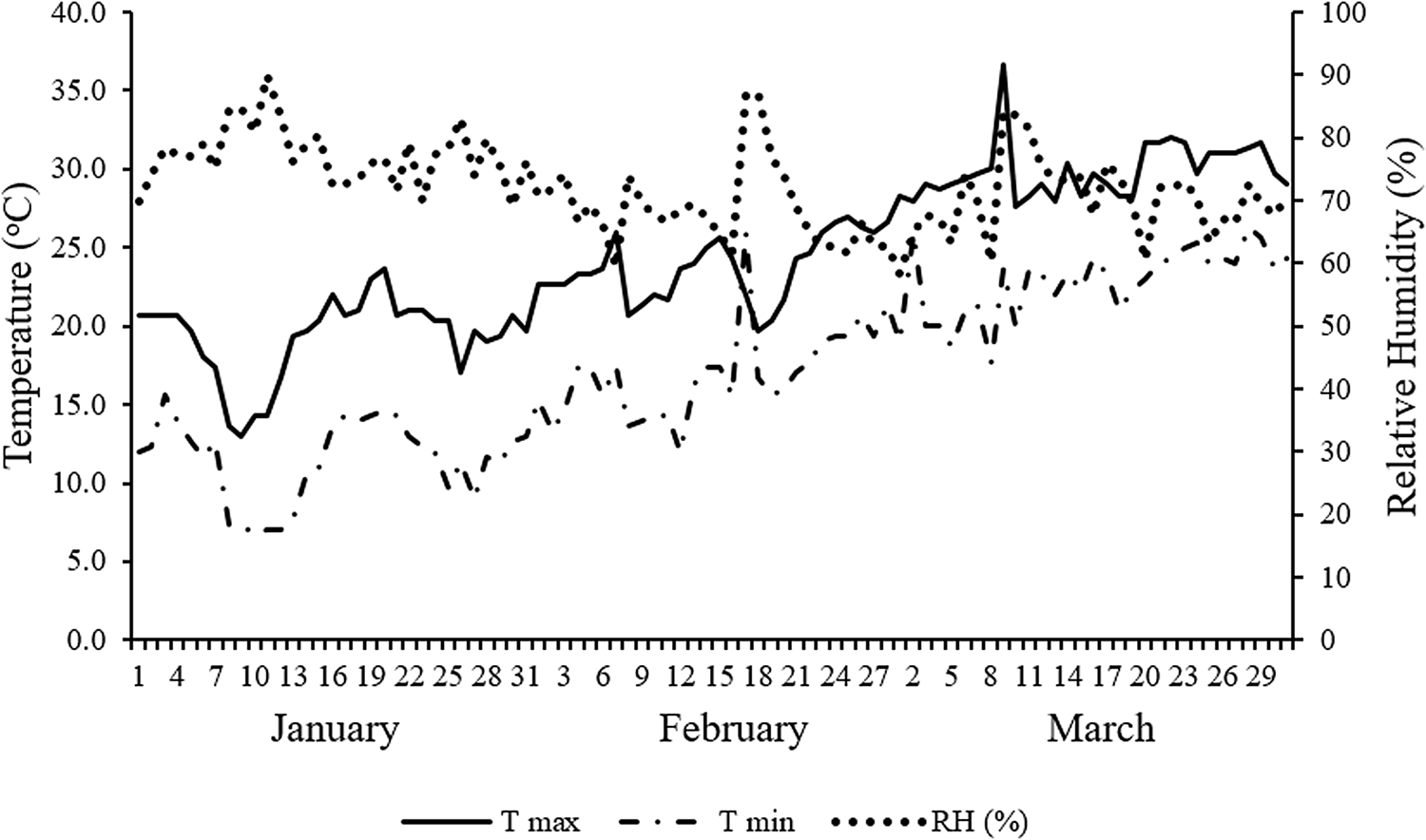
The first stemphylium blight symptoms observed in the field appeared on the susceptible check ILL 5888 and a few LR-26 RILs in mid-December 2012. The main infection started in early January 2013 when extended periods of foggy conditions occurred, resulting in high relative humidity (80%) at moderately warm temperatures around 21°C (Fig. 1). Approximately 5–6 h of foggy conditions every morning provided sufficient moisture to keep the leaf surface wet throughout most of the cropping season and resulted in rapid disease progress.
Minimum and maximum daily temperature (Tmin°C and Tmax°C) and relative humidity (%) during the 2012/2013 growing season at Pulses Research Centre, Ishurdi, Bangladesh.

In the greenhouse, symptoms of stemphylium blight started with the appearance of tiny lesions on the susceptible checks CDC Glamis and ILL 5888 at 4 dpi. In the growth chamber, symptoms started to appear on the susceptible check CDC Glamis and a few RILs at 3 dpi.
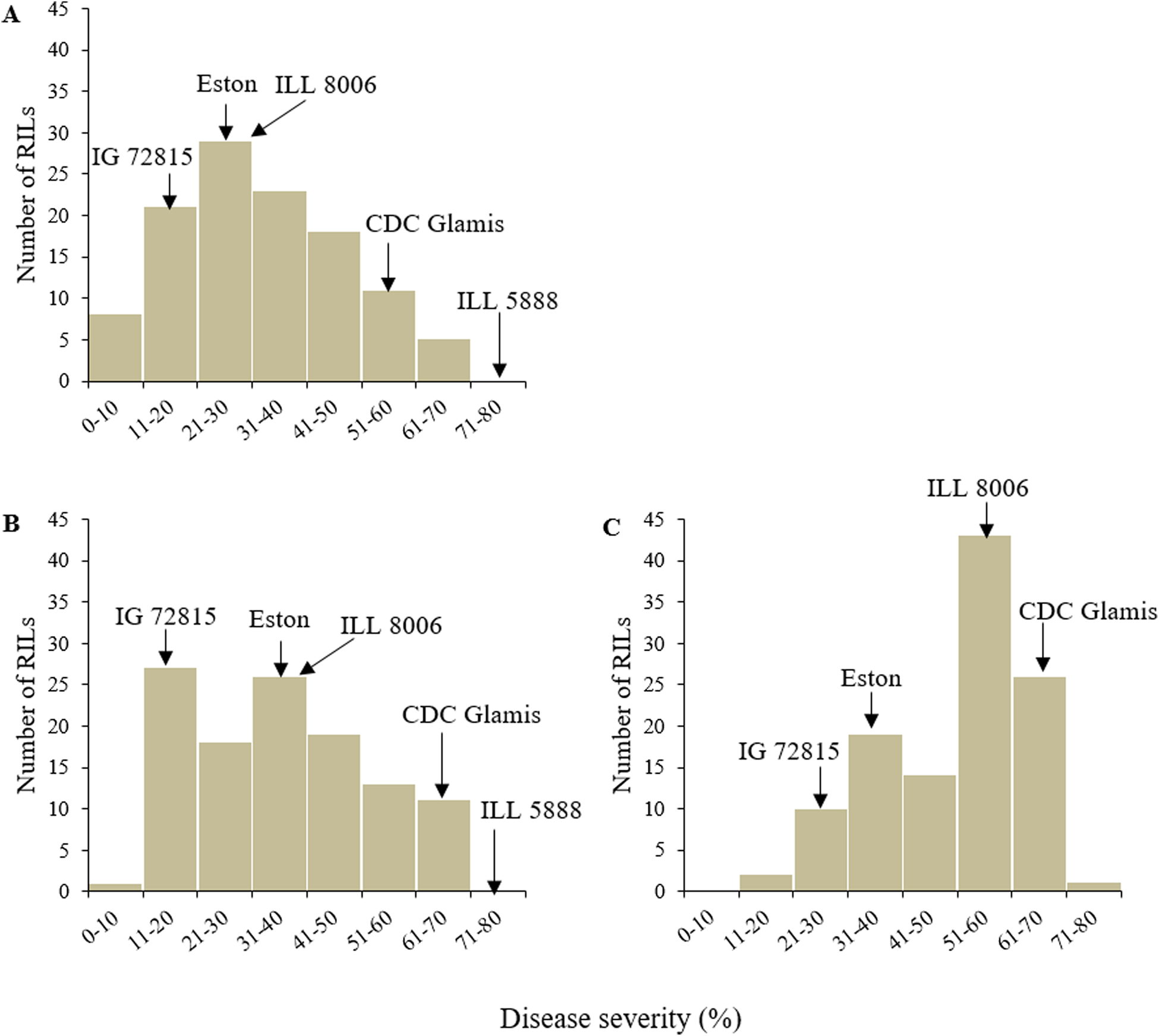
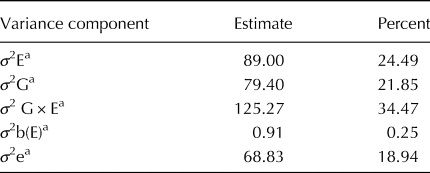
The combined analysis of variance revealed significant effects of genotype, environment and genotype × environment interactions on disease severity (Table 1). The variation in disease severity due to genotype, environment and the genotype × environment interactions were 22, 24 and 34% of the total variation, respectively (Table 2). This indicated a significant role of environment in the development of stemphylium blight among the genotypes. The mean disease severity varied across environments and this was reflected in the frequency distributions of disease reaction at each environment (Fig. 2). The frequency distribution of mean disease severity scores of 115 RILs in all environments revealed a continuous distribution, suggesting the interplay of several genes with minor effects in stemphylium blight resistance.
Distribution of stemphylium blight severity in 115 lentil interspecific RILs screened in the field at Ishurdi, Bangladesh in 2012/2013 (A) and at Saskatoon in greenhouse in 2012 (B) and growth chamber in 2018 (C).

Combined analysis of variance (Type III SSS) using a mixed model for stemphylium blight severity in lentil interspecific recombinant inbred line population (LR-26) screened in the field at Ishurdi, Bangladesh in 2012/2013 and in the greenhouse in 2012 and growth chamber in 2018 at Saskatoon, Canada

Estimates of variance components for stemphylium blight severity in 115 lentil interspecific RIL population screened in the field at Ishurdi, Bangladesh in 2012/2013 and in the greenhouse in 2012 and growth chamber in 2018 at Saskatoon, Canada

a σ 2E, environmental variance; σ 2G, genotypic variance; σ 2G × E, genotype by environment interaction variance; σ 2b(E), block nested within environment variance; σ 2e, error variance.
Among the RILs, disease severity observed in the growth chamber in 2018 was higher (18.3–71.7%) than that observed in greenhouse in 2012 (9.6–69.2%) and the field in 2012 (4.7–65%) (Fig. 2, online Supplementary Table S1). The susceptible, local Bangladeshi check ILL 5888 had the highest disease severity in the field (71.7%) and greenhouse (76.7%) experiments. The mean disease severity of the susceptible check CDC Glamis varied from 55.0 to 65.0% across environments, whereas the moderately resistant check Eston had disease severity ranging from 21.7 to 48.3%. Eston had significantly less disease than the susceptible checks CDC Glamis and ILL 5888 across all environments (online Supplementary Table S1).
Under field conditions, disease severity of resistant L. ervoides parent IG 72815, cultivated parent Eston and resistant Bangladeshi check ILL 8006 was not significantly different (online Supplementary Table S1). None of the RILs had significantly less disease than the resistant parent IG 72815, although 16 RILs had a nominally lower mean disease severity than IG 72815 (online Supplementary Table S1). Fifty-eight RILs, however, had disease severity levels similar to the resistant L. ervoides parent IG 72815, and 57 RILs had significantly more disease than IG 72815. Seventy-one RILs had similar disease severity levels and 44 RILs had significantly higher disease severity levels when compared to Eston (online Supplementary Table S1).
The resistant parent IG 72815 had significantly less disease than Eston and ILL 8006 in greenhouse and growth chamber experiments (online Supplementary Table S1). Similar to the field experiment, none of the RILs had significantly less disease than resistant parent IG 72815 under controlled conditions. Forty-four RILs inoculated under greenhouse conditions, and 38 RILs tested in the growth chamber had similar disease severity levels compared to the resistant parent IG 72815. Seventy-one RILs screened in the greenhouse and 77 RILs screened in the growth chamber had significantly more disease compared to the resistant parent IG 72815. Among the 115 RILs screened in the greenhouse and growth chamber, the number of RILs that had significantly less disease than Eston was 35 and 21, respectively. In addition, 44 RILs and 76 RILs screened in the greenhouse and growth chamber had similar disease severity compared to Eston.
Pearson correlation analysis revealed a significant positive correlation (r = 0.55, P < 0.0001) between mean disease severity scores in the greenhouse and growth chamber. Disease severity scores under field conditions were positively correlated with those in the growth chamber (r = 0.27, P = 0.0034) and the greenhouse (r = 0.29, P = 0.0017), but explained a very low proportion of the variability.
Discussion
The original intent for developing the LR-26 population was to transfer resistance to C. lentis race 0 from wild L. ervoides accession IG 72815 to cultivated L. culinaris (Tullu et al., Reference Tullu, Bett, Banniza, Vail and Vandenberg2013). Upon screening of wild relatives of cultivated lentil for resistance to S. botryosum, several L. ervoides accessions including IG 72815 were identified as good resistance sources (Podder et al., Reference Podder, Banniza and Vandenberg2013). This study was conducted with the objective to phenotype the available interspecific RILs of the LR-26 population under field and controlled conditions, and to determine the pattern of inheritance of resistance to stemphylium blight. A high level of phenotypic variation for stemphylium blight resistance was observed among the LR-26 interspecific RILs after evaluation under both field and controlled conditions.
The resistant parent IG 72815 and the moderately resistant parent Eston had significantly less disease severity than the susceptible checks CDC Glamis and ILL 5888 in all environments. However, no resistant transgressive segregants were found in the LR-26 RIL population in all environments. According to Rieseberg et al. (Reference Rieseberg, Archer and Wayne1999), transgressive segregation mainly occurs as a result of genes acting in complementary manner. Therefore, one of the reasons for no resistant transgressive in the population might be due to both parents having the same alleles for resistance to stemphylium blight. An alternative explanation might be due to masking of the wild allele phenotype by the domesticated allele. Eston and IG 72815 both originated from Turkey, which is part of the centre of origin of cultivated lentil (Cubero et al., Reference Cubero, Pérez de la Vega, Fratini, Erskine, Muehlbauer, Sarker and Sharma2009). A further explanation might be due to the stringency of the statistical tests used to declare significant transgression in this study. Compared to the resistant parent IG 72815, 50% of the RILs had similar resistance levels when tested in the field. In the greenhouse, 38% of RILs had resistance level similar to IG 72815. A similar trend (33%) was observed in the growth chamber experiment. Across all environments, 14 RILs (LR-26-41, −78, −79, −91, −110, −125, −128, −138, −145, −151, −194, −220, −228, −266) consistently had resistance levels similar to the resistant parent IG 72815. Among these, LR-26-220 and LR-26-228 were reported to have retained agronomic traits including days to maturity similar to those of the cultivar Eston (Tullu et al., Reference Tullu, Bett, Banniza, Vail and Vandenberg2013). The susceptible check ILL 5888 from Bangladesh had the highest disease severity score in the field at Ishurdi and in the greenhouse at Saskatoon. This genotype would be a reliable susceptible check for the screening of lentil genotypes for stemphylium blight resistance.
The frequency distribution of disease severity scores for RILs shows continuous distribution for field and controlled experiments suggesting polygenic inheritance of stemphylium blight resistance. Bhadauria et al. (Reference Bhadauria, Ramsay, Bett and Banniza2017) reported a bimodal frequency distribution for an intraspecific population derived from a cross between L. ervoides accessions L01-827A and IG 72815, screened in the greenhouse with S. botryosum SB-19 isolate and suggested an oligogenic inheritance of resistance. Saha (Reference Saha2009) studied the inheritance of stemphylium blight resistance and reported non-allelic interactions among genes conferring resistance that could influence quantitatively inherited traits as well as phenotypic expression.
Inconsistent disease severity reactions for some RILs were observed, in particular in field versus controlled environment experiments. This could have been caused by the presence of different Stemphylium spp. in the field during the growing season whereas under controlled conditions only one Canadian isolate (SB-19) of S. botryosum was used. From molecular phylogenetic studies based on internal transcribed spacer and glyceraldehyde-3-phosphate dehydrogenase gene sequences of primarily Canadian and several South Asian field isolates, Caudillo-Ruiz et al. (Reference Caudillo-Ruiz, Bhadauria and Banniza2017) reported that S. botryosum is one of probably two Stemphylium spp. involved in the development of stemphylium blight on lentil in Canada. In the same study, Canadian isolate SB-19 and two isolates from Bangladesh were reported to belong to the same species with 1.2% variation of the total nucleotides from the ex-type of S. botryosum (Caudillo-Ruiz et al., Reference Caudillo-Ruiz, Bhadauria and Banniza2017). However, an isolate from lentil from Pakistan was distinct from this cluster, indicating that more than one species may be involved in stemphylium blight of lentil in South Asia as well. The Canadian isolate SB-19 used in the controlled experiments was previously found to be significantly less aggressive than an isolate collected from Bangladesh (Kumar, Reference Kumar2007), which could indicate that differences in aggressiveness exist between the Canadian and Bangladeshi populations of this pathogen, and would influence disease reaction among RILs. The subjectivity of disease severity scoring by different evaluators as well as single plant scoring under controlled conditions versus whole plot scoring in the field could also have contributed to variation in scores (Kumar, Reference Kumar2007), as could have differences in environmental conditions. As a result, weaker correlations were observed between disease severity ratings from the field and controlled conditions than between greenhouse and growth chamber ratings.
Disease severity appears to be significantly influenced by environmental factors including moisture and temperature, as was previously shown by Mwakutuya et al. (Reference Mwakutuya, Vandenberg and Banniza2006). In our experiments under controlled conditions, temperature and light were set to create long day conditions with high humidity. Under field conditions in Bangladesh, fluctuation in day and night temperatures and moisture levels could have influenced disease development and severity. Furthermore, plants were exposed to repeated infection cycles under natural conditions in the field whereas a single infection cycle was created under controlled conditions. This may account for some of the observed variability in the disease reactions.
Screening of selected resistant RILs of LR-26 at additional locations in Saskatchewan could help identify superior candidates with consistent resistance to stemphylium blight. Construction of a linkage map, and subsequent identification of QTLs conferring resistance to stemphylium blight using the LR-26 population could be attempted as a step toward the development of robust molecular markers for introgression of resistance QTLs into elite lentil cultivars. Alternatively, superior L. ervoides interspecific RILs could be used as intermediates to develop mapping populations for identification of QTLs/genes and marker development and validation as segregation distortion has been reported in LR-26 in previous studies (Tullu et al., Reference Tullu, Bett, Banniza, Vail and Vandenberg2013).
The results presented here could have an impact on lentil breeding in production regions in both North America and South Asia where stemphylium blight is a threat to lentil production and ultimately a threat to food and nutritional security. Use of crop wild relatives to widen the genetic base of cultivated crops is a fundamental strategy that shows promise for improving both disease resistance and productivity of the lentil crop.
Supplementary material
The supplementary material for this article can be found at https://doi.org/10.1017/S1479262120000295.
Acknowledgements
We would like to thank Dr Abebe Tullu for developing the LR-26 population. We also want to thank Dr Rajib Podder for allowing us to use part of his LR-26 population data from his MSc thesis, accessible at https://harvest.usask.ca/. The authors also acknowledge technical support from the research staff of the Bangladesh Agricultural Research Institute, PRC, Ishurdi, and the technical staff of the pulse breeding and pathology programmes at the Crop Development Centre/Department of Plant Sciences, University of Saskatchewan. We also acknowledge funding for this study, provided by Saskatchewan Pulse Growers (SPG) and the Natural Sciences and Engineering Research Council (NSERC) of Canada – Industrial Research Chair Program.