The International Criminal Tribunal for the former Yugoslavia (ICTY) can be seen as one of the pioneering institutions in the field of international criminal justice. Its jurisprudence has set a number of important legal precedents and contributed significantly to the development of many areas of not only substantive but also procedural international criminal law. Whether the same can be said of the ICTY's sentencing policy has been a matter of some controversy. Not only have individual sentencing decisions of the Tribunal been criticized but also overall ICTY sentencing practice has been designated as inappropriate, flawed, and inconsistent.Footnote 1 This article addresses some of these concerns by statistically analysing the sentences handed down by the Tribunal to date.
From the inception of the ICTY it has been consistently emphasized that despite the condemnable and horrendous character of the atrocities committed in the territory of the former Yugoslavia, proceedings conducted before the Tribunal should in all regards respect the principles of fair trial. It was presumed that only fair proceedings and sentencing could lead to the attaining of the Tribunal's fourfold objectives: to hold accountable those responsible for the crimes and, by doing this, to bring justice to victims, to deter further crimes, and to bring peace to the Yugoslavian region.Footnote 2 It is therefore of the utmost importance for the achievement of the Tribunal's mission to hold fair trials and to deliver fair sentences. In order to be fair, sentences need to be clear, predictable, and proportionate, or, in other words, consistent. The need for consistent sentencing has been recognized by the ICTY itself. In the Čelebići case the ICTY Appeals Chamber noted, ‘One of the fundamental elements in any rational and fair system of criminal justice is consistency of punishment.’Footnote 3 There are several dimensions to the concept of consistency of punishment. First, all sentences should follow the same underlying principles, thus creating a coherent and harmonious system. Second, sentences should be based exclusively on legally relevant factors. Finally, similar factors should be given similar weight in all sentencing decisions unless some special circumstances require otherwise. The last dimension refers to predictability of sentencing. The predictability of sentences can be seen as one of the necessary components of fair and consistent sentencing practice.
This article analyses the sentencing jurisprudence of the ICTY and assesses its predictability. The main text is divided into three parts. In the next section the theoretical and normative underpinnings of the ICTY's sentencing regime are discussed. The second section addresses the motivation of the study and the methodology. In the final part the ICTY sentencing practice is described and the results of the statistical analysis are examined.
1. The ICTY penal regime in law
The ICTY Statute,Footnote 4 together with the Rules of Procedure and Evidence (Rules),Footnote 5 provide only general guidelines as to what factors should be taken into account in sentencing considerations. Judges are vested with rather extensive discretionary powers when deciding on the appropriate sentence. This broad discretion is only slightly limited by the Statute and the Rules.
According to these documents the sentence shall be restricted to imprisonment.Footnote 6 The judges are also instructed, if it is applicable, to order the restitution of property unlawfully acquired by criminal conduct, to its legal owner.Footnote 7 This remedy, however, has never been used in the ICTY jurisprudence.
The factors that judges shall take into account in the sentencing determination include ‘such factors as the gravity of the offence and the individual circumstances of the convicted person’.Footnote 8 These should form the central issues from which the determination of the sentence evolves. As noted by the trial chamber in the Čelebići case, ‘[b]y far the most important consideration, which may be regarded as the litmus test for the appropriate sentence, is the gravity of the offence’.Footnote 9 The gravity is assessed by the ICTY judges mainly on a case-by-case basis:
The determination of the gravity of the crime requires a consideration of the particular circumstances of the case, as well as the form and degree of the participation of the accused in the crime.Footnote 10
No objective scale exists wherein the crimes under the ICTY's jurisdiction are distinguished in terms of their inherent gravity. There is no such thing as a sentencing tariff setting minimum and maximum penalties for individual crimes. Individual offences are not pre-categorized in terms of their objective gravity and corresponding sentence range. The seriousness of individual crimes is appraised on a case-by-case basis without referring to any objective benchmark. The only limitation in this respect can be found in Rule 101 of the Rules – the longest possible sentence is life imprisonment.
The seriousness of the crime is often discussed together with aggravating circumstances;Footnote 11 the obligation to consider mitigating and aggravating circumstances is explicitly provided for in Rule 101. However, there is no illustration of what circumstances could justify a reduction of or increase in the sentence.Footnote 12 There are only two factors explicitly mentioned in the law: ‘mitigation due to a substantial co-operation with the Prosecutor’Footnote 13 and ‘mitigation for acting on the basis of a superior order’.Footnote 14 Again, the judges are left free to fill this lacuna on a case-by-case basis. According to the case law, aggravating factors should be proved by the prosecution beyond any reasonable doubt and should be directly related to the charged offence.Footnote 15 A lesser standard of proof applies to mitigating factors – they should be proved on the balance of probabilities and may include circumstances not directly related to the offence.Footnote 16 The final factor which should play a role in the determination of the sentence is ‘the general practice regarding prison sentences in the territory of the former Yugoslavia’. This provision has been construed by judges restrictively, holding that it does not render an obligation to follow the domestic Yugoslavian practice.Footnote 17
The positive law is silent as regards the rationales for sentencing. However, some principles have emerged in the case law. In this respect, judges clearly found inspiration in classical domestic penal theories. Among them, deterrence and retribution are given primary attention.Footnote 18 The weight of rehabilitative concerns is considered to be limited, especially in the light of the gravity of international crimes.Footnote 19 These classical rationales of punishment are from time to time complemented by sentencing principles developed to reflect the specifics of international crimes, such as the principle of reconciliation of societies fractured by long-lasting violence or the principle of restoration of peace.Footnote 20 Also the educative function of international sentencing, in a sense of making it clear that the international criminal law is indeed enforced, is often emphasized.Footnote 21 All these principles form a general background against which the individual sentence should be determined. Decisions of judges as to which aggravating and mitigating factors would be acceptable are informed by these rationales. Most of the aggravating factors accepted by the chambers so far are underpinned by retributive concerns. The culpability of the offender is often emphasized in this respect. Rehabilitative concerns together with reconciliation are often behind mitigation of the punishment.
These principles, stemming from the case law, together with the positive law, form the legal framework of sentencing considerations. This framework establishes only a minimal set of legal constraints on the judges’ determination of the sentence. On one hand, this considerable amount of discretion enables judges to reflect on the particularities of every case and to individualize the sentence, but on the other hand this gap of discretion makes sentencing decisions vulnerable to legally irrelevant influences.Footnote 22 Whether judges have so far managed to establish a predictable sentencing practice based on the strict legal criteria is assessed in the following paragraphs.
2. Methodology
2.1. Methods
Most of the scholarly attention concerning the ICTY so far has been devoted to the legal and normative aspects of its activities. Empirical and quantitative studies of the ICTY sentencing process have been scarce. In these rare cases, a combination of various legal and extra-legal factors and their influence on sentence length was examined.Footnote 23 According to Meernik and King, only the legal factors – that is, factors derived from international law, the ICTY Statute and the Rules – play a significant role in predicting sentence length.Footnote 24 The other legally irrelevant considerations do not seem to predict significantly the sentencing outcome.Footnote 25 In their studies Meernik and King focused on the combined effect of the legal and extra-legal factors on the sentence. They paid only fragmentary attention to the interplay of the legal factors exclusively.Footnote 26 In this article, therefore, only the legal factors and their predictive value in relation to sentence length will be examined. In order to acquire a more comprehensive picture of the dynamics of the legal factors, more legal determinants of the sentence length were identified and included in the model. Since in general one single sentence is pronounced for each convicted individual, data were organized and sentences were estimated on a person-by-person basis. At the time of writingFootnote 27 63 individuals have been sentenced by the ICTY.Footnote 28 Based on the analysis of the case law, the following data were collected for each individual: (i) the length of the final sentence before any reduction due to time spent in detention; (ii) the number of counts on which a person was convicted; (iii) the category of crime for which they were convicted; (iv) the mode of responsibility; (v) the number of mitigating factors; (vi) the number of aggravating factors; (vii) a guilty plea; and, finally, (viii) actual rank in the military or political hierarchy.Footnote 29 All these data were obtained from the written versions of the judgments published on the ICTY web page.Footnote 30
All the collected data were then analysed by the analytical software SPSS 14.0 for Windows. First, the basic descriptive statistic, such as mean sentence and median sentence,Footnote 31 were computed and compared. Thereafter, a multiple regression analysis was conducted with sentence length as dependent variable. Multiple regression analysis is a statistical technique that attempts to predict from independent variables a dependent variable – that is, in our case, sentence length. It seeks a combination of predictors that is maximally correlated with the sentence. It then enables assessment of the relative importance of the individual predictors given the effect of other variables in the model. Multiple regression accounts for a combined effect of all predictors included in the model. Whenever an independent variable is found significant, it has a predictive value for sentence length given the effect of the other variables entered into the analysis.Footnote 32 As such, the analysis shows the added value of each independent variable for predicting sentence length after the effect of all the other predictors has been taken into account.Footnote 33
The independent variables included in the analysis were (i) number of convictions (actual number); (ii) number of aggravating factors (actual number); (iii) number of mitigating factors (actual number); (iv) category of crimes (dummy variable – conviction for war crimes used as a reference category); (v) guilty plea; (vi) superior responsibility; (vii) direct perpetration; (viii) participation in joint criminal enterprise (JCE); (ix) ordering; (x) instigating; (xi) planning; or (xii) aiding and abetting (all dichotomous variables, YES/NO); and, finally, (xiii) actual rank (dummy variable with low rank as a reference category). Multiple regression analysis with a backward elimination was used. In this method all the independent variables are first entered into the model. Then those factors that do not significantly predict sentence length are gradually removed. The resulting model is limited to only those variables which play a significant role in predicting sentence length. As the aim of this study was explorative – to explain the dynamics of the legal factors behind the sentence determination – this particular method is appropriate. All the statistical assumptions for using this method were met.Footnote 34
2.2. Independent variables
2.2.1. Category of crimes
Each offence under the ICTY jurisdiction can be qualified as a war crime, as a crime against humanity, or as genocide.Footnote 35 If a scale of severity of these categories of crimes were proposed then genocide would probably be at the top. Due to its extreme gravity, magnitude, and specific features, genocide is often denoted as ‘the crime of crimes’.Footnote 36 However, the hierarchical relationship between crimes against humanity and war crimes is controversial. On one hand, in the current ICTY jurisprudence it is emphasized that ‘there is in law no difference between crimes against humanity and war crimes that would require, in respect of the same acts, that the former be sentenced more harshly than the latter’.Footnote 37 Judges take the position that there is no difference in inherent gravity between those two categories of international crimes. According to the case law, there should be no a-priori distinction in the sentencing.Footnote 38 On the other hand it has been argued that, in theory, because of their special characteristics, crimes against humanity should constitute a more serious category of crimes.Footnote 39 First, the contextual element of crimes against humanity – that is, their widespread or systematic character – is emphasized.Footnote 40 Crimes against humanity must be committed as part of large-scale premeditated attacks. In contrast, war crimes can be isolated acts. Second, the specific mental element of crimes against humanity – that is, crimes must be committed with the knowledge that they are part of a widespread or systematic attack against civilians – is often added to demonstrate their inherently more serious nature.Footnote 41 Finally, it can also be argued that crimes against humanity, as opposed to war crimes, target in a systematic or widespread manner a group of people – ‘any civilian population’. Therefore a group of people, not an individual as such, is the object of attack. This collective feature is an extra element distinguishing crimes against humanity from war crimes. On account of these characteristics crimes against humanity can be considered the more serious category of international crimes per se.
In order to see whether any differences exist in actual sentencing practice, the sentences for those above two categories have been examined separately. Where a person has been convicted of both categories of crimes, he is then included only in the allegedly ‘more serious category’ of crimes against humanity. Genocide as a distinct group has not been included for pragmatic reasons; so far only one person has been convicted by the ICTY of genocide – Radislav Krstić.Footnote 42
2.2.2. Aggravating factors
The assessment of the gravity of the offence is also linked to the consideration of aggravating factors. When aggravating circumstances are found, the seriousness of the offence is said to increase. Sentence length should reflect this enhanced gravity. It is expected that as the number of aggravating factors rises, the sentence increases accordingly. In practice, a large variety of aggravating circumstances have been recognized by the judges. The most frequent factors accepted in aggravation are as follows:
1. abuse of superior position/position of authority or trust (accepted in 35 cases);
2. special vulnerability of victims (accepted in 31 cases);
3. extreme suffering or harm inflicted on victims (accepted in 25 cases);
4. large number of victims (accepted in 15 cases); and
5. cruelty of the attack (accepted in 14 cases).
2.2.3. Number of counts
Most of the accused before the ICTY were found guilty of several criminal acts. The practice has evolved in the direction of handing down a single sentence to cover all guilty counts. Therefore it is impossible to distinguish among individual crimes and their relative contribution to total sentence length. Transparency of sentencing in this respect is lacking. This fact was one of the reasons for using multiple regression analysis. If we want to tease out the contribution of individual factors to sentence length, multiple regression is the most appropriate method in this respect.
The single sentence should reflect the totality of the offender's criminal activities. When a person is convicted for more crimes, he or she should be subjected to severer punishment. When somebody's criminal activity is based on multiple acts, it is expected that his or her sentence increases accordingly, in order to reflect all criminal activities. Only in this manner is the gravity of all his or her crimes properly accounted for.
2.2.4. The actual rank of the offender
Assessment of the gravity of the crimes should also include appraisal of the degree and the form of participation of the offender. In practice, the actual position of the perpetrator in a state military or political structure can often indicate his personal contribution to criminal activities. Therefore the actual status of the offender may play a significant role in determining the sentence. In case of international crimes, it is widely accepted that those to be blamed most should be those occupying high and influential positions in the military or political hierarchy.Footnote 43 Systematic violence committed on such a large scale as to qualify as an international crime is hardly conceivable without those at the top levels of the state hierarchy devising destructive policies, implementing them, and persuading others to follow. Without influential and high-ranking supporters of these policies there would be no systematic and widespread violence. Generally, perpetrators of mass atrocities can be divided into three broad categories: leaders (perpetrators at the top hierarchical levels), superiors (offenders occupying middle-ranking positions), and actual killers (low-ranking individuals). These groups represent the descending level of moral blameworthiness for atrocity.Footnote 44 In addition, as the abuse of superior position is the most cited and emphasized aggravating factor in the ICTY jurisprudence, it is expected that as one rises to a higher level in the hierarchy, the sentence increases accordingly.Footnote 45
To assess possible differences in sentencing different ranks of offenders, all convicted individuals have been divided into the following three categories: (i) low-ranking offenders – those who held little or no power and influence in the overall circumstances of the Yugoslavian conflict, such as camp guards, ordinary soldiers, or local commanders and sub-commanders (21 convicted); (ii) middle-ranking offenders – those who held the authority to command and influence the conduct of others, such as camp commanders or senior army officers with more extensive power of command (26 convicted); and (iii) high-ranking offenders – those who held leadership positions in the military or political structure at the regional and national level, such as members of a regional government or military officers above the rank of colonel (16 convicted).
2.2.5. The mode of responsibility
The mode of responsibility serves as another important indicator of the form and degree of the offender's participation in the crimes committed. It reflects his actual criminal conduct and his unique contribution to the crimes committed. According to the ICTY Statute, there is a distinction between superior responsibility and other modes of individual responsibility. The latter category is further divided, based on Article 7 of the Statute, into (i) direct perpetrators; (ii) participants in JCE; (iii) planners; (iv) instigators; (v) order-givers; and (vi) aiders and abetters. This distinction enables the judges to distinguish between different degrees of individual guilt. Given the different elements of the individual modes – different degree of involvement of the offender in the crimes (actus reus) and his different state of mind (mens rea) – there should be a consequent difference in punishment. There are two basic groups: primary or principal liability (direct perpetration, co-perpetration), and secondary or accessory liability (participation in JCE,Footnote 46 planning, instigating, ordering, and aiding and abetting).Footnote 47 When someone is held to be guilty as an accessory, this suggests that his behaviour had a substantial effect on the commission of a crime by someone else. In the case of principal responsibility the crime is ascribed to his own conduct.Footnote 48 This difference in actual criminal conduct should be reflected in the sentencing. However, there is one important caveat peculiar to international crimes. It does not often occur that persons at the highest levels of the state hierarchy participate personally in the committed atrocities as direct perpetrators. Instead they usually co-operate in planning, instigating, or ordering the commission of crimes. Those individuals are usually far removed from the actual crime scene. But, as argued above, these are the ones to be blamed most, not their respective followers. Systematic and widespread violence is hardly conceivable without planning, instigation, and eventual orders coming from top officials through mid-level superiors to actual perpetrators. Therefore, despite the fact that ordering, instigation, and planning are classified as derivative modes of responsibility, the sentences for international crimes should reflect these considerations. It is not suggested here that planners, instigators, and order-givers must necessarily be higher-ranking offenders. Requirements of actus reus and mens rea for these modes of responsibility can be satisfied by any perpetrator irrespective of his or her rank. But in a majority of cases those convicted by the ICTY for planning, instigation, or ordering have been those occupying middle- or high-ranking positions.Footnote 49
2.2.6. Mitigating factors
Mitigating factors may be related not only to the crimes committed but also to the offender's attributes. They often reflect the individual circumstances of the perpetrator at the time of sentencing. In contrast to aggravating factors, acceptance of factors in mitigation should result in a lesser punishment. Therefore it is expected that, where more factors in mitigation are identified, a shorter sentence is pronounced. Similarly to aggravation, a great variety of factors is taken in mitigation by ICTY judges. Those cited most often by the judges include the following:
1. family circumstances (cited in 35 cases);
2. remorse (cited in 27 cases);
3. assistance to victims (cited in 24 cases);
4. conduct in detention (cited in 22 cases); and
5. voluntary surrender (cited in 22 cases).
2.2.7. A guilty plea
The final factor considered in the analysis is whether or not the defendant pleaded guilty. At the time of writing, 20 defendants have pleaded guilty before the Tribunal. A guilty plea was included as a separate variable for several reasons. First, a guilty plea has always been considered an aspect in mitigation and, as has been argued in the literature, it is repeatedly one of the most influential mitigating factors the ICTY judges will accept.Footnote 50 Second, the guilty plea has often been linked with the expression of remorse and (substantial) co-operation with the Prosecutor – these are other commonly accepted mitigating circumstances. In every case of a guilty plea there has been this specific accumulation of mitigating factors calling for a significant reduction in the sentence. In addition, every time a defendant pleads guilty there is a separate sentencing hearing. This fact can have some impact on the sentence determination, since attention is then devoted only to the sentencing considerations. In contrast, in ‘normal’ cases sentencing arguments must be presented before the determination of guilt. Therefore most attention is devoted to the consideration of the guilt of the accused and not to the potential sentence. On the basis of all these arguments, it is expected that the sentences of those pleading guilty will be lower.
3. The ICTY penal regime in practice
3.1. Descriptive overview
Until August 2008 the ICTY's trial chambers had handed down 67 convictions and sentences, and nine defendants had been acquitted. Fifty-five trial judgments were appealed against by either a defendant or the Prosecutor. On appeal, four defendants were acquitted and ten appeal proceedings are currently still pending.Footnote 51
The mean length of all the issued sentences is 15.1Footnote 52 years; the median is 15 years.Footnote 53 The sentences range from two years to the longest possible sentence – life imprisonment.Footnote 54 When only first-instance decisions are examined the mean sentence is 15.9 years, the median being 15 years. The mean sentence issued by the Appeal Chamber is 14.9 years, with a median of 15 years. In the majority of cases sentences issued by the trial chambers are either confirmed or reduced on appeal. In only three cases has the Appeal Chamber modified a sentencing decision to the detriment of the accused.Footnote 55
On average, a person is convicted on 4.6 counts; this number is higher when only the first-instance decisions are analysed, when the average rises to 5.1. The most frequent conviction is for the crime of persecution under Article 5(h) of the Statute; currently, 35 accused have been found guilty of persecution. The average sentence of those convicted is 16.5 years.
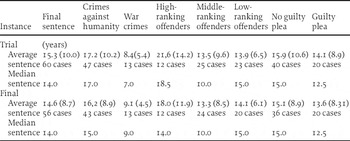
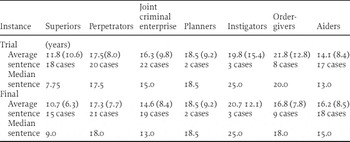
In tables 1 and 2, comparisons of the average and median sentences for different groups of offenders are presented. The convicted have been categorized according to the legal characteristics of their cases. The tables are divided into two rows: in the first row only the first-instance sentences are analysed; in the second row all the finalized sentences, including appeal chambers’ modifications, are compared.Footnote 56
Comparison of average and median sentences (standard deviations are indicated in parentheses).

Comparison of average and median sentences (standard deviations are indicated in parentheses)

Table 1 data are given in eight columns. In the first column the final sentences pronounced by the judges in all cases are given. The other columns represent different categories of cases. The sentences are examined separately on the basis of category of crimes, the actual rank of the offender, and the guilty plea.
We can see from Table 1 that generally sentences were reduced once a case went successfully to appeal. The comparison between the sentence length of those convicted for crimes against humanity and those convicted for war crimes is also interesting. The perpetrators of crimes against humanity are sent to prison for substantially lengthier terms.
As regards the sentences of differently ranking offenders, the highest-ranking individuals have been sentenced to substantially longer terms than their subordinates. However, there is not, as might be expected, a reduction in the sentence length when we move from middle-ranking offenders to low-ranking individuals. The low-ranking offenders are apparently punished more severely. A possible explanation can be seen in the fact that the low-ranking individuals, as the actual killers, rapists, and torturers, are, in the light of the actual brutality and depravity of their acts, assigned blame equal to or greater than that assigned to their direct superiors. These considerations seem to add to the sentence and finally counterbalance the assessment of the relative role of the offender in the overall situation.
Finally, those who pleaded guilty have been sentenced to slightly shorter prison terms. However, the difference between the sentences of those pleading guilty and those not so doing is minimal. This is at odds with the general belief that a guilty plea results in much lower sentences. Obviously, those pleading guilty may again have other characteristics that lead to higher sentences.
Table 2 data are given in seven columns, divided on the basis of the different modes of individual responsibility underlying the offender's conviction.
On one hand, in line with the arguments above, those who planned or instigated crimes have indeed been subjected to the severest punishments. On the other hand, final sentences of those giving the orders have been lower than sentences pronounced on the actual perpetrators. It is remarkable that those giving the orders – usually offenders occupying higher ranking and influential positions –are punished less severely than the actual perpetrators – their subordinates. It has been argued that, given their position of authority and their specific role in the commission of international crimes, the sentences of those giving the orders should rather be comparable with the higher sentences of the instigators and planners.Footnote 57
The lowest sentences have been given to those convicted on the basis of superior responsibility. This may be due to the fact that the superior responsibility lies in a passive behaviour of a superior – a failure to punish subordinates or to prevent them from committing crimes. The omissions of superiors are perceived as being less serious offences than active participation in criminal activities. This finding can also be linked to the difference discussed above between the sentences imposed on middle-ranking offenders and those imposed on the others. Those at the middle levels of the hierarchy are often found responsible for omissions in their capacity as superiors. This fact is most probably also reflected in the generally lower sentences of the middle-ranking offenders.
After appeal, the second-lowest sentences have been handed out to participants in JCE. Even those who were convicted purely as accomplices – aiders and abetters – have been punished more severely. Yet, it is argued in theory that due to its specific mens rea – ‘the common purpose/plan element’ – participation in JCE should be considered a more serious contribution to a criminal activity than aiding and abetting. Participation in JCE connotes a close involvement in the commission of a crime, while aiding and abetting constitutes mere facilitation. The degree of culpability of JCE participants is arguably higher that that of aiders and abetters.Footnote 58 Furthermore, the concept of JCE has been used by the ICTY primarily in the identification of the criminal acts of higher-ranking government and military officials in organizing systemic criminality.Footnote 59 One would expect, therefore, that it attracts generally higher penalties. Apparently, however, there are in practice additional legally relevant sentencing factors that lead to the surprisingly low sentences for participants in JCE or to the higher sentences for aiders and abetters.
On closer inspection of Table 2 another notable fact is revealed, related to the considerations in the previous paragraph: contrary to other categories, the final sentences of aiders and abetters are much longer than the sentences pronounced at trial. Aiders and abetters are thus sentenced more severely on appeal. Often those convicted on appeal of aiding had been originally held guilty as participants within the joint criminal enterprise.Footnote 60 It is conceivable that at trial the sentence was aimed at reflecting the more serious involvement of the JCE participant in criminal activities. Once this mode of responsibility was changed to the purely derivative responsibility of aiding by the Appeal Chamber, it appears that the appellate judges did not want to depart in a significant manner from the benchmark set by the original sentence pronounced for JCE participants at trial. This explanation is further underpinned by the fact that there is, in general, no new evidence admissible on appeal in relation to the sentencing.
3.2. The sentencing model
To understand better the differences in sentencing between examined categories of cases, a multivariate analysis was used to assess the factors that influence sentencing decisions. All 63 individuals sentenced by the Tribunal so far have been included in the analysis. The backward method of multiple regression analysis was used to examine how the selected legal factors statistically predict sentence length. Initially, 14 different independent variables were entered into the model.Footnote 61
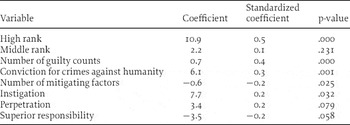
The results of the analysis are presented in Table 3. Five of all the entered legal variables are statistically significant – that is, these factors, given the other predictors, contribute significantly to predicting sentence length. Overall, 60 per cent of the sentence variation can be explained by the combination of these legal variables. The table is divided into four columns. In the first column, labels of individual selected predictors are indicated. Coefficients, displayed in the second column, represent the change in sentence length for a one-unit change of a respective predictor when remaining predictors are held constant. For example, the coefficient for number of guilty counts, after controlling for all other variables included in the model, is 0.7. Thus each additional guilty count tends to result in a 0.7-year increase in sentence length, given the effect of other predictors. The values of coefficients reflect each predictor in its original unit of measurement and therefore are difficult to compare. The standardized coefficients, shown in the third column, allow for comparisons among predictors. They indicate the relative strength of each predictor in predicting sentence length. The relative importance of individual predictors in the model can thus be compared. In the final column, p-value indicates whether a coefficient is statistically significant – that is, whether a result is unlikely to occur by chance. Generally, p-value is considered significant when it is smaller than 0.05.
ICTY sentencing model

N = 63
R2 = 0.653
Adjusted R2 = 0.602
Standard error of estimate = 5.7909
Joint significance test of the model: F test (8, 54) = 12.704, p < 0.001
Based on the standardized coefficients, the strongest predictor of sentence length is the rank of the offender. When a sentenced person occupies a position at a high level of a political or military hierarchy, his sentence is, ceteris paribus, 10.9 years longer (approximately 131 months) than the sentence of a low-ranking offender. Therefore those at the highest leadership levels are subjected to a more severe punishment than their respective followers – those without any influence whatsoever in the overall conflict. Given the characteristics of international crimes this differential treatment is justified. The regression analysis also confirmed that there is no statistically significant difference between the sentences of middle- and low-ranking offenders, even when the effect of the other variables is taken into account. A possible explanation for this phenomenon, already indicated above, is that in these cases considerations of the relative role of the offender in the overall conflict situation are overshadowed by considerations of the cruelty and depravity of the crimes committed. As opposed to their direct – middle-ranking – superiors, the low-ranking offenders are in the majority of cases the actual perpetrators of brutal atrocities.
The second-strongest factor in predicting sentence length is the number of guilty counts. As expected, the more counts on which the accused is found guilty, the lengthier the sentence. All other things being equal, each additional guilty count results in extra 0.7 years in prison (8 months). Therefore the more extensive criminal activity of the offender does indeed result in a more severe sentence.
Another major predictor of sentence length is the category of crime. To recap, all offenders were divided into two categories depending on the legal qualification of their acts – crimes against humanityFootnote 62 or war crimes.Footnote 63 The analysis revealed that there is indeed a substantial difference between the sentences of those found guilty of crimes against humanity and those convicted for war crimes. The sentence for perpetrators of crimes against humanity is approximately 6.1 years longer (73 months) than the sentence for those convicted solely on the basis of war crimes, given the other predictors. One objection could be raised in this respect – the category of crimes against humanity also included those cases where the offender was convicted of both war crimes and crimes against humanity simultaneously. It can be argued that it is this particular combination that makes the difference. Because of this objection, the difference between the sentences pronounced exclusively for either crimes against humanity or war crimes was further examined.Footnote 64 This closer examination corroborates the previous interpretation: it is indeed the fact that those convicted of crimes against humanity are punished more severely than those found guilty of war crimes. This finding empirically underpins the need for further discussions as to the creation of a seriousness scale of international crimes.
The number of mitigating factors stands out as another important predictor of the sentence length. As expected, mitigating factors account for a reduction in the sentence. Given all other factors, a sentence is on average reduced by 0.6 years (7 months) for each mitigating factor. Therefore there is a clear pattern of sentence reduction once a factor in mitigation is attributed. It was also expected that a guilty plea, as one of the prominent mitigating factors, would result in a specific reduction of the sentence. However, pleading guilty did not stand out in the model. This may be due to the fact that the separate effect of the guilty plea was subsumed in the overall effect of this general category – the number of mitigating factors.
Instigation is the final significant predictor of sentence length included in the model. When somebody instigates others to commit a crime, his sentence increases by an extra 7.7 years (92 months) when controlling for other variables. Despite the fact that there have only been three cases of convicted instigators so far, instigation is the only mode of responsibility that stood out in the resulting model in a statistically significant way. This in itself speaks of its remarkable relevance in the prediction of sentence length. That this is the case calls for special attention to be given to this mode of responsibility in the future.
Finally, the analysis revealed emerging trends in sentencing the perpetrators themselves and those convicted on the basis of superior responsibility, although the coefficients for these variables just missed statistical significance. On one hand, there is a trend of reducing the sentence when a person is convicted as a superior. On the other hand, the sentences of actual perpetrators tend to be increased by an extra 2.2 years.Footnote 65
4. Conclusions
The aim of this article has been to explain the dynamics of the legal factors behind the sentence determination by the ICTY judges and to assess whether the ICTY sentencing practice is predictable. Predictability can be seen as one of the important elements of consistency and fairness of sentencing. It has been demonstrated that the determination of the sentences can to a certain extent be predicted by the examined legal factors. Well-interpretable and legally relevant patterns in the sentencing practice have emerged: the high-ranking criminals in influential positions are sentenced to substantially longer prison terms than the ordinary low-ranking offenders. Those convicted of more extensive criminal activities are punished more severely than perpetrators of isolated, single acts. The analysis has also suggested a distinction in sentencing practice between crimes against humanity and war crimes. Those guilty of crimes against humanity receive longer sentences. Also, sentence length is reduced if factors in mitigation are present. Finally, those who instigate others to commit crimes are punished more severely than all the other participants in the atrocities. The analysis also suggests emerging trends in the case law: (i) actual perpetrators are sentenced to slightly longer prison terms; and (ii) superiors tend to be punished less severely than all other participants in atrocities.Footnote 66
Despite these patterns, approximately 40 per cent of the sentence variance remains unexplained by the proposed model – that is, the model accounted for 60 per cent of the variation in sentence length. It is difficult to judge the adequacy of this number; from a theoretical perspective, it is impossible to evaluate it in objective terms. There is no generally applicable gauge as to ‘how much should be predictable’ against which the result can be assessed. These considerations are related to the empirical question ‘how much variance in sentencing is actually predictable?’ – that number is unknown and not likely to be 100 per cent. Arguably, there is a multiplicity of legitimate factors influencing sentencing and it is impossible to include all these factors in the analysis. This is even more the case for our analysis, where our small, in a statistical sense, sample limits the number of predictors we can include. It is conceivable that more variation in sentencing would be accounted for if a more detailed analysis were performed. Possible further factors to be examined include the underlying offence leading to a conviction (arguably it would make a difference whether an offender were found guilty of murder or of appropriation of property) or particular mitigating and aggravating factors. At the national level empirical, quantitative studies of sentencing consistency have attempted to predict sentencing outcomes with different degrees of success.Footnote 67 However, above 60 per cent of sentence variance explained by legally relevant factors is generally considered evidence of fairly predictable sentencing practice.Footnote 68 Given the underlying requirement of fairness of sentencing, it is important to realize that there always will be unexplained variation in sentencing. And in fact, in order to be fair, sentences should also reflect the particular individual circumstances of offenders. The necessary individualization of a sentence is, next to sentencing predictability, another important sentencing principle. Both these principles should be respected in order for sentencing to be fair, and it is important to strike the right balance between the two. If sentencing were 100 per cent predictable, this would mean that particular differences between individual offenders would go unremarked, and such sentencing could hardly be perceived to be fair. Fairness thus demands not only predictability but a certain degree of unpredictability.
This study has demonstrated that despite the loose legal regulation, legally relevant patterns in the ICTY sentencing jurisprudence have emerged. Five legal factors are actually used in ICTY sentencing practice in a consistent and predictable way. On the basis of the combination of these factors 60 per cent of sentence variation can be explained. These findings can offer empirically based counter-arguments to all the criticism raised against the ICTY sentencing regime as to its disparateness and inconsistency.Footnote 69 On the basis of this study we can conclude that there are indeed some consistent and predictable patterns in ICTY sentencing practice. The question is whether being able to explain 60 per cent of variance on the basis of five legal predictors is good enough. The answer to this question is a matter of both normative judgement and empirical realism.
All these considerations are related to the recent calls for international sentencing guidelines.Footnote 70 It is often argued that, in order to address alleged existing unwarranted disparities in international sentencing and to prevent inconsistencies, sentencing decision-making should be more structured, in other words that there should be more legal sentencing guidance. Our results might provide a good starting point for such sentencing guidelines. At the same time it can be argued, based on our results, that ICTY sentencing is already fairly structured and logical, as consistent and detectable patterns in the ICTY sentencing practice determine sentence length to a sizeable extent. Whether that pertains to other international sentencing is a matter that we plan to investigate.
The call for sentencing guidelines is becoming even more relevant as more and more international criminal courts emerge. The existence of sentencing guidelines serving as a point of reference for international judges could make international sentencing more predictable and transparent, and thus consistent and fair; one issue is not only whether judges within one tribunal or type of international court sentence predictably, but also whether that is the case across legal institutions. Assuming that all relevant factors are included, statistical analysis can be perceived as one of the building blocks for understanding the phenomenon of international sentencing and developing appropriate sentencing guidance. To achieve this objective, more empirical and normative enquiries into international sentencing and international crimes are warranted.