INTRODUCTION
Worker-related engagement (‘engagement’) has been a much-researched construct in the past two decades – and for good reason. It has been empirically linked to several valued organizational outcomes, including job satisfaction, organizational commitment, pro-social behaviors, worker retention, task, and extra-role performance, as well as life satisfaction and better health (e.g., Rich, Lepine, & Crawford, Reference Rich, Lepine and Crawford2010; Christian, Garza, & Slaughter, Reference Christian, Garza and Slaughter2011; Shimazu, Schaufeli, Kamiyama, & Kawakami, Reference Shimazu, Schaufeli, Kamiyama and Kawakami2015). Importantly, engagement has also been found negatively related to withdrawal behaviors and worker burnout (e.g., Harter, Schmidt, & Hayes, Reference Harter, Schmidt and Hayes2002; Schaufeli & Bakker, Reference Schaufeli and Bakker2004; Schaufeli & Salanova, Reference Schaufeli and Salanova2014), consequences organizations hope to avoid. In addition to engagement consequences, research has begun to flourish on worker-related engagement antecedents, including job characteristics – such as autonomy, performance feedback, and task significance (Hackman & Oldham, 1975) – as well as organizational and personal resources (e.g., social support, psychological capital, conscientiousness, positive affectivity; Bakker & Demerouti, Reference Bakker and Demerouti2007; Christian, Garza, & Slaughter, Reference Christian, Garza and Slaughter2011).
Despite this burgeoning research, gaps remain. For instance, little is known about employee perceptions of how supportive leadership is of their efforts, and how such perceptions impact employee engagement. In addition, while conceptual distinctions have been made about work orientation – as a job, a career or profession, or as a ‘calling’ (Bellah, Madsen, Sullivan, Swidler, & Tipton, Reference Bellah, Madsen, Sullivan, Swidler and Tipton1985; Wrzesniewski, McCauley, Rozin, & Schwartz, Reference Wrzesniewski, McCauley, Rozin and Schwartz1997) – little is known empirically about the engagement relationship with what might be the most likely high-engagement work orientation – calling. However, as noted below, there are studies that provide some level of confidence that such extrapersonal (i.e., supportive leadership) and intrapersonal (i.e., calling) factors may serve to enhance a worker’s engagement level.
Thus, in the current study of 297 millennial workers from a variety of jobs and industries in 44 of the 48 contiguous United States, we examine two potentially valuable antecedents that we posit will positively augment workers’ level of engagement: the degree to which they feel ‘called’ to their current work, and perceptions that leadership is supportive of their work. We hypothesize positive engagement relationships for both antecedents. More specifically, we suggest that the most engaged workers in our study will feel ‘called’ to their current work and will indicate perceptions of high support from their organization’s leadership. In addition, we expect an interaction effect with these antecedents. That is, we assert that those indicating both a calling and with having positive perceptions of support from their organization’s leadership will result in an engagement boost.
Given now abundant evidence of positive consequences of highly engaged workers, negative consequences of disengaged workers, and low overall percentages of engaged workers – just 31.5% in a 2014 Gallup poll of US workers (Adkins, Reference Adkins2015) – continued research on engagement seems not only warranted but also vital.
Our current study’s focus on millennial workers also highlights the engagement dilemma in work settings, as the same Gallup poll found just 28.9% of millennials indicating being engaged at work-less than their older generational counterparts. Millennials are a particularly compelling group in the current context because, when compared with prior generations, they may be the most focused on finding meaningful work that contributes to society (e.g., Baggott, Reference Baggott2009; Buchanan, Reference Buchanan2010). As noted by Benson (Reference Benson2016), millennials strongly seek a sense of purpose and also desire to address larger societal concerns in their work. Thus, improving work engagement for millennials may require organizational leaders to clearly develop ‘a deeply compelling vision of what the company or team is contributing to society’ (Benson, Reference Benson2016: para. 4). Given that the global workforce in less than 10 years may be dominated more by millennials than any other single generational group (Schawbel, Reference Schawbel2013; Baird, Reference Baird2015; Fry, Reference Fry2016), it is surprising how little this group has been studied by social scientists. Further, given the overlap explained below between millennials’ values and the attributes of a calling work orientation, it would seem most wise for organizational leaders to attend to what aids their work engagement.
Engagement
Work-related engagement involves the degree to which a worker invests his or her ‘hands, head, & heart’ in his or her work (Ashforth & Humphrey, Reference Ashforth and Humphrey1995: 110). More specifically, and applying Kahn’s (Reference Kahn1990) seminal insights, job engagement is ‘a multi-dimensional motivational concept reflecting the simultaneous investment of an individual’s physical, cognitive, and emotional energy in active, full work performance’ (Rich, Lepine, & Crawford, Reference Rich, Lepine and Crawford2010: 619). In other words, engagement involves high levels of personal investments of energy – that is, cognitively vigilant, physically involved, and emotionally connected – at work and to their work (Rich, Lepine, & Crawford, Reference Rich, Lepine and Crawford2010; Christian, Garza, & Slaughter, Reference Christian, Garza and Slaughter2011). Engaged workers are mindful, focused, emotionally involved, attentive, and bring their full selves to their work experience and performance (Kahn, Reference Kahn1990; Rich, Lepine, & Crawford, Reference Rich, Lepine and Crawford2010; Christian, Garza, & Slaughter, Reference Christian, Garza and Slaughter2011).
Several authors have attempted to capture models of work-related engagement (also often viewed as work engagement, job engagement, or simply engagement). For instance, Christian, Garza, and Slaughter’s (Reference Christian, Garza and Slaughter2011) meta-analysis showed evidence for their proposed model, a model of engagement antecedents and consequences. Evidence for engagement antecedents was found for job characteristics (e.g., autonomy, task significance, and social support), for leadership (transformational leadership and leader–member exchange factors), and for dispositional characteristics (conscientiousness, positive affect, and proactive personality). Regarding engagement consequences, they found evidence for both task performance and for contextual (i.e., extra-role, prosocial) performance. They also make a clear case for engagement’s discriminant validity from other common attitudinal constructs – job satisfaction, organizational commitment, and job involvement.
Rich, Lepine, and Crawford’s (Reference Rich, Lepine and Crawford2010) study extended and validated Kahn’s (Reference Kahn1990) theory of personal engagement by examining cognitive, affective, and physical engagement antecedents. Specifically, they found support for value congruence (a cognitive component they relate to psychological meaningfulness), perceived organizational support (an affective construct supportive of a feeling of psychological safety), and core self-evaluations (a psychological self-assessment resulting in greater investments of energy into one’s work). As with Christian, Garza, and Slaughter (Reference Christian, Garza and Slaughter2011), they also found evidence for engagement’s positive impact on task and contextual performance.
Since both individual and organizational factors influence worker motivation, one’s cognitive experience of work, and one’s efforts to perform, we chose both an intrapersonal individual factor (a ‘calling’ work orientation) and an extrapersonal organizational factor (perceived leadership support) for this study.
Calling
In her comprehensive book, Conversations About Calling: Advancing Management Perspectives, Myers (Reference Myers2014) articulates the various views about calling over many centuries. Whereas calling – from the Latin term ‘vocare,’ meaning ‘voice’ – once was (and still is, by some; see Keller, Reference Keller2012) viewed as a sacred and divine summons from a transcendent God to do morally responsible work (e.g., Weber, Reference Weber1958), recently it has been conceptualized more broadly as ‘work performed out of a strong sense of inner direction’ (Markow & Klenke, Reference Markow and Klenke2005: 12) that transcends self-interest, serves others, makes a difference, and provides a deep sense of meaning and purpose for one’s life (e.g., Wrzesniewski, Reference Wrzesniewski2003, Reference Wrzesniewski2012; Hall & Chandler, Reference Hall and Chandler2005; Myers, Reference Myers2014). The Encyclopedia of Career Development defines calling as ‘consisting of enjoyable work that is seen as making the world a better place in some way’ (Greenhaus & Callanan (Reference Greenhaus and Callanan2006) in Myers (Reference Myers2014): 1).
In an extensive review of calling across a variety of literatures, Dik and Duffy (Reference Dik and Duffy2009) identified three characteristics of a work-related calling. These include an external summons, which ‘implies a “caller,” which may come in the form of a higher power, the needs of society, a family legacy, the needs of one’s country, or any other force external to the individual’ (Duffy & Dik, Reference Duffy and Dik2013: 429). The second component deals with the fit between an individual’s work and her broader sense of purpose in life (see also Dik, Duffy, & Eldridge, 2009). The third characteristic is motivational – those with a calling typically are prosocially oriented; that is, they are motivated to use their career to help others or advance the greater good (Hagmaier & Abele, Reference Hagmaier and Abele2012). Thus, calling can be viewed as the combination of having an external summons, work-related fit with one’s meaning/purpose, and prosocial motivation. For purposes of the present research, we apply Dik and Duffy’s definition for calling as a ‘transcendent summons, experienced as originating beyond the self, to approach a particular life-role in a manner oriented toward demonstrating or deriving a sense of purpose or meaningfulness and that holds other-oriented values and goals as primary sources of motivation’ (Reference Dik and Duffy2009: 427).
According to several authors (e.g., Bellah et al., Reference Bellah, Madsen, Sullivan, Swidler and Tipton1985; Baumeister ,Reference Baumeister1991; Wrzesniewski et al., Reference Wrzesniewski, McCauley, Rozin and Schwartz1997; Elangovan, Pinder, & McLean, Reference Elangovan, Pinder and McLean2010), calling can be been distinguished from a job and from a career (or profession) when considering motivations of workers. A job is commonly viewed as an extrinsically driven exchange relationship – effort and productivity for compensation. In other words, those who see their work as a ‘job’ view it as a way to make a living and earn material benefits; thus, a job is an extrinsically driven endeavor to support one’s ability to live (e.g., Wrzesniewski, Reference Wrzesniewski2003). A career (or profession) is commonly viewed more broadly and with more pride than is a job, and includes work that ‘traces one’s progress through life by achievement and advancement in an occupation’ (Bellah et al., Reference Bellah, Madsen, Sullivan, Swidler and Tipton1985: 66). A career often is viewed in terms of social status, prestige, professional advancement, and the development of work-related competencies that can strongly influence one’s self-esteem (Bellah et al., Reference Bellah, Madsen, Sullivan, Swidler and Tipton1985; Wrzesniewski, Reference Wrzesniewski2003).
In comparison with ‘just’ a job or a career, someone with a true calling sees his or her work as deeply meaningful and as having a higher other-oriented purpose, as part of one’s identity and moral character, and as described by Bellah et al. ‘morally inseparable from his or her life. It subsumes the self into a community of disciplined practice and sound judgment whose activity has meaning and value in itself, not just in the output or profit that results from it’ (Reference Bellah, Madsen, Sullivan, Swidler and Tipton1985: 66). Unlike many who would describe their work as a job or a career, someone with a calling typically is intrinsically motivated by the work itself, by the meaning one experiences performing the work, and by a sense of purpose and through its meaningful impact on the common good (Wrzesniewski, Reference Wrzesniewski2003; Dik & Duffy, Reference Dik and Duffy2009).
Empirical research on calling supports many positive work-related outcomes for those with a calling work orientation. According to a variety of studies, those with a calling have a variety of different work effects when compared with its work orientation counterparts. For example, from an individual effects perspective, those with a calling put in more hours at work – even if not compensated (Wrzesniewski, Reference Wrzesniewski2003), have higher job and life satisfaction (Wrzesniewski et al., Reference Wrzesniewski, McCauley, Rozin and Schwartz1997; Duffy & Dik, Reference Duffy and Dik2013), and receive more satisfaction from work than from leisure or other activities (Wrzesniewski, Reference Wrzesniewski2003). In addition, Duffy, Allan, Autin, and Douglass (Reference Duffy, Allan, Autin and Douglass2014) found a positive relationship between those ‘living a calling’ and career commitment, work meaning, and job satisfaction. As suggested by Duffy, England, Douglass, Autin, and Allan (Reference Duffy, England, Douglass, Autin and Allan2017), those experiencing a calling in their work may indeed be happier and experience greater life meaning.
From a work group perspective, those groups with a higher percentage of workers indicating having a calling orientation reported less conflict, greater identification with the group, more commitment to the group, and a healthier group process (Wrzesniewski, Reference Wrzesniewski2003). They also reported greater satisfaction with coworkers and with the work itself. Perhaps even more fascinating are the opposite results for those groups (in the same study) with a preponderance of career-focused members. That is, groups with mostly career-oriented members – as opposed to those identifying more with work as a calling – indicated being less committed to the group process, identified less with the group, had more conflict, and a more negative view of the group process. They also were less satisfied with coworkers and with the work itself. Several authors have suggested the need for addition calling-related research (e.g., Elangovan, Pinder, & McLean, Reference Elangovan, Pinder and McLean2010; Duffy & Dik, Reference Duffy and Dik2013). In response, the current research examines calling with another important and burgeoning organizational construct – worker-related engagement.
Calling and engagement
We expect to find a more positive engagement relationship for workers indicating having a calling – as opposed to those with ‘just’ a job or a career – for a variety of reasons. First, the literature also offers several examples that provide us some confidence for our prediction that calling will predict worker-related engagement. In a study of German employees, Hirschi (Reference Hirschi2012) found calling to have an indirect and positive impact on engagement via work meaningfulness and occupational identity mediating variables. In a longitudinal study of Australian religious workers by Bickerton, Miner, Dowson, and Griffin (Reference Bickerton, Miner, Dowson and Griffin2014), calling was one of three aggregated ‘spiritual resources’ components (along with secure attachment to God and collaborative religious coping). They found spiritual resources to have a positive cross-lagged effect on work engagement. Relatedly, Markow and Klenke (Reference Markow and Klenke2005) found that those who acted on their calling – in comparison with those without a calling – had a positive relationship with organizational commitment. Organizational commitment has been found highly correlated with engagement (e.g., Christian, Garza, & Slaughter, Reference Christian, Garza and Slaughter2011). In a study linking calling to organizational attachment, Cardador, Dane, and Pratt (Reference Cardador, Dane and Pratt2011) found support for their hypotheses that calling was positively related to organizational identification and negatively to turnover intention. Given that those with a calling are more likely (than those with a job or career) to identify strongly with their work, we expect a strong calling identification to enhance work engagement as well.
Second, in different contexts from the current one, two recent studies found a positive relationship between calling and engagement. In a study of unanswered callings, Gazica (Reference Gazica2014) cited in Gazica and Spector (Reference Gazica and Spector2015) found that those who failed to act on a perceived calling had lower work engagement, among other organizational outcomes. Building on that work in a study of American academics, Gazica and Spector (Reference Gazica and Spector2015) found that – in comparison with those with unanswered callings – academics who answered a perceived call were significantly more likely to have higher work engagement and on a variety of other attitudinal and health measures.
Applying career construction theory in a study of Chinese workers in one large enterprise, Xie, Xia, Xin, and Zhou (Reference Xie, Xia, Xin and Zhou2016), found calling to be positively and directly related to work engagement, and indirectly related as mediated by career adaptability. The tenets of career construction theory (Savickas, Reference Savickas2005; Savickas & Porfeli, Reference Savickas and Porfeli2012) offer additional theoretical basis for our expectation of a positive link between calling and engagement. Career construction theory posits that high-functioning individuals commonly have four characteristics related to the crafting of their careers over time. These characteristics include adaptive readiness (i.e., willingness to explore better fitting career alternatives), adaptability resources (possessing the ability to effectively pursue such alternatives), adapting responses (proactive behaviors that help the individual positive address changing conditions), and adaptation results (positive person–environment fit outcomes; Savickas & Porfeli, Reference Savickas and Porfeli2012). In the current context, acting on one’s calling would seem to be a combination of adaptivity and adapting responses – indicators of strong self-awareness, desire for good career fit, willingness to act on such desire, and proactive acts in an endeavor to attain good career fit.
Third, we expect a calling–engagement relationship in part because both have been linked to important – and related – work attitudes. For example, Hallberg and Schaufeli (Reference Hallberg and Schaufeli2006) found engagement, organizational commitment, and job involvement to be correlated (r’s of 0.35–0.46), concluding that all three are subsumed under organizational attachment. Similarly, Cardador, Dane, and Pratt (Reference Cardador, Dane and Pratt2011) apply a theory of role investment to make a case for those with a calling being more likely to form a strong organizational attachment. Workers who find particular work roles important to them are more likely to invest in such roles; such role investments are likely to enhance one’s self-esteem and self-fulfillment (e.g., Brown, Reference Brown1996). Further, a high level of investment in one’s work is likely to extend to greater investment and engagement in other work roles in part because these investments enhance desired in-role performance (Rothbard & Edwards, Reference Rothbard and Edwards2003).
Lastly, those with a calling are more likely to find meaning in their work. In his meaningfulness theory, Baumeister (Reference Baumeister1991) describes four needs that, if satisfied, result in a person commonly describing his or her life as meaningful (see also Baumeister & Wilson, Reference Baumeister and Wilson1996). These four meaning-related components include a need for purpose, efficacy, value and justification, and self-worth. Because calling is more intrinsically oriented and, by definition, more meaning- and purpose-oriented (e.g., Cardador, Dane, & Pratt, Reference Cardador, Dane and Pratt2011; Myers, Reference Myers2014) than are the other work orientations, we expect that those with a calling will be more engaged in their work than others. Meaningfulness and purpose in one’s work are endemic both to having a calling (e.g., Wrzesniewski et al., Reference Wrzesniewski, McCauley, Rozin and Schwartz1997; Bunderson & Thompson, Reference Bunderson and Thompson2009) and to being fully engaged in one’s work. As noted by Cardador, Dane, and Pratt, ‘those who hold a calling orientation expect work to be personally fulfilling and purposeful, and view work as one of the most important aspects of their life’ (Reference Cardador, Dane and Pratt2011: 368; also see Hall & Chandler, Reference Hall and Chandler2005). Relatedly, Schaufeli, Salanova, González-Romá, and Bakker (Reference Schaufeli, Salanova, González-Romá and Bakker2002) view engaging work as work that is, among other descriptors, fulfilling. And Richards (Reference Richards1995: 94), in his discussion of ‘artful work,’ stressed a link between meaningful work and worker engagement, suggesting that only when there is meaning at work ‘… will our work become more joyful [and] our organizations will flourish with commitment, passion, imagination, spirit, and soul.’
Given the foregoing, we propose the following:
Hypothesis 1: Higher levels of worker calling are positively related to worker engagement.
Leadership support and engagement
Although leadership support’s effect on engagement per se has not yet been examined, certain aspects of leadership have been linked empirically to engagement. For example, transformational leadership has been found positively related to worker engagement (Zhu, Avolio, & Walumbwa, Reference Zhu, Avolio and Walumbwa2009) and to extra-role contextual performance (Salanova, Lorente, Chambel, & Martínez, 2011), a commonly found outcome of worker-related engagement (e.g., Christian, Garza, & Slaughter, Reference Christian, Garza and Slaughter2011). Transformational leadership is a process whereby ‘leaders and their followers raise one another to higher levels of morality and motivation’ (Burns, Reference Burns1978). Transformational leadership has four dimensions (e.g., Bass, Reference Bass1985; Judge & Piccolo, Reference Judge and Piccolo2004): idealized influence (or charisma), inspirational motivation, intellectual stimulation, and individualized consideration. Each is seen as aiding followers’ motivation. In particular, leaders characterized as exhibiting idealized influence and inspirational motivation affect workers’ emotions – a key factor in worker engagement. Relatedly, Babcock-Roberson and Strickland (Reference Babcock-Roberson and Strickland2010) found charismatic leadership to be positively related to both engagement and to organizational citizenship behaviors (i.e., extra-role, contextual, prosocial performance).
Interestingly, in a recent engagement meta-analysis, Christian, Garza, and Slaughter found that ‘at best, leadership is only weakly related to engagement when other factors are taken into account’ (Reference Christian, Garza and Slaughter2011: 122). They suggest opportunities for future research, including how trust in leadership and psychological safety might moderate the leadership–engagement relationship (cf., Macey & Schneider, Reference Macey and Schneider2008) such that workers who feel more ‘safe to engage’ in their work may indeed become more engaged (Kahn, Reference Kahn1990; Christian, Garza, & Slaughter, Reference Christian, Garza and Slaughter2011: 122). Operating from our belief that workers desire trustworthy leadership and psychological safety in their workplaces, we decided to explore ‘perceived leadership support’ as a potentially fruitful engagement antecedent. Bolstering our claim that supportive leadership will be helpful to worker-related engagement, Greco, Laschinger, and Wong (Reference Greco, Laschinger and Wong2006) found in a nursing context that leaders’ empowering behaviors ultimately had a positive impact on work engagement (and reduced perceptions of burnout) by positively impacting nurse empowerment and person–job fit.
One engagement study, by Saks (Reference Saks2006), is intriguing in that it examined both organizational engagement and employee engagement with two aspects of social support: perceived organizational support and perceived supervisor support. Adapting items from the Survey of Perceived Organizational Support (Rhoades, Eisenberger, & Armeli, Reference Rhoades, Eisenberger and Armeli2001), he found an engagement relationship for perceived organizational support but not for perceived supervisor support, a result that may have been influenced by the inclusion of both constructs in the same model. Given the strong relationship in the extant empirical literature for the link between intent to turnover and one’s supervisor (Maertz, Griffeth, Campbell, & Allen, Reference Maertz, Griffeth, Campbell and Allen2007), and given findings for low engagement-turnover intention effects (e.g., Harter, Schmidt, & Hayes, Reference Harter, Schmidt and Hayes2002), this nonsignificant perceived supervisor support finding bears further exploration.
In the current study, we examined the relationship between perceived leadership support and worker engagement. A benefit of this approach is that it constrains perceived support to those in leadership roles (including but not limited to one’s supervisor), excludes peers, and limits nonhuman organizational support influences, such as financial resource provisions and technology availability. Instead, it focuses on the people with the power to support workers (i.e., the leadership).
We expect a positive engagement relationship with employee perceptions of leadership support for several reasons. First, applying reciprocity principles from Social Exchange Theory (Homans, Reference Homans1958; Cropanzano & Mitchell, Reference Cropanzano and Mitchell2005), employees who feel trusted and supported by leadership will respond with greater energy and effort (than those who feel less supported). Effective leadership typically responds to such effort, energy, and performance with positive feedback and valued rewards. As argued by Saks (Reference Saks2006), organizational work involves reciprocal interdependence. Because an organization’s leaders and workers depend on each other, when leadership provides valued support to workers, workers feel obligated to respond with more engaged work.
A second reason to expect greater engagement resulting from positive perceptions of leadership support comes from the feedback component of the Job Characteristics Model (Hackman & Oldham, Reference Hackman and Oldham1975). Along with work that involves skill variety, task significance, task identity, and autonomy, employees value leaders who provide authentic, accurate, and timely feedback. The absence of such feedback – or when leaders manage by exception by focusing feedback only on what they perceive needs correction – can result in greater frustration and reduced employee commitment, effort, and trust (e.g., Oldham & Hackman, Reference Oldham and Hackman1981). When a leader’s feedback is reinforcing and constructive, it provides support for both individual and team functioning and engages positive emotions, resulting in greater effort, commitment, and – ultimately – work performance (e.g., Spector & Jex, Reference Spector and Jex1991; Judge, Thoresen, Bono, & Patton, Reference Judge, Thoresen, Bono and Patton2001).
A third reason to believe that supportive leadership will enable greater engagement is that such leadership – in comparison with less supportive leadership – will be much more likely to provide a psychologically safe work environment in which to engage. Kahn, in the context of his theory of personal engagement, wrote that psychological safety is ‘… experienced as feeling able to show and employ one’s self without fear of negative consequences to self-image, status, or career’ (Reference Kahn1990: 708). Saks (Reference Saks2006) suggests that supportive and trusting relationships at work help to promote psychological safety. Others have noted that psychological safety can also promote trust, self-expression, and interpersonal risk-taking (Kahn, Reference Kahn1990; Edmondson, Reference Edmondson1999). Empirical results also suggest that when leadership provides a supportive and safe work environment, workers are more apt to be engaged in their work. For example, May, Gilson, and Harter (Reference May, Gilson and Harter2004) found a positive relationship between supportive supervisory relations and psychological safety, and Schaufeli and Bakker (Reference Schaufeli and Bakker2004) found that job resources (including social support of colleagues) predicted engagement. Moreover, a dearth of social support appears to lead to burnout (e.g., Maslach, Schaufeli, & Leiter, Reference Maslach, Schaufeli and Leiter2001), commonly seen as a polar opposite to engagement (e.g., Schaufeli & Bakker, Reference Schaufeli and Bakker2004; Nahrgang, Morgeson, & Hofmann, Reference Nahrgang, Morgeson and Hofmann2011). Thus, leaders who promote supportive organizational climates are more likely to foster worker engagement.
Based on the foregoing, we propose the following:
Hypothesis 2: Favorable perceptions of leadership support are positively related to worker engagement.
In addition to positive antecedent effects, we suggest that those individuals indicating both a calling work orientation and favorable leadership support perceptions will have the highest engagement of all. We expect this interaction for a variety of reasons. First, given their already positive orientation toward their work – and the positive outcomes that flow from a calling orientation – we anticipate that those with a calling are likely to be high performers as well (cf., Wrzesniewski, Reference Wrzesniewski2003). Given their greater commitment to their work, more hours at work, and more faith and trust in management (Wrzesniewski, Reference Wrzesniewski2003), organizational leadership likely will respond more favorably to requests for support from such high performing ‘calling workers’ – and workers will notice and respond to this welcome display of support.
A second reason to expect an engagement interaction between calling and perceived leadership support is by examining the literature on the Job Demands–Resources model (e.g., Demerouti, Bakker, Nachreiner, & Schaufeli, Reference Demerouti, Bakker, Nachreiner and Schaufeli2001). The Job Demands–Resources model was developed in part to explore work-related issues related to job stress, strain, and burnout, but also has been used to explore a wide variety of organizational outcomes, including worker well-being, productivity, and motivation. It posits that job demands can lead to negative work outcomes, whereas job resources can ameliorate these negative effects and also can lead to positive effects. In the context of our current study, one of the job resources is supervisor support. According to the Job Demands–Resources model, a supportive supervisor can enhance subordinate motivation, engagement, and productivity, as well as reduce job stress and strain. Given the already high prosocial motivation of those with a calling orientation (Dik & Duffy, Reference Dik and Duffy2009; Duffy & Dik, Reference Duffy and Dik2013), leadership which acknowledges the citizenship behaviors that commonly follow from a prosocial motivation orientation will more likely provide the support such workers need to thrive. In return, workers with a calling will perceive leadership to be highly supportive. Thus:
Hypothesis 3: Favorable perceptions of leadership support will enhance the positive relationship between a calling work orientation and worker engagement.
METHODS
Sample population and data collection
The sample population consisted of working millennials born between the years 1980 and 1995 with a mean age of 26 years. Data in this study was derived from a survey questionnaire that was distributed via email to millennials residing in the contiguous 48 United States. The authors teamed with a large nonprofit organization with this convenience sample. All respondents had prior or current voluntary (nonemployment) contact with a nondenominational religious organization at some point in the past 15 years. This contact varied widely, including, for instance, attendance at an event sponsored by the organization, email dialogue, or membership on a listserv. Not surprisingly, a high percentage identified themselves as religious: 88% of the sample self-reported that they were Christian and 10% reported other religious affiliations.
To encourage individuals to respond, we offered potential participants the opportunity to be placed in a lottery to win gift certificates if they completed the survey. The survey link was opened by 992 individuals, with 417 (42%) answering questionnaire items. Of these 417 individuals, 308 (73%) of those who started the survey provided complete responses. Because we were focused on millennials (i.e., those born in the years 1980–1995; Finn & Donovan, Reference Finn and Donovan2013), we removed 11 participants’ responses not born during that timeframe from the data analysis and thus arrived at our final sample of 297.
The sample consisted of 41% males and 59% females located in 44 of the lower 48 states. In total, 93% of the respondents were working full-time, 4% indicated working part-time, with 3% not currently employed. Of those who reported where they were employed, 47% indicated working in the for-profit sector, 23% for nonprofits, and 14% for government entities.
Measures
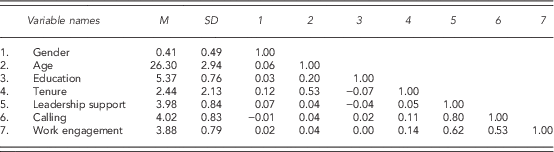
Three validated scales were used in this study to measure calling, perceived leadership support, and work engagement. Initial robustness checks for the measures were conducted using principle component analyses (PCAs) and Cronbach’s α using SPSS version 20 (IBM Corp. Released, 2011). The PCA revealed that the three scales explained 76% of the variance among the measures in a three-factor solution. Confirmatory factor analysis, using LISREL 8.7 (Jöreskog & Sörbom, Reference Jöreskog and Sörbom2006) with a nested model approach, was used to confirm construct validity and the orthogonal nature of the scales (Kelloway, Reference Kelloway1998; Kline, Reference Kline1998). All scale items are presented in the Appendix and descriptive statistics and correlations are presented in Table 1.
Indicator descriptive statistics and correlations

Note. N=297.
Correlations >0.20, p<.001.
Correlations between 0.14 and 0.19, p<.01.
Correlations between 0.10 and 0.13, p<.05.
Calling
Calling was measured using a 4-item Likert-type (1=‘strongly disagree,’ to 5=‘strongly agree’) scale that was developed by Dik, Eldridge, Steger, and Duffy (Reference Dik, Eldridge, Steger and Duffy2012). This scale was part of the calling and vocation questionnaire. Since its inception in 2012, components of this scale has been cited or used in more than 70 calling-research studies. The scale displayed a Cronbach’s α of 0.88 and PCA revealed all item-to-factor loadings were 0.4 or greater (Nunnally, Reference Nunnally and Bernstein1978). As Duffy and colleagues (e.g., Duffy & Dik, Reference Duffy and Dik2013; Duffy et al., Reference Duffy, Allan, Autin and Douglass2014) have clearly noted, the belief that a worker is actually enacting (i.e., living out) a calling matters more to work-related outcomes than a perception that an individual feels a calling. As such, the calling scale chosen for this study better reflects calling enactment.
Perceived leadership support
Leadership support was measured using a 4-item Likert-type (1=‘strongly disagree,’ to 5=‘strongly agree’) scale developed by Eisenberger, Huntington, Hutchison, and Sowa (Reference Eisenberger, Huntington, Hutchison and Sowa1986). In order to ascertain respondent perceptions about their organizational leaders (i.e., the leaders themselves) and not other organizational resources (e.g., professional development funding; state of the art equipment), we made a minor modification to this scale by changing the original scale item wording from ‘organization’ to ‘leadership’ for the current study. This scale displayed a Cronbach’s α of 0.91 and factor loadings for the PCA were all within acceptable ranges (Nunnally & Bernstein, Reference Nunnally1994).
Work engagement
Work engagement was measured using a 6-item Likert-type (1=‘strongly disagree,’ to 5=‘strongly agree’) scale developed by Rich, Lepine, and Crawford (Reference Rich, Lepine and Crawford2010). Due to the more tacit dimensions associated with constructs in this study, work engagement was measured using Rich, Lepine, & Crawford (Reference Rich, Lepine and Crawford2010) emotional work engagement items. This scale displayed a Cronbach’s α of 0.93 and all PCA factor loadings were above acceptable thresholds. Appendix shows the items for each scale.
RESULTS
Model estimation and construct validity
The 14 survey questionnaire items, representative of three constructs, were subjected to a confirmatory factor analysis using maximum likelihood estimation with LISREL 8.7 (Jöreskog & Sörbom, Reference Jöreskog and Sörbom2006). Maximum likelihood has been the most frequently used method of analysis employed in structural equation models (Kelloway, Reference Kelloway1998). With 297 survey responses, our sample was deemed adequate for the study (Anderson & Gerbing, Reference Anderson and Gerbing1988; Bentler & Chou, Reference Bentler and Chou1987; Kelloway, Reference Kelloway1998; Kline, Reference Kline1998).
Confirmatory factor analysis and nested model comparison
We employed nested model comparisons (for an extended discussion on this approach, see Anderson & Gerbing, Reference Anderson and Gerbing1988; Kelloway, Reference Kelloway1998; Kline, Reference Kline1998) to evaluate the robustness of the survey questionnaire scales. The nesting of models involves evaluating a sequence of structural models beginning with a null (e.g., unidimensional) model with all factor correlations set equal to one (Kelloway, Reference Kelloway1998: 56). The null model is then modified and reevaluated with subsequent structural models using the sequential χ2 difference test. This is calculated by subtracting the χ2 values between sequentially nested models. The χ2 statistic is asymptotically independent (Steiger, Shapiro, & Browne, Reference Steiger, Shapiro and Browne1985), thus the difference score can be evaluated for significance using standard χ2 tables. These tests provide evidence for discriminant validity when a model with more factors offers an improved fit over a smaller number of factors, as long as they display a significant χ2 difference test and are theoretically appropriate (Anderson & Gerbing, Reference Anderson and Gerbing1988; Bollen, Reference Bollen1989).
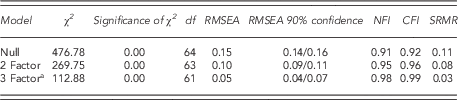
All model tests in our study were analyzed using the covariance matrix and maximum likelihood estimation as implemented in LISREL version 8.7 (Jöreskog & Sörbom, Reference Jöreskog and Sörbom2006). Nested model comparisons and model fit statistics are presented in Table 2. Evaluation of the respective fit indices for each of these tests and χ2 difference tests indicated that the three-factor model provided a superior fit to the covariance matrix. Thus, the null and two-factor models were rejected. The three-factor model displayed a χ2=112.88 (61 df) with an normed fit index (0.98) and comparative fit index (0.99), well above acceptable ranges of 0.90. The root mean squared error of approximation was 0.05 and the standardized root mean residual was 0.03, both within acceptable ranges as well (Kline, Reference Kline1998).
Confirmatory factor analysis results

Note. N=297.
a All latent variable item measure paths were significant at p<.05.
RMSEA=root mean squared error of approximation; NFI=normed fit index; CFI=comparative fit index; SRMR=standardized root mean residual.
Linear model tests
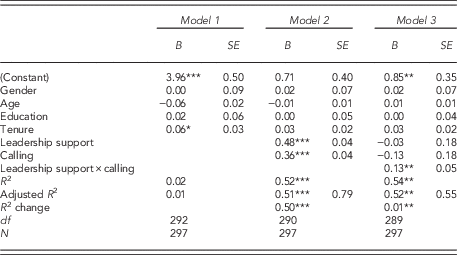
The confirmatory factor analysis results confirmed the robustness of the survey measures and their suitability for additional analysis for evaluation of the hypothesized relationships. Multiple ordinary least squares regression was used to regress the work engagement measure on the linear combination of the control variables (entered in the first model), the main effects (entered in the second model, p<.001), and the interaction term (entered in the third model, p<.001). Drawing on the recent work of Xie et al. (Reference Xie, Xia, Xin and Zhou2016), we controlled for age, gender, tenure with the current employer, and level of education (see Table 1). The r 2 changes for the second and third models were both significant at p<.01. The variance inflation factors and variance proportions were examined for evidence of multicollinearity. Both of these diagnostics were well below accepted thresholds (Mason & Perreault, Reference Mason and Perreault1991), indicating no cause for concern for multicollinearity. The regression results and unstandardized coefficients are presented in Table 3.
Regression results

Note. All variance inflation factors metrics >1.5, tolerances>0.87.
Dependent variable: work engagement.
*p<.05; **p<.01; ***p<.001.
Regression results
Regression outcomes indicated in Table 3 show that the overall model for the two constructs of calling and leadership support was statistically significant (p<.001) and explained 52% of the variance in the dependent variable, work engagement. In support of Hypotheses 1 and 2, calling and leadership support each displayed a positive relationship with work engagement and were significant. Evaluation of the standardized βs revealed that the single greatest predictor of work engagement in this model was leadership support with a standardized β=0.51 (b=0.48); p<.001. Calling displayed a standardized β=0.38 (b=0.36); p<.01. The interaction term was entered in the third model and was comprised of both the calling and perceived leadership support metrics. The interaction was positive and significant (β=0.85 [b=0.13], p<.01), thus supporting the third hypothesis.
DISCUSSION
In the current study, we found a significant worker-related engagement relationship for both an extrapersonal organizational issue – perceptions of leadership support – and for an intrapersonal worker issue – a ‘calling’ work orientation. We also found a small but nonetheless significant interaction effect. Given the high (>0.50) explained variance and coefficients for calling and leadership support, we have some degree of confidence that both appear to play positive roles in explaining work engagement.
As having an ‘enacted calling’ (as assessed in the current study) is in essence a personal assessment of motivational and values fit with one’s work, the current study’s findings add to prior antecedents shown to predict work engagement. Whereas more research is needed to further provide confidence in our current findings, it is apparent that a ‘calling’ work orientation likely should be included in work engagement models.
While much is known about engagement antecedents and outcomes (Christian, Garza, & Slaughter, Reference Christian, Garza and Slaughter2011), our findings demonstrate that research is still needed to explain the worker engagement phenomenon. Given engagement’s demonstrated importance to valued organizational outcomes such as in-role task performance and context performance (e.g., Rich, Lepine, & Crawford, Reference Rich, Lepine and Crawford2010; Christian, Garza, & Slaughter, Reference Christian, Garza and Slaughter2011), findings that help explain variance should aid both theory and practice.
From a theoretical perspective, our findings hint toward more nuanced, yet important issues related to fit, to leadership, and to support models. Teasing out such nuanced predictors – particularly given the high explained variance in the current study – may help add to extant engagement models. For example, none of the engagement models posed by Christian, Garza, and Slaughter (Reference Christian, Garza and Slaughter2011), Rich, Lepine, and Crawford (Reference Rich, Lepine and Crawford2010), or Bakker and Demerouti (Reference Bakker and Demerouti2008) include leadership support or a calling work orientation. Future engagement research may benefit from including work orientation and supportive leadership perceptions in both theoretical models and empirical investigations.
In addition, as articulated by Myers (Reference Myers2014), calling has been discussed in the literature in three overarching ways. One is a sacred calling (i.e., a divine calling) about which Martin Luther, John Calvin, and Max Weber (Reference Weber1958) wrote cogently. Another is a transcendent calling; that is, an external calling not necessarily from a divinity, but rather from, for example, fate, the needs of society, family legacy, circumstances, or opportunities (Myers, Reference Myers2014; see also Duffy & Dik, Reference Duffy and Dik2013). Third is a secular individualistic calling, which is more of an internal and nonreligious calling, though Myers (Reference Myers2014) suggests that many proponents of this form equate it to person–environment fit. Our study makes no distinctions between these types. Future research would benefit from exploring these three forms and how they manifest in organizational functioning. For example, are those with a more sacred calling more engaged than others with their work? Does it depend in part on organizational culture and leadership?
Practitioners also should know that supportive leadership perceptions and a calling work orientation impact worker engagement. Since engaged workers are less likely to turnover and more likely to be committed and higher performing (e.g., Rich, Lepine, & Crawford, Reference Rich, Lepine and Crawford2010; Christian, Garza, & Slaughter, Reference Christian, Garza and Slaughter2011), determining how to enact more supportive leadership and ascertain greater ‘calling fit’ for workers would seem fruitful. From a calling perspective, it would seem wise for practitioners to ascertain – using person–job fit assessments, behavioral interviews, and other hiring tools – the degree to which a job candidate might indeed feel called to – and thus ‘fit’ – the work in question. Applying the results of the current study, prospects who feel called to the job opening for which they are interviewing may ultimately feel more engaged in that work when compared with those without such a calling.
In addition, providing workers with supportive leadership will likely enhance worker engagement. Beyond a supportive supervisor, adequate compensation, and a clear strategic vision, our study’s findings appear to indicate that when workers perceive an organization’s entire leadership to be supportive of worker efforts and outcomes, engagement is stronger. Organizational leaders who care about more than just their own direct reports – via, for example, more interactions both of a work nature and outside of work, and through a ‘names and faces’ stakeholder management approach (McVea & Freeman, Reference McVea and Freeman2005) – may see a positive engagement culture shift that results in greater productivity and more cohesive teamwork, and more satisfied workers who are less likely to depart. Given the well-documented impact on valued organizational outcomes (e.g., job satisfaction, commitment, intent to turnover) that manifest from the worker–supervisor relationship (e.g., Judge et al., Reference Judge, Thoresen, Bono and Patton2001), workers perceiving favorable support from leaders throughout an organization will more likely feel psychologically safe, and thus respond with greater energy and less distraction.
Our sample context – of millennial workers who have previously been affiliated in some way with a large nondenominational religious organization – is worth further research exploration. In a recent article on millennial’s motivation at work, Benson (Reference Benson2016) suggested several ways to improve work engagement for millennials, including the importance of creating ‘a deeply compelling vision of what the company or team is contributing to society.’ Millennials strongly desire a sense of purpose and desire to address larger societal concerns in their work. Organizational leaders who are adept at creating more personally meaningful initiatives for their millennial workers should see increases in work engagement for such workers. According to Benson (Reference Benson2016), a second way to improve millennials’ work engagement is to ‘train managers and supervisors to communicate openly, effectively, and frequently.’ Benson cites a recent Chamber of Commerce (2016) report which found that millennials leave an organization more because of their bosses than for any other reason. This same report asserts that millennials demand work–life balance and more frequent feedback in comparison with other generations. Supervisors who effectively and frequently communicate in a transparent and trust-building manner will more likely experience greater subordinate engagement than counterparts. In sum, employers who couple such initiatives with hiring and retention practices effective in finding and retaining millennial workers with a calling orientation should see leaps in work engagement, among other positive outcomes. Given that millennials make up a huge portion of the current and near-future workforce around the globe (Finn & Donovan, Reference Finn and Donovan2013; Chamber of Commerce, 2016), and given that millennials as a group have been shown to value a job that fits with prosocial values, future research on this important generational cohort seems warranted.
All studies have limitations, and the current study had several. First, sampling bias may have affected the results as this was a sample consisting of individuals with a prior voluntary (not employment) relationship with a religious-based organization. While the vast majority of study respondents indicated being currently employed with a variety of different organizations (e.g., for-profit, nonprofit, government), for some in the sample there still may have been a strong emotional attachment to this organization that could have influenced responses. Engagement studies of this sort would benefit from future research that considers other religious affiliations or other heterogeneous groupings.
Second, since the average employment tenure of the sample was less than 3 years, it is possible that results were impacted by the ‘honeymoon’ phase of early employment with an organization. Fichman and Levinthal describe a honeymoon as ‘the period of time the relationship is relatively shielded from negative outcomes’ (Reference Fichman and Levinthal1991: 446). Thus, it is possible that the small average tenure in this sample may have impacted the results, shielding some respondents from potentially negative outcomes often experienced by more tenured workers. Future research would benefit from a bifurcated sample which would compare groups with lesser tenure to those with greater amounts of tenure.
Third, this sample also may have been influenced by a small ($25 US) gift card incentive. While nothing in the data causes us concerns about final participant responses, who actually participated (and who did not) may have been influenced by this incentive. Fourth, our study benefited from a convenience sample based on email addresses in the nonprofit organization’s stakeholder database. Also, data was cross-sectional in nature and is subject to common method bias limitations (Podsakoff, MacKenzie, & Podsakoff, Reference Podsakoff, MacKenzie and Podsakoff2012), as participants responded to both predictor and dependent variable items at a single point in time. Future research of this sort would benefit from more randomized samples with data collected longitudinally and from data collected from multiple sources.
Future engagement research will benefit from applying new models and scales. For example, Myers (Reference Myers2014: 203) cross-cultural theory of calling asserts that calling’s core dimensions include moral duty, disposition, destiny, and transcendence. Whereas her model does not explicitly include worker engagement, given the current study’s findings it may prove fruitful to examine each of the specific dimensions of calling and their impact on engagement. In addition, further examination of the multidimensionality of both calling and leadership support on engagement could be enlightening. For example, Hagmaier and Abele’s (Reference Hagmaier and Abele2012) suggestion that calling may have three facets (identification/fit; transcendent guiding force; and sense, meaning, and values-driven behavior) may merit further examination in the work engagement context.
A particularly promising area of engagement-related research would be to examine moderators to the direct relationships we found. For example, Duffy et al. (Reference Duffy, England, Douglass, Autin and Allan2017) found that a strong calling motivation strengthened the positive relationship between calling perceptions and living a calling (i.e., an enacted calling, as in the current study), and that life satisfaction was strengthened in the process. Might a similar phenomenon occur for work engagement? Specifically, for those who believe that their current work fits with their calling, might the engagement relationship with such an enacted calling change based on the strength of one’s motivation to continue with this calling, one’s relationship with salient other workers (e.g., one’s supervisor and coworkers), or the degree that one’s work indeed manifests in prosocial outcomes (e.g., task significance)?
Another area that could prove fruitful is through applying Job Demands–Resources model (e.g., Bakker & Demerouti, Reference Bakker and Demerouti2007) attributes as moderators. For example, might the positive relationship between an enacted calling and work engagement erode when job demands – such as unreasonable work deadlines, and emotional demands at work – are high? We might expect a similar erosion for leadership support perceptions as well. Moreover, job resources – such as authentic and helpful feedback, professional development opportunities, a skilled coach, and desirable decision discretion (autonomy) – might prove to have an accelerating effect on our direct findings. We expect that such additional research will provide useful insights for both scholarship and practice.
Finally, in addition to engagement, since studies and models of empowerment share many of the same correlates (e.g., meaningfulness; cf., Thomas & Velthouse, Reference Thomas and Velthouse1990; Spreitzer, Reference Spreitzer1995) as the engagement construct, research exploring empowerment impacts of leadership support perceptions and a calling work orientation may prove particularly fruitful.
In conclusion, our study highlights the continued need for research that explores who to hire, for attraction and retention purposes, as well as how to create conditions that help workers feel supported. Specifically, we found that workers who have a ‘calling’ work orientation – as opposed to those who view their full-time work as a ‘job’ or as a ‘career’ – were most likely to be engaged with their work. As is well known from the extent literature, engagement plays a valuable role in achieving desired organizational outcomes, such as worker productivity, extra-role behaviors, organizational commitment, and worker retention. In addition, our results indicate a strong engagement relationship with perceptions of supportive leadership. In sum, organizational leaders will likely benefit from including work orientation among their selection and retention decision criteria. Moreover, decision-makers seeking high worker engagement can influence worker perceptions of organizational leadership by authentically providing the support workers need to flourish in their work roles.
Acknowledgements
This work was supported by the College of Business, James Madison University. The authors also want to sincerely thank two very helpful anonymous reviewers of earlier drafts.
Financial Support
Data obtained from The Navigators Millennial Calling and Work Project funded by the Lilly Endowment.
This manuscript is an original work that has not been submitted to nor published anywhere else.
APPENDIX
Survey Items
Calling, Perceived Leadership Support, and Work Engagement
Calling Scale Items (1=‘strongly disagree.’ to 5=‘strongly agree’)
I believe that I have been called to my current line of work.
I believe that a force beyond myself has helped guide me to my career.
I was drawn by something beyond myself to pursue my current line of work.
I am pursuing my current line of work because I believe I have been called to do so.
Perceived Leadership Support (1=‘strongly disagree,’ to 5=‘strongly agree’)
The leadership I am currently working for values my contribution to its well-being.
The leadership I am working for really cares about my well-being.
The leadership I am working for cares about my general satisfaction at work.
The leadership I am working for takes pride in my accomplishments at work.
Work Engagement (1=‘strongly disagree,’ to 5=‘strongly agree’)
I am enthusiastic in my job.
I feel energetic at my job.
I am interested in my job.
I am proud in my job.
I feel positive about my job.
I am excited about my job.