INTRODUCTION
Conflicts emerge due to differences or perceived differences between parties in their interests, preferences, values, position, and personality (e.g., Deutsch & Coleman, Reference Deutsch and Coleman2000). The anticipation of potential conflicts may lead people to take action to avoid conflicts, such as by softening bad news or by withholding criticisms (De Dreu, Weingart, & Kwon, Reference De Dreu, Weingart and Kwon2000; Montoya-Weiss, Massey, & Song, Reference Montoya-Weiss, Massey and Song2001). Studies have established that, when people value interpersonal relationships, they demonstrate higher tendencies to avoid conflicts (e.g., Friedman, Chi, & Liu, Reference Friedman, Chi and Liu2006; Leung, Reference Leung1988). However, conflict avoidance often fails to promote harmonious relationships, and may even intensify the interpersonal tensions in the long run (Kuster et al., Reference Kuster, Bernecker, Backes, Brandstätter, Nussbeck, Bradbury, Martin, Sutter-Stickel and Bodenmann2015). Thus, it is important to explore how to reduce or even eliminate conflict avoidance tendency. To answer this question, the current research explores the psychological underpinning of conflict avoidance. Taking a motivated social cognition perspective, we reason that conflict avoidance stems from one's negative anticipation of confronting conflicts. Importantly, such negative anticipation is jointly influenced by the need for epistemic security (need for closure) and the motivation to prevent losses (prevention focus). Specifically, we posit that individuals with high need for closure and high prevention focus show the strongest conflict avoidance tendency due to their heightened negative anticipation. For individuals with low need for closure, their avoidance tendency is likely to diminish or disappear, even among those who are highly prevention-focused.
The contributions of this research are threefold. First, we apply theories of motivated social cognition (e.g., Crowe & Higgins, Reference Crowe and Higgins1997; Higgins, Reference Higgins1997; Kruglanski & Webster, Reference Kruglanski and Webster1996) to explain why people avoid conflicts. It enriches the conflict management literature by revealing the motivated cognitive process underlying conflict avoidance. Second, our research challenges the well-accepted notion that avoidance is a default conflict handling style when people are concerned about interpersonal harmony. It reveals that it is the need for epistemic security and the motive for protecting oneself from relational loss that jointly drive people to construct a conflict situation in a negative way, which in turn results in conflict avoidance. This finding highlights the importance of examining individual difference in conflict resolutions, and contributes to understanding how individuals manage conflicts in our ever-changing societies, in which individual motives and needs are becoming increasingly diversified. Third, our research suggests seemingly biased ‘default’ conflict management practices could be de-biased by lowering individuals’ need for closure. This provides important practical implications for managing conflicts.
THEORETICAL BACKGROUND AND HYPOTHESES
Avoidance as a Response to Motivated Social Cognition in Conflict Situation
In the face of a conflict, individuals may choose either to avoid or to confront it. For example, if someone borrowed money from us but has not returned it yet, we could either ask him/her to pay us back directly at the risk of offending or embarrassing that person, or avoid asking for the money at our own expense (Zhang, Zhang, & Wang, Reference Zhang, Zhang, Wang, Leung, Chiu and Hong2011). Individuals consider the potential consequences of different conflict management approaches before deciding how to handle a conflict situation. They may anticipate that if they behave assertively (e.g., by asking for the money in the above scenario, or by correcting the other's misbehavior or pointing out problems in a work setting), the other parties might react negatively, damaging their relationship with the parties involved. Such a negative anticipation predisposes individuals to adopt a conflict avoidance strategy (Zhang et al., Reference Zhang, Zhang, Wang, Leung, Chiu and Hong2011). For instance, relative to Western people, Chinese people are more likely to expect that direct confrontation would result in relationship damage. Such a negative expectation partly explains the stronger inclination of Chinese people to avoid conflicts than their American counterparts (Friedman et al., Reference Friedman, Chi and Liu2006). Importantly, there are within-culture variations in the extent to which individuals hold negative anticipations. A study among Chinese participants showed that some of them hold higher levels of negative anticipations toward direct conflict confrontation than others (Zhang et al., Reference Zhang, Zhang, Wang, Leung, Chiu and Hong2011).
As negative anticipation reflects the cognition of conflict confrontation, it may be influenced by individual motives. In the past decades, social psychologists have recognized that individuals’ judgment and decisions are not purely based on cognition (i.e., ‘cold cognition’) but the interface of motivation and cognition (i.e., ‘hot’ or ‘warm’ cognition; e.g., Kruglanski, Reference Kruglanski, Higgins and Kruglanski1997). That is, individuals’ social judgment and decisions are influenced by motivational forces, such as their needs and desires. Research on motivated social cognition highlights the interplay of motivation and cognition in regulating individual behaviors (e.g., Gollwitzer & Bargh, Reference Gollwitzer and Bargh1996; Higgins, Reference Higgins1997; Kruglanski, Reference Kruglanski, Higgins and Kruglanski1997; Kunda, Reference Kunda1990). In interpersonal settings, this perspective highlights the role of cognition in regulating interpersonal activities in accordance with various personal motives (De Grada, Kruglanski, Manetti, & Pierro, Reference De Grada, Kruglanski, Mannetti and Pierro1999).
Consistent with the motivated cognition perspective, we argue that individual motives influence the extent of their negative anticipation toward the consequences of direct confrontation, which in turn leads to conflict avoidance. Recent research on values and conflict resolution has provided indirect evidence for the critical role of individual motives in construing a conflict situation. For instance, although conflict avoidance has long been attributed to the value of interpersonal harmony, Leung and colleagues (Leung, Reference Leung, Christopher and Erez1997; Leung, Brew, Zhang, & Zhang, Reference Leung, Brew, Zhang and Zhang2011) distinguished two motives for maintaining harmony – disintegration avoidance and harmony enhancement – which can result in different approaches to conflict. Whereas disintegration avoidance is an instrumental motive focusing on the negative consequences of a strained relationship, leading to avoidance, harmony enhancement reflects a genuine desire to establish a long-term and mutually beneficial relationship, promoting active approaches in handling conflicts. Consistent with this argument, Leung and colleagues (Reference Leung, Brew, Zhang and Zhang2011) found that disintegration avoidance is positively related to conflict avoidance, but not harmony enhancement. Moreover, disintegration avoidance is related to integrating conflict management style negatively, but harmony enhancement is related to it positively. Similarly, in organizational settings, employees with stronger communal motives perceive the consequences of criticizing others in a more negative way, and thus are reluctant to do so (Wei, Zhang, & Chen, Reference Wei, Zhang and Chen2015).
In sum, individual preferences for conflict avoidance might vary, depending on their motivated cognition, which shapes the anticipated consequences of conflict confrontation. In the next section, we will elaborate how individuals’ need for closure and prevention focus jointly shape their negative anticipations which result in conflict avoidance.
Joint Effect of Need for Closure and Prevention Focus
Given that conflict avoidance is a response to anticipated relationship damage, we posit that individuals’ self-regulation geared toward avoiding losses may set up a habitual way of anticipating and responding to potential conflicts. The regulatory focus theory (Higgins, Reference Higgins1997) distinguishes between two types of goals – attainment and growth on one hand and safety and security on the other hand (Liberman, Idson, Camacho, & Higgins, Reference Liberman, Idson, Camacho and Higgins1999). Such goals set up the priorities of individuals’ goal pursuit strategy. Promotion-focused individuals pursue the goal of attainment and growth, and their eager anticipation sensitizes them to gains and non-gains. When involved in conflicting interests with others, promotion-focused individuals may set aggressive goals, probe for opportunities, and prefer the dominating or integrating strategy (Galinsky, Leonardelli, Okhuysen, & Mussweiler, Reference Galinsky, Leonardelli, Okhuysen and Mussweiler2005). Prevention-focused individuals pursue the goals of safety and security. Their vigilance anticipation sensitizes them to losses and non-losses (e.g., Crowe & Higgins, Reference Crowe and Higgins1997). Thus, individuals with a prevention focus are sensitive to potential negative events and outcomes, and have a risk-averse and defensive orientation in managing situations (Higgins, Reference Higgins, van Lange, Kruglanski and Higgins2012). Consistent with this argument, it was found that individuals with high prevention focus perceived threat in ambiguous social interactions (Keltner, Gruenfeld, & Anderson, Reference Keltner, Gruenfeld and Anderson2003). They tend to overestimate the possibility that the other party was experiencing hostile emotions (Anderson & Berdahl, Reference Anderson and Berdahl2002), and are more likely to anticipate losses (Crowe & Higgins, Reference Crowe and Higgins1997). They also showed more avoidance and withdrawal behaviors in interpersonal settings (Crowe & Higgins, Reference Crowe and Higgins1997; Pham & Higgins, Reference Pham, Higgins, Ratneshwar and Mick2005) so as to protect their social connections from threats (Winterheld & Simpson, Reference Winterheld and Simpson2011, Reference Winterheld and Simpson2016).
Given that prevention focus is associated with concerns about relationship losses, we expect that prevention focus would influence the use of conflict avoidance practices as they are akin to concerns for losses. However, we do not expect promotion focus to be related with conflict avoidance practices as it is associated with concerns about gains and attainment. That is, prevention focus (but not promotion focus) would influence the use of conflict avoidance practices. Furthermore, we expect that its effect would be influenced by epistemic motive, as we discuss next.
Consistent with the motivated cognition perspective, we argue that epistemic motive may influence the extent to which individuals rely on their habitual way of constructing and responding to potential conflicts. The need for closure (NFC) is a basic epistemic motive. It refers to individuals’ desire for a firm answer to a question in an ambiguous situation, and the motivated readiness to close one's mind to alternatives (Kruglanski, Reference Kruglanski2004). There are two entwined tendencies underlying NFC: whereas the urgency tendency refers to the inclination to ‘seize’ information to attain closure quickly, the permanence tendency refers to the desire to maintain or ‘freeze’ on established knowledge. Individuals under high NFC tend to consider fewer alternative solutions to a problem or discard information that is inconsistent with existing solutions, whereas those with low NFC engage in extensive information search and generate multiple solutions for a given situation. Therefore, individuals with high NFC tend to rely more on existing stereotypic knowledge (Kruglanski & Webster, Reference Kruglanski and Webster1996) to draw conclusions without consulting alternative evidence in making decisions (De Grada et al., Reference De Grada, Kruglanski, Mannetti and Pierro1999), and to anchor on conventional practices to handle situations to obtain epistemic security (Chao, Zhang, & Chiu, Reference Chao, Zhang and Chiu2010; Fu, Morris, Lee, Chao, Chiu, & Hong, Reference Fu, Morris, Lee, Chao, Chiu and Hong2007). Furthermore, NFC is not only a dispositional trait, but also a transient state induced by situations. For example, people who are under time pressure were found to experience a stronger need for closure than those who are not under time pressure (Bukowski, von Hecker, & Kossowska, Reference Bukowski, von Hecker and Kossowska2013; Kruglanski & Freund, Reference Kruglanski and Freund1983; Richter & Kruglanski, Reference Richter and Kruglanski1998). Studies have shown that the effects of individual difference in NFC are consistent with those obtained when NFC is situationally manipulated (e.g., Chiu, Morris, Hong, & Menon, Reference Chiu, Morris, Hong and Menon2000; Webster & Kruglanski, Reference Webster and Kruglanski1994).
When confronted with a conflict situation wherein one differs from another person in interests or opinions, individuals with relatively higher NFC will rely on their prior knowledge to interpret the situation and to handle the conflict. Therefore, we argue that if individuals with high NFC are also high on prevention focus, they will focus more on preventative concerns and negative outcomes. If individuals with high NFC are low on prevention focus, however, they will be less aware of the potential tension and negative emotions evoked by confrontation. Seizing and freezing on high prevention mindsets, individuals with high NFC tend to neglect case-specific or individuating information in deciding how to handle a conflict situation, and, thus, will report higher levels of negative anticipation and conflict avoidance. In contrast, individuals with low NFC tend to consider more alternatives; they also tend to search for information more extensively before making judgments. Thus, regardless of whether they are high or low prevention focus, low NFC individuals will not be strained by their negative anticipations in the face of a conflict situation. They are more likely to consider alternative interpretations of and solutions in conflict situations (Kruglanski & Webster, Reference Kruglanski and Webster1996), and thus are more likely to override the effect of prevention focus. Based on these arguments, we hypothesize that:
Hypothesis 1: NFC and prevention focus exercise an interaction effect on negative anticipation, such that the difference in negative anticipation between high and low prevention focused individuals will be weaker or even disappear when NFC is relatively low (vs. high).
When the fear of evoking negative reactions from the others is high in a conflict situation, people prefer conflict avoidance over confrontation to minimize relationship costs (Friedman et al., Reference Friedman, Chi and Liu2006). Tjosvold and Sun (Reference Tjosvold and Sun2002) maintained that the Chinese consider avoidance as a means to protect interpersonal relationships, and are likely to avoid conflicts. Zhang and colleagues (Reference Zhang, Zhang, Wang, Leung, Chiu and Hong2011) advanced that conflict avoidance stems from individuals’ anticipation of the other party's negative responses to confrontation, which may disrupt interpersonal relationships. We thus predict that negative anticipation leads to conflict avoidance.
Hypothesis 2: Negative anticipation will be positively related to conflict avoidance.
Avoiding Conflict for Safety at Workplace
In organizational settings, when employees recognize problems in work practices, procedures, or rules that are devised or implemented by people at the management level, they are facing a latent conflict situation. Speaking up about the problems or dysfunctional practices may undermine the supervisors’ authority (Liang, Farh, & Farh, Reference Liang, Farh and Farh2012) or spark their defensiveness (Burris, Reference Burris2012). Thus, keeping silent is an avoidance strategy that aims to prevent having conflicts with the supervisors (Huang, Van de Vliert, & Van der Vegt, Reference Huang, Van de Vliert and Van der Vegt2005).
Whether employees confront their supervisors or remain silent depends on their anticipated consequences (e.g., Detert & Burris, Reference Detert and Burris2007; Morrison, Wheeler-Smith, & Kamdar, Reference Morrison, Wheeler-Smith and Kamdar2011). If they expect that direct confrontation may disrupt their relationship with the supervisors and may result in personal losses, they will be reluctant to speak up. For example, Milliken, Morrison, and Hewlin (Reference Milliken, Morrison and Hewlin2003) found that employees would remain silent when they were worried about negative consequences, such as being labeled as a troublemaker or a complainer, disrupting interpersonal relationships, or being punished at work. Anticipating managerial retaliation, employees are inclined to keep silent rather than voice out their concerns (Detert & Burris, Reference Detert and Burris2007; Detert & Edmondson, Reference Detert and Edmondson2011; Detert & Trevino, Reference Detert and Treviño2010). Wei, Zhang, and Chen (Reference Wei, Zhang and Chen2015) further demonstrated that employees are less likely to doubt or warn about problematic practices if they anticipate high risks of relationship damage and career costs. Taken together, we predict a moderated mediation model in which NFC functions as the first stage moderator, moderating the effect of prevention focus on conflict avoidance through negative anticipation.
Hypothesis 3: NFC and prevention focus interact to influence conflict avoidance through negative anticipation. Specifically, the indirect effect of prevention focus on avoidance through negative anticipation will be weaker or even disappear when NFC is relatively low (vs. relative high).
OVERVIEW OF STUDIES
We conducted three studies to test our theory and hypotheses. Study 1 examined the interaction effect of NFC and prevention focus on negative anticipation (Hypothesis 1) using a daily situation. In Study 2, we tested the full moderated mediation model of NFC and prevention focus on conflict avoidance through negative anticipation (Hypotheses 2 and 3) in the work setting. Study 3 replicated the results of Study 2 by manipulating need for closure using time pressure. The participants in these studies came from China as the Chinese context is a particularly appropriate setting to test our hypotheses. Chinese people have long been documented to have a greater preference for conflict avoidance compared with Western people (e.g., Friedman et al., Reference Friedman, Chi and Liu2006; Morris et al., Reference Morris, Williams, Leung, Larrick, Mendoza, Bhatnagar, Li, Luo and Hu1998). However, with drastic social changes in China in the past decades, individuals become increasingly divergent in their conflict management practices. Although individuals do not necessarily adopt conflict avoidance strategy and may prefer collaborating and accommodating strategies (Zhang, Reference Zhang2007), the reluctance to express disagreements or doubts about dysfunctional practices is still prevalent in China (Wei et al., Reference Wei, Zhang and Chen2015). Such variation in the use of conflict avoidance practices among the Chinese population allows us to test our hypothesized moderated mediation effects. Although our studies focus on the effect of NFC and prevention focus on conflict avoidance, we also assessed and controlled for the effects of promotion focus to rule out potential alternative explanations and to provide a more stringent test of our hypotheses as promotion focus has been shown to be associated with the use of different conflict management practices (Galinsky et al., Reference Galinsky, Leonardelli, Okhuysen and Mussweiler2005).
Study 1
Study 1 tested the hypothesized NFC X Prevention focus effect on negative anticipation toward conflict confrontation in an everyday setting. A conflict scenario involving two parties was specifically developed for this study.
Methods
Participants
One hundred and forty-four (60% female) undergraduate students from a social psychology course in Northern China took part in this study. Their average age was 19.53 years (SD = 1.50). They participated in the study for course requirement credits. The study was conducted in Chinese, the native language of the participants.
Materials and procedure
After participants consented to take part in the study, they completed a survey package that consisted of the NFC scale (Webster & Kruglanski, Reference Webster and Kruglanski1994) and the General Regulatory Focus Measure (GRFM; Lockwood, Jordan, & Kunda, Reference Lockwood, Jordan and Kunda2002). The NFC items were rated using a 6-point scale (1 = strongly disagree, 6 = strongly disagree). Items tapping regulatory focus were rated on a 9-point scale (1= not at all true of me; 9 = very true of me). Both scales were reliable (NFC α = 0.70, prevention focus α = 0.70, promotion focus α = 0.81). In addition, they responded to the following conflict scenario. The scenario was developed using pilot studies. It depicts a common daily situation.
One day you asked one of your classmates of the same gender to go shopping. He/she found a pair of shoes that he/she liked and decided to buy it. However, he/she forgot to bring credit card, and did not have enough cash – he/she needed ¥30 (approximately US$5) more. So, he/she borrowed ¥30 from you, and bought the shoes with joy. He/she promised to pay you back soon.
In the following weeks, though you had run into this classmate several times, he/she neither paid you back, nor mentioned when he/she planned to pay back.
According to Leung's (Reference Leung1988) insights, whether people would confront or avoid conflict depends on their evaluation of their potential gains or losses. In the above scenario, the potential gains or losses depend on the amount of money involved and the relationship between the two parties. The amount of money was deliberately set to engender a dilemma for the participants in the above scenario: Asking the other party to pay back might offend or hurt the other as the amount was relatively small, but not getting the money back represented a personal loss. The dilemma created a latent conflict situation for the participants.
Participants were asked to put themselves into the situation, and to indicate how the classmate would respond if they were to remind him/her to pay back. Negative anticipation was assessed by a 6-item measure (Zhang et al., Reference Zhang, Zhang, Wang, Leung, Chiu and Hong2011). Two sample items were, ‘I would offend him/her’ and ‘Our relationship would deteriorate’. Participants were asked to indicate on a 7-point scale (1 = strongly disagree; 7 = strongly agree). The measure was reliable (α = 0.93).
Results for Study 1
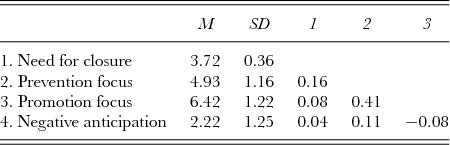
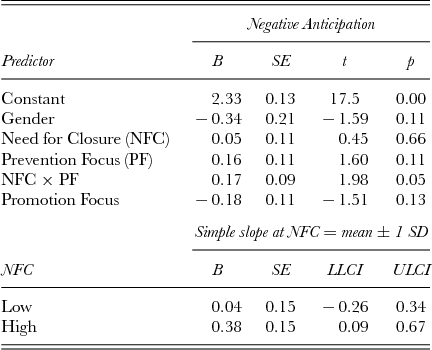
The descriptive statistics and correlations of the variables are presented in Table 1. To examine the hypotheses, we regressed negative anticipation on NFC, prevention focus, and the interaction, controlling for the effects of promotion focus, and gender (see Table 2). The effect of gender was not significant, B = −0.34, p = 0.11. We, thus, excluded gender as a control variable in later studies.
Mean, standard deviation, and correlation of variables in Study 1

Note. N = 144; r >|0.16|, p < 0.05.
Regression results for Study 1

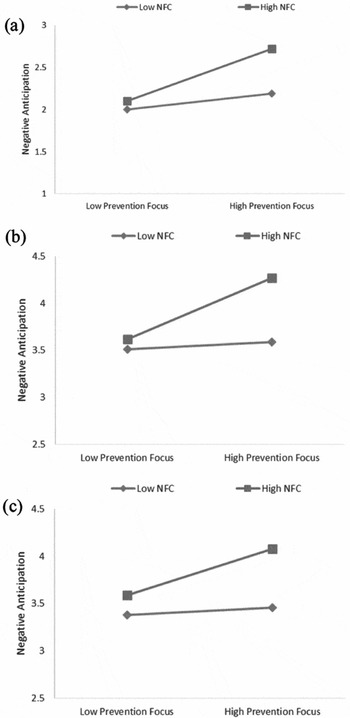
The NFC X Prevention focus interaction was significant, B = 0.17, p = 0.05. The ∆R2 is 0.03, p = 0.05, suggesting that the NFC X Prevention focus interaction accounts for 3% of the total variability. As shown in Figure 1(a), simple slope analysis (Aiken & West, Reference Aiken and West1991) found that the effect of prevention focus was significant when NFC was relatively high, B = 0.38, with the boostrapped 95% confidence interval of [0.09, 0.67], but not significant when NFC was relatively low, B = 0.04, with the boostrapped 95% confidence interval of [−0.26, 0.34]. Hypothesis 1 was supported.
The NFC X Prevention focus effect on negative anticipation in: (a) Study 1, (b) Study 2, and (c) Study 3.

The results of Study 1 supported the NFC X Prevention focus effect on negative anticipation. Specifically, difference in negative anticipation between high and low prevention focused individuals is eliminated when NFC is relatively low, but not when NFC is relatively high. This study has limitations, however. First, the mean level of negative anticipation was only 2.22. This suggests that, overall, participants had a low level of negative anticipation for conflict confrontation. Such low level of negative anticipation among these Chinese participants might reflect the goal of nowadays society. With an increasing emphasis on individuality and personal entitlements among the younger generation (McEwen, Fang, Zhang, & Burkholder, Reference McEwen, Fang, Zhang and Burkholder2006), the Chinese participants, who are young college students in this study, may be more inclined to pursue their personal interests. Second, this study only focused on the first stage moderation, and did not test the other hypotheses. Thus in Study 2, we tested all the hypotheses with working adults.
Study 2
This study examined the full hypothesized moderated mediation model among the working sample with a conflict scenario that took place in the working setting.
Methods
In a pilot study, we interviewed 12 middle-level managers (41.7% female) in Northern China. Their average age was 34 (SD = 5.2). They were asked to recall one or two conflict situations that happened in their companies, and to report how they handled the conflict. We obtained 15 vignettes regarding (implicit or explicit) conflicts with upper levels (46.7%), with peers (20%), with external stakeholders (13.3%), and conflicts involving more than one of the three parties (20%). The conflicts with upper levels involved disagreements with problematic practices or decisions performed by them. In 13 of the 15 vignettes, the middle-level managers adopted an ‘outflanking’ strategy, or gave up their own positions out of the fear of relationship damage due to direct confrontation.
We chose a conflict scenario from the pilot study that described an implicit conflict situation in which the chief operation officer (supervisor) announced a new policy at a meeting, but the director (subordinate) knew that the policy was not workable (see the Appendix). Participants were asked to imagine that they were the director and to decide whether they would speak up against the problematic supervisory decision or would keep quiet as an avoidance tactic. In another pilot study, among 30 middle managers (23.4% female) who were part-time MBA students with an average age of 35 years, only five (16.7%) indicated that they would directly express their views, and others indicated that their actions depended on the closeness with the supervisor (53.3%), or they would echo the doubts voiced out by other colleagues (36.7%). Respondents who would not express their views reported their concerns about relationship disruption, including ‘I will embarrass the supervisor’ (53.3%), ‘the supervisor would alienate me’ (36.7%), ‘speaking up would hurt the trust between us’ (26.7%), etc.
Participants
One hundred and thirty-seven (33% female) MBA students from a university in Northern China took part in this study. Their average age was 32.00 years (SD = 3.46) with an average of 4.17 years (SD = 1.8) of work experiences. They participated in the study voluntarily.
Measures and procedure
Participants completed the short version of the NFC scale (Pierro & Kruglanski, Reference Pierro and Kruglanski2005) and the GRFM (Lockwood et al., Reference Lockwood, Jordan and Kunda2002). The NFC items were presented using a 6-point scale (1 = strongly disagree, 6 = strongly disagree), and the GRFM items were rated on a 9-point scale (1 = not at all true of me; 9 = very true of me). Both scales were reliable (NFC α = 0.80, prevention focus α = 0.74, promotion focus α = 0.80). Participants then read the conflict scenario. They were asked to put themselves into the role of the subordinate and to indicate how their supervisor, the chief operation officer, would respond if they express their concerns directly.
Negative anticipation was assessed by a 6-item measure adopted from the scale developed by Zhang et al. (Reference Zhang, Zhang, Wang, Leung, Chiu and Hong2011). Two sample items were, ‘I would offend the chief operation officer’ and ‘The chief operation officer would feel that I am not cooperative’. Participants indicated on a 7-point scale the extent to which they agree/disagree with each of the items (1 = strongly disagree, 7 = strongly agree). The scale was reliable (α = 0.77). Participants’ perceived efficacy of speaking up was also assessed by four items developed for this study. Example items were, ‘The chief operation officer will appreciate my suggestions’, and ‘My suggestion will be taken into account when the chief operation officer makes the final decision’. Participants indicated on a 7-point scale the extent to which they agree/disagree with each of the items (1 = strongly disagree, 7 = strongly agree). The scale was reliable (α = 0.70).
Finally, the use of avoidance strategy was measured by two items, ‘how likely would you voice out your opinion to the chief operation officer during the meeting’ (reverse coded) and ‘how likely would you keep quiet’? The items were rated on a 7-point scale (1 = not at all likely, 7 = extremely likely). The scale was reliable (α = 0.77).
Results for Study 2
The descriptive statistics and correlations of variables are presented in Table 3. We adopted the PROCESS macro in SPSS developed by Hayes (Reference Hayes2013) to estimate the moderated mediation model. This macro uses an OLS regression-based path analytical framework for estimating direct, indirect, and conditional indirect effects. Bootstrap methods are implemented to estimate indirect and conditional indirect effects (Hayes, Reference Hayes2013).
Mean, standard deviation, and correlation of variables in Study 2

Note. N = 137; r >|0.20|, p < 0.05.
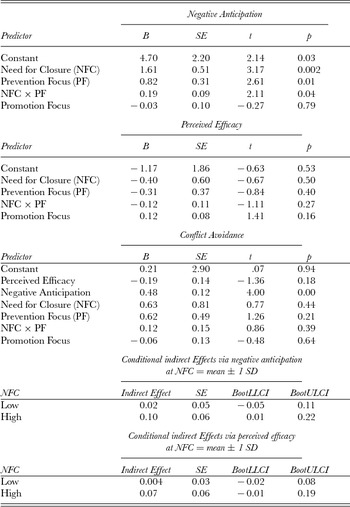
Table 4 presented the regression results for the moderated mediation (Model 8 in the PROCESS macro), and the bootstrapping results that estimated the conditional indirect effects. Regressing NFC, prevention focus, and the interaction term on negative anticipation, it showed that the NFC X Prevention focus effect on negative anticipation was significant, B = 0.19, p = 0.04, and the ∆R-square of this model was 0.06, p = 0.04. As shown in Figure 1(b), the effect of prevention focus on negative anticipation was significant when NFC was high, B = 0.39, with bootstrapped 95% CI of [0.18, 0.60], but the effect was not significant when NFC was low, B = 0.02, with bootstrapped 95% CI of [−0.19, 0.15]. These results supported Hypothesis 1. The relationship between negative anticipation and the intention to avoid conflict was also significant, β = 0.48, p < 0.001, supporting Hypothesis 2. The indirect effect of NFC on conflict avoidance via negative anticipation was significant among individuals with high NFC, B = 0.10, with bootstrapped 90% CI of [0.01, 0.22], but not among those with low NFC, B = 0.02, with bootstrapped 90% CI of [−0.05, 0.11]. These results supported the moderated mediation effect (Hypothesis 3). The R-square of this full model was 0.19, with F (6, 130) = 5.05, p < 0.001. In a supplementary analysis, we examined the main and interaction effects of NFC and prevention focus on perceived efficacy. None of the effect was significant. These results further suggested that the hypothesized NFC X Prevention focus interaction effect exerted influence specifically on negative anticipation, and their effect was not attributable to the perceived efficacy of speaking up.
Regression results for the moderated mediation model for Study 2

To conclude, the results of Study 2 supported our hypotheses. The use of working adult sample and workplace scenario derived based on a pilot study with middle-level managers also enhanced the external validity of our findings. The time restriction in collecting data from a working adult sample did not allow us to use the long version of the NFC measure. However, the short version of NFC scale (Pierro & Kruglanski, Reference Pierro and Kruglanski2005) was reliable in our study. Although we did not examine the validity of this short NFC scale used in Study 2 compared with the long version used in Study 1, findings from both studies converged. They provided converging support to the hypothesized effect. A limitation of Study 2 is that, like Study 1, it is also cross-sectional in nature. Thus, we are not able to draw conclusions about the causal effects of NFC. To address this issue, Study 3 examined the causal effect of NFC by manipulating it, instead of measuring it as individual differences.
Study 3
Participants
One hundred and two (30% female) mid-level managers in Northern China took part in this study. Their average age was 36 years (SD = 6.01). They participated in the study voluntarily.
Measures and procedure
Participants completed the GRFM (Lockwood et al., Reference Lockwood, Jordan and Kunda2002) to assess their prevention focus (α = 0.71) and promotion focus (α = 0.77) as in Studies 1 and 2. In the following day, they were randomly assigned into one of two groups (high vs. low NFC) in an experimental session and then responded to the scenario used in Study 2.
As in previous study (Chiu, Morris, Hong, & Menon, Reference Chiu, Morris, Hong and Menon2000), we evoked participants’ NFC by manipulating their felt time pressure while they were responding to the scenario during the experimental session. Participants in the high NFC group were told that it typically took 15 minutes to finish this exercise, but they only had 10 minutes. They were instructed to complete the study as quickly as possible. Participants in the low NFC group were told that it typically took 7 minutes to finish this exercise, but they had 10 minutes. Thus, they were told to take their time in completing the study. Both groups were given 10 minutes to finish the exercise. After the NFC manipulation, the participants were asked to imagine themselves in the conflict scenario. They reported their negative anticipation; that is, how their supervisor would respond if they expressed their concerns. Negative anticipation was assessed by the same measure (α = 0.87) as in Study 2. They also indicated on a 7-point scale (1 = strongly disagree to 7 = strongly agree) their perceived efficacy of speaking up (α = 0.77). Finally, their conflict avoidance was assessed using the same scale (α = 0.91) as in Study 2.
Manipulation check
At the end of the exercise, participants reported the extent to which they felt time pressure while completing the exercise on a 5-point scale (1 = strongly disagree to 5 = strongly agree). Participants in the high NFC group (M = 3.48, SD = 0.77) indicated higher level of time pressure than participants in the low NFC group (M = 1.63, SD = 0.61), F (1, 61) = 113.50, p < 0.001.
Results for Study 3
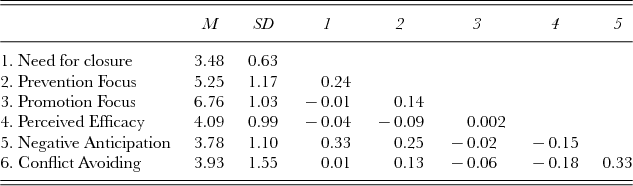
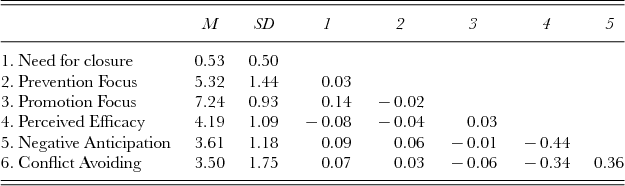
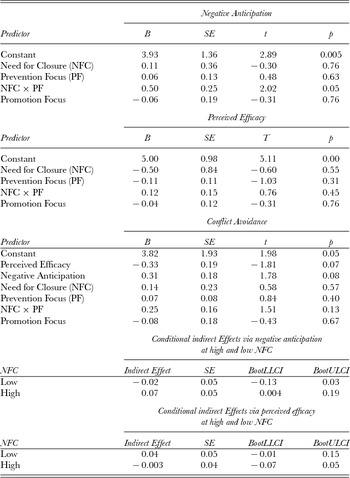
The descriptive statistics and correlations of variables are presented in Table 5. Table 6 presented the regression results of the first-stage moderated mediation (Model 8 in the PROCESS macro), and the bootstrapping results of the conditional indirect effects. The NFC X Prevention focus effect on negative anticipation was significant, B = 0.50, p = 0.046. As shown in Figure 1(c), the effect of prevention focus on negative anticipation was significant when NFC was high, B = 0.20, with bootstrapped 95% CI of [0.08, 0.31], but it was not significant when NFC was low, B = 0.05, with bootstrapped 95% CI of [−0.24, 0.09]. The ∆R-square of this model was 0.04, p = 0.046. These results supported Hypothesis 1. The relationship between negative anticipation and conflict avoidance was significant at 0.10, B = 0.31, p = 0.08 providing some support for Hypothesis 2.
Mean, standard deviation, and correlation of variables in Study 3

Note. N = 102; r >|0.20|, p < 0.05.
Regression results for the moderated mediation model for Study 3

The indirect effect of prevention focus on conflict avoidance via negative anticipation was significant among individuals with high NFC, B = 0.07, with bootstrapped 90% CI of [0.004, 0.19], but not among those with low NFC, B = −0.02, with bootstrapped 90% CI of [−0.13, 0.03]. The R-square of this full model was 0.17, with F (6, 95) = 3.20, p = 0.01. These results supported the moderated mediation effect (Hypothesis 3). As a supplementary analysis, we also examined the main and interaction effects of NFC and prevention focus on perceived efficacy. The results showed that none of the three predictors was significant. These results, again, suggested that the hypothesized NFC X Prevention focus interaction effect exerted influence on negative anticipation. Such effect could not be attributed to the perceived efficacy of speaking up. Taken together, findings of Study 3 provided further support to our hypotheses.
DISCUSSION
The three studies consistently showed that need for closure and prevention focus interacted to influence negative anticipation and conflict avoidance. Study 1 examined the NFC X Prevention focus effect on negative anticipation in a daily situation, providing support to Hypothesis 1. Study 2 examined whether a subordinate would engage in conflict avoidance in a work setting and revealed an NFC X Prevention focus effect on conflict avoidance via negative anticipation, providing support to all three hypotheses. Study 3 replicated the findings of Study 2 and established the causal effect of NFC.
A Motivated Social Cognition Perspective on Conflict Avoidance
Our research establishes the effect of NFC and prevention focus on how individuals construe conflict situations and their conflict management strategy. It advances existing literature and knowledge about conflict resolutions in several important ways. First, existing literature has focused on how to effectively manage conflicts that have occurred; however, little is known about how people manage anticipated conflicts and the factors that contribute to conflict avoidance. We apply basic psychological principles of motivated social cognition to account for individual variations in their use of conflict avoidance practices. We argue that epistemic motivation shapes the anticipated outcomes of conflict confrontation, which then influences the tendency to avoid conflict. Specifically, high NFC leads individuals to rely on existing knowledge to resolve problems. It enables individuals to quickly assess the conflict situations. Therefore, among high NFC individuals who are also high prevention focus, their regulatory focus orients them toward the negative consequences of conflict confrontation and their high NFC leads them to seize and freeze on such negativity. Individuals with low NFC tend to consider more alternatives. Thus, regardless of their level of prevention focus, low NFC individuals are not strained by negative anticipations in the face of a conflict situation. They are more likely to override the effect of prevention focus. Findings across three studies provided consistent support to this motivated social cognition perspective of conflict anticipation and avoidance. The hypothesized NFC X Prevention focus interaction effect was supported by the results using different methods, vignettes, and samples. We also established the effect of need for closure as individual characteristic and as situational influence. Therefore, by integrating the effects of need for closure and prevention focus, we provided a theoretical framework to understand conflict avoidance from a motivated social cognition perspective and enriched our understanding of conflict avoidance. Although we focused on avoidance and conducted research in Chinese settings, the motivated cognition perspective on conflict resolutions and the debiasing role of epistemic motives should be generalizable. Our motivated cognition perspective may help to explain why ‘default’ conflict resolution practices are formed across different cultures and whether they are malleable. For instance, promotion focus is associated with a more assertive tendency, driving individuals to focus on their target prices in negotiations and probe more aggressively for opportunities to achieve their aspirations (Galinsky et al., Reference Galinsky, Leonardelli, Okhuysen and Mussweiler2005). As American participants tend to score high on promotion focus, their preference of integrating strategy may be due to a joint effect of high NFC and promotion focus.
The Debiasing Effect of Low Need for Closure
Our research debunks the conventional wisdom that conflict avoidance is a normative response to conflicts in China. Overall, our Chinese participants neither had a high level of negative anticipation nor a strong conflict avoidance tendency, regardless of whether they were college students or working adults and regardless of whether the conflicts occurred in a daily situation or at work. In Study 1, the mean level of negative anticipation was quite low (2.22 out of 7), but this is not unusual. For example, previous studies (see Friedman et al., Reference Friedman, Chi and Liu2006, Figure 4) had found that negative expectation of conflict confrontation among Chinese respondents was about 2.6 to 2.7 on a 7-point scale, and about 0.3 among American respondents; in addition, the use of avoiding tendency among Chinese respondents was about 4.1, just around midpoint of the 7-point scale, and was about 1 among American respondents (see Friedman et al., Reference Friedman, Chi and Liu2006, Figure 3). In another study (Morris et al., Reference Morris, Williams, Leung, Larrick, Mendoza, Bhatnagar, Li, Luo and Hu1998), the use of avoiding strategies among American and Chinese participants on a 5-point scale were on average 3.17 (SD = 0.84) and 3.21 (SD = 0.50), respectively (see Morris et al., Reference Morris, Williams, Leung, Larrick, Mendoza, Bhatnagar, Li, Luo and Hu1998, Table 2). These findings suggested that avoidance is not a normative response to conflicts in China, nor in the US.
Although avoidance is not a default style in managing conflicts, individuals often engage in conflict avoidance in practice (Welch & Welch, Reference Welch and Welch2005). Three studies consistently showed that high (vs. low) prevention focus led to more negative anticipation among individuals with relatively high need for closure, but this effect disappeared among those with low need for closure. Similarly, both Studies 2 and 3 indicated that high (vs. low) prevention focus led to more conflict avoidance among individuals with relatively high need for closure, but this effect disappeared among those with low need for closure. These findings suggest that low need for closure exerts a debiasing effect on conflict anticipation and avoidance. They also reveal the importance of considering need for closure in understanding conflict management practices. In construing conflict situations, individuals with low need for closure may consider more alternative resolution strategies. Unlike individuals with high need for closure who rely on their default anticipations about conflict confrontation, individuals with low need for closure may entertain the possibilities of both positive and negative outcomes from conflict confrontation, and weight both the benefits and costs of avoidance. With a more balanced construal of the conflict situation and potential outcomes, they are less likely to engage in conflict avoidance. Existing studies have provided supportive evidence for this account. For example, Zhang and colleagues (Reference Zhang, Zhang, Wang, Leung, Chiu and Hong2011) found that Chinese people overestimated the negative consequences of confrontation; however, after engaging in a perspective-taking exercise, their negative anticipation about conflict confrontation was reduced significantly, and they are more likely to confront rather than avoid the others in order to resolve the conflict. The perspective-taking exercise enables individuals to have the opportunity to critically reflect on their negative anticipation. It allows them to construe the conflict situation differently in order to realize alternative solutions that may be more conductive to resolving the conflict than avoidance. Consistent with this idea, when people are asked to consider alternative perspectives, their biases in judgments were attenuated (e.g., Galinsky & Mussweiler, Reference Galinsky and Mussweiler2001).
Limitations and Future Research Directions
Despite the contributions of our research to the conflict management literature, it also has limitations. First, we reasoned that relationship concern leads people to focus on the risk of relationship disruption in resolving a conflict, particularly among individuals with a high need for closure and prevention focus, who are especially motivated to safeguard themselves against losses. Though the three studies provide robust evidence for our theoretical arguments, relationship concern is not the only factor that contributes to conflict avoidance. For instance, in situations in which individuals’ concern for economic interests take precedence over their relationship concern, the interaction effect of need for closure and prevention focus on conflict avoidance might be mediated by different anticipation mechanisms, such as negative anticipation toward financial costs. Future research could examine how the salience of competing goals (e.g., relationship concerns vs. economic concerns) influences the use of conflict management strategy.
Second, employees are concerned about their relationship with supervisors at work because their supervisors possess the power to influence their interests and benefits. As a result, employees might be reluctant to speak up in order to avoid damaging the relationship even if the supervisory decision is questionable. Disrupted relationship with supervisors may result in career costs, such as poor performance appraisal (Burris, Reference Burris2012), harsh job assignment (Milliken et al., Reference Milliken, Morrison and Hewlin2003), and fewer promotion opportunities (Detert & Edmondson, Reference Detert and Edmondson2011). Conflict avoidance in such situations stems from employees’ instrumental consideration. Similar phenomena exist across different social and cultural settings. As Jack Welch pointed out, individuals ‘keep their mouths shut in order to make people feel better or to avoid conflict. . .That is true in every culture and in every country and in every social class’ (Welch & Welch, Reference Welch and Welch2005: 16). This suggests that people at the workplace are concerned about negative repercussions resulting from conflicts, and would attempt to prevent conflicts from occurring. Therefore, as long as relationship concern exists, the NFC X Prevention focus effect may hold. Future research should extend to other organizational and social contexts to investigate such questions as: Does the NFC X Prevention focus effect on negative anticipation and conflict avoidance differ across cultures? Does such interaction effect vary across cultures with different levels of power distance?
Third, we manipulated need for closure by eliciting participants’ felt time pressure in Study 3, demonstrating the robustness of our results. However, it is possible that the need for closure manipulation affects both negative anticipation and conflict avoidance, which inflated the relationship between the mediator and dependent variable. Future studies can make use of separate experiences to tease the moderating effects of NFC on negative anticipation and conflict avoidance apart (e.g., Spencer, Zanna, & Fong, Reference Spencer, Zanna and Fong2005).
CONCLUSION
This research examines the motivated cognition factors that contribute to individual variations in conflict avoidance. We argue that the use of conflict avoidance practices is influenced by the joint effect of need for closure and prevention focus. Results across three studies conducted in China indicated that only individuals with relatively high need for closure and high prevention focus tend to avoid conflicts, but not among those with high need for closure with low prevention focus or with low need for closure in general. This finding debunks the widely accepted notion that conflict avoidance is the normative response to conflicts in China. We offer a motivated social cognition perspective on conflict avoidance, and reveal that low need for closure serves a debiasing function on negative anticipation. This finding provides practical implications for conflict management.
Appendix: The Scenario for Studies 2 and 3
Firm F was a company that was involved in communication system terminal design. You were the director of a hardware technology division. Your direct supervisor was the chief operation officer. The interaction between you and your supervisor was mainly limited to work setting; personal interaction was rare.
Projects at Firm F had traditionally been completed by project teams. According to the company policy, the division directors also served as project managers, taking charge in selecting project members and assigning work tasks. In a meeting today, the chief operation officer notified all the division managers that the company had decided to change the project team management policy. Specifically, the company would no longer require project teams to be managed by the respective division managers. Any employees who proposed creative and feasible plans would be appointed as the project team managers to carry out their own project. More importantly, their performances as project managers would have direct impact on their performance appraisal. The chief operating officer insisted that all the division managers should implement this policy and should encourage their subordinates to take the initiative to be project team managers.
However, you know that most of the subordinates, particularly the junior ones, did not have sufficient work and management experience to lead a project independently. They might also encounter difficulties in handling human resource issues. It would be extremely challenging for them to be project managers, and would create unnecessary burden for them if their performance evaluation was primarily based on their performance as project managers. Thus, you know that the company must slow down the implementation of this new policy so that the employees can be more prepared.