According to data from January 2023, the most popular social networks are Facebook, YouTube, and Instagram, with billions of users worldwide. A survey conducted among employees in museum libraries in Hungary, Serbia, Bulgaria, Croatia, and Slovenia, showed that librarians are increasingly using social media, with the most popular being Facebook, Twitter, and Instagram. This fosters a better understanding of the needs of users in order to develop strategically well-placed programs within the constraints of human and financial resources of artistic and cultural institutions.
In most cases, librarians in museum libraries use social media to inform about exhibitions, new research titles, and professional information. Additionally, social media is used for promotion and advertising.
Social media is most often defined as sources of online information that are created, initiated, circulated and used by users with the intention of exchanging information with each other. They include numerous and very diverse media, such as blogs, social networks, and virtual worlds. Social media represents a type of website through which it is possible to combine modern Internet technology (Web 2.0) with user interaction in a simple way.Footnote 1
It is very important to note that it is incorrect to equate social media with social networks – social networks represent only one segment of a much wider set of social media. The biggest advantages of social media and the reason for its great popularity are at the same time its biggest disadvantages:
Ease of use – anyone can use social media,
It is two-way communication (conversation)
Generally speaking, few people have a real culture of conversation because people simply ‘listen, but do not hear’ what is said, said or written to them. In addition to giving information, it is also necessary to receive it.
Defining social media, Tim Frick says: ‘The use of social media to achieve the company’s goals (company use of social media), from a communication point of view, is the design and implementation of various methods of communication through selected social media, which result in the generation of publicity.’Footnote 2 It is obvious that there are a very large number of diverse types of social media, and that the goal of using social media for business purposes is basically to use more social media. The following basic questions arise: is it enough to use only one social media platform (eg Facebook)? Are all forms of social media being used or just social networks?
Worldwide, over the last few years, there has been an increase in the number of users of social media, especially the social network Facebook. According to data from 2023, Facebook has almost 3 billion monthly users, followed by YouTube with 2.5 billion and Instagram and Whatsapp with 2 billion.Footnote 3
From the data above, we can see that social media is very important in society. By listening to the needs of the society, targeted users can be easily reached through social media. By using social media, users benefit both in their private lives and for business purposes and the same is true for libraries. The connection between libraries and the use of social networks is very clear – libraries quickly recognized that social networks are effective tools in which to actively engage in communication with their users.Footnote 4
The research above, as well as a two-year research project by Betsy Brand of the Getty Research Institute titled ‘Useful, Interesting, and Evil: Investigating Art History and Visual Culture Scholars Use of and Relationship to Social Media’ (2017), served as the basis for the research ‘How Employees and Users in Libraries Use Social Media’Footnote 5 The authors shared the results of their research and agreed that certain questions from their questionnaire could be used in our research.
The research for this article has its roots in a conference presentation: ‘Art Libraries in Hungary and Serbia and how our researchers use and interact with social media’, which was presented at the IFLA Art Library SectionFootnote 6 within the IFLA conference of 2021. In Serbia, the research was led by Olivera Nastić from the Belgrade City Library, and in Hungary by Anelia Tűű from the Museum of Applied Arts in Budapest. The following year the survey was conducted in Bulgaria, Slovenia and Croatia.
Research methodology
A descriptive method was adopted for this research and a survey of librarians from museum libraries, as well as other types of libraries, was conducted. The survey was sent to 1019 email addresses of library employees. In Serbia and Hungary, the survey period began on May 19 and lasted until July 2, 2021. In Bulgaria it began on June 7th and lasted until July 6th, 2022. The survey in Croatia and Slovenia was conducted from June 7th to July 15th, 2022.
As an instrument for collecting quantitative data, a unique questionnaire consisting of 20 questions was created: four of the questions referred to the sociodemographic facts, the other questions asked: for what purposes do respondents use social media; what information do they wish to receive through social media; and how useful that information is to them?
The purpose of the research is to determine the differences in the use social media in these five countries. Based on the analysis of the obtained data, we can conclude to what extent contemporary museum libraries in these countries use social media, and to what purpose. The research conducted in this paper aims to contribute to the study of social networks in the five participating libraries.
The goal of the survey is to determine:
How many users and employees in libraries use social media in their work?
What are the social media activities of users and employees in libraries?
On which social networks are library employees and researchers most active?
Although the survey was anonymous, an additional question was included at the end: to collect e-mail from participants who were interested in receiving the results of the survey (which was offered as an incentive to take the survey).
Analysis and interpretation of research results
Using each of the aforementioned platforms, researchers (users and librarians) have different expectations of what they will achieve: Facebook connects them to a wide network of family, friends and peers, as well as to current news, both related to the profession and beyond; Academia.edu provides easy access to the latest research and scholarships that would allow them to research outside of their place of residence; and Instagram is mostly a place for fun and allows users to see events through photos. YouTube offers the ability to watch events and lectures that users could not attend, and as entertainment to listen to music and concerts. Both researchers and librarians try to reconcile these two needs (professional and personal), which the results of the research will partially show. The final number of responses to the survey was 55 in Serbia, 50 in Hungary, 30 in Bulgaria, 9 in Slovenia and 14 in Croatia. Most of the respondents are professionals involved in some way with art research.
Use of social media
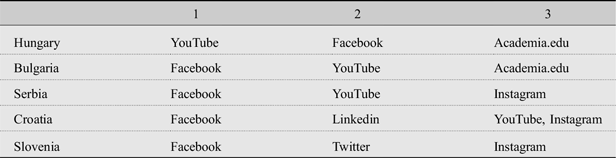
Respondents were asked to name the three most useful social media for them (see Table 1).
From the survey responses we conclude that Facebook is the most useful social media in most of the countries surveyed.
Most useful social media, by country

How users interact with social media
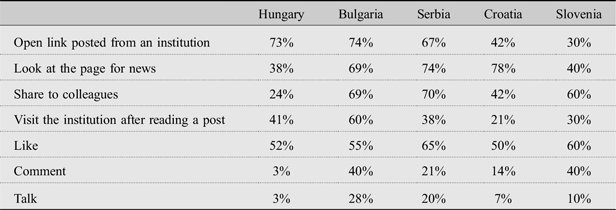
When asked how and for what purposes respondents use social media, most used social media to open links posted from institutions to share among colleagues (see Table 2). From this, it can be concluded that social media is not particularly useful for professional work, but more for professional development, information gathering, and connecting with colleagues. Half of the respondents use social media for simply liking posts and information. Most do not add comments and prefer to just read the information (Bulgaria and Slovenia contributed the most comments in social media at 40%).
How respondents use social media, by country

These results are also visible in practice. Most cultural institutions have profiles on Facebook, where they publish current events from their institutions. This is the fastest and easiest way to inform a large portion of the population.
The main characteristics of social media are that they are the most effective and fastest source of information, that they are transparent, always available, free, public, dynamic, multimedia and provide the necessary two-way communication.
When asked for what purposes they most often used social media, respondents answered that they used it frequently for information about news in their professional field, and for connecting with colleagues in the profession.
What kind of information are respondents seeking?
Are social media useful? For most of the respondents, social media is useful (see Table 3).
With the help of social media, and especially social networks, users build connections, share knowledge, educate oneself, conduct research, and stay in touch with others, both privately and professionally (see Tables 4 and 5). The main purpose of the existence of all social networks, as their name suggests, is based on connection. We all use social networks, where we meet colleagues, expand acquaintances, communicate politely and share experiences. Knowledge is shared with others, content is published and users can exhibit expertise in certain areas, marking them as a professional. The places one visits daily through social networks can be shaped as needed. Instead of a huge pile of information that can be boring and exhausting, users can choose to read and follow pages or profiles that inspire, entertain, and/or teach and inform about topics of interest. Perhaps the most importantly, social networks help users to maintain contact with old friends, acquaintances and colleagues. Sometimes it is much easier to communicate through social networks – the main characteristic of communication through social media is the ability to connect individuals and groups without direct contact, with quick availability of information, free will in establishing contacts, impersonality in the relationship between users, an exchange of ideas, attitudes and opinions in fast communication.
Usefulness of social media, by country

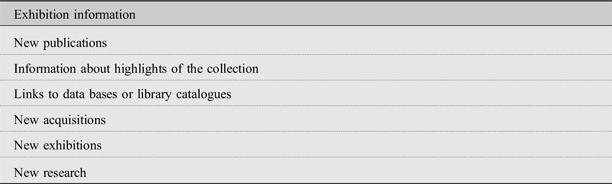
Types of information sought by respondents on social media

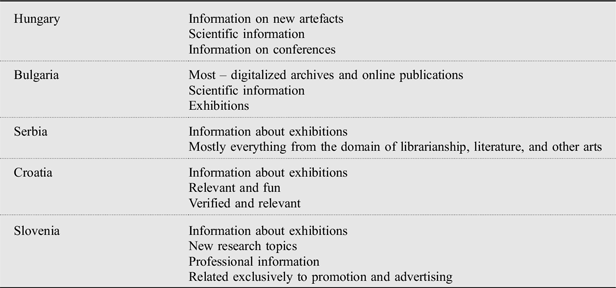
Type of information sought by respondents, by country

What kind of information are respondents expecting?
Social media changed the nature of communication at the beginning of the new millennium, and these ongoing changes open new and different social horizons. One can almost trace the line of generational separation – one that is still trapped by classical media, and one for whom social media is the axiom of overall communication and lifestyle today (see Table 6). The advantage of the new generation is increasingly visible, both in raising the quality of communications, and in the power of new styles of communication, which can change culture and social patterns on a global level. Social networks enable active but virtual interaction. The Internet leads to simple and fast communication, enables direct and almost free access to up-to-the-minute information. Social media have given individuals the opportunity to express opinions and viewpoints to the larger public, enabling them, more than ever, to approach intercultural communication and cooperation.
Respondent’s use of social media by years of work experience

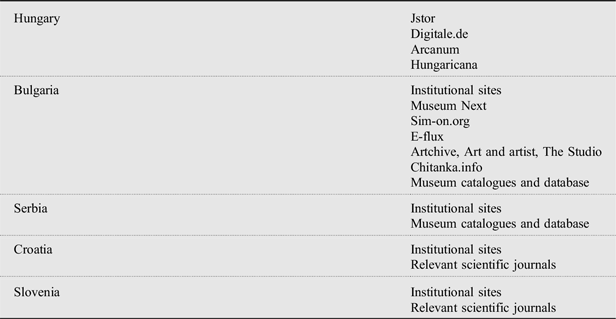
Useful sites outside of social networks
Certainly, social media will not replace traditional sources of information in the foreseeable future, in large part due to the relevance of the content and the unverifiability of the majority of the information distributed through these networks. We see this verified in the answers of the respondents – in what types of information and how much they are interested in getting from social media (see Table 7). Based on the results above, respondents are generally more interested in informative materials about their institutions.
Sites used outside of social networks, by country

Conclusion
Social media has changed the way people around the world communicate. This new platform for communication can lead to the breaking down of cultural barriers and the establishment of conversations between members of different cultures, ethnicities, social and other statuses. Due to social media, the nature of communication has undergone significant changes in the last two decades and these changes are still not complete. While older generations still rely on classic media, for younger generations social media is already erasing the boundaries of personal interaction in the modern social system. Social networks are increasingly used and gradually occupy a central place in modern electronic communication. They are replacing e-mail and SMS, especially since more and more people currently have the Internet on their phones. From the survey, we learned how researchers use social media, as well as what they do on each of the platforms. Although the largest number of researchers reported using Facebook, they are also very active on YouTube as well as Instagram. Respondents are looking for resources to help them advance their own work through updates on industry news, peer work, and researching new resources, and the fact that they’re just looking, rather than participating, is key. Although researchers often use social media, they are not visibly active on social media. They refrain from commenting or publishing original material, but are constantly looking for the latest information in their fields of activity.