INTRODUCTION
Of the 14 penaeid prawn species recorded in the Mediterranean Sea (Galil et al., Reference Galil, Froglia, Noel and Briand2002 ; Galil et al., Reference Galil, Froglia and Noel2015), eight are considered to have been introduced through the Suez Canal – Metapenaeopsis aegyptia Galil & Golani, 1990; Metapenaeopsis mogiensis consobrina (Nobili, 1904); Metapenaeus monoceros (Fabricius, 1798); Metapenaeus stebbingi Nobili, 1904; Penaeus hathor (Burkenroad, 1959); Penaeus pulchricaudatus Stebbing, 1914; Penaeus semisulcatus De Haan, 1844, Trachysalambria palaestinensis (Steinitz, 1932); one species – Penaeus japonicus Spence Bate, 1888 – was officially introduced for mariculture (Tournier, Reference Tournier1972); and five species, all of commercial interest and newly recorded in the past decade – Metapenaeus affinis (H. Milne Edwards, 1837); Penaeus aztecus Ives, 1891; Penaeus merguiensis De Man, 1888; Penaeus subtilis (Pérez Farfante, 1967); Rimapenaeus similis (Smith, 1885) – are likely illegal introductions.
The first record for Penaeus aztecus in the Mediterranean Sea dates to December 2009, when it was collected in Antalya, Turkey (Deval et al., Reference Deval, Kaya, Güven, Gökoğlu and Froglia2010, as Farfantepenaeus aztecus). Soon after, it was collected from trawl catches along the Mediterranean coast of Turkey from Iskenderun to Finike (Gökoğlu & Ovzarol, Reference Gökoğlu, Ovzarol, Bilecenoglu, Alfaya, Azzurro, Baldacconi, Boyaci, Circosta, Compagno, Coppola, Deidun, Durgham, Durucan, Ergüden, Fernández-Álvarez, Gianguzza, Giglio, Gökoğlu, Gürlek, Ikhtiyar, Kabasakal, Karachle, Katsanevakis, Koutsogiannopoulos, Lanfranco, Micarelli, Özvarol, Pena-Rivas, Poursanidis, Saliba, Sperone, Tibullo, Tiralongo, Tripepi, Turan, Vella, Yokeş and Zava2013; Özvarol & Gökoğlu, Reference Özvarol, Gökoğlu, Stergiou, Bobori, Ekmekçi, Gökoğlu, Karachle, Minos, Özvarol, Salvarina, Tarkan and Vilizzi2014). Subsequently, it was reported from the Aegean Sea (Nikolopoulou et al., Reference Nikolopoulou, Baxevanis, Kampouris and Abatzopoulos2013; Kevrekidis, Reference Kevrekidis2014; Kondylatos & Corsini-Foka, Reference Kondylatos, Corsini-Foka, Zenetos, Akel, Apostolidis, Bilecenoglu, Bitar, Buchet, Chalari, Corsini-Foka, Crocetta, Dogrammatzi, Drakulić, Fanelli, Giglio, Imsiridou, Kapiris, Pkarachle, Kavadas, Kondylatos, Lefkaditou, Lipej, Mavrič, Minos, Moussa, Pancucci-Papadopoulou, Prato, Renda, Ríos, Rizkalla, Russo, Servonnat, Siapatis, Sperone, Theodorou, Tiralongo and Tzovenis2015; Minos et al., Reference Minos, Kokokiris, Imsiridou, Karachle and Kapiris2015), off Corfu, the Ionian Sea (Kapiris & Apostolidis, Reference Kapiris, Apostolidis, Kapiris, Apostolidis, Baldacconi, Başusta, Bilecenoglu, Bitar, Bobori, Boyaci, Dimitriadis, Djurović, Dulčić, Durucan, Gerovasileiou, Gökoğlu, Koutsoubas, Lefkaditou, Lipej, Marković, Mavrič, Özvarol, Pesic, Petriki, Siapatis, Sini, Tibullo and Tiralongo2014) and Montenegro, Adriatic Sea (Marković et al., Reference Marković, Gökoğlu, Petović and Mandić2014). We report its occurrence in the Tyrrhenian Sea.
MATERIAL AND METHODS
On 6 August 2014, a single female specimen was found in the haul of M/V ‘Jolly’, whilst trawling for red mullets, pink shrimps and karamote prawns (Melicertus kerathurus) on muddy bottoms near Castiglione della Pescaia (42°42.258′N 010°53.716′E) at a depth of 70 m. The specimen (total length estimated at 180 mm) was photographed, though not preserved. On 4 November 2014, a single male specimen was collected by the same vessel in Follonica Gulf (42°51.146′N 10°39.000′E) on a muddy bottom, at a depth of 40 m. This specimen (total length 135 mm) was photographed and deposited in the crustacean collection of the Natural History Museum of Florence University (collection number MZUF 4303). A pereiopod was detached for molecular analysis.
A small (<1 mm) piece of the pereiopod was cut with sterilized scissors near the proximal end of the articulation and used as a DNA source. The total genomic DNA was isolated using a Zymo Universal G-DNA kit (Zymo Research, Irvine, California). The digest was spun for 30 s at 14,000 g to pellet the undigested exoskeleton and 1 μl of the supernatant was used as a PCR template. A segment about 550 base pairs (bp) long of the 16SrRNA (16S) mitochondrial gene was PCR amplified using primers 16SarL and 16SbrH (Palumbi et al., Reference Palumbi, Martin, Romano McMillan, Stice and Grabowski1991) in 12.5 μl reactions volumes containing 10 ng of genomic DNA, 1X EconoTaq PLUS Green Master Mix (Lucigen Corporation, Middleton, Wisconsin) and 5 pmol of each primer. PCR was performed on an Eppendorf Mastercycler Gradient (Eppendorf, Hamburg, Germany) with thermocycling parameters consisting of an initial denaturation step at 94°C for 4 min followed by 36 cycles at 94°C for 30 s, 55°C for 45 s, 65°C for 1 min and a final extension at 65°C for 3 min. The quality of amplified product was verified by agarose gel electrophoresis and a negative control was included to screen for cross-contamination. The amplicon was diluted 1:10, and 2 μl of this dilution were used as template in sequencing reactions performed in both directions in 10 μl volumes that contained 10 pmol of primer and the BigDye™ Terminator Cycle sequencing Ready Reaction Kit (Applied Biosystems, Foster City, California, USA) as recommended by the manufacturer and the STeP fast cycling protocol (Platt et al., Reference Platt, Woodhall and George2007). Unincorporated dye terminators and primers were removed using ZR DNA Sequencing Clean-up Kit™ (Zymo Research) and clean sequencing reactions were eluted in 20 μl of Hi-Di Formamide (Life Technologies, Grand Island, NY) and then loaded on an ABI 3130 Genetic Analyser (Applied Biosystems) to determine the DNA sequence. The resulting 16S chromatogram of the Tyrrhenian Sea specimen was visually inspected in Geneious Ver. 7.1.7 (Biomatters Ltd., Auckland, NZ) and the sequence was submitted to GenBank using the program Blastn (GenBank Accession # pending). The program ClustalW (Larkin et al., Reference Larkin, Blackshields, Brown, Chenna, McGettigan, McWilliam, Valentin, Wallace, Wilm, Lopez, Thompson, Gibson and Higgins2007) was invoked in Geneious using default settings to align the 16S sequence of the Italian specimen against the orthologous of other penaeid shrimp with the GenBank accession numbers: AF279811–AF279812, AF279818, AF192051–AF192056, AF192071, AF192087–AF192089, AF255054–AF255057, AJ297970–AJ297971, AJ132780, A40446914 (Maggioni et al., Reference Maggioni, Rogers, Maclean and D'Incao2001) and HM014401-HM014412 (Alvarado Bremer & Ditty, Reference Alvarado Bremer, Ditty, Turner and Saxton2010). The resulting alignment file was used in MEGA to reconstruct the phenetic relationship of the Italian specimen against the reference sequences using neighbour joining (NJ) based on a matrix of Tamura-Nei distances with branch support, obtained using non-parametric bootstrapping (Felsenstein, Reference Felsenstein1985) involving 1000 pseudo-replicates.
RESULTS AND DISCUSSION
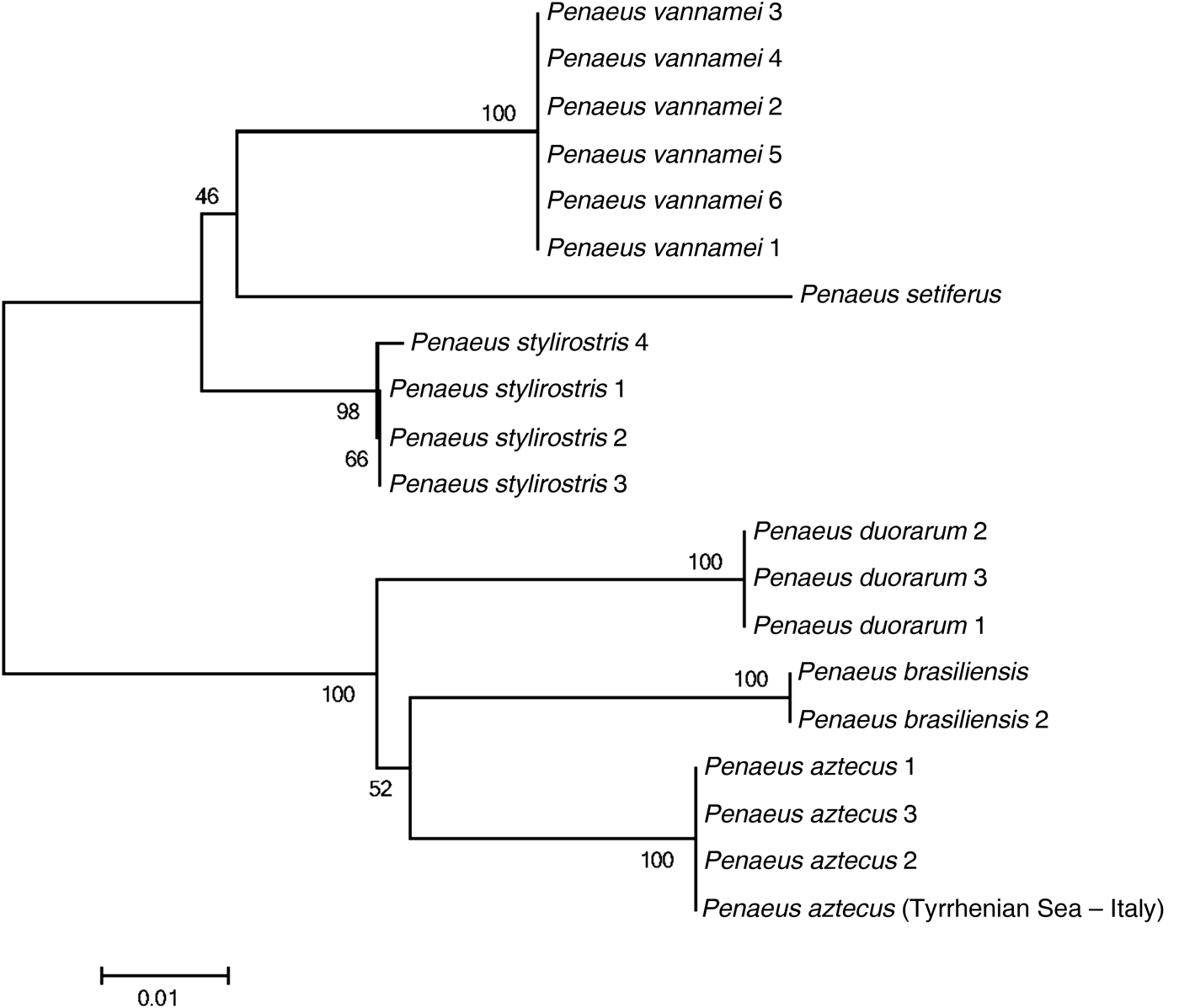
The male specimen was identified following Pérez-Farfante (Reference Pérez-Farfante1988: 12, Figure 17): the adrostral sulcus long, almost reaching posterior margin of carapace, median sulcus long, deep along entire length; rostrum with three ventral teeth; cheliped coxae unarmed; telson with deep median sulcus, lateral movable spines; ventral costa of petasma tapering distally, arched, bearing elongate patch of closely set small teeth were noted. After inspection, 510 bp of high quality (QV > 20) sequence of the mtDNA 16 s rRNA gene were determined for a specimen identified, based on morphological characters, as Penaeus aztecus. The submission of this sequence to GenBank returned a perfect match (100%) against reference sequences of 16S for that species (Maggioni et al., Reference Maggioni, Rogers, Maclean and D'Incao2001; Alvarado Bremer & Ditty, Reference Alvarado Bremer, Ditty, Turner and Saxton2010). Phylogenetic inference using NJ based on the analysis of 467 bp of sequence unequivocally identifies this specimen as Penaeus aztecus (bootstrap values = 100%), which it turn are readily differentiated from other penaeid shrimp (Figure 1).
NJ consensus gene tree based on the analysis of 16S sequences depicting the relationship of the Tyrrhenian specimen of Penaeus aztecus against the published sequences of other Penaeid shrimp species available in GenBank (see Materials and Methods).

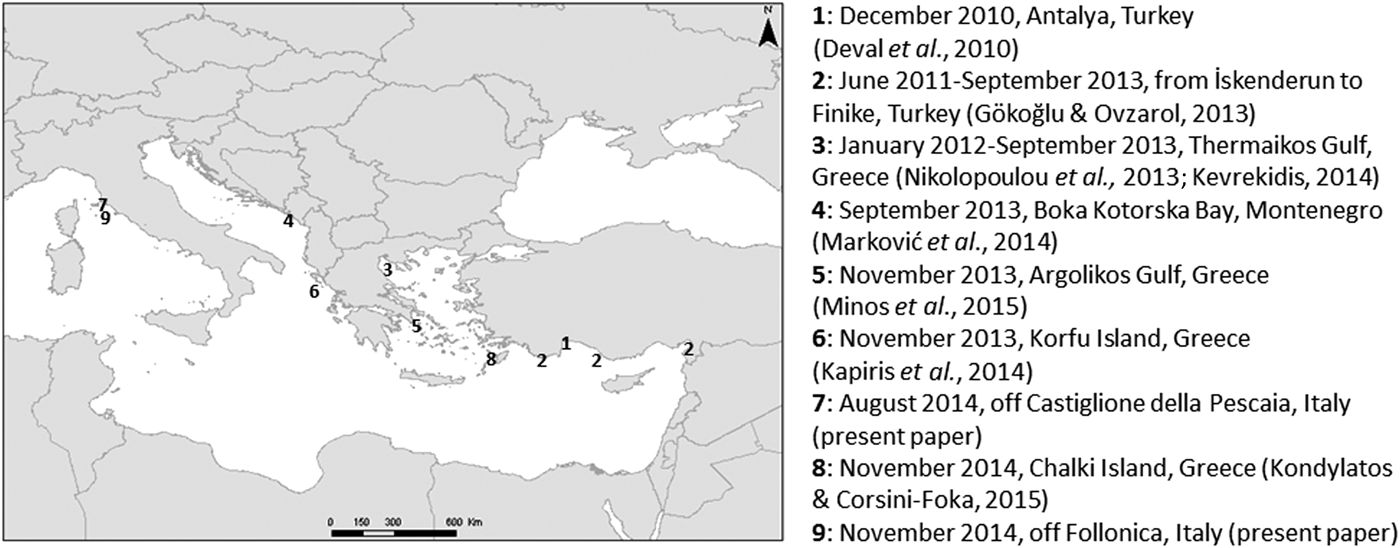
Penaeus aztecus is native to the Western Atlantic, from Massachusetts, USA to Yucatan, Mexico. It occurs in the circalittoral, commonly on bottoms less than 50 m deep, but occasionally is found at greater depths. The young are found in lagoons or estuaries, but adults migrate seawards. It is a commercially important species: annual landings are estimated at 50,000 tons (NOAA, 2013). In the Mediterranean Sea, it has been recorded in lagoons, estuaries and the continental shelf (5 to 150 m), on sandy, muddy or mixed bottoms (Gökoglu & Özvarol, Reference Gökoğlu, Ovzarol, Bilecenoglu, Alfaya, Azzurro, Baldacconi, Boyaci, Circosta, Compagno, Coppola, Deidun, Durgham, Durucan, Ergüden, Fernández-Álvarez, Gianguzza, Giglio, Gökoğlu, Gürlek, Ikhtiyar, Kabasakal, Karachle, Katsanevakis, Koutsogiannopoulos, Lanfranco, Micarelli, Özvarol, Pena-Rivas, Poursanidis, Saliba, Sperone, Tibullo, Tiralongo, Tripepi, Turan, Vella, Yokeş and Zava2013) (Figure 2).
Records of Penaeus aztecus along the Eastern and Central Mediterranean Sea, in chronological order.
Deval et al. (Reference Deval, Kaya, Güven, Gökoğlu and Froglia2010) and Kevrekidis (Reference Kevrekidis2014) consider ballast waters as the most likely vector for the introduction of Penaeus aztecus in the eastern Mediterranean. Yet, the arrival of five commercially important prawns in quick succession within the past decade raises a suspicion of direct human introduction, particularly as these species have been found in the vicinity of fish and shellfish farms. The bilaterally ablated female banana prawn, Penaeus merguiensis, collected in the Bay of Iskenderun, Turkey, in 2006, is certainly an escape or an inadvertent release from an aquaculture facility, since unilateral and bilateral eyestalk ablation is commonly used in aquaculture for inducing maturation of gonads (Özcan et al., Reference Özcan, Galil, Bakir and Katagan2006). Thermaikos and Argolikos gulfs are used for fish and shellfish farming, as well as the area along the Castiglione della Pescaia and Follonica coast, Tyrrhenian coast of Italy, where the reported specimens were collected. Mediterranean countries have been notoriously insouciant about biosecurity hazards relating to the movement of stock, feed and equipment that may result in the introduction of marine species (CIESM, Reference Briand2007); e.g. the southern flatfish, Paralichthys lethostigma Jordan and Gilbert, 1884, was introduced to Israel in 2001 and reared in inland closed systems in order to assess its suitability for aquaculture. According to Golani et al. (Reference Golani, Sonin and Rubinstein2015), ‘all adults and juveniles died and the enterprise was closed’, yet an adult individual was collected off shore five years later.
The facility with which international transfer via transboundary trade in live prawns is evinced by cases of White Spot Disease in Italian shrimp farm stocked with infected shrimps originating in Turkey (Stentiford & Lightner, Reference Stentiford and Lightner2011). As in the case of the clandestine importation of Penaeus pulchricaudatus from Turkey into Italy, and Penaeus merguiensis into Turkey (Özcan et al., Reference Özcan, Galil, Bakir and Katagan2006), no reporting has been made to the Competent Authorities by the industry of importation of Penaeus aztecus. Kevrekidis (Reference Kevrekidis2014) related the potential impacts if the population of Penaeus aztecus increases to the point where it competes with the commercially important native prawn Melicertus kerathurus. It seems that, despite directives and regulations, significant biosecurity gaps still exist as concerns the movement of commercially valuable species across international borders and possible consequences once they are released into natural habitats.
ACKNOWLEDGEMENT
The authors thank Alessandro Taiti, who brought his unusual catch to our attention. This research received no specific grant from any funding agency, commercial or not-for-profit sectors.