The immediate repetition of single nonword forms such as woogalamic or noitauf is a paradigm that has attracted a great deal of interest in the fields of cognition, cognitive development, and communication sciences in recent years. The reason for this attention is that despite the apparent simplicity of the task, the abilities to repeat nonwords and to learn language are very closely related to one another: individuals who perform poorly on nonword repetition typically struggle to learn the phonological form of language. Although the evidence linking nonword repetition and the learning of novel phonological forms is now extensive (see Gathercole, 2006), the cognitive processes suggested to underlie nonword repetition are a matter of debate. Nonword repetition was first proposed as a relatively pure index of verbal short-term memory capacity (Gathercole & Baddeley, 1989, 1993). According to this view, repetition of nonwords requires more reliance on the temporary storage of phonological representations in short-term memory because of the reduced availability of long-term lexical knowledge to support the unfamiliar phonological forms. Other researchers have focused on other constraints on nonword repetition performance including lexical knowledge (Snowling, Chiat, & Hulme, 1991), phonotactic probability (Edwards, Beckman, & Munson, 2004), phonological sensitivity (e.g., Bowey, 1996; Metsala, 1999), and output phonology (e.g., Vance, Stackhouse, & Wells, 2005; Wells, 1995).
One line of evidence in support of the short-term memory account of nonword repetition is the reliable correlations found between nonword repetition and more conventional measures of temporary verbal storage abilities such as digit span in both developmental and neuropsychological populations (e.g., Gathercole & Baddeley, 1989; Gathercole, Frankish, Pickering, & Peaker, 1999; Gathercole, Willis, Emslie, & Baddeley, 1992; Gupta, 2003; Gupta, MacWhinney, Feldman, & Sacco, 2003). Other findings suggest that both shared and distinct processes contribute to nonword repetition and digit span tasks. For example, measures of nonword repetition have been found to be more strongly linked to vocabulary knowledge than digit span (Gathercole, Hitch, Service, & Martin, 1997). In addition, children with specific language impairment, a relatively specific condition affecting language development (Leonard, 1998), typically perform much more poorly on nonword repetition than other measures of short-term memory (Archibald & Gathercole, 2006; Conti-Ramsden, 2003). It must be acknowledged, however, that the nonword repetition and serial recall measures employed in these studies differed substantially (i.e., in length, familiarity, and phonological properties) precluding direct comparisons. The aim of the present study was to compare serial recall and nonword repetition performance directly by using matched phonological content across tasks for typically developing groups of children.
Serial recall is a paradigm that has been employed extensively to study the temporary retention of verbal material (e.g., Baddeley, Thomson, & Buchanan, 1975; Conrad, 1964; Henson, Norris, Page, & Baddeley, 1996). Immediate repetition of items for ordered recall forms a classic “serial position curve” in which recall starts very accurately, decreases throughout the list, and then improves toward the end of the list (e.g., Murdock, 1962; Waugh & Norman, 1965). Incorrect responses in serial recall can be classified as either item or order errors (e.g., Henson et al., 1996; Pickering, Gathercole, & Peaker, 1998). Examples of item errors include omissions (no response) and intrusions (an item that was not in the present list is recalled). Order errors occur when an item that was in the original sequence migrates in the recall protocol to an incorrect position.
Error patterns in serial recall depend on the nature of the lists to be remembered. As in the majority of serial recall studies, when lists contain items sampled from a small and highly familiar stimulus pool such as letter names, order rather than item errors dominate (Aaronson, 1968; Bjork & Healy, 1974), whereas when lists are constructed from an open stimulus vocabulary (Gathercole, Pickering, Hall, & Peaker, 2001) or include nonwords (Jeffries, Frankish, & Lambdon Ralph, 2006), the majority of errors are item rather than order. Item fragmentation has been noted in serial recall when list items are relatively unfamiliar. For example, Gathercole et al. (1999) found that partially accurate recalls containing one or two phonemes from the target were more common in memory lists comprising unfamiliar than familiar lexical forms. In a study of the serial recall of monosyllabic nonword items, Treiman and Danis (1988; see also, Treiman, 1995) reported that phoneme rather than whole-item movements comprised the majority of errors. Consistent with earlier data concerning item migrations at the whole-item level (e.g., Lee & Estes, 1977), phoneme movement errors covered smaller distances than would be predicted if no memory for serial position had been retained. Most errors involved phoneme recombinations that preserved syllabic structure. Vowels were recalled more accurately than consonants (see also Ellis, 1980; Gathercole et al., 1999), and vowels and consonants rarely substituted for one another.
It is widely accepted that this pattern of serial recall behavior reflects both a system for storing phonological aspects of list items and a mechanism for encoding and retrieving order information. In computational models developed to simulate such data, serial order is encoded by associating a temporal tag with either a specific list position (Page & Norris, 1998a) or an individual list item (Brown, Preece, & Hulme, 2000; Burgess & Hitch, 1992, 1998). Typically, these models have been based on a closed set of items and lack the capacity to account for the more detailed phoneme error profiles described above. As yet, only Hartley and Houghton (1996) have aimed to develop a model of serial recall for unfamiliar phonological forms that represents stimuli at both the syllable and phoneme level.
Relatively few studies have provided comparable examinations of nonword repetition data. One important study has replicated the classic serial position curve in nonword repetition: Gupta (2004a) demonstrated primacy and recency effects in nonword repetition both for naturally spoken stimuli and nonwords composed from the concatenation of monosyllables. These findings do indeed suggest that common sequencing mechanisms may underlie both nonword repetition and serial recall. Phoneme substitutions (item errors) are a relatively common error pattern in nonword repetition (Gathercole et al., 1992), and tend to share articulatory features with the target (Bisiacchi, Cipolotti, & Denis, 1989; Caramazza, Miceli, & Villa, 1986).
Although much evidence points to the high degree of association between serial recall and nonword repetition, differences between the paradigms exist even in the present study, which employed matched stimuli: sequences of consonant–vowel (CV) syllables were presented either in isolation for serial recall (e.g., fow … moy … chee) or as a single coarticulated nonword for repetition (e.g., fowmoychee). Some of the differences between tasks may be expected to benefit nonword repetition. For example, it is possible that multisyllabic nonwords convey more information about sound structure, which would lead to a recall advantage for nonword repetition. One potential source of the additional information in the acoustic signal for naturally spoken nonwords is coarticulation, the modification of the speech signal associated with a particular sound by prior and subsequent phonetic segments. Coarticulation extends across vowel–vowel segments (e.g., Nijland, Maassen, van der Merlen, Gabreels, Kraaimaat, & Schreuder, 2002) and even word boundaries (e.g., Coleman, 2003), and significantly influences word recognition processes (e.g., Nguyen, 2001). Coarticulatory cues across successive syllables will therefore be a feature of naturally spoken nonwords but not of isolated syllable sequences representing the same phonological structure. A second additional source of information present in spoken nonwords but absent in syllable sequences is prosodic contour. Prosody represents a complex set of cues including vowel reduction, pauses, and amplitude patterns, and can interact with coarticulation (e.g., Cho, 2004). Stress pattern is known to exert a powerful influence on nonword repetition, with the majority of errors located in unstressed syllables (Roy & Chiat, 2004). One further difference that may favor nonword repetition is overall stimulus duration, which will be shorter for nonword repetition potentially creating opportunities for more rapid responding or rehearsal.
Other factors differentiating the paradigms may benefit serial list recall. Intensity and duration patterns of consonant and vowel segments are known to vary with syllable structure (Lehiste, 1970), position (Yoo & Blackenship, 2003), and stress pattern (Cho & McQueen, 2005). It is expected that each syllable will have a higher level of acoustic–phonetic salience when produced singly in a serial sequence than in equivalent multisyllabic productions, which may convey an advantage in immediate serial recall. Also, output demands are considerably less for serial recall than nonword repetition: the multisyllabic responses required for nonword repetition are associated more rapid and coarticulated speech gestures.
It is clear from the preceding discussion that although both serial recall and nonword repetition may provide an index of short-term memory, they also differ in several important ways. The purpose of the present study was to examine the extent to which performance is influenced by these additional factors in typically developing children. Because the syllabic content of the sequences employed in the present study was the same in the two tasks, the short-term memory load is equivalent. Thus, if verbal storage abilities alone are sufficient to account for performance on both tasks, repetition accuracy in nonword repetition and serial recall should be comparable. More accurate repetition in nonword repetition would indicate that additional cues inherent in the multisyllabic stimuli such as coarticulatory and prosodic information support repetition, whereas superior serial recall performance may reflect the importance of acoustic salience or low output demands in enhancing recall.
METHOD
Participants
Twenty-six children participated in the present study in two age groups: 11 children (6 males, 5 females) ranged in age from 9 to 13 years (M = 11 years, 1 month, SD = 1.15) and 15 (10 males, 5 females) were in the 5- to 8-year-old range (M = 6 years, 10 months, SD = 1.20). All participants obtained standard scores of 85 or greater on measures of nonverbal ability in the Coloured Matrices (Raven, Court, & Raven, 1986) and a language measure in the British Picture Vocabulary Scales, 2nd ed. (Dunn, Dunn, Whetton, & Burley, 1997). All were native English speakers, and were considered to be displaying typical development by teachers and parents.
Procedure
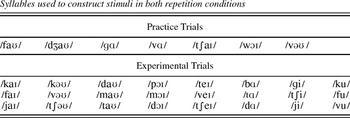
All participants completed two tasks, serial recall and nonword repetition. Order of presentation of the two repetition tasks was counterbalanced, with six or seven participants within each group completing serial recall first, and the remainder, nonword repetition first. In each task, eight experimental trials preceded by two practice trials were presented at each of three syllable lengths: three, four, and five CV syllables. The serial recall and nonword repetition lists were constructed from a pool of phonemes excluding the eight consonants that are late acquired (Shriberg & Kwiatowski, 1994). Only tense vowels were included so that the multisyllabic nonwords were produced with equal stress across syllables (Dollaghan & Campbell, 1998), thereby minimizing prosodic differences between tasks. The resulting pool of 30 CV syllables generated by combining 13 consonants and eight vowels are shown in Appendix A. Twenty-four syllables were selected for use in the experimental trials. The remaining 6 syllables were employed in the practice trials only with the exception of 1 syllable from the experimental pool that had to be used to construct the 5-syllable practice items to fulfill the criteria described below for sequence construction. The eight sequences at each list length were created by combining the syllables from the 24-syllable pool for the experimental tasks with the following constraints: no phonemes were repeated within a sequence, all syllables occurred at least once for each list length, each vowel occurred in each ordinal position at least once within each list length, and all syllables occurred at least four times in different ordinal positions across all the items.
A digitized recording was made of a female speaker producing syllables in isolation and multisyllabic nonwords. Presentation of the experimental stimuli was controlled by a specialized computer program written in Visual Basic (Microsoft, 2003). For the serial recall task, the child was asked to listen to each sequence of sounds, and to repeat them in the same order at the end of the sequence. The syllable sequences were presented at the rate of one every 750 ms for serial recall. For nonword repetition, the child was told that they would hear a made-up word and asked to repeat it back immediately. All responses were recorded digitally and phonetically transcribed.
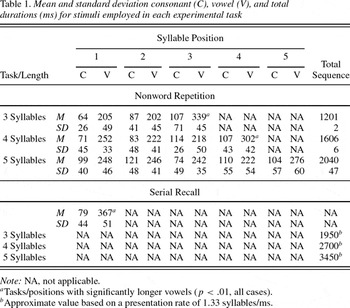
The duration of consonants and vowels (segments) in all syllables, and the total duration for the nonword repetition stimuli was measured on an acoustic waveform with visual and auditory control using the software program, Goldwave (2003). Consonant durations included closure, burst, and aspiration, where applicable. Vowels were measured from onset to offset of voicing. Table 1 presents average total stimuli, and segment durations for the monosyllables in serial recall, and the syllables within the multisyllabic nonword forms. In one-way analyses of variance (ANOVAs) comparing duration across tasks, no significant difference was found for consonants (p>.05), whereas vowel durations were significantly longer in the monosyllables for serial recall than the multisyllable nonwords for nonword repetition (p<.001). Segment durations in the nonword repetition stimuli were compared in two-way ANOVAs as a function of length (three-, four-, five-syllable nonwords) and position (initial, medial, final). For these analyses, medial positions for the four- and five-syllable nonwords comprised the average durations of segments occurring in the second and third syllable positions of four-syllable sequences and second, third, and fourth syllables of five-syllable sequences. Preliminary analyses revealed no differences in consonant or vowel durations at these positions (p>.05). No differences were found in consonant durations across positions (p>.05), whereas vowel durations were significantly longer in the final positions of the three- and four-syllable sequences (p<.01, both cases).

RESULTS
Recall accuracy in the serial recall and nonword repetition tasks was scored at the syllable and phoneme level using a strict serial order criterion according to which, a unit is only scored as correct if it is recalled in its original position within the sequence. Raw scores were converted to percentage values for the purposes of comparison across sequence lengths. A rationalized arcsine transform function was used to convert all percentage scores into interval level data prior to statistical analysis (Studebaker, 1985).
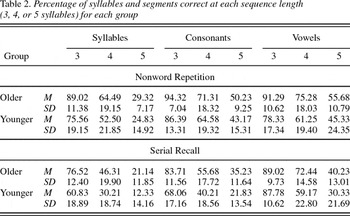
The percentage of syllables correctly recalled for the two participant groups on the serial recall and nonword repetition tasks is summarized in Table 2. An ANOVA was performed for syllables correctly recalled by each child within the two participant groups as a function of task (serial recall and nonword repetition) and length (three, four, and five syllables). All three main effects were significant: task, F(1, 24) = 59.508, p<.001, ηp2 = 0.72; length, F(2, 48)=424.289, p<.001, ηp2 = 0.95; and group, F(1, 24)=5.434, p<.05, ηp2 = 0.19. All interaction terms were nonsignificant. Recall accuracy was significantly greater for nonword repetition than serial recall as reflected by the main effect of the task. The main effects of length and group reflect, respectively, poorer recall accuracy with increased length, and the higher scores of the older group.

Table 2 also presents descriptive statistics for percentage of consonants and vowels correctly recalled by children in each group for both experimental tasks. Repetition accuracy was considerably higher in nonword repetition than serial recall for consonants, and for vowels at the five-syllable length. For both consonants and vowels, the decline in accuracy with increasing sequence length was greater in serial recall than nonword repetition.
An ANOVA was conducted for phonemes correctly recalled as a function of task, group, length, and segment (consonants, vowels). All four main effects were highly significant. The main effects of task, F(1, 24)=58.301, p<.001, ηp2 = 0.71, length, F(2, 48)=339.114, p<.001, ηp2 = 0.93, and group, F(1, 24)=4.553, p<.05, ηp2 = 0.16, mirrored those of the previous analysis. There was also a main effect of segment, F(1, 24)=27.047, p<.001, ηp2 = 0.53, reflecting more accurate repetition of vowels. Three interactions were significant: task and segment, F(1, 24)=27.869, p<.001, ηp2 = 0.54, because of a greater nonword repetition advantage for consonants; segment and length, F(2, 48)=5.950, p<.005, ηp2 = 0.20, reflecting a greater decrement to consonants at the four-syllable length; and task, segment, and group, F(1, 24)=6.081, p<.05, ηp2 = 0.20, because of the poorer performance of the younger group on consonants in nonword repetition. The remaining interactions were nonsignificant.
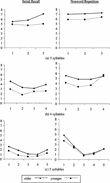
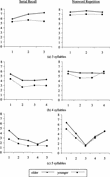
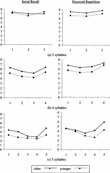
To provide a more detailed analysis of the pattern of performance in serial recall and nonword repetition, recall accuracy was examined as a function of serial position across groups. Figures 1, 2, and 3 present the respective mean numbers of correctly produced syllables, consonants, and vowels at each serial position for both tasks, groups, and all sequence lengths.

Mean number of syllables correctly recalled as a function ofserial position, group, and task for lists of (a) three, (b) four, and (c) five syllables.
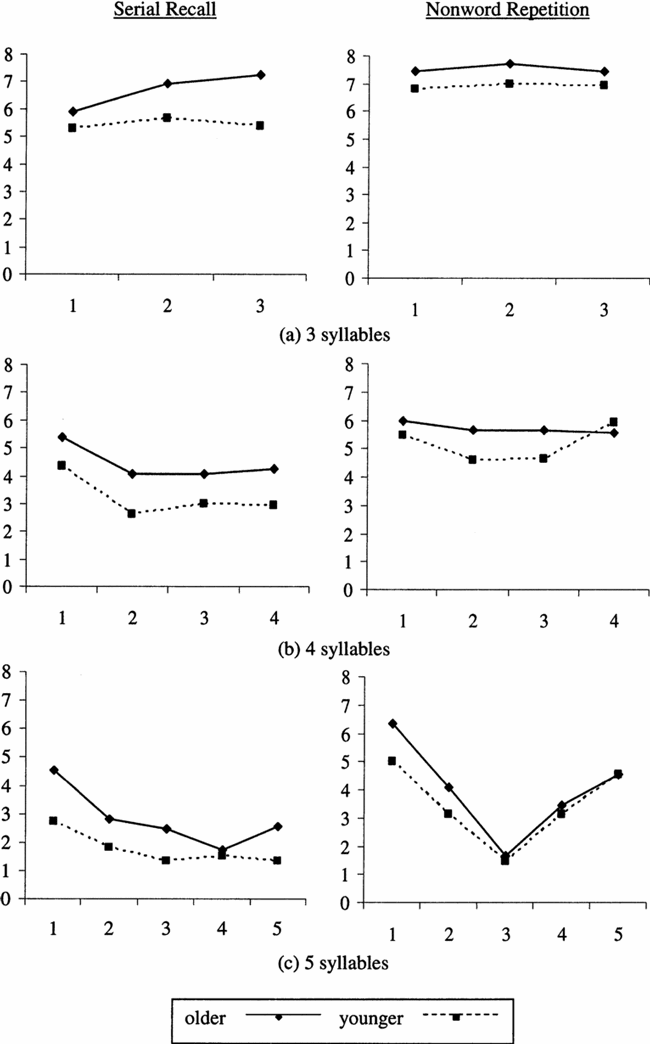
Mean number of consonants correctly recalled as a function ofserial position, group, and task for lists of (a) three, (b) four, and (c) five syllables.
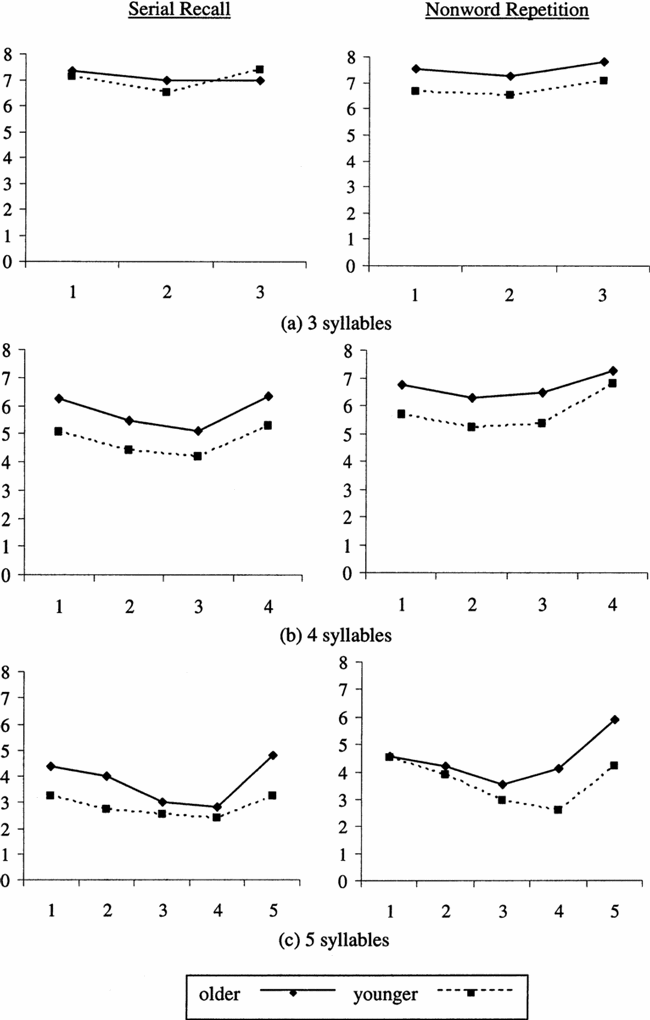
Mean number of vowels correctly recalled as a function of serialposition, group, and task for lists of (a) three, (b) four, and (c) five syllables.
Consider first the syllable level (see Figure 1). Separate ANOVAs were performed for syllables correctly recalled as a function of task and position for each list length (three, four, and five syllables). For the three-syllable length, all three main effects were significant, task, F(1, 24)=19.480, p<.001, ηp2 = 0.45, position, F(2, 24)=6.227, p<.005, ηp2 = 0.21, and group, F(1, 24)=6.427, p<.05, ηp2 = 0.21, as was the interaction between task, position, and group, F(2, 24)=3.630, p<.05, ηp2 = 0.13. The remaining terms were nonsignificant. As in the previous analyses, the main effects of task and group reflect, respectively, the superior performance on nonword repetition and of the older group. Within-subject contrasts revealed a significant linear function for the main effect of position. For the three-way interaction, analysis of simple effects indicated that the older group had significantly higher scores for the third syllable of the serial recall lists only (p<.001). The remaining comparisons were nonsignificant (p>.05).
In the corresponding ANOVA for the four-syllable length, significant main effects of task, F(1, 24)=24.771, p<.001, ηp2 = 0.51, and position, F(3, 72)=10.021, p<.001, ηp2 = 0.30, were modified by a significant interaction between task and position, F(3, 72)=2.789, p<.05, ηp2 = 0.10. The remaining terms were nonsignificant. The pattern of results was the same for the five-syllable length: significant effects included task, F(1, 24)=27.504, p<.001, ηp2 = 0.53, position, F(4, 96)=35.207, p<.001, ηp2 = 0.60, and the interaction between task and position, F(4, 96)=11.430, p<.001, ηp2 = 0.32. The remaining terms were nonsignificant. For both of these analyses, within-subject contrasts revealed a significant quadratic function for the main effect of position. These results demonstrate standard primacy and recency effects. For the interaction between task and position, analysis of simple effects revealed a slightly different pattern for the four- and five-syllable lengths: scores were significantly higher for nonword repetition than serial recall on the first syllable of the four-syllable length at p<.05, and each of the remaining positions (second, third, and fourth) at p<.001. For the five-syllable length, a nonword repetition advantage was present for the first and second syllables at p<.001, and the fourth at p<.05, but not the third (p>.05) or fifth syllable (p=.053).
Separate ANOVAs were performed on the phoneme accuracy scores as a function of group, task, segment (consonants, see Figure 2; vowels, see Figure 3), and serial position for each list length (three, four, and five syllables). Significant effects in the analysis of the three-syllable length data that mirrored those of previous analyses included: task, F(1, 24)=14.128, p<.001, ηp2 = 0.37; segment, F(1, 24)=7.723, p<.01, ηp2 = 0.24; group, F(1, 24)=5.378, p<.05, ηp2 = 0.18; task and segment, F(1, 24)=18.098, p<.001, ηp2 = 0.43; and task, segment, and group, F(1, 24)=6.663, p<.05, ηp2 = 0.22. Also significant were the interactions between segment and position, F(2, 48)=4.768, p<.05, ηp2 = 0.17, because of a greater advantage to vowels in initial and final positions, and task, segment, and position, F(2, 48)=3.272, p<.05, ηp2 = 0.12, reflecting the poorer recall of consonants in the initial list position for serial recall than nonword repetition. The remaining terms were nonsignificant.
In the corresponding ANOVA for the four-syllable length, there were significant main effects of task, F(1, 24)=27.045, p<.001, ηp2 = 0.53, segment, F(1, 24)=58.744, p<.001, ηp2 = 0.71, and position, F(3, 72)=12.326, p<.001, ηp2 = 0.34. Significant interactions occurred between task and segment, F(1, 24)=4.671, p<.05, ηp2 = 0.16, task and position, F(3, 72)=4.025, p<.01, ηp2 = 0.14, and segment and position, F(3, 72)=6.625, p<.001, ηp2 = 0.24. These interaction terms reflect, respectively, a greater nonword repetition advantage for consonants, more accurate recall in final positions of the nonword repetition sequences, and a reduction in the advantage to vowels in the initial position. The remaining terms were nonsignificant.
The ANOVA performed on the five-syllable length data revealed significant main effects of task, F(1, 24)=39.903, p<.001, ηp2 = 0.62; segment, F(1, 24)=14.739, p<.001, ηp2 = 0.38; and position, F(4, 96)=37.188, p<.001, ηp2 = 0.61, as well as significant interactions between task and segment, F(1, 24)=12.356, p<.005, ηp2 = 0.34; task and position, F(4, 96)=9.301, p<.001, ηp2 = 0.28; segment and position, F(4, 96)=9.055, p<.001, ηp2 = 0.27; segment, position, and group, F(4, 96)=2.764, p<.05, ηp2 = 0.10; and task, segment, and position, F(4, 96)=4.343, p<.005, ηp2 = 0.15. The remaining terms were nonsignificant. The interaction between segment and position was due to the more accurate recall of consonants in the initial position and vowels in the remaining positions. This effect was greater for the older than younger age group as reflected by the significant interaction between segment, position, and group. The interaction between task, segment, and position was due to the greater advantage to consonants in the initial position for nonword repetition than serial recall.
To summarize, recall of both syllables and phonemes was more accurate in nonword repetition than serial recall. For phonemes, this advantage was greater for consonants than vowels. Although performance decreased with increasing sequence length for both tasks, the impact of length was greater on consonants. Standard primacy and recency effects were noted in both experimental tasks. Consonants benefited to a greater extent from being in the initial position of a sequence, whereas vowels benefited in later positions. This effect was greater for nonword repetition than serial recall. Although the older group performed at superior levels as expected, the group difference was greatest for consonants in nonword repetition.
Error analysis
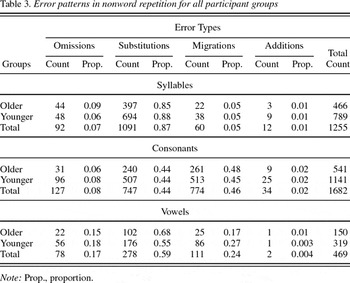
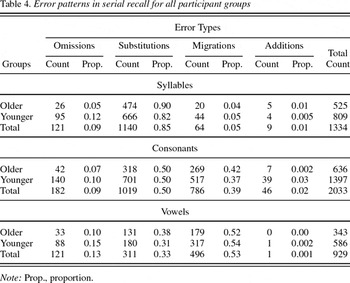
Errors were classified as omissions, substitutions, additions, or migrations. The first three categories can be considered item errors: An omission error was recorded when no phoneme occurred in an expected position. A substitution error was recorded when a phoneme not occurring anywhere in the target was provided in place of a target phoneme. An addition was noted when an extra unit appeared in the response. A migration error occurred whenever a phoneme from the target was recalled in the incorrect position and reflects an order error. For each participant group, frequency and proportions of the four error types for syllables, consonants and vowels are provided in Table 3 for nonword repetition and Table 4 for serial recall.


Consider first the syllable level. Substitutions were the dominant error type at the syllable level for all groups and conditions. For both tasks, migration errors of entire syllables were infrequent (<10%), although migrations constituted approximately 40% of consonant errors overall and 50% of vowel errors in serial recall. Omissions and additions were rare at the syllable level, indicating that recall attempts and input sequences typically matched in number of syllables.
Consonant errors varied according to task with substitutions occurring at rates similar to migration errors in nonword repetition but at higher rates in serial recall. Consonant additions and omissions were rare, and will not be analyzed further. Error proportions were transformed using an arcsine root function to make them appropriate for analysis of variance, as categorical data with repeated measures cannot be submitted to a chi-square test (Hopkins, 2000; Osbourne, 2002). An ANOVA was performed on the consonant error proportions as a function of group, task, and error type (substitutions, migrations). There was a significant main effect of group, F(1, 24)=5.195, p<.05, ηp2 = 0.18, which was indirectly due to the lower proportion of omission and addition errors in the older group resulting in substitution and migration errors representing a larger proportion of errors for this group than the younger group. The main effect of error type was significant, F(1, 24)=24.033, p<.001, ηp2= 0.50, and was mediated by a significant interaction between task and error, F(1, 24)=35.648, p<.001, ηp2 = 0.60, and between error and group, F(1, 24)=7.448, p<.05, ηp2 = 0.24. The remaining terms were nonsignificant. For the interaction between task and error, analysis of simple effects revealed that, whereas migrations and substitutions occurred at equivalent rates in nonword repetition (p>.05), the proportion was significantly greater in serial recall for substitutions than migrations (p<.001). In addition, the proportion of substitutions was significantly greater in serial recall than nonword repetition (p<.001), whereas the proportion of migrations was significantly greater in nonword repetition than serial recall (p<.001). For the error and group interaction, the proportion of migration errors was significantly higher for the older than younger group (p<.05).
A corresponding ANOVA was performed on the vowel errors as a function of group, task, and error type (substitutions, migrations). Three participants who made no migration errors in nonword repetition were excluded from this analysis: one from the older and two from the younger groups. There was a significant main effect of task, F(1, 21)=92.230, p<.001, ηp2 = 0.82, and a significant interaction between task and error type, F(1, 21)=130.956, p<.001, ηp2 = 0.86. The remaining terms were nonsignificant. Exploration of simple effects established that whereas migration errors represented a greater proportion of the errors in serial recall than nonword repetition (p<.001), the proportion of substitution errors did not differ between tasks (p>.05).
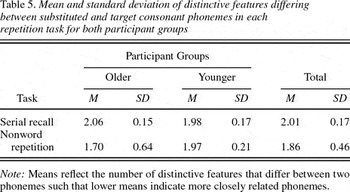
Consonant substitution errors were examined further in terms of the relationship between articulatory features of the substituted and input phonemes. Three distinctive articulatory features were considered in this analysis: presence/absence of voicing, place of articulation, and manner of articulation. Substitutions were scored according to the number of different features from the target consonant such that a score of 1 indicated that the substitute and target differed by one distinctive feature, 2 indicated two features, and so forth. From these, a mean score was calculated for each participant and task. Table 5 presents mean numbers of different distinctive features characterizing substitutions for both tasks and participant groups. In the ANOVA performed on this data as a function of group and task, the main effect of task was significant, F(1, 24)=4.320, p<.05, ηp2 = 0.15, confirming that the substituted phonemes were more closely related to the target in nonword repetition than serial recall. All remaining terms were nonsignificant.

To summarize the error analyses, consonant migrations were more common, and substitutions more closely matched to input phonemes in nonword repetition than serial recall. The pattern of vowel errors was opposite to that found for consonants with migrations more common in serial recall. A higher proportion of consonant errors were migrations in the older than younger group.
DISCUSSION
In this study, the performance of typically developing school-age children was compared on nonword repetition and serial recall tasks in which matched sequences of syllables were presented auditorily for recall. The purpose of the study was to establish whether nonword repetition and serial recall both tap short-term memory, or are influenced differentially by additional mechanisms such as those supporting coarticulation or output processes. In line with findings from many previous studies of short-term memory behavior, standard primacy and recency effects were present within sequences for both serial recall and nonword repetition. Vowels were recalled more accurately than consonants, and performance declined with increasing sequence length. It is important, though, that nonword repetition was associated with higher levels of repetition accuracy than serial recall, an advantage that was greater for consonants than vowels. Consonants were recalled more accurately when they occurred in the initial position of a sequence, an effect that was greater in nonword repetition than serial recall. Error patterns also differed between the tasks. Consonant errors were more closely related to the target in nonword repetition, whereas vowel errors were more closely related to the target in serial recall.
These results do indicate that nonword repetition and serial list recall are related tasks (Gupta, 2003, 2005; Gupta et al., 2003). Decreased recall accuracy for lengthier sequences is typically attributed to temporal decay of the phonological representations in a short-term store (Baddeley et al., 1975; Cowan, Saults, Winterowd, & Sherk, 1991). The bow-shaped serial response curve is widely accepted to reflect the retention of order information (e.g., Brown et al., 2000; Burgess & Hitch, 1992; Page & Norris, 1998a). The presence of both of these hallmark findings in the nonword repetition and serial recall tasks in the present study suggests that common mechanisms for retaining item and order are operative in both tasks. One possibility proposed by Gupta (2004) is that a nonword is processed like a list when first encountered, and is thus directly dependent on list sequencing mechanisms.
Recall in nonword repetition and serial recall was not equivalent in the present study, however; multisyllabic forms were reproduced more accurately than matched syllable sequences presented singly in a list. It is apparent that additional mechanisms facilitated recall in nonword repetition. Of potential importance are the temporal differences that distinguish the two paradigms. Overall sequence duration was shorter in nonword repetition than serial recall allowing an earlier response, perhaps reducing opportunities for decay of the phonological representation in the short-term store. One problem for this suggestion, however, is the finding that recall accuracy in nonword repetition was improved to a greater extent for consonants than vowels even though it was vowel duration that was significantly shorter in this paradigm (and consonant duration unchanged). In addition, vowel errors were more closely related to the target in serial recall than nonword repetition reflecting more accurate recall when vowel duration was longer.
Another possible explanation of the superior nonword repetition performance is that participants capitalized on the physical cues to underlying structure that were present in the connected multisyllabic nonwords but not the isolated individual syllables. Such cues include prosody (Roy & Chiat, 2004) and coarticulation (Nijland et al., 2002), both of which play important roles in the perception and retention of speech. In English, there are a small number of places of articulation for consonants, which tends to promote coarticulation, whereas tense vowels tend to resist coarticulation. Thus, coarticulatory cues may be expected to have had the greatest impact on consonants in the present study. Consistent with this prediction, the nonword repetition advantage was greater for consonants than vowels, and consonant errors were more closely related to the target in nonword repetition than serial recall. It may also be that these cues differentially benefit consonants in the initial position of longer lists. Although the present study aimed to minimize prosodic differences across tasks, recall may be facilitated as well by the “(non)word” level contour which spanned the entire sequence in nonword repetition rather than each list item in serial recall.
The present findings extend those reported for immediate recall of unfamiliar sequences (Gathercole et al., 1999, 2001; Jeffries et al., 2006; Treiman & Danis, 1988). In contrast to studies employing closed lists of familiar items (Aaronson, 1968; Bjork & Healy, 1974), item errors were more common than order errors at the whole-syllable level replicating previous findings with open stimulus sets composed of both words and nonwords (Gathercole et al., 1999; Treiman & Danis, 1988). At the phoneme level, order errors have been found to be more common than item errors in list recall (Gathercole et al., 2001; Treiman & Danis, 1988). Although in the current work this was true in serial recall for vowel errors only, it was also the case for consonant errors in nonword repetition. It is clear from these findings that independent migrations of phonemes are a common feature of both serial recall and nonword repetition, although the degree to which phonemes remain tightly bound in a coherent unit may be influenced by lexical and semantic knowledge as recently demonstrated by Jeffries et al. (2006). These results call for a verbal short-term memory model in which order information is associated with individual phonemes rather than a singular representation of an item, at least for unfamiliar words or nonwords. It is possible that familiar word forms are represented in a more holistic fashion.
An alternative explanation of the present results is that the recall performance reflects factors other than a separate storage capacity, such as linguistic processing. It has been suggested that immediate memory tasks involving verbal material tap linguistic processing abilities with individual differences in performance arising because of variations in exposure to language or biological differences in processing accuracy (MacDonald & Christiansen, 2002). According to this view, nonword repetition and serial recall both rely on linguistic processing mechanisms, and thus, similar constraints influence outcome resulting in commonalities across tasks. It can be assumed, however, that the processing demands of single-syllable and multisyllabic forms vary to some degree, resulting in differences in performance across tasks and error patterns that follow established linguistic rules. It is well known that speech production errors obey phonological rules: errors are phonotactically legal, segment exchanges involve constituents from the same position within the syllable (i.e., both rimes), and errors typically involve word-initial sounds (Gupta & Dell, 1999). Models of speech production account for these patterns by postulating that phonological forms activate both a word–shape frame and a lexical representation of the actual sounds (e.g., Dell, 1988). Thus, the consonants in each syllable in serial recall in the present study would be coded as a word-initial sound, whereas only the first consonant in the multisyllabic stimuli in the nonword repetition task would be word-initial and the rest syllable-initial sounds. It may be argued then, that initial consonants would have been less likely to migrate in the nonword repetition than serial recall task as there were no other like-coded phonemes within the word–shape frame resulting in more accurate recall overall, and an advantage to word-initial consonants in nonword repetition.
It should be noted that Page and Norris (1998b) have described a further specification of the phonological output stage of the primacy model to account for the phonological similarity effect in serial recall. This model has some ability to accommodate individual phoneme errors, and is similar to the speech production model described above (Dell, 1988). Two interconnected layers are postulated: one layer containing word nodes and the other, phoneme nodes. When a single word node receives an activation boost, nodes representing its constituent phoneme nodes are activated. Activation from these phonemes can project back to any word nodes to which they are connected. Thus, the word nodes of phonologically similar items receive activation from the phoneme layer, resulting in a boost that may be sufficient to lead to the selection of an incorrect phoneme at output. Phonologically similar extra list items also receive activation from the phoneme level making them a potential output choice on rare occasions. Although this model specifically addresses the recall of single-syllable lexical items, it may point to some mechanisms that could influence phoneme recall in the case of nonwords. As noted previously, differences in the word nodes (frames) activated by single versus multisyllabic forms may introduce differential probabilities for phoneme errors across word and syllabic positions. In addition, activated phonemes may activate related extra list phonemes, leading to their incorrect selection on occasion.
The results of the present study indicate that although verbal short-term memory constrains both nonword repetition and serial recall performance, additional cues inherent in nonword repetition do lead to more accurate recall with greater retention of features of target phonemes. This pattern established for two age groups of typically developing children in the current work appears to be a signature of normal development. The cues available in multisyllabic nonword repetition may allow for richer encoding with greater binding of phonemic features resulting in better quality phonological representations that are less susceptible to interference or loss. Nonword repetition differs from serial recall in several ways such as the presence of prosodic and coarticulatory cues, temporal properties, and motoric demands. Systematic experimental examination of the influences of these factors is needed to gain an understanding of the underlying processes supporting nonword repetition, and related vocabulary learning skills.
APPENDIX A