Brain natriuretic peptide is a cardiac hormone secreted from the ventricular myocardium as a response to ventricular volume expansion and pressure overload and is thought to be mainly produced from the ventricular myocardium.Reference Nir and Nasser1, Reference Mukoyama, Nakao and Morii2 It has diuretic, natriuretic, and vasodilator activities.Reference Yoshimura, Yasue and Morita3 It has been reported that plasma brain natriuretic peptide levels are increased in states of left ventricular overload, such as left ventricular failure or left ventricular hypertrophy.Reference Nishikimi, Yoshihara and Morimoto4
Acute rheumatic carditis is still an important health problem in developing countries and histological studies on biopsy and autopsy material obtained from patients with rheumatic cardiac disease reveal infiltration of the myocardium and endocardium with monocytes, neutrophils, and lymphocytes, and also other features of granulomatous myocarditis.Reference Raizada, Williams and Chopra5–Reference Chopra, Narula, Kumar, Sachdeva and Bhatia7 Although there are a few studies of brain natriuretic peptide levels in children with acute rheumatic fever,Reference Tissières, da Cruz and Habre8, Reference Bayram, Kocatürk, Yücel, Atalay, Çolak and Ateşal9 to our knowledge, no previous study has systematically assessed the plasma levels of its N-terminal prohormone in acute rheumatic carditis.
In this study, we present our experience of the prohormone levels, caused by acute rheumatic carditis in children. Patient group was evaluated by clinical, electrocardiographic, and echocardiographic investigations. We studied the plasma prohormone levels to determine whether prohormone levels increases in parallel to erythrocyte sedimentation rate, C-reactive protein levels, anti-streptolysin-O titter, electrocardiographic, and echocardiographic findings in patient and healthy controls, before and after treatment.
The objectives of this study were to measure the plasma N-terminal prohormone levels in children with acute rheumatic carditis, to assess whether it varies with the treatment and to determine whether prohormone concentrations correlate with clinical and echocardiographic findings at the time of diagnosis and after therapy.
Materials and methods
This study is conducted in Paediatric Cardiology Unit from December 2006 to September 2007. A total of 24 patients – 14 girls and 10 boys – with a mean age of 11.0, plus or minus 2.48 years, ranged from 6 to 17 with acute rheumatic carditis and 23 healthy children – 13 girls and 10 boys – with a mean age of 11.43, plus or minus 2.50 years, and age- and sex-matched control subjects were included in this study. The study was carried out after obtaining a written informed consent from all parents of the subjects. The protocol was approved by the ethics committee of the hospital.
All of patients had rheumatic carditis. A total of 15 (63%) patients had isolated mitral regurgitation and 9 (37%) patients had combined mitral and aortic regurgitation. No patients had rheumatic pericarditis. All of patients were treated with oral prednisolone. The diagnosis of acute rheumatic fever was based on Jones criteria.10 If supported by evidence of a preceding group A β hemolytic streptococcal infection, rheumatic carditis was defined as the presence of a new murmur representing mitral or aortic regurgitation with or without cardiomegaly, pericarditis, and congestive cardiac failure, additional Jones criteria. All patients in study group had no evidence of other additional inflammation and no cardiac failure.
Blood samples were collected by venipuncture into tubes containing lithium heparin. After collection, samples were promptly centrifuged at 2500 × g for 5 minutes at 4 degrees centigrade. N-terminal pro-brain natriuretic peptide was measured using the sandwich immunoassay (Dimension RxL Max, Dade Behring).
The plasma prohormone levels were measured of healthy controls and also at the time of diagnosis and 6–8 weeks of the treatment for children with acute rheumatic carditis. In addition, erythrocyte sedimentation rate, C-reactive protein, and anti-streptolysin-O titters were examined in every patient group. Sedimentation rate was determined by Westergren method. Anti-streptolysin-O (Rapitex ASL) and C-reactive protein titters were determined by using standard reagents Beckman-Coulter DXC 800 systems analyser. Anti-streptolysin-O titter was considered to be elevated if it was greater than 320 Todd units per millilitre and C-reactive protein if it was greater than 5 milligrams per litre.
All patients were examined by paediatric cardiologists. After routine cardiovascular examination, chest roentgenogram and electrocardiogram were obtained for all patients. Cardiac diagnosis was confirmed by echocardiographic investigation. A Philips sonos 5500 system (The Netherlands) ultrasonic imager with S3 probe was used for echocardiographic assessments. Instantaneous measurements were made over three cardiac cycles and the mean values were obtained. The echocardiograms were obtained in the standard precordial positions, following the recommendations of the American Society of Echocardiography.Reference Sahn, DeMaria, Kisslo and Weyman11, Reference Feigenbaum12 Rheumatic valvular disease was diagnosed based on echocardiographic detection of typical B-mode features, such as thickening of valve leaflets and chordal apparatus, restricted leaflet separation, diastolic doming of the anterior mitral leaflet, commissural fusion or M-mode detection of diminished mitral E-F slope, and upward movement of posterior mitral leaflet in early diastole.Reference Duchak, Chang and Feigenbaum13 Doppler methods including assessment of regurgitant jet characteristics were used in the assessment of the severity of valvular regurgitation. The pressure gradient between the right ventricle and right atrium was calculated by applying the Bernoulli equation.Reference Karaaslan, Demirören, Oran, Baysal, Başpınar and Uçar14, Reference Smith15
Statistics
Values are given as mean plus or minus standard deviation. Statistical analysis was carried out by means of Mann–Whitney U and statistical package for social science (SPSS, version 10.0, Chicago, IL, USA) computer program. Wilcoxon signed-rank test was used to compare pre- and post-treatment values of the study group. Differences were considered significant when p-value was less than 0.05.
Results
In all, 24 consecutive patients with acute rheumatic carditis and 23 healthy children as control group were enrolled in the study. No cardiomegaly was noted on chest radiograms. Two patients had prolonged PR interval in electrocardiograms. No patients had cardiac failure. Although there were no patients with a positive throat culture for group A β-haemolytic streptococcus, all patients had supportive evidence of a preceding streptococcal infection which was documented by high anti-streptolysin-O titters.
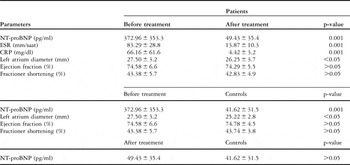
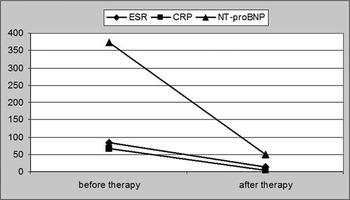
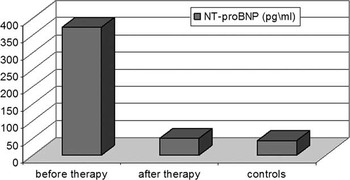
Laboratory values are shown in Table 1 and Figures 1 and 2. On day 0 (before the treatment) anti-streptolysin-O titters, erythrocyte sedimentation rate, C-reactive protein, and plasma N-terminal pro-brain natriuretic peptide levels were significantly higher in the patient group than the control group (p < 0.05).
Values in patient groups and controls.

NT-proBNP, N-terminal segment of pro-B-type natriuretic peptide; ESR: erithrocit sedimentation rate; CRP: C-reactive protein
Values of before and after therapy in patient group.

N-terminal segment of pro-B-type natriuretic peptide values, before and after therapy in patient group and controls.

The plasma prohormone levels were significantly higher in patient group before therapy than in controls (372.96 plus or minus 353.3 and 41.62 plus or minus 31.5 picograms per millilitre, respectively, p < 0.0001). Following the anti-inflammatory therapy, we found a progressive decrease, from 372.96 plus or minus 353.3 to 49.43 plus or minus 35.4 picograms per millilitre, in plasma levels. There was not a significant difference between the control group and the patient group at the end of therapy in point of plasma prohormone levels (49.43 plus or minus 35.4 and 41.62 plus or minus 31.5, respectively, p > 0.05).
Discussion
In this prospective study, we examined whether plasma concentrations of the prohormone are increased in children with rheumatic carditis. Our study is unique in evaluating longitudinal changes in these prohormone levels in children with acute rheumatic carditis. We found that the plasma levels were significantly increased compared with healthy subjects in acute stage of disease. Another important result of our study is the significant decrease of plasma N-terminal pro-brain natriuretic peptide levels following anti-inflammatory therapy. In addition, plasma levels were not statistically different among patients with and without rheumatic valvar sequela (mitral and/or aortic regurgitation) end of therapy.
Rheumatic myocarditis is usually believed to occur in the setting of pancarditis, the most severe form of rheumatic carditis, during which the rheumatic process is supposed to involve endocardium, pericardium, and myocardium. Revised guidelines10 for the diagnosis of rheumatic fever indicate that left ventricular dysfunction resulting from myocarditis, although ‘uncommon’ in the absence of severe valvular damage, ‘may contribute’ to the genesis of cardiac failure.
Aschoff nodules are the histological hallmark of rheumatic fever, and have been identified in left atrial appendages and ventricular myocardium of patients with rheumatic fever and rheumatic cardiac disease. However, the presence of Aschoff nodules in the ventricular myocardium does not signify that they play a role in the genesis of congestive cardiac failure during the acute stage of the disease.Reference Virmani and Roberts16
Cardiac natriuretic peptides, atrial natriuretic factor, and brain natriuretic peptide are polypeptide hormones secreted by the heart. An increasing number of studies shows that plasma brain natriuretic peptide and N-terminal pro-brain natriuretic peptide levels predict all-cause mortality and cardiovascular events including cardiac failure, myocardial infarction, stroke, atrial fibrillation, and cardiovascular death in stable patients with or without known cardiovascular disease and provide information about cardiovascular risk in addition to that provided by traditional risk factors.Reference Campbell17, Reference Morita, Yasue and Yoshimura18
The genetic expression and secretion of the cardiac polypeptide hormones, atrial natriuretic peptide, and brain natriuretic peptide have been studied mainly in the context of cardiac diseases associated with haemodynamic changes arising from cardiac dysfunction such as chronic congestive cardiac failure. The plasma concentrations of brain natriuretic peptide and N-terminal segment of its prohormone are increased in patients with cardiac failure, including acute myocardial infarctionReference Morita, Yasue and Yoshimura18 hypertrophic cardiomyopathy,Reference Vesely and de Bold19, Reference Ogawa, Veinot, Mercedes, Bold, Georgalis and Bold20 and myocarditis, using the experimental autoimmune myocarditis rat model, which histologically resembles human giant cell myocarditis.
Earlier data suggest that plasma brain natriuretic peptide may increase after acute myocardial infarction and chronic cardiac failure in adulthood. The cardiac natriuretic peptide system is activated after acute myocardial infarction. Morita et alReference Morita, Yasue and Yoshimura18 conclude that the plasma level of brain natriuretic peptide is increased markedly in patients with acute myocardial infarction and may reflect the degree of left ventricular dysfunction in these patients. The relationship between these natriuretic peptides and survival is believed to be based mainly on their reflection of increased left ventricular filling pressure secondary to left ventricular dysfunction.
On the other hand, an increase in circulating brain natriuretic peptide, but not atrial natriuretic factor, is observed coincident with cardiac allograft rejection that pro-inflammatory cytokines may uniquely modulate brain natriuretic peptide gene expression and secretion. The cardiac natriuretic peptides, atrial natriuretic factor, and brain natriuretic peptide are discoordinately regulated in myocardial inflammation associated with acute allograft rejection in humans and during in vitro exposure of cardiocyte cultures to some pro-inflammatory cytokines.Reference Vesely and de Bold19 Ogawa et alReference Ogawa, Veinot, Mercedes, Bold, Georgalis and Bold20 used experimental autoimmune myocarditis to determine whether the discoordinate regulation of atrial natriuretic factor and brain natriuretic peptide was specific to the situations above. They are concluded that the inflammatory process contributes specific cytokines, leading to the disregulation of cardiac atrial natriuretic factor and brain natriuretic peptide production observed during myocardial inflammation.
Recent studies in humans have found that plasma brain natriuretic peptide levels increase in the absence of haemodynamic changes with probably some pro-inflammatory cytokines in sepsis.Reference Vesely and de Bold19 Similarly, in active rheumatic carditis, the cellular infiltrates are primarily composed of T cells and macrophages are as shown by Kemeny et alReference Kemeny, Grieve, Marcus, Sareli and Zabriskie21 Kumar et alReference Kumar, Ganguly, Anand and Wahi22, Reference Kumar, Ganguly, Sethi, Anand, Verma and Wahi23 suggested that these phagocytic cells, which infiltrate the myocardium, may have a role in the pathogenesis of cardiac disease seen in patients with rheumatic cardiac disease, through the generation of oxygen-free radicals. Despite pathologic evidence of myocardial inflammation, the significance of myocarditis in children with acute rheumatic carditis remains controversial. Elevations in cardiac troponin-I have been shown in all of the other forms of myocarditis, but acute rheumatic carditis.Reference Oran, Atabek, Karaaslan, Reisli, Gültekin and Erkul24, Reference Oran, Çoban, Karaaslan, Atabek, Gürbilek and Erkul25 The fact that levels of cardiac troponin-I are not elevated in the serum of children with acute rheumatic carditis suggests that there is minimal or no myocytic necrosis in this setting.Reference Williams, Minich, Shaddy, Veasy and Tani26 This supports the concept that the major haemodynamic abnormality may be acute valvar regurgitation in these patients.
In this study, although there was no rheumatic valvar sequela in half of the patient group after therapy, plasma levels of both halves were similar. Thus, it is thought that the major cause of high plasma N-terminal prohormone levels is not only haemodynamic changes, but also the rheumatic myocardial inflamation with or without valvitis. It can be claimed that possible suboptimal haemodynamic changes, which may affect the heart, could be stimulated by the prohormone secretion in acute stage of acute rheumatic carditis.
Whatever the mechanism leading to high N-terminal prohormone levels may be, there have been a few clinical investigations supporting the hypothesis that high plasma levels of this prohormone is a marker for increased cardiovascular risk in children with acute rheumatic carditis.
In conclusion, N-terminal segment of pro-B-type natriuretic peptide appears to be regulated uniquely in the setting of a cardiac inflammatory process and plasma levels increased to different extents in the acute stage of illness. Another result of the study is that increased plasma levels due to acute rheumatic carditis are reversible. Therefore, in order to determine the diagnosis and activation of disease, it may be used as a biomarker of cardiac involvement.
Study limitations
Further prospective studies including the importance of brain natriuretic peptide levels in the follow-up and management of patients with acute rheumatic carditis are needed. Although brain natriuretic peptide levels were higher in the acute and convalescent phases of the disease, whether these parameters may be used as minor Jones criteria as diagnostic and follow-up markers like C-reactive protein and erythrocyte sedimentation rate in acute rheumatic carditis should be investigated.
Acknowledgements
This study has been supported by a research grant of “Selçuk University Research Found”. The authors thank Professor Said Bodur, MD, for assistance in the statistical analysis.