Between Lord Kitchener's appeal for men on 7 August 1914 and the introduction of conscription in 1916, 2·5 million men volunteered for service in Britain's armed forces. It was a powerful display of patriotism by Britain's citizenry. As such, the popular perception has been of a rush to colours, inspired by patriotism and a romantic view of war that was ignorant of the nature of modern warfare. Yet, this wave of volunteerism was not immediately evident in Devon. In the first month of the war, recruitment numbers in Devon were lower than was the case nationally, and remained low until early 1915. By the time enlistment numbers began to rise in Devon, they had already started to decline in most other areas of England. Part of the problem was the lack of centralized recruiting agencies in Devon. It took considerably more time to organize recruitment efforts in the county than in larger urban centres such as London. Further, within the county, there was a discrepancy between the response of the urban population and those living in the countryside and in smaller towns and villages. This discrepancy was largely due to the county's demographic nature; two-thirds of the population lived in Devon's sparsely populated rural countryside. In remote areas of north-west Devon, the recruitment campaign failed to convey the true gravity of the country's position and residents were sluggish in their responding to the war effort. Though the ‘national spirit’ slowly emerged, efforts remained underdeveloped until the end of the war in many areas. In northern and western Devon, recruiting agents were accosted by angry residents resentful of attempts to shame men into enlisting, recruiting posters were forcibly removed, and pro-conscriptionists were shouted down during public recruitment rallies. Devonians were divided on recruitment strategies and demonstrated a strong desire to negotiate the nature of their participation in the war.
While there are several national histories of the volunteer movement in Britain, there are few that examine the public's response to recruitment techniques at a local level. Both Roy Douglas and Alice Goldfarb Marquis point to considerable confusion on the part of recruiting and propaganda agencies in the first year of the war, and suggest that part of the problem with the volunteer effort stemmed from a lack of co-operation between agencies.Footnote 1 Both are, however, institutional histories, examining the role of the Parliamentary Recruiting Committee (PRC) and the national press in promoting a spirit of volunteerism among the populace. Similarly, Peter Dewey's comprehensive study of enlistment and the labour force examines factors that influenced the process of recruitment, but not the public's response.Footnote 2 This article broadens Dewey's thesis that enlistment was not necessarily determined by conceptions of patriotism, but also by economic, demographic, and institutional circumstances. It considers why rural Devonians were not only largely unresponsive, but also aggressive toward recruiting agents, and why volunteer battalions, which enjoyed considerable success in Devon's major urban centres, were unsuccessful in rural areas. More specifically it seeks to understand why Devonians were slow to respond to the call for men and why the lord lieutenant of Devon waited so long before agreeing to the formation of a civilian recruiting committee (CRC), whose sole purpose was to increase the number of volunteers in Devon. Ultimately, Devon's recruitment patterns diverged from the national trend and the demographic and geographic nature of the county stifled recruitment efforts until early 1915. This article discusses the character of the volunteer movement in Devon, the efforts of recruiting agencies, and the nature and impact of the tactics employed by recruiters between August 1914 and January 1916. It suggests that the response of potential recruits to recruitment efforts was not only guided by conflicting loyalties to their homes and nation, but was also due to employment, geography, and the failure of the local press to practise self-censorship.
I
The recruitment campaign was slow to develop in Devon. It took several weeks for the Devon PRC to be established under Hugh Fortescue and to co-ordinate the formation of the division executive committees (DECs) for the major districts and towns in the county. In Devon, these committees were not fully functioning until approximately seven weeks after the declaration of war, which was considerably longer than the three weeks required to make similar preparations in other counties.Footnote 3 The reason for the slow development of the PRC and the executive committees was that Fortescue did not believe that such committees were necessary; rather, he believed that the Devon County Council, together with district councils, could manage Devon's recruitment efforts. Devonians who wished to volunteer for military service would report to the Higher Street barracks, or other barracks throughout the county, and the military authorities would handle recruitment policies and procedures in conjunction with district councils.Footnote 4 When the committees were eventually formed, the Devon PRC organized and oversaw the DECs, whose primary role it was to manage enlistment numbers in the county. Ralph Buller Hughes (known as Hughes-Buller) was appointed regional director of recruiting in mid-August 1914 and was put in charge of overseeing Devon's recruiting efforts.
The declaration of war brought into question the ability of the small British Expeditionary Force (BEF) to offer assistance to France on the continent. The task of raising a citizen army fell to Field Marshal Lord Kitchener, appointed secretary of state for war in August 1914. Kitchener acted on the assumption that the war would be prolonged, possibly three years, and determined that if the BEF was to be effective in France, an additional one million men were required.Footnote 5 However, until the end of September 1914, the mechanisms for recruitment and propaganda were largely absent in Devon. While the recruiting committees were being established, the promotion of the war was left in the hands of various organizations. The most immediate response came from the Devon branch of the National Service League (NSL), which was represented by Col. M. W. Skinner. To aid Kitchener's efforts, the NSL made several appeals in the press and at local rallies for able-bodied men between the ages of sixteen and thirty to join the regular army, rather than the Devonshire Territorials. The reason for the distinction was that Kitchener felt that territorial units were untrained, unprofessional, and had an ‘amateur spirit which he regarded as incurable’. Accordingly, he believed that it was best to dedicate territorial units to home service, and to raise a new army of volunteers.Footnote 6
In Devon, initial results to Kitchener's call were mediocre and there was no immediate rush. Rallies organized by the NSL were not well attended and reports from the League suggested that the demonstrations had little impact on the population. W. J. Reader has noted that, following the declaration of war, men flocked to recruiting stations, whether volunteering or compelled, and recruiting stations quickly became a ‘seething mass’ of men wanting to enlist.Footnote 7 While enlistment figures appear to support Reader's conclusion, Niall Ferguson has questioned the extent to which volunteer numbers are evidence of enthusiasm. Rather than agreeing with Reader's assessment, Ferguson suggests that a more critical evaluation of the volunteer movement ‘qualifies, if it does not wholly refute, the thesis of mass bellicosity’.Footnote 8 This certainly seemed to be the case in Devon where the recruiting campaign did not began to take shape until the end of August 1914 and although information was made available to potential recruits at local postal offices and military depots, recruiting stations were slow to appear, particularly outside Exeter and Plymouth. Furthermore, the number of recruiting officers was limited in north and west Devon. In the northern town of Okehampton, only one recruiting officer had been appointed by 10 October and residents in the town of Clovelly and neighbouring areas had to travel to Okehampton or other centres to enlist. This was generally the case in Devon's rural areas, particularly in the north, where men had to walk long distances to recruiting stations often to find no recruiting agent available on arrival.
In the opening weeks of the war, another major problem with the recruitment effort in Devon was a lack of co-operation between the NSL and the local press. Calls for men were printed in Devon's newspapers, but the press was initially uncommitted to recruitment efforts. Instead, front pages were confined to military reports, news from the continent, and parliamentary actions taken by Asquith's government. ‘Calls for Men’ were generally to be found in short, obscure articles located in the final pages of Devon newspapers.
The fact is that the urgency of the war was not felt immediately. The agreement of the press to self-censor meant that the press reported little negative news from the continent. On 5 August 1914, all the major newspapers in Devon ran headlines ‘Britain declares war!’ and, over the next several days, reported on the celebrations in London and the influx of young men to recruiting stations. Reports of singing and celebrations in Devon were, however, largely absent. From available sources, it is evident that, on the day following the declaration of war, the mood in the county was quiet. Beatrix Cresswell, a local author, set the scene in her diary where she noted that citizens ‘gathered in small numbers outside town halls, at local restaurants, and at parish churches waiting for news, but there were few celebrations’.Footnote 9 William Huntley recorded in his war diary that he went to the ‘town hall to see what was going on. There was a crowd of about twenty people all waiting for the Mayor. When he came out he told us that after the most careful attempts at negotiation England declared war on Germany and that information would soon be made available.’Footnote 10 At town halls and community gatherings, men inquired about pay scales, the length of service, and the frequency of leaves. As elsewhere in the country, Devonians were anxious and apprehensive about leaving their local communities for military service.Footnote 11
In response, Fortescue made a plea to Devon's newspaper proprietors to assist the war effort by encouraging enlistment.Footnote 12 On 25 August, Fortescue's plea appeared in The Hartland and West Country Chronicle. The statement read,
At this time when every effort is being made to induce all able bodied young men to enlist, may I plead that the people of Devon answer the call to arms and that the newspapers aid in this venture by assisting recruiting agents and the Devon County Council in our efforts to meet Lord Kitchener's call for 100,000 men.Footnote 13
Fortescue's letter did not, however, appear in the Exeter Flying Post, the Express and Echo, or the Western Morning News, three of Devon's most widely circulated newspapers. The owners of the newspapers censored recruiting advertisements and many of the calls for enlistment made by the NSL and the Devon PRC were omitted. Explanation for the lack of publicity given to Fortescue's plea might derive from pre-war hostility between the press and Fortescue over complaints about housing and working conditions in Devon. Both the Exeter Flying Post and the Express and Echo had publicly criticized the Devon County Council for not appropriating sufficient funding for housing and sanitation reforms. In response, Fortescue had criticized the press for their ‘poor form’ and indifference to the efforts put forward by the local government.Footnote 14 Possibly some newspapers chose not to include Fortescue's address due to pre-existing tensions.
Until the end of August, Devon's newspapers focused on stories about troop training, Britain's leaders, and the ‘good’ relationship between Britain and its allies. It was, however, The Times's report on the British retreat at Mons that had a startling impact on enlistment numbers. The paper reported that the battle of Mons ‘has so far gone ill for the Allies’ and ‘we fear that more [bad news] must follow’.Footnote 15 A few days later the ‘Amiens dispatch’ appeared in The Times and called the BEF a ‘broken army’ unprepared for the enemy's resolve. The report ended with a melancholic cry that the BEF ‘needs men, men and yet more men’.Footnote 16 Peter Simkins argues that the article shocked those at home and enlistment numbers dramatically rose, first in London and then at recruiting stations throughout Britain.Footnote 17 In Devon, news of the defeat at Mons appeared the next day, but the response was more mixed. By the end of August, Plymouth was swarming with regular and territorial soldiers, so much so that many areas of the city were cordoned off. In Exeter, there was a dramatic rise in recruitment numbers as men volunteered to serve with the Devonshire Territorials and the Devonshire Regiment. But, in outlying communities, the response was more reserved. In the villages of Okehampton, Marwood, North Molton, and Clovelly the war was hardly noticeable. Few men appeared in uniform, recruiting stations and agents were sparse, and recruiting posters were largely absent until early October.
The town councils established recruiting committees to arrange rallies and to ensure participation of a local recruiting agent, church representatives, the mayor, as well as for live music and snacks for children. Rallies not only encouraged young men to enlist, but also made direct appeals for women to make sacrifices for their country and for all able children to participate where possible. At a rally in the Newton District, Captain Phillpotts asked the people of Newton Abbot to
look upon our allies across the sea and see how their countries have been devastated, their homes burned and their women and children slaughtered. It is the duty of every man to protect his King, Country, wife and child. Women of Newton Abbot, we ask that you don't hold your men to their homes, but encourage them to offer their service and join a Rifle Corps or the Royal Navy.
Although the rally was well attended, of the 600 people present from Newton Abbot and the surrounding district, only twelve volunteered for service.Footnote 18
Local businesses also participated in the recruiting campaign and some men felt pressure from their employers to enlist.Footnote 19 Fraser's Insurance Company, for example, rewarded men who enlisted with a £1 bonus, the Shell Oil Company offered employees a £2 bonus, and the John Heathcoat and Co. Ltd and the Devon Clay Company sought to convince men to enlist by promising that they could return to their jobs when the war was over. Some, like John Heathcoat's lace manufacturers, owned by Sir Ian Murry Heathcoat-Amory, also gave small bonuses to families of men who volunteered for service.Footnote 20 The Great Western Railway Magazine also contributed to the county's recruitment efforts by printing stories about men who had volunteered, as well as thanking their families and communities for supporting the national effort. By the end of the war 3,587 men, more than 30 per cent of the staff employed at the commencement of the war, were serving with the armed forces.Footnote 21
Despite the best efforts of the NSL and local businesses to promote enlistment, recruitment percentages for the county remained low. Without a co-ordinated effort to manage the county's recruitment campaign, efforts were disjointed and lacked the necessary commitment from Devon's local leaders. The scarcity of recruiting depots and agents, particularly in northern and central Devon, as well as a lack of information about the war, meant that the true gravity of the situation was not adequately impressed upon the population and many men, rather than leaving their families and loved ones, chose to remain at home.
II
In late September 1914, the PRC and the district divisions became operational and, by the beginning of October, the number of recruiting stations had increased and recruiting agents began to visit rural districts to encourage enlistment. District committees were encouraged to make appeals specific to various counties and to increase the number of recruiting agents in places where recruitment numbers were low. At a town meeting in Tavistock, the DEC made a ‘Call to Devon’ at a rally of approximately 300 people. Fortescue attended and told the people of Tavistock that ‘it was very much to be regretted that our representative bodies had not been more successful in stimulating recruiting’.Footnote 22 Fortescue did not subscribe to the short-war illusion; rather, he believed that the county's efforts were lacking because the severity of the situation was not fully appreciated by Devonians:
Our Ministers have told us that this country was fighting for its existence. But this does not seem to make an impression on the people of Devon. Possibly one reason for the lack of enthusiasm is that the newspapers have failed to report on the dismal numbers for this county. We are not going to win the war by simply holding ground or by making progress to the extent of 50 yards in one place or 200 in another on such an extensive front. If we are going to win – and defeat is something that we absolutely refuse to contemplate – we must carry the war into the enemy's country. It is an undignified – some might say cowardly – attitude for a county like this to say that we are content to mark time and to enter hereafter into the fruits of victory gained by other people who had made greater exertions and sacrifices than we were prepared to make … We must not be afraid. Instead we must do our duty.Footnote 23
In conjunction with Fortescue's efforts, the PRC distributed a seven-page pamphlet entitled ‘Men of Devon’ throughout the county and made a specific appeal to Devonians:
In past time, England has often called to her men for help, and the Men of Devon have never been deaf to her call. They sailed with Drake against the Armada, they went with Marlbourough into Flanders, with Wellington to the Peninsula and Waterloo, with Roberts to Afghanistan, and with Buller to Africa. Wherever in the world their country has wanted them. Men of Devon have ever been to the fore.
But, Men of Devon! – your country never needed you more than she needs you now. Never in all the mighty story of the English people has the Motherland been faced by a more tremendous task or threatened with dangers so terrible.Footnote 24
The League also called attention to the long history of the Buller family in Devon and asked Devonians to ‘not disappoint Mr. Hughes-Buller, Director of Recruiting For Devon. His family has successfully served this nation in the past and he is here to carry on the noble tradition of service to King and Country.’Footnote 25 Major-General Laye held a similar rally in Dawlish where he told citizens that ‘Devonians are too content here away from the war in the sunshine and quietude of lovely Devon, they hardly realise the seriousness of the situation.’Footnote 26
The pleas of recruiting agents had little effect, especially in rural areas. In the sparsely populated countryside, there were no large recruitment rallies or military parades to infuse the public with a sense of enthusiasm. Instead, representatives of the NSL visited local farms and harassed men of military age, goading them into enlisting by questioning their patriotism. They also visited door-to-door, often during dinner hours when men were sure to be home, intruding into the private sphere of the family in ways that many Devonians found distasteful.Footnote 27 Devon County Council records show that, in Tiverton and Stoke Cannon, recruiting agents who visited door-to-door were largely ignored. In a letter to the Devon County Council, Wilber Mason of Stoke Cannon expressed his frustration that, every morning for more than a week, there were two recruiting officers looking for his sons. The same agents also harassed his neighbour, who was a widow with two sons of military age. Both families were distressed by the war, but claimed that the situation was exacerbated by the presence of agents in their homes and communities.Footnote 28 The Council, however, took no action; instead, recruitment efforts for the county were intensified and recruiting agents became permanent fixtures in most communities.Footnote 29
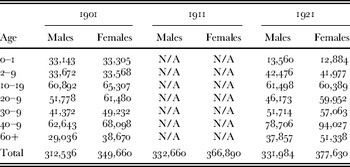
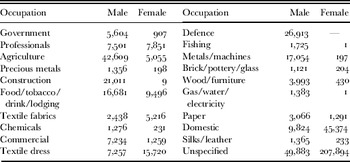
In mid-October, the NSL, with the support of the PRC, launched a press campaign that compared the response of Devonians to the war with the response of other counties in the West Country. A letter from Colonel Symesis was printed in the Western Morning News entitled ‘Unpatriotic Devon’. The article made specific reference to recruiting numbers in the region and a comparison with the county of Dorset revealed the poor response of Devonians. In 1911, Dorset had a population of 223,266 and in the first two months of the war had recruited 1,800 men. By comparison, the population of Devon was 662,196 and for the same period, Devon had recruited only 1,200 men. The article was quick to place blame, observing that, of the 1,200 recruits, slightly less than 20 per cent were from the working class. The article also pointed out that in the county of Cornwall, which had a population of 328,098, the number of recruits was more than 2,500 for the same period.Footnote 30Table 1 shows the population breakdown of Devon by age group and gender and reveals that, prior to the war, approximately 14 per cent of the male population of Devon was between the ages of twenty and thirty-nine. Table 2 reveals that a significant proportion of Devon's population worked in agriculture, defence, construction, and unspecified occupations.Footnote 31 The census shows that more than 15,000 of the men employed in agriculture were unskilled labourers and that more than 24,000 of the men employed in defence were ‘men of the army, navy or marines’, which excluded officers. Existing recruitment records show that, in the opening months of the war, the groups most represented in terms of volunteers were construction workers (largest showing from Exeter and Plymouth), railway workers (fairly even distribution throughout south Devon), the service sector, dockworkers (HM Dockyard, south Devon), miners (central Devon), fishermen (south Devon), university students, and those employed in tourism (north and south Devon). Agriculture and forestry were noticeably absent in the early stages of the war, as were the fisheries and shipbuilding industries in north Devon. The absence of the last two groups is understandable given that the major trading period in the north was between March and November (it was more spread out in the south), and the peak of activity was in August. Furthermore, these industries had been in a state of decline since the mid-nineteenth century and, although they experienced a temporary revival during the war, families in these areas were dependent on a relatively small pool of male labourers.Footnote 32 Dockworkers were prominent among early recruits, but the importance of the Devon dockyards during the war, both for imports and the construction of battleships, meant that such men were discouraged from enlisting and were later protected against conscription under the ‘Dockyard Umbrella’. Further, low numbers from agriculture, the largest industry in Devon, can partly be explained by the fact that the 1914 harvest had been particularly plentiful, and since the county had considerably more land under crop than Dorset, Somerset, and Cornwall, it required a substantially larger labour force. The change of landownership in the fifty years prior to the war provides further explanation. While large landowning estates survived, increasing debt and falling land prices led to an increasing number of landowners selling off their land. On the eve of the war, there were a greater number of owner-occupiers with farms of between 200 and 250 acres, which were primarily family-run or employed a small labour force.Footnote 33 Such farms were most susceptible to declining labour supplies, and in an effort to maintain their skilled workforce, Devon's farmers were willing to offer monetary incentives to young men who remained at home.Footnote 34 Devon's farmers believed that if they could stave off initial labour shortages, the war would be over and the repercussions would be less severe. The farmers' willingness to offer monetary incentives paid off and recruitment numbers among agricultural labourers remained low until mid-1915.
Population of Devon by age and gender, 1901, 1911, and 1921

Source: Census of England and Wales, County Series, Devon, 1901, p. 61; Census of England and Wales, 1911, p. 64; Census of England and Wales, County Series, Devon, 1921, p. xii.
Occupational structure of Devon by gender, 1911

Source: Census of England and Wales, occupations and industries, 1911, pp. 160–3.
The response of Devon's agricultural community was not exceptional. In rural Essex, Reverend Andrew Clark noted that farm-hands were underrepresented in terms of volunteers, as were farmers' sons, and in Norfolk slow recruitment numbers were initially blamed on the harvest, which consumed the energies of the agricultural community. It was also reported that rural districts tended to be undermanned in terms of recruiting stations, which may help to explain the lack of volunteers in rural districts. Similar concerns about the perceived indifference of agricultural labourers were also voiced in France and the Rhineland and Westphalia. For example, Jean-Jacques Becker's study of France notes a lack of enthusiastic patriotism among rural workers, but also notes that their lack of enthusiasm did not necessarily denote defeatism. Becker argues that rural communities were not unsympathetic to the national crisis; rather, he suggests that local concerns about labour, supplies, and the difficulties of daily living, at times, superseded appeals to patriotism.Footnote 35
Following publication of the labour officer's report, many Devonians expressed shock at the county's lack of commitment to the war effort. In a letter to Fortescue, W. H. Bolt desired to know if ‘these figures relating to Devon recruiting (a reflection on the County's Patriotism) are correct? I can hardly believe it and if wrong could you please make the necessary correction’.Footnote 36 Similar letters appeared in local newspapers asking the editors to investigate and report on the ‘real’ recruiting numbers for the county. A letter to the Teignmouth Post read: ‘The numbers published in the Western Morning News should be of great concern to us all and I for one would like to know where the numbers came from and if they are real or accurate.’Footnote 37 In the Western Express and Torrington Chronicle, ‘an Optimist’ noted that he had ‘served my country for thirty years and I am astonished that Devon has been so poorly represented. If the numbers are true then I appeal to the local residents to let their actions speak for them. It is our duty as Englishmen to help each other.’Footnote 38 In response, the Western Morning News and the Western Independent reported similar numbers to those released by Colonel Symesis. Both papers reported that 800 men from Devon enlisted in the armed forces in the first month of the war and another 600 for September and October. The numbers were provided by the PRC, but were not entirely accurate. Fortescue's records show that approximately 1,000 men enlisted in the Devonshire Territorials and the Devonshire Regiment in the first week of the war and by mid-September the records demonstrated that approximately 200 men per day had reported to the Higher Street Barracks for enlistment. Approximately 30 per cent of these men were, however, enlisting for home service and another 20 per cent were rejected as medically unfit.Footnote 39 A report in early October 1914 by the PRC explained that although more than 1,200 men had come forward, the ‘discrepancy was necessary to encourage enlistment. Like the vast majority of our countrymen I feel and deplore the horrors of war, but where circumstances arise, (as in the present crisis) when the nation is at stake, I most heartedly and aggressively must proceed with what is needed.’Footnote 40 The inconsistency in recruitment numbers is simply due to presentation. The PRC was only reporting enlistees who had been found medically fit and were enlisted for foreign service in the regular army. The numbers presented in the Fortescue papers were raw numbers of potential recruits for the county, as opposed to the number of actual enlistees. It is also important to note that in Dorset and Cornwall the numbers provided were the total numbers that had come forward, rather than the total numbers accepted.
While recruiting rallies provided a venue for Devonians to express their patriotism, letters to newspapers and personal correspondence allude to a slightly different response: one that was defensive yet patriotic. These letters suggest that there was eagerness on the part of Devonians publicly to explain their so-called ‘lack of patriotism’. In a letter entitled ‘Failure of military authorities’, for example, James Walken blamed the military authorities for the poor recruitment numbers in Devon: ‘Everyday the Times has reports about the Germans and the need for men, but has there been any kind of propaganda for the counties? NO! People treat the war as a joke, it will soon be over they say.’Footnote 41 Other letters suggested to the NSL that the problem was not a lack of patriotism among Devonians, but rather that ‘Englishmen are over-confident. They say, “We have the Royal Navy and until it is defeated the Germans cannot land on this Island”.’Footnote 42 Many believed that participation beyond the efforts of the Royal Navy was unnecessary. Further, Devon had traditionally been a recruiting ground for the Royal Navy which explains some men's reluctance to join the army. Gerald Wasley explains that, in August 1914, the Royal Navy was, in many ways, already mobilized for war due to the Royal Spithead Review. The fleet had been engaged in naval exercises and, in light of the political situation in Europe, had not been discharged or granted leave. With such a strong naval tradition, it is unsurprising that many Devonians were confident in the navy's ability to protect Britain's shores.Footnote 43
In an attempt to encourage enlistment and increase enthusiasm for the war, the government introduced ‘Pals battalions’. Men who grew up together would serve together, thus reinforcing both community and regimental loyalty. Bonds created in the workplace or during recreation provided a basis for solidarity that was considered to be one of the army's greatest strengths. The largest groups to come forward were from commercial, banking, and professional backgrounds and were most successful in Britain's northern industrial areas.Footnote 44 As such, it is unsurprising that the two city battalions raised in Devon were specifically middle class. Class affiliation, sporting association, and school background mobilized loyalties among the men.Footnote 45 The city battalions, based on a similar premise as the Pals, were not only recruited in specific areas, but many also remained in those areas for training, and some were able to return home on weekends or in evenings. The purpose was to keep men visible and connected to their home communities to encourage friends, neighbours, and family members to enlist. In Plymouth, men were trained within the city limits and training and marching exercises were frequent in the city's streets. The ‘marching of the Pals’ was a public spectacle and this combination of national and local recruiting efforts allowed the recruitment system to extend far beyond the limits of central authority in London. Local groups were able to appeal specifically to local residents. In Plymouth and Exeter, city battalions had considerable success. Residents lined streets to watch and children followed behind, mimicking the soldiers. Local men marching and training together reinforced the traditions and honour of the army and helped encourage enlistment within Devon's larger towns.
John Stevenson argues that, in some areas of Britain, even the smallest community was able to raise an entire battalion. This was possible due to strong social networks that existed in rural areas. Work, schools, churches, and leisure activities helped to prevent social isolation and aided in the development of community bonds and identities, the primary appeal of groups like the ‘Pals’.Footnote 46 Since approximately 420,000 of Devon's 662,196 residents lived outside Plymouth and Exeter, it would be expected that volunteer battalions would have had a powerful impact on rural areas.Footnote 47 However, the strong opposition to recruitment and propaganda techniques in Devon's rural areas, particularly in northern and western regions, may have undermined the appeal of such groups. Communities in north and central Devon were small, close-knit communities, generally centred on a particular industry such as mining, fishing, or shipbuilding. The dangerous nature of such work contributed to the strengthening of community bonds and made residents acutely aware of the economic and social concerns of their neighbours. Certainly parish and church committees played an important role in promoting common interests and developing a sense of community identity, but the half-hearted response of many churches, particularly Nonconformist, to recruiting, may have prevented recruiting agents from accessing potential recruits. In the fifty years prior to the war, there was a large and growing number of Nonconformists in north and central Devon. Wesleyan Methodism was generally confined to the working classes, but not entirely, and tended to be most dominant in the mining and agricultural communities of central and northern Devon. In the West Country the largest gathering of Baptists was in Devon, who were recorded in all twenty of Devon's registration districts in 1852.Footnote 48 Although Nonconformists generally supported the war, there was more opposition among Methodists and Baptists in Devon than was evident within the Established Church. A considerable number of Anglican clergy were willing to use church grounds as auxiliary recruiting stations and many ministers were comfortable using the pulpit to promote the war, encourage enlistment, and warn against cowardice.Footnote 49 Conversely, Methodist and Baptist clergymen were more cautious not to interfere with liberty of conscience, a primary justification for their continued separation from the Established Church, and many refused to promote the war in their churches. There were also a number of Methodist and Baptist clergy who opposed British involvement in the war and encouraged parishioners to pray for a return to peace.Footnote 50
The growing influence of Nonconformity in north Devon meshed well with the continued strength of Liberal politics in that region. Between 1886 and 1906, Devon was divided between Liberals and Unionists; Liberal strength was in the north where the appeal of Nonconformity grew throughout the nineteenth century, and Unionism dominated in the south where the Established Church maintained its stronghold, despite advances by Catholicism. The central state had little authority over the lives of the general public, and north and central Devon, isolated from the south due to poor road and rail networks,Footnote 51 and facing a dramatic decline in the fishing, shipbuilding, and mining industries, was more susceptible to local, rather than county or national interests. Although the Conservatives won eleven of thirteen seats in the December 1910 election, two liberals, George Lambert of South Molton and Sir Geoffrey Baring of Barnstaple, represented north Devon. Neither could be described as ‘New Liberals’, and both men's election campaigns had been based on old values of ‘peace, retrenchment, and reform’.Footnote 52 In north Devon, a Liberal victory was unsurprising given the growing influence of Nonconformity, the decline of large landowning families, and the presence of small tenant farmers.
Further explanation for the lack of local interest in volunteer battalions was that, unlike in Manchester, Liverpool, and Birmingham where the local press participated in promoting the formation of groups like the Pals, they were hardly mentioned except in the Exeter and Plymouth newspapers. In fact, the response of smaller newspapers was less than enthusiastic. The Launceston Weekly News described the Pals as an ‘adolescent mockery of the BEF’.Footnote 53 Likewise, a man from Hartland wrote to the Hartland and West Country Chronicle that ‘the Pals Battalions are a half-hearted effort to put the BEF in France. In Plymouth the Pals are marched through the streets to encourage enlistment, but they have no uniforms, no band. They whistle along like some phantom army’.Footnote 54 In Devon, most new volunteers did not have uniforms; instead they wore matching colours and marched without rifles. Due to incentives from employers, many men who worked in textiles enlisted in the armed forces creating a temporary shortage of workers, and uniforms and supplies were then imported into the county. However, due to a series of train accidents in October and November 1914, also the result of insufficient labour, uniforms and supplies being shipped to Devon were destroyed causing further delays.Footnote 55 Meanwhile, some residents took occasion to mock men who appeared during marching drills without a uniform. For some young men, the ‘Pals’ were an ‘oddity of sorts. Untrained men marching together in an effort to convince the Germans that they are soldiers.’Footnote 56 The image of soldiers marching without uniforms did little to inspire confidence in Britain's army and did even less to convince men to enlist. Furthermore, John Hartigan's study of Pals battalions in Birmingham notes that, over time, appeals to group dynamics, which was an important component of the Pals, ‘may have provided more of an opportunity to shame men into enlisting than providing the means by which they could volunteer more easily’.Footnote 57 This ‘manipulation’, as Hartigan terms it, may have undermined the intended effects of the group movement.
Resistance to recruitment strategies was not confined to volunteer battalions and reports from recruiting agents across the county indicated that their efforts were met with resistance. The recruiting officer for north Devon, Colonel Alexander, reported that the poster campaign was a
complete failure. I continue to have difficulty in getting recruiting posters put up in the towns. In September and October posters were placed at the post offices, town halls, local restaurants and pubs, but soon after they were affixed they were torn down. I have recently gone around and no posters remain in Okehampton, Barnstaple or Ilfracombe. The depot has been repeatedly vandalized and residents are hostile to my efforts.
He also noted that private businesses were offering to attach posters, but were requesting a small fee: ‘It is difficult to believe, but apparently patriotism is not free in Devon.’ Colonel Alexander's report stated that if the War Office wished posters to be placed in north Devon he would need further assistance from the PRC ‘for more posters and for people to affix them weekly. It is my opinion that such efforts would be wasted.’Footnote 58 Similarly, in the town of Newton Abbot the recruiting officer reported that groups of young boys were vandalizing recruiting depots and buildings that bore recruiting posters, whilst in Okehampton and Tavistock ‘recruiting agents have been the recipients of the most foul criticisms’.Footnote 59 In August 1915, Charles Sprague of the DEC in Tavistock reported, ‘I have spent considerable time trying to understand how to reach the people of Tavistock. Since the commencement of the war I have not had much success as apparently no authoritative body can compel these men to come forward.’Footnote 60 Reports from Salterton, Tiverton, and Chudleigh revealed comparable circumstances. At a recruiting rally in Salterton in June 1915, less than fifty people attended and at the rally in Tiverton, the recruiting officer was heckled by several men in the audience who shouted at him demanding to know ‘What keeps you from France?’.Footnote 61
Throughout Devon, the recruitment campaign attracted criticism and during the first half of 1915 some residents did not believe that the situation required action. One young man, in a letter to Fortescue, described his feelings about the war:
In Abbots Clayton it is commonly understood that there is a war going on somewhere. Many believe that the county is actually involved in it … The truth is that we cannot imagine Abbots Clayton as part of England, and England as part of the British Empire … Why don't the men go to war? … If they want me, why don't they come and fetch me?Footnote 62
In the same month the 3rd Battalion Devon's began its campaign around the county visiting communities in north Devon. They passed through Yeoford, Colebrooke, Witherridge, and South Molton, and even though their marches were well planned and announced in the local press, few supporters met them and even fewer enlisted. At Beaford and Langtree, children excitedly greeted the soldiers and dinners were held in support of the troops as they made emotional appeals to the men from these towns, as well as to the men of Stubbs Cross and Shebbear. Although some came forward, the public's response was ultimately unsatisfactory. What is particularly revealing was that the Western Morning News reporter who accompanied the soldiers on their marches reported that the young men from such communities appeared indifferent. At one farm, the labourers called out that they would only go ‘when the farmers sons go’ and another stated, ‘We will stay at home and do the farming, let others do the fighting.’ According to this reporter, the most common response to requests for volunteers was ‘I'll go when compelled’ or as another young man stated, ‘When the Germans come we will join the Army’. In the end, the Devon's did not achieve the results they sought and after six days of marching on the poor roads of north Devon, they returned to Exeter with only fifty-four additional recruits.Footnote 63
III
Changes to the propaganda campaign in Devon were necessitated not only by public hostility, but also by the war itself. Between September 1914 and February 1915, the Devonshire Regiment sustained high casualties. At the end of October, the 2nd Battalion had been without rest for over a month and with more than a hundred losses in the first two months of the war, Fortescue was anxious to encourage replacements. To do so, he decided to support the formation of a civilian committee to manage public opinion by way of a centralized agency for propaganda in Devon. A civilian recruiting agency had been suggested in November 1914, but was dismissed when it failed to receive support from Fortescue or the Devon County Council. The mayor of Exeter reported that ‘residents are already upset by the appearance of recruiting agents in their towns. It is important to push, but gently’.Footnote 64 For his part, Fortescue believed that, although the men of Devon were hesitant, they ‘will not put the future of this nation at risk. The severity of the war has not yet settled in, but when it does our recruiting depots will be overwhelmed by men volunteering to defend her.’ Fortescue's ‘wait and see’ policy was met with strong opposition from the town councils of Okehampton, Sidmouth, South Hams, and Bideford whose mayors believed that a CRC was essential to the war effort. Not only was recruitment low in these areas, but war societies and charity organizations were also slow to emerge. Despite protests, the issue was dropped and was not revisited until January 1915. In February 1915, a CRC was established under the PRC and operated in conjunction with the military authorities. Its primary objective was to promote enlistment by managing the morale of the civilian population and four CRCs were put into operation in Devon during the war. The committees were regional and operated in the north, south, east, and west and each was made up of civilians. The message of the committee was simple: an appeal to patriotism, to ‘Rally round the Flag’, and the tirelessly repeated, ‘Your Country needs YOU.’Footnote 65
In March 1915, the CRC launched a new poster campaign. Posters had been used since the beginning of the war, but the committee determined that earlier campaigns, comprised of uninteresting letterpress posters, had been unsuccessful, and in some places had a negative effect on public opinion. The new campaign focused on posters with daring imagery and a straightforward message. Between July and August 1915, 2,000 copies of Kitchener's ‘Does the call of duty find no response in you until reinforced … by the call of compulsion?’ were distributed throughout Devon's towns and villages.Footnote 66 The continuation of the war beyond Christmas 1914 led many Devonians to reconsider their participation in the war effort and by January 1915, the propaganda campaign gathered momentum. The revamped poster campaign was successful in visualizing the need for men in urban areas and, by March, recruitment numbers for the county began to increase steadily. In the countryside, the poster campaign made slow but steady progress, and by mid-1915 affixed posters had a longer life expectancy than in 1914. The poster campaign in Britain ran for just over a year and produced 6·7 million posters, but its sheer volume should not conceal the complexities of wartime recruiting.Footnote 67
The increased participation of the local press in the propaganda campaign aided the efforts of Devon's recruiting agents. On 7 May 1915, a German submarine sank the Lusitania drowning 1,198 people off the south coast of Ireland. Unlike the German attack on Belgium, carried out against a foreign people on foreign land, this attack involved British civilians whose bodies washed up on British shores. Growing levels of hostility and acts of vandalism spurred by the sinking of the Lusitania were also partly the result of the real or imagined relationship between Britain and its colonies and dominions. Among the Lusitania's victims were Canadian and American citizens with ties to Britain, including many women and children. Nicoletta Gullace notes that, among the shock and distress that followed from the sinking of the Lusitania, ‘the boundaries between kinship and fictional kinship became blurred’.Footnote 68 Devonians ‘from all classes and categories’ called for immediate steps to be taken for the removal of German residents in the county.Footnote 69 An internment camp was established on Dartmoor to house non-naturalized, adult male German aliens. Although many German residents gave themselves up to the authorities, the process was slow. In the meantime, the newly revealed ‘threat’ posed by German civilians created a sense of panic. In May 1915, Devonians called for the formation of a Devon Volunteer Regiment to assist the authorities in arresting and interning enemy aliens. The volunteer movement was not confined to the cities, and across Devon, thirty-one volunteer units were formed.Footnote 70
Ian Beckett and Keith Simpson observe that increased numbers for the Territorials in the spring and summer of 1915 was unsurprising, given that the campaign was loosely based on Lord Derby's model, which had also enjoyed limited success in Devon. In comparison with the New Armies, the Territorial Forces were less likely to go abroad and would only be called for foreign service when absolutely necessary. Although these men were volunteers, there was some confusion as to their role. Prior to March 1915, men could make the distinction between home and imperial service, the majority of whom chose home service.Footnote 71 Many of the volunteers from Devon remained in the county (or the United Kingdom), and were generally responsible for home defence, with the perception that they were a home force. Those who stayed in the county and were employed in essential industries often remained in their home communities and in their current occupations. A number of the men who came forward in the spring of 1915 were from the dockyards, railways, and the fishing communities of north Devon, the majority of whom would have remained at home. Territorial forces like the 1/7th Cyclist battalion were formed and expanded in response to local concerns, such as fear of enemy invasion, centred around town loyalties (a land force that complemented the county's long naval traditions), and were maintained by the county's infrastructure. In the pre-war period, the growth of Cyclist battalions, and the Territorials generally, was partly the work of the Fortescues. Fortescue, like his father before him, was involved in and supported the Territorials, and believed that they could play an important role in the war. The lord lieutenant was an hon. col. of the North Devon Yeomanry Cavalry and was disappointed that volunteer numbers for the Territorials had been lacking in the opening months of the war. Despite Kitchener's exclusion of the Territorials as a component of the New Army, Fortescue encouraged Devonians to join the Territorials and made several appeals in local newspapers stressing the value of such units. As Kitchener predicted, the Territorials shared a local outlook and were motivated to join from local patriotism, and perhaps even local rivalries. Several of Devon's Territorial forces also remained in Britain and reinforced the belief that the Territorials were a home force. The 1/7th Cyclist battalion, for example, remained in Devon throughout the war patrolling the south coast and the Scout Cycling Programme, a training programme for middle-class youths between the ages of fourteen and seventeen, was organized in response to pre-war fears of invasion and expanded due to wartime concerns about coastal security.Footnote 72 Further, not all who volunteered for home service were fit to serve overseas, and were instead employed as special constables.Footnote 73 These men were often given the difficult task of recruiting outside the major centres, and for foreign service.Footnote 74
Despite confusion regarding the territorial forces, the sinking of the Lusitania dramatically increased anti-German sentiment in the county. In June 1915, the Plymouth Volunteer Battalion was formed, and in late May the Plymouth Rifle Club created the Scouts: a volunteer organization that patrolled coastal areas.Footnote 75 The Scouts were comprised of older men, above the age of military service, who, armed with a rifle, and often a dog, volunteered to ‘stand guard’. The Scouts described themselves as Britain's ‘last line of defence. We will hold this land until the Empire can come to our aid.’Footnote 76 Gisela Lebzelter argues that the ‘myth of a hidden hand’ – that German spies were promoting pacifist propaganda, causing food shortages, and ‘manipulating international finance’ against British interests – led to expressions of anti-Germanism across Britain.Footnote 77 In response, the Anti-German League, formed in April 1915, became more visible in mid-May.Footnote 78 The formation of an Anti-German League in Exeter in June 1915 sought to remind Devonians of the ‘killing of defenceless women, the butchering of non-combatants, the wanton destruction of cities, the killing of our soldiers after having surrendered, and the laughing Hun whilst their victims drown’. The League asked Devonians to keep in mind that ‘We are fighting an enemy unscrupulous in warfare and who will be equally so in commerce when the war is over.’Footnote 79 Likewise, the All-British Women's League of Devon promoted a ‘Britain for the British’ and stressed that it was not sufficient to sing patriotic songs, but ‘we must go further and put our principles into practice’. If every British woman would ‘realise that it is shameful and treacherous to give financial help to the Germans by buying German goods, we would be able to take back this country’.Footnote 80 By mid-1915, the success of the propaganda campaign in Devon, now embraced by the newspapers, found new expression as Devonians became actively engaged in the promotion of the war.
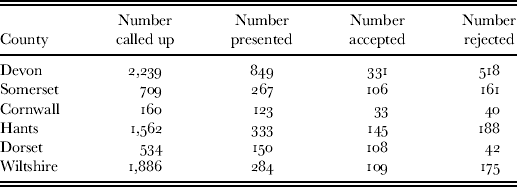
The intended message of recruiting propaganda was to equate Britishness with nobility of action. In a letter to the editor of the Western Morning News, Charles Jerram wrote that ‘I applaud the voluntary system and the desire of Roberts to maintain the traditions of this country by calling on men to do their duty. Recruiting officers are doing their best and I believe that the voluntary system will be sufficient to meet the military needs of the country.’Footnote 81 By June 1915, enlistment numbers for Devon rebounded. Table 3 shows recruitment numbers for Devon as compared to other counties between March and June 1915.
Western recruiting from April to June 1915
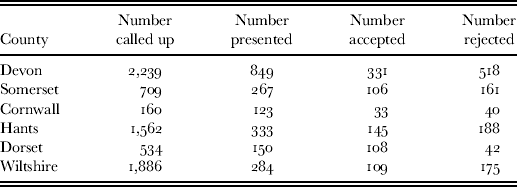
Source: Western recruiting report, June 1915, DRO, 1262M/L129.
This shows substantial improvement, considering that of the 2,103 called up between January and March, only 589 reported to recruitment depots.Footnote 82 Reports from the PRC show that, in many areas of Devon, recruiting efforts witnessed considerable change between January and June 1915. A letter from C. A. L. Fursdaus to Fortescue in May reported that, of those who did come forward between August 1914 and May 1915, ‘218,000 [volunteers] were from the poorest classes and deemed unfit for military service. These numbers are quite unacceptable when compared with England's east and I'm afraid that recruiting numbers for Devon continue to be an embarrassment to your Lordship.’Footnote 83 However, in June Hughes-Buller reported that
significant headway has been made in Newton Abbot where recruiting numbers are on the rise and shop assistants in Bideford and labourers in Tiverton have since come forward. Barnstaple has been very active and the upper classes have done especially well, as have the lower classes in some districts. Recruitment in the county is finally showing signs of life.Footnote 84
Nationally, the trend was quite different. Peter Simkins notes that between October 1914 and May 1915, enlistment numbers declined in most areas of the country. The recruitment boom in the first two months of the war congested recruiting depots and overwhelmed training facilities, which, in turn, deterred large numbers of men from enlisting. Perhaps more importantly, however, was that in September 1914 the height restriction was raised to 5ft 6in, which deterred enlistments.Footnote 85
A number of historians have argued that it was not just moral pressure, propaganda, or war posters that drove men to enlist, but also various conceptions of patriotisms or ‘allegiance’ to their country. Yet, David Silbey carefully points out that this sense of duty cannot be understood without analysing how it was expressed, identified, and embodied during the war.Footnote 86 Propaganda appealed to a particular kind of masculinity centring on loyalty to the state and family. Gullace argues that the liberal government adopted a conservative image of national identity that defined military service as the sole basis of appropriate masculine behaviour. While the roles of men were clearly defined, women's roles were more ambiguous. The Order of the White Feather or the White Feather Brigade originated within the voluntary system and called on women to encourage their men to go to war. Recruiting propaganda relied on a ‘patriotic appeal that welded masculinity to military service and branded the unenlisted civilian as a coward beneath contempt’.Footnote 87 Women who gave out white feathers helped set the parameters of male citizenship by equating khaki with virtuous masculinity and national service, while simultaneously proclaiming themselves to be in the service of national interests. But by transgressing the norms of feminine behaviours, the White Feather Brigade also invited public criticism and a backlash over their activities developed during the war. In Devon, the white feather campaign found some support. Initially, the press and Fortescue supported the activity, believing it to be a useful recruitment technique. The Tiverton Gazette offered ‘Congratulations to Devon's women who have answered the call of service and who have led by example and encouraged all men to provide a worthy example for their sons and brothers to answer the King's call for service.’Footnote 88 Similarly, Fortescue and his wife supported the Brigade in the first month of the war. On 30 August 1914, Lady Fortescue responded to a woman complaining about the ‘inappropriate actions’ of the White Feather Brigade. She wrote, ‘My husband and I support the efforts of the White Feather Brigade to assist recruiting in Devon. The numbers, as we know, are dismal and necessary and dramatic steps are required to rectify the situation.’Footnote 89 A woman from Devoran responded to the flurry of criticisms levelled against the White Feather Brigade in the local press, claiming that ‘individual recruiting did as much good as recruiting meetings’, and that all women should ‘use their influences to convince men that they might do their duty’. She continued that ‘it is the women in Devon who are holding the men back’ and that ‘any woman who holds her man back was almost a criminal. The White Feather Brigade has done its part, even if only one recruit is obtained.’Footnote 90
Despite initial support for the White Feather Brigade, the campaign came under heavy criticism. Gullace argues that, within the parameters of the white feather campaign, female patriotism became masculinized and menacing in questioning notions of service and citizenship by implying that a man unwilling to defend his country was a poor citizen and an unfit husband and father.Footnote 91 A man from Exeter criticized the Brigade's efforts by pointing out that ‘Doubtless these ladies are able at a glance to distinguish whether a young man is married or single, whether he has responsibilities or not, and so avoid gratuitously insulting and publicly branding with cowardice the wrong man. Let each help and “judge not, that ye be not judged”.’Footnote 92 The giving of a white feather generated considerable hostility and many men resented the notion that only a military uniform was a suitable symbol of patriotism. A man in Crediton also expressed that the ‘women sending the feathers fail to realise, I hope, that they are causing needless pain to sensitive natures. Our old town has done full well its share of providing recruits in proportion to the population and in any case to insult a man is not a means to attract him to one's object.’Footnote 93 Women of the white feather campaign became associated with the enemy; both inflicted considerable pain and both appeared indifferent to the consequences of their actions.
Nevertheless, postcards were sent to the homes of young men of military age charging them with a failure to do their duty. In a letter to the Teignmouth Post, H. W. Michelmore stated, ‘whoever is sending these anonymous postcards is acting very unwisely indeed, and very unfairly and unjustly to a number of men’.Footnote 94 While he admired the patriotic zeal of Devon's women, Michelmore deemed the behaviour objectionable and prejudicial rather than beneficial to the recruiting campaign. Gullace argues that, in the context of war where self-sacrifice was the single most important civic task, women could gain a similar attachment to the war by vicariously participating in the fighting through their male recruits.Footnote 95 It was not, however, only women who took part in the white feather campaign. Many men participated, for whom the giving of a white feather was a form of patriotic expression. Maurice C. Bolt received a card in the post with a white feather sewn on the back from ‘A Retired Man, White Feather Brigade’. The note accused him of ‘unmanly and cowardly behaviour’ and questioned why he allowed others to risk their lives while he stayed at home.Footnote 96 The white feather was sent by a retired man, clearly above military age and unable to participate in the fighting. Like women who could not make the ultimate sacrifice, retired men may also have been performing a nationalistic gesture by sending a white feather. They could not go to war themselves, but saw it as their duty to send others in their stead. Also, two different letters were sent to Lady Fortescue asking for her to support the efforts of the Brigade in the local press. The letters were signed ‘A Disabled Man, White Feather Brigade’ and ‘A Working Man and Member’, and, between them, claimed to have sent more than twenty feathers since the start of the war.Footnote 97 Similar motives may also have encouraged sending a white feather from a disabled man or even someone in a starred occupation. Both may have perceived the sending of a white feather as a symbol of their patriotism that was justified by both their individual relationship to the war, as well as by the exigencies of a national emergency. The records of the CRC demonstrate that numerous men took part in the postcard campaign with neighbours and friends reporting more than a dozen men who admitted to participating in the campaign by sending postcards to men of military age who had not yet enlisted. Almost all the men reported to the authorities were above the age of military service.Footnote 98
Although men were involved in the campaign, it was the actions of Devon's women that aroused ferocious debate in the press. Women were encouraged to do their part and participated in the recruitment campaign in a number of ways. At recruiting rallies across the county women demonstrated their patriotism by offering to enlist when men failed to do so. A young woman in Lynton offered to ‘take the place of any slacker here who would rather hear stories about the mutilation of women and children, and risk the possibility of similar action here in Britain, than to fight the Hun and destroy all possibility’.Footnote 99 The woman's efforts were applauded in the local press, but were also dismissed as harmless antics, since she was making a mockery of shirkers and, despite her offer to enlist, she surely could not. Likewise, countless poems appeared in the press to aid the national recruiting effort by asking men to go to war. E. C. Gerrard submitted a poem entitled ‘Duty's call to men who will not go’, where she asked:
Women attempted to shame men into enlisting by calling into question their masculinity. A woman offering to enlist, or calling men cowards, were explicit attacks on their patriotism. As such, it is unsurprising that some women were confused regarding the outrage expressed in local newspapers against the white feather campaign. In a letter to the Dawlish Gazette, a member of the White Feather Brigade wrote: ‘I am a proud member of the White Feather Brigade and it is my patriotic duty to convince the young men of this town that they are needed for Kitchener's Army.’ She saw no difference in her actions, presenting a white feather to men in civilian clothes, than the behaviour of the recruiting officer in her town: ‘Why should I be criticised for doing my part when a man can stand on the street and call men cowards and shirkers and convince them to sacrifice their lives. Why is one patriotic and the other not?’Footnote 101 In response, a woman explained, ‘Here in Devon we do not expect women to be so scrupulous and conniving as to send feathers through the post branding men, who are complete strangers, cowards. That is something only women in London do.’Footnote 102 Although propagandists encouraged women to take up the cause of scorning men out of uniform, the image of a woman could be disfigured by her conduct in the war and the giving of a white feather was seen as an ‘emblem of all that was wrong with female patriotism’.Footnote 103
IV
During the war the recruitment and propaganda campaigns were partly successful. Both attempted to create the image of a united Britain and played a crucial part in constructing a wartime identity that many Devonians willingly adopted. Some young men identified with the sense of camaraderie developed and promoted in the city battalions. Their commitment to the war effort was fostered by a belief that they were fighting for the protection of their families, communities, and nations. Yet, recruitment numbers were disappointing, especially outside Devon's urban areas. The efforts of the military representatives were frustrated by the employment of unpopular tactics in attempts to convince the citizenry to commit to preconceived notions of patriotism and nationalism. Early strategies such as posters, badgering, threats, and fear mongering were poorly received and largely ineffective in Devon's rural areas. Local inhabitants destroyed recruiting posters, vandalized depots, and accosted recruiting agents, and it was quickly evident that patriotic dances and concerts, and large Saturday evening recruiting rallies had a more powerful impact in urban areas than they did in Devon's sparsely populated rural communities. Ideas about the collective good, culled from traditional conservative and nationalist ideologies, failed to convince the rural poor. It was not because they were anti-war or unpatriotic, nor were Devon's young men unsympathetic to the needs of the military. Rather, lack of war news and a geographic disconnection from the fighting meant that the severity of the situation was not immediately felt, and the willingness of recruiting agents to intrude into the private sphere of the home was not only regarded as distasteful, but also rendered residents sceptical about state policies and the extension of government powers. The reality of the situation was that rural areas tended to be more nucleated where connection to national interests was often overshadowed by local needs. Devon's rural communities took longer to become fully engaged in the war effort and by the time recruitment numbers began to rebound in the late summer of 1915, the volunteer system was moribund. Studies such as this suggest that the national picture, with regard to recruiting and enlistment, needs to be re-evaluated within the context of competing loyalties and identities, and must take into consideration the nuances and localisms that shaped wartime experiences at county and community levels.