

On October 27, 1944, the editors of Neamul evreesc (The Jewish Nation), one of the main Jewish national newspapers, published an editorial entitled “We Want Justice: One Hour Earlier” (Vrem dreptate: cu un ceas mai devreme) reflecting the most important requests of the Jews of Romania to help them rebuild their lives after the Holocaust. They represented the voices of the largest Jewish community in postwar Europe outside the USSR, estimated at 428,000–450,000 people in 1947.Footnote 1 Arguing that expropriation of property and denial of rights was the second worst category of antisemitic crimes perpetrated by the pro-Nazi dictatorship of General/Marshall Ion Antonescu between September 1940 and August 1944 (the first being mass murder, as Romania had been the largest Holocaust perpetrating country after Germany), the journalists emphasized that the Jewish survivors “expected with an understandable impatience that all the injustices they suffered be fully repaired” by the new democratic Romania (Figure I.1). They expressed their disappointment about the delay of the “restitution in integrum” (full restitution) of their rights and wondered about the reasons behind it. Acknowledging the difficulty of repairing injustices and returning property taken by force and the lawmakers’ efforts to draft a restitution law, the journalists emphasized that postponing full restitution and reparations meant the perpetuation of suffering for many Jews. The journalists also argued that the Jews who were tortured in the camps or lost their family members were entitled to reparations and asked lawmakers to adopt a law to immediately address this injustice after the first restitution law would be enacted. This newspaper editorial encapsulates the problems, disappointments, and hopes of many Jewish survivors during their struggle to obtain restitution and rebuild their lives in post-Nazi Romania.Footnote 2 It took several years of intense domestic and international activism, community organization, and petitioning from individual Jews and their leaders to achieve some form of restitution and reparations.
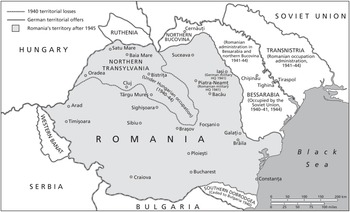
Map of Romania during and after the World War II.

My book shows that while the post-Antonescu governments were reluctant to return rapidly all the confiscated properties to their former Jewish owners, the majority of the survivors managed to recuperate their rights and assets – through court litigation, administrative decisions, or agreements with the profiteers – and to somehow rebuild their lives and communities during the first postwar years. I argue that the Romanian government allowed a significant restitution of “expropriated” and “sold” property – even though only temporarily – because of its preoccupation with obtaining favorable terms at the Paris peace negotiations with the Allies, whom it suspected to have acted under Jewish influence. This led to a substantial restitution of this type of property by local courts, and Jews won around 66 percent of the restitution cases at the Supreme Court. The restitution process happened until the postwar pro-communist regime that came to power in March 1945 fully consolidated itself by 1948. Between 1948 and 1950, the communist government largely abandoned any meaningful restitution. Instead, it pursued its own mass confiscation policies (deemed “nationalizations”) targeting political enemies and the bourgeoisie, which led to many survivors losing again their property and rights. Thus, as restitution scholars such as Itamar Levin and Tatjana Tonsmeyer have noted, within a decade the Jews of Romania and other countries in Eastern Europe had suffered a “double theft” of their property.Footnote 3
That a communist regime was not interested in the full restitution of private property of an ethnic-religious minority – perceived by many of its leaders through the antisemitic stereotype of “Jewish capitalist exploiters and rootless cosmopolitans” – could not be a surprise. As historians Martin Dean, Constantin Goschler, Philipp Ther, and Ulrich Herbert have noted, there is a strong connection between restitution of private property and the structure of civil property rights. A “liberal economic order based on private property,” they argued, “has always been a necessary prerequisite for the restitution of Jewish property,” even if it did not necessarily trigger such restitution.Footnote 4 Aiming to restructure property relations by reducing the role of private property and increasing the state- and cooperative-owned property, the Romanian communist regime tolerated private property and a certain level of restitution for a while as a tactical consideration until it felt the time was ripe (between 1948 and the 1950s) to pursue its full-fledged economic policies that included extensive nationalizations.
A putsch organized by King Michael, army officers, and a four-party political coalition made-up of the National Peasant Party (PNŢ), National Liberal Party (PNL), Social Democratic Party (PSD), and the Romanian Communist Party (PCR) toppled the military dictator Ion Antonescu, one of Hitler’s main allies, on August 23, 1944. As a consequence, Romania changed sides: It abandoned the Axis and joined the Allies. Jewish survivors therefore expected the abolishment of antisemitic policies and the restoration of their rights, especially the restitution of properties that had been “nationalized” during the years of Romanianization, 1940–1944 (the local equivalent of Nazi Aryanization, in the broad sense). In fact, by the end of summer 1945, the main laws aiming to abrogate and reverse racial legislation, including Romanianization, had been enacted (641/1944, 607/1945, and 645/1945). Even though the new transitional governments formally repealed antisemitic legislation rather quickly, reversing its effects did not go smoothly. This was mainly the result of their political calculations and of the fact that antisemitism, anti-minority discrimination, and nationalizing policies had been staples of local society from the time of the creation of modern Romania, aggravated during the interwar and, especially World War II (henceforth, WWII) years. The elites of modern Romania used ethno-nationalism, economic nationalism, misogyny, and ableism for state- and nation-building processes that restricted the rights of ethno-religious minorities such as Hungarians, Turks, Armenians, Roma, and, especially Jews, as well as the rights of women and the disabled.Footnote 5
During their hundreds of years old presence in the territories of Wallachia, Moldova, and Transylvania, the Jewish communities faced a long and complex history of peaceful coexistence, discrimination, and violence. The birth of modern Romania in 1859 – through the union of the Principalities of Moldavia and Wallachia – and its accompanying problems, including poverty, huge social polarization, and political and inter-ethnic tensions, added to the fin de siècle European ideologies that intensified local nationalism and antisemitism and the perception of Jews as “unassimilable” foreigners, politically disloyal inhabitants, and exploiters of the local society, especially peasants. These intolerant ideas that frequently became policies contributed to the marginalization and impoverishment of the majority of the Jews and to the widespread anti-Jewish violence. Even though the Jews made a major contribution to the economic and sociocultural development and modernization of Romania, the political elites rejected the naturalization of most of the Jewish inhabitants before WWI in spite of the Great Powers’ pressures to do so. These waves of discrimination and persecution triggered a significant Jewish emigration from Romania in the late nineteenth and early twentieth century.Footnote 6
As a result of WWI, Romania more than doubled its territory and population by acquiring the provinces of Transylvania, Bukovina, Bessarabia, and Southern Dobrogea (initially annexed at the end of the Second Balkan War in 1913). Consequently, the share of minorities grew significantly to around 29 percent by 1930. The Romanian political and cultural elites resented the increased number of minorities, especially, Hungarians, Jews, Russians, Ukrainians, and Bulgarians, and suspected them of disloyalty. The authorities emancipated the Jews following the Entente’s conditioning the recognition of its territorial acquisitions by the country’s implementation of equal minority rights (including for Jews). However, Romania discriminated against some minorities in spite of its international commitments assumed through the 1919 Peace Treaty, the Treaty of Minorities, and its membership in the League of Nations, which triggered domestic and international tensions.Footnote 7
As a result of the newly acquired territories and population, Romania’s Jewish community grew significantly to more than 728,115 according to the 1930 national census.Footnote 8 The Jewish community became more heterogenous regarding its cultural identity and socioeconomic status. While most of the Jews of Bessarabia spoke Yiddish and Russian, were religious, rather poor, and lived in villages and small towns, those from Transylvania were more affluent, acculturated, and assimilated into the Hungarian minority culture and society, and were mostly urbanites. The Jews of Bukovina were mostly acculturated into the Austrian-German culture of the Habsburg Empire, were more affluent, and mostly urbanized. During the interwar era, all these different Jewish communities had to adapt to the realities of a new state and its ethno-nationalist, antisemitic, and centralization policies. They had to negotiate their place in the broader society and within Romania’s Jewish community, whose members were on the path of acculturation and assimilation into the Romanian culture and society.Footnote 9
Interwar Romania was a multiparty liberal democracy flawed by political violence, nepotism, clientelism, and corruption and dominated by two main parties after the demise of the influential prewar Conservative Party and the decline of the post–WWI populist parties: the National Liberal Party – a center right political organization that promoted economic nationalism through protectionism and industrialization and was led by the Brătianu family – and the National Peasant Party – a center left party which advocated for a developed peasant economy based on small farms and cooperatives and was led mostly by Iuliu Maniu. Both parties promoted ethno-nationalism and rotated to power in the 1920s and 1930s, though PNL was more influential in the economy and stayed in power for longer terms. After he became King for the second time, in 1930, Carol II pushed for seizing more power and wealth beyond the typical boundaries of a constitutional monarch. To achieve his goals, Carol II weakened PNL and PNŢ by encouraging factionalism within these parties in the 1930s (such as by promoting the PNL faction led by Gheorghe Tătărescu, who served as prime minister between 1934 and 1937, and from 1939 to 1940). He also used the state of exception to suspend the rule of law and encouraged clientelism and corruption by supporting his business partners from his inner circle. At the same time, Carol II promoted a project of modernizing Romania, including its economy, culture, and society.Footnote 10
Gradually, the rise of radical right-wing and anti-minority politics significantly affected the status and livelihoods of the Jews. A student movement that started in the 1920s by agitating extreme ethno-nationalist, antisemitic, and social demands developed into a popular fascist party (entitled the Legion of the Archangel Michael, henceforth, the Legion) in the 1930s under the leadership of “Captain” Corneliu Zelea Codreanu.Footnote 11 During the interwar years, the legionaries promoted a radical discourse against the political establishment and minorities, especially the Jews, depicted as exploiters of the Romanian peasants and workers and as disloyal foreigners. They also promoted a cult of violence against their political enemies and the Jews and disseminated ideas about national rebirth (palingenesis), self-sacrifice, and martyrdom among its members and the public. Exaggerating the number of Jews and other minorities and their influence in Romania, the legionaries pushed for their exclusion from the national economy and society, in a radical interpretation of economic nationalism and xenophobic violence. The popularity of the Legion triggered the hostility of Carol II, who initially tried to manipulate the fascists and, later on, to undermine their influence among the youth and the nationalist public. He persecuted the legionaries by using state institutions, such as the police and gendarmery, who faced off with the fascist death squads that attacked state officials. This antagonism resulted in a campaign of mutual violence and retaliation that plagued Romania throughout the 1930s and 1940. Jews were somehow caught in the middle of this violent struggle, as both the legionaries and increasingly Carol II used them as scapegoats for the problems experienced by the country and adopted antisemitic discourses and policies.Footnote 12
At the same time, even the mainstream democratic parties, PNL and PNŢ, promoted ethno-nationalist policies, including in the economic and cultural sphere. The protectionist legislation adopted to promote the proto-Romanianization of the economy and society resulted in the exclusion of some Jews (and “foreigners”) from the civil service, private jobs, property ownership, and businesses.Footnote 13 Things worsened for the Jews during the last years (1937–1940) of the regime of King Carol II, who, inspired by the fascist model, began to dismantle the democratic political system. In December 1937, Carol II appointed a government made by an extreme right-wing/fascist National Christian Party led by two antisemitic politicians, Octavian Goga and A. C. Cuza.Footnote 14 Opposing the Treaty of Minorities, the League of Nations, and liberal democracy, the Goga-Cuza government adopted legislation that discriminated against minorities such as the Ukrainians and especially the Jews, and canceled some of their rights. As historian Philippe Henri Blasen has shown, while promoting a broad discriminatory policy against minorities, Carol II treated some minorities, such as Germans and Hungarians, better than the Jews and the Ukrainians due to foreign and domestic policy considerations and cultural stereotypes. The most openly antisemitic law was the January 1938 denaturalization law (Decree Law no. 169), which resulted in around 225,000 Jews losing their Romanian citizenship. At the protests of French and British governments and international Jewish organizations, Carol II did not implement all these antisemitic measures. He soon dismissed the Goga-Cuza government and installed a one-party authoritarian system, with himself as a royal dictator. Trying to win favor with Axis powers, Carol II gradually adopted measures imitating some of the Nazi policies, which resulted in further antisemitic laws and administrative measures in summer 1940.Footnote 15
While antisemitic violence took place throughout the late nineteenth century, early twentieth century, and interwar years – including attacks on individual Jews and neighborhoods (such as the Oradea pogrom of 1927) – it intensified during the last years of the Carol II regime. Soldiers, policemen, various officials, and local fascists perpetrated several pogroms, such as those in Dorohoi (with tens of victims) and Galaţi (with hundreds of victims) in the summer of 1940. These cases of antisemitic mass violence and other individual crimes on the eve of the Holocaust took place especially after the territorial losses suffered by the country in the summer of 1940 (when Romania lost Northern Bukovina, Bessarabia, Southern Dobrogea, and Northern Transylvania to its Soviet, Bulgarian, and Hungarian neighbors), for which the Jews became the convenient scapegoats.Footnote 16
The antisemitic General (Marshal from 1941 on) Ion Antonescu viewed the Jews as disloyal people who aided Romania’s enemies (particularly the USSR) and economically exploited the nation. Rising to power in September 1940 following the collapse of Carol II’s dictatorship, Antonescu first shared power with the Legion and joined the Axis in fall 1940 aiming to recover the contested territories lost earlier that year. Antonescu soon clashed with his fascist partners over domestic policies and power control, and after the Legion’s failed January 1941 coup (known as the “Legionary Rebellion”) against him and his main supporter, the army, he excluded the rebel legionaries from the government. Supported by a bureaucracy of military and civilian cadre, Antonescu controlled Romania as a military dictator until August 1944. He aimed to expel the Jews from the local economy and society and his antisemitic policy intensified after the invasion of the USSR in June 1941, to which Romania was the second largest contributor among all Axis members. The Romanian authorities deported to Transnistria – an occupied Soviet territory in Southern Ukraine – hundreds of thousands of Bessarabian and Bukovinian Jews and 25,000–30,000 Roma. Transnistria became “a kingdom of death” (as historian Jean Ancel has labeled it), with more than 150 camps and ghettos in which many Jews, Roma, and other “enemies” were imprisoned, exploited for slave labor, starved, and murdered.Footnote 17
Though Jews continued to die in Transnistria, Antonescu softened this genocidal policy in fall 1942, due to his growing doubts that the Axis would achieve a fast and complete military victory. He henceforth curbed mass executions and allowed the Jewish community in the Old Kingdom and Southern Transylvania to send aid to deportees, repatriate orphans and other categories of deportees, and organize limited emigration to Palestine. Most of the scholars who examined Antonescu’s genocidal policies estimated that his regime was responsible for the death of a large number of Jews (between 250,000 and 420,000) and 12,000–15,000 Roma.Footnote 18
The confiscation of Jewish property and businesses was one of the antisemitic measures of the Antonescu regime and was initially promoted by his Legionary partners. This measure played an important role in the broader Romanianization, nation-building, and modernization projects. Unlike the tactics of the Legionaries, who engaged in a violent and chaotic Romanianization during their months of power-sharing (September 1940–January 1941), Antonescu envisioned a “legal” and gradual dispossession of the Jews. The government presented the process as a social and national justice “reform,” encompassing a broad policy of economic nationalism and population control, which aimed to dispossess or replace “foreigners” (minorities, especially Jews) with ethnic Romanians, in order to build a strong national bourgeoisie. Antonescu implemented Romanianization through several agencies, of which the most important was the National Romanianization Center (CNR) – part of the Under-Secretariat of Romanianization, Colonization, and Inventory (SSRCI) – and which focused mostly on real estate (land, forests, and buildings). He also enacted a series of laws, such as the Romanianization of Jewish-owned rural properties (October 1940), private jobs (November 1940), and urban housing (March 1941). While on paper Romanianization seemed to advance rapidly, in practice the policy was crippled by the war, corruption, and the inefficiency of the bureaucracy, as well as by the Jewish resistance – mainly through litigation and camouflage (fictious transfers of property to gentiles to avoid confiscation).Footnote 19
Among other Romanianization measures, the Antonescu government expropriated around 75,000 Jewish residential units (located in 30,691 buildings) and rented them to state agencies, NGOs, and “deserving” ethnic Romanians. Worried that the economy would collapse during the vital mobilization of the production for the anti-Soviet war effort, Antonescu never pursued an expropriation of Jewish companies and businesses as he did with the rural land and urban real estate. Nevertheless, he encouraged and supported ethnic Romanian entrepreneurs to buy and manage Jewish enterprises or start new ones to compete with the Jews, but this plan proved rather unsuccessful.Footnote 20 Some of the Antonescu regime’s nationalizing policies targeted also the Jewish communal property of spiritual-cultural importance, such as synagogues, cemeteries, schools, and Judaica. The authorities expropriated a number of 330 synagogues, temples, and prayer houses from the Jewish communities and legal persons throughout the country. Just as in other Axis countries, the Romanian authorities “expropriated” (and destroyed) several Jewish cemeteries, such as the Sevastopol cemetery in Bucharest (between 1942 and 1944) and the Ciurchi cemetery in Iaşi (1943), to obliterate the material traces of the Jewish presence in Romania. As historian Adrian Cioflâncă has argued, for Antonescu these cemeteries, usually situated in the center of major cities, were the unpleasant proof of the centuries-long Jewish presence in the territory of Romania. This contradicted the official discourse (justified with antisemitic and public health pretexts) about the Jews as recent and dangerous foreigners that should be removed from the center of the main cities and, eventually, from the entire country.Footnote 21 In addition to the “expropriations,” numerous spiritual-cultural properties, such as synagogues, Torah scrolls, books, and other Judaica were destroyed, damaged, or stolen through the violence unleashed by local fascists, antisemites, and ordinary citizens, especially during the Legionary Rebellion and the deportations. Some of the ruins of these structures remained during the war and early postwar years as silent reminders of the once thriving communities and the violence that targeted them.Footnote 22
After the aggressive Romanianization of Jewish real estate and businesses during the first part of the Antonescu regime (1940–1942), restitution was debated throughout Romanian society during the last years of the regime (1943–1944), when many non-Jewish citizens gradually lost confidence in an Axis victory. While many Jews hoped to recover their assets and devised strategies for restitution in a post-Antonescu society, gentile beneficiaries worried about losing their gains, a strong reason to continue their support of the Antonescu regime. Rumors about both restitution and new or more extensive “nationalizations” fueled the anxieties of many. In particular, Jewish and non-Jewish property owners feared that Antonescu’s precedents were paving the way for a communist-style society in which most of the private property would be nationalized.Footnote 23
In spite of all the Antonescu regime’s discriminatory measures targeting their properties and other rights and the threat of deportation, the Jews continued to seek exemption from expropriation or the return of their assets or compensation by petitioning the courts, administrative offices, and opposition politicians until the demise of Antonescu in August 1944. For example, the Jews opened more than 40,000 lawsuits against expropriation and, surprisingly, in some cases they recuperated their assets even during the Antonescu regime. As I have shown in my book Jewish Resistance to Romanianization, 1940–44, the restitution of “illegally” seized property did become, in some circumstances, an accepted social practice, and the Jews succeeded to reverse Romanianization in about 10 percent of all court cases.Footnote 24 In addition to houses, some businesses and other assets Romanianized through violence by Legionaries were also returned to their Jewish owners by the administrative and judicial authorities, as well as some scared looters, especially after the defeat of the Legionary (January 1941) Rebellion.Footnote 25
The recovery of some Romanianized property, thus, illustrates the plasticity of Antonescu’s policies. He allowed a limited degree of restitution, in part because he viewed the Legionaries’ radical Romanianization during their four months of power as a violation of law and order that had gone against his policy of cautious and “legal” nationalization of Jewish wealth. He also saw racial dispossession as a threat to Romania’s war production, macroeconomic stability, and potential good standing in postwar peace negotiations. At the same time, Antonescu did not simply grant full restitution to the Jews because that would have clashed with his radical antisemitic beliefs and public image and would have contradicted his overall aim of excluding the Jews from the economy and society. Romanianization, far from an immutable process, could under particular circumstances be challenged, criticized, and in some cases successfully reversed.
The massive struggle for restitution started after the collapse of Antonescu’s dictatorship, which resulted in a substantial return of properties to their former Jewish owners. This is the main focus of this book. In other words, this study examines the short postwar transition years of Romanian society from the demise of the pro-Nazi dictatorship (on August 23, 1944) to 1950, which was the year when the consolidated communist regime adopted a major nationalization law targeting urban property. This was extremely relevant for local Jews, at that time overwhelmingly urbanites. The restitution process – through court litigation, administrative measures, or informal agreements – just as the hopes of most of the Jews to rebuild their lives in Romania, virtually stopped around 1949–1950. December 1950 is also the moment when the communist regime adopted the five years plan (1951–1955) strategy, thus marking the end of the postwar transitional period and the beginning of a new stage in its modernization masterplan. Its story should be the subject of a different book.
In spite of the major importance of the Romanian Jews within the post-Nazi European Jewry as the largest Jewish community outside the USSR, the rebuilding of Jewish lives and communities in Romania, including the crucial restitution of property and other rights, has received only limited academic examination. This book aims to address this gap in scholarship and tell the story of the extraordinary efforts of the Romanian Jews to recover their property and other rights and rebuild their lives and communities. More specifically, this book examines the Jewish efforts to achieve reparatory justice in the first years of post-Nazi Romania, the strategies they used, the obstacles they overcame, and the hostility or help they received from their neighbors and governments, as well as the communist nationalizations and their impact on their lives. I employ the term “restitution” as encompassing various forms of legal restitution, which includes the return of specific immovable items – real estate and enterprises (companies and businesses) – that were Romanianized from the Jews, reparations/compensations, and return of citizenship.Footnote 26 Therefore, my understanding of restitution is narrower than the “restitution” conceptualized by historian Elazar Barkan, as a broad “cultural concept” that includes not only legal restitution but a variety of other methods used to repair historical injustices, including cultural and symbolic forms of restitution.Footnote 27
These methods of amending the massive violations of the Jews’ rights were part of a broader process known today as “reparatory justice.” I am using the concept of reparatory justice in a narrower sense than it was employed in the Encyclopedia of Transitional Justice (2016), in which political scientist Raluca Ursachi argued that it
refers to the victim-oriented policies aimed at the reparation of past wrong, including compensation for losses, restitution of confiscated property, and rehabilitation of victims of repressive regimes. By focusing on victims – who can be granted not only material benefits and compensations, but also symbolic reparations, such as public honor, recognition, tributes, commemorations, and judicial rehabilitation – reparatory justice seeks to promote healing, restore dignity, and clarify the historical truth.Footnote 28
As it would not be possible to cover all the aspects of reparatory justice suggested in this definition within the limits of one book, here I will focus only on the legal aspects of reparatory justice, such as restitution of immovable property, citizenship, and reparations/compensations.
Methodologically, my book uses an interdisciplinary approach (history and transitional justice) and a variety of published and unpublished primary sources to examine what happened with the Romanian Jews’ property and rights after August 1944 and to analyze decision makers’ and citizens’ patterns of behavior and legal responses to the process of reversing Antonescu’s Romanianization and reestablishing justice. More specifically, my book employs historian Saul Friedländer’s “integrated history” approach of researching the Holocaust and its legacy by bringing together the voices, perspectives, and the archival sources and ego-documents of perpetrators, victims, bystanders/neighbors, and international observers (diplomats and journalists).Footnote 29 These different perspectives of organizations and individuals who sometimes had completely opposite interests and stakes in the restitution, allow me to triangulate the transitional era in post-Antonescu Romania and reconstruct as closely as possible the history of the restitution process and rebuilding the Jewish communities, and the stories of its participants.
I use the term Jewish survivor broadly, as explained by the United States Holocaust Memorial Museum (USHMM): every Jewish person who survived the antisemitic policies of the Nazis, their Axis partners, and local collaborators. Survivors’ perspectives and voices – recorded in their diaries, memoirs, interviews, and other testimonies – receive special attention in this book and form one of the most important categories of primary sources employed in my study.
One of the main limitations of the scope of this research is given by the wartime boundaries of Antonescu’s Romania and its antisemitic policies, including Romanianization. Therefore, my study will not examine the restitution aiming to repair the dispossession and damages caused by the Aryanization pursued by the Hungarian and German authorities in Northern Transylvania – under Hungarian rule between 1940 and 1944 – which was implemented through different laws, had different categories of beneficiaries, and was reversed through a different legislation.Footnote 30 I will mention the general legal framework of the restitution for Northern Transylvania to clarify the wartime and postwar contexts, but I will not discuss it thoroughly nor use case studies from that region. While I briefly discuss the fate of “abandoned”/heirless property – the assets that belonged to the Jews who died or disappeared during the war – I will not examine this topic thoroughly as most such property was located in Northern Transylvania, which was under the Hungarian and German authority during the Holocaust, and thus falls beyond the scope of this book, which focuses on the legacy of the Antonescu regime.
This book explores several main questions: What were the domestic and international political and socio-legal frameworks that helped the reconstruction of the Jewish community and especially the restitution of property in post-Holocaust Romania? What were the attitudes and actions (especially the legal strategies) of Jews and gentiles toward the issues of restitution, reparation, and restoration of Jewish rights in the aftermath of the Antonescu regime? How was the restitution of property, reparation, and restoration of rights implemented, what problems did it encounter, and what were the results? How did the communist nationalization policies influence the process of restitution of Jewish property and the Jewish efforts of rebuilding their lives and communities? To answer these questions, I rely on the official archival documents produced by the post-Antonescu transitional governments (especially by the Ministry of Justice, Ministry of Interior, Ministry of National Economy, Ministry of Foreign Affairs, and the Secret Police), the Jewish community, and foreign diplomats, which depict official and unofficial perspectives on the process of restitution and rebuilding Jewish lives and communities.Footnote 31
An additional layer of personal sources complementing the archival documents is made up of the ego-documents (diaries, memoirs, interviews, and letters) produced by the Jewish and gentile inhabitants and the foreign citizens who resided in Romania. These sources reveal the personal opinions and actions of individuals who participated in the complex process of rebuilding Jewish lives and communities and repairing antisemitic injustices during the early postwar years. The press coverages, op-eds, editorials, debates, draft laws, and readers’ letters published in the Jewish and non-Jewish newspapers and scholarly journals that multiplied during the first post-Antonescu transitional years represent the third layer of crucial primary sources employed in this book.
A particularly important subset of primary sources is made of the court documents pertaining to restitution litigation, which give great insight into the legal aspects of restitution. While Romania has not yet granted access to early postwar courts’ archives and land registries, I have managed to collect 155 court decisions related to Jewish restitution litigation published in the following legal journals: Buletinul Deciziunilor Înaltei Curţi de Casaţie și Justiţie (The Bulletin with Decisions of the Supreme Court of Justice), Curierul Judiciar (The Judiciary Courrier), Jurisprudenţa Generală (General Jurisprudence), Justiţia Nouă (New Justice), Pandectele Săptămânale (Weekly Pandectes), and Pandectele Române (Romanian Pandectes).Footnote 32 Even though the legal journals published only a summary of each decision, sometimes giving the initials of the litigating parts and their lawyers and sometimes their full names and their gender, they contain valuable information on the decision and the date, the location of the disputed property, transaction details, the court type, and the lower-level court decision in that case. These decisions were issued by courts at different jurisdiction levels – Judecătorie (local court), Tribunal (Tribunal), Curte de Apel (Appeals Court) in cities from across Romania – and most of them (104) came from Înalta Curte de Casaţie și Justiţie (henceforth, Supreme Court), which was the top court of the local hierarchical judiciary system. The latter court’s decisions are extremely important because the Supreme Court was the ultimate decision-making judiciary body made up of the most highly trained and experienced jurists, who could reverse any decision issued by a lower court. Additionally, the Supreme Court’s decisions were made in reference to the lower courts’ decisions that they evaluated, thus providing precious insight into more decisions, those produced by the lower courts. Even if this is not a full representative sample for the entire restitution litigation, it is a significant exploratory finding until the court archives become available.Footnote 33 The last Supreme Court decision in a Romanianization restitution case I could find in my research was issued in March 1949 (and published in summer 1949).Footnote 34 This suggests that the court litigation for Jewish property based on the restitution laws (nos. 641, 607, 645) stopped in 1949. It is highly likely that such litigation did not continue in 1950, the year when the communist regime engaged in a massive nationalization of housing that affected many Jewish survivors, including some of those who recuperated their Romanianized assets during the previous years, as official nationalization documents and Jewish ego-documents show.
The plunder of Jewish-owned property and rights had been a key aspect of the Nazis and their collaborators’ genocidal project – often financing the war effort and benefiting the hegemon “Aryan” communities. This massive dispossession was implemented by governments, various organizations, private companies, and individual gentiles. As legal scholar Irwin Cotler has argued, the dispossession of the Jews – deemed as “thefticide” – and the issue of a subsequent failure of rapid and just restitution and reparation represented, in retrospect, a major violation of international human rights and international humanitarian law.Footnote 35 Furthermore, Holocaust restitution experts Michael J. Bazyler and Kristen L. Nelson have showed that Article 17 (2) of the Universal Declaration of Human Rights was adopted in 1948 as a (partial) response of the international community (under the United Nations Organization) to the unprecedented crimes and theft perpetrated in WWII and stipulated that “no one should be arbitrarily deprived of his property.” Additionally, Article 8 mentioned that “everyone has the right to an effective remedy by the competent national tribunals for acts violating the fundamental rights granted him by the constitution or by law.”Footnote 36 As Bazyler and Nelson have highlighted, a variety of other “remedies came into being in the immediate post-war era often independent of Article 8 of the UDHR” and showed the international community’s concern for the topic of reparatory justice in post-conflict societies.Footnote 37 Nevertheless, before WWII the international law framework in general lacked reparatory stipulations (codified in international conventions and treaties) in favor of individual victims of massive abuses perpetrated by states and allowed restitution and reparations mainly between states. During the interwar years, Romania was entangled in an international legal dispute with Hungarian minority property owners from Transylvania whom it expropriated at the end of WWI to enact rural reforms and, eventually, agreed to compensate them for their property.Footnote 38 WWII triggered a major legal and conceptual transformation that enabled individual victims and their organizations to claim restitution and reparations by internationalizing human rights and gradually promoting a victims-centered justice.Footnote 39
After a short postwar period, scholarly and public interest in the restitution of Jewish property plundered by the Nazis and their collaborators faded away. It has boomed over the last several decades, especially in the Western world. This interest of the media and academia was mainly caused by the collapse of communist dictatorships in Eastern Europe, the increased access to crucial archives, a globalized economy, disclosures about the Holocaust profiteers and looted property, a growing interest in the memory of WWII and its atrocities, a concern for human rights and repairing historical injustices, and survivors’ and their heirs’ litigation campaign in the United States. The interest in the topic of Holocaust restitution is illustrated by the recent studies authored by scholars such as Leora Auslander, Michael Bazyler, Jean Marc Dreyfus, Shannon Fogg, Constantin Goschler, Jurgen Lillteicher, Regula Ludi, Michael R. Marrus, Jonathan Petropoulos, Antoine Prost, and Ronald W. Zweig, and the media depiction of the topic in films such as The Rape of Europe (2006), Woman in Gold (2015), and the popular graphic narrative The Property (2013) by Israeli artist Rutu Modan.Footnote 40 Restitution scholar Itamar Levin has further recognized the importance of unfinished restitution and considered it “the last chapter of the Holocaust” that haunted survivors, their heirs, and communities.Footnote 41
However, this international debate has had only a limited influence on scholarship on Eastern Europe. Though the field of transitional justice has recently witnessed a resurgence, only a few scholars have examined Holocaust restitution and reparation for Jews in Eastern Europe. As Itamar Levin has shown, in Eastern Europe, the collapse of the communist regimes and the reemergence of the topic of restitution of Jewish property triggered fears of Jewish claims for lost assets and intense public debates.Footnote 42 Most of those who examined the topic of repairing historical injustices focused on the restitution and reparations for the property confiscated by the communist regimes, but there were noteworthy exceptions. In one of the most important studies on post-WWII Jewish communities in Eastern Europe, Anna Cichopek-Gajraj examined the tensions surrounding the restitution of property in postwar Poland and Slovakia, including the authorities’ actions of delaying and paralyzing the Jewish efforts for restitution and the ordinary gentiles’ (often violent) opposition to the process of restitution.Footnote 43 Recently (2019), Michael Bazyler and his coauthors edited the most comprehensive legal history survey of the restitution of property and its problems in forty-seven countries that signed the 2009 Terezin Declaration on Holocaust Era Assets and Related Issues. One chapter of this book presents an overview of the confiscation and restitution of Jewish property in Romania from the Antonescu regime until nowadays and focuses mostly on the restitution legislation and litigation in post-communist Romania.Footnote 44
In early postwar Romania only a handful of authors – usually Jewish legal scholars who supported the abolition of racial laws or gentile jurists who commented on the emerging restitution laws and jurisprudence – discussed the issue of returning Romanianized property to its Jewish owners.Footnote 45 After the 1948 consolidation of the communist regime, topics related to the restitution of Jewish property and reparations disappeared from the public space. Only the collapse of the communist regime in 1989 enabled historians Jean Ancel, Carol Iancu, and Liviu Rotman to produce studies that examined Jewish history in the postwar years, but they only tangentially discussed some aspects of restitution and usually dismissed the significant success of Jewish survivors obtaining the restitution of their assets.Footnote 46
After the relatively rapid adoption of the main restitution laws and successful court litigation, things started to change from 1948 on. The local and international Jewish leaders and organizations struggled a lot to oppose Romania’s efforts to collect the Jewish heirless and unclaimed (allegedly “abandoned”) property for the public treasury. The Romanian communist government decreased its interest in the restitution of and compensation for Romanianized Jewish property after the crucial years of 1947–1948. During that time, the communists signed the Peace Treaty (February 1947) and ratified it (September 1947), dismantled the main democratic opposition parties PNŢ (in July 1947) and PNL (in November 1947), abolished the monarchy (in December 1947), forced PSD to merge with PCR into the Romanian Labor Party (in February 1948), and adopted a new constitution (April 1948) that formally legitimized its rule. The decrease of the official interest in restitution was caused by the emergence of the Cold War, the antisemitism of some of Romania’s pro-communist leaders, and their lack of incentive to pursue further restitution. The communist officials felt more secure about their grip on power over the local society, stopped worrying about Western pressure, and expected support from their Soviet patrons to deflect potential Western interferences on behalf of local Jews, especially after the USSR started to promote antisemitism in late 1948.Footnote 47 Significantly, the last court decision in restitution cases I could identity was from spring 1949. The Jewish ego-documents I have consulted are also silent about the restitution of their authors’ or their friends’ and acquaintances’ homes and businesses taking place after 1948–1949. These political developments also had international consequences. As historian Lawrence Weinbaum has noted, by the early 1950s, after the onset of the Cold War, which brought about the consolidation of the communist regimes, and the weakening of local Jewish communities, the restitution of Jewish property in Eastern Europe “disappeared from the international Jewish agenda” as the international Jewish organizations turned their attention to restitution and reparations in Germany, Austria, and Greece.Footnote 48
In spite of the main tendencies within the Jewish community in Romania that by 1948–1950 became increasingly focused on emigration, things were not so clear immediately after the demise of Antonescu in August 1944. Resembling the social and interethnic realities uncovered by Cichopek-Gajraj for Poland and Slovakia, many Jews did not envision their emigration immediately after the collapse of Antonescu. Instead, they saw a future in Romania during the early postwar years between September 1944 and November 1946, when the communists rigged the first postwar elections.Footnote 49 After the arrest of non-communist politicians, the dismantling of the opposition parties and of all independent Jewish organizations, the massive nationalizations of private property, and the increase of surveillance and arrests that became ubiquitous by 1950, most Jews understood that they had a problematic future in the new dictatorship and were ready to emigrate.
Chapter 1 examines the general political, social, economic, and cultural aspects of early post-Nazi Romania, looking at the political struggle and the main economic and social developments. This chapter also discusses the official and unofficial (popular) antisemitism that did not disappear from local society and how it impacted Jewish lives during the first post-Holocaust years.
Chapter 2 investigates the status of the post-Antonescu Jewish community in Romania focusing on the Jews’ efforts to rebuild their lives and communities. The chapter traces both the communal – related to Jewish parties and organizations – and individual developments.
Chapter 3 examines the political negotiations and debates that took place within Romania’s transitional governments concerning the process of drafting and adopting the restitution legislation. It shows that while a few Romanian politicians supported a full and rapid restitution, others were reluctant to do so and even displayed antisemitic prejudice. Most of the politicians agreed to adopt restitution laws because they saw them as requirements of the allegedly philosemitic Allies and, thus, useful for improving Romania’s standing at the peace conference. Some ministers supported specific categories of beneficiaries and devised various strategies aiming to help them keep the Jewish assets.
Chapter 4 discusses the attitudes and reactions of the public toward the topic of restitution, focusing on the role of the press and various political and social organizations who supported, opposed, or publicly discussed a complete and rapid restitution of Jewish property and restoration of their rights.
Chapter 5 discusses the postwar international struggle for and against restitution carried out by the Romanian government and the local and international Jewish organizations that aimed to convince the Allies who prepared the peace treaty with Romania. On the one hand, it shows the local Jewish leaders’ and organizations’ efforts to obtain restitution, reparations, and restoration of rights by enlisting support from international Jewish organizations and Allied (Western) politicians. On the other hand, it highlights how most of the Romanian politicians and diplomats tried to limit restitution in favor of the Jews. In this chapter, I also discuss other reparative justice measures adopted by the post-Antonescu governments, including the payment of limited reparations (pensions to some categories of survivors of camps, ghettos, and pogroms) and the return of citizenship.
Chapter 6 scrutinizes the restitution of Jewish property through litigation, petitioning to administrative offices, and other avenues. It shows that local Jews were successful at recuperating in court their “expropriated” residences but less successful when they tried to retrieve their “sold” homes and businesses. The administrative avenue was usually used for the restitution of communal property, such as synagogues, cemeteries, schools, and other such buildings.
Chapter 7 investigates the nationalizations of property adopted by the communist regime during the crucial (formative) six years of its power (1945–1950) and their role in shaping the lives of Jewish individuals and communities, especially in relation to their emigration from Romania. It shows that many Jews feared and opposed the communist measures of nationalizing private and communal property and that many of them were victimized through these dispossession policies in a higher proportion than the majority gentile population. This happened because the Jews were disproportionately represented among the urban middle-class entrepreneurs and property-owning groups of the population that were specifically targeted by the communist regime, allegedly as “capitalist exploiters” and other “unreliable” cosmopolitan citizens.