Introduction
Previous research has demonstrated that expression of the psychosis phenotype extends from subclinical psychotic experiences (PEs) to clinical psychotic disorders (van Os et al., Reference van Os, Linscott, Myin-Germeys, Delespaul and Krabbendam2009; Linscott and van Os, Reference Linscott and van Os2013; Fonseca Pedrero and Debbane, Reference Fonseca Pedrero and Debbane2017). Furthermore, individuals who report PE have elevated risk for later psychotic disorders in comparison with those who do not (Poulton et al., Reference Poulton, Caspi, Moffitt, Cannon, Murray and Harrington2000; Hanssen et al., Reference Hanssen, Bak, Bijl, Vollebergh and van Os2005; Dominguez et al., Reference Dominguez, Wichers, Lieb, Wittchen and van Os2011; Werbeloff et al., Reference Werbeloff, Drukker, Dohrenwend, Levav, Yoffe, van Os, Davidson and Weiser2012; Zammit et al., Reference Zammit, Kounali, Cannon, David, Gunnell, Heron, Jones, Lewis, Sullivan, Wolke and Lewis2013). However, most PE are self-limiting and the predictive value of PE for subsequent psychotic disorders is typically low at <1% per year in previous community-based studies (Hanssen et al., Reference Hanssen, Bak, Bijl, Vollebergh and van Os2005; Kaymaz et al., Reference Kaymaz, Drukker, Lieb, Wittchen, Werbeloff, Weiser, Lataster and van Os2012; Linscott and van Os, Reference Linscott and van Os2013; Zammit et al., Reference Zammit, Kounali, Cannon, David, Gunnell, Heron, Jones, Lewis, Sullivan, Wolke and Lewis2013). Transition rates are higher in clinical studies of individuals with affective disorder and substance use disorders with a degree of psychosis admixture, considered at ultra-high risk (UHR) (Fusar-Poli et al., Reference Fusar-Poli, Bonoldi, Yung, Borgwardt, Kempton, Valmaggia, Barale, Caverzasi and McGuire2012; Schmidt et al., Reference Schmidt, Schultze-Lutter, Schimmelmann, Maric, Salokangas, Riecher-Rossler, van der Gaag, Meneghelli, Nordentoft, Marshall, Morrison, Raballo, Klosterkotter and Ruhrmann2015; Schultze-Lutter et al., Reference Schultze-Lutter, Michel, Schmidt, Schimmelmann, Maric, Salokangas, Riecher-Rossler, van der Gaag, Nordentoft, Raballo, Meneghelli, Marshall, Morrison, Ruhrmann and Klosterkotter2015; Fusar-Poli and Schultze-Lutter, Reference Fusar-Poli and Schultze-Lutter2016). However, these were conducted in help-seeking samples and generating risk enrichment, making it difficult to compare results to longitudinal studies of PE in the general population (van Os and Guloksuz, Reference van Os and Guloksuz2017).
PEs were associated with increased risk of later non-psychotic disorders as well as psychotic disorders among different age groups (McGrath et al., Reference McGrath, Saha, Al-Hamzawi, Andrade, Benjet, Bromet, Browne, Caldas de Almeida, Chiu, Demyttenaere, Fayyad, Florescu, de Girolamo, Gureje, Haro, Ten Have, Hu, Kovess-Masfety, Lim, Navarro-Mateu, Sampson, Posada-Villa, Kendler and Kessler2016). First, studies assessing outcomes of PE in adolescents found associations with later depression, suicide attempts, substance use disorders and post-traumatic stress disorder (Dhossche et al., Reference Dhossche, Ferdinand, Van der Ende, Hofstra and Verhulst2002; De Loore et al., Reference De Loore, Gunther, Drukker, Feron, Sabbe, Deboutte, van Os and Myin-Germeys2011; Fisher et al., Reference Fisher, Caspi, Poulton, Meier, Houts, Harrington, Arseneault and Moffitt2013; Sullivan et al., Reference Sullivan, Wiles, Kounali, Lewis, Heron, Cannon, Mahedy, Jones, Stochl and Zammit2014; Zavos et al., Reference Zavos, Eley, McGuire, Plomin, Cardno, Freeman and Ronald2016). Second, PE at age 19/20 years predicted dysthymia, bipolar disorder, social phobia and obsessive–compulsive disorder by age 49/50 years (Rossler et al., Reference Rossler, Hengartner, Ajdacic-Gross, Haker, Gamma and Angst2011). Finally, PEs were related to increased risk of later service use (Bhavsar et al., Reference Bhavsar, Maccabe, Hatch, Hotopf, Boydell and McGuire2017) and hospitalization for non-psychotic disorders (Werbeloff et al., Reference Werbeloff, Drukker, Dohrenwend, Levav, Yoffe, van Os, Davidson and Weiser2012).
Definitions of PE and type of screening instruments used varied across studies (Kelleher et al., Reference Kelleher, Harley, Murtagh and Cannon2011), contributing to the heterogeneity of results in this area. Definitions of PE were mainly based on attenuated forms of delusional thinking and hallucinatory perceptions (van Os et al., Reference van Os, Linscott, Myin-Germeys, Delespaul and Krabbendam2009; Linscott and van Os, Reference Linscott and van Os2013; Fonseca Pedrero and Debbane, Reference Fonseca Pedrero and Debbane2017), similar to those used in the current paper. However, negative, disorganization and affective dimensions were identified in addition to the positive dimension (van Os and Reininghaus, Reference van Os and Reininghaus2016). It was suggested that positive and negative dimensions of PE might be associated with emergence of different types of psychopathology (Debbane et al., Reference Debbane, Eliez, Badoud, Conus, Fluckiger and Schultze-Lutter2015). Moreover, many factors such as comorbid non-psychotic symptoms (Yung et al., Reference Yung, Phillips, Yuen, Francey, McFarlane, Hallgren and McGorry2003; Hanssen et al., Reference Hanssen, Bak, Bijl, Vollebergh and van Os2005; Perlis et al., Reference Perlis, Uher, Ostacher, Goldberg, Trivedi, Rush and Fava2011; van Rossum et al., Reference van Rossum, Dominguez, Lieb, Wittchen and van Os2011; Kelleher et al., Reference Kelleher, Keeley, Corcoran, Lynch, Fitzpatrick, Devlin, Molloy, Roddy, Clarke, Harley, Arseneault, Wasserman, Carli, Sarchiapone, Hoven, Wasserman and Cannon2012; Wigman et al., Reference Wigman, van Nierop, Vollebergh, Lieb, Beesdo-Baum, Wittchen and van Os2012; Smeets et al., Reference Smeets, Lataster, van Winkel, de Graaf, Ten Have and van Os2013; Falkenberg et al., Reference Falkenberg, Valmaggia, Byrnes, Frascarelli, Jones, Rocchetti, Straube, Badger, McGuire and Fusar-Poli2015; Guloksuz et al., Reference Guloksuz, van Nierop, Lieb, van Winkel, Wittchen and van Os2015; Honings et al., Reference Honings, Drukker, van Nierop, van Winkel, Wittchen, Lieb, Ten Have, de Graaf, van Dorsselaer and van Os2016; Salokangas et al., Reference Salokangas, Schultze-Lutter, Hietala, Heinimaa, From, Ilonen, Loyttyniemi, von Reventlow, Juckel, Linszen, Dingemans, Birchwood, Patterson, Klosterkotter and Ruhrmann2016), persistence (Poulton et al., Reference Poulton, Caspi, Moffitt, Cannon, Murray and Harrington2000; Yung et al., Reference Yung, Phillips, Yuen, Francey, McFarlane, Hallgren and McGorry2003; Dominguez et al., Reference Dominguez, Wichers, Lieb, Wittchen and van Os2011; Nelson et al., Reference Nelson, Yuen, Wood, Lin, Spiliotacopoulos, Bruxner, Broussard, Simmons, Foley, Brewer, Francey, Amminger, Thompson, McGorry and Yung2013), cognitive impairment (Shah et al., Reference Shah, Eack, Montrose, Tandon, Miewald, Prasad and Keshavan2012; Carrion et al., Reference Carrion, McLaughlin, Goldberg, Auther, Olsen, Olvet, Correll and Cornblatt2013; Kelleher et al., Reference Kelleher, Wigman, Harley, O'Hanlon, Coughlan, Rawdon, Murphy, Power, Higgins and Cannon2015), familial risk (Cannon et al., Reference Cannon, Cadenhead, Cornblatt, Woods, Addington, Walker, Seidman, Perkins, Tsuang, McGlashan and Heinssen2008; Shah et al., Reference Shah, Eack, Montrose, Tandon, Miewald, Prasad and Keshavan2012; Smeets et al., Reference Smeets, Lataster, Viechtbauer and Delespaul2015) and environmental exposures (Cougnard et al., Reference Cougnard, Marcelis, Myin-Germeys, De Graaf, Vollebergh, Krabbendam, Lieb, Wittchen, Henquet, Spauwen and Van Os2007; Cannon et al., Reference Cannon, Cadenhead, Cornblatt, Woods, Addington, Walker, Seidman, Perkins, Tsuang, McGlashan and Heinssen2008; Collip et al., Reference Collip, Myin-Germeys and Van Os2008; Dragt et al., Reference Dragt, Nieman, Veltman, Becker, van de Fliert, de Haan and Linszen2011; Smeets et al., Reference Smeets, Lataster, van Winkel, de Graaf, Ten Have and van Os2013, Reference Smeets, Lataster, Viechtbauer and Delespaul2015; Guloksuz et al., Reference Guloksuz, van Nierop, Lieb, van Winkel, Wittchen and van Os2015; van Dam et al., Reference van Dam, van Nierop, Viechtbauer, Velthorst, van Winkel, Bruggeman, Cahn, de Haan, Kahn, Meijer, Myin-Germeys, van Os and Wiersma2015) were shown to impact on outcome of PE (Fonseca Pedrero and Debbane, Reference Fonseca Pedrero and Debbane2017).
The above studies demonstrate that PE indexes risk for a variety of common mental disorders as well as psychotic disorder. However, this research has some limitations. Diagnoses at follow-up, with one notable exception (Werbeloff et al., Reference Werbeloff, Drukker, Dohrenwend, Levav, Yoffe, van Os, Davidson and Weiser2012), were mostly based on lay interviewer assessments and re-interviews were not performed by clinicians. Furthermore, research on follow-up DSM diagnoses in community-based populations with baseline PE, and the role of baseline differences thereof, remains limited.
The aims of this paper were to analyse, over a 6-year period, in a general population sample:
(i) The follow-up diagnostic status of participants with baseline PE;
(ii) To explore the role of socio-demographics, characteristics of PE, co-occurrence of mood disorders and family history of mental disorders in the association between baseline PE and presence of any follow-up DSM diagnosis;
(iii) To explore the role of the same factors in discriminating between the outcome of psychotic and non-psychotic outcome in those with baseline PE.
Methods
Sample and study design
Data came from the TürkSch (Izmir Mental Health Survey for Gene-Environment Interaction in Psychosis) study which collected longitudinal data on the prevalence, incidence, risk factors, comorbidity and course of mental disorders in a random, representative community-based sample covering a time frame of approximately 6 years (Binbay et al., Reference Binbay, Elbi, Alptekin, Aksu Tanik, Drukker, Onay, Ozkinay, Zagli and Van Os2011; Binbay et al., Reference Binbay, Alptekin, Elbi, Zagli, Drukker, Aksu Tanik, Ozkinay, Onay and Van Os2012a, Reference Binbay, Drukker, Elbi, Tanik, Ozkinay, Onay, Zagli, van Os and Alptekin2012b). The sample of the baseline assessment (T 1) was randomly selected from the wider Izmir metropolitan area using a multistage sampling procedure, stratified by urbanicity covering 11 districts and 302 neighbourhoods. The households were visited in person by trained lay interviewers between 2007 and 2009. One household member aged between 15 and 64 years was randomly selected using the Kish within-household sampling method (Kish, Reference Kish1949). A total of 4011 participants were interviewed with the Composite International Diagnostic Interview (CIDI) (Andrews and Peters, Reference Andrews and Peters1998). Of those 4011 participants, 406 (10.1%) endorsed a PE either with a duration of at least ‘1 week’ or with a frequency of at least ‘sometimes’ or associated with help-seeking/interference with functioning or enjoying relationships (Binbay et al., Reference Binbay, Drukker, Elbi, Tanik, Ozkinay, Onay, Zagli, van Os and Alptekin2012b). Those 406 participants were re-contacted and the Structured Clinical Interviews for DSM-IV (SCID) (Spitzer et al., Reference Spitzer, Williams, Gibbon and First1992) were conducted (Binbay et al., Reference Binbay, Drukker, Elbi, Tanik, Ozkinay, Onay, Zagli, van Os and Alptekin2012b). Of the 406 participants, 99 were diagnosed with a DSM-IV disorder with psychotic features (baseline psychotic disorder – PD group), and thus excluded from the sample of the current analysis. The remaining participants (baseline PE group, n = 307) were included in the current analyses (Fig. 1). Full details on the Izmir metropolitan area, sampling, representativeness, instruments and procedures of T 1 have been published previously (Binbay et al., Reference Binbay, Elbi, Alptekin, Aksu Tanik, Drukker, Onay, Ozkinay, Zagli and Van Os2011).
General design and T 2 outcome of participants with psychosis endorsement at T 1.

At follow-up assessment (T 2), addresses of all T 1 participants were re-visited in person by trained lay interviewers 6 years after the baseline assessments (years 2013–2015). Attempts were made to reduce the number of non-respondents from the baseline sample (Binbay et al., Reference Binbay, Elbi, Alptekin, Aksu Tanik, Drukker, Onay, Ozkinay, Zagli and Van Os2011). One hundred and eighty-seven of the 307 individuals within the baseline PE group were successfully interviewed with CIDI (response rate: 60.9%; sample and results of the visits were presented in Fig. 1). All of these 187 participants were re-interviewed with SCID by the team psychiatrist (122 interviews at the hospital and 65 at the participants’ residence). Both assessments of the TürkSch study were approved by the Ege University ethics committee and participants provided written informed consent.
Interviewers and quality control
At T 1, lay interviewers had at least high school education, a health-related profession and/or were experienced in doing field surveys. At T 2, lay interviewers were psychology graduates. At T 2, both the lay interviewers and the psychiatrist who conducted the SCID interviews (UK) had not participated in T 1, and thus were blind to baseline results. At both assessments, lay interviewers had a 2-week formal training. Each CIDI interview was conducted according to a standard procedure, with recording and quality coding (Binbay et al., Reference Binbay, Elbi, Alptekin, Aksu Tanik, Drukker, Onay, Ozkinay, Zagli and Van Os2011).When the quality of the interview was considered low or if any missing value was present, a second visit was planned by a different lay interviewer (n = 65). The missing values still present after the second visit (n = 18) were assessed by the psychiatrist following the clinical interview. The inter-rater reliability of the CIDI psychosis section had a κ value of 0.45 at T 1 (Binbay et al., Reference Binbay, Elbi, Alptekin, Aksu Tanik, Drukker, Onay, Ozkinay, Zagli and Van Os2011) and 0.67 at T 2.
Assessments
Composite international diagnostic interview
The CIDI is a fully structured interview developed by the World Health Organization (Robins et al., Reference Robins, Wing, Wittchen, Helzer, Babor, Burke, Farmer, Jablenski, Pickens, Regier, Sartorius and Towle1988). The CIDI can be used by both clinicians and trained lay interviewers. CIDI was found to be appropriate for use in different countries and cultures (Wittchen, Reference Wittchen1994) and was used in various epidemiological surveys around the world including Turkey (Cilli and Kaya, Reference Cilli and Kaya2003; Deveci et al., Reference Deveci, Taskin, Dinc, Yilmaz, Demet, Erbay-Dundar, Kaya and Ozmen2007; Alptekin et al., Reference Alptekin, Ulas, Akdede, Tumuklu and Akvardar2009).The reliability and validity functions of the Turkish version of the CIDI were studied as part of an international study (Rezaki et al., Reference Rezaki, Ozgen, Kaplan, Gursoy, Sagduyu, Ozturk, Ustun and Sartorius1995). The CIDI was found to have excellent inter-rater reliability in almost all sections with κ values ranging from 0.67 to 0.97 (Wittchen et al., Reference Wittchen, Robins, Cottler, Sartorius, Burke and Regier1991). In particular, κ for agreement between clinicians for delusions and hallucinations was found to be 0.85 and 0.87, respectively. Furthermore, the sensitivity of the CIDI was found to be higher than its specificity for both delusions (0.93 v. 0.55) and hallucinations (0.86 v. 0.50) (Cooper et al., Reference Cooper, Peters and Andrews1998).
Assessment of psychotic experiences
PE were rated using 14 CIDI delusions items (G1, G2, G3, G4, G5, G7, G8, G9, G10, G11, G12, G13, G13b and G14) and five CIDI hallucinations items (G17, G18, G20, G20C and G21). All items were rated dichotomously indicating the presence or absence. The time frame for PE was lifetime at T 1 and the last 6 years at T 2.
The rating of PE can be difficult because sometimes individuals can be describing a plausible event that in the CIDI may be rated as a PE. Therefore, the following procedures were followed. First, during the interview, each time a participant endorsed a CIDI PE, the participant was asked to give an example, which was written down verbatim by the interviewer for later review with the team psychiatrist and/or senior psychologist. When it was not clear whether or not the participant had truly endorsed a positive PE, the participant was re-contacted by the team psychiatrist over the telephone to confirm the experience.
Persistence of PE was recoded into transient or persistent according to the presence at follow-up assessment. Co-presence of delusional and hallucinatory PE was recoded into a dummy variable: 0 = delusional or hallucinatory 1 = combined delusional and hallucinatory.
Assessment of baseline (T 1) mood disorders
In order to evaluate the presence of any mood disorder at baseline assessment, a binary variable was constructed and coded positive if there was either a CIDI depressive or a hypomanic/manic episode, as described below.
For depression, participants were asked if they had experienced an episode lasting at least 2 weeks during which they felt depressed, or had a lack of interest. Depressive symptoms were only rated if any of the core items (depressed mood and loss of interest) were endorsed as having been present for 2 weeks. If endorsed, participants were asked if, during this period, they had experienced lack of energy, appetite change, sleep problems, being slow or restless, feelings of worthlessness or guilt, decreased self-esteem, trouble thinking or indecisiveness and thoughts of death. For a manic/hypomanic episode, participants were asked whether they had experienced elevated mood or irritability for a period of at least 4 consecutive days either noticed by others or causing problems. If this was the case, participants were asked if, during this period, they had experienced excessive goal-directed activity, psychomotor agitation, spending sprees, sexual indiscretions, increased talkativeness, flight of ideas, loss of normal social inhibitions, increased self-esteem or grandiosity, decreased need for sleep and distractibility. For both depressive and manic symptoms, association with substance use or physical conditions, help-seeking, clinician diagnosis and treatment history were assessed. Depressive and hypomanic/manic episode was coded positive in accordance with the definitions and criteria of DSM-IV. Time frame for baseline mood disorders was the past year.
Other assessments
The baseline and follow-up assessments included a socio-demographic questionnaire in order to determine various risk factors and background characteristics. In guidance of the previous literature revealing that onset of psychotic disorders occurs usually in late adolescence and progresses over time (Fusar-Poli et al., Reference Fusar-Poli, Carpenter, Woods and McGlashan2014), age (in years in 2008) was recoded into 15–30 and >30. Level of education was defined in regard to last graduated school. Socio-economic status (SES proxy) was based on the profession of the participant (if the participant had no profession, father/husband's profession was used instead) and recoded into three ordinal categories: 1 = professional and non-manual employees, 2 = owners of small businesses, 3 = manual workers (Goldthorpe, Reference Goldthorpe1987).
Using questions derived from the Family Interview for Genetic Studies (NIMH, 1992), history of mental disorders in the father, mother, siblings and offspring was assessed. Thus, a ‘family history of mental disorders’ variable was defined and coded guided by previous literature (Mortensen et al., Reference Mortensen, Pedersen and Pedersen2010): 0 = no or undefined family history of mental disorders; 1 = common mental disorder (depression/anxiety disorders) in at least one family member but no severe mental illness; 2 = severe mental illness (bipolar disorder/psychotic disorder/hospitalization/completed suicide) in at least one family member (Binbay et al., Reference Binbay, Drukker, Elbi, Tanik, Ozkinay, Onay, Zagli, van Os and Alptekin2012b).
Alcohol and cannabis use were assessed using screening questions on CIDI alcohol and substance-related disorders sections. Conform previous CIDI-based research, cannabis use of five times or more was defined as exposure status for cannabis. Regular alcohol use was defined as use of alcohol at least once a week. Using information from both T 1 and T 2, alcohol use was recoded into three variables: 0 = never used; 1 = history of alcohol use at any level but no regular use at follow-up assessment; 2 = regular alcohol use at follow-up assessment.
Life events were assessed at follow-up using the List of Threatening Life Events Questionnaire (Brugha and Cragg, Reference Brugha and Cragg1990). Time frame was the last 6 years. The number of life events was a continuous variable with a minimum of 0 and maximum of 12.
Dependent variable
The main outcome of the study was follow-up diagnosis of participants based on the SCID-I. Guided by previous research (Kessler et al., Reference Kessler, Chiu, Demler, Merikangas and Walters2005), standardized diagnostic hierarchy rules among the disorders were applied when there was more than one diagnosis. Follow-up diagnostic outcomes were also categorized into two groups according to the psychotic features: the psychotic disorder (PD) group included participants who had any DSM-IV diagnosis with clinical psychotic features (including schizophrenia and other psychotic disorders; mood disorders with psychotic features; psychotic disorder due to general medical condition; substance-induced psychotic disorder). The non-psychotic disorders group included participants who had any DSM-IV disorder without psychotic features (e.g. mood disorders without psychotic features, anxiety disorders, somatoform disorders, substance use disorders, impulse control disorders, dementia, primary insomnia).
Statistical analyses
All analyses were conducted using the software package STATA, version 13.1. First, we performed the analysis to explore the role of factors in the association between baseline PE and presence of any DSM diagnoses at follow-up. In these analyses, logistic regression was used with the dependent variable any/no follow-up DSM-IV diagnosis.
We explored the role of factors in developing a psychotic disorder in comparison with non-psychotic disorder. Participants with a follow-up DSM diagnosis were included, logistic regression was performed with the dependent variable psychotic v. non-psychotic follow-up DSM-IV disorder. Associations were presented both without adjustment and also adjusted for other variables such as socio-demographic factors (age, sex, SES proxy and marital status), presence of baseline mood disorder, family history of mental disorders, alcohol/cannabis use and number of life events. Multicollinearity was assessed using correlation matrix and variance inflation factor (VIF).
Results
Participant characteristics
Detailed characteristics of the sample were depicted in Table 1. There were no large or significant differences between participants and non-participants at follow-up according to socio-demographic and clinical characteristics (Table 1). Sixty-seven participants (35.8%) reported use of psychotropic medication and 13 (7.0%) reported antipsychotic use.
Baseline characteristics and comparison of those participated with those lost to follow-up

Follow-up DSM outcomes of participants with baseline psychotic experiences
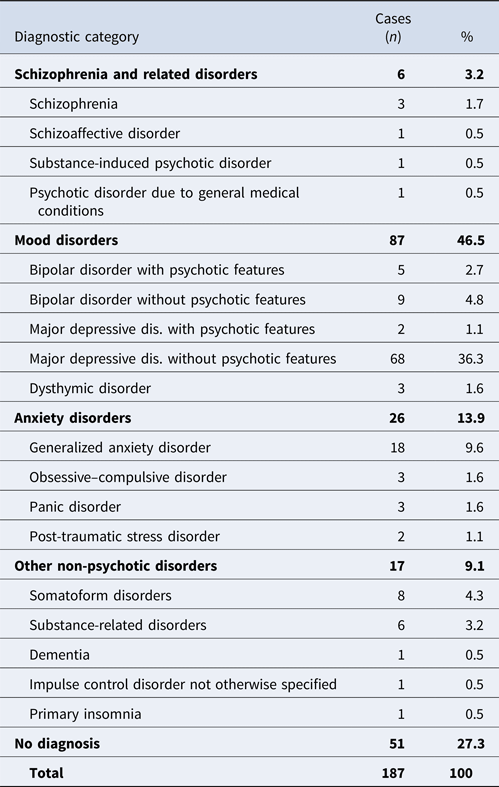
Of the participants with baseline PE (n = 187), 7.0% (n = 13) transitioned to psychotic disorder at follow-up (six with DSM-IV schizophrenia and related disorder; seven with DSM-IV mood disorders with psychotic features; Table 1). Of non-transitioned participants (n = 174); 70.7% (n = 123) had at least one DSM-IV diagnosis at follow-up (46.0% DSM-IV mood disorder without psychotic features, 24.7% other non-psychotic DSM-IV disorder). Details of the follow-up DSM diagnoses are presented in Table 2.
DSM-IV diagnoses at 6-year follow-up in respondents with baseline PE

Factors associated with the presence of any follow-up DSM diagnosis in participants with baseline PE
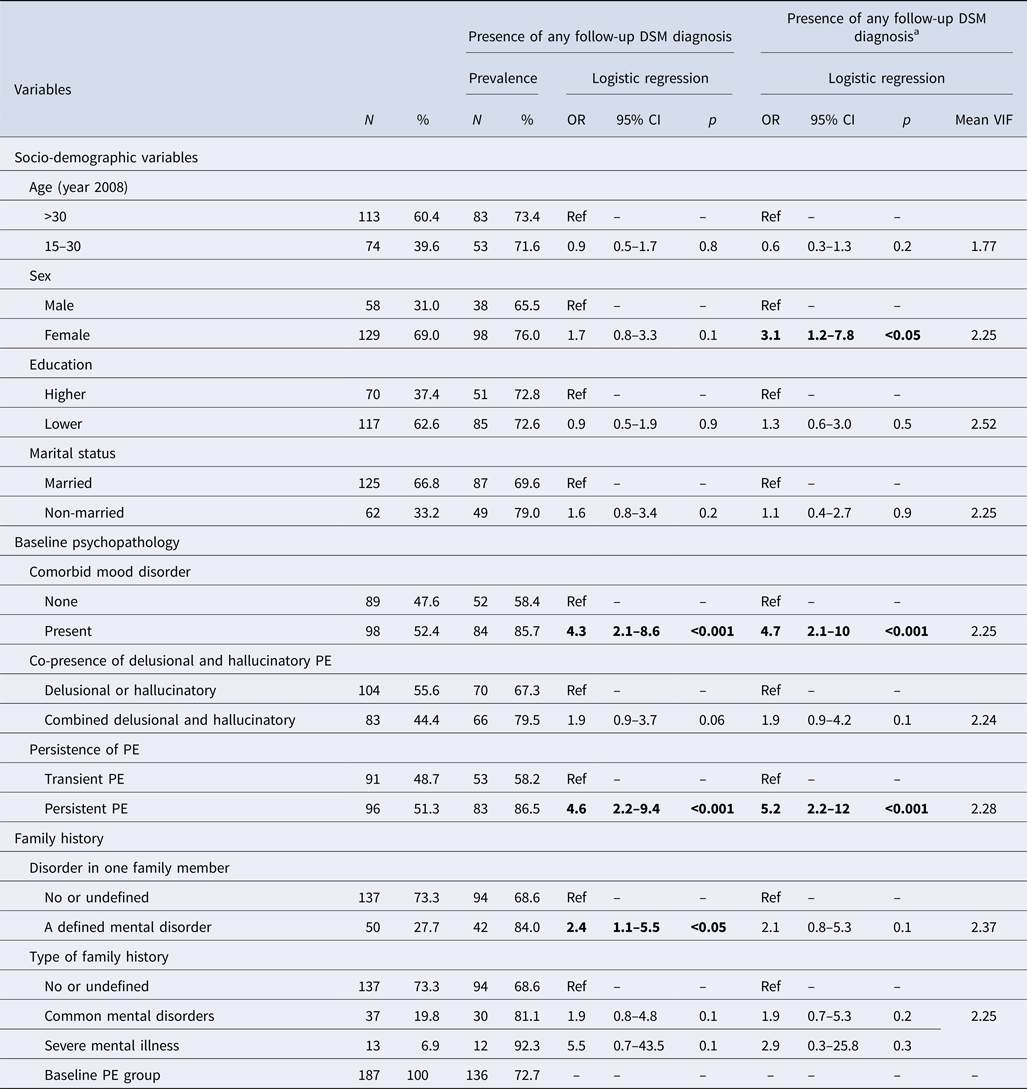
Of participants with baseline PE (n = 187), 72.7% (n = 136) had a DSM-IV diagnosis (psychotic or non-psychotic) at follow-up. Female sex, co-occurrence of mood disorders and persistence of PE predicted any follow-up DSM diagnosis outcome. Family history of any mental disorder was also associated with the presence of follow-up DSM diagnosis, although this association was attenuated on inclusion of other factors (Table 3).
Factors associated with any DSM diagnosis at 6-year follow-up in respondents with baseline PE

a Adjusted for age, gender, marital status, SES proxy, presence of baseline mood disorder, family history of mental disorders, alcohol use, cannabis use and number of life events.
Factors associated with developing a psychotic disorder in comparison with non-psychotic disorder
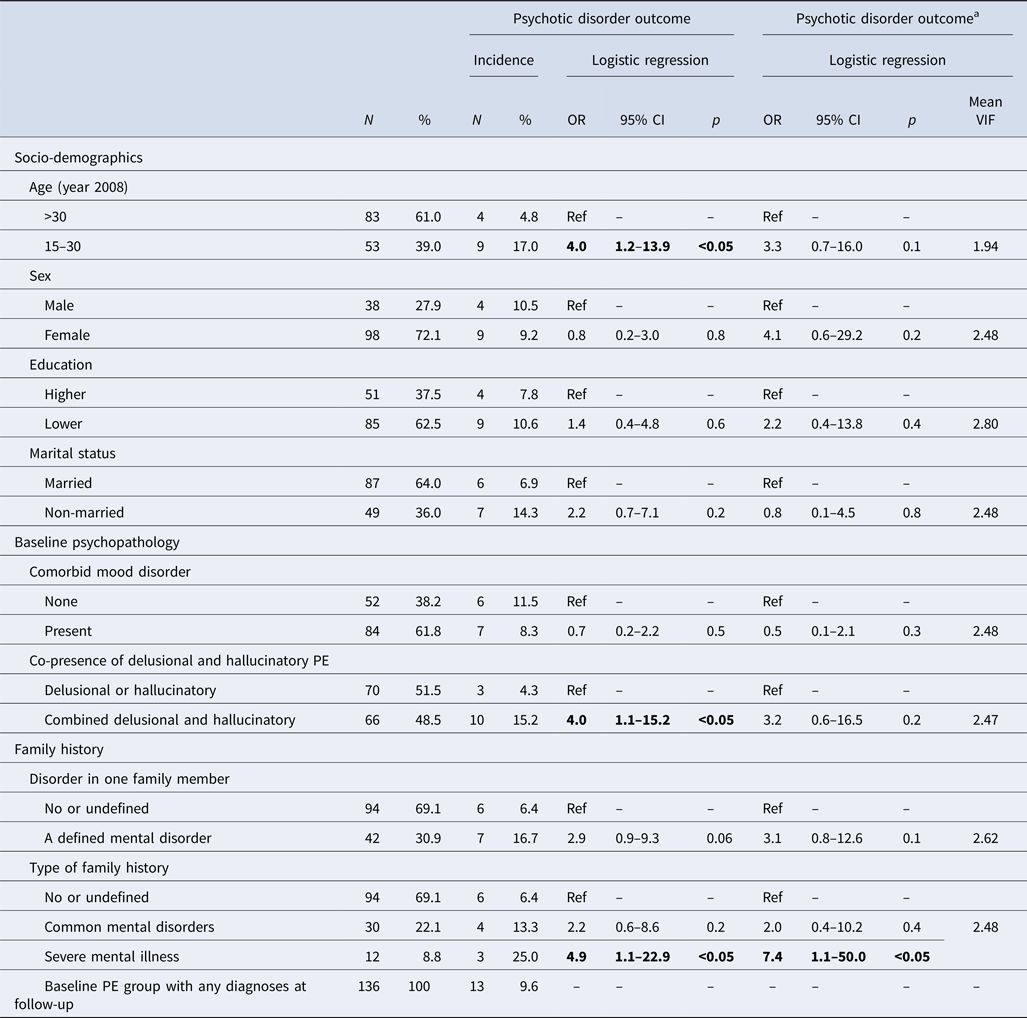
Of the participants with any DSM diagnosis at follow-up (n = 136), 9.6% (n = 13) had a psychotic disorder. Participants in the age range of adolescence or early adulthood (15–30 years old) had more risk to develop a psychotic disorder in comparison with older participants. Furthermore, participants with combined delusional and hallucinatory PE at baseline were more likely to develop a psychotic disorder than participants with only delusional or hallucinatory PE. However, these latter associations were attenuated when adjusted for other factors. Family history of severe mental illness was significantly associated with developing a psychotic disorder in comparison with non-psychotic disorder (Table 4). Tests indicated that no significant multicollinearity was present (Tables 3 and 4).
Factors associated with developing a psychotic DSM disorder v. a non-psychotic DSM disorder at 6-year follow-up in respondents with baseline PE

a Adjusted for age, gender, marital status, SES proxy, presence of baseline mood disorder, family history of mental disorders, alcohol use, cannabis use and number of life events.
Discussion
Follow-up DSM-IV diagnoses in participants with baseline psychotic experiences
The 6-year transition to PD rate in this study of 7.0% (i.e. around 1% per year) is consistent with the previous community-based findings (Kaymaz et al., Reference Kaymaz, Drukker, Lieb, Wittchen, Werbeloff, Weiser, Lataster and van Os2012; Linscott and van Os, Reference Linscott and van Os2013). In total, 70.7% of non-transitioned participants with baseline PE had a DSM-IV diagnosis at follow-up. Forty-six per cent of the non-transitioned participants had a mood disorder. Although any comparison with the UHR literature is problematic, as mentioned earlier, this proportion is similar to a recent UHR study showing that 68.1% of non-transitioned high-risk participants met criteria for at least one disorder and 48.7% met criteria for a mood disorder (Lin et al., Reference Lin, Wood, Nelson, Beavan, McGorry and Yung2015). The prevalence of non-psychotic disorders in participants with baseline PE was higher than the estimates of these disorders in the general population (Topuzoglu et al., Reference Topuzoglu, Binbay, Ulas, Elbi, Tanik, Zagli and Alptekin2015). Furthermore, the follow-up psychotic disorder rate was much lower than the rate of non-psychotic disorders. These findings are in line with previous evidence linking PE with increased risk of later non-psychotic psychopathology (Chapman et al., Reference Chapman, Chapman, Kwapil, Eckblad and Zinser1994; Dhossche et al., Reference Dhossche, Ferdinand, Van der Ende, Hofstra and Verhulst2002; Addington et al., Reference Addington, Cornblatt, Cadenhead, Cannon, McGlashan, Perkins, Seidman, Tsuang, Walker, Woods and Heinssen2011; De Loore et al., Reference De Loore, Gunther, Drukker, Feron, Sabbe, Deboutte, van Os and Myin-Germeys2011; Rossler et al., Reference Rossler, Hengartner, Ajdacic-Gross, Haker, Gamma and Angst2011; Kaymaz et al., Reference Kaymaz, Drukker, Lieb, Wittchen, Werbeloff, Weiser, Lataster and van Os2012; Werbeloff et al., Reference Werbeloff, Drukker, Dohrenwend, Levav, Yoffe, van Os, Davidson and Weiser2012; Kelleher et al., Reference Kelleher, Cederlof and Lichtenstein2014; Sullivan et al., Reference Sullivan, Wiles, Kounali, Lewis, Heron, Cannon, Mahedy, Jones, Stochl and Zammit2014; McGrath et al., Reference McGrath, Saha, Al-Hamzawi, Andrade, Benjet, Bromet, Browne, Caldas de Almeida, Chiu, Demyttenaere, Fayyad, Florescu, de Girolamo, Gureje, Haro, Ten Have, Hu, Kovess-Masfety, Lim, Navarro-Mateu, Sampson, Posada-Villa, Kendler and Kessler2016; Bhavsar et al., Reference Bhavsar, Maccabe, Hatch, Hotopf, Boydell and McGuire2017). Majority of individuals with PE in the general population does not develop a psychotic disorder but still need care for non-psychotic disorders. Outcome of PE over follow-up in the general population appears to take the form of a wide range of mental disorders including bipolar disorder, depression, anxiety disorder, somatoform disorder and impulse control disorder as well as psychotic disorders. It may be useful to consider PE as a risk indicator that has trans-diagnostic value (van Os and Reininghaus, Reference van Os and Reininghaus2016).
Factors associated with the follow-up outcomes of baseline psychotic experiences
The follow-up outcome of baseline PE may be usefully divided into three types (i) no clinical disorder, (ii) non-psychotic disorder (trans-diagnostic phenotype) and (iii) psychotic disorder (psychotic outcome). In addition, a range of moderators may be relevant.
Participants in the adolescent or early adulthood age range had a similar risk of developing a follow-up DSM disorder as older participants. However, they were more likely to be a psychotic disorder outcome of baseline PE than older participants. This finding is in line with the previous studies showing associations between younger age and different levels of the extended psychosis phenotype (van Os et al., Reference van Os, Hanssen, Bijl and Ravelli2000; Verdoux and van Os, Reference Verdoux and van Os2002; van Os et al., Reference van Os, Linscott, Myin-Germeys, Delespaul and Krabbendam2009). Developmental maturation of the frontal cortex and synaptic pruning accelerate during adolescence (Fatemi and Folsom, Reference Fatemi and Folsom2009).The normal neurobiology of the adolescent and early adult human brain may have a unique sensitivity for manifesting psychosis in comparison with older individuals (Hyde et al., Reference Hyde, Ziegler and Weinberger1992; Paus et al., Reference Paus, Keshavan and Giedd2008). However, as psychotic disorders often emerge around the third decade, it should be kept in mind that in excluding the baseline ‘psychosis caseness’, the age-of-onset curve in the remaining sample may have been shifted to the right, resulting in relatively low rates. Therefore, this particular factor might have impacted on the analysis of the effect of age.
Women had a greater risk to develop a follow-up DSM disorder than men, adjusting for other variables. This finding is in line with a recent study, albeit in a help-seeking sample, reporting higher rates of persistent or recurrent non-psychotic disorder in women in a follow-up of a UHR sample (Lin et al., Reference Lin, Wood, Nelson, Beavan, McGorry and Yung2015). However, no significant differences between the sexes were found in risk of developing a psychotic disorder in comparison with non-psychotic disorder. A male excess in psychotic disorder is seen with narrow definitions, whereas broader definitions show a female excess (Castle et al., Reference Castle, Wessely and Murray1993). Our psychotic disorder outcome variable (including both non-affective and affective psychosis) thus may explain why no significant sex difference was found. Participants displaying both delusional and hallucinatory PE at baseline were more prone to psychotic disorder outcome of PE in comparison with participants having only delusional or hallucinatory PE. It has been shown that more severe genetic and environmental risk may underlie the co-presence of delusional and hallucinatory PE at baseline (Smeets et al., Reference Smeets, Lataster, van Winkel, de Graaf, Ten Have and van Os2013), which the current result may predict poorer transition outcomes. The fact that the association between baseline co-presence of delusional and hallucinatory experiences and psychotic outcome was weakened after adjustment for other causes confirms the hypothesis that co-presence of delusional and hallucinatory experiences reflects greater exposure to risk.
PEs are known to be closely associated with non-psychotic disorders at the population level (Linscott and van Os, Reference Linscott and van Os2013). Our results demonstrated that more than half of the participants with baseline PE had a concurrent mood disorder. Participants with both baseline PE and mood disorders had more risk to develop a follow-up DSM diagnosis than participants with PE in isolation. This result is in line with epidemiological studies reporting that greater degree of affective dysregulation predicts help-seeking behaviour and dysfunction associated with PE (van Rossum et al., Reference van Rossum, Dominguez, Lieb, Wittchen and van Os2011; Wigman et al., Reference Wigman, van Nierop, Vollebergh, Lieb, Beesdo-Baum, Wittchen and van Os2012; Guloksuz et al., Reference Guloksuz, van Nierop, Lieb, van Winkel, Wittchen and van Os2015). Nevertheless, baseline co-occurrence of mood disorders with PE was not associated with developing a psychotic disorder in comparison with non-psychotic disorder. This result is in line with a previous finding reporting that mania and depression have a stronger impact below the psychotic disorder end of the spectrum (Binbay et al., Reference Binbay, Drukker, Elbi, Tanik, Ozkinay, Onay, Zagli, van Os and Alptekin2012b). However, the non-significance of the association might also be explained by the fact that the psychotic disorder group was not restricted to non-affective psychosis. A recent study with a clinical sample reported that co-occurrence of depression with PE predicts persistence of PE (Salokangas et al., Reference Salokangas, Schultze-Lutter, Hietala, Heinimaa, From, Ilonen, Loyttyniemi, von Reventlow, Juckel, Linszen, Dingemans, Birchwood, Patterson, Klosterkotter and Ruhrmann2016). Persistence of PE can be considered as a significant marker of emerging psychotic impairment (Dominguez et al., Reference Dominguez, Wichers, Lieb, Wittchen and van Os2011). Furthermore, our results showed that persistence also increases the risk of non-psychotic disorders.
Having a family history of mental disorder significantly increased the risk of having a follow-up DSM diagnosis in participants with baseline PE; however, this association was basically attenuated on inclusion of presence of baseline mood disorders. A plausible explanation is that genetic risk also impacts the risk of baseline mood disorder and can thus be considered on the same causal pathway. Furthermore, participants with a family history of severe mental illness were more prone to psychotic disorder outcome of PE in comparison with participants with no such family history. This result is in line with a previous finding reporting that loading with more severe mental illness was associated with increased risk of the disorder end of the psychosis spectrum (Binbay et al., Reference Binbay, Drukker, Elbi, Tanik, Ozkinay, Onay, Zagli, van Os and Alptekin2012b).Thus, it may be hypothesized that ‘severity’ of familial risk translates to ‘severity’ of the transition outcome.
Strengths and limitations
As far as we know, this is the first longitudinal study in a community-based population that examines follow-up ‘any’ clinical diagnosis of baseline PE based on interviews performed by psychiatrists. The design and the fact that the study was conducted in a representative population-based sample enabled us to include non-help-seeking individuals and so prevent potential help-seeking bias and increased transition rates due to sample enrichment (van Os and Guloksuz, Reference van Os and Guloksuz2017). Furthermore, we were able to take baseline differences in multidimensional psychopathology, socio-demographic features and familial risk may into account. Moreover, the design of the study enabled us to adjust the results for other causes of psychopathology including life events and substances. Nevertheless, the results need to be considered in the light of the following limitations. First, as with most longitudinal studies with general population-based samples, a limitation is the possibility of selection bias caused by differential attrition over time. The comparison of baseline socio-demographic and clinical characteristics between non-participants and participants showed no large or significant differences. Furthermore, the 6-year transition rate from PE to psychotic disorders found in our sample (7.0%) is consistent with previous meta-analytical findings (Kaymaz et al., Reference Kaymaz, Drukker, Lieb, Wittchen, Werbeloff, Weiser, Lataster and van Os2012; Linscott and van Os, Reference Linscott and van Os2013), supporting the present conclusions. Therefore, it is unlikely that attrition would have created bias in results. Second, the low number of participants who transitioned from PE to PD (n = 13) resulted in less than five participants in some subgroups of participants with follow-up psychotic disorder (age categories, sex, education, co-presence of delusional and hallucinatory PE, type of family history; Table 4). Therefore, the analyses with the dependent variable psychotic v. non-psychotic disorder may have insufficient statistical power. Results of these analyses are explorative and need to be replicated. Third, our baseline PE group consisted of individuals with PE either with a duration of at least ‘1 week’ or with a frequency of at least ‘sometimes’ or associated with help-seeking/interference with functioning or enjoying relationships. Thus, these results cannot be generalized to individuals with less severe forms of PE. Furthermore, we considered only the positive dimension of PE, whereas negative and disorganized dimensions are also relevant (van Os and Reininghaus, Reference van Os and Reininghaus2016). Therefore, these results cannot be generalized to negative and disorganized dimensions. Fourth, as we do not have follow-up SCID data of the participants who did not have PE at baseline, we unfortunately cannot introduce control comparisons. Therefore, we compared the prevalence of disorders in participants with baseline PE with the estimates of the disorders in the general population. Fifth, the baseline diagnostic interviews were conducted with a view to identify participants with psychotic disorder (Binbay et al., Reference Binbay, Elbi, Alptekin, Aksu Tanik, Drukker, Onay, Ozkinay, Zagli and Van Os2011). Thus, the baseline DSM-IV diagnoses of some participants were missing. Therefore, we were not able to define the rate of incident common mental disorders in participants with baseline PE. Finally, women were over-represented which may bias towards higher levels of mood and anxiety disorders.
Conclusion
This longitudinal epidemiological study with clinical diagnostic interviews showed that the majority of participants with baseline PE develop a non-psychotic DSM disorder (particularly mood and anxiety disorders) rather than a psychotic disorder. Socio-demographic factors, genetic risk and baseline severity of multidimensional psychopathology may impact on course and outcome of PE. Results may have important implications for the conceptualization of PE, decision-making in high-risk settings and clinical care for individuals with PE seeking help at the level of health services. Future studies should take into account non-psychotic disorder outcome of PE in addition to psychotic disorder outcomes.
Acknowledgements
The authors wish to acknowledge Cengiz Kılıç for providing CIDI 2.1 training, Özen Önen Sertöz for help in lay interviewer training, Nesli Zağlı and Kübra Yıldırım for coordination of the project, lay interviewers for data collection, and all the TürkSch participants who kindly participated.
Financial support
This work is part of the TürkSch project, funded by the Scientific and Technological Council of Turkey 1001 programme, project no: 107S053 and 112S476.
Conflict of interest
None.