Teat-end hyperkeratosis (TEH) is the thickening of the skin in the teat canal and the external orifice due to excessive deposition of keratin. TEH usually happens around the teat orifice and is characterised by the presence of a thick, smooth or rough keratin ring with or without old keratin fronds (Mein et al. Reference Makovec and Ruegg2003). These symptoms are a hyperplasia of stratum corneum caused by forces applied to the teat skin during machine milking. TEH develops slowly and it may take several weeks to become noticeable (Mein et al. Reference Kelly, Tiernan, O'Sullivan and Joyce2001, Reference Makovec and Ruegg2003; Neijenhuis et al. 2001a). The teat canal is the first barrier against penetration of microorganisms into the udder (Hamann, Reference Hamann1987). Therefore, TEH may favour udder invasion with pathogens (O'Shea, Reference Pilla, Schwarz, Konig and Piccinini1987; Besier et al. Reference Besier, Lind and Bruckmaier2016) and increase the risk of infection with clinical (CM) and subclinical (SM) mastitis.
TEH is highly prevalent in dairy cows; according to recent epidemiological studies its prevalence may vary from 16 to 45% (de Pinho Manzi et al. Reference de Pinho Manzi, Nόbrega, Faccioli, Troncarelli, Menozzi and Langoni2012; Paduch et al. Reference Pilla, Malvisi, Snel, Schwarz, Konig, Czerny and Piccinini2012; Sandrucci et al. Reference Reneau and Packard2014). This high prevalence can be from faults in milking machines such as high vacuum level and high teat compression. It can also be from poor milking technique such as slow milking and over-milking (Mein et al. Reference Kelly, Tiernan, O'Sullivan and Joyce2001, Reference Makovec and Ruegg2003; Neijenhuis et al. 2001a). Moreover, TEH has been indicated as a risk factor of CM (Neijenhuis et al. Reference Oliver, González, Hogan, Jayarao, Owens, Oliver, González, Hogan, Jayarao and Owens2001b) and SM (Lewis et al. Reference Hockett, Payne and Rodriguez2000), associated with increased teat-canal microbial load (Paduch et al. Reference Pilla, Malvisi, Snel, Schwarz, Konig, Czerny and Piccinini2012).
In dairy ewes, intramammary infection (IMI) leading either to CM or SM is an issue of major concern with great financial losses for the farmers (Bergonier et al. Reference Bergonier, de Crémoux, Rupp, Lagriffoul and Berthelot2003). Considering the multifactorial nature of mastitis (Gelasakis et al. Reference Gelasakis, Mavrogianni, Petridis, Vasileiou and Fthenakis2015; Bramis et al. Reference Bramis, Gelasakis, Kiossis, Banos and Arsenos2016), TEH could be an important risk factor in dairy ewes. However, to the best of our knowledge there is not such evidence in the literature. Therefore, we tested the hypotheses that: (i) machine milked dairy sheep have a high prevalence of teat-end hyperkeratosis (TEH) and (ii) TEH contributes to udder health problems in dairy ewes.
Materials and methods
Farms and animals
A random sample of 28 semi-intensive dairy sheep farms in Northern Greece was monitored. The average flock had 229 ± 146 (mean ± sd) milking ewes (37% in first lactation) which produced on average 273 ± 71·7 (mean ± sd) kg milk. The average duration of the lactation period was 8·4 ± 1·7 (mean ± sd) months. In these farms a random sample of approximately 20% of each flock was monitored, comprising 1360 milking ewes in total.
Experimental design
A cross-sectional study was used to assess milking procedure, milking parlour characteristics, maintenance and functionality. This assessment was done once, either during morning or afternoon milking, from February to June 2015. During the visit, milking procedures and milking parlour characteristics were recorded using a designated recording sheet. These procedures included pre-stripping, cluster removal after vacuum cessation, post-milking disinfection, if gloves were worn routinely by milkers and number of milkers, from which number of ewes/milker was calculated. Characteristics of milking parlours included type, number of stalls and milking units. Number of milking units was used to calculate number of milking units/milker and number of ewes/milking unit.
Farmers were surveyed to record frequency of cluster replacement and number of milkings/day. Number of milkings/milking unit from the last replacement of clusters until the day of visit was calculated. Moreover, vacuum level, pulsation rate and ratio were measured as indicators of parlour's functionality using ‘Exendis Milking System Analyser, PTV’. These measurements were used to assign milking parlours into four groups: VP1 = <40 kPa and <150 cycles/min, VP2 = <40 kPa and ≥150 cycles/min, VP3 = ≥40 kPa and <150 cycles/min, VP4 = ≥40 kPa and ≥150 cycles/min.
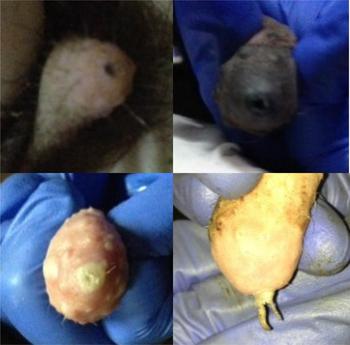
The random sample of 20% of the ewes in each flock was tested for mastitis using the California Mastitis Test (CMT) before milking started. This test was always done by the same veterinarian using the 5-degree CMT scale (0–4) proposed by Schalm et al. (Reference Schwarz, Diesterbeck, Konig, Brugemann, Schlez, Zschock, Wolter and Czerny1971). At the end of milking and immediately after cluster removal, the same ewes were assessed for TEH using teat-end examination. This assessment was done using the scale (1–4) described by Mein et al. (Reference Kelly, Tiernan, O'Sullivan and Joyce2001). The scale was adjusted for dairy ewes (Fig. 1). Following TEH assessment the ewes were assigned into three groups: Group 1 (no or mild TEH) – ewes with both teat-ends scored <3; Group 2 (medium TEH) – ewes with only one teat-end scored ≥3; Group 3 (severe TEH) – ewes with both teat-ends scored ≥3.
Teat-end hyperkeratosis scores of ewe teat-ends: score 1 (top left) – no keratin ring around the teat orifice; score 2 (top right) – a smooth or slightly rough ring around the orifice and no keratin fronds; score 3 (bottom left) – a raised roughened ring with isolated fronds of old keratin extending 1–3 mm from the orifice; and score 4 (bottom right) – a raised ring with rough fronds of old keratin extending >4 mm from the orifice.

Statistical analyses
Frequencies of categorical traits, prevalence of TEH scores at teat and ewe level and means, standard deviation of means, minimum and maximum values of continuous flock traits were calculated.
Variables affecting TEH severity were analysed using ordinal regression analysis with R package ‘MASS’ (Venables & Ripley, Reference Schwarz, Diesterbeck, Konig, Brugemann, Schlez, Zschock, Wolter and Czerny2002). The variables included in the model were selected by calculating a partial correlation matrix for all continuous variables in SPSS 21. From each pair of highly correlated variables (r > 0·500) only one was kept for further analyses. Retained variables were included in ordinal regression analysis with fixed effects of categorical variables (vacuum level, pulsation rate, vacuum cessation and post-milking disinfection). Finally, only variables with significant effects were retained and used for the final model:
 $$Y = {\rm \mu} + V \times P + {\rm \beta} _1 \times {\rm EPM} + {\rm \beta} _2 \times {\rm EPU} + e({\rm Model}\;{\rm 1})$$
where: Y, TEH severity (3 levels, 1 = no or mild, 2 = medium and 3 = severe TEH); μ, intercept; V × P, the fixed effect of the interaction term of Vacuum level (V) and Pulsation rate (P) (4 levels; VP1 = <40 kPa and <150 cycles/min; VP2 = <40 kPa and ≥150 cycles/min; VP3 = ≥40 kPa and <150 cycles/min; VP4 = ≥40 kPa and ≥150 cycles/min); β1, the fixed effect of the regression coefficient of number of ewes/milker (EPM); β2, the fixed effect of the regression coefficient of number of ewes/milking unit (EPU); e, residual.
Similarly, an ordinal regression analysis was used to assess the effect of TEH severity on CMT score:
 $$Z = {\rm \mu} + V \times P + {\rm TEHS} + e({\rm Model}\;{\rm 2})$$
where: Z, CMT score (5 levels: 0–4); μ, intercept; V × P, the fixed effect of the interaction term of Vacuum level (V) and Pulsation rate (P) (4 levels; VP1 = <40 kPa and <150 cycles/min; VP2 = <40 kPa and ≥150 cycles/min; VP3 = ≥40 kPa and <150 cycles/min; VP4 = ≥40 kPa and ≥150 cycles/min); TEHS, the fixed effect of TEH severity (3 levels, 1 = no or mild, 2 = medium and 3 = severe TEH); e, residual.
Results
Descriptive statistics
The studied farms had different types of parallel milking parlours (Supplementary Table S1). Most of the milking parlours had a vacuum level of 40 kPa (14 farms), followed by 38 and 42 kPa (8 and 2 farms, respectively); the remaining four farms had vacuum levels of 36, 37, 39 and 44 kPa. Regarding pulsation rate, 85, 120, 150 and 180 cycles/min were measured in 1 (3·6%), 5 (17·9%), 20 (71·4%) and 2 farms (7·1%), respectively. In the majority of farms the milking parlours were assigned to VP2 and VP4 combinations (10 and 12 farms, respectively); the rest of them were assigned to VP1 (1 farm) and VP3 combinations (5 farms). Finally, pulsation ratio was 50/50 and 60/40 in 15/28 (56%) and 13/28 farms (44%), respectively. The average number of ewes/milking unit and number of ewes/milker was ca. 15 ± 8·5 and ca. 106 ± 51·7, respectively (Supplementary Table S2).
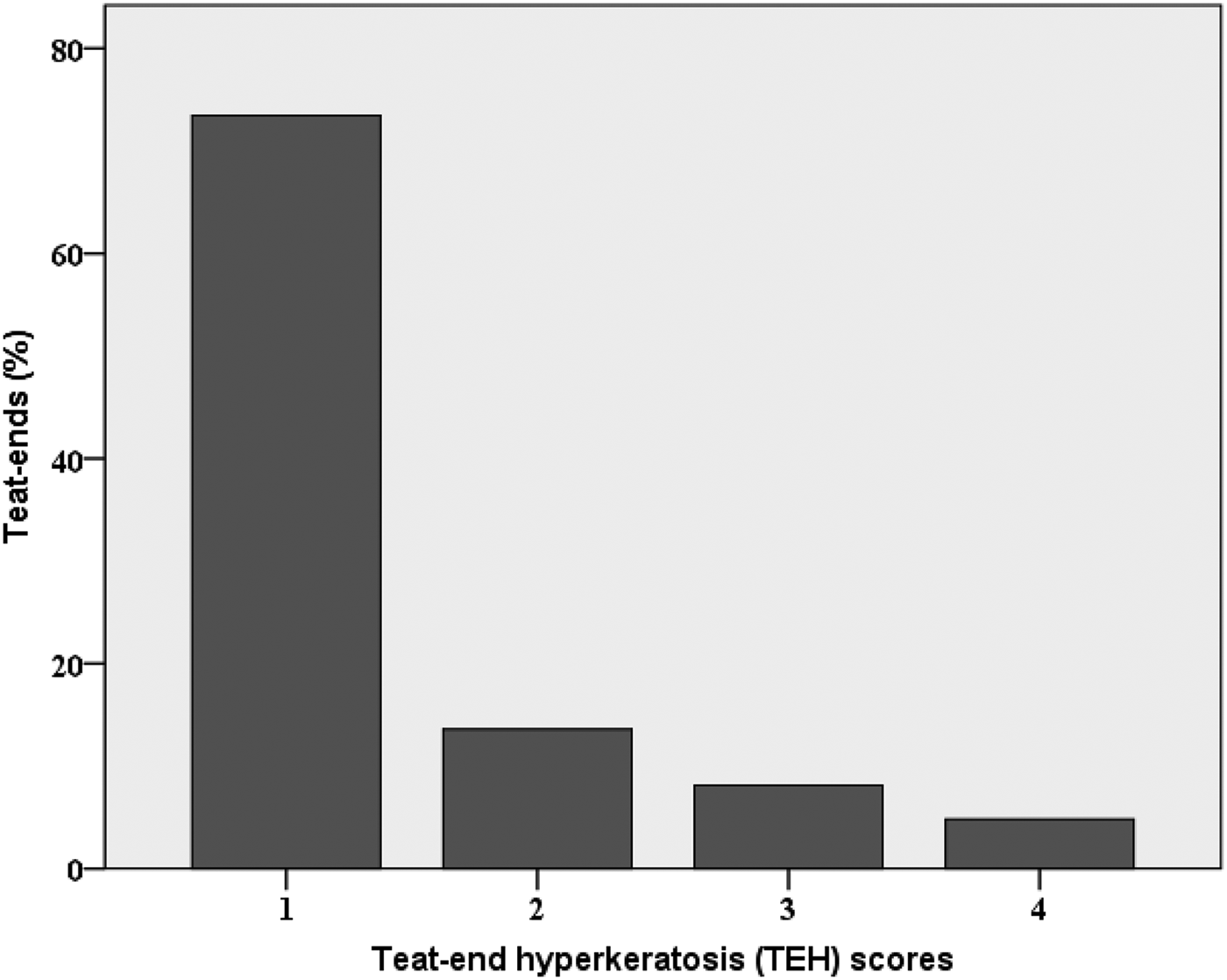
Most of the ewes had CMT score 0 (52·2%), then 4 (22·4%), 1 (9·3%), 2 (8·8%) and 3 (7·2%; Supplementary Fig. S1). Most of the teats had a TEH score 1 (73·5%), then 2 (13·6%), 3 (8·1%) and 4 (4·8%; Fig. 2). Most ewes were in a TEH category of no or mild (82·6%) then severe (8·9%) and medium (8·5%).
Prevalence (%) of teat-end hyperkeratosis (TEH) scores.

Assessment of TEH severity
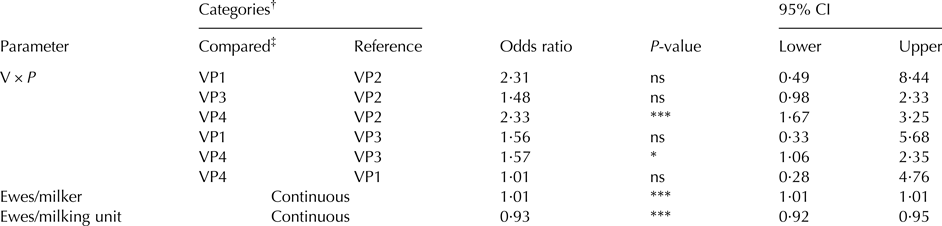
Table 1 summarises the effects on TEH severity. Ewes milked with VP4 combination were 2·33 times more likely to have a one-level increase on TEH severity compared to ewes milked with VP2 combination (P < 0·001) and 1·57 times more likely compared to ewes milked with VP3 combination (P < 0·05). There were no significant differences between the other V × P combinations (P > 0·05). Moreover, the likelihood of a one-level increase on TEH severity was 1·01 times higher for each unit increase in number of ewes/milker (P < 0·001) and 1·08 times higher for each unit decrease in number of ewes/milking unit (P < 0·001).
Odds Ratio, P-value and 95% Confidence Interval (CI) of teat-end hyperkeratosis (TEH) severity (one-level increase) for interaction of vacuum level and pulsation rate (V × P), number of ewes/milker and number of ewes/milking unit

† Categories: VP1 = <40 kPa and <150 cycles/min; VP2 = <40 kPa and ≥150 cycles/min; VP3 = ≥40 kPa and <150 cycles/min; VP4 = ≥40 kPa and ≥150 cycles/min.
‡ V × P pairwise comparisons show the odds of the compared category increasing TEH severity by 1 level compared to the reference category.
***P < 0·001; *P < 0·05; ns P > 0·05.
Effect of TEH and other effects on CMT score
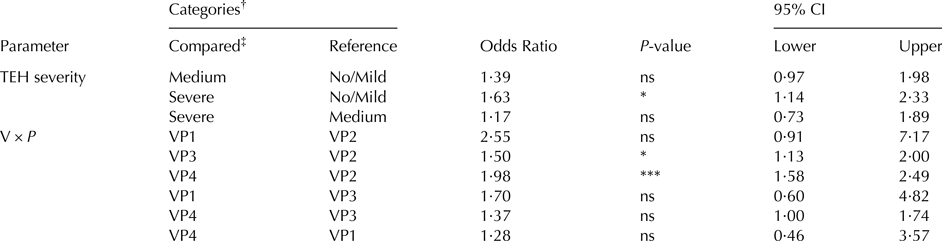
The effects on CMT score are summarised in Table 2. Ewes with severe TEH were 1·63 times more likely to have a one-level increase on CMT score compared to ewes with no or mild TEH (P < 0·05). There were no significant differences between ewes with severe and medium TEH and ewes with medium and no or mild TEH (P > 0·05). Moreover, ewes milked with VP4 and VP3 combinations were significantly more likely to have a one-level increase on CMT score compared to ewes milked with VP2 combination (1·98, P < 0·001 and 1·50, P < 0·05, respectively); no significant differences were observed when comparisons were made between the other V × P combinations (P > 0·05).
Odds Ratio, P-value and 95% Confidence Interval (CI) of California Mastitis Test (CMT) score (one-level increase) for teat-end hyperkeratosis (TEH) severity and interaction of vacuum level and pulsation rate (V × P)

† Categories: VP1 = <40 kPa and <150 cycles/min; VP2 = <40 kPa and ≥150 cycles/min; VP3 = ≥40 kPa and <150 cycles/min; VP4 = ≥40 kPa and ≥150 cycles/min.
‡ TEH severity and V × P pairwise comparisons show the odds of the compared category increasing CMT score by 1 level compared to the reference category.
***P < 0·001; *P < 0·05; ns P > 0·05.
Discussion
We found that approximately 13% of teats had a TEH score ≥3. Additionally, about 18% of ewes had medium or severe TEH. TEH severity was affected by the combination of vacuum level and pulsation rate of milking parlour. Ewes milked with high-high combination (VP4) were more likely to have higher TEH severity compared to ewes milked with low vacuum level and high pulsation rate (VP2) or high vacuum level and low pulsation rate combination (VP3). Additionally, the likelihood of higher TEH severity increased when the number of ewes/milker increased and decreased when the number of ewes/milking unit increased. Finally, ewes with severe TEH were also more likely to have higher CMT score. Therefore, the results confirmed our initial hypotheses.
The prevalence of severe TEH (sum of scores 3 and 4) in teats of milked ewes was lower than in studies with dairy cows; de Pinho Manzi et al. (Reference de Pinho Manzi, Nόbrega, Faccioli, Troncarelli, Menozzi and Langoni2012) and Paduch et al. (Reference Pilla, Malvisi, Snel, Schwarz, Konig, Czerny and Piccinini2012) reported prevalence of 39·4 and 44·4%, respectively. However, Sandrucci et al. (Reference Reneau and Packard2014) found a similar prevalence (ca. 16%). In the present study, the combined prevalence of medium and severe TEH at ewe-level was approximately 18%. The latter is considered an acceptable prevalence in dairy cows (Mein et al. Reference Kelly, Tiernan, O'Sullivan and Joyce2001). Therefore, our results are similar to some studies in cows.
Vacuum level and pulsation rate are likely to affect TEH severity because of the combination of applied pressure and application time during milking. In dairy cows, TEH severity is closely related to the pressure in the teat skin during milking and the amount of time the pressure is applied. Applied pressure is the combination of vacuum level and pulsation rate; extra pressure is applied by the closed liner as it bends around the teat-end in each pulsation cycle (Mein et al. Reference Makovec and Ruegg2003).
In the case of VP4 combination, extreme pressure is applied to teats which increased TEH severity. This confirms the findings of Ryšánek et al. (Reference Pitkala, Haveri, Pyorala, Myllys and Honkanen-Buzalski2001), who suggested that the intense extraction of milk initiates a loss of keratin layer. The latter leads to overproduction of keratin from keratinocytes which results in the formation of a keratin ring around the teat orifice. When ewes are milked with VP1 combination the pressure is lower due to low vacuum level and pulsation rate. This low pressure makes milk extraction slower, prolonging milking with the pressure applied for a much longer time. This increase in time could also increase the risk of higher TEH severity. The latter hypothesis was not confirmed by the results of our study. However, only a small number of ewes were milked with VP1 combination and we expect that with more animals there would be significant differences between VP1 combination and V2 and V3 combinations. Milking with VP2 or VP3 combinations decreased the risk of TEH. This could be the result of a better balance between applied pressure and application time. Therefore, farmers should find the proper balance between vacuum level and pulsation rate to avoid TEH.
Dairy sheep farms in Greece have few milkers and small milking palours compared to the size of the flocks. When there are too many ewes per milker then milking is inefficient because of delays between attachment and detachment of clusters for each ewe. Such delays can cause over-milking. In dairy cows, over-milking contributes to TEH (Mein et al. Reference Kelly, Tiernan, O'Sullivan and Joyce2001). In dairy ewes, over-milking changes teat thickness (Peris et al. Reference Pillai, Kunze, Sordillo and Jayarao2003) but we did not find any references about how this causes more TEH. Therefore, effects of over-milking on ewes’ TEH should be further researched and include milking time of individual ewes and milking practices. Automatic cluster removal would reduce the time that clusters are on the teat and consequently over-milking and TEH. These automatic clusters, however, are rarely used by sheep farmers in Greece and other countries where considerable numbers of dairy sheep are raised. Therefore, farmers should consider the health benefits of automatic clusters when upgrading or installing milking parlours.
The negative association between number of ewes per milking unit and TEH severity could also be explained on the basis of time for which clusters remain on teats. For a fixed number of milkers, more ewes per milking unit increase total milking time. In such case, milkers possibly work faster and consequently remove clusters on time. For a fixed flock size, more ewes per milking unit are the result of a smaller milking parlour. In smaller milking parlours, milkers have to walk a shorter distance which could also facilitate the removal of clusters on time.
We found that ewes with severe TEH were more likely to have higher CMT score compared to ewes with no or mild TEH. This relationship indicates a negative effect of TEH on udder health of dairy ewes. This is because CMT score is a direct indicator of milk somatic cell counts (SCC) and an indirect indicator of SM (González-Rodríguez & Cármenes, Reference González-Rodríguez and Cármenes1996; Lafi, Reference Lafi2006). Therefore, farmers should aim to reduce TEH because it will also improve udder health and make their flock more productive.
To the best of our knowledge, this is the first study to link TEH with udder health in dairy ewes. In dairy cows, de Pinho Manzi et al. (Reference de Pinho Manzi, Nόbrega, Faccioli, Troncarelli, Menozzi and Langoni2012) showed that cows with high TEH scores were 30% more likely to develop CM. Moreover, Neijenhuis et al. (Reference Oliver, González, Hogan, Jayarao, Owens, Oliver, González, Hogan, Jayarao and Owens2001b) reported that the risk of CM was higher in udder quarters having teat-ends with increased thickness and roughness. Several studies (Gleeson et al. Reference Gleeson, Meaney, O'Callaghan and Rath2004; Sandrucci et al. Reference Reneau and Packard2014; Zoche-Golob et al. Reference Tomazi, Goncalves, Barreiro, Arcari and Dos Santos2015), found no significant relationship between TEH and SM using milk SCC as an indicator. Lewis et al. (Reference Hockett, Payne and Rodriguez2000), however, , found that teat-ends with severe TEH had a higher CMT score compared to mild TEH teat-ends when CMT score was used as an indicator of SM. The latter study supports the results of our study. Therefore, it is likely that TEH contributes to SM in dairy ewes.
Teats with severe TEH scores have a thick and rough ring around teat orifice (Mein et al. Reference Kelly, Tiernan, O'Sullivan and Joyce2001). This thick ring affects teat-end's tight closure and microorganisms can enter into the teat canal. The rough ring has cracks which bacteria can enter (Neijenhuis et al. 2001a). Hence, ewes with thick and rough rings in both teat-ends have a higher risk of udder invasion with pathogens and consequently a higher risk of SM. Nevertheless, to support this statement, a study focused on the isolation of pathogens from the milk of ewes with high TEH scores is needed. Also, research on teat-ends local defence mechanisms against pathogens could possibly reveal a negative effect of TEH.
Conclusion
In conclusion, we found the first association between TEH and udder health in dairy ewes. TEH is common in Greek dairy ewes and contributes to udder health problems. Dairy farmers can avoid TEH by optimising vacuum level and pulsation rate of the milking parlour, number of ewes/milker and number of ewes/milking unit. Reducing TEH severity will improve udder health and is potentially important for productivity and welfare of ewes. Further research to establish milking machine standard operating procedures could further help reduce TEH prevalence and enhance udder's hygiene status.
The authors thank Ms Sofia Termatzidou, Ms Panagiota Kazana, Mr Markos Managos and Mr Theodoros Panos for their assistance in field work. Moreover, the company ‘Milkplan S.A. - farming technologies’ is acknowledged for providing financial support and equipment that enabled the research team to undertake the study.
Supplementary material
The supplementary material for this article can be found at https://doi.org/10.1017/S0022029917000887.