Introduction
The rice leaf folder, Cnaphalocrocis medinalis (Guenée), an important insect pest of rice crop causes severe outbreaks in many Asian countries, including China, Pakistan, India, Japan, Korea, Malaysia, Sri Lanka and Vietnam (Wada et al., Reference Wada, Kobayashi and Shimazu1980; Heong, Reference Heong, Hu, Guo and Li1993). In China and Southeast Asia, it migrates and results in rice crop yield losses by 20–30% (Shen et al., Reference Shen, Zhang, Zhao and Xue1988; Shepard et al., Reference Shepard, Barrion and Litsinger1995). More than 25.3 million hectares of rice fields were damaged by this pest in South China during 2007, which was higher than all outbreaks over past 20 years (Liu et al., Reference Liu, Wang, Feng and Jiang2008). It may result in up to 80% yield losses in rice crop if not properly managed (Prabal & Saiki, Reference Prabal and Saiki1999). Major yield losses of rice are positively connected with the larval leaf damage (Bautista et al., Reference Bautista, Henirichs and Rejesus1984). Infestation sometimes causes leaf necrosis suppressing the growth of tillers (Mishra et al., Reference Mishra, Singh and Perwez2006). Alternative host plants for rice leaf folder include many cultivated crops (maize, sorghum, sugarcane and wheat), sedges and different graminaceous grasses (Khan et al., Reference Khan, Abene and Fernandez1996). But the host preference of the rice leaf folder under different temperatures is ambiguous.
Abiotic factors mainly regulate insect pest populations by limiting or supporting their survival and reproduction. Two major factors, i.e. temperature and food affect population distributions by direct affecting their behavior and physiology or by indirect altering the host quality and abundance (Harrington et al., Reference Harrington, Woiwod and Sparks1999; Parmesan et al., Reference Parmesan, Ryrholm, Stefanescu, Hill, Thomas, Descimon, Huntley, Kaila, Kullberg, Tammaru, Tennent, Thomas and Warren1999; Hughes, Reference Hughes2000; Bale et al., Reference Bale, Masters, Hodkinson, Awmack, Bezemer, Brown, Butterfield, Buse, Coulson, Farrar, Good, Harrington, Hartley, Jones, Lindroth, Press, Symrnioudis, Watt and Whittaker2002; Andrew & Hughes, Reference Andrew and Hughes2007). According to some climate studies, the temperature of the earth surface has increased after 19th century by 0.6 ± 0.2°C due to the results of anthropogenic factors. Furthermore, different climatic models predict that temperature will rise by 1.4–5.8°C by 2100 (IPCC, 2001). Under these circumstances, it is crucial to check the relationship of temperature with food preference of insects. Insect host orientation and settling preference are determined by performing the choice tests that involves selection and suitability of the host plant sites in which insects have an option for acceptance and rejection (Smith et al., Reference Smith, Khan and Pathak1994).
Meanwhile, living organisms can adapt to temperature variations by thermal acclimation (Huey & Berrigan, Reference Huey, Berrigan, Johnston and Bennett1996; Angilletta et al., Reference Angilletta, Niewiarowski and Navas2002). It is a process in which an organism adjusts itself to change in climatic temperature and may establish into a number of behavioral and physiological traits for thermal preference and resistance (Angilletta et al., Reference Angilletta, Niewiarowski and Navas2002; Lagerspetz, Reference Lagerspetz2006). These traits, under thermal acclimation, have been extensively studied in various living organisms from insects to mammals, both in the laboratory and field conditions, and may vary between different populations, species or even ontogeny (Wilson et al., Reference Wilson, James and Johnston2000; Grigaltchik et al., Reference Grigaltchik, Ward and Seebacher2012). For example, the heat-escape temperature of aphids decreased as acclimation temperature increased from 25 to 36°C (Ma & Ma, Reference Ma and Ma2012). However, some insects and small crustaceans were failed to acclimate their locomotory performance (Schuler et al., Reference Schuler, Cooper, Storm, Sears and Angilletta2011; Niehaus et al., Reference Niehaus, Wilson, Storm and Angilletta2012).
Effects of temperature on the survival, development and reproduction of rice leaf folder have been studied (Wada & Kobayashi, Reference Wada and Kobayashi1980; Padmavathi et al., Reference Padmavathi, Katti, Sailaja, Padmakumari, Jhansilakshmi, Prabhakar and Prasad2013; Liao et al., Reference Liao, Qian and Liu2014; Park et al., Reference Park, Ahn and Park2014). The threshold temperatures of development in egg, larvae and pupa were 12.5, 12.2 and 14.2°C, respectively, and temperature 30°C arrested the development of larva but not the egg and pupa (Wada & Kobayashi, Reference Wada and Kobayashi1980). The temperature ranges for survival of egg, larva and pupa of rice leaf folder were 19–31, 22–28 and 22–31°C, respectively, and the survival rates were the highest at 25–26°C (Wu & Zhang, Reference Wu and Zhang1984; Zhang & Gu, Reference Zhang and Gu1989). The rice leaf folders reared at constant 30°C or more produced less or no fertile eggs (Liao et al., Reference Liao, Huang, Fang and Liu2013). The copulation frequency of rice leaf folders decreased when adults were exposed to 40°C (Liao et al., Reference Liao, Qian and Liu2014).
The characteristic behavior of larval rice leaf folder is to make leaf roll longitudinally by stitching up opposite rims of a rice leaf, and feed inside by scraping mesophyll (Fraenkel & Fallil, Reference Fraenkel and Fallil1981; Fraenkel et al., Reference Fraenkel, Fallil and Kumarasinghe1981). This kind of shelter-building is a common behavioral habit of the Lepidoptera. This habit provides benefits for insect themselves, such as sunshine shielding (Sandberg & Berenbaum, Reference Sandberg and Berenbaum1989), enhancement in microclimate (Larsson et al., Reference Larsson, Haggstrom and Denno1997) and protection from the natural enemies (Eubanks et al., Reference Eubanks, Nesci, Petersen, Liu and Sanchez1997). If the capacity of larva to make leaf fold was impacted by heat stress, the rice leaf folder would be subjected to more harm than the direct injury of heat.
We presumed that the high temperature would impact the behaviors of larval rice leaf folders to choose host plant and make leaf fold, and lead to a great decline of population in the hot seasons. Therefore, our objectives were to illustrate effects of high temperature on larval feeding behaviors, such as host choice, preference and making leaf fold. The results will assist in better understanding of roles of thermal stresses in feeding behavior of rice leaf folders, and aid the monitoring, forecasting and management of this important rice insect pest.
Materials and methods
Insects and host plant
The rice leaf folder larvae were collected from Experimental Station of Nanjing Agricultural University, Nanjing, China during 2010 and mass reared on maize seedlings in a climate incubator at 25 ± 2°C, 60 ± 10% RH and 14L: 10D photoperiod by following the method by Liao et al. (Reference Liao, Huang and Liu2012). The insects were reared for 5 years on maize seedlings in laboratory.
The test host plants were maize, rice and wheat seedlings, which are the main grain crops in China. Rice and maize are sympatric crops usually planted synchronously. Wheat is one of host plants of rice leaf folder (Khan et al., Reference Khan, Abene and Fernandez1996). During the spring harvest of 2014–2015, rice leaf folders were noticed on wheat from seedling stage to ear head formation stage in India, and the extent of damage ranged from 30 to 100% (Murthy et al., Reference Murthy, Nagaraj, Prabhuraj and Kalleswaraswamy2015). Moreover, this insect was also reared and maintained very well using wheat seedlings in laboratory, and their biological traits were as similar as those reared on maize (Zhu et al., Reference Zhu, Qian and Liu2015). The rice leaf folders reared on maize and wheat can use rice seedlings well (Liao et al., Reference Liao, Huang and Liu2012; Zhu et al., Reference Zhu, Qian and Liu2015). Therefore, we measured the host preference of rice leaf folder after heat stress for these three potential host plants: rice, maize and wheat. All host plants were cultured in the plant growth houses. The chosen plants for experiments were of similar biomass.
Host preference of larvae experienced heat stress
The larvae on maize seedlings were exposed to 34, 37 and 40°C from 27°C in a climate chamber for 4 h with constant light and 60–70% RH. The larvae were maintained at 30°C for 30 min for acclimation before 34°C treatment. Before 37°C treatment larvae were placed at 30°C (30 min) and 34°C (30 min). For 40°C treatment larvae were acclimatized at 30°C (30 min), 34°C (30 min) and 37°C (30 min). Before choice test for maize, rice and wheat leaves, these treated larvae were starved 2 h at 27°C. The first, second, third, fourth and fifth instar larvae of rice leaf folder were exposed to different temperatures and provided with a choice of 6 cm long leaf cuts of three test plants in separate three-choice experiment. For the three-choice tests, two leaf cuts of maize, wheat and rice host, were arranged equidistantly, along the edge of a Petri dish (20 cm diameter) and lined with moist filter paper. Twenty larvae of each instar of C. medinalis were released in the center of the petri dish. The Petri dish was covered with a lid and sealed with parafilm to avoid the escape of the larvae. The larval preference and number of larvae found on the upper surface, lower surface of the leaf cuts and out of leaf (settling position) were recorded at intervals of 5, 10, 15 and 20 min after release. The experiment was replicated three times, and each temperature treatments tested total of 60 larvae.
Leaf folding behavior of larvae under heat stress
Ten eight-day-old maize seedlings with a part of stems covered with wet cotton were put into a glass test tube (diameter 15–16 mm, height 200–220 mm), and then ten third, fourth or fifth instar larvae were released on the tips of seedlings. The larvae were exposed directly to 27, 34, 37 and 40°C in a climate chamber for 10 min with constant light and 50–70% RH. After 10 min, numbers of leaf fold made by these larvae were observed. Experiment was replicated three times for each temperature treatment, and ten larvae were used for each replication.
To observe the thermal acclimation effects on the larval leaf folding behavior, three kinds of temperature acclimation program were designed, program I: 27°C for 10 min → 30°C 10 min → 32°C 10 min → 34°C 10 min → 37°C 10 min → 40°C 10 min; program II: 27°C 10 min → 32°C 10 min → 37°C 10 min → 40°C 10 min; and program III: 27°C 10 min → 37°C 10 min → 40°C 10 min with constant light and 50–70% RH. Ten larvae (third, fourth or fifth instar) were released on the tips of ten eight-day-old maize seedlings in a glass test tube. Test tube was placed in a climate chamber and started each of the above designed temperature program, respectively. When one step of the temperature program ended, leaf folds made by these larvae were observed and these ten larvae were released on fresh seedlings for the next step of the temperature program. This experiment was replicated four times for each acclimation programs.
Data analysis
The larvae choice frequencies to settle on maize, rice and wheat leaves were used to show the host choice preference, and larvae frequencies to settle on upper, lower surface of leaves and out of leaves were considered as the settling position preference in this study. The generalized linear model (GLM) was used to check the effects of temperature, larvae instar and observation time on choice frequency to leaves of maize, rice and wheat, or on settling frequency to upper, lower and out of leaf, and the observation time was considered as a repeated measurement variable. The arc sine transformation was used for all the ratio data before statistical analysis in order to meet the requirement of normalization. The numbers of leaf fold made by larvae under different temperatures were analyzed by the one-way ANOVA. If there were significant differences among means, multiple comparisons of means were performed using the Tukey's HSD post hoc comparisons method. The effect of acclimation on capacity of larvae to make leaf fold was analyzed by GLM using the different acclimation temperatures as a repeated measurement. The numbers of leaf fold made by larvae at 40°C for 10 min among three kinds of acclimation were analyzed by ANOVA. These analyses were performed with SPSS statistics software V17.0.
Results
Effect of high temperature on host preference of larvae
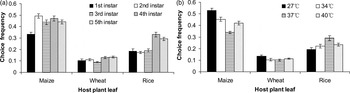
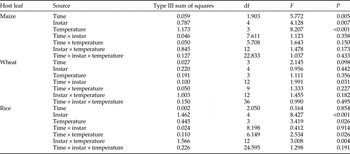
Host preference of C. medinalis larvae for maize was strongly dependent on larval instar, temperature, and observation time, and there were no significant interactions between the three factors (table 1). The choice frequency of the first instar to maize was lower than that of the second- to fifth instar (fig. 1a). The choice frequency to maize decreased with a rise of temperature (fig. 1b). The choice frequency to wheat was not affected by larval instar, temperature and observation time, and there was only a significant interaction between larval instar and observation time (table 1, fig. 1). The choice frequency to rice was significantly affected by larval instar and temperature, and there were significant interactions between temperature and instar or observation time (table 1). The choice frequencies of fourth- and fifth-instar to rice were higher than that of the first- to third instars (fig. 1a). The frequency of larvae chosen rice increased as the temperature increased from 27 to 37°C (fig. 1b). The rice leaf folder larvae preferred maize leaves to rice and wheat at the normal temperature 27°C, but the preference for rice leaves became stronger after exposure to high temperature (fig. 1).
Choice frequency (mean ± SE) of different instar larvae (a) and larvae at different temperatures (b) to maize, wheat and rice leaves. Data from different observation intervals were pooled.

Effects of temperature, larvae instar and observation time on choice frequency of rice leaf folder larvae to maize, wheat and rice leaves.

Effect of high temperature on settling preference of larvae
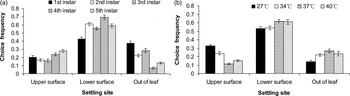
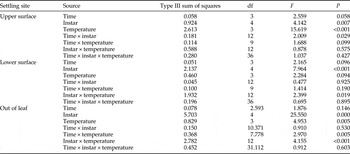
The high temperature and larvae instar significantly affected the settling site choice of larvae (table 2). The older larvae settling on the upper and lower surface of leaves were more than the young ones, and settling out of leaves were less (fig. 2a). The settling frequency of larvae on upper surface of leaves decreased with the rise of temperature, followed by an increase of settling frequency on lower surface (fig. 2b). When temperature rose, the larval frequency not to find a leaf was increased (fig. 2b).
Settling frequency (mean ± SE) of different instar larvae (a) and larvae at different temperatures (b) on the upper surface, lower surface and out of leaf. Data from different observation intervals were pooled.

Effect of temperature, larvae instar and observation time on the settling frequency of rice leaf folder larvae on upper and lower surfaces, and out of leaf.

Effect of high temperature on making leaf fold behavior of larvae
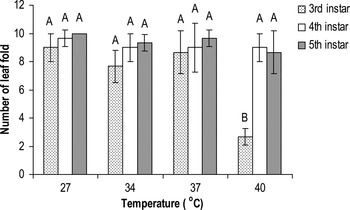
Capacity of the third instar larvae to make leaf fold was decreased when larvae were directly exposed to temperature of 40°C for 4 h (F 3,8 = 20.800, P < 0.001), whereas the high temperatures of 34 and 37°C did not affect this capacity (fig. 3). High temperatures (34, 37 and 40°C) did not affect this capacity of the fourth (F 3,8 = 0.250, P = 0.859) and fifth (F 3,8 = 1.296, P = 0.341) instar larvae to make leaf fold (fig. 3).
The number of leaf fold made by ten third, fourth and fifth instar larvae during 10 min (mean ± SD) under different temperatures. The different alphabetic capital letters show significant differences among different temperatures (P < 0.05, Tukey's test).

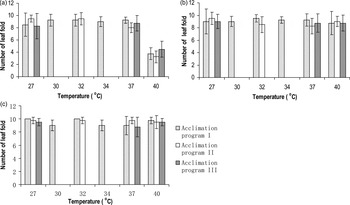
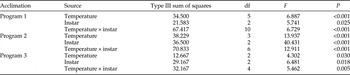
Temperature and larval instar significantly affected the capacity of larvae to make leaf fold (table 3). The short-term heat acclimation could not improve the capacity of the third instar larvae to make leaf folds at 40°C, and the numbers of leaf fold were still significantly less at 40°C than that at 27, 30, 32, 34 and 37°C under three kinds of heat acclimation (table 3, fig. 4a). The capacities of larvae making leaf fold at 40°C were not significantly different among three kinds of acclimation (for the third instar: F 2,9 = 1.357, P = 0.305; the fourth instar: F 2,9 = 0.043, P = 0.958; the fifth instar: F 2,9 = 0.158, P = 0.856, fig. 4).
Mean number of leaf fold (mean ± SD) made by ten third (a), fourth (b) and fifth instar (c) larvae during 10 min under three short-term heat acclimation programs (programs I, II and III).

Effects of temperature and larval instar on the capacity to make leaf roll of rice leaf folders under three kinds of temperature acclimation.

Discussion
Temperature affects host preference
Out of all abiotic factors, temperature is the most crucial one, which exerts profound effects on the development, biology, distribution and abundance of insects (Braman et al., Reference Braman, Sloderbeck and Yeargan1984). The result of the present study demonstrated that heat stress affected host preference of larval rice leaf folders. The larvae reared on maize seedlings generally preferred maize leaves under the normal temperature, but they preferred rice leaves when they experienced heat stress. The previous study illustrated that the rice leaf folders fed on rice seedlings were more heat-resistant than fed on maize seedlings (Liao et al., Reference Liao, Huang, Fang and Liu2013). Therefore, these results imply that the rice leaf folder has the capacity to actively choose a suitable host plant under heat stress, and populations on rice can persist longer than on the maize or wheat host plant in hot summer conditions. Similarly, stick-insect preference for nutritionally rich host plant was increased with the increasing temperature (Nosil et al., Reference Nosil, Riesch and Muschick2013). Whereas, large pine weevil, Hylobius abietis, showed strong host preferences at high and low thermal stress and relaxed at medium temperature (Leather et al., Reference Leather, Ahmed and Hogan1994).
The first instar larvae showed a lower capacity to find a host plant leaf after they were exposed to high temperature, but the fourth and fifth instar larvae showed a strong capacity. The result reveals that the young larvae of rice leaf folders are less tolerant to high temperature than the older ones, and these results are in accordance with the laboratory studies on Cydia pomonella that the fifth instar was the most heat-resistant life stage (Wang et al., Reference Wang, Yin, Tang and Hansen2004; Burgi & Mills, Reference Burgi and Mills2012), and Nilaparvata lugens nymphal life stage was less heat tolerant than the adults (Piyaphongkul et al., Reference Piyaphongkul, Pritchard and Bale2012). Insect larvae developing in different seasonal parts may face quite different ecological conditions, including availability and suitability of host plants (Alonso & Herrera, Reference Alonso and Herrera2000; Rodrigues & Moreira, Reference Rodrigues and Moreira2004). As a consequence, the localities containing the suitable host plants grown in different microtopographic or microhabitat conditions could be important to support the insect populations in long term, and some food plants may be better choice than others to increase the number of insect generations (Hunter & McNeil, Reference Hunter and McNeil1997; Wedell et al., Reference Wedell, Nylin and Janz1997). From these results, it can also be speculated that rice leaf folder can expand their range to less-preferred (secondary) food plants when climatic conditions are suitable, in order to reduce the intraspecific competition. Similar effects of high temperature were reported on the host preference of pine processionary caterpillar (PPC), Thaumetopoea wilkinsoni Tams, and high temperature blurred the host selectivity of PPC larvae, which could increase selection to other less favorite pine species (İpekdal & Çağlar, Reference İpekdal and Çağlar2012).
Temperature affects settling preference
The poikilothermic insects maintain their body temperature range by different physiological and behavioral means which may include some processes, such as convection, radiation, metabolism and evaporation during different activities (Heinrich, Reference Heinrich1993). Most probably the effective and common mechanism to regulate insect body temperature is behavioral control through short-term microhabitat selection especially shaded or sunny substrates (May, Reference May1979; Casey, Reference Casey and Heinrich1981). Results from this study indicated that high-temperature stress led rice leaf folder larvae to choose lower surface of leaves for settling. In field, the temperature on the lower surface of leaf is usually lower than the upper surface in sunny days during the summer. Settling preference for lower surface is beneficial for larvae to avoid heat stress. Different insects inhabiting life activities have been reported previously avoiding the heat stress by moving toward canopy shades and vegetation covers (Pincebourde et al., Reference Pincebourde, Sinoquet, Combes and Casas2007; Barton & Schmitz, Reference Barton and Schmitz2009; Kearney et al., Reference Kearney, Shine and Porter2009). Free living insect can move and disperse from one locus to another in response to deleterious high temperatures. In hot periods of a day, individuals of Rhopalosiphum padi were found beneath soil (Wiktelius, Reference Wiktelius1987), and tenebrionid beetles climbed up bushes or buried themselves beneath sand surface to survive the lethality of high temperature (Ward & Seely, Reference Ward and Seely1996). According to our results that rice leaf folder larvae preferred the lower surface of leaves after treated by high temperatures, those are similar with the observations of R. padi and Sitobion avenae which moved to back side of leaves from the upper side to avoid higher temperatures (Ma & Ma, Reference Ma and Ma2012). However, the larval rice leaf folder settling on lower surface of leaf cannot normally make a fold to hide and feed, because the larva usually folds leaf longitudinally with the upper surface inside the fold (Islam & Karim, Reference Islam and Karim1997). Alternatively, in rice field, the larva might choose to make a leaf fold to avoid high temperature rather than to hide lower surface of leaf. We found that the capacities of the fourth- and fifth-instar larvae to make leaf folds were not impacted by high temperatures from 34 to 40°C, although the capacity of the third-instar larvae became lower at an extremely high temperature 40°C.
Effect of thermal acclimation on behavior
Thermal acclimation generally changes the adaptation of insects to temperature. The way an insect responds to thermal acclimation is likely to play a crucial role in field fitness (Chown & Terblanche, Reference Chown and Terblanche2007; Huey & Pascual, Reference Huey and Pascual2009). Results presented here suggest that heat acclimation cannot change the capacity to adapt to high temperature in making leaf fold which is characteristic behavior of C. medinalis larvae before feeding. These findings are in accord with previously reported studies. For example, fall field crickets were unable to acclimate to changes in temperature (Niehaus et al., Reference Niehaus, Wilson, Storm and Angilletta2012), and thermal sensitivity of tsetse fly, Glossina pallidipes, was not affected by acclimation (Terblanche et al., Reference Terblanche, Clusella-Trullas, Deere, Van Vuuren and Chown2009). Thermal acclimation affected jumping distance of Acheta domesticus, but not running speed (Lachenicht et al., Reference Lachenicht, Clusella-Trullas, Boardman, Le Roux and Terblanche2010). Temperature acclimation did not affect the thermal preferences of adult Drosophila melanogaster and Drosophila simulans (Krstevska & Hoffmann, Reference Krstevska and Hoffmann1994). On the contrary, environmental acclimation could be advantageous for an organism performance (Leroi et al., Reference Leroi, Bennett and Lenski1994). Trichogramma sibericum acclimated at low temperature during rearing which increased its flying ability as adult at lower temperatures better than those reared at higher temperatures (Prasad et al., Reference Prasad, Roitberg and Henderson1999). In a sterile insect release program, warm-acclimation improved the field performance of moth C. pomonella compared with cold-acclimation (Chidawanyika & Terblanche, Reference Chidawanyika and Terblanche2011). Effect of thermal acclimation on performance is dependent of insect species. The migration habit of adult rice leaf folders before the coming of hot season might limit the development of larval acclimation to high temperature.
Conclusion and prospect
In conclusion, high temperature had significant impacts on the C. medinalis larval capacity to choose a suitable host plant and settling place, and to make leaf fold. Short-term thermal acclimation cannot relive the impact of heat stress on rice leaf folder larvae to make leaf fold before feeding. Results from this study showed that young age larvae were more sensitive to extreme high temperatures than the old age larvae, and more young larvae cannot find a host plant and make leaf folds after or during heat stress. Summer temperature in the Eastern and Southern China can be more than 36°C which could be adverse for rice leaf folder behavioral decisions.
Behaviorally avoiding temperature costs more time and energies, and thus potentially reduces other living activities, such as development and reproduction (Hughes et al., Reference Hughes, Hill and Dytham2003). Climate warming will make the rice leaf folder cost more energy to avoid potential heat injuries to enhance survival opportunities. The decrease of host preference after heat stress might lead larvae to spend more time to find a new favorite host. And also larvae may have to endure starvation during their heat avoidance which has been found in other terrestrial invertebrates (Lima, Reference Lima1998; Oku et al., Reference Oku, Yano and Takafuji2004). The decline of making leaf fold under high temperature would impact the feeding of larvae. We found that food consumption of the third-instar larvae during and after heat stress at 41°C significantly decreased (unpublished data). Moreover, trade-off due to climate warming was found between dispersal and reproduction in lepidopteron insects (Hughes et al., Reference Hughes, Hill and Dytham2003). Therefore, we think that the life history traits of rice leaf folders may be influenced by the changes of host preference and settling behavior under climate warming, and their ecological consequences should be more concerned.
Acknowledgements
We thank the two anonymous reviewers and subject editor for valuable comments for the data analysis. This study was supported by the Special Fund for Agro-scientific Research in the Public Interest of China (Grant No. 200903051).