Introduction
Effective plant protection is essential for sustainable crop production, as crops are continuously exposed to herbivorous insects that can significantly reduce yields (Kalogiannidis et al., Reference Kalogiannidis, Kalfas and Chatzitheodoridis2022; Zadoks, Reference Zadoks2007). While chemical insecticides have long dominated pest control due to their rapid action and effectiveness, rising concerns about environmental safety and human health have underscored the need for alternative approaches (Kaur et al., Reference Kaur, Choudhary and Bali2024; Zhou et al., Reference Zhou, Li and Achal2024). Among these, biological control methods, particularly the use of entomopathogenic nematodes (EPNs), are increasingly recognised as sustainable options for pest management (Abd-Elgawad, Reference Abd-Elgawad2019; Koppenhöfer et al., Reference Koppenhöfer, Shapiro-Ilan and Hiltpold2020; Shakeel, Reference Shakeel, De Mandal, Ramkumar, Karthi and Fengliang2022). In fact, EPNs, primarily from the genera Steinernema and Heterorhabditis, have demonstrated remarkable efficacy against a wide range of economically important insect pests, making them valuable tools in integrated pest management (IPM) programmes (Singh, Reference Singh2022; Vashisth et al., Reference Vashisth, Chandel and Sharma2013). Notably, Steinernema carpocapsae (Weiser) has emerged as an effective biocontrol agent, consistently achieving high mortality rates in pest populations and gaining attention as an effective and environmentally friendly ‘green control’ strategy (Guo et al., Reference Guo, Wang and Men2023; Yan et al., Reference Yan, Sarkar and Meng2020). These nematodes employ a complex infection mechanism: upon encountering a suitable host, they enter through natural body openings, such as the mouth, spiracles, or cuticle, and release symbiotic bacteria into the insect’s haemocoel causing insect mortality within 24–76 h (Lewis et al., Reference Lewis, Campbell and Griffin2006; San-Blas et al., Reference San-Blas, Gowen and Pembroke2008; Vashisth et al., Reference Vashisth, Chandel and Sharma2013). Thus, S. carpocapsae is a promising biological control agent against a range of insect pests.
Among the most problematic insect pests to control, lepidopteran pests consume a diverse range of host plants, including major crops such as maize, which can lead to substantial yield losses (Ayana, Reference Ayana2019; Li et al., Reference Li, Liu and Whalen2024b). For instance, Ostrinia furnacalis Guenée (Lepidoptera: Crambidae) is a common stemborer pest occurring throughout Eastern China and Southeast Asia, as well as the Pacific and Australasia, and causes serious damage to corn, sorghum, millet, and cotton (Li et al., Reference Li, Liu and Whalen2024b). The first and second larval stages voraciously damage maize during the whorl leaf stage and then attack the stem, ears and cobs. The larvae also feed on silks and kernels, causing ear rot, increased mycotoxin contamination and reduced grain quality. Annual yield losses caused by O. furnacalis are estimated to be 6–9 million tons (Alam et al., Reference Alam, Abbas, Ali, Liangzhu, Shakeel, Ullah, Xiao, Weibo, Haichao, Jiali and Abbas2024; Liu et al., Reference Liu, Feng and Abbas2023; Myint et al., Reference Myint, Huang and Bai2023). Mythimna separata Walker (Lepidoptera: Noctuidae) is considered the second most damaging lepidopteran pest in China (Cang et al., Reference Cang, Zhao, Yang, Yuan, Liu, Liu, Yang and Wu2023). This highly destructive, migratory, and polyphagous pest targets a wide range of cereal crops, including rice, wheat, and maize. It is broadly distributed across Asia, and Africa, where it significantly impacts both the quality and quantity of crop yields (Mediouni Ben Jemâa et al., Reference Mediouni Ben Jemâa, Soltani and Djebbi2023; Sharma et al., Reference Sharma, Sullivan and Bhatnagar2002). Recent outbreaks have been observed in several regions of China, especially Jilin, Hebei, Heilongjiang, Liaoning, and Shanxi, and this species poses a severe threat to corn production due to the serious damage caused by the larvae during their life cycle (Huang et al., Reference Huang, Zhang and Xie2024; Otuka et al., Reference Otuka, Niiyama and Jiang2023). Another important pest of the order Lepidoptera is the tobacco cutworm, Spodoptera litura Fabricius (Lepidoptera: Noctuidae), an omnivorous and voracious agricultural pest, mainly distributed in the Middle East, much of Asia, the Americas, Africa, and the South Pacific (ElShahed et al., Reference ElShahed, Mostafa and Radwan2023; Zhou et al., Reference Zhou, Li and Achal2024). The larvae of S. litura feed on leaves, flowers, buds, and fruits and can attack 389 species of host plants from 109 families, including maize, tobacco, pepper, taro, peanuts, and other cash crops. Large outbreaks lead to serious economic losses to local growers (Gu et al., Reference Gu, Zhou and Gao2015; Hu et al., Reference Hu, Yang and Zhang2023).
Research has demonstrated the effectiveness of S. carpocapsae across a range of pest orders, with notable success against lepidopteran pests, which are particularly resilient and significantly impact crop yields (Ali et al., Reference Ali, Pervez, Hussain and Ahmad2008; Arthurs et al., Reference Arthurs, Heinz and Prasifka2004). However, much of the existing research has focused on EPNs’ impact on larval stages, leaving gaps in understanding the behaviour and infection dynamics at later developmental stages, such as the pupal stage. The pupal stage of lepidopteran pests presents a critical yet underexplored target for biological control, as it represents a vulnerable phase of the insect lifecycle while also being less mobile and more confined in its habitat compared to larvae or adults (Brackley, Reference Brackley2021). The interaction between EPNs and lepidopteran pupae is an important ecological aspect to understand, as it sheds light on how EPNs select and infect their hosts (Dillon et al., Reference Dillon, Rolston and Meade2008). Pupae, which are typically found in sheltered environments like soil or plant debris, present a favourable target for EPNs (Dillon et al., Reference Dillon, Rolston and Meade2008). Exploring the attraction of EPNs to different body regions (head, thorax, abdomen) or between male and female pupae can offer insights into the factors that influence infection success. Additionally, examining how nematodes respond to infected versus uninfected pupae can enhance our understanding of their host recognition mechanisms, which is crucial for improving their use in biological control programmes. Numerous studies have investigated the effects of EPNs on the larval stages of lepidopteran pests, particularly examining their feeding behaviours and habitat preferences (van der Linden et al., Reference van der Linden, Fatouros and Kammenga2022). However, the behaviour of lepidopteran larvae can vary significantly depending on species and environmental conditions. While some larvae may prefer moist, concealed environments and exhibit limited mobility under food scarcity or harsh environmental stressors (Bell, Reference Bell1990; Chown et al., Reference Chown, Sørensen and Terblanche2011), others may disperse extensively when resources are limited. Given this variation, focusing on the pupal and adult stages, which are more consistent in their environmental requirements and mobility, may offer a more reliable approach to evaluating the efficacy of nematodes as biological control agents. By concentrating on the pupal stage, we aim to broaden the application scope of EPNs and deepen understanding of their potential as biological control agents against lepidopteran pests.
This study aims to assess the efficacy of S. carpocapsae in infecting the pupal stage of three economically important lepidopteran pests: O. furnacalis, M. separata, and S. litura. We hypothesise that S. carpocapsae will exhibit selective infection patterns, preferring female pupae over male pupae and exhibiting higher infection rates in specific body regions, such as the thorax or abdomen. Additionally, we hypothesise that infection will result in sublethal effects on adult longevity and fecundity, which have been observed in other pest species (Koppenhöfer et al., Reference Koppenhöfer, Shapiro-Ilan and Hiltpold2020). Such effects are important for pest management, as they can reduce the reproductive success without necessitating complete elimination of individuals. Through this study, we seek to answer critical research questions: (1) Do S. carpocapsae exhibit a preference for male or female pupae? (2) Are specific body regions of the pupae more susceptible to penetration by EPNs? (3) What are the sub-lethal effects of S. carpocapsae infection on adult survival and fecundity, and how do these effects vary across different host species? By addressing these questions, this study will enhance our understanding of the ecological dynamics between S. carpocapsae and its insect hosts, ultimately improving its efficacy as a biocontrol agent in IPM strategies.
Material and methods
Insect
The first instar larvae of an artificially reared culture of O. furnacalis, M. separata, and S. litura were obtained from the Agricultural Entomology and Pest Control laboratory at Jilin Agricultural University, China. The larvae of all three insect species were reared on artificial diet (Abbas et al., Reference Abbas, Alam, Abbas, Abbas, Ali, Schilthuizen, Romano and Zhao2024; Alam et al., Reference Alam, Abbas, Ali, Liangzhu, Shakeel, Ullah, Xiao, Weibo, Haichao, Jiali and Abbas2024). Details on the preparation of these diets are provided in Supplementary File 1. Pupae were then transferred to a plastic container (10 cm × 20 cm × 20 cm) lined with moist cotton to maintain humidity. Upon adult emergence, the insects were paired and transferred to mesh cloth cages (16 cm × 16 cm × 16 cm; 13 adult pairs per cage) under controlled environmental conditions (26 ± 2°C temperature, 65 ± 5% relative humidity and 16 L:8 D photoperiod) for mating. Butter paper was placed on the upper side of the mesh cloth cages for oviposition. A cotton swab soaked in a honey water solution (10% honey) was provided to the adults. After an incubation period of 2–4 days, eggs were collected and placed in a plastic container (10 cm × 20 cm × 20 cm), where larvae were fed with an artificial diet as described above. The insect rearing process was continued and experiments were conducted at each pupal stage.
Entomopathogenic nematode
Infective juveniles (IJs) of S. carpocapsae (third instar) were obtained from the Keyun Biological Company in Jiyuan City, Henan Province, China. The nematodes were delivered as part of a formulated product in powder form in a sealed polyethylene bottle. Two millilitres of the powder was mixed with 1 mL of water in a 4-mL tube, vortexed at high speed for 1 min to ensure thorough mixing, and refrigerated at 10°C for experimental use. A micropipette was utilised to dispense 10 µL of the nematode suspension onto the centre of each Petri dish, with each 10 µL containing approximately 100 IJs. Microscopic observation was performed to confirm the number of nematodes in the solution.
Experimental procedure
A Petri dish (10 cm diameter) served as the experimental arena. An agar solution (8 g/L) was poured into the dish and allowed to solidify. The Petri dish was divided into two equal halves by waterline (20 µL) pipetted in the middle of Petri dish. This waterline provided a moisture path that allowed nematodes to migrate across the agar surface. A 10 µL of nematode suspension (treatment) was inoculated in the centre of Petri dish. One pupa (1–2 cm length) from each insect pest was placed at the right side of the waterline and 10 µL of distilled water (control) was inoculated at the left side of water line. The placement of the pupa (left or right side) was randomised across replicates to prevent any experimental bias. The number of nematodes attracted to the treatment and control sides was directly counted on agar under a microscope after a specified duration. The nematodes were counted within a 1.5 cm diameter (effective preference) of the control and treatment zones. Details regarding the experimental set-up are provided in the supplementary file (Figure S1). Pupae of three insect species (O. furnacalis, M. separata, and S. litura) were tested, with 10 replicates conducted for each experiment.
Nematode preference towards pupa vs control
We examined the nematodes preference towards control (distilled water) and treatment (uninfected pupae) in this experiment. One side of the Petri dish (as described in the set up under section 2.3) was designated as the control section and the other side as the treatment section. The number of nematodes attracted to treatment and control sides was counted directly on agar under a microscope after 6 h. Pupae of three insect species (O. furnacalis, M. separata, and S. litura) were tested, with ten replications.
Nematode preference towards female vs male
Following the confirmation of nematode attraction to uninfected pupae, we further evaluated their sex preference in this experiment by comparing attraction to uninfected female (treatment 1) and uninfected male pupae (treatment 2). One half of the Petri dish was designated for the female pupae and second half designated for the male pupae. The features used to differentiate between males and females are described in supplementary file (Figure S2). The number of nematodes attracted to female pupae and male pupae was counted directly on agar under a microscope after 6 h. We counted the number of nematodes within a 1.5 cm diameter (effective preference) of female pupae and male pupae zone. Pupae of three insect species (O. furnacalis, M. separata, and S. litura) were tested, with 10 replications.
Nematode infection performance in different body parts
To evaluate nematode infection performance in the three body parts (head, thorax, and abdomen), a Petri dish (10 cm diameter) was divided into two equal halves by a waterline pipetted along the centre. Three pupae were placed on this waterline. One pupa (for the head part) was placed on the right side of the waterline, the second pupa (for the thorax part) was placed in the centre, and the third pupa (for the abdomen region) on the left side. The morphological investigation of the head, thorax and abdomen were done based on the detailed in supplementary file (Figure S3). To ensure experimental accuracy, non-target body parts were sealed with a Parafilm layer: for the observation regarding the head of pupae, the thorax and abdomen were sealed; for the observation regarding the thorax of pupae, the head and abdomen were sealed; and for the observation regarding the abdomen, the head and thorax were sealed. This encapsulation prevented nematodes from migrating to non-target regions, confining them to the designated area as described in the Supplementary file (Figure S4). Using a micropipette, 10 µL of the nematode suspension was applied near the left and right sides of the head of the first pupa, another 10 µL near the thorax of the second pupa, and a final 10 µL near the abdomen of the third pupa of each species. Six hours post-application, the number of nematodes remaining on the external surface of the head, thorax, and abdomen was counted within a 1.5 cm diameter area around each body part under a microscope. This measurement, termed ‘effective infection performance’, aimed to quantify nematode performance for specific body parts based on their external presence. Importantly, the experiment focused solely on external nematode observation and did not assess internal infection or mortality. The study was conducted with ten replications for each body part of each species.
Nematode preference for uninfected vs infected pupae
To evaluate the nematode preferences for uninfected vs 48 h infected pupae. We examined the nematodes preference towards control (uninfected pupae) and treatment (48 h infected pupae) in this experiment. One half of the Petri dish was designated as the control, and the second half designated as the treatment. The base of the Petri dish was filled with 2% water agar (8 g/L) to facilitate nematode movement. The number of nematodes was counted within a 1.5 cm diameter (effective preference) of the control and treatment zone. Pupae of the three insect species (O. furnacalis, M. separata, and S. litura) were tested, with ten replications.
Survival and oviposition of uninfected and exposed adults
Four groups of adults were taken: the first group consisted of uninfected females and uninfected males (control) that emerged normally without nematode infection at pupal stage, the second group consisted of infected females and uninfected males, in which the females were infected with nematode for 24 h at pupal stage, the third group consisted of uninfected females and infected males, in which the males were infected with nematode for 24 h at pupal stage, and the fourth group consisted of infected females and infected males, in which the females and males were infected with nematode for 24 h at the pupal stage. These groups were placed in separate mesh cloth cages (15 cm × 15 cm × 15 cm; one pair per cage) maintained under controlled environmental conditions (26 ± 2°C temperature, 65 ± 5% relative humidity and 16 L:8 D) for mating. Butter paper was positioned at the top of the mesh cages for egg-laying. A cotton swab soaked in a honey water solution (10% honey) was provided to the adults. After a 48 h incubation period, the adults were checked daily for survival and oviposition performance (number of laid eggs) until their death. This experiment consisted of ten pairs per replication, with a total of 10 replications.
Statistical analysis
The preference of S. carpocapsae towards host pupae of different treatments wsa tested using a generalised linear model with quasibinomial distribution. The count data regarding infection performance of EPN or oviposition performance of host insects were modelled using a generalised linear model with Poisson distribution. The model statistics were derived using ANOVA function from car package (P < 0.05). Pairwise comparisons were then performed with Tukey multiple comparison tests (emmeans package). Survival analysis was performed using Kaplan–Meier estimators (survminer and survival packages). A log-rank test revealed the significance level of each pair of treatments on the longevity of the host insects. All figures were generated using the package ggplot2 with the help of other packages such as dplyr, officer and rvg. All statistical analysis were performed in the open-source statistical environment R(v4.4.1) (R Development Core Team, 2024).
Results
Pupa vs control
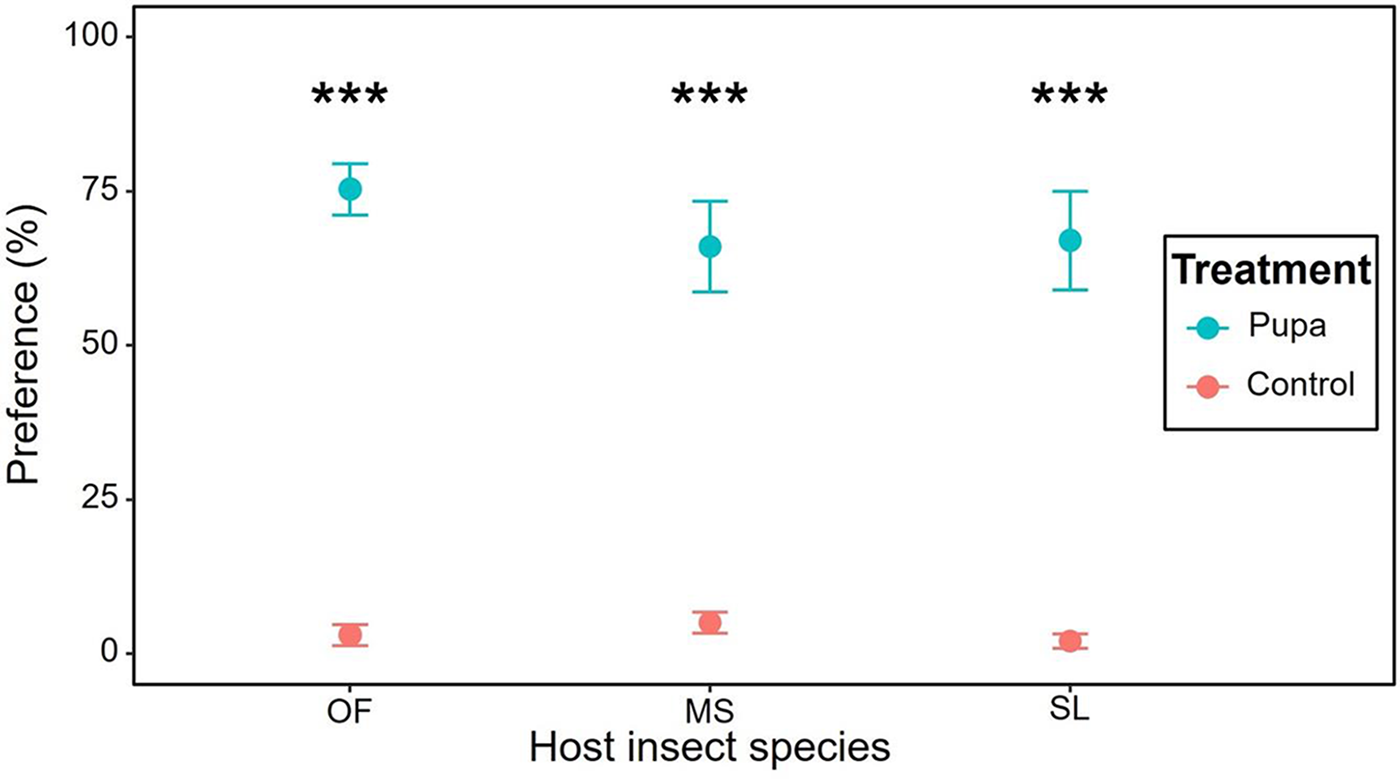
The choice experiment submitting the pupa of each pest separately in comparison with blank site to S. carpocapsae revealed a consistent preference for the pupae O. furnacalis ( $\chi^{2}$df = 1 = 131.10, P < 0.001), M. separata (
 $\chi^{2}$df = 1 = 60.46, P < 0.001), S. litura (
 $\chi^{2}$df = 1 = 61.99, P < 0.001) (fig. 1).
Preference percentage (mean ± SEM) of Steinernema carpocapsae towards pupae (in comparison to blank control) of different Lepidopteran pests (OF, Ostrinia furnacalis; MS, Mythimna separata; SL, Spodoptera litura). The asterisks demonstrate the significance level between treatment and control (***P < 0.001).

Female vs male
Steinernema carpocapsae did not differentiate between female and male pupae of O. furnacalis ( $\chi^{2}$df = 1 = 1.77, P = 0.186) and S. litura (
 $\chi^{2}$df = 1 = 0.05, P = 0.829); however, IJs of the EPN demonstrated a preference for female M. separata pupae, compared to male pupae (
 $\chi^{2}$df = 1 = 6.46, P = 0.011) (fig. 2).
Preference percentage (mean ± SEM) of Steinernema carpocapsae towards female and male pupae of different Lepidopteran pests (OF, Ostrinia furnacalis; MS, Mythimna separata; SL, Spodoptera litura). The asterisks demonstrate the significance level between treatment and control (*P < 0.05, ns = P > 0.05).

Body parts
The infection performance of S. carpocapsae was significantly affected by body parts of each pest species; O. furnacalis ( $\chi^{2}$df = 2 = 26.76, P < 0.001), M. separata (
 $\chi^{2}$df = 2 = 27.50, P < 0.001), S. litura (
 $\chi^{2}$df = 2 = 12.78, P < 0.01). Specifically, S. carpocapsae lower infection performance on the head compared to the other body parts in O. furnacalis and S. litura, while it exhibited a higher infection performance on the abdomen when compared to other body parts in M. separata (fig. 3).
Infection performance (mean ± SEM) of Steinernema carpocapsae over body parts, head, thorax, and abdomen (in comparison) of different Lepidopteran pests (OF, Ostrinia furnacalis; MS, Mythimna separata; SL, Spodoptera litura). The asterisks demonstrate the significance level between treatment and control (*P < 0.05, ns = P > 0.05). The lower cases over the body parts of O. furnacalis demonstrate the differences between the groups.

Preference for healthy vs infected
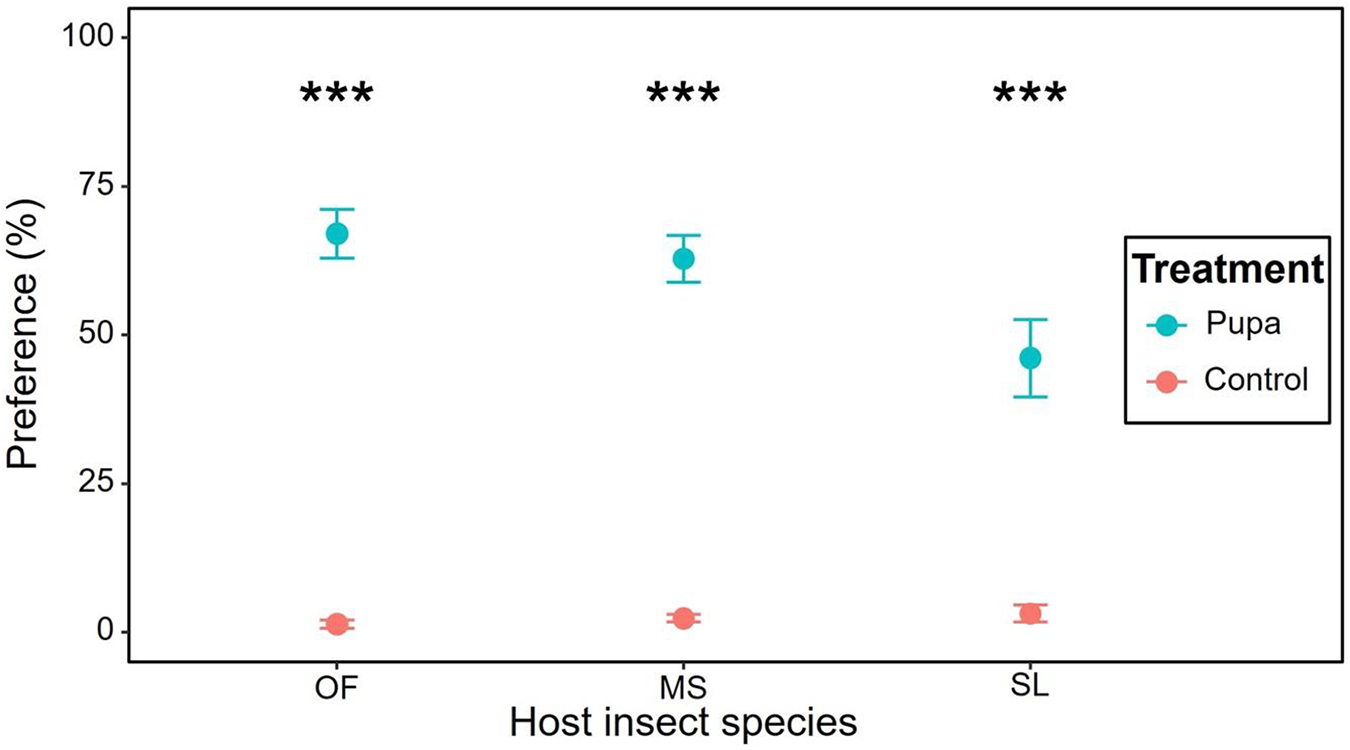
Steinernema carpocapsae exhibited a clear preference for infected hosts over uninfected (healthy) host across all lepidopteran pests, O. furnacalis ( $\chi^{2}$df = 1 = 206.32, P < 0.001), M. separata (
 $\chi^{2}$df = 1 = − 229.58, P < 0.001), S. litura (
 $\chi^{2}$df = 1 = 47.82, P < 0.001) (fig. 4)
Preference percentage (mean ± SEM) of Steinernema carpocapsae towards infected and healthy pupae of Lepidopteran pests (OF, Ostrinia furnacalis; MS, Mythimna separata; SL, Spodoptera litura). The triple asterisks indicate the significance level between each pair of infected and healthy hosts (***P < 0.001).

Survival and oviposition of infected vs healthy lepidopteran pests
Survival: Survival analysis for all lepidopteran pests have revealed that female hosts infected at the pupal stage had a lower survival probability than healthy host in the adult stage: O. furnacalis ( $\chi^{2}$ = 16.51, P < 0.001), M. separata (
 $\chi^{2}$ = 20.99, P < 0.001), S. litura (
 $\chi^{2}$ = 20.41, P < 0.001) (fig. 5). Similarly, infected male hosts had a lower survival probability in all lepidopteran pests: O. furnacalis (
 $\chi^{2}$ = 20.18, P ≤ 0.001), M. separata (
 $\chi^{2}$ = 21.45, P < 0.001), S. litura (
 $\chi^{2}$ = 20.81, P < 0.001) (fig. 6).
The survival curves established based on Kaplan–Meier estimators of healthy and Steinernema carpocapsae-infected females of Lepidopteran pests (A = Ostrinia furnacalis, B = Mythimna separata, C = Spodoptera litura). The P values are generated via log-rank tests.

The survival curves established based on Kaplan–Meier estimators of healthy and Steinernema carpocapsae-infected males of Lepidopteran pests (A = Ostrinia furnacalis, b = Mythimna separata, c = Spodoptera litura). The P values are generated via log-rank tests.

Oviposition: Infection in either males or female pupae, or both, significantly reduced the oviposition performance of all three lepidopteran pests: O. furnacalis ( $\chi^{2}$df = 3 = 3336.80, P < 0.001), M. separata (
 $\chi^{2}$df = 3 = 1260.00, P < 0.001), S. litura (
 $\chi^{2}$df = 3 = 2710.00, P < 0.001). The lowest oviposition performance was consistently observed when both infected males and females were paired for mating in all host species. Across all infection combinations, oviposition performance of host insects decreased compared to healthy pairs (fig. 7).
The oviposition performance (i.e. total number of laid eggs in mean ± SEM) of the cross-lines consisted of the pairs; Steinernema carpocapsae – infected males + infected females (IM-IF), infected males + and uninfected females (IM-UF), uninfected males + infected females (UM-IF) and uninfected males and uninfected females (UM-UF) of the Lepidopteran pests (OF, Ostrinia furnacalis; MS, Mythimna separata; SL, Spodoptera litura). Different lower cases on bars depict the significant differences between tested groups of each Lepidopteran pest separately.

Discussion
This study demonstrated the behavioural preferences of S. carpocapsae towards the pupal stages of O. furnacalis, M. separata, and S. litura. The nematodes exhibited a clear and consistent preference for pupae over control treatments and for infected pupae over uninfected ones across all test pest species. While adults were not directly infected by EPNs, the negative impacts observed in the pupal stage suggest detrimental outcomes for adult traits as a result of nematode infection.
Previous studies indicate that nematode attraction to pupae, particularly infected ones, may be driven by volatile compounds or biochemical cues emitted by the host, which play a significant role in enhancing nematode pathogenicity (Dillman et al., Reference Dillman, Guillermin and Lee2012; Labaude and Griffin, Reference Labaude and Griffin2018; Lee and Dreves, Reference Lee and Dreves2024). In our experiment assessing nematode preference for uninfected vs infected pupae, the significantly higher attraction to infected pupae suggests that infection-induced changes in host physiology, such as alterations in cuticle composition, may facilitate easier penetration by subsequently attacking nematodes (Labaude and Griffin, Reference Labaude and Griffin2018; Patel and Wright, Reference Patel and Wright1998). Additionally, the release of symbiotic bacteria by the nematodes during infection could accelerate host degradation, potentially creating a more favourable microenvironment for nematode survival and proliferation, which may further enhance their attraction to infected pupae (Li et al., Reference Li, Liu and Whalen2024b; Ogier et al., Reference Ogier, Pagès and Frayssinet2020). Overall, female M. separata pupae were more attractive to S. carpocapsae. This preference may be attributed to physiological and biochemical differences between the sexes, as female pupae typically have greater energy reserves and higher nutritional content, making them more attractive to the S. carpocapsae (Patil et al., Reference Patil, Vijayakumar and Linga2020). Additionally, the presence of female-specific pheromones or sex-related chemicals may further enhance nematodes attraction, allowing them to maximise reproductive success by selecting hosts with greater resources (Chaudhuri et al., Reference Chaudhuri, Bose, Tandonnet, Adams, Zuco, Kache, Parihar, von Reuss, Schroeder and Pires-dasilva2015; Choe et al., Reference Choe, Chuman, von Reuss, Dossey, Yim, Ajredini, Kolawa, Kaplan, Alborn and Teal2012).
Overall, the nematodes exhibited a higher infection rate in the thorax and abdominal regions compared to the head regions. Infection rates varied significantly among body regions across species, with the thorax showing a similar level of population establishment as for the abdomen in two of the three species. The abdomen, containing softer tissues and vital organs, provides a more accessible entry point for nematode to reach the resources (Deka et al., Reference Deka, Baruah and Babu2021; Kaya and Stock, Reference Kaya and Stock1997). The abdominal fat reserves and reproductive organs likely offer a nutrient-rich environment for both nematodes and their symbiotic bacteria (Deka et al., Reference Deka, Baruah and Babu2021). In contrast, the head region, with its thicker cuticles and more rigid structures, may act as a physical barrier to nematode penetration, providing less favourable target. Meanwhile, the thorax, despite its structural rigidity, appears to support nematode establishment at levels comparable to the abdomen in certain species, suggesting that factors beyond cuticle thickness may influence infection success.
Infected adults exhibited significantly reduced longevity compared to uninfected individuals, supporting the potential of S. carpocapsae as a biological control agent. This result aligns with findings from previous attempts that revealed similar nematode-induced reductions in adult longevity (Garriga et al., Reference Garriga, Morton and Ribes2020). The impact on these life-history traits is likely due to the toxins produced by the nematode’s symbiotic bacteria, such as Xenorhabdus spp., which impair metabolic functions, immunity, and reproduction (Banerjee and Saha, Reference Banerjee and Saha2021). While S. carpocapsae successfully infected the pupae, it did not always cause immediate mortality, suggesting possible host immune responses such as encapsulation of the nematodes, which may have limited their full pathogenic potential (Filgueiras and Willett, Reference Filgueiras and Willett2021). However, even in cases where infection did not lead to pupal death, sublethal effects persisted into adult life stages (Girling et al., Reference Girling, Ennis and Dillon2010). The presence of residual bacterial toxins or immunological stress from the infection may have contributed to the observed reductions in adult longevity and fecundity (Ansari et al., Reference Ansari, Tirry and Moens2003; Tarasco et al., Reference Tarasco, Fanelli and Salvemini2023). Additionally, epigenetic modifications induced by early-life infection could play a role in altering adult physiological functions, leading to compromised reproductive output (McCaw et al., Reference McCaw, Leonard and Stevenson2024; Olivares-Castro et al., Reference Olivares-Castro, Cáceres-Jensen and Guerrero-Bosagna2021).
These findings have significant implications for IPM strategies. The parasitic activity of S. carpocapsae presents a potentially effective, multipronged approach to pest suppression. This is particularly relevant within agricultural systems, where reducing pest populations can decrease reliance on chemical pesticides. Our results demonstrate that S. carpocapsae infection during the pupal stage leads to sublethal effects in adults, reducing their longevity and fecundity. While we did not find nematodes persisting inside emerged adults, these physiological impairments could still contribute to population suppression by limiting reproductive success and overall fitness. Future studies could explore whether such sublethal effects influence pest dispersal behaviour or vulnerability to additional stressors, further enhancing the biocontrol potential of S. carpocapsae.
While laboratory experiments provide controlled environments to test parasitic efficacy, the findings from this study offer valuable insights into the performance of S. carpocapsae under these conditions. Specifically, the results demonstrate that EPNs induce both lethal and sublethal effects on key lepidopteran pests. By focusing on three important pest species, this study significantly contributes to the understanding of S. carpocapsae’s potential in pest management. These controlled conditions help to isolate the effects of the nematode, allowing for a clearer understanding of its biological interactions and efficacy. Further research should build on these findings to explore the nematode’s performance in diverse pest management contexts, including its interactions with natural enemies and its role in IPM. Expanding research to include various pests and non-target effects on beneficial insects is critical for comprehensively understanding the role of S. carpocapsae in agroecosystems. This broader perspective could enhance the biological control potential of nematodes and other entomopathogenic species, particularly by evaluating how different strains perform under diverse conditions.
Supplementary material
The supplementary material for this article can be found at https://doi.org/10.1017/S0007485325100102.
Acknowledgements
The authors would like to express their gratitude to the Deanship of Research and Graduate studies at King Khalid University, Saudi Arabia, Large Group Research Project (RGP2/535/45).
Author contributions
Chen Ge (Methodology [equal], Writing – original draft preparation [equal], Writing – review & editing [equal]); Aleena Alam (Writing – original draft preparation [equal], Writing – review & editing [equal]); Wu Haichao (Methodology [lead], Geng Mengchen (Methodology [lead]); Sohail Abbas: (Writing – review & editing [supporting]), Qin Weibo (Writing – review & editing); Arzlan Abbas: (Writing – review & editing [supporting]), Faisal Hafeez (Formal analysis [supporting]); Khalid Ali Khan (Writing – review & editing [lead]); Hamed A. Ghramh (Writing – review & editing [lead]); Jamin Ali (Writing – original draft preparation [equal], and Writing – review & editing [equal]), Visualisation [lead], Formal analysis [equal]; Adil Tonga (Writing – original draft preparation [equal], and Writing – review & editing [equal]), (Formal analysis [lead], Data curation [lead], Visualisation [lead], Writing – review & editing [equal]); Chen Rizhao (Supervision [lead], Validation [lead], Resources [lead], Project administration [lead], Writing – review & editing [lead], Funding acquisition [lead]).
Financial support
The authors thank the People’s Government of Jilin Province (20220203198SF), the Ministry of Science and Technology of China (2022YFD1500701), and the Ministry of Agriculture of the People’s Republic of China (15226025).
Competing interests
The authors declare no conflict of interest.