With high levels of problem drinking and juvenile offence rates triple that of the adult cohort (Australian Institute of Criminology, 2011), delinquency and problem drinking are serious problems among Australian adolescents. As young people spend a substantial proportion of their time at school, schooling institutions are commonly seen as key agencies to identify early maladjustment and institute interventions (Griffin & Griffin, Reference Griffin and Griffin1978).
In order for schools to contribute to the prevention of adolescent delinquency and problem drinking, a thorough understanding of the co-occurrence between problem drinking and various forms of contemporary delinquency is required. Because of the hidden nature of delinquency and associated deviant behaviours, many adolescents are never apprehended for these activities. As a result, official statistics may underestimate the prevalence of adolescent drinking and delinquent activities in the general adolescent population, and very few studies have compared specific areas of offending and their associations with problem drinking concurrently, particularly among Australian school students.
Despite substantial empirical research depicting strong associations between problem drinking and general delinquency (e.g., Barnes, Welte, & Hoffman, Reference Barnes, Welte and Hoffman2002; Kenny & Schreiner, Reference Kenny and Schreiner2009), most epidemiological studies include narrow definitions of delinquency or use delinquency as an umbrella term for a range of behaviours (Hasking, Scheier, & Abdallah, Reference Hasking, Scheier and Abdallah2011). The resulting methodological implication is that delinquency is generally considered a unitary phenomenon with equal weights given to different types of offending. Therefore, relationships between more contemporary forms of delinquency, such as cyber-bullying, with problem drinking are lesser known, and gender differences in various types of delinquent activities associated with problem drinking are rarely explored. With new trends suggesting rising incidences of problem drinking and delinquency, including violence, among young females (Carrington, Reference Carrington2013; Clarke, Kim, White, Jiao, & Mun, Reference Clarke, Kim, White, Jiao and Mun2013; Keyes, Li, & Hasin, Reference Keyes, Li and Hasin2011), there is a need to examine these patterns and interrelationships using self-reports among Australian male and female school students, and to evaluate gender differences. Owing to the often hidden and secretive nature of adolescent delinquency and problem drinking, and because many adolescents are never apprehended for these behaviours, self-report methods may elicit a more accurate estimate of the prevalence of delinquency and problem drinking among adolescents within the general population.
Addressing the unitary constraints of the term delinquency, Curcio, Mak, and Knott (Reference Curcio, Mak and Knott2015) recently redeveloped the Australian Self-Reported Delinquency Scale (Mak, Reference Mak1993) to maintain consistency with the contemporary youth culture and for use in general adolescent populations. The Australian Self-Reported Delinquency Scale — Revised (ASRDS-R; Curcio et al., Reference Curcio, Mak and Knott2015) comprises eight subscales, derived from confirmatory factor analysis, to characterise an individual's involvement in specific types of delinquent activities.
The ASRDS-R was found to demonstrate acceptable levels of internal consistency reliability for the total scale (.93) and its subscales: Alcohol use (illegally purchasing and consuming alcohol in public places; .80), Driving/Vehicle (illegal behaviours using a vehicle such as intoxicated driving or racing with others; .80), Theft (shoplifting or stealing; .70), Cheat (misdemeanours such as wagging school; .65), Public Disturbance (damaging public or private property; .78), Fight (violent or threatening acts; .62), Drugs (consumption of licit and illicit substances; .86), and Media (using various forms of media to threaten or harass another, including designing, obtaining, or using fake identification; .64), as well as concurrent validity against self-reported police warnings.
While the three-item alcohol subscale of the ASRDS-R assesses underage alcohol use, it does not consider more problematic forms of drinking. For the purposes of this article, two very different approaches to evaluating adolescent drinking will be examined: underage alcohol use as commission of status offences, and problematic drinking styles. From this point onwards, the term underage alcohol use, or simply alcohol use, will refer to underage acquisition or consumption of alcohol in public places that is illegal owing to the age of the offender (assessed by the ASRDS-R Alcohol subscale). The term problem drinking will refer to drinking styles characterised by excessive or frequent consumption and alcohol-related problems (assessed by the Alcohol Use Disorders Identification Test [AUDIT]; Saunders, Aasland, Babor, de la Fuente, & Grant, Reference Saunders, Aasland, Babor, de la Fuente and Grant1993).
Common cause models of general adolescent deviance, such as Jessor and Jessor's (Reference Jessor and Jessor1977) problem behaviour theory, hypothesise that common factors account for adolescent involvement in a range of multiple problematic behaviours. Similarly, Curcio, Mak, and George's (Reference Curcio, Mak and George2013) revised psychosocial control theory states that personality traits, poor attachment to parents, low perceived seriousness of risk-taking behaviours, and association with deviant peers increase the likelihood of adolescent delinquency and problem drinking specifically. Based on these existing theories, delinquency and problem drinking share classes of etiological causes and are likely to have high rates of concurrence. Therefore, the relationships among various indicators of alcohol use and delinquent activities could be expected to be strong for both male and female general adolescent populations.
While there is limited research examining self-reported patterns of problem drinking, alcohol use, and various types of delinquency among Australian school students, research conducted in other countries or with older populations show that violent offences, vandalism, drug use, and car theft are more often associated with problem drinking than other offences (Felson, Savolainen, Aaltonen, & Moustgaard, Reference Felson, Savolainen, Aaltonen and Moustgaard2008; Franklin, Allison, & Sutton, Reference Franklin, Allison and Sutton1992; Greenfield & Henneberg, Reference Greenfield and Henneberg2001; Helstrom, Bryan, Hutchison, Riggs, & Blechman, Reference Helstrom, Bryan, Hutchison, Riggs and Blechman2004; Madu & Matla, Reference Madu and Matla2003). In order to inform school prevention and intervention programs, further research is required to comprehend whether similar patterns occur among an Australian adolescent cohort, and whether these relationships hold for males and females.
The Present Study
Overall the present study aimed to investigate and compare the patterns and interrelationships of various indicators of self-reported drinking and delinquent behaviours in secondary school male and female students. To address this overall aim, we formulated five research objectives.
First, we set out to investigate item-level patterns of self-reported problem drinking and underage alcohol use for male and female adolescents, and to examine gender differences. Predicated on recent findings (Clarke et al., Reference Clarke, Kim, White, Jiao and Mun2013; Keyes et al., Reference Keyes, Li and Hasin2011), we hypothesised that males and females would not differ in self-reported problem drinking or alcohol use items.
Second, we examined gender differences in problem drinking, alcohol use, and delinquency at AUDIT and ASRDS-R scale and subscale levels. Based on recent research (Carrington, Reference Carrington2013; Clark et al., Reference Clarke, Kim, White, Jiao and Mun2013), we hypothesised that males and females would not differ in problem drinking styles, alcohol use, or delinquency at scale and subscale levels.
Third, we aimed to examine the intercorrelations of problem drinking, alcohol use, and different types of delinquent activities, for males and females separately. Based on common cause perspectives (Curcio et al., Reference Curcio, Mak and George2013; Jessor & Jessor, Reference Jessor and Jessor1977), we tested the third hypothesis that both problem drinking and alcohol use indicators would maintain strong and positive associations with various types of delinquent activities.
The fourth research objective, also involving correlates, was to investigate whether problem drinking would be particularly strongly associated with certain types of delinquent activities. Specifically, we compared the magnitude of the correlation coefficients of problem drinking with each of the delinquent activities for males and females separately. Consistent with international findings (e.g., Felson et al., Reference Felson, Savolainen, Aaltonen and Moustgaard2008; Helstrom et al., Reference Helstrom, Bryan, Hutchison, Riggs and Blechman2004), we tested the fourth hypothesis that the magnitude of the correlations between problem drinking and forms of delinquency involving physical violence, use of substances other than alcohol, and car theft would be stronger than other forms of offences.
For our fifth and final objective, we set out to compare correlation coefficients across males and females to determine whether engagement in problem drinking was more strongly associated with particular types of delinquent activities for one gender over another. Pertaining to recent research indicating a narrowing of the gender gap in relation to problem drinking, delinquency, and violence (Carrington, Reference Carrington2013; Keyes et al., Reference Keyes, Li and Hasin2011), we tested the fifth hypothesis that there would be no gender differences in the various correlates of problem drinking with delinquent activities.
Method
Participants
After obtaining clearance from appropriate ethical boards, we approached the principals of various government and independent high schools and colleges in Canberra, Australia for permission to recruit students aged less than 18 years (legal drinking age in Australia) to participate. Owing to ethics protocol, students from government schools required opt-in parental consent, whereas students from independent schools were allowed opt-out parental consent. Students also provided consent and were informed that the survey was voluntary. Eight schools agreed to participate (four government, four independent), and had students with parental consent complete the 15-minute survey during class.
Due to the sensitive nature of questions, an online survey was designed, as computerised surveys have been shown to limit socially desirable responses by ensuring anonymity (Grimm, Reference Grimm2010). However, as some classes did not have access to a computer lab or laptops, these participants completed the survey via paper format (60.9%) rather than online (39.1%). In both online and paper formats, the students were informed of, and directed to the survey by author AC, a trained psychologist and researcher, or by the student's teacher. In the instances where the students were directed to the survey by their teacher, the teacher read a blurb about the survey and directions to complete the survey provided by the authors. The convenience sample resulted in 180 males and 132 females (from a pool totalling approximately 800 students) aged 13 to 17 years (mean age 15.64).
Measures
Problem drinking
Problem drinking was assessed using items from the Alcohol Use Disorders Identification Test (AUDIT; Saunders et al., Reference Saunders, Aasland, Babor, de la Fuente and Grant1993). The AUDIT is a 10-item questionnaire that has been used in Australian contexts (Conigrave, Saunders, & Reznik, Reference Conigrave, Saunders and Reznik1995), as well as with adolescents under the age of 18 years (Santis, Garmendia, Acuña, Alvarado, & Arteaga, Reference Santis, Garmendia, Acuña, Alvarado and Arteaga2009). The three subscales identify quantity and frequency of consumption, problems resulting from drinking, and alcohol dependence. The total AUDIT score is a summation of all three subscales with a possible range of 0–40 (Selin, Reference Selin2006; Reinert & Allen, Reference Reinert and Allen2007).
Delinquency
Patterns of delinquency, including the commission of alcohol-related status offences, were assessed using the 30-item Australian Self-Reported Delinquency Scale-Revised (ASRDS-R; Curcio et al., Reference Curcio, Mak and Knott2015). Participants were requested to indicate their engagement (Yes/No response format) in a range of marginally deviant to seriously criminal activities over the past 6 months. The ASRDS-R also contains three lie items to detect potentially biased responding (failing to respond to at least two of the three lie items), and includes an item referring to police warnings for validity check.
The ASRDS-R comprises eight subscales to facilitate assessment of engagement in specific types of offending (Alcohol Use, Driving/Vehicle, Theft, Cheat, Public Disturbance, Fight, Drugs, and Media) with coefficients ranging from .62 to .86 for a combined sample of male and female adolescents (Curcio et al., Reference Curcio, Mak and Knott2015). The Alcohol subscale of the ASRDS-R comprises three items pertaining to illegally purchasing or consuming alcohol, drinking alcohol in a public location, and drinking alcohol in a venue where the age requirement is 18 and over. Given the AUDIT was the primary measure used in the current study, the three items on the ASRDS-R pertaining to alcohol use were removed from the overall ASRDS-R total in subsequent analyses to minimise inflated scores due to conceptual overlap.
Data Analysis
Missing data were below 5%, and were treated with direct proration by calculating the average valid item response for each participant (Orr, Reference Orr1995) where there were no more than 20% of items with missing values for a scaled score. This imputation method combines available information from the observed data for each participant in order to estimate the missing data and population parameters. Four additional cases were excluded for being 18 years of age and a further two were excluded due to potentially biased responding (failing to respond to at least two of the four lie items on the ASRDS-R). In terms of assessing the AUDIT Problems subscale, we adopted the recommended cut-off score of 8 or more to signify hazardous/harmful alcohol use (e.g., Conigrave, Hall, & Saunders, Reference Conigrave, Hall and Saunders1995; Reinert & Allen, Reference Reinert and Allen2007).
Results
Gender Differences in Item-Level Patterns of Problem Drinking and Alcohol Use
The total score on the AUDIT was considered to contextualise the patterns and prevalence of drinking within the current sample of school students. The mean total AUDIT score was 3.54, with 17.3% of overall participants (17.6% of males and 16.7% of females) consuming alcohol at hazardous/harmful levels (≥8 on the total measure).
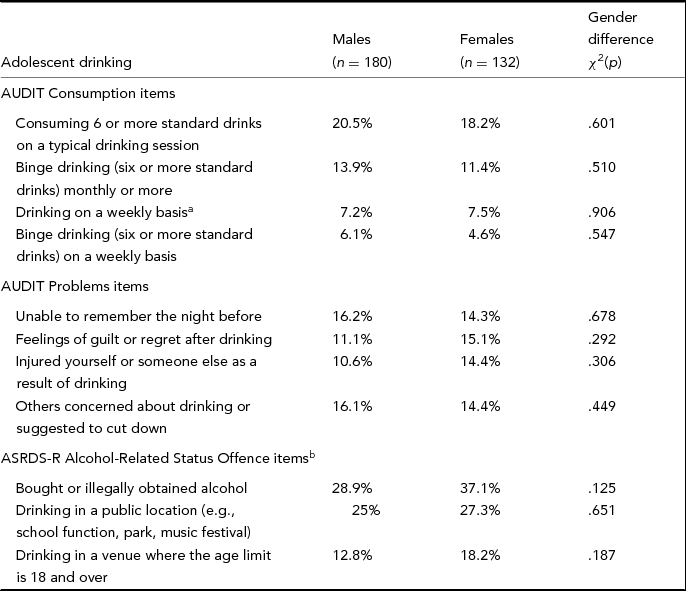
To address the hypothesis that males and females would not differ in self-reported problem drinking or alcohol use, we examined item-level participation rates on key adolescent drinking items. Responses to items comprising the AUDIT Consumption and Problems subscales and the ARSDS-R Alcohol Use subscale are presented in Table 1. Item-level chi-square tests showed no gender difference in any of the self-reported items on problem drinking and alcohol use. For item-level gender differences in self-reported ASRDS-R delinquency items refer to Curcio et al. (Reference Curcio, Mak and Knott2015).
Self-Reported Participation in AUDIT Problem Drinking and ASRDS-R Alcohol-Related Status Offence Items for Males and Females

Note: AUDIT = Alcohol Use Disorders Identification Test; ASRDS-R = Australian Self-Reported Delinquency Scale — Revised. aDrinking on a weekly basis refers to consuming alcohol 2 to 3 times a week. bItem-level gender differences in ASRDS-R items are taken from Curcio et al. (Reference Curcio, Mak and Knott2015).
Gender Differences in Problem Drinking, Alcohol Use and Delinquency at Scale and Subscale Levels
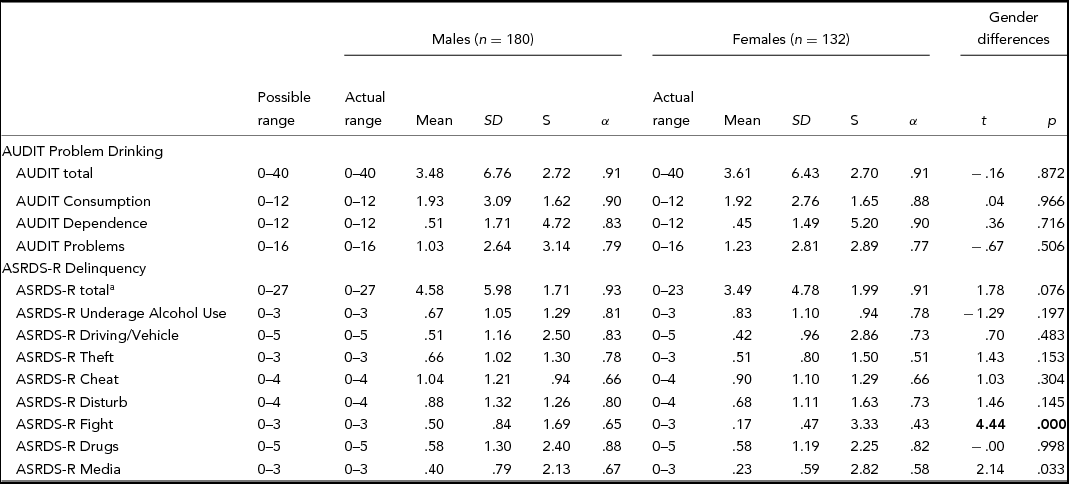
Table 2 presents descriptive statistics, including coefficient alphas, for the AUDIT and its three subscales and the ASRDS-R and its eight subscales for male and female adolescents separately. Some caution is advised owing to female alphas below .6 for three delinquency subscales (Theft, Fight, and Media).
Descriptive Statistics and Gender Differences for the AUDIT and ASRDS-R (excluding alcohol items) Scales and Respective Subscales (N = 312)
Note: AUDIT = Alcohol Use Disorders Identification Test; ASRDS-R = Australian Self-Reported Delinquency Scale — Revised; S = Skewness. aThe three ASRDS-R items pertaining to alcohol use were excluded from the ASRDS-R total in all analyses in order to reduce conceptual overlap. Gender differences (t, p) highlighted in bold are significant with Bonferroni's correction.
The distributions of most scales and subscales were positively skewed, most notably the AUDIT Dependence subscale. This was due to many participants scoring zero on this measure. While alcohol consumption is often frequent and excessive in youth, alcohol dependence usually does not develop until early adulthood, requiring a consistently high level of consumption over a lengthy period of time (National Institute of Health, 2007). We decided to exclude the Dependence subscale from further analyses. Owing to slightly skewed data, we adopted a more stringent p value (<.01).
To address the hypothesis that males and females would not differ in patterns of problem drinking, alcohol use or delinquency at scale or subscale level, gender differences across the AUDIT and ASRDS-R scales and subscales were compared using a series of independent samples t tests with Bonferroni correction. The results are reported in Table 2, and reveal that gender differences were found only for the ASRDS-R Fight subscale. Males (M = .50, SD = .84) reported higher participation rates for violent offences than did females (M = .17, SD = .47).
Associations Between Problem Drinking, Alcohol Use, and Various Delinquent Activities
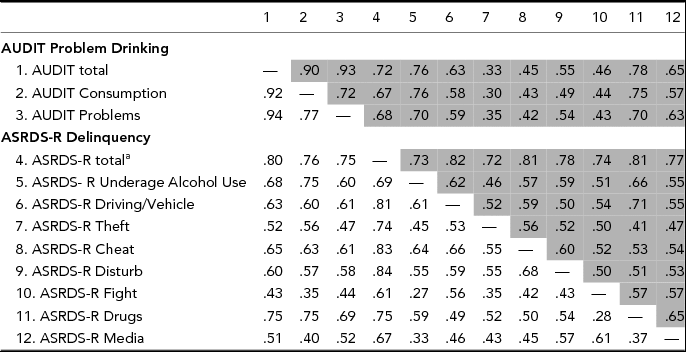
To test the hypothesis that both problem drinking and alcohol use indicators would maintain strong, positive associations with various types of delinquent activities, we examined the interrelationships of these behaviours by calculating Pearson correlations at AUDIT and ASRDS-R scale and subscale levels. We report the results in Table 3. Notably, large correlations were found between the AUDIT scale and subscales with the ASRDS-R delinquency total, despite the removal of the three items pertaining to alcohol use. Large correlations were also found between AUDIT problem drinking scale and subscales with the ASRDS-R underage alcohol use subscale. All remaining scaled scores correlated positively, showing medium to large effect sizes (Cohen, Reference Cohen1988), and were significant at p < .001.
Correlations Between AUDIT Problem Drinking and ASRDS-R Adolescent Delinquency Scale and Subscale Scores for Males and Females
Note: AUDIT = Alcohol Use Disorders Identification Test; ASRDS-R = Australian Self-Reported Delinquency Scale — Revised. aThe three ASRDS-R items pertaining to alcohol use were excluded from all analyses in order to reduce conceptual overlap. ǂAll items are statistically significant at p < .001. Male correlations are presented in the top right diagonal of the table and females in the bottom left.
Correlates Between Problem Drinking and Types of Delinquent Activities
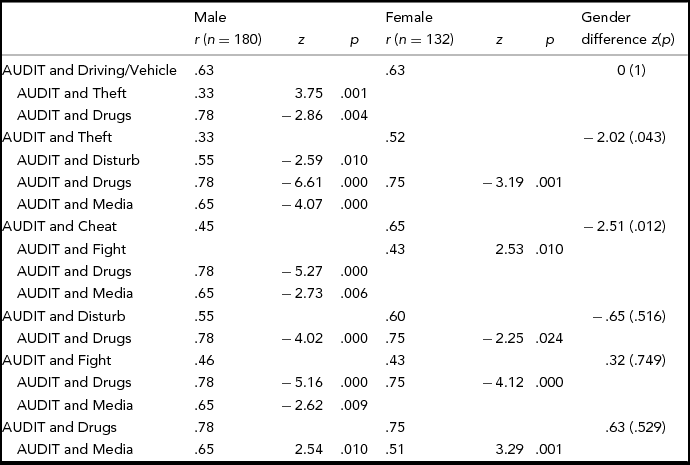
Our next hypothesis was that the magnitude of the correlation between problem drinking and forms of delinquency involving physical violence, use of substances other than alcohol, and car theft would be stronger than that between problem drinking and other offences. Using the correlation coefficients presented in Table 3, we conducted Fisher's z tests to compare the magnitude of the correlation coefficients of problem drinking (measured by the total AUDIT score) with each of seven different areas of delinquent activities (measured by the ASRDS-R subscales). We performed the comparisons for males and females separately. We excluded the ASRDS-R Alcohol Use subscale from the analysis owing to conceptual overlap with AUDIT problem drinking. Table 4 shows the Fisher's z tests comparing the magnitude of the correlation coefficients only where we found statistically significant results.
Significant Fisher's z Tests Comparing the Magnitude of Correlations of (a) Problem Drinking and Delinquent Behaviours for Males and Females Separately and (b) Comparing across Gender
Note: AUDIT = Alcohol Use Disorders Identification Test; ASRDS-R = Australian Self-Reported Delinquency Scale — Revised.
In terms of correlates with problem drinking, among males, we found scores on the Drugs factor (involving the use of cigarettes and illicit substances) to be more strongly associated with problem drinking than scores on any other delinquent activity. Scores on Driving/Vehicle, Public Disturbance, and Media were generally more strongly related to problem drinking than scores on Theft, Cheat, and Fight.
Among females, we found scores on Drugs to be more strongly associated with problem drinking than scores on Theft, Public Disturbance, Fight, and Media, but not more so than scores on Driving/Vehicle or Cheat. Scores on Cheat were more strongly related to problem drinking than scores on Fight.
Correlates Between Problem Drinking and Types of Delinquent Activities Across Gender
Additionally, we set out to compare correlation coefficients of problem drinking with types of delinquent activities across males and females to determine whether particular types of delinquent activities were more strongly associated with problem drinking for one gender over another. We found no gender differences in the associations of problem drinking with scores on the delinquency subscales when taking a more stringent p value (.001) into consideration.
Discussion
Our overall aim was to investigate and compare the patterns and interrelationships of various indicators of self-reported problem behaviours in secondary school male and female students. Our research objectives were to: (a) examine item-level patterns of self-reported problem drinking and alcohol use; (b) inspect patterns of problem drinking, alcohol use, and delinquency at AUDIT and ASRDS-R scale and subscale levels; (c) investigate interrelationships of problem drinking, alcohol use as status offences, and other areas of delinquent activities; (d) compare the magnitude of the correlation coefficient between problem drinking and each of the delinquent activities; and (e) compare gender differences regarding correlates of problem drinking and various delinquent offences.
Gender Differences in Patterns of Problem Drinking, Alcohol Use, and Delinquency
In relation to our first and second research objectives, the hypotheses that males and females would not differ in self-reported alcohol use, problem drinking, or delinquency at item level, scale level, and subscale level were supported. Males and females did not differ in terms of problematic alcohol use or rates of underage alcohol purchase and consumption. Similarly, male and female participation rates did not differ in regards to overall levels of self-reported delinquency, nor for offences involving the use of vehicles, theft, cheating, public disturbance, drugs, or media. Males were, however, significantly more likely to report engaging in fights or using or threatening to use weapons or force than were females. These findings provide some support for recent research indicating that females are catching up with their male counterparts in terms of problematic styles of drinking (Clarke et al., Reference Clarke, Kim, White, Jiao and Mun2013; Keyes et al., Reference Keyes, Li and Hasin2011) and delinquent involvement (Carrington, Reference Carrington2013).
Associations Between Problem Drinking, Alcohol Use, and Various Delinquent Activities
For our third research objective, we examined the intercorrelations of different aspects of adolescent drinking with various delinquent activities. Supporting theories predicated on common cause conceptualisations (e.g., Curcio et al., Reference Curcio, Mak and George2013; Jessor & Jessor, Reference Jessor and Jessor1977), we found moderate-to-strong associations between problem drinking, alcohol use as status offences, and additional varieties of delinquent activities, including illegal driving or vehicle behaviours, theft, cheating, public disturbance, fighting, drug use, and media. This finding suggests that alcohol-related problems are not a standalone issue, but rather are associated with other law-violating behaviours and are likely caused by similar social relationships, individual traits or environmental systems.
We further investigated whether problem drinking would be particularly strongly associated with certain types of delinquent activities. We predicted that the magnitude of the correlations between problem drinking and forms of delinquency involving physical violence, drug use, and car theft would be strongest. In partial support of this hypothesis, and consistent with international findings (Felson et al., Reference Felson, Savolainen, Aaltonen and Moustgaard2008; Helstrom et al., Reference Helstrom, Bryan, Hutchison, Riggs and Blechman2004; Madu & Matla, Reference Madu and Matla2003), we found that scores on measures of drug use and driving offences were generally more likely to be associated with problem drinking than other types of delinquent activities. It was further found that, among males, scores on public disturbance tended to co-occur with problem drinking more frequently than scores on theft.
However, in direct contrast to previous research (e.g., Franklin et al., Reference Franklin, Allison and Sutton1992; Greenfield & Henneberg, Reference Greenfield and Henneberg2001), the current findings indicated that scores on violent offences were less likely to co-occur with problem drinking than scores on drug use and media offences for males, and drug use and cheating (e.g., wagging school) for females. These findings reveal that problem drinking is particularly associated with drug use, cyber-bullying, and school truancy for Australian school students, indicating avenues for school education and prevention programs. While the current sample comprised a general adolescent population, associations between problem drinking and violent offences may be more pronounced in official offender or clinical samples, or among adults of legal drinking age.
Correlates Between Problem Drinking and Types of Delinquent Activities Across Gender
Finally, we set out to compare correlation coefficients across males and females to determine whether engagement in certain types of delinquent activities correlated more strongly with problem drinking for one gender over another. The hypothesis that there would be no gender differences in the various correlates of problem drinking with delinquent activities was supported. In terms of correlates with problem drinking, scores on drug use were most commonly affiliated for both genders. Among males, scores on driving and media offences were more strongly related with problem drinking, whereas scores on driving and cheating offences were more commonly associated with problem drinking among females. It is interesting to note that scores on media offences (e.g., threatening or intimidating someone via mobile phone or online) were prominent among males, as covert forms of aggression have typically been viewed as female-dominant (Lansford et al., Reference Landsford, Skinner, Sorbing, Di Giunta, Deater-Deckard, Dodge and Chang2012). It is possible that, due to recent advances in technology, relational aggression (e.g., cyber-bullying) may be becoming more prominent than physical aggression for young adolescents as victims become easily accessible through social networking sites. Finally, there were no significant gender differences regarding associations between problem drinking with each of the delinquency offences. To aid gender specificity, problem drinking interventions could also target drug use, driving and media offences for males; and drug use, driving, and cheating offences for females.
The findings of the current study indicate that drinking and delinquency patterns are already well entrenched within Australian secondary school students. Current Australian school programs to address these issues tend to be secondary interventions in nature — aimed at school-age children and designed in response to already established behavioural problems (Omaji, Reference Omaji1992). However, evaluations conducted in the United States conclude that preschool-based prevention strategies, such as the Perry Preschool Project, are the most effective in actively preventing the onset of drinking and delinquent behaviour (Omaji, Reference Omaji1992; Potas, Vining, & Wilson, Reference Potas, Vining and Wilson1990; Zagar, Busch, & Hughes, Reference Zagar, Busch and Hughes2009). Perhaps the Australian education system could implement similar programs in the preschool years — programs that are holistic in nature and address risk factors for delinquency and problem drinking such as those highlighted by Curcio et al.'s (Reference Curcio, Mak and George2013) revised psychosocial control theory. For example, prevention strategies could focus on providing practical and social support to parents, education for parents and children regarding the seriousness of the law and risk-taking behaviours, strategies to increase empathy and self-discipline, and skills for school-readiness, while simultaneously fostering positive and supportive attachments with the schooling system (Curcio et al., Reference Curcio, Mak and George2013; Omaji, Reference Omaji1992).
Limitations
Owing to the cross-sectional nature of the research, casual connections cannot be inferred. While the current findings may provide some insight into patterns of adolescent drinking and delinquency in the city where the research was conducted, Canberra, it likely does not represent Australian adolescents in general. The self-report method of the current measures also presents some limitations. Specifically, adolescents may report inaccurately, and are subject to biases such as memory distortions, social desirability, and acquiescent responses (Paulhus, Reference Paulhus, Robinson, Shaver and Wrightsman1991; Sibley et al., Reference Sibley, Pelham, Molina, Waschbusch, Gnagy, Babinski and Biswas2010). In the case of the ASRDS-R, biases due to social desirability can, to some extent, be detected by curiously low scores on the three lie items embedded into the delinquency scale. Despite potential response bias, the use of self-report measures allowed us to capture patterns of adolescent alcohol use and delinquency that would otherwise remain concealed due to the somewhat secretive nature of these acts.
Another limitation pertains to sample representativeness and response rates. Ethics protocol required Canberra government students to obtain opt-in parental consent. While we were unable to determine the exact response rates for government versus independent students, we observed that it was harder to recruit student participants from government schools. This may have led to the selection of students with particularly supportive parents or with lower levels of alcohol use and delinquency in government schools. Female alphas were below .6 on three of the delinquency subscales, perhaps indicating low levels of delinquent involvement. Furthermore, students responding via paper format reported significantly higher levels of problem drinking than students responding via online format, which may have potentially confounded results.
In terms of adopting a cut-off score for AUDIT problem drinking, we used the generally recommended cut-off score of 8 (Conigrave et al., Reference Conigrave, Hall and Saunders1995; Reinert & Allen, Reference Reinert and Allen2007). Some researchers suggest that when screening adolescent participants, this cut-off should be lower (e.g., Meneses-Gaya, Zuardi, Loureiro, & Crippa, Reference Meneses-Gaya, Zuardi, Loureiro and Crippa2009; Santis et al., Reference Santis, Garmendia, Acuña, Alvarado and Arteaga2009), although there is debate as to what cut-off score allows for the best sensitivity. Finally, participants’ ages ranged from 13 to 17, which may also account for variation in engagement in drinking and delinquency. Assessing patterns of problem drinking, alcohol use, and additional types of delinquent activities at various developmental stages may provide further insight into such trajectories.
Future Research and Conclusions
Partially supporting theories based on common cause conceptualisations (e.g., Curcio et al., Reference Curcio, Mak and George2013; Jessor & Jessor, 1997), the current study found that school students who engage in problem drinking are more likely to be involved in all areas of delinquency, with limited gender differences. In the current study, we used a recently updated measure of delinquency that facilitated assessment of engagement in specific areas of offending. Future research could adapt the ASRDS-R to hold relevance for young adult populations containing similar items and subscales to the adolescent measure. This would assist in facilitating a succinct assessment of overall levels of criminality, as well as characterise involvement in specific types of offending, such as the propensity for violence and problem drinking. Another avenue for future research could investigate developmental trajectories of problem drinking and delinquency for adolescents and young adults, and whether etiological risk factors are similar given the high prevalence of problem behaviours among these cohorts.
Prevention efforts to reduce risk factors should be targeted at preschool age to deter the initiation of alcohol use and delinquent activity, and should be evaluated for efficacy in Australian students. Interventions aimed at primary and high-school students could include education, particularly pertaining to the severity of problem drinking, drug use, cyber-bullying, and driving/vehicle-related offences, and aim to prevent school drop out and truancy by fostering strong attachments with the school environment.
Acknowledgments
The authors would like to thank participating schools and principals.