INTRODUCTION
Point Conception, in California, USA, located at 34.5°N, has been considered a boundary between the Oregonian province and the Californian biogeographical provinces (Briggs, Reference Briggs1974; Doyle, Reference Doyle1985; Gobalet, Reference Gobalet2000). However, there are species whose distribution range includes both provinces (Newell, Reference Newell1948; Briggs, Reference Briggs1974; Hayden & Dolan, Reference Hayden and Dolan1976; Horn & Allen, Reference Horn and Allen1978; Newman, Reference Newman, Gray and Boucot1979). Therefore, this boundary is referred to by other authors (Seappy & Littler, Reference Seappy, Littler and Powers1980) as a transitional zone. Burton (Reference Burton1998) considers that, in the marine environment, detailed research is necessary to clarify the hypothetical concordance of the biogeographical and phylogeographical boundaries originally proposed by Avise et al. (Reference Avise, Arnold, Ball, Bermingham, Lamb, Neigel, Reeb and Saunders1987) and Avise (Reference Avise1992). The complex interaction of the oceanographic variables may favour dispersion and recruitment of some species with planktonic larval stages highly capable of remaining in the pelagic region, but their dispersion might be otherwise limited by seasonal and local oceanographic events.
The starfish Pisaster ochraceus is distributed along the north-western coast of North America, occupying both the Oregonian and the Californian provinces. Its northern limit is considered to be in the area of Prince William Sound (Alaska) and the southern at Cedros Island (Baja California, Mexico) (Lambert, Reference Lambert2000). It is commonly found in the intertidal and rocky subtidal zones, where it feeds mainly on mussels, crustaceans and algae. Ecologically, this species plays an important role as it impacts the structure and diversity of the intertidal community, particularly over the populations of the mussel Mytilus californianus that constitutes its preferred prey (Ricketts & Calvin, Reference Ricketts and Calvin1952; Paine, Reference Paine1966; Mauzey et al., Reference Mauzey, Birkland and Dayton1968).
Pisaster ochraceus undergoes external fertilization and the fertilized eggs produce after approximately six days a planktotrophic larva called bipinnaria. These larvae can survive between 76 and 228 d (Strathman, Reference Strathmann1978). Afterwards, they present the brachiolaria phase, which develops up to the juvenile star (Carefoot, Reference Carefoot1977). In California, the reproductive cycle of the populations of P. ochraceus has been described by Pearse & Eemisee (Reference Pearse and Eernisee1982). The spawning season lasts from March to May; the gonadic indices are low until October, then they begin to increase until the following spring when the next spawning takes place.
The genus Pisaster (species, subspecies, forms and/or varieties) exhibits considerable morphological variation within and among its populations (Fisher, Reference Fisher1930). This author suggested eight taxa, including four of them on the P. ochraceus complex, by establishing synonymies between some of the 13 taxa previously recognized by Verril (Reference Verrill1914). Later, Clark (Reference Clark, Jangoux and Lawrence1996) recognized only three species in the genus and four subspecies, distinguishing two P. ochraceus subspecies according to their distribution: P. ochraceus ochraceus from Alaska to Point Conception, in California, and P. ochraceus segnis from the northern end to the middle portion of the Baja California Peninsula. However, Lambert (Reference Lambert2000) recently recognized P. ochraceus as a single species whose distribution ranges from south-eastern Alaska to Cedros Island, in Baja California, Mexico.
The aforementioned reviews of P. ochraceus considered exclusively morphological characters. The research of Stickle et al. (Reference Stickle, Foltz, Katoh and Nguyen1992) is the only one based on molecular genetic markers; they used allozymes and found genetic homogeneity among populations in their northern distribution range, supporting the taxonomic classification proposed by Lambert (Reference Lambert2000).
In this paper, we used a different molecular marker and extended the area to include the southern populations of P. ochraceus. We tested for the Point Conception hypothetical breakdown in the connectivity between the populations from the Oregonian and Californian biogeographical provinces by polymerase chain reaction–restriction fragment length polymorphism (PCR-RFLP) of the mitochondrial partial genes CO I and CO III.
MATERIALS AND METHODS
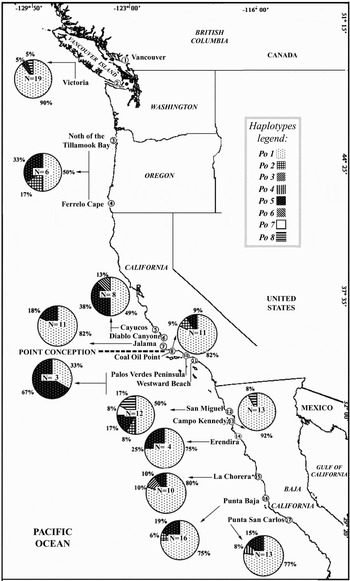
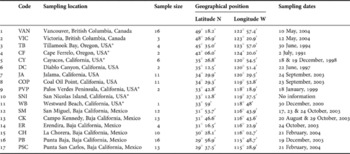
Tube feet tissue of Pisaster ochraceus (approximately 200 mg) was cut from field or museum specimens representing 17 localities along the north-western coast of North America, between British Columbia, Canada, and Baja California, Mexico. Additionally, we obtained tissue from some Pisaster giganteus specimens at three localities to be used as an external group in phylogenetic analyses (Table 1; Figure 1). The tissue was obtained by cutting the tip of an arm with sterilized scissors and storing it in Eppendorf tubes with 70% ethanol for preservation. Tissue from museum specimens was donated by the Natural History Museum of Los Angeles in California.
Study sites, sample size (N), and haplotype frequencies distribution along the north-eastern Pacific Coast for Pisaster ochraceus.

Code, location, dates and size of the samples collected for the phylogeographical study of Pisaster ochraceus. The number of P. giganteus specimens used in the analysis is shown in parentheses.

*donation samples.
Prior to DNA extraction, ethanol was removed and samples were re-hydrated for 12 h in distilled, deionized and sterilized water. The salt extraction method described by Miller et al. (Reference Miller, Dykes and Polesky1988) was used with slight modifications. Briefly, 50–100 mg of tissue was homogenized in 400 µl of salt extraction buffer (200 mM Tris–HCl pH 7.4, 250 mM NaCl, 25 mM EDTA pH 8.0, 0.5% SDS) and incubated at room temperature under agitation for 15–30 minutes. Cellular debris was eliminated by centrifugation and the supernatant was recovered in another tube. The supernatant was mixed with 250 µl of preheated CTAB buffer (100 mM Tris–HCl pH 8.0, 20 mM EDTA pH 8.0, 20% CTAB, 0.1% PVPP, 0.1% SDS, 0.2% mercaptoethanol). The mixture was incubated at 65°C for 10 minutes and centrifuged at 12000 × g for 5 minutes. Purification of DNA was done in one volume of chloroform and precipitated with one isopropanol volume. The pellet was washed with a volume of cold 70% ethanol, dried, re-suspended in 50 µl of 0.1 mM TE pH 8.0 and stored at –70°C. FastPCR v. 3.1.32 beta software (Kalendar, Reference Kalendar2004) was used to design primers from the complete mtDNA sequence of P. ochraceus (GeneBank Accession No. NC 004610; Smith et al., Reference Smith, Banfield, Doteval, Gorski and Kowel1990), targeting a 1386 base pair (bp) fragment of CO I and a 739 bp fragment of CO III. Primer sequences were: PocCOI-f 5′-tgagctggcat gataggcacc 3′ and PocCOI-r 5′-ttcagggtggataggggttcg-3′; and PocCOIII-f 5′-accaacatccataccacctgg-3′ and PocCOIII-r 5′-agtcagacaacatctacgaagtgtc–3′. PCR reactions were performed in 50 µl of a mixture of 22 mM Tris–HCl, 55 mM KCl, 220 mM dNTPs, 1.55 mM MgCl2, 150 nM forward primer, 150 nM reverse primer, 0.5u of Taq polymerase and 15 ng of DNA template. Mitochondrial partial CO I and CO III genes were amplified in a BIO-RAD iCycler 3.021 thermocycler through the following profile: initial denaturalization at 95°C for 4 minutes; 35 cycles of denaturalization at 94°C for 45 seconds, annealing at 59°C for 45 seconds, extension at 72°C for 1.5 minutes and a final extension step at 72°C for 7 minutes. Amplification products of both partial genes were sequenced for a single specimen in an ABI-Prism 3100 capillary automatized sequencer and deposited in the GenBank (Accession Nos. DQ021905 and DQ021906) and used to select the potential endonucleases for RFLP analysis. The endonucleases selected were Mbo I, Bfa I, Nci I and Mnl I for CO I, and Nla III and Tsp509 I for CO III. Digestion reactions of PCR products were carried out in a final volume of 10 µl following the manufacturer's instructions. The products of enzymatic digestions were analysed through 10% PAGE against a 50 bp molecular weight marker.
Statistical analysis of the compound haplotypes distribution was performed through an analysis of molecular variance (AMOVA) to obtain the fixation indices Fst and ϕst, using 1000 permutations. For this analysis, localities were grouped into provinces, with Point Conception as the limit between them. The geographical homogeneity in haplotype frequencies was also evaluated with Monte Carlo simulations as described by Roff & Bentzen (Reference Roff and Bentzen1989). According to this method, a large number of randomizations (in this case 1000) of the original data set must be generated, subject to the constraint that the original row and column totals remain equal to the original data matrix; the P value is equal to the frequency of χ2 statistics that exceed the original statistic. A MATLAB procedure was developed for this purpose. The phylogeographical pattern was assessed through the construction of a minimum spanning network (MSN) using the Jukes and Cantor method to compute genetic distances; this and the AMOVA tests were conducted with Arlequin version 2.0 software (Schneider et al., Reference Schneider, Roessli and Excoffier2000).
RESULTS
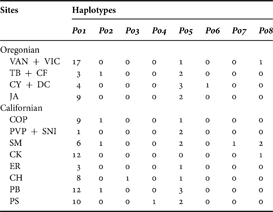
The RFLP patterns obtained from the digestion of the two partial gene amplicons from 126 Pisaster ochraceus specimens consisted of eight compound haplotypes and six Pisaster giganteus specimens of three compound haplotypes (Table 2; Figure 1). Frequency distribution of haplotypes pointed out two predominant haplotypes: Po1 and Po5; the former was present at all localities and the latter was absent only at Campo Kennedy. Po2 and Po8 are the haplotypes following in importance, since they are present at both sites north and south of Point Conception. The rest of the haplotypes (Po3, Po4, Po6 and Po7) were specific to some locality and rare. San Miguel, in Baja California, exhibited the largest number of haplotypes, where Po7 was specific.
Number of composite haplotypes found per location or couple of locations (abbreviations as in Table 1).

For the hierarchical AMOVA, localities were grouped into north and south populations, with Point Conception as the limit between them, thereby representing each biogeographical province. Most of the molecular variance was explained within province differences (98.86% for Fst and 97.87% for ϕst). Therefore, no genetic differentiation was evident between provinces (Fst = 0.011, P = 0.217 and ϕst = 0.021, P = 0.133). The Roff & Bentzen (Reference Roff and Bentzen1989) algorithm confirmed the homogeneity in the haplotype frequencies between provinces (P = 0.369). The P values for the Oregonian and the Californian provinces were 0.069 and 0.479 respectively. At α = 0.05, the null hypothesis of no significant geographical variation within each province cannot be rejected, but the Oregonian province shows a higher genetic difference, mainly due to the frequency distribution of Po1.
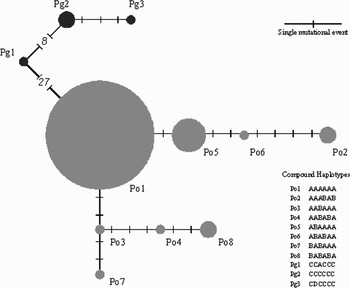
Minimum spanning network topology for P. ochraceus haplotypes is shown in Figure 2. Haplotype Po1 showed the highest frequency and occupied a central position, from which the rest of the haplotypes derive by one to four mutational events. Pisaster giganteus haplotypes are also linked to the most common P. ochraceus haplotype, but through 27 mutational events, representing a clear polarized and independent group.
Minimum spanning network for the polymerase chain reaction–restriction fragment length polymorphism analysis of CO I and CO III mitochondrial gene fragments for Pisaster ochraceus. The area of circle of each haplotype is proportional to the frequency of this haplotype. Genetic distances were computed according to the Jukes and Cantor method. Circles in black represent the P. giganteus haplotypes.

Therefore, we found no evidence suggesting a phylogeographical pattern along the sampling zone. Haplotypes Po1, Po2, Po3, Po4, Po5, Po7 and Po8 were present south of Point Conception, whereas Po1, Po2, Po5, Po6 and Po8 were found north of it, indicating a slightly larger diversity for the Californian province.
DISCUSSION
Pisaster ochraceus populations were found to exhibit high genetic homogeneity along the study area. Similar patterns have been described for other echinoderm species, such as the purple urchin Strongylocentrotus purpuratus, where the most common haplotypes were shared by all populations throughout its geographical range (Flowers et al., Reference Flowers, Schroeter and Burton2002). Such homogeneity could be explained by high rates of genetic flow among populations of these species as a consequence of the dispersal capacity of their planktotrophic larvae. Therefore, the chance for dispersal, settlement, and effective recruitment into other areas besides that of origin will be greater for larvae of the most common haplotypes. Dispersal capabilities of larvae are associated with the time of planktotrophic larvae in the water column before their settlement, the fertility rate of the adult organisms, the spawning season, and the area where the latter takes place, coupled to physical factors, such as oceanic currents, upwellings, and local or regional gyres (Dawson, Reference Dawson2001; Wares et al., Reference Wares, Gaines and Cunningham2001; Cowen et al., Reference Cowen, Paris, Olson and Fortuna2002; Hohenlohe, Reference Hohenlohe2004).
Particularly, P. ochraceus is a highly fertile species (Lambert, Reference Lambert2000), with a spawning season from March to May (Farmanfarmaian et al., Reference Farmanfarmaian, Giese, Boolotian and Benett1958; Boolotian, Reference Boolotian and Boolotian1966; Pearse & Eernisee, Reference Pearse and Eernisee1982). The planktotrophic larvae may remain in the water column for more than six months (Strathman, Reference Strathmann1978), a period that allows them to initiate metamorphosis only when they find the appropriate conditions of substrate and/or nourishment (George, Reference George1999; Crawford & Jackon, Reference Crawford and Jackon2002).
Therefore, it is very likely that these larvae have a dispersal capacity ranging from a few metres up to hundreds of kilometres along their distribution, if the oceanographic and environmental conditions are favourable. Coinciding with the spawning season, the California Current system presents, in spring, a marked southward tendency (Strub & James, Reference Strub and James2000). The previous scenario may explain the high degree of homogeneity found in the P. ochraceus populations north and south of Point Conception, from Vancouver to Baja California.
Dawson (Reference Dawson2001), in his compilation of phylogeographical studies carried out along the coast of California, published an important number of invertebrate taxa with larva stages remaining for more than 4 weeks in the plankton and with high fertility rates, whose populations do not present genetic differentiation through Point Conception. In particular, no phylogeographical structure has been found for the Colisella digitalis and C. austrodigitalis (Murphy, Reference Murphy1978) limpets, the mussel Mytilus californianus (Levinton & Suchanek, Reference Levinton and Suchanek1978), the sea star Ecasterias troschelli (Stickle et al., Reference Stickle, Foltz, Katoh and Nguyen1992) and the coral Paracyathus stearsii (Beauchamp & Powers, Reference Beauchamp and Powers1996; Hellberg, Reference Hellberg1996).
Nevertheless, there are examples of species whose populations do present a strong phylogeographical signal along the coast of the north-eastern Pacific, as in the case of the sea stars Leptasterias hexactis (Kwast et al., Reference Kwast, Foltz and Stickle1990) and Leptasteria epichlora (Stickle et al., Reference Stickle, Foltz, Katoh and Nguyen1992), and the gastropod Nucella emarginata (Wares et al., Reference Wares, Gaines and Cunningham2001). These species have larval stages that are incubated by the adults or that cannot disperse large distances due to their permanence time in the plankton.
Analysing the minimum spanning network, one may assume that the haplotypes Po1 and Po5 are the oldest, since they are the ones that have had the opportunity to accumulate the greater number of copies (Donnely & Tavaré, Reference Donnely and Tavaré1986; Crandall & Templeton, Reference Crandall and Templeton1993; Excoffier & Smouse, Reference Excoffier and Smouse1994), whereas the new haplotypes are derived from the haplotypes with larger frequencies. Particularly, Po1 seems to be the ancestral haplotype, since it is the one that connects with the external group. The presence of specific alleles (Po3, Po4, Po6 and Po7), found in some populations, might be due to their recent genetic differentiation; however, more specific analyses must be performed to test this assumption.
In summary, the results of this study seem to fit the second hypothesis proposed by Avise (Reference Avise2000, p. 136), which states that ‘species with life histories conducive to dispersal generally have less phylogeographic population structure’. The high planktonic duration stage, high fertility, and the spawning season of the species, coupled to the circulation pattern of the California Current System, are the main factors determining the homogeneity in the genetic structure of populations. Given the genetic continuity, as shown through the RFLP study of a 2125 bp fragment of the mitochondrial DNA of P. ochraceus, we propose to discard the supposed subspecies P. ochraceus ochraceus and P. ochraceus segnis. Therefore, results of this study recognize P. ochraceus as a single species, as established also by Stickle et al. (Reference Stickle, Foltz, Katoh and Nguyen1992) and Lambert (Reference Lambert2000).
ACKNOWLEDGEMENTS
The collection of starfish tissue in their diverse stages was achieved with the help of many people. The authors are deeply grateful to: A. Giles, V. Rodríguez, M. Neocoechea, A. Ortínez, D. Guzmán, K. Selkoe, R. Beas, H. Serrano and A.L. González, from Ensenada, Baja California; to Dr Blanchette and A. Wyndham from the PISCO team of the University of California at Santa Barbara; to B. Leighton from the Simon Fraser University, and to Dr P. Lambert, curator of the Royal British Columbia Museum, Canada. We also thank Dr G. Hendler, curator of the Natural History Museum of Los Angeles, for his kind donation and Leslie Harris for her hospitality. This project was financed by CONACYT (AMELIS Project J37689 and SEP-CONACYT project J50046 to L.B.L.) and UC MEXUS (Key Intertidal Species Project to L.B.L.); the first author received a grant from CONACYT (No. 168156). We gratefully acknowledge the two anonymous referees for their helpful comments on the manuscript.