Cardiac malformations represent the most frequent group of congenital anomalies. The incidence of such cardiac defects varies, according to different studies, from between 5 and 14% of live births. The defects represent the primary cause of infant mortality in western countries.Reference Petrini, Damus, Russell, Poschman, Davidoff and Mattison1 Thanks to an impressive improvement in the diagnosis, medical and surgical treatment of these children during the past decades, there are a growing number of patients who now survive to reproductive age in good health. For all these children who become adults, the risk of having a child with a congenitally malformed heart is greater than in the general population.Reference Whittemore, Wells and Castellsague2, Reference Burn, Brennan and Little3
Several authors have already emphasized the risk that consanguinity may play in increasing the rate of congenital cardiac malformation.Reference Gatrad, Read and Watson4–Reference Nabulsi, Tamim, Sabbagh, Obeid, Yunis and Bitar9 Nevertheless, other studies have not demonstrated an increased incidence of congenital cardiac malformations in highly inbred populations,Reference Subramanyan, Joy, Venugopalan and Al Khusaiby10 or invoked factors other than consanguinity to explain the increased incidence of congenital cardiac defects in these highly inbred populations.Reference Robida, Folger and Hajar11 It is also not clear whether consanguinity increases all types of malformation, or only a subset of defects. Only two reports have addressed that specific question, and have produced conflicting results.Reference Nabulsi, Tamim, Sabbagh, Obeid, Yunis and Bitar9, Reference Becker, Al-Halees, Molina and Paterson12 Lebanon is one of the countries in the Middle-East where the level of consanguinity is high, but varies with religions, urban, or rural characteristics, and with socio-economic conditions.
The purpose of our current study, therefore, was to test the relationship between the incidence of congenitally malformed hearts and different degrees of consanguinity in the largest cohort of patients thus far reported, to the best of our knowledge, and to reanalyze this putative relationship after stratifying the lesions according to their phenotypic features.
Patients and methods
Subjects
We reviewed all the new cases registered between May 1st, 1999, and February 28th, 2006, at the National Registry of the Paediatric and Congenital Heart Disease of the Society of Cardiology in Lebanon, Lebanese Order of Physicians. We studied multiple variables, but paid particular attention to place of residence, consanguinity and its degree when this later was present, age at diagnosis, presenting signs, course of pregnancy and delivery, occurrence of other cases of congenital cardiac disease in the family, diagnostic procedures, such as computed tomography, magnetic resonance imaging, or cardiac catheterisation, and eventually cardiac surgery. In all cases, an echocardiogram with Doppler interrogation had been performed. In certain cases, we obtained information collated during surgical repair. All data was collected by physicians.
The cohort includes 1747 patients, since we excluded 162 cases because they were associated with extra-cardiac abnormalities. These involved trisomy 21 in 83 cases, malformations and dysmorphic syndromes in 40, Marfan’s syndrome in 9, cleft palate in 9, sexual ambiguity in 5, Noonan’s syndrome in 4, Turner’s syndrome in 3, trisomy 18 in 3, congenital rubella in 2, Williams-Beuren syndrome in 2, trisomy 13 in 1, and cri du chat syndrome in 1.
Malformations were classified according to the presumed embryological stage of appearance, and to their level of severity. In this way, the diagnosis of a large ventricular septal defect is retained when associated with mild pulmonary stenosis, or a small persistently patent arterial duct, as previously employed by Pradat et al.Reference Pradat, Francannet, Harris and Robert13
The first group of control patients was collated by a study involving UNICEF and the Ministry of Health in Lebanon, and performed in 2000, when consanguinity was evaluated from 8125 live births.14 A second control group is composed of children referred to physicians of the National Register of Paediatric and Congenital Heart Disease who are free of any cardiac or extra-cardiac anomaly. Collection of the same parameters as for the cases themselves was started on May 1st 1999, and continued until February 28th 2006. None of the children in the second control group had undergone computed tomography, magnetic resonance imaging, cardiac catheterization, or cardiac surgery, since their clinical examination and systematic echocardiography with Doppler had proven normal. They were residents scattered among all departments of Lebanon, with an age varying from birth to 18 years old.
Statistical analysis
Groups and sub-groups were compared by Chi-squared testing when samples were of sufficient size. Confidence intervals of 95% of the ratio of risk were calculated according to the formula of Woolf.
Results
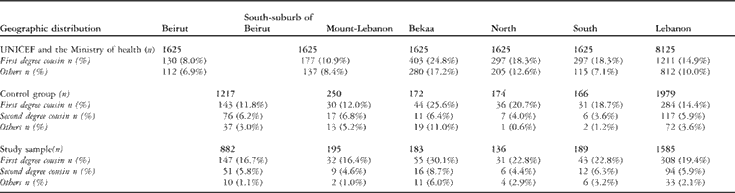
After exclusion of 162 patients because they had extra-cardiac anomalies, and/or syndromic features, we enrolled 1585 patients with non-syndromic congenital cardiac malformations in this study. Of the group, 881 (55.6%) were male, and 704 (44.4%) female. The age of patients varied from birth to 23 years old, with a majority of newborns and infants, and a small number of adults. The age of the mothers varied from 17 to 44 years. The control group obtained from the National Register of Paediatric and Congenital Heart Disease was made up of 1979 children with no cardiac anomalies as demonstrated by clinical examination and echocardiogram. Table 1 shows the geographic distribution and the degree of consanguinity of a combined study sponsored by UNICEF and the Ministry of Health,14 the National Register of Paediatric and Congenital Heart Disease control group, and the group of patients. In the control group assembled by the National Register of Paediatric and Congenital Heart Disease, the percentage of consanguineous marriages was 14.4% for those with first degree cousin consanguinity, 5.9% for those with second degree cousins, 3.6% for the other groups, and 23.9% for all degrees of consanguinity. In the UNICEF study, consanguinity was classified in only 2 groups, namely first degree cousins and “others”. In order to make comparison possible, we pooled together the “2nd degree cousins” and “others” group of the National Register of Paediatric and Congenital Heart Disease. We then compared the rate of consanguinity between the study sponsored by UNICEF and the Ministry of Health with that coming from the National Register of Paediatric and Congenital Heart Disease. The 2 samples did not differ, with Chi-squared values with 2 degrees of freedom equal to 0.86, not significant. Moreover, in both control groups, there was a parallel variation of the percentage of first degree cousin consanguinity along Lebanese regions, with the highest rate of consanguinity in the Bekaa region, and the lowest rates in the urban population of Beirut.
Geographic distribution of consanguinity in Lebanon.

Numbers and percentages of consanguineous parents (1st degree cousin, 2nd degree cousin and other parental consanguinity) among the groups surveyed under the auspices of UNICEF and the Ministry of Health, the National Register of Paediatric and Congenital Heart Disease, and the congenital heart disease study group. Data are presented according to different Lebanese departments.
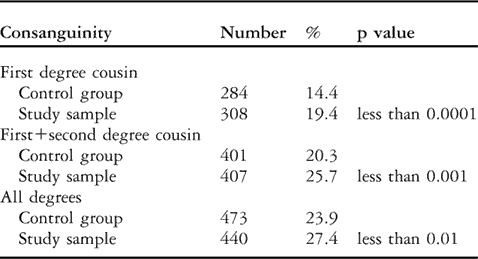
We then compared the rates of consanguinity between the group assembled from the National Register of Paediatric and Congenital Heart Disease and the group with congenitally malformed hearts. In this latter group, the percentage of first degree cousin amongst parents was 19.4%, 2nd degree cousins 5.9%, others 2.1%, and 27.4% for all degrees. These values differed from the controls in the group assembled from the National Register of Paediatric and Congenital Heart Disease, with the Chi-squared value with a degree of freedom of 3 equal to 22.4, giving a p value of less than 0.001. The sample with congenitally malformed hearts had a higher rate of 1st degree cousin consanguinity than did the control sample, at 19.4% as opposed to 14.4%, with the Chi-squared value with a degree of freedom of 1 equal to 16.4, giving a p value of less than 0.0001 (Table 2). This difference persisted when groups with 1st and 2nd degree consanguinity were pooled, at 25.7 as opposed to 20.3, with the Chi-square value with a degree of freedom of 1 equal to 14.7, giving a p value of less than 0.001. They also differed when all groups of consanguinity were pooled, at 27.4 as opposed to 23.9, with the Chi-squared value with a degree of freedom of 1 equal to 6.9, giving a p value of less than 0.01.
Comparison of parental consanguinity between the control persons obtained via the National Register of Paediatric and Congenital Heart Disease and the patients with congenitally malformed hearts.

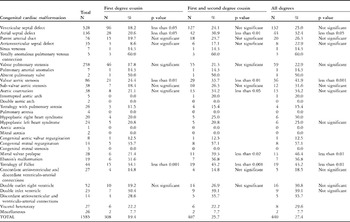
We then tried to determine which particular types of congenital cardiac malformation could account for this higher rate of consanguinity rate in the parents of those with malformed hearts, by splitting the various groups of consanguinity into the various malformations themselves. Data is presented on Table 3. The small number of cases in several types of malformation prevented any statistical testing. The other groups were compared to the proportion in the control samples assembled from the National Register of Paediatric and Congenital Heart Disease. Only three types of congenital cardiac defect had a higher rate of consanguinity than the controls in the groups made up of 1st degree cousins, 1st and 2nd degree cousins, and those with any degree of consanguinity, specifically those with atrial septal defect, valvar aortic stenosis and tetralogy of Fallot. Several other patients with congenital cardiac defects had a higher percentage of consanguineous parents than those in the control group assembled by the National Register of Paediatric and Congenital Heart Disease, but without reaching significant levels. By contrast, three types of malformation, although making a sub-group of sufficient size for analysis, did not show any increase in parental consanguinity. These were those with atrioventricular septal defect and common atrioventricular junction (“atrioventricular canal”), valvar pulmonary stenosis, and discordant ventriculo-arterial connections (“transposition”). For instance, those with atrioventricular septal defect had consistently a similar rate of parental consanguinity, at 8.6%, 17.1% and 22.9%, when compared to the appropriate controls in the National Register of Paediatric and Congenital Heart Disease, with values of 14.4%, 20.3%, and 23.9%, respectively.
Parental consanguinity among patients with different types of congenitally malformed hearts. Comparison with the control group was performed only when the size of the sample was sufficiently large.

Several of these solitary malformations are often associated on developmental grounds because they are presumed to be the consequence of a disturbance of common embryologic processes. This grouping is also based on family cases, with recurrence of congenital cardiac malformations in several family members. Within a family, affected members might present different but “concordant” defects. For instance, those with discordant ventriculo-arterial connections with concordant or discordant atrioventricular connections, and those with double outlet right ventricle and subpulmonary interventricular communication, compose such a group of concordant lesions. In this group, they were 73 cases, with 18 or 19.4% having 1st degree cousin consanguineous parents, 23 or 24.7% with 1st plus 2nd degree cousin consanguineous parents, and 26 or 28.0% with any type of consanguineous parents. This group did not differ statistically from the data coming from the controls assembled by the National Register of Paediatric and Congenital Heart Disease. By contrast, those with valvar aortic stenosis, aortic atresia, mitral atresia, and aortic coarctation can be considered as showing variable expressions of obstruction within the left outflow tract. When these lesions are grouped, producing a total of 151 cases, there were 34 1st degree cousin cases or 22.5%, 47 1st plus 2nd degree cousin cases, or 31.1%, and 55 all consanguinity groups, or 36.4%. These values were statistically significantly higher for consanguinity when compared to parents in the comparable control groups (Chi-squared degree of freedom 1 equal to 7.37, p less than 0.01; 9.97, p less than 0.01 and 11.8, p less than 0.001, respectively). The ratio of risk for those with tetralogy of Fallot, and all types of obstruction of the left ventricular outflow tract, in consanguineous parents (all subgroups together) compared to the control group is 2.42, with 95% confidence interval from 1.32 to 4.43, and 1.83 with 95% confidence interval from 1.29 to 2.58, respectively. By contrast, those with atrioventricular septal defect, persistent patency of the arterial duct, and the group of those with discordant ventriculo-arterial connections or double outlet right ventricle, have no increased ratio of risk for consanguineous parents: 0.94 with 95% confidence interval of 0.43 to 2.09; 1.14 with 95% confidence interval of 0.68 to 1.91; 1.24 and 95% confidence interval from 0.78 to 1.97, respectively.
Discussion
In our study, the ratio of genders in the patients with congenitally malformed hearts is 1.25. This is much higher than in the normal population, but identical to the ratio of 1.25, with 95% confidence intervals between 1.20 and 1.31, observed in the recent report from 3 other large registries.Reference Pradat, Francannet, Harris and Robert13 In the other recent report, the 12 932 patients with congenitally malformed hearts were stratified into those with severe and less severe defects, revealing an increased ratio of genders in those with severe defects.
The sample of control patients used in our study was assembled from the National Register of Paediatric and Congenital Heart Disease, and is composed of children and young adults referred to physicians reporting to the National Register without congenital cardiac defects. Since the sample assembled under the auspices of UNICEF and the Ministry of Health did not detail, as we did, those with 2nd degree cousin and other consanguineous relationships, we had no other alternative than to pool these 2 groups. Compared to the systematic study of the population assembled through UNICEF and the Ministry of Health,14 the rates of consanguinity were similar between both groups. There are, nonetheless, 2 limitations in comparing our sample group to the group assembled through UNICEF and the Ministry of Health. First, in the study sponsored by UNICEF and the Ministry of Health, a definite sample of 1625 cases was recorded in each of the selected geographic regions, irrespective of its demographic size, while in our control group achieved through the National Register of Paediatric and Congenital Heart Disease, the variation in size of each geographic group reflects roughly the relative demographic importance of each region. Second, the study conducted through UNICEF and the Ministry of Health included the south suburb part of Beirut within the population of Mount Lebanon, which reflects the true boundaries of these regions. By contrast, we pooled this part of the population of Mount Lebanon with the city of Beirut, because it is physically and demographically part of Beirut. It makes more sense to separate urban and rural populations, because they have different habits, rather than to split them on the ground of territorial limits. Despite these 2 limitations, we deemed that it was appropriate to use the data assembled through the National Register of Paediatric and Congenital Heart Disease as a control, and to compare this with the controls assembled through UNICEF and the Ministry of Health.
It is well accepted that congenital cardiac malformations reflect a multifactorial mode of inheritance, including possible interactions between genes. It is also known that consanguinity increases the risk of cardiac and non-cardiac congenital malformations.Reference Stoltenberg, Magnus, Lie, Daltveit and Irgens15, 16 It was previously reported that consanguinity is increased in parents of cohorts of patients with congenitally malformed hearts when compared to the general population.Reference Badaruddoza, Afzal and Akhtaruzzaman6, Reference Becker, Al-Halees, Molina and Paterson12 Moreover, highly inbred populations, as in Qatar, seem to have a higher rate of congenital cardiac disease when compared to non-inbred populations.Reference Robida, Folger and Hajar11, Reference Pradat, Francannet, Harris and Robert13 In our study, we found that all degrees of consanguinity, and the pooled data, were relatively greater in the patients with congenitally malformed hearts when compared to the control samples. Nevertheless, when stratifying the malformation on the basis of the phenotypic morphology, the rate of consanguinity was seen to vary greatly. Atrial septal defect, tetralogy of Fallot, and valvar aortic stenosis emerged as malformations with a high incidence of consanguineous parents, supporting the notion of involvement of autosomal recessive genes in these particular lesions. This observation may seem at odds with recent progress in molecular genetics. Families having atrial septal defects transmitted in autosomal dominant mode led the way to the identification of NKX2.5,Reference Schott, Benson and Basson17 GATA4,Reference Garg, Kathiriya and Barnes18 and more recently MYH6,Reference Ching, Ghosh and Cross19 as the involved gene. Aortic valvar anomalies in families with autosomal dominant transmission were found to be secondary to mutation in a gene known as NOTCH1.Reference Garg, Muth and Ransom20 This apparent discrepancy between autosomal recessive and dominant inheritance is not insurmountable. There are several examples in genetics where a single gene may be responsible for autosomal recessive and dominant inheritances, depending on the types of mutation. Beside these genes, other still unknown genes might be implicated. At this point, it is not known whether or not genes responsible for congenitally malformed hearts in families with autosomal dominant transmission will also be implicated in families with autosomal recessive inheritance. At least, both family types converge in that the genetic factors are carried on autosomal chromosomes.
Tetralogy of Fallot is one of the malformations of the ventricular outflow tracts that is frequently observed in Di George syndrome, but cases of Di George syndrome were excluded from our series. This association between tetralogy of Fallot and consanguinity was not observed in the report of Becker and colleagues,Reference Becker, Al-Halees, Molina and Paterson12 who surveyed a population in Saudi Arabia where the ratio of 1st degree cousin parents in the general population was 28%. This discrepancy cannot be explained by the absence of screening for 22q11 microdeletion, since Digilio et al.Reference Digilio, Marino, Giannotti, Toscano and Dallapiccola21 reported no change in the risk of recurrence of tetralogy of Fallot after exclusion of cases with 22q11 microdeletion. In support of our results, the study of Wulfsberg et al.Reference Wulfsberg, Zintz and Moore22 reported instances of recurrence of tetralogy of Fallot in siblings.
It should also be noted that, in rare sporadic cases of tetralogy of Fallot, mutations have been found in the NKX2.5,Reference Goldmuntz, Geiger and Benson23 ZFPM2/FOG2 Reference Pizzuti, Sarkozy and Newton24 or GATA4 Reference Nemer, Fadlalah and Usta25 genes. Furthermore, unlike our own findings, Becker and colleaguesReference Becker, Al-Halees, Molina and Paterson12 failed to find any association between valvar aortic stenosis and consanguinity. It is possible that these differences reflect different genetic backgrounds. In support of this hypothesis, Nabulsi et al.,Reference Nabulsi, Tamim, Sabbagh, Obeid, Yunis and Bitar9 who studied 759 patients with congenitally malformed hearts in Lebanon, found that all but 2, who had an atrioventricular septal defect and aortic coarctation, respectively, had an increased ratio of parental 1st degree cousins. Their control group was assembled by collaborative efforts from centres in Beirut to evaluate the consanguinity rate in parents of newborns. As could be expected from an essentially urban sample, the rate of 1st degree cousin consanguineous parents was low (8.2%) when compared to our own data assembled via UNICEF and the Ministry of Health, and our National Register of Paediatric and Congenital Heart Disease, where the comparative figures are 14.9%, and 14.4%, respectively. Nabulsi et al.Reference Nabulsi, Tamim, Sabbagh, Obeid, Yunis and Bitar9 also compared the rate of 1st degree cousin consanguineous parents of patients with congenitally malformed hearts to the highest consanguinity percentage of their controls, which was 13.2% for the Bekaa region. This percentage is close to our own figure of 14.4% derived from the control group assembled from the National Register of Paediatric and Congenital Heart Disease control group. Interestingly, when this control closer to our own values is used as a reference, only 3 types of congenital cardiac malformation emerge with a higher rate of consanguineous parents, as in our study, namely atrial septal defect, valvar aortic stenosis, and tetralogy of Fallot. In addition, those with atrioventricular septal defects and discordant ventriculo-arterial connections had a rate of consanguineous 1st degree cousin parents similar to the control group, as in our own study. This result for those with atrioventricular septal defect and common atrioventricular junction is in agreement with previous reports showing an autosomal dominant segregation for this lesion when seen in large families.Reference O’Nuallain, Hall and Stamm26–Reference Sheffield, Pierpont and Nishimura30 Moreover, heterozygous mutations have been demonstrated in rare sporadic cases.Reference Robinson, Morris and Goldmuntz31, Reference Zatyka, Priestley and Ladusans32 These conclusions are highly important to understand the molecular mechanisms that underlie these 2 congenital cardiac malformations. Since there is a normal ratio of genders amongst patients with atrioventricular septal defect, it can be presumed that genetic factors are essentially on autosomal chromosomes, and that only individuals with heterozygous mutations can survive to birth. Carrying a mutation on both copies of an implied gene is probably lethal. On the other hand, since there is a much greater ratio of males to females in those patients with discordant ventriculo-arterial connections or double outlet right ventricle with subpulmonary ventricular septal defect, it can be inferred that these latter lesions are essentially secondary to mutations of a gene or genes located on the X chromosome. Mutations in ZIC3, a gene that is located on the X chromosome, have been implicated in the production of visceral heterotaxy,Reference Bamford, Roessler and Burdine33 and some rare non-syndromic cases with discordant ventriculo-arterial connections.Reference Megarbane, Salem and Stephan34 The role of ZIC3 in the male preponderance of discordant ventriculo-arterial connections warrants further studies. Systematic ascertainment of relatives in a series of patients with discordant ventriculo-arterial connections revealed a surprising high recurrence at 10%.Reference Digilio, Casey and Toscano35 Moreover, the recurrence of regular transposition, and congenitally corrected transposition, within several families suggests a common pathogenic link to both conditions.Reference Piacentini, Digilio and Capolino36 By contrast, most cases of visceral heterotaxy are presumably autosomal recessive. In our study, the percentage of 1st degree cousin consanguineous parents is higher in the group with visceral heterotaxy, at 22.2% as opposed to the control group at 14.4%, but the small size of this subgroup precluded statistical evaluation.
There are limitations to our study. First, the population surveyed under the auspices of the UNICEF and the Ministry of Health, and that gathered via the National Register of Paediatric and Congenital Heart Disease, differ in several aspects. The group garnered through UNICEF and the Ministry of Health produced definite samples of population, in contrast to the cases obtained through the National Register of Paediatric and Congenital Heart Disease. Second, the south suburb of Beirut was included in the population of Mount Lebanon in the survey undertaken through UNICEF and the Ministry of Health, but was considered part of the population of Beirut in our control group. Third, in the study sponsored by UNICEF and the Ministry of Health, consanguinity was considered only in two groups, whereas we created three groups in our own study. A further limitation is that we did not stratify patients with double outlet right ventricle according to the location of the interventricular communication in relation to the arterial trunks. As a consequence, when we pooled this group of patients with those having discordant ventriculo-arterial connections, we included all cases. Strictly speaking, only those with the so-called Taussig-Bing variant are directly related morphologically to those with discordant ventriculo-arterial connections.
In conclusion, our study has shown that parental consanguinity increases the risk of producing an infant with a congenitally malformed heart only when the malformation itself is such as tetralogy of Fallot, valvar aortic stenosis, or atrial septal defect. Consanguinity in our own population did not increase the risk of production of other types of congenitally malformed heart, such as atrioventricular septal defect with common atrioventricular junction, discordant ventriculo-arterial connections and related lesions, canal, or valvar pulmonary stenosis. This information may help in improving the understanding of genetic factors predisposing to the production of congenitally malformed hearts, and in counselling populations with a tradition of inbreeding. The physicians who are performing prenatal screening should also be aware of these specific risks. More work is now required to determine whether the genetic factors predisposing to an increased risk in parental consanguinity are the same as those identified in dominant pedigrees. The identification of genes implicated in the genesis of congenital malformations in the context of inbreeding will improve counselling. To this end, close collaboration will be needed between different countries to identify the appropriate families, and to perform the genetic studies.
Acknowledgements
We thank Mr. Fouad Nakhle, Department of Biostatistics at the Lebanese University, Faculty of Medical Sciences, for his help in the statistical analysis. The Laboratoire Cardiogénétique is actively supported by the Foundation Renaud FEBVRE.