Congenital malformation of the heart is the most common defect seen at defect, and affects a large number of neonates, infants and children. Nearly one-third to one-half of these patients have critical lesions, requiring surgery or intervention in the first year of life.Reference Hoffman and Kaplan1 Over the last 50 years, improvements in diagnosis, medical treatment, and techniques for surgery and catheter intervention, have markedly changed the pattern of survival for such patients. This privilege of early diagnosis and timely management, however, is currently restricted to children born in so-called developed countries. In Indonesia, it is not uncommon to see adults with uncorrected congenital cardiac malformations. The majority of children born with congenitally malformed hearts in developing countries are undetected, and they do not get the necessary care, leading to a high morbidity and mortality.
Prevalence of congenitally malformed hearts in Indonesia
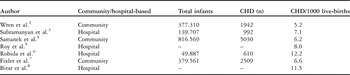
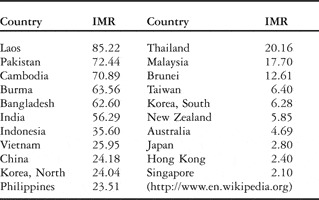
As judged from various studies based on the community and hospitals, the incidence of congenitally malformed hearts in infancy varies from 5 to 12 per 1000 live-births (Table 1).Reference Hoffman and Kaplan1–Reference Bitar, Baltaji, Dbaibo, Abed el-Jawad, Yunis and Obeid8 It is a fact that studies based on statistics derived from admission to hospital produce a higher prevalence when compared to studies carried out in the community. In Indonesia, a hospital-based study performed in 6 university hospitals, and assessing 3,069 live-births, showed a prevalence of congenital cardiac malformations of 9 per 1000 live-births.9 At a crude birth rate of 20 per 1000, the total annual live-births would be 4.5 million. Considering the estimate as referenced above9 a total of 40,500 infants with congenitally malformed hearts are added every year to the total pool. Up to half of the patients will require some form of intervention or surgery during childhood.Reference Fixler, Pastor, Chamberlin, Sigman and Eifler7 Thus, every year, at least 18,000 children born in Indonesia require surgery or care at an advanced infant cardiac centre. In our country, however, not every child who needs surgery is submitted to treatment. The number of surgical procedures for congenital cardiac disease in the whole country during 2005 was 706. The majority of congenitally cardiac malformations remain undetected, contributing to a high infant mortality rate of over 35 deaths for each 1000 live births (Table 2). Overall, one-tenth of these deaths during infancy are due to congenital malformations, and half of these are the consequence of cardiovascular malformations.Reference Pýnar10
Congenitally malformed hearts in defined live-birth populations.

The infant mortality rate (IMR – death per 1000 live-birth) in Asian Pacific countries.

Resources and infrastructure
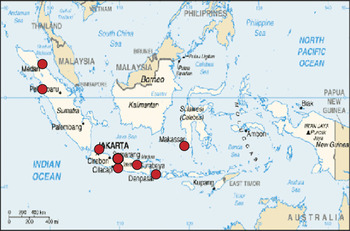
The resources and infrastructure as in any developing country are limited. There are only 2 centres in our country that have paediatric cardiac surgeons along with facilities for paediatric cardiac care, including infant and neonatal cardiac surgery. Both are located in the capital city, Jakarta. There are 8 other centres (Fig. 1), but less than 50 patients in each year undergo cardiac surgery in these centres. The majority of these institutions share their infrastructure between adult and paediatric cardiac services. The total number of dedicated paediatric cardiologists and cardiac surgeons is also very low. In the whole country, there are only 25 paediatric cardiologists, of whom 9 are located in the capital city, with 3 paediatric cardiac surgeons.
The Cardiac Surgical Centres in Indonesia are located in Jakarta, Semarang, Jogyakarta, Surabaya, Denpasar, Medan, Padang, and Ujung Pandang (red dots).

According to the guidelines of American College of Cardiology, it is recommended that, for every 5 million people, there should be at least one paediatric cardiac centre. Accordingly, the estimated number of cardiac centres required for the population of Indonesia, at 220 million, will be about 44. In an optimal structure, the overall surgical activity for each of these centres should be over 250 patients undergoing surgery each year.Reference Daenen, Lacour-Gayet and Aberg11 Each surgeon needs to operate on at least 125 patients so as to maintain his or her skill.
Over time, the national focus on primary care will paradoxically result in increasing recognition of congenitally malformed hearts in children, and the increased need for referral to specialist units. Improvements in antenatal and postnatal care should also result in increasing recognition of congenitally malformed hearts. Furthermore, it is recognized that “non specialists are increasingly reluctant to take responsibility for diagnosing normality”,Reference Hall, More and Camm12 and that referrals of healthy children with innocent murmurs to cardiology services are likely to increase.
Echocardiography is highly reliable in our centre, and most patients undergo surgery without prior cardiac catheterization. Three-dimensional echocardiography and magnetic resonance angiography for congenitally malformed hearts are not yet in clinical practice. Occasionally we use spiral computerized tomographic scans as a diagnostic tool. Substantial progress has been made in antenatal diagnosis as a result of the improvement in echocardiographic imaging. We do not have any experience in intrauterine fetal interventions. There are four laboratories for cardiac catheterization shared by the adult and paediatric cardiologists, electrophysiologists, and those undertaking vascular diagnosis and intervention.
Intervention for congenitally malformed hearts
There are three major centres, specifically The National Cardiovascular Centre and the Cipto Mangunkusumo General Hospital, both in Jakarta, and the Dr Sutomo General Hospital in Surabaya, which perform a wide range of interventions. In other centres, such as the Dr Sardjito Hospital in Jogyakarta, and the Dr Mohammad Hoesin Hospital in Palembang, interventions have just been started. I can summarise the interventional data for the whole country until August, 2006.
Balloon dilation and stenting procedures
Balloon atrial septostomy is routinely performed at the bedside, guided by echocardiography. Balloon pulmonary valvoplasty is the treatment of choice for pulmonary stenosis, and is cheaper than surgery. This has been performed in 178 cases, with good results and minimal complications. Our experience on balloon aortic valvotomy, and dilation of coarctation of the aorta is very limited. Equipment for radiofrequency perforation is not yet available in Indonesia.
Closing defects and embolisation of collaterals
The two most commonly used devices for occlusion of the persistently patent arterial duct in Indonesia are intravascular coils, such as detachable Cook coils, or the Amplatzer Ductal Occlusion device, which costs 50% more than performing surgery. We inserted 30 coils, and 266 Amplatzer devices, with good results. The device used in Indonesia to close atrial septal defects in the oval fossa is the Amplatzer Septal Occluder. We do not have experience with other devices. Using the Amplatzer device costs 25% more than surgery. It has been inserted in 135 patients, with good results. Compared to closure of either arterial ducts or atrial septal defects, interventional closure of ventricular septal defects is a relatively new. Our experience using Amplatzer devices is limited to 11 cases. Our experience in embolisation of collateral vessels with Gianturco coils and vascular plugs is also very limited.
Radiofrequency ablation
Radiofrequency ablation of abnormal arrhythmic pathways is increasing. In our centre, this procedure is performed by an adult electrophysiologist.
Surgery for congenitally malformed hearts at the National Cardiovascular Centre
Statistics in Indonesia, as in any other developing country, are not easily available. Even when available, they lack precision and accuracy. Since there is no national database on the profile of congenitally malformed hearts, and approximately 80% of the total surgery is performed in the National Cardiovascular Centre, I have used data from this institution in this report. We have 2 operating rooms, serviced by 2 paediatric cardiac surgeons, and 9 beds for intensive care. We can call on 4 well-trained paediatric cardiologists, supported by 2 paediatric intensivists.
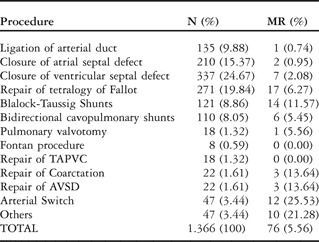
Over the period of 3 years from 2003 through 2005, 1366 patients underwent open and closed cardiac surgical procedures at the National Cardiovascular Centre. The hospital mortality rate was 5.56%, with complexity as judged by the Aristotle system of 6.25, putting our experience at a medium level. Since patients are often referred late, several have co-morbid conditions like pulmonary vascular obstructive disease, ventricular dysfunction, and arrhythmias, thereby increasing the perioperative mortality and morbidity. Over seven-tenths of the procedures involved ligation of the arterial duct, closure of atrial or ventricular septal defects, and repair of tetralogy of Fallot. Surgery in infancy has increased over time, and during this period accounted for approximately three-tenths of the total cases. The rate of mortality for operations performed in the neonatal period or early infancy, such as the arterial switch procedure, repair of atrioventricular septal defect, or relief of aortic coarctation, remains high at between 15 and 20% (Table 3).
Surgical Procedures at The National Cardiovascular Centre 2003–2005.

MR: hospital mortality rate; TAPVC: totally anomalous pulmonary venous connection; AVSD: atrioventricular septal defect.
Compared to Caucasian countries, we have fewer patients with aortic valvar stenosis, muscular venticular septal defects, coarctation of the aorta, and hypoplastic left heart syndrome. It is our policy not to operate on those with hypoplasia of the left heart due to the high mortality. Evaluation of patients with ventricular septal defect undergoing surgery from 2000 through 2004 showed that a large number had subarterial doubly committed defects, at 26.6% and 43.6% in childhood and adulthood respectively; while muscular defects accounted for less than 2%. The different profile of congenitally malformed hearts in the Chinese population has been reported by Leung et al.Reference Leung, Yung and Ng13 Pulmonary obstruction, including pulmonary atresia or stenosis with or without ventricular septal defect, was much more common in Hong Kong compared with the figures reported in Western literature, and obstruction of the left ventricular outflow tract, including coarctation of the aorta and hypoplastic left heart syndrome, was rarer than in the West. Our findings in Indonesia support this data.
Reasons for poor paediatric cardiac care in Indonesia
There are several reasons currently operating, which can be summarized as:
• Limited resources.
• Limited centres for training in paediatric cardiac care.
• Lack of awareness amongst referring physicians. Most births occur without the supervision of a paediatrician, and the ability of most general physicians and paediatricians to detect cardiac disease is very limited.
• Limited knowledge of diagnosis, management, and natural history of patients with congenitally malformed hearts, leading to delay of referrals to a paediatric cardiac centre. Eisenmenger’s syndrome is one of the most common complications found in patients with intra- or extra-cardiac shunt.
• Problems with transportation. Indonesia is a country encompassing an archipelago of 17,508 islands, of which 6,000 are inhabited, and which span more than 5000 kilometres. Patients have to travel hundreds of kilometres to reach a tertiary centre, which is located in the capital city. Many patients have to wait for workup, and the waiting list for surgery is more than two months. Besides expenses involved in travelling and staying in an alien city, there is considerable loss of income.
• Paediatric cardiac care is too expensive for the average Indonesian family, despite subsidies from hospital, government and voluntary organizations.
• Paediatric cardiac care is more demanding and more expensive than most hospital specialties, and is associated with a higher morbidity and mortality rate. Most private hospitals are not interested in developing such units.
• There are no government policies for cardiac care in children, since it is not identified as a health priority.
• Many families in Indonesia seek advice from an unqualified person. This further adds to the delay in diagnosis and proper management of the child with a congenitally malformed heart.
Conclusions
Paediatric cardiac care in Indonesia is still in its infancy, and leaves much to be desired. The barriers are: lack of awareness about congenital cardiac disease, coupled with limited resources and facilities, the high cost of treatment, and limited financial support. Training programmes exclusively dedicated to paediatric cardiology and paediatric cardiac surgery need to be established in centres with good standards of paediatric cardiac care. As the preventable causes of mortality in children decline, the importance of congenitally malformed hearts is likely to increase. It is time to take stock of the situation, and formulate guidelines for improving cardiac care for infants and children.