Introduction
Difficulties in the regulation of emotion are among the most common and debilitating consequences of severe traumatic brain injury (TBI; e.g., Draper, Ponsford, & Schonberger, Reference Draper, Ponsford and Schonberger2007; Engberg & Teasdale, Reference Engberg and Teasdale2004; Ownsworth & Fleming, Reference Ownsworth and Fleming2005; Wood, Liossi, & Wood, Reference Wood, Liossi and Wood2005). Many patients fail to return to work, have decreased leisure activity, or experience breakdowns in intimate relationships as a result of changes in emotional and social behaviors (e.g., Engberg & Teasdale, Reference Engberg and Teasdale2004; Gosling & Oddy, Reference Gosling and Oddy1999; Morton & Wehman, Reference Morton and Wehman1995; Wood & Yurdakul, Reference Wood and Yurdakul1997). The aim of this study was to investigate body and facial feedback, two processes that have a role in healthy emotional regulation (Koole, Reference Koole2009). We will first review emotional issues for people with TBI. We will then define body and facial feedback, before setting out the objectives and hypotheses of this study.
Problems of Emotional Regulation Following TBI
TBI commonly impairs both the expression and experience of negative affective states. There may be decreases in self-monitoring and control that are manifested through displays of irritability, aggression, impulsivity, and quick-temperedness (Elsass & Kinsella, Reference Elsass and Kinsella1987; Grattan & Eslinger, Reference Grattan and Eslinger1989; Newton & Johnson, Reference Newton and Johnson1985). Alternatively, there may be a reduction in drive as evidenced by a diminution of arousal and motivation and a high level of apathy. While these different problems with regulation might suggest different patterns of responsivity, the experimental literature, to date, presents a picture of under-reactivity to external emotional events. These studies found that people with TBI, compared to control participants, display low emotional reactivity to emotional stimuli, especially to unpleasant stimuli, measured by the startle reflex, skin conductance, facial reactions, or subjective rating of arousal (Angrilli, Palomba, Cantagallo, Maietti, & Stegagno, Reference Angrilli, Palomba, Cantagallo, Maietti and Stegagno1999; Blair & Cipolotti, Reference Blair and Cipolotti2000; de Sousa et al., Reference de Sousa, McDonald, Rushby, Li, Dimoska and James2010, Reference de Sousa, McDonald, Rushby, Li, Dimoska and James2011; Hopkins, Dywan, & Segalowitz, Reference Hopkins, Dywan and Segalowitz2002; McDonald, Li, et al., Reference McDonald, Li, De Sousa, Rushby, Dimoska and James2011; Sanchez-Navarro, Martinez-Selva, & Roman, Reference Sanchez-Navarro, Martinez-Selva and Roman2005; Saunders, McDonald, & Richardson, Reference Saunders, McDonald and Richardson2006; Soussignan, Ehrle, Henry, Schaal, & Bakchine, Reference Soussignan, Ehrle, Henry, Schaal and Bakchine2005). For example, the research has shown that TBI patients are impaired in mimicking angry facial expressions of others (de Sousa, et al., Reference de Sousa, McDonald, Rushby, Li, Dimoska and James2011; McDonald, Li, et al., Reference McDonald, Li, De Sousa, Rushby, Dimoska and James2011). This low emotional contagion to others’ emotions has also been documented in lower self-reported empathy in patients with TBI compared to control participants (de Sousa, et al., Reference de Sousa, McDonald, Rushby, Li, Dimoska and James2010, Reference de Sousa, McDonald, Rushby, Li, Dimoska and James2011; Grattan & Eslinger, Reference Grattan and Eslinger1989; Williams & Wood, Reference Williams and Wood2010a; Wood & Williams, Reference Wood and Williams2008).
Affective impairment has been linked to damage to an automatic/ventromedial neural system important for the production and automatic regulation of affective autonomic responses and the identification of emotion-related stimuli (Bornhofen & McDonald, Reference Bornhofen and McDonald2008; McDonald, Li, et al., Reference McDonald, Li, De Sousa, Rushby, Dimoska and James2011). This system is mediated by the amygdala, insula, ventral striatum, and ventral regions of the anterior cingulate and prefrontal cortex (Phillips, Drevets, Rauch, & Lane, Reference Phillips, Drevets, Rauch and Lane2003). It interacts with a dorsal system, which includes the hippocampus and dorsal aspects of the anterior cingulate gyrus and dorsolateral prefrontal cortex and is involved in effortful, slower processing of emotional stimuli (Phillips et al., Reference Phillips, Drevets, Rauch and Lane2003).
Alexithymia is a multifaceted construct, first described by Sifneos (Reference Sifneos1973) as difficulty identifying and communicating feelings, differentiating feelings and body sensations, a diminution of fantasy, and an externally oriented cognitive style. The research also suggests that alexithymia is prevalent in people who have suffered from TBI (Allerdings & Alfano, Reference Allerdings and Alfano2001; Becerra, Amos, & Jongenelis, Reference Becerra, Amos and Jongenelis2002; Koponen et al., Reference Koponen, Taiminen, Honkalampi, Joukamaa, Viinamaki and Kurki2005; McDonald, Rosenfeld, et al., Reference McDonald, Rosenfeld, Henry, Togher, Tate and Bornhofen2011; Williams & Wood, Reference Williams and Wood2010a; Wood & Williams, Reference Wood and Williams2007). Lesions in the cingulate gyrus and the corpus callosum, the latter being related to inter-hemispheric communication, have been proposed to account for this difficulty (Koponen et al., Reference Koponen, Taiminen, Honkalampi, Joukamaa, Viinamaki and Kurki2005). Damage to these structures is associated with alexithymia (Berthoz et al., Reference Berthoz, Artiges, Van De Moortele, Poline, Rouquette and Consoli2002; Gundel et al., Reference Gundel, Lopez-Sala, Ceballos-Baumann, Deus, Cardoner and Marten-Mittag2004; Houtveen, Bermond, & Elton, Reference Houtveen, Bermond and Elton1997; Kano et al., Reference Kano, Fukudo, Gyoba, Kamachi, Tagawa and Mochizuki2003; Lane, Ahern, Schwartz, & Kaszniak, Reference Lane, Ahern, Schwartz and Kaszniak1997) and can occur with TBI (Tomaiuolo et al., Reference Tomaiuolo, Carlesimo, Di Paola, Petrides, Fera and Bonanni2004; Yount et al., Reference Yount, Raschke, Biru, Tate, Miller and Abildskov2002). Lane and colleagues (Lane, Sechrest, Riedel, Shapiro, & Kaszniak, Reference Lane, Sechrest, Riedel, Shapiro and Kaszniak2000; Subic-Wrana, Bruder, Thomas, Lane, & Köhle, Reference Subic-Wrana, Bruder, Thomas, Lane and Köhle2005) conceptualized alexithymia as a failure to connect the implicit or unconscious processing of affect (i.e., awareness of peripheral manifestations of emotional arousal through body sensations or a tendency to action) to explicit or conscious processing (i.e., ability to distinguish or identify multiple nuances of emotions). Thus, according to that definition, TBI may impair the connection between body-sensations and conscious feelings.
Body and Facial Feedback
The idea that afferent feedback from expressive behavior may play a causal role in emotional experience traces back to Charles Darwin and William James. Darwin (Reference Darwin1872) noted that the intensity of subjective feelings could be regulated by enhancing or inhibiting the emotional expression. James (Reference James1890) went further, proposing that the experience of peripheral bodily changes (i.e., visceral and striated muscle activity) are the emotion. The subjective experience of emotion follows bodily changes. Following those ideas, Tomkins proposed that specific features of emotional facial expression cause equally specific emotional feelings (Reference Tomkins1963). Since then, research has provided some support in favor of what has been labeled the facial feedback hypothesis (review in McIntosh, Reference McIntosh1996; see also, Davis, Senghas, & Ochsner, Reference Davis, Senghas and Ochsner2009; Soussignan, Reference Soussignan2002). Body-posture also influences subjective emotional feelings, and its simultaneous combination with the matched emotional facial expression has an additional effect on feelings (Flack, Laird, & Cavallaro, Reference Flack, Laird and Cavallaro1999b).
We are not equal in terms of responsivity to body and facial feedback effects (Duclos & Laird, Reference Duclos and Laird2001; Laird et al., Reference Laird, Alibozak, Davainis, Deignan, Fontanella and Hong1994; Laird & Crosby, Reference Laird and Crosby1974). People whose subjective emotional experience is influenced by facial feedback are more sensitive to emotional contagion (Doherty, Reference Doherty1997, Reference Doherty1998; Hatfield, Cacioppo, & Rapson, Reference Hatfield, Cacioppo and Rapson1992, Reference Hatfield, Cacioppo and Rapson1994) and are more empathic (Andréasson & Dimberg, Reference Andréasson and Dimberg2008). Individuals with psychiatric disorders have been found to be affected differently by their body cues compared to healthy subjects (Flack, Laird, & Cavallaro, Reference Flack, Laird and Cavallaro1999a; Stel, van den Heuvel, & Smeets, Reference Stel, van den Heuvel and Smeets2008).
From a clinical point of view, deliberate manipulation of expressive behaviors might influence subjective emotional feelings (e.g., Duclos & Laird, Reference Duclos and Laird2001; Gellhorn, Reference Gellhorn1964; McIntosh, Reference McIntosh1996). Techniques of adopting or inhibiting emotional behaviors (the most common being relaxation; e.g., Esch, Fricchione, & Stefano, Reference Esch, Fricchione and Stefano2003) are widely used in everyday life and in clinical contexts. It is unknown, however, whether people with TBI have normal responses to adoption of emotional behaviors. This is an important clinical issue. Not only can somatic feedback be useful therapeutically, but emotional awareness has been described as an initial step in the regulation of emotion (Herwig, Kaffenberger, Jäncke, & Brühl, Reference Herwig, Kaffenberger, Jäncke and Brühl2010). Problems with the regulation of aggression in people with TBI, for example, may potentially reflect a failure to respond to cues emanating from their own posture.
The Present Study
The object of this study was to evaluate the combined effect of body and facial feedback for the emotions of happiness, anger, and sadness in people with TBI to gain some understanding of contributors to problems with emotional regulation. Based on prior research indicating high level of alexithymia, low reactivity to emotional stimuli, and low level of empathy, we predicted that people with TBI would be less responsive to the effects of combined body and facial feedback than control participants. As the low emotional reactivity following TBI is especially found for negative stimuli and specifically for angry stimuli, we further predicted that people with TBI would report that their subjective emotional feelings are less affected by negative body cues of emotion (and specifically the emotion of anger) than positive ones.
Method
Participants
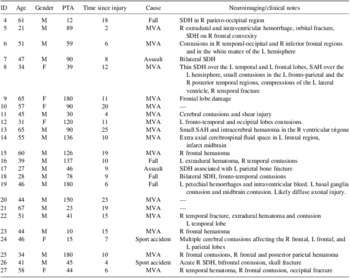
Twenty-seven individuals with severe TBI participated in the study. They were recruited from several brain injury units in Sydney, Australia. All had sustained a TBI of sufficient severity to warrant inpatient rehabilitation, experienced a period of posttraumatic amnesia longer than 7 days, were at least 2 years post-injury, and had no identified aphasia, agnosia, or psychosis. Two participants were subsequently excluded from the study as they were currently experiencing extremely severe depression and/or anxiety (as measured by the Depression Anxiety and Stress Scale, DASS-21; Lovibond & Lovibond, Reference Lovibond and Lovibond1995). A further TBI participant was excluded from the study due to his incapacity to perform the task correctly, resulting in 24 TBI participants (6 Female, 18 Male). These participants all had sufficient cognitive and motor capacity to understand and comply with instructions. As is typical in this population, visible cranial and cerebral pathology, as documented on available clinical scans, was diverse including skull fractures, hemorrhages, and contusions throughout the brain. A summary of clinical information obtained from hospital records and self-reports is found in Table 1.
Demographic and clinical features of participants with traumatic brain injuries

Note. Age and time since injury in years. M = male, F = female, PTA = posttraumatic amnesia (days), MVA = motor vehicle accident, R = right, L = left, SAH = subarachnoid hemorrhage, SDH = subdural hematoma.
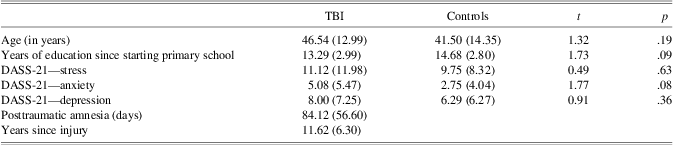
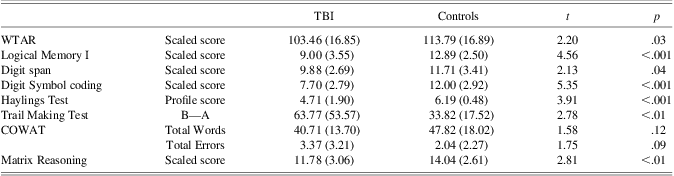
Twenty-nine healthy individuals were recruited from the general community in an effort to match TBI participants on demographic variables. They did not have any history of neuropsychological impairment, and were matched as closely as possible to the demographic characteristics of the TBI population with regard to gender, age, and years of education. One participant was subsequently excluded from the study as he was currently experiencing extremely severe depression and anxiety, resulting in 28 control participants (12 female, 16 male). Pearson's Chi Square analysis indicated that there were no significant differences between groups for distribution of gender (χ 2 = 1.82; df = 1; p = .18). Exclusion criteria for all participants included history of substance abuse, and psychiatric, developmental, or neurological disorders (apart from the brain injury in the TBI group). Demographical and control data are presented in Table 2. All participants were assessed for (a) premorbid ability: Wechsler Test of Adult Reading (WTAR; Wechsler, Reference Wechsler2001); (b) working memory: Wechsler Adult Intelligence Scale–Third Edition (WAIS–III), Digit Span (Wechsler, Reference Wechsler1997a); (c) processing speed: WAIS–III, Digit Symbol Coding; (d) new learning: Wechsler Memory Scale–Third Edition, Logical Memory I (Wechsler, Reference Wechsler1997b); (e) executive functions: Controlled Oral Word Association Test (flexibility, generativity; COWAT; Spreen & Strauss, Reference Spreen and Strauss1991), Haylings Test (inhibition; Burgess & Shallice, Reference Burgess and Shallice1997), Trail Making Test (flexibility; Reitan, Reference Reitan1992), and WAIS-III, Matrix Reasoning (fluid reasoning, flexibility). Neuropsychological data are presented in Table 3. These participants were also involved in a related study on emotional expression (Dethier, Blairy, Rosenberg, & McDonald, Reference Dethier, Blairy, Rosenberg and McDonald2012). All participants gave informed consent, and the research was approved by the Human Ethics Committee of the University of New South Wales.
Means, standard deviations, and comparisons between participants with severe traumatic brain injury (TBI; n = 24) and control participants (n = 28) on the demographical and control measures
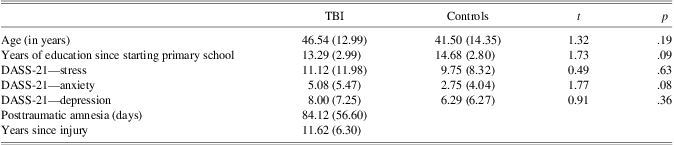
Notes. DASS-21 = Depression, Anxiety, and Stress Scale-21. Standard deviations are in parentheses.
Means, standard deviations, and comparisons between participants with severe traumatic brain injury (TBI; n = 24) and control participants (n = 28) on the neuropsychological measures
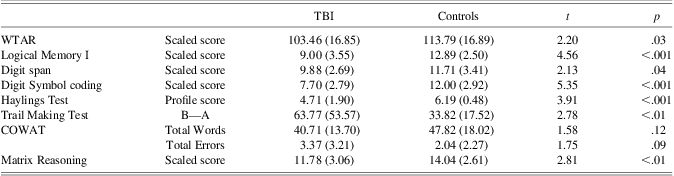
Notes. WTAR = Wechsler Test of Adult Reading. COWAT = Controlled Oral Word Association Test. Standard deviations are in parentheses.
Body and Facial Feedback Task
The procedures used in this study were adapted, in part, from those developed by Flack and his colleagues (Flack, Reference Flack2006; Flack et al., Reference Flack, Laird and Cavallaro1999a, Reference Flack, Laird and Cavallaro1999b). Participants were asked to take part in a study on the relationship between the adoption of certain postures, the contraction of certain facial muscles and body sensations. The example of feeling of pain after holding the same position during a certain amount of time was given. This explanation as to the purpose of the study was designed to disguise the fact that the experimenters were testing relationships between expressive behaviors and emotional feelings. Participants sat facing a video camera, while the experimenter was seated behind them and out of their view.
Before each manipulation of combinations of expressions and postures, participants were told to relax all the muscles in their faces and bodies. Once participants indicated that they were relaxed, instructions for a facial expression/posture manipulation were given (see Appendix). Expressions and postures of anger, sadness, and happiness were manipulated. A further neutral expression/posture manipulation was used as baseline. The sequence of the four expression/posture manipulations was counterbalanced between participants. Participants were told to hold their muscles according to the instructions for 10 s each. Instructions for emotional expressions and postures were adapted from those of Flack et al. (Reference Flack, Laird and Cavallaro1999b). Those for the neutral expression/posture were developed during pilot testing.
To check that participants produced and maintained the correct expression/posture, participants were filmed during the experiment. Two judges, naive to the diagnostic group of the participant, classified (by a multiple-choice) each video segment of expression/posture manipulation in one of the following emotion categories: happiness, anger, sadness, or neutral. Cohen's kappa between the two judges was .98. One TBI participant was subsequently excluded from the study because at least one of his expressions/posture was not detected correctly by one judge.
After each expression/posture manipulation, subjects were given a body sensations scale to complete to rate their experience. The scale contained fifteen 7-point scale items ranging from “not at all” to “very strongly”; 10 concerned body sensations (change in breathing, sensations of cold or shivers, burning cheeks, tense or rigid muscles, shaking, perspiration, vertigo, numbness or tingling, muscular pain, and sensation of diffuse heat) and 5 concerned subjective emotional feeling (cheerfulness, sadness/depression, fear/anxiety/distress, revulsion/disgust, irritation/anger). Three of the five emotional items were directly relevant to the expression/posture manipulation (cheerfulness/happiness, depression/sadness, and irritation/anger).
A post-experimental interview was used to determine whether or not participants deduced the true purpose of the experiment during the procedure. Participants were asked what they understood the purpose of the experiment to be, if they could think of any other purpose the study might serve, and if they believed that the muscle contractions had affected their feelings in any way. Participants were assigned to one of two guess groups on the basis of their answers (if it was not clear in which group they belonged from their answers to these three questions, further questions were asked): those who guessed that the experiment examined how expression/posture could affect/produce emotion and those who did not.
Results
All statistical analyses were conducted by using STATISTICA, version 10, for windows (StatSoft, Reference StatSoft2011). First, we examined the impact of control and neuropsychological variables on the body and facial feedback variables. Second, comparisons were computed regarding body and facial feedback measures. Finally, we investigated the role of guessing the purpose of the experiment on the body and facial feedback results.
Preliminary Analyses
As shown in Table 2, no between-group difference on demographic and clinical measures reached significance although there was a non-significant trend for anxiety and educational level. As seen in Table 3, TBI participants were poorer than control participants on all neuropsychological measures, except the COWAT. However, no correlation reached statistical significance between age, education level, the DASS-21, and neuropsychological tests on the one hand, and any facial and body feedback variables, on the other hand, in the combined sample or in the two groups separately. Furthermore, a series of analyses of covariance was conducted to control for (1) neuropsychological measures and (2) anxiety and level of education. The inclusion of these covariates did not affect the facial and body feedback results. Similarly, duration of posttraumatic amnesia and time since injury did not have any impact on the dependent variables in the TBI group. Finally, no gender influence was observed on the computed dependent variables in the whole group of participants or in each group independently. Therefore, all subsequent analyses were collapsed across these factors.
Body and Facial Feedback Task
To control for baseline emotional state, difference scores for subjective ratings for each emotional expression/posture were calculated by subtracting ratings from the baseline neutral condition. All the subsequent analyses were conducted with these difference scores.
Global Responsivity
We computed a score of global responsivity to body and facial feedback by summating the extent to which the happy, the angry, and the sad expression/posture increased feelings of the relevant emotion compared to the neutral expression/posture (e.g., cheerfulness ratings during the happy expression/posture minus cheerfulness ratings during the neutral expression/posture) and adding these together. A score of zero would represent no change in response to any condition. TBI participants had a lower global score of responsivity than control participants (M = 1.71; SD = 4.12 and M = 5.07; SD = 5.61, respectively), F(1,50) = 5.89, p = .02, η 2 = .11.
Responsivity to Each Expression/Posture Manipulation
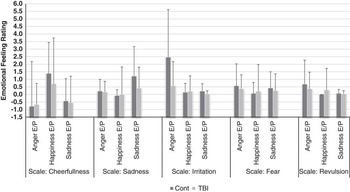
The following analyses were conducted to test if, as predicted, between-group differences on responsivity were larger for negative compared to positive emotions. A 3 (Manipulation) × 5 (Scale) × 2 (Diagnostic Group) analysis of variance (ANOVA) revealed significant Manipulation x Scale and Manipulation × Scale × Group interactions, with F(8,400) = 12.72, p < .001, η 2 = .20, and F(8,400) = 2.51, p = .01, η 2 = .05, respectively. This indicated that differences between groups were dependent upon emotion. Planned comparisons were then conducted to answer two questions for each expression/posture manipulation: (1) Were participants from each diagnostic group affected by the manipulation? (2) Were participants from the two diagnostic groups affected differently by the manipulation? To answer these questions, we compared the rating of the emotional scale matching a given expression/posture manipulation with ratings of the same emotional scale across the remaining, non-matching expression/posture manipulations. For example, to know if participants were affected by the angry expression/posture manipulation, we compared the rating of irritation during the angry expression/posture manipulation with the ratings of irritation during sad and happy expression/posture manipulations. Between-group differences on those analyses were then computed. Figure 1 illustrates these analyses.
Means of subjective emotional feeling rating for participants with severe traumatic brain injuries (TBI; n = 24) and control participants (n = 28) as a function of the emotional scale and the expression/posture manipulation (E/P).

Happiness analyses
Results showed that both control and TBI participants were affected by the happiness expression/posture manipulation, with F(1,27) = 15.47, p < .001, η 2 = .36, and F(1,23) = 6.00, p = .02, η 2 = .21, respectively. No significant difference emerged between groups, F(1,50) = 0.86, p = .36, η 2 = .02.
Anger analyses
Result showed that control participants were affected by the angry expression/posture manipulation, F(1,27) = 16.01, p < .001, η 2 = .37. We did not find evidence that TBI participants were affected by this manipulation, F(1,23) = 2.00, p = .17, η 2 = .08. Control participants were more affected by the angry expression/posture manipulation compared to TBI participants, F(1,50) = 7.08, p = .01, η 2 = .12.
Sadness analyses
Result showed that control participants were affected by the sad expression/posture manipulation, F(1,27) = 8.90, p < .01, η 2 = .25, whereas we did not find evidence that TBI participants were, F(1,23) = 1.87, p = .18, η 2 = .08. Results revealed a non-significant trend regarding the difference between control and TBI participants, F(1,50) = 2.95, p = .09, η 2 = .06.
Fear analyses
As no expression/posture manipulation matched the emotional scale of fear, we compared the fear ratings for negative (angry and sad) versus positive (happy) expression/posture manipulations. Our assumption was that the negative expression/posture manipulations would enhance more feelings of fear than the positive one. Results revealed a non-significant trend for control participants to feel more fear in the negative than positive expressions/postures, F(1,27) = 3.59, p = .06, η 2 = .12. No difference emerged for TBI participants, F(1,23) = .15, p = .70, η 2 = .01, or between the two groups, F(1,50) = 1.02, p = .32, η 2 = .02.
Disgust analyses
As it has been shown previously that angry expression/posture manipulations increased feelings of disgust (Flack et al., Reference Flack, Laird and Cavallaro1999a, Reference Flack, Laird and Cavallaro1999b), we compared revulsion ratings for the angry expression/posture manipulation to the other two conditions. Control participants felt more revulsion during angry than during other expression/posture manipulations, F(1,27) = 5.04, p = .03, η 2 = .16. No significant difference emerged for TBI participants, F(1,23) = .87, p = .36, η 2 = .04, or between the two groups, F(1,50) = 1.36, p = .25 η 2 = .03.
Impact of Guessing the Purpose of the Experiment
Twenty-one control participants and eight TBI participants were assigned to the guess group based on their expressed awareness of the purpose of the experiment. Seven control participants and 16 TBI participants were assigned to the no-guess group. Results showed that group and guess variables were dependent (χ 2 = 9.1, df = 1, p > .01). Consequently, the between guess group analyses yielded a similar pattern of results to the between diagnostic group analyses, that is, similar to the original ANOVA based upon diagnostic group, the Manipulation × Scale × Guess Group interaction was significant, F(8,400) = 4.18, p < .001, η 2 = .08, and, similarly to control participants, participants from the guess group were more affected than others by the angry expression/posture manipulation, F(1,50) = 6.19, p = .01, η 2 = .11. As it seems that guessing or not guessing depended upon the diagnostic group status, we did not compute any analyses to control for the guess factor.
Participants from the guess group had a higher score of global responsivity than the no-guess group (M = 5.31; SD = 5.71; and M = 1.3; SD = 3.47), F(1,50) = 8.94, p < .01. The η 2 was .15, indicating that the effect of guessing accounted for 15% of the variance in the score of responsivity. Moreover, we classified each participant in a responsive versus no responsive group. Participants were assigned to the responsive group if their global responsivity score was superior to 0. In the guess group, 23 participants were responsive and 6 were not. In the no-guess group 7 were responsive and 16 were not. Results showed that the guess and the responsive group variables were dependent (χ 2 = 12.55; df = 1; p > .001).
Discussion
The purpose of the present research was to investigate responsivity to the combined effect of body and facial feedback in people with TBI. As predicted, TBI participants were globally less responsive to the effects of body and facial feedback than control participants. Even more interestingly, this group difference differed between emotions. In accord with our hypotheses, TBI participants were responsive to positive but not to negative expression/posture manipulations. More specifically, in control participants, happy expression/posture enhanced cheerful feelings, angry expression/posture enhanced irritation and revulsion feelings, and sad expression/posture enhanced sadness feelings. In the TBI group, however, only the happy expression/posture enhanced matched feelings.
These results are concordant with the results of previous studies that found that people with TBI experience more difficulty in processing and reacting emotionally to negative facial cues of emotion than to positive facial cues of emotion in others: specifically, their capacity to mimic negative faces, their autonomic reactions to negative faces, and their recognition of negative faces are impaired (e.g., Blair & Cipolotti, Reference Blair and Cipolotti2000; Croker & McDonald, Reference Croker and McDonald2005; de Sousa et al., Reference de Sousa, McDonald, Rushby, Li, Dimoska and James2011; Hopkins et al., Reference Hopkins, Dywan and Segalowitz2002; McDonald, Li, et al., Reference McDonald, Li, De Sousa, Rushby, Dimoska and James2011; Williams & Wood, Reference Williams and Wood2010b). The present study extends these finding by showing that emotional reactions to their own negative facial and body cues of emotion are also impaired in people with TBI.
Furthermore, in the present study, the angry expression/posture manipulation was the one that was least effective for people with TBI compared to control participants. Different processes, not mutually exclusive, may explain this result, e.g., failure to experience the somatosensory, visceral, autonomic, etc., effects of anger, failure of the angry expression/posture to elicit anger, or difficulty consciously identifying feelings of anger in oneself. The latter interpretation fits within Lane's conceptualization of alexythimia, that is, this result may be interpreted as patients with TBI failing to connect unconscious processing of affect (i.e., physiological or body sensations) and conscious ones. As emotional knowledge has an important role in emotional regulation (Herwig et al., Reference Herwig, Kaffenberger, Jäncke and Brühl2010; Koole, Reference Koole2009), it stands to reason that people with TBI may have problems regulating feelings of anger because they do not recognize them. Thus conceptualized, this result is consistent with the frequent report of irritability and aggressiveness in people with TBI (Alderman, Reference Alderman2003; Baguley, Cooper, & Felmingham, Reference Baguley, Cooper and Felmingham2006; Kim et al., Reference Kim, Lauterbach, Reeve, Arciniegas, Coburn and Mendez2007; Medd & Tate, Reference Medd and Tate2000), although it is likely that other factors (e.g., impaired empathy) are also involved. Research on alexithymia in people with TBI has previously documented an increased incidence of difficulty in the identification of one's own emotions (e.g., McDonald, Rosenfeld, et al., Reference McDonald, Rosenfeld, Henry, Togher, Tate and Bornhofen2011; Williams & Wood, Reference Williams and Wood2010a; Wood & Williams, Reference Wood and Williams2007). Our study provides empirical evidence for heightened difficulty connecting bodily sensations to explicit feelings of emotion in this group. Before this study, this difficulty has only been apparent from self-report questionnaires on alexithymia. Our study is also the first to show that difficulty in the identification of one's own emotions may differ between emotional categories.
The majority of participants guessed that the purpose of the experiment was to examine how expression/posture could affect/produce emotion. The probability of being assigned to the guess versus no-guess group differed as a function of the diagnostic group: most TBI participants did not see through the experiment while most control participants did. Diagnosis and guess groups were thus intrinsically related. This raises questions regarding the interpretation of the diagnostic group differences with respect to responsivity to body and facial feedback. Specifically, a major potential problem for our results may be that sensitivity to experimenter demands affected performance. However, this seems unlikely. Indeed, this does not explain the significant interaction between manipulation, scale, and group found in this study. There is no reason why participants would wish to comply with experimenter demands more for some emotions than others. In general, evidence from previous studies suggests that experimenter demand is not likely to have a role in body and facial feedback effects. First, body and facial feedback effects were still found in studies in which the real purpose of the experiment was extremely well disguised (e.g., Stepper & Strack, Reference Stepper and Strack1993; Strack, Martin, & Stepper, Reference Strack, Martin and Stepper1988) or in which participants who reported seeing through the experiment were excluded (Duclos et al., Reference Duclos, Laird, Schneider, Sexter, Stern and Van Lighten1989). Second, the response to facial feedback has been associated with several subsequent emotional responses in previous studies (e.g., recall of emotional events, mimicry; Duclos & Laird, Reference Duclos and Laird2001; Laird et al., Reference Laird, Alibozak, Davainis, Deignan, Fontanella and Hong1994; Schnall & Laird, Reference Schnall and Laird2003). As it is unlikely that participants would respond intentionally to a second emotional measure in accordance with their response to the first, this association does not seem consistent with the effects of experimenter demand. Finally, several previous studies have shown that people responsive to facial feedback are less likely to respond to social expectations than others (Duclos & Laird, Reference Duclos and Laird2001; Laird, Reference Laird1984; Laird & Bresler, Reference Laird and Bresler1992).
The experimenter demand hypothesis is based on the assumption that participants who guessed the purpose of the experiment were found to be responsive to body and facial feedback because they responded to the experimenter's expectations. However, Flack (Reference Flack2006) has suggested that the reverse explanation is equally plausible: people who are responsive to body and facial feedback are more likely to guess the purpose of the experiment after the fact because feeling strong emotion provides additional cues as to the purpose of the experiment. However, in the present case, this alternative explanation suffers from the same weakness as the experimenter demand hypothesis: it does not explain the interaction between manipulation, scale, and group.
If experimenter demand does not account for our results, we are left with the conclusion that TBI participants were less responsive to expression/posture manipulation, especially to the angry one, and were less likely to guess the purpose of the experiment. Furthermore, we need to consider how these issues are related. Presumably, the more associations one makes between expression/posture configuration and emotional state, the more cues one has as to the purpose of the experiment. In the present study, we hypothesize that control participants associated each expression/posture configuration with an emotional state whereas TBI participants associated only the happiness configuration with the emotion of happiness. This, in addition to cognitive impairments (including memory impairments) commonly ascribed to this population (e.g., Draper & Ponsford, Reference Draper and Ponsford2008; Kinnunen et al., Reference Kinnunen, Greenwood, Powell, Leech, Hawkins and Bonnelle2011; Scheid, Walther, Guthke, Preul, & von Cramon, Reference Scheid, Walther, Guthke, Preul and von Cramon2006), may account for the fact that more control participants guessed the purpose of the study than TBI participants.
Two major theories have been proposed to explain the mechanisms involved in facial and body feedback. A neuropsychological account postulates a connection between the motor/somatosensory cortex underpinning emotional movements and their associated sensations and the limbic region that mediates physiological changes during emotions (Damasio, Reference Damasio1994; Ekman, Reference Ekman1992; Levenson, Ekman, & Friesen, Reference Levenson, Ekman and Friesen1990). The second account is a psychological one, the self-perception theory, which postulates that we know about ourselves in the same way that others know about us, that is, we identify our emotional state by observation and interpretation (not necessarily conscious) of our behaviors and of the situations in which we find ourselves (Bem, Reference Bem1967; Laird & Bresler, Reference Laird and Bresler1992). Situational cues provide expectations about how most people would feel in the same circumstances. Personal cues (our own behavior, speech, and appearance) account for body and facial feedback effects. When people perceive themselves in a particular facial and body configuration that they know is commonly associated with a given emotional state, they can infer that they are experiencing that emotion. This theory thus suggests that people who are sensitive to personal cues first associate their facial and postural configurations with an emotion before feeling that emotion. Many people with TBI present with impairments in their ability to decode sad and angry (but not happy) configurations in other people (Croker & McDonald, Reference Croker and McDonald2005; Green, Turner, & Thompson, Reference Green, Turner and Thompson2004; Hopkins et al., Reference Hopkins, Dywan and Segalowitz2002; Jackson & Moffat, Reference Jackson and Moffat1987; McDonald, Flanagan, Rollins, & Kinch, Reference McDonald, Flanagan, Rollins and Kinch2003; Williams & Wood, Reference Williams and Wood2010b). According to this theory, these impairments in decoding body and facial configurations of emotion in others may extend to difficulty recognizing the same configurations in themselves, thus providing reduced cues with which to recognize their negative emotional state.
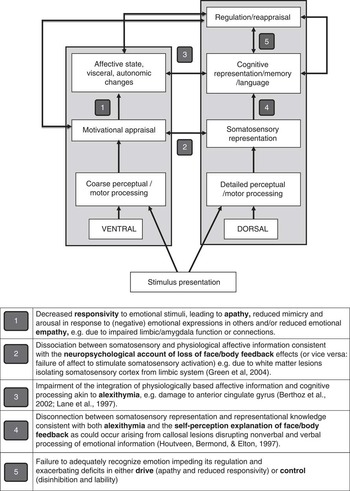
These two theories are not incompatible. Indeed, current neural modeling of emotion processes (e.g., Adolphs, Reference Adolphs2002, Reference Adolphs2003; Phillips et al., Reference Phillips, Drevets, Rauch and Lane2003) emphasizes the likelihood of dual interacting systems, entailing a ventral system that mediates early processing of emotionally significant events and physiological reactivity to those events, and a slower, dorsal route that mediates detailed processing of incoming information engaging memory and other cognitive functions as well as regulation of ongoing processes. While the specifics of this model of information processing are far from understood, a schematic representation based on the work of Phillips et al. and Adolphs is useful to summarize the various stages of processing of emotional information so as to place the current findings in context (see Figure 2).
Schematic model of emotion processes based on similar schemas by Phillips et al. (Reference Phillips, Drevets, Rauch and Lane2003) and Adolphs (Reference Adolphs2003). The ventral system entailing the amygdala, insula, ventral striatum, and ventral regions of the anterior cingulate and prefrontal cortex mediates the early, rapid appraisal of emotionally significant stimuli and affective autonomic responses. The slower, dorsal route including the hippocampus and dorsal aspects of the anterior cingulate gyrus and prefrontal cortex, with input from motor/sensory and association cortex, provides effortful processing of emotional stimuli and regulation of other processes in line with contextual requirements.

According to this model, there are numerous stages in the processing of emotional information that can be impaired, lead to different disorders. Specifically, under-responsivity to emotional events including low empathy to the emotional state of others, or low responses to internal cues may reflect damage to the ventral system, impairing early automatic responses (Stage 1 in the model), especially to negative emotional events. Loss of utility of the facial and body feedback may additionally reflect dissociations between somatosensory representation and triggering of physiological responses (Stage 2) or failure to integrate bodily sensations, either physiological reactivity (Stage 3) or somatosensory representation (Stage 4), with cognitive processing.
Our data suggested that those with TBI were both poor at identifying the effects of (angry) expressions/postures and also guessing the nature of the experiment. Impairments in the ventral route (Stages 1, 2, or 3) would account for the specific lack of sensitivity to negative emotions as research with neurological populations has consistently demonstrated that the ventral system is specifically tuned to the appraisal of negative emotions. This does not, however, exclude possible deficits at other points in the system. In particular, the additional information provided by somatosensory feedback (Stage 4) needs to be considered.
Several limitations to our study need to be mentioned. First, despite likely frontal involvement, the heterogeneous nature of the brain damage following severe TBI prevents the localization of specific structures to the observed deficits in facial and body feedback in people with TBI. Second, the fact that a large number of participants saw through the experiment introduces a potential confound although this, in itself, may reinforce the significance of our finding: people with TBI lack awareness of the relation between posture and emotional experience. This potential confound could be reduced in future studies by mentioning to the participants that feelings are only measured because they constitute an uninteresting by-product of the manipulation. Third, while subjective reports have the advantage of directly representing the participant's emotional experience, they can be affected by social desirability and lack of self-reflective skills. Further research into this topic would be facilitated by the inclusion of autonomic measures to provide a more comprehensive assessment of the nature of impaired processes. Fourth, future studies should use a control task that assesses recognition of the participant's own limb and face movements and those of others in non-emotional related expression and posture. In the present study, the interaction between emotions limits the potential implication of a general deficit of facial and body feedback in the results of people with TBI.
In conclusion, this study provides clear evidence that the effect of a combination of facial and body feedback is abnormal in people who had suffer from a TBI. Participants with TBI were less reactive to the effects of facial and body feedback than control participants, especially for negative emotions. Reported problems in the regulation of negative emotions, especially anger, following TBI may come, in part, from difficulties that people with TBI have in correctly recognizing their own emotions. Findings from the present study have important clinical implications. Rehabilitation of emotion regulation deficits following TBI may need to target the disconnection between emotional behavior and emotional awareness to bring emotional behavior under conscious control.
Acknowledgments
This study was supported by a research grant from the University of Liege. This study is the result of collaboration between the University of New South Wales and the University of Liege and was conducted while the first author was visiting the University of New South Wales. The authors thank all the people with traumatic brain injuries and community controls who willingly donated their time to participate in this research. We also acknowledge the contribution of Rebekah Randall who assisted with data collection and entry. The authors have no competing or conflicts of interest to report.
Instructions for facial expression/posture manipulationFootnote 1
This study concerns the relationship between the adoption of certain postures and the contraction of certain facial muscles and body sensations. For example, if you hold the same position for a long time, you will experience the sensation of pain.
I will read some instructions. Your task requires you to adopt the position described by the instructions. You will have to maintain this position during ten seconds. Then, you will have to answer a questionnaire that assesses the body sensations you felt during this exercise. Be careful to pay attention to what you are feeling while you are holding the posture to answer this questionnaire. The task consists of four different positions. You will have to fill in the questionnaire four times. We will film you during these tasks to check that you have adopted and maintained the positions as we described in our instructions. Before starting, we will have a practice test. During this practice testing, you can ask me all the questions you want.
Practice testing
Before doing the exercise, it is important to relax. Take the time you need to relax. You can close your eyes if you need to. Try to relax your shoulders and all the muscles of your face. When you feel relaxed, indicate it to me, with a wave of your hand.
Put your index fingers in the middle of your eyebrows, and push straight up. Hold your muscles just like that, and take your hands away slowly. Let your mouth hang open a little, open your eyes widely, and look straight ahead.
Angry expression/posture
Take the time you need to relax. When you are, indicate it to me.
Put your index fingers on the inside edges of your eyebrows, and push them together and down toward your nose. Hold your muscles just like that, and take your hands away from your face. Now clench your teeth tightly, push your lips together, and look straight ahead.
Put your feet flat on the floor, directly below your knees, and put your forearms and elbows on the arms of the chair. Now clench your fists tightly and lean your upper body slightly forward.
Sad expression/posture
Take the time you need to relax. When you are, indicate it to me.
Make sure that your mouth is closed. Now place your index fingers on the outer edges of your eyebrows, and lightly pull them down toward your cheeks. Hold your muscles just like that, and take your hands away from your face. Now place one index finger in the centre of your chin, and push up lightly so that you raise your lower lip. Hold your muscles just like that, slowly take your hand away and, keeping your head up, look down toward your lap. Sit back in your chair, resting your back comfortably against the back of the chair, and draw your feet loosely in under the chair. You should feel no tension in your legs or feet. Now fold your hands in your lap, just loosely cupping one hand in the other. Drop your head, letting your rib cage fall, and letting the rest of your body go limp. You should feel just a slight tension up the back of your neck and across your shoulder blades.
Happy expression/posture
Take the time you need to relax. When you are, indicate it to me.
First, make sure that your mouth is closed, and that your lower teeth are touching your upper teeth. Now put your index fingers at the corners of your mouth, and push up and back a little, letting your mouth open a bit. Hold it just like that, slowly take your hands away from your face, and look straight ahead. Sit up as straight as you can in your chair. Put your hands at the ends of the armrests, and make sure that your legs are straight in front of you, with your knees bent, and feet right below your knees.
Neutral expression/posture
Take the time you need to relax. When you are, indicate it to me.
Make sure that your mouth is closed. Hold your head straight and look in front of you. Sit back in your chair, hold your back straight and your shoulders low. Put down your feet flat on the floor. Your feet should stand at approximately 10 cm from each other. You should feel as little tension as possible.