Introduction
The risks of polypharmacy can be far greater than its benefits, especially in the elderly. Comorbidity makes polypharmacy very prevalent in this population and changes in pharmacodynamics and pharmacokinetics increase the frequency of adverse effects. Previous studies indicate that about 35% of elderly outpatients experience adverse drug reactions (ADRs) and 29% of these cases require the intervention of health services (medical care, emergency, or hospitalization) (Hanlon et al., Reference Hanlon1997). In nursing homes, the prevalence of ADRs is high, ranging from 1.19 to 7.26 cases per 100 residents per month (Handler et al., Reference Handler, Wright, Ruby and Hanlon2006).
To solve this problem, the most common strategy is to use lists of potentially inappropriate medications (PIM). However, using these lists are time consuming, requiring a minimum of 30 minute per polymedicated patient (Dalleur et al., Reference Dalleur, Boland and Spinewine2012) and is, therefore, difficult to implement in large samples.
STOPP/START (Screening Tool of Older Persons’ potentially inappropriate Prescriptions/ Screening Tool to Alert doctors to the Right Treatment) criteria assist in the systematic identification of PIM. The first version of the STOPP criteria consisted of 65 indicators of PIM, selected after a two-round Delphi process among a group of panelists including geriatricians and experts in pharmacotherapy in the elderly. STOPP incorporates commonly encountered PIMs prescribing in older people including drug–drug and drug–disease interactions, drugs which adversely affect older patients at risk of falls and duplicate drug class prescriptions. STOPP criteria are arranged according to relevant physiological systems for ease of use, as is the case in most drug formularies. Each criterion is accompanied by a concise explanation as to why the prescription is potentially inappropriate (Gallagher et al., Reference Gallagher, Ryan, Byrne, Kennedy and O'Mahony2008). Both START and STOPP have been validated and show good inter-rater reliability with both pharmacists and physicians (Hill-Taylor et al., Reference Hill-Taylor, Walsh, Stewart, Hayden, Byrne and Sketris2016).
In order to minimize the expenditure of time, our group devised a pilot computer tool, called Polimedication that automatically processes medication lists, providing the corresponding STOPP alerts and facilitating the elaboration of standardized reports.
The aims of the present paper were (1) to analyze the automatic alerts that arise from the program, (2) to determine the types of drugs that originated the largest number of alerts, (3) to evaluate the rate of acceptance of alerts by general practitioner (GP) and psychiatrist, and (4) to calculate the potential time and pharmacoeconomic savings.
Methods
Our first task was to create a complete database with active principles and brand names associated to their corresponding STOPP alerts using the official drug database from the Spanish Ministry of Health and Spanish Agency of drugs and sanitary products (https://www.aemps.gob.es/cima/pestanias.do?metodo=nomenclator).
Second, an excel spreadsheet was programmed in Visual Basic for Applications (VBA) to detect the PIMs, arise alerts, and standardize and simplify the generation of reports for the GP or psychiatrist. As a feasibility study, the drug lists for 115 residents in Santa Marta nursing home belonging to Fundación San Rosendo (Ourense, Spain) were processed.
STOPP alerts were automatically generated using the software. Subsequentially, these automatic alerts were reviewed by a family physician trainee (TGC), his tutor (CM), and an old-age psychiatrist (RM), all familiar with START–STOPP methodology using the patient's clinical history. Germane alerts were included in a report afterwards evaluated by the GP (RFA) and the old-age psychiatrist in the nursing home (AGC). Finally, the resulting medication changes were recorded.
Results
The drug lists of 115 residents of Santa Marta Nursing Home (Fundación San Rosendo, Ourense, Spain) were included.
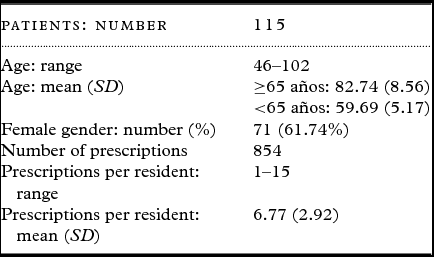
The mean age of the entire sample was 79 ± 11.44, ranging from 46 to 102 years; 61.74% were women. One-hundred-two patients (88.70%) were over 64 years of age, with a mean of 82.74 ± 8.56 years (Table 1).
Characteristics of patients

The total number of active prescriptions was 854 representing an average of 6.77 ± 2.92 drugs per patient (Table 1).
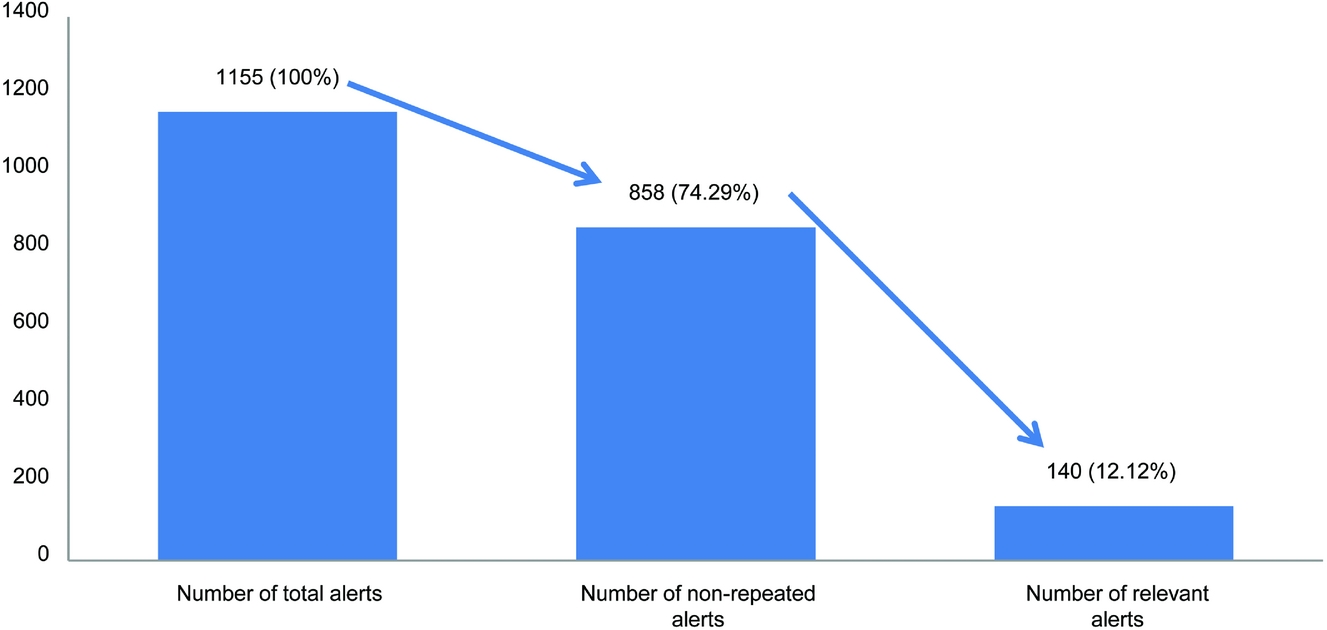
The program detected a total of 1,155 alerts (10.04 alerts/patient), of which 74.29% (858 alerts; 7.83 alerts/patient) were not repeated. After reviewing these alerts, 12.12% of the total were considered relevant (140 alerts; 16.32% of total non-repeated alerts, 1.30/patient) (Figure 1). This means that 67.83% of patients taking drugs had at least one pertinent warning and 16.39% of all prescriptions had at least one relevant alert.
Polimedication program alerts.

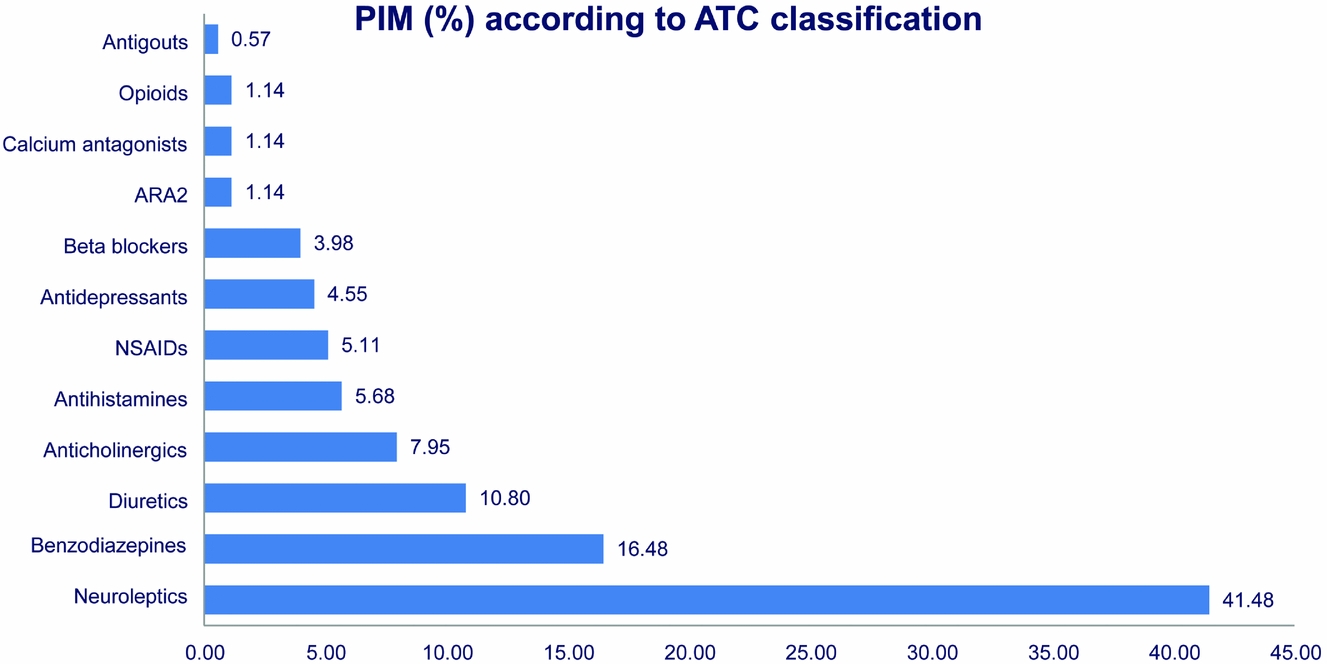
When drugs were classified by “Anatomical classification Therapeutic Chemical (ATC),” the largest number of alerts corresponded to neuroleptic drugs (41.48% of total alerts), followed by benzodiazepines (16.48%) (Figure 2).
Potentially inappropriate medication following STOPP criteria.

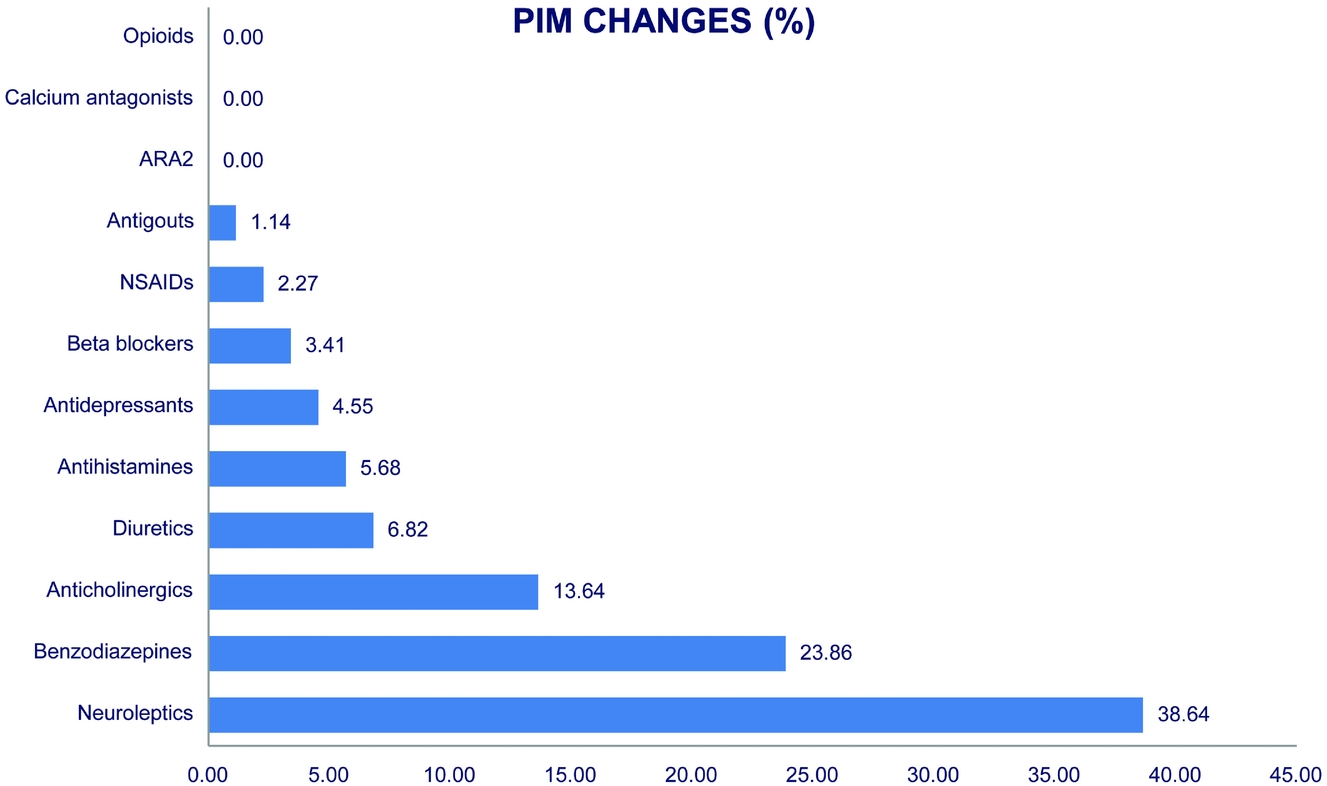
The patient's GP or psychiatrist accepted the alert, and made medication changes in 62.86% of the relevant alerts (88/140). The largest number of changes involved the group of neuroleptic drugs (38.64% of total changes), followed by benzodiazepines (23.86%) (Figure 3).
Changes performed in PIM following ATC classification.

The time spent in the generation and review of the warnings by the research team was 12 hours, i.e. 6.26 minute per patient.
Total changes resulted in a savings of 3,768.40 €/year. This was calculated according to the cost per unit of each modified or withdrawn drug and represents a savings of 32.77 € per resident and year (not to mention the potential cost of emergency interventions or hospitalization avoided).
Discussion
In recent years, several PIMs lists have been used to reduce polypharmacy in both nursing home populations and the general population. The objectives were to improve quality of life, reduce the adverse effects of drugs, and to obtain more efficient prescriptions. The variability among studies makes it difficult to establish precise conclusions about the effectiveness of this strategy, but there is evidence to support that its use is not associated with increased adverse events, mortality, or hospital admissions (Alldred et al., Reference Alldred, Raynor, Hughes, Barber, Chen and Spoor2013).
Until recently, the most widely used system for this approach has been the American System Beers (The American Geriatrics Society 2012 Beers Criteria Update Expert Panel, 2012). However, its use in Europe is controversial because up to 50% of drugs included in this panel are either not present in the pharmacopoeia of most European countries, or not clearly contraindicated for clinical practice (Gómez-Lobón et al., Reference Gómez-Lobón, Periáñez Parraga, Galán Ramos and Martínez López2012).
To try to solve these problems, in 2008, the STOPP/START criteria sponsored by the European Society of Geriatrics was published (O'Mahony et al., Reference O'Mahony, O'Sullivan, Byrne, O'Connor, Ryan and Gallagher2015). This tool is organized into physiological system drugs, includes the common pharmacopoeia in Europe, provides special attention to drug interactions and contains examples of drug groups considered PIMs but not included in the Beers panel (Smith and Lesar, Reference Smith and Lesar2011). For these reasons, STOPP/START criteria has become one of the most popular systems and is widely used in Spain (Sotoca Momblona et al., Reference Sotoca Momblona, Anglada Martínez, Molas Ferrer, Fontanals Martínez, Rovira Illamola and Sebastián Montal2011; Ubeda et al., Reference Ubeda, Ferrandiz, Maicas, Gomez, Bonet and Peris2012; Blanco-Reina et al., Reference Blanco-Reina, Ariza-Zafra, Ocaña-Riola and León-Ortiz2014; Reboredo-García et al., Reference Reboredo-García, González-Criado Mateo and Casal-Llorente2014).
More recently, the PRISCUS criteria was developed for specific use in Germany and conceived for single drugs regarding possible therapeutic alternatives and precautions to be followed when used (Holt et al., Reference Holt, Schmiedl and Thürmann2010).
These screening tools have been used in nursing homes for a number of years (Lau et al., Reference Lau, Kasper, Potter and Lyles2004; Finkers et al., Reference Finkers, Maring, Boersma and Taxis2007), because the elderly are a polymedicated group with cognitive impairment and a high degree of dependence, which may hamper communication and identification of adverse medication effects (Ubeda et al., Reference Ubeda, Ferrandiz, Maicas, Gomez, Bonet and Peris2012).
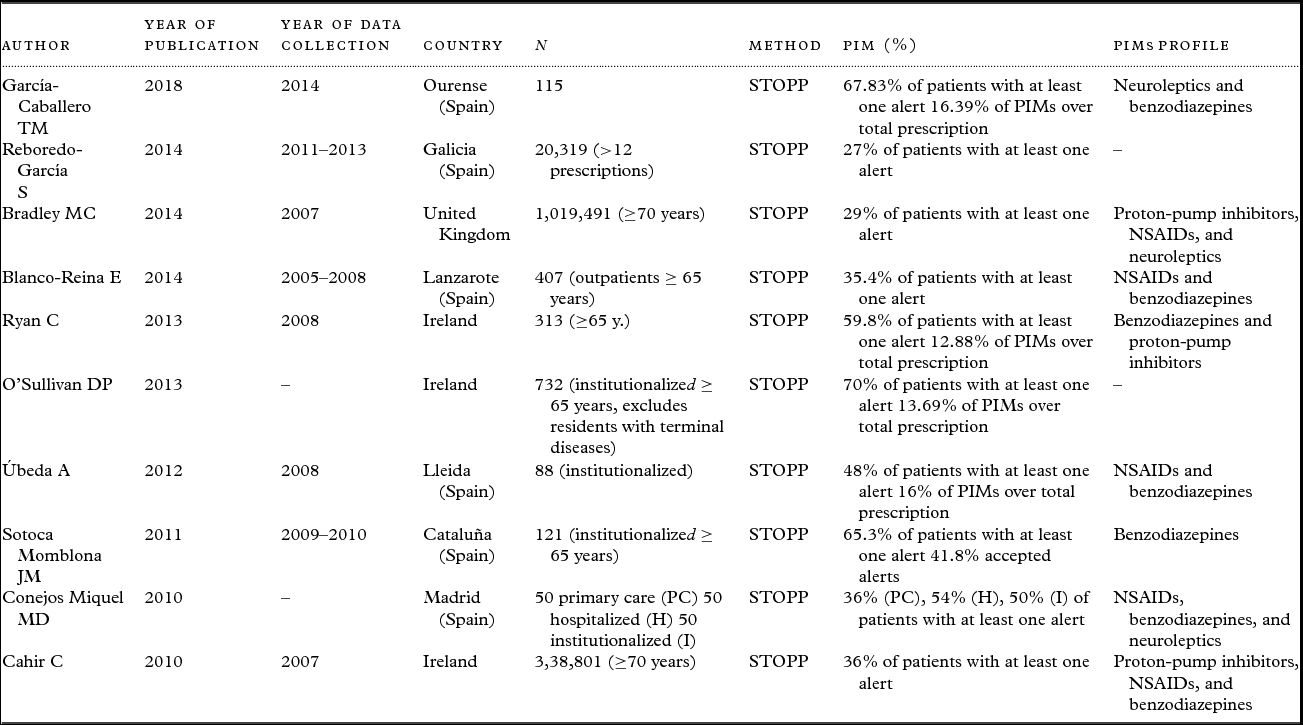
Data from our study demonstrated the existence of at least one PIM alert in 67.8% of institutionalized patients and 16.4% of total prescription volume. These data are similar to those reported in the literature. O'Sullivan et al. (Reference O'Sullivan2013), studying institutionalized population aged more than 65 years and over, reported 70% of patients with at least one alert and PIMs in 13.7% of total prescriptions. Meanwhile, Ryan et al. (Reference Ryan2013) reported the presence of alerts in 59.8% of patients and PIMs in 12.9% of total prescriptions.
In Spain, Sotoca Momblona et al. (Reference Sotoca Momblona, Anglada Martínez, Molas Ferrer, Fontanals Martínez, Rovira Illamola and Sebastián Montal2011) also reported similar percentages, 65.3% of patients with at least one alert, of which the physician accepted 41.8% of alerts. In our study, 62.9% of alerts were accepted, but the difference may be due to the fact that one of the prescriber physicians was part of the research team and, thus, was probably more motivated to make changes. In contrast, patients in the study by Sotoca Momblona et al. (Reference Sotoca Momblona, Anglada Martínez, Molas Ferrer, Fontanals Martínez, Rovira Illamola and Sebastián Montal2011) were attended by four different primary care physicians and alerts were proposed by the primary care pharmacist. To avoid this bias, in future phases of our study, the review will be conducted by a pharmacist and prescribers will not be included in the research team.
Nursing home samples always have higher PIM prevalence than those in ambulatory care (see Table 2), which is explained by the higher prevalence of comorbidity. Conejos Miquel et al. (Reference Conejos Miquel2010) compared in consecutive admissions to hospital, a group of patients from nursing homes, and a group of elderly outpatients. The elderly outpatients group had 36% of PIMs, but in nursing home group this frequency increased to 50% and to 54% in the hospital admissions group. Similar percentages (35.4%) of outpatient PIMs have also been reported in other studies (Blanco-Reina et al., Reference Blanco-Reina, Ariza-Zafra, Ocaña-Riola and León-Ortiz2014). In our community, Reboredo-García et al. (Reference Reboredo-García, González-Criado Mateo and Casal-Llorente2014) reported that 27% of polymedicated outpatients showed at least one STOPP criteria, in a strategy of gradual implementation of polypharmacy review throughout the population carried out by the Galicia Health System, which would be undoubtedly facilitated by the use of a computer tool as presented in this work.
Characteristics of different studies

Note that our sample, unlike other studies, included the entire nursing home population and not only those over 65 years of age (88.7% of the study population), since all patients under that age have dementia or intellectual disabilities, a high degree of dependence and polypharmacy, and therefore, could benefit from an alert program initially designed for the geriatric population.
The family of drugs most frequently detected as PIMs were central nervous system drugs. This is consistent with a variety of studies (Sotoca Momblona et al., Reference Sotoca Momblona, Anglada Martínez, Molas Ferrer, Fontanals Martínez, Rovira Illamola and Sebastián Montal2011; Ubeda et al., Reference Ubeda, Ferrandiz, Maicas, Gomez, Bonet and Peris2012; Ryan et al., Reference Ryan2013; Blanco-Reina et al., Reference Blanco-Reina, Ariza-Zafra, Ocaña-Riola and León-Ortiz2014), although the prevalence is higher in our study because of the huge weight of neuroleptic prescriptions, which represented 41.5% of total PIMs. The high prevalence of neuroleptics in nursing homes in our country has been confirmed by other studies (Robles Castiñeiras et al., Reference Robles Castiñeiras, Díaz Grávalos, Reinoso Hermida, López González, Vázquez Gil and García Caballero2012), reporting a prevalence of 47.6% in nursing homes. This is much higher, for example, than in Sweden (38%), as shown in a recent study on the use of antipsychotics in people with dementia (Gustafsson et al., Reference Gustafsson, Karlsson and Lövheim2013), or in the USA, where only 32.88% of 6,103 patients over 64 years with dementia in nursing homes had been prescribed at least one neuroleptic (Kamble et al., Reference Kamble, Chen, Sherer and Aparasu2009).
This disparity in figures leads us to conclude that there is an overprescription of neuroleptics in our area compared with international samples. In the current study, neuroleptic drugs also involve the most changes (38.6%), confirming the importance of the proposed revision strategy. It is worth noting that neuroleptics involve a greater risk of stroke (Sacchetti et al., Reference Sacchetti, Turrina and Valsecchi2010) as well as increased risk of falling from Parkinsonism (Leipzig et al., Reference Leipzig, Cumming and Tinetti1999). If we combine neuroleptics with benzodiazepines and antihistamines, there is an increased risk of falling, cognitive deterioration, choking, and bedsores among other frequent complications in the nursing home environment (Parsons et al., Reference Parsons2011). Finally, note that different prevalence of drugs with PIM between studies depends essentially on the study environment, being more frequent the proton-pump inhibitor (Bradley et al., Reference Bradley2014) or nonsteroidal anti-inflammatory drugs (NSAIDs) (Blanco-Reina et al., Reference Blanco-Reina, Ariza-Zafra, Ocaña-Riola and León-Ortiz2014) in ambulatory setting.
There are also relevant savings in personnel hours adopting an automatized tool, using as a reference a minimum of 30 minute per patient with a pencil and paper method (Dalleur et al., Reference Dalleur, Boland and Spinewine2012), our study achieved a time reduction of at least 79.2% compared to the standard method. Time savings, however, have not been fully addressed in the literature and depends on the speciality (physicians vs. pharmacists) and the relation with the patient (being the doctor in charge or being just a reviewer with no clinical relation with the patient).
We must also highlight the pharmacoeconomic savings by using Polimedication. The impact of applying STOPP at the population level in Ireland in 2007 was estimated to be 45.6 million €, i.e. 9% of total spending on drugs for people over 70 years of age (Cahir et al., Reference Cahir, Fahey, Teeling, Teljeur, Feely and Bennett2010). With respect to the nursing home population, we can confirm that the savings of 32.77 €/ per resident and year obtained in our study was similar to the 22 £ (30.34 €)/per resident and year reported by Furniss et al. (Reference Furniss, Burns, Craig, Scobie, Cooke and Faragher2000), and the 64 Australian dollars (44.37 €) per resident and year reported by Roberts et al. (Reference Roberts2001). However, other authors like Crotty et al. (Reference Crotty2004) and Zermansky et al. (Reference Zermansky2006) found no significant savings when the expenses of implementing the protocol at the staff level were taken into account.
Finally, it must be considered that the computerized system proposed is nothing more than a tell-tale. It is giving us valuable information but to be managed with care. As we have seen (Figure 1), only 12.12% of the original warnings were finally proposed to the physician and of this 12.12% only 62.86% (7.62% of the original alerts) were finally accepted and implied changes. Furthermore, this 7.62% of changes have been achieved only in the restricted and supervised niche of a nursing home with daily medical and weekly psychiatric assistance, where any ADR could be easily identified and corrected.
These figures would be logically less impressive in primary care with community-based patients because making multiple changes in frail patients could be disastrous. However, this kind of tools could have the ability to prompt us to change and to avoid hesitations, which follow the adage “if ain't broke don't fix it” that especially in chronic psychiatric patients gives rise to accumulative lists of medication.
In summary, the application of Polimedication program detected a high proportion of potentially inappropriate prescriptions in institutionalized elderly patients. The use of Polimedication program achieved significant savings in pharmaceutical expenditure, as well as a reduction in the time taken for the review of these medications.
Conflict of interest
None.
Description of authors’ roles
T. M. García-Caballero reviewed the automatic alerts and assisted with writing the paper. J. Lojo programmed the Polimedication software. C. Menéndez and R. Mateos reviewed the automatic alerts. R. Fernández-Álvarez evaluated the report of alerts establishing the prescription changes. A. García-Caballero designed the study, evaluated the report of alerts establishing the prescription changes, and wrote the paper. All authors read and approved the final paper.
Acknowledgments
This study has been selected as part of Innovation strategy of Servicio Galego de Saúde (Hospital program 2050-living lab 2013–14). The project of extention to all nursing homes of the Ourense EOXI has been selected as a Node Innovation project of Ourense for 2015. The authors are indebted to the staff of Fundación San Rosendo, Ourense, Spain, for their collaboration during the performance of this work.