

Students’ sense of school belonging — the feeling that they are ‘accepted, respected, included, and supported by others’ (Goodenow, Reference Goodenow1993b, p. 80) — is associated with many positive outcomes, including higher levels of motivation, greater academic achievement, and a lower risk of depression (e.g., E.M. Anderman, Reference Anderman2002; L.H. Anderman & Freeman, Reference Anderman and Freeman2004; Zumbrunn, McKim, Buhs, & Hawley, Reference Zumbrunn, McKim, Buhs and Hawley2014). Research suggests that a number of factors, including contextual characteristics and self-appraisals, influence students’ perceptions of belonging in school. For instance, Graham and Morales-Chicas (Reference Graham and Morales-Chicas2015) found that when students believe that their identifications (e.g., ethnicity) are respected at school, they report stronger perceptions of belonging. Further, factors such as school structural organisation, perceived peer acceptance, teacher support, and the promotion of prosocial values have been associated with students’ sense of belonging (e.g., E.M. Anderman, Reference Anderman2002; Freeman, L.H. Anderman, & Jensen, Reference Freeman, Anderman and Jensen2007; Battistich, Solomon, Watson & Schaps, Reference Battistich, Solomon, Watson and Schaps1997).
Although school belonging is often discussed in the literature as a single construct, many researchers suggest it is multidimensional, including relationships with peers and teachers, as well as institutional affiliation. This structure is also evident in a widely used survey measure, Goodenow's (Reference Goodenow1993b) Psychological Sense of School Membership (PSSM) scale (L.H. Anderman & Freeman, Reference Anderman and Freeman2004; Goodenow, Reference Goodenow1993a, Reference Goodenow1993b; Wallace, Ye, & Chhuon, Reference Wallace, Ye and Chhuon2012). Goodenow (Reference Goodenow1993a) reported the factor analysis of an earlier version, the Class Belonging and Support Scale (CBSS), which revealed three factors: peer support, teacher support, and belonging/alienation, which Goodenow (Reference Goodenow1993a) defined as students’ general sense of belonging and alienation. When Goodenow (Reference Goodenow1993b) went on to create and validate her widely utilised Psychological Sense of School Membership scale (PSSM), she maintained a similar factor structure to that found from the CBSS, except that her items assessing students’ general sense of belonging and alienation were targeted towards students’ overall institutional affiliation as opposed to their classroom affiliation. Despite the multidimensional nature of this measure, however, both Goodenow and subsequent researchers have tended to treat the full scale as a single construct (see L.H. Anderman & Freeman, Reference Anderman and Freeman2004).
More recently, Wallace et al. (Reference Wallace, Ye and Chhuon2012) conducted a confirmatory factor analysis (CFA) of the items from the PSSM, along with selected items from two other scales measuring sense of belonging. The results of this analysis aligned with the original three factors of belonging that Goodenow (Reference Goodenow1993a) had originally proposed, with the exception that teacher support was split into two distinct factors: one highlighting a connection to teachers in general, and the other highlighting a connection to a specific teacher (Wallace et al., Reference Wallace, Ye and Chhuon2012). These findings provide even further support for Goodenow's original conceptualisation that students’ sense of belonging is dependent on their relationships with their peers and teachers, as well as their connection to the school environment in general.
To date, the majority of research that examines students’ sense of belonging has tended to focus on students attending schools with a traditional structure (e.g., L.H. Anderman, Reference Anderman2003; L.H. Anderman & E.M. Anderman, Reference Anderman and Anderman1999; Goodenow, Reference Goodenow1993a, Reference Goodenow1993b; Wallace et al., Reference Goodenow2012). In this study, we examined perceptions of belonging for students in a school model that is less typical, but is quickly being seen as a viable option for schooling, especially for those students who are considered to be gifted in STEM subjects (Olszewski-Kubilius, Reference Olszewski-Kubilius2009). The field of STEM is a conglomeration of the individual subjects of science, technology, engineering, and mathematics. Much attention has been devoted to STEM education in the United States in recent years, partly in response to difficulties that undergraduate institutions in the United States have had in retaining and recruiting students in STEM fields (Daempfle, Reference Daempfle2003; Perez, Cromley, & Kaplan, Reference Perez, Cromley and Kaplan2014).
STEM School (a pseudonym) is a small, early-college, opt-in secondary school in a large metropolitan region in the Midwest of the United States. There are several reasons to believe that this school environment should be an especially adaptive one for students. For instance, enrolment in STEM School is voluntary and admission is determined by lottery; allowing families to choose the school that their children attend has been associated with increased student achievement, particularly in urban areas in which there are multiple schools from which to choose (Wöbmann, Lüdemann, Schütz, & West, Reference Wöbmann, Lüdemann, Schütz and West2007). Furthermore, some research suggests that smaller school communities are associated with higher perceptions of belonging among students (Centers for Disease Control and Prevention, 2009; McNeely, Nonnemaker, & Blum, Reference McNeely, Nonnemaker and Blum2002), although this finding has not been consistent in the literature. Finally, an emphasis on task mastery and the provision of stable, supportive teacher relationships have also been associated with a sense of belonging (see L.H. Anderman & Freeman, Reference Anderman and Freeman2004, for a review). The purpose of this study, therefore, was to provide a rich description of students’ perceptions of a school environment that is explicitly focused on providing a supportive community and promoting high academic performance, to determine if belonging looks the same in this rigorous academic environment as it does in more traditional scholastic environments. A qualitative approach was taken in order to capture a full picture of students’ lived experiences, which aided in the interpretation of what students consider to be most salient in their experience of their sense of belonging at school.
Conceptualisations of Belonging
Some researchers have posited that belonging is a basic human need; for example, Baumeister and Leary (Reference Baumeister and Leary1995) presented evidence that a lack of belonging severely and negatively impacts individuals’ emotions, cognitions, and health. Similarly, Ryan and Deci (Reference Ryan and Deci2000) proposed that belonging (referred to as relatedness in their model) is a crucial factor in personal growth, social development, and wellbeing. In terms of school belonging, specifically, Goodenow's (Reference Goodenow1993a) seminal work suggests that students’ subjective perceptions of school membership influence their motivation and engagement.
In past work, students’ sense of belonging has been associated with a range of indicators of academic motivation, including expectations of success (L.H. Anderman, Reference Anderman2003), valuing of school work, self-reported effort (Goodenow Reference Goodenow1993a; Reference Goodenow1993b), personal mastery goals (L.H. Anderman & E.M. Anderman, Reference Anderman and Anderman1999), and behavioural and emotional engagement (Furrer & Skinner, Reference Furrer and Skinner2003). In particular, in their recent longitudinal study, Gillen-O'Neel and Fuligni (Reference Gillen-O'Neel and Fuligni2013) found that when American public high school students perceived a greater sense of school belonging, they were more likely to enjoy, and perceive the usefulness of, their schoolwork. Additional research suggests that students with a higher sense of belonging are more likely to report lower levels of social rejection and problematic behaviours, as well as more optimism, intrinsic motivation, autonomy, and internal regulation (E.M. Anderman, Reference Anderman2002; Deci & Ryan, Reference Deci and Ryan1985; Ryan & Deci, Reference Ryan and Deci2000; Ryan, Reference Ryan1995). Similarly, recent work conducted with a large sample of Flemish adolescents suggests that when these students perceived a greater sense of school belonging, they were less likely to engage in problematic behaviours (Demanet & Van Houtte, Reference Demanet and Van Houtte2012). Finally, recent research conducted by Walton and Cohen (Reference Walton and Cohen2011) demonstrated that when African American college freshmen were informed that the social difficulties they experienced on their campus (i.e., low perceptions of belonging) were common and normal for all college students, they experienced an increase in their grade point averages, reported higher levels of overall health and wellbeing, and were found to have visited the doctor less often 3 years after this intervention was implemented. Given these findings, it is clear that students’ sense of belonging is a crucial part of their educational experience and development.
Although conceptualisations of perceived belonging have primarily focused on social relationships, it has long been held that students’ sense of belonging at school has significant implications for academic outcomes. For instance, Finn's (Reference Finn1989) theoretical identification-participation model suggests that if students feel a sense of identification with school, which includes the sense of belonging, they are more likely to engage in scholastic activities; this greater engagement, in turn, increases the likelihood that their academic performance will improve. Similarly, a review of research on students’ sense of belonging by Juvonen (Reference Juvonen, Alexander and Winne2006) suggests that belonging is linked to increases in academic achievement (e.g., see E.M. Anderman, Reference Anderman2002; Goodenow, Reference Goodenow1993b; Wang & Holcombe, Reference Wang and Holcombe2010). Recently, Good, Rattan, and Dweck (Reference Good, Rattan and Dweck2012) found that when female students enrolled in a college calculus class believed that math ability is unchangeable, and that men have a greater math ability than women, they were less likely to perceive that they belonged to the field of math. This lowered sense of belonging, in turn, was associated with decreased grades in math, as well as lowered intentions to pursue math in the future.
Generally, however, the literature on belonging, including Goodenow's (Reference Goodenow1993b) empirical research, Finn's (Reference Finn1989) theoretical identification-participation model, Juvonen's (Reference Juvonen, Alexander and Winne2006) review of empirical studies, and Good et al.’s (Reference Good, Rattan and Dweck2012) empirical study, has tended to conceptualise academic achievement as an outcome of school belonging, not a component of the construct itself. Instead, Goodenow and others have focused primarily on students’ social relationships, including those with peers, teachers, and a general sense of pride or affiliation with their schools as contributing to the sense of belonging. This may be due, in part, to the widespread use of Goodenow's original survey measures (e.g., the Psychological Sense of School Membership scale, PSSM). Although the results of many studies utilising these scales suggest that students’ academic engagement and behaviour can increase (or undermine) their sense of belonging (L.H. Anderman & Freeman, Reference Anderman and Freeman2004; Good et al., Reference Good, Rattan and Dweck2012; Juvonen, Reference Juvonen, Alexander and Winne2006), they have not considered academic fit as a dimension of the sense of belonging itself. In the present study, we suggest that for some students, sense of academic fit may provide an alternative pathway, beyond interpersonal relationships, to feeling a more general sense of school belonging. That is, students’ perceptions of whether they are among intellectual peers, are able to meet high academic standards, and share academic interests with others may represent a further dimension of the sense of school belonging. The theoretical roots of academic belonging can be found in cognitive development concepts such as the zone of proximal development (Vygotsky, Reference Vygotsky1978), which suggests that students thrive with appropriate challenge, instructional scaffolding, and assistance from both teachers and peers. In the following sections, we present evidence for academic belonging and discuss its implications for theory and practice.
Method
Setting
STEM School serves approximately 200 students in middle school, which encompasses Grades 6–8, aged approximately 11–13 years, and 400 students in high school (Grades 9–12; aged approximately 14–18 years) in the Midwest of the United States. It holds a public charter and enrols by lottery from several school districts in a large, metropolitan area. The school population is diverse: 50% of students are non-White, 30% are considered to be low-income, and 13% receive special education services. The school places a strong emphasis on academic achievement, which manifests in a number of different school-level practices. First, the school has a focus on STEM, as well as early college preparatory programming that partners with a nearby state university to allow students to begin taking college classes as early as 11th grade. To support students in this aim, entire classes are accelerated to be taught in a single semester rather than over a full academic year, and students are permitted to ‘test out’ of courses for which they can demonstrate content mastery. Finally, students are held to high academic standards. In order to pass their classes, students must receive at least a score of 90% (equivalent to a grade of A) on all of their assignments and exams. If students do not achieve 90% mastery the first time, they must redo assignments and retake exams until they do. In addition to practices that emphasise academic achievement, STEM School also promotes a supportive community for students through practices such as assigning an advisory teacher who follows students across multiple years, systematically including students’ input into evaluating their own progress and course planning, and the ready availability of extensive technology support.
Procedures
Participants
Student interviews were conducted as part of a larger, longitudinal, multiple-methods project. An initial pool of 76 students responded to an online survey, including an open-ended question that asked students to describe ‘anything you would like us to know about being a student at STEM School’. Based on these responses, we purposively selected nine middle-school students who represented the heterogeneity of the school's population and both positive and negative perspectives on their experiences. Our final sample included three students each from Grades 6, 7, and 8. Six were girls, and six self-reported their ethnicity as White, with one each reporting being Asian, Black, and Multiracial.
Interviews
Interviews were semi-structured, audio-recorded, and conducted by trained members of the research team. The participants were interviewed three times: first during the Spring 2014 semester, again during the Fall 2015 semester, and for a third time in the Spring 2015 semester. Each interview lasted about 30 minutes, and questions asked students to explain school and classroom structures of STEM School in their own words, their academic and social experiences both at STEM School and at previous schools, and their short- and long-term academic and career goals.
Data analysis
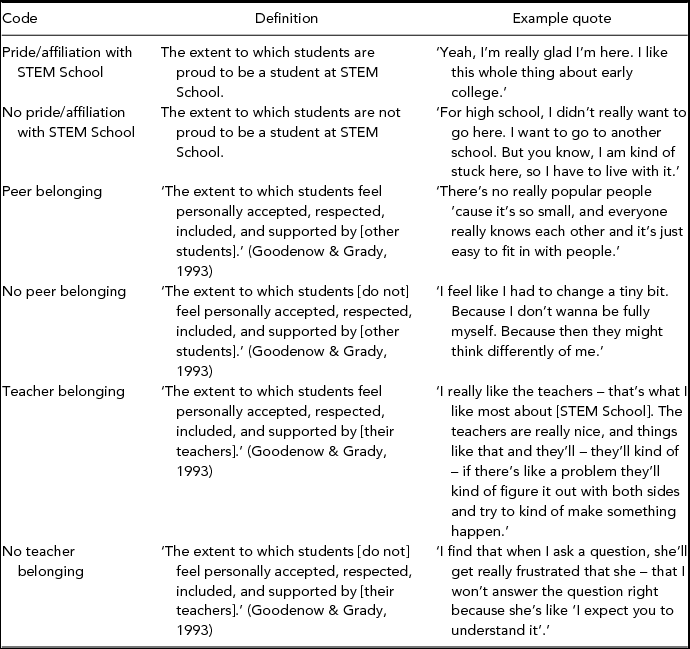
Four members of the research team met to draft provisional codes based on the theoretical framework guiding the study; that is, the commonly reported three-factor model of belonging, which includes relationships with peers, relationships with teachers, and institutional affiliation (L.H. Anderman & Freeman, Reference Anderman and Freeman2004; Goodenow, Reference Goodenow1993a, Reference Goodenow1993b; Wallace et al., Reference Goodenow2012). Provisional coding is a technique in qualitative inquiry, used when the primary purpose includes corroborating or comparing data with established literature (Saldaña, Reference Saldaña2012). It is common to modify or expand codes, or to include new codes, as data are collected and analysed, which typically involves a deductive approach to analysis (Miles, Huberman, & Saldaña, Reference Miles, Huberman and Saldaña2013). Each aspect of belonging was assigned two codes. One code reflected instances in which students described the presence of that aspect of belonging, whereas the second code reflected instances in which students noted a lack of that aspect of belonging. These six provisional codes, as well as examples of quotes that fell into each category, are provided in Table 1.
Initial Qualitative Codes and Example Quotes

Two members of the research team independently coded the entire dataset using the agreed-upon provisional codes. Data analysis was conducted in NVivo (version 10.2.1). Initial interrater agreement was 82.5%, above the 80% threshold suggested for qualitative agreement (Miles & Huberman, Reference Miles and Huberman1994). Researchers then compared codes and resolved points of disagreement in their coding until consensus was reached. Next, the researchers provided their finished analyses to a third researcher, who verified the conceptual accuracy of the codes by coding 10% of the data. A limited number of quotes are presented here as exemplars, but these themes also permeate other interviews in the dataset.
Findings
When reviewing the data coded according to the three-dimensional framework of belonging (teacher relationships, peer relationships, and pride/affiliation), we observed a clear distinction between students who reported feeling as though they belonged at their school because of social aspects, and those who felt as though they belonged because of academic aspects. Therefore, students’ descriptions of what it means to fit in at STEM School were classified further into two categories: social belonging and academic belonging. It should be noted that the original three-dimensional framework was well supported by these data.
Students reported that they feel as though they belong at STEM School because of the open social environment, characterised by close relationships with peers and teachers. For instance, one student, a boy who was in 6th grade when the study began, said: ‘The good part is you can get to know more people . . . and you get to be friendly with 6th or 7th graders.’ An 8th-grade female student noted: ‘The teachers are really understanding . . . they are really open, as I said earlier, and welcome. So I feel like I could be myself here and not like be judged or anything like that.’ Thus, some students reported experiences that mapped onto the traditional understanding of belonging.
There were students, however, whose sense of belonging seemed grounded in the strong academic environment and opportunities provided by the school. In particular, some students reported that STEM School offered a level of rigor that had been missing at their previous schools. One student, a boy who was in 6th grade when the study began, said:
The best thing is probably the mastery system . . . I feel like it just led me to learn a lot more than I ever would in any other school. The classes are the most important part for me . . . I'm excited to get more learning opportunities and subjects I'm interested in.
These students’ sense of belonging seemed closely tied to feeling that the school met their academic needs. In fact, when asked about what makes them feel as though they fit in at STEM School, a male student in 7th grade when the study began spoke positively of both the academic and social environments: ‘I spend time with kids that like their work, they get done with their work, they're really focused on that. But at the same time, they like to have fun.’ Thus, it appears that it is easy for some students to see how STEM School can support their sense of belonging in both the academic and social spheres. Importantly, however, some students reported experiencing one type of fitting in without the other, suggesting that social and academic belonging may be meaningfully distinct experiences. For example, one student, a 7th-grade girl, emphasised disliking both studying and STEM subjects, but suggested that STEM School was bearable: ‘. . . because I have such good friends here. ’Cause at my old school . . . I didn't have good friends. So, I feel like here it's, like, really good . . . it's great.’ This student felt that she belonged at STEM School even though she did not enjoy the academic activities. An 8th-grade male student, however, recognised that: ‘I just don't try and put myself out there that much. I am not really trying to make friends that much.’ This same student was positive, however, about the academic aspect of STEM School:
I love the grading system, being able to make sure you learn everything . . . ’cause sometimes it's just really frustrating if you don't grasp the concept of something, and I really do like it. It's been . . . a good experience, and I know it's gonna be good in the future as well.
Thus, students at STEM School sometimes felt a sense of a belonging in terms of the social environment, and sometimes in terms of being in the right place academically, but not necessarily both kinds of belonging together.
Further, many students expressed that they were proud to be a STEM School student, a feeling that resulted for some from the accelerated nature of the school. One student, a 7th-grade girl, stated:
I believe this is the best school for me, because the other schools I attend[ed] were easy and this one meets my limits, trying to help me develop and get me to better grades, so I like the school.
Though many students appeared to feel accepted at STEM School when they were able to perform well academically, students who struggled to achieve academic success reported feeling out of place among their peers. This finding provides further evidence of the importance of academic belonging, because students clearly articulated when they felt as though it was missing. For instance, one female student, who was in 8th grade when the study began, emphasised that:
Well, in this school, like, there's like a high standard that you have to match and . . . I feel like some students are . . . super smart, like, prodigy students, and then, like, you have to, like, work your way up with them if you wanna, like, be up there with them. You have to work really hard, like — it might be easier for some students, but other students — depending on where they come from — it might be a little more challenging.
It appears that although students were proud to attend a school with a strong focus on learning at an accelerated pace, their sense of belonging in this environment was undermined if they felt unable to achieve academic success. Without perceived academic success, some students appeared to experience a decrease in their self-efficacy, which had an impact on their sense of academic belonging. A 6th-grade girl said, ‘The mastery program . . . makes the students who don't have their grades in mastery feel like complete idiots, but still [laughs] I guess that, I guess they kind of deserve that. And by “they” I mean “me”.’
Interestingly, there were some circumstances under which students were less likely to experience a decrease in their self-efficacy. For these students, it seems that the most notable difference arose in the way they described belonging in terms of their teachers. A female student who was in 8th grade when the study began, for example, reported: ‘Like, I will get a good grade if I try hard, ’cause my teachers care. And like, if they know I'm putting in effort, then they want me to succeed.’ This student not only indicated that she knows her teachers care about her, but also that this encourages her to work hard and perform well academically. However, when students reported that their teachers did not make them feel as though they belonged, they were more likely to report lower self-efficacy. One struggling 6th-grade female student remarked of her teacher, for example: ‘She sometimes says stuff that I'm not sure that she should say, especially, um . . . so — once she said something that made me burst into tears.’
Finally, students who reported receiving academic help from their peers appeared to experience higher self-efficacy. One 7th-grade female student who reported receiving frequent homework help from her peers via video chat, for example, reported that this helped her: ‘Because I feel like if you have help from your friends then you'll feel more boosted up, like then you can do it.’ Thus, it appears that both teachers and peers played a powerful role in helping students to feel able to meet the academic demands of the school and, consequently, that they belonged in an academically accelerated environment.
Discussion
The results of the present study provide a rich account of students’ sense of belonging at STEM School. By speaking with students, we obtained a new level of understanding of the barriers and supports that students encounter, and learned more about their sense of belonging at school. This study supports and extends the results of previous empirical work on belonging in several ways. First, when asked to describe their sense of school belonging, students at STEM School described aspects of experience that mapped onto the three dimensions represented in the PSSM (Goodenow, Reference Goodenow1993b). In addition, however, students described the role that perceived academic fit, the availability of academic challenge, and the acceptability of academic values play in helping them feel as though they belong.
Importantly, whereas some students reported either interpersonal or academic sources of belonging, others reported both; thus, these appear to be orthogonal concepts. It is additionally crucial to note that students’ sense of belonging appeared to influence their motivation. Students who perceived a sense of academic belonging were more likely to speak of their enjoyment of their school's academic structure, as well as their belief that this system would benefit them in the future. On the other hand, however, students who did not perceive a sense of academic belonging were more likely to report that they had a difficult time achieving academic success. These findings are consistent with prior literature that has shown an association between students’ enjoyment and perceived usefulness of their schoolwork, as well as expectations of academic success, and their sense of belonging (e.g., L.H. Anderman, Reference Anderman2003; Gillen-O'Neel & Fuligni (Reference Gillen-O'Neel and Fuligni2013), Good et al., Reference Good, Rattan and Dweck2012). Equally important, however, was the finding that when students reported receiving support with academic work from either peers or teachers, they were less likely to speak about having low self-efficacy and sense of academic belonging.
These findings help illuminate both the components of belonging and the factors that serve as barriers and supports to students’ sense of belonging. In particular, the finding that students who were experiencing academic difficulties were less likely to feel a sense of academic belonging draws strong parallels to Vygotsky's (Reference Vygotsky1978) notion of the zone of proximal development, which suggests that students need to be given work that challenges them just beyond what they are able to complete independently. It seems likely that those students who were struggling in this academically accelerated environment may have had insufficient preparation to meet the demands placed upon them. This pattern of findings reinforces the importance of schools providing sufficient academic support for student success, even while promoting high academic standards. As schools press for ever-accelerated rates of achievement for students, teachers in similar environments may need guidance in the best ways to provide support for students’ sense of both social and academic belonging.
To this end, our exploration of academic belonging echoes the concept of pedagogical caring (Noddings, Reference Noddings1992; Wentzel, Reference Wentzel1997). The present data suggest that students are more likely to feel as though they belong academically when their teachers show that they care, not only about their students as people, but also about their academic success. That is, teachers influence their students’ sense of school belonging not only by providing warmth and interpersonal caring, but also by communicating their expectation for students to do their best, providing high-quality instruction, and making themselves available for additional instruction and help when it is needed. The present results also show that, for many students, their sense of academic belonging was influenced by the accelerated nature of the school environment, as well as the academic interests students shared with their peers.
Conclusion
Exploring the rigorously academic environment of STEM School complicates our understanding of belonging, suggesting that we may need to think more carefully about the specific school context when attempting to understand what it means to belong. It is important to note, however, that the results of this case study are limited to the specific context of STEM School; it is not clear how robust the current findings might be across other settings. Furthermore, we focused our investigation on students who were in the middle-school grades (early adolescence) in the first year of our study. Additional research will be needed to determine if these findings hold true for those students in other academically accelerated environments, as well as in more traditional scholastic environments. Future research should also explore the balance and relative importance of academic and social sources of belonging for students at different ages, including in the elementary grades and in later adolescence and early adulthood. If such research confirms that academic belonging is an important contributor to students’ overall sense of school belonging, the development of survey measures of academic belonging would enable larger-scale, quantitative investigations.
The suggestion that students’ sense of belonging can derive from both social and academic perceptions, and that these components might be orthogonal, holds potential implications for educators interested in supporting students’ engagement, achievement, and wellbeing. We concur with other scholars (e.g., Turner & Meyer, Reference Turner, Meyer, Pintrich and Maehr2004) that adaptive educational contexts must balance high academic expectations and press for understanding with interpersonal warmth and support. This balance may be particularly important in the early adolescent years, when students are particularly vulnerable to disengaging (Eccles et al., Reference Eccles, Midgley, Wigfield, Buchanan, Reuman, Flanagan and MacIver1993). Creating a school environment that focuses on developing warm, caring interpersonal relationships with students, promoting respectful peer interactions, and also providing students with academic challenge and support for their scholarly ambitions will increase the opportunities for all students to experience a sense of belonging in school.
Acknowledgments
We would like to acknowledge Dr Shirley Yu, the principal investigator of the larger multiple-methods project that the present research was a part of, whose support of our research question was instrumental in our success. We would also like to acknowledge the members of our research team for their hard work and assistance in conducting student interviews.
Financial Support
This research received no specific grant from any funding agency, commercial, or not-for-profit sectors.
Conflicts of Interest
None.
Ethical standards
The authors assert that all procedures contributing to this work comply with the ethical standards of the relevant national and institutional committees on human experimentation and with the Helsinki Declaration of 1975, as revised in 2008.