Implications
Our study suggests that growing pigs can be selected for improved nutrients and energy digestibility, especially if fed on a high dietary fibre diet. This study also confirms the increase in energy digestibility with BW increase; this increase would be independent on genetic background. A single digestibility measurement carried out at 60 to 70 kg BW would be representative for evaluating genetic differences in energy digestibility in growing-finishing pigs. The mechanisms involved in the genetic differences of digestion (microbiote, genomics, gut structure and physiology, etc.) deserve further studies. Routine methods for evaluating the digestibility on large numbers of pigs should also be proposed.
Introduction
Digestive efficiency is a key in the efficiency of monogastric systems: the digestive loss of nutrients and energy in pig ranges from 15% to 25% of the total intake in usual rearing systems (Le Goff and Noblet, Reference Le Goff and Noblet2001). Variations in diet composition, feed technology, animal development (BW) or animal breed can impact digestibility coefficients of nutrients and energy (Le Gall et al., Reference Le Gall, Warpechowski, Jaguelin-Peyraud and Noblet2009). With regard to breed effects, comparing Asian breeds with commercial European lines in pig has generally shown that commercial European lines have a lower digestive efficiency than Asian populations, especially when given fibrous feeds (Kemp et al., Reference Kemp, den Hartog, Klog and Zandstra1991; Février et al., Reference Février, Bourdon and Aumaitre1992; Morel et al., Reference Morel, Lee and Moughan2006; Len et al., Reference Len, Hong, Ogle and Lindberg2009a). On the other hand, recent selection experiments in pigs reported no difference in digestive efficiency between pigs divergently selected for residual feed intake (de Haer et al., Reference de Haer and De Vries1993; Barea et al., Reference Barea, Dubois, Gilbert, Sellier, van Milgen and Noblet2010). Similarly, earlier comparisons of lean and fat pig selected lines or cross-bred animals (Sundstöl et al., Reference Sundstöl, Standal and Vangen1979; Yen et al., Reference Yen, Tess, Pond and Dickerson1983; Wenk and Morel, Reference Wenk and Morel1985) showed small or inconsistent differences for digestive efficiency in relation with fatness. In poultry, a selection experiment targeting directly digestive efficiency within a given breed has proven the existence of individual variability of digestive efficiency for lipid, protein, starch and energy (Mignon-Grasteau et al., Reference Mignon-Grasteau, Muley, Bastianelli, Gomez, Sellier, Millet, Besnard, Hallouis and Carré2004). This divergent selection experiment on digestibility also showed that modifying digestive efficiency greatly impacted gut anatomy and histology (Rougière et al., Reference Rougière, Gomez, Mignon-Grasteau and Carré2009). In pig, to our knowledge, genetic variability of digestive efficiency (i.e. individual variability within a line or a breed that is genetically inherited) has not been quantified yet. Kyriazakis (Reference Kyriazakis2011) suggested that pigs, because of their microbial-based hindgut digestion, which is much more developed than in poultry, should show a higher potential for genetic improvement of digestive efficiency than poultry, at least when fed challenging high dietary fibre (DF) diets. In addition, digestibility coefficients of energy and nutrients increase with BW increase (Noblet et al., Reference Noblet, Shi and Dubois1994; Le Goff et al., Reference Le Goff, van Milgen and Noblet2002a). The rate of that increase, related to the hindgut development, may also be submitted to individual variability with a subsequent necessity of measuring the dynamics of digestibility coefficients of energy and nutrients at variable BW stages. Finally, commercial lines have been selected on high-energy and -protein diets and therefore low DF diets: the evaluation of their potential to digest high DF diets is therefore required, especially in a context of increased availability of fibrous ingredients (by-products, for instance) for livestock feeding. Indeed, the increasing competition for available ingredients between animal species, humans and industry (including biofuels), and the society pressure to reduce excreta stimulate the research of a more efficient utilization, either digestive or metabolic, of energy and nutrients by animals. In addition, this increasing competition will probably force livestock, ruminants but also non-ruminants, to use more by-products that usually contain high levels of DF. Therefore, the purpose of our trial was to provide the first and preliminary evaluation of the genetic variability of energy digestibility in growing pigs and to examine the possibility to select pigs being more efficient at this level of feed utilization. But as energy digestibility is not constant over the growing period, it was important to quantify the stages or BW at which pig digestibility may differentiate. We thus compared the digestibility in four small half sib families fed a high DF diet during all the growing–finishing period. This progeny test had a limited power for each time point because of the relatively small number of progeny per sire, but repeated measurements on each progeny (10 time points) ensured that the differences between sire average levels of progeny for digestibility would be accurately estimated if the trait is reasonably heritable, as reported in poultry.
Material and methods
This study was conducted in accordance with the French legislation on animal experimentation and ethics, and the senior researchers were authorized by the French Ministry of Agriculture to conduct experiments on living animals at the INRA facilities in Saint Gilles, France.
Animals, housing and feeding
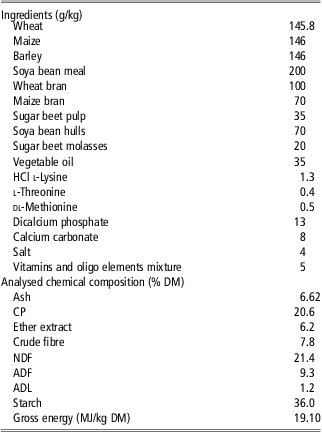
Four Large White boars were chosen as lowly related as possible in French artificial insemination centres to each inseminate four Large White sows as lowly related as possible housed in an INRA experimental facility (GEPA, Le Magneraud, France). Because of reproduction difficulties with one sow with each of two boars, piglets from only 14 sows in the same farrowing batch were used, with one or two piglets per litter used in the digestibility trial. In practice, at weaning (28 days), a total of 24 piglets, one or two castrated male piglets from each litter (six offsprings for each sire origin), were sampled for having a BW close to their male littermates average BW. They were immediately transferred in another INRA experimental facility (PEGASE, Saint-Gilles, France). In this unit, piglets were distributed in groups of three to four sibs (two groups per boar origin) and raised in cages up to about 25 kg. From weaning to 25 kg, they were fed ad libitum two successive standard piglet diets (1.25% and 1.15% digestible lysine). At about 25 kg, five pigs per boar with comparable BW and originating from all sows (three to four per boar, with a maximum of two pigs tested per litter) were chosen. The piglets not retained were randomly excluded, conditionally on having a full-sib maintained in the trial to avoid reduction of sow origins. From 25 kg to slaughter, these 20 pigs were kept individually in digestibility cages and offered a unique experimental diet with a high DF content (Table 1) on a feeding scale basis established from the compilation of previous studies conducted in our digestibility cages and changing linearly from 2.50 MJ ME/kg BW0.60 at 25 kg to 2.25 MJ ME/kg BW0.60 at 95 kg. This slight restriction allowed to homogenize feed intakes between pigs according to their BW, and to limit feed refusals and spillage that may generate subsequent errors in digestibility measurements. Feed allowance was constant over each of the 5 days of the collection period and it increased over the 2 days between two collection periods in order to adjust to the feeding scale for spontaneous feed intake changes. Feed was provided as pellets in two daily meals. Feed was usually consumed quickly after the meal distribution. In case of refusals about 1 h after the evening meals on days before the beginning and the end of collection of excreta, they were collected in order to minimize possible bias in the calculation of digestibility coefficients due to differences in feeding levels between the two ‘transition’ days and the 5 days collection of excretion. According to this caution and also to the small change in feeding level over successive periods (i.e. about plus 100 g each week), it can be assumed that the digestibility coefficients can be calculated from ingesta and excreta over the same 5-day period. The experimental feed contained 0.90 g digestible lysine per MJ net energy, which is above the 0.85 g requirement at about 30 kg BW; the ratios between other essential amino acids and lysine were also above the recommendations. Therefore, the diet met the protein requirements all over the measurements period. All animals were tested simultaneously. The measurements lasted for 10 successive weeks and started when pigs reached at least 30 kg BW, after a 1-week adaptation period to the diet and housing conditions. The room temperature was set at 24°C. The space allowance in the cage was adjusted each week up to a maximum space of 0.56 × 1.20 m for optimizing the comfort of the animal and the quality of digesta collection.
Ingredients and chemical composition of the diet
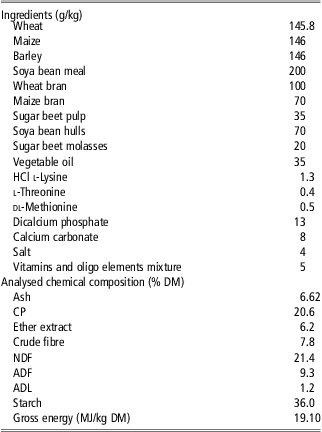
DM = dry matter.
Measurements
BWs were recorded each Friday morning. Faeces were daily and totally collected, cumulated from Sunday morning (i.e. first collection on Monday morning) to Friday morning during 10 successive weeks and stored in airtight buckets at +4°C. At the end of each week, faeces were homogenized and two separate samples were prepared, one for freeze-drying and further chemical analyses and one for immediate dry matter (DM) determination. Cumulated feed intake and cumulated eventual feed refusals or spillage over each 5-day collection period were recorded, and the DM of proposed weekly feed and refusals were measured. That allowed the calculation of DM intake (DMI) for each collection period. At the end of the trial, the 10 weekly feed samples were pooled for lab analyses.
Chemical analyses and calculations
The feed sample and each of the 200 faeces samples were analysed for gross energy (IKA adiabatic calorimeter), ash (incineration at 550°C) and nitrogen (Dumas method). The feed sample was also characterized for its carbohydrates fractions and fat content (Le Goff and Noblet, Reference Le Goff and Noblet2001; Le Gall et al., Reference Le Gall, Warpechowski, Jaguelin-Peyraud and Noblet2009). Apparent digestibility coefficients of DM, organic matter, nitrogen and energy were calculated for each pig at each period according to standard procedures (Le Gall et al., Reference Le Gall, Warpechowski, Jaguelin-Peyraud and Noblet2009). These digestibility coefficients were also calculated for each pig for the total 10-week experimental period as the weighted mean of the weekly digestibility coefficients, weights being the corresponding DMIs for each week.
Statistical analyses
The effects of period or week (10 levels), sire origin (4 levels) and animal (20 levels) were accounted for in a variance analysis using a mixed model, with a correlated structure of the variance over time for the animal effect nested within sire (proc MIXED, SAS, 2008). The dam origin was not accounted for in the model because of the reduced (one or two) and heterogeneous number of littermates tested. The interaction between period and sire effects was also tested in order to evaluate the differences in changes of digestibility coefficients with period or age related to sire origins. A covariance analysis was also conducted in order to evaluate the effect of BW as a covariate on the digestibility coefficients of energy, organic matter and nitrogen with the animal number (n = 20) as a fixed effect; the homogeneity of the slope was tested by fitting the interaction between BW and animal in the model, which was never significant (P > 0.05). Finally, a variance analysis (proc GLM, SAS, 2008) on the 20 observations representing the cumulative 10-week period with the sire origin as the only effect (n = 4) was applied.
Results and discussion
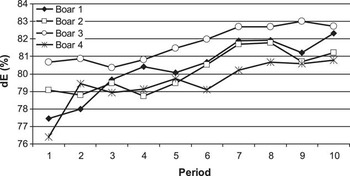
All the animals behaved normally in the cages with only one period of diarrhoea on one pig in the 6th week of experiment. According to the relatively linear increase in faecal digestibility over the successive experimental weeks (Figure 1), this missing data were replaced by the mean of the previous and the following week.
Effects of sire origin and successive 1-week period on energy digestibility (dE, %) in growing pigs (five measurements per boar and per period). Boar 3 was different from the other three (P < 0.05) and the interaction between boar origin and period was not significant (P > 0.05) (Table 2).

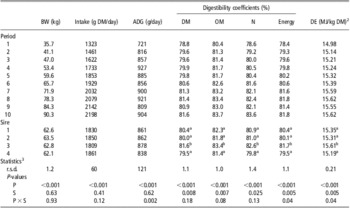
Average feed intakes increased regularly with BW and age (Table 2). However, to ensure equal intakes among pigs, feed intake was restricted and as a result, growth (860 g/day on average) was lower than what would be expected in pigs fed ad libitum on such diets (Le Bellego et al., Reference Le Bellego, van Milgen and Noblet2002). Finally, over the 2 days between two successive collection periods, feed intake was progressively increased up to the feeding level of the following period on the 2nd day and refusals and spillage were not recorded; therefore, precise feed intake on these 2 days was not available. Consequently, it was not possible to calculate the feed efficiency; the ratio between feed intake (over 5 days of collection) and ADG (over 7 days) as calculable from Table 2 is then only indicative.
Effects of BW and sire origin on performance and faecal digestibility coefficients (%) of DM, OM, N and energy in growing pigs (least squares means)Footnote 1

DM = dry matter; ADG = average daily gain; OM = organic matter; N = nitrogen; DE = digestible energy; r.s.d. = residual standard deviation.
1 Twenty observations per period and 50 observations per boar.
2 The DE can also be expressed as MJ/kg of OM and calculated as DE (as MJ/kg of DM) divided by 0.934 (OM content of feed).
3 From the ANOVA with period (P, n = 10), sire origin (S, n = 4) and animal (within sire origin and repeated) effects; values within one column for the different sire origins with the same letter exponent do not differ (P > 0.05).
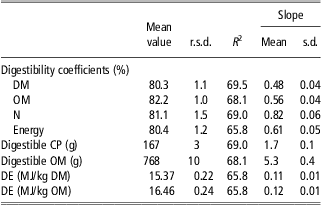
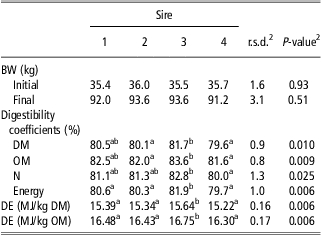
All digestibility coefficients were affected by period (P < 0.001) with a continuous and linear increase over time (Table 2) or with BW (Table 3). For instance, energy digestibility was increased by 0.6 point per 10 kg BW increase. This result is consistent with literature data; a compilation of a few trials provided an increase averaging 0.50 point per 10 kg BW increase (Le Goff et al., Reference Le Goff, van Milgen and Noblet2002a; Noblet, Reference Noblet2006; J. Noblet, unpublished data). The higher value obtained in the present trial is probably dependent on the high dietary NDF content. Indeed, a large fraction of the improvement of energy digestibility related to BW increase, that is observed in growing–finishing pigs or when adult sows are compared with growing pigs, affects the DF fraction of the feed that is more degraded in heavier or more mature pigs with a higher hindgut capacity and a slower transit of digesta (Le Goff et al., Reference Le Goff, Dubois, van Milgen and Noblet2002b). Our results and those of the literature also suggest that this dependency of digestibility measurements on BW or age of the pigs should be taken into account in the compilation of literature data. Finally, they indicate that ‘routine’ measurements should be conducted at a stage that provides results that are representative for a much longer period of time. For instance, in the present trial, the overall mean energy digestibility for the total feed intake was 80.6% (Table 4); this value was obtained at the 6th period for a BW averaging 65 kg (Table 2). That observation confirms previous proposals suggesting that digestibility measurements conducted in 60 to 70 kg pigs provide nutritional values that are representative of the total feed consumed during the growing–finishing period (Noblet and van Milgen, Reference Noblet and van Milgen2004; Noblet, Reference Noblet2006).
Rate of increase of digestibility coefficients and DE content with BW increase (per 10 kg)Footnote 1
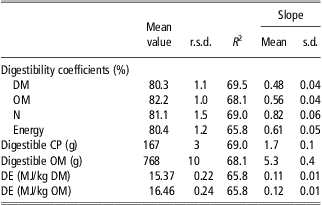
DE = digestible energy; r.s.d. = residual standard deviation; DM = dry matter; OM = organic matter; N = nitrogen.
1 From covariance analysis with BW as a covariate and animal (n = 20) as a fixed effect; both effects were significant (P < 0.001); no significant interaction between animal ID and BW on digestibility coefficients (P > 0.05); the overall mean BW was 62.7 kg; n = 200 observations; r.s.d. of the covariance model; R 2: % of the variability explained by the statistical model.
Effects of sire origin on performance and overall growth period faecal digestibility coefficients (%) of DM, OM, N and energy in growing pigs (least squares means)Footnote 1
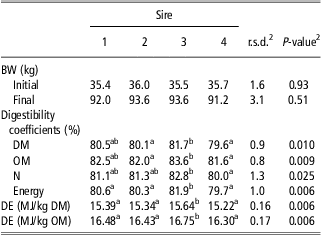
DM = dry matter; OM = organic matter; N = nitrogen; r.s.d. = residual standard deviation; DE = digestible energy.
1 Calculated as the cumulated values over the 10 successive periods of each pig according to the feed daily DM intake; values on the same horizontal row with the same letter exponent do not differ (P > 0.05).
2 From the ANOVA with sire origin (n = 4) effect; five measurements per sire origin.
Table 2 also indicates that the effect of boar origin on nutrients and energy digestibility was significant (P < 0.005 for energy), with differences between the extreme values averaging 2 points for organic matter or energy. Logically, these differences between boar origins are confirmed when the coefficients obtained on the total amount of feed consumed by each pig are analysed (Table 4). Expressed as a percentage of the faecal losses of organic matter or energy, this difference between the extremes is equivalent to about 10%. The difference in N digestibility between the extremes is even bigger (close to 3 points), but we have no indication of its localization in the digestive tract. It can be hypothesized that the differences in absorption of N originate mainly at the hindgut level with no consequence on the protein value of the feed. However, that hypothesis remains to be tested and is little documented (Len et al., Reference Len, Ngoc, Ogle and Lindberg2009b), even in other animal species. To our knowledge, this within-population genetic variability of energy digestibility observed in our trial has not been previously reported in the literature for pigs. Differences in energy digestibility between breeds have been observed (Kemp et al., Reference Kemp, den Hartog, Klog and Zandstra1991; Morel et al., Reference Morel, Lee and Moughan2006; Len et al., Reference Len, Hong, Ogle and Lindberg2009a) or between lines selected for differences in adiposity (Sundstöl et al., Reference Sundstöl, Standal and Vangen1979) but a familial effect, suggesting a transmitted genetic merit from the sires to their progeny, that is, an heritable effect, has never been documented as pigs tested in earlier studies differed in terms of breeds or lines and BW and/or age and/or maturity of their digestive tract and/or feeding levels.
It was hypothesized that the increase in digestibility with BW or age in growing pigs may differ between animals and especially according to the boar origin, so we tested the interactions between animal and BW on one hand (Table 3) and boar origin and period on the other hand (Table 2). Our results either analysed according to the period effect (Table 2) or the BW effect (Table 3) and illustrated in Figure 1 indicate tendencies for interactions (P = 0.04 for energy; Table 2) but, quantitatively, these interactions are weak, not consistent and probably caused by other uncontrolled experimental factors. Overall, our results, despite a limited power to detect an interaction between sire and period, suggest that the genetic variability of energy digestibility in growing pigs would not be dependent on the BW or the age of the pig and therefore, it would be present independently of the animal BW, at least over the BW range tested in the present trial. From a practical point of view, this also means that the quantification of genetic levels for energy digestibility can be done whatever the BW of the pigs, with similar estimations of the genetic potential of the animals. A major practical question for evaluating the genetic digestibility value is to implement routine methods on large numbers of pigs. The near-infrared spectroscopy (NIRS) methods already evaluated in broilers look promising (Bastianelli et al., Reference Bastianelli, Carré, Mignon-Grasteau, Bonnal and Davrieux2007; Bastianelli et al., Reference Bastianelli, Bonnal, Juin, Mignon-Grasteau, Davrieux and Carré2010).
Differences in energy digestibility between pigs are associated with differences in energy supply to the pig for a given feeding level and subsequent differences in gain of energy and performance. The measurements that were carried out in the present trial did not allow testing such hypotheses. However, it is noticeable that the pigs originating from the boar with the highest digestive efficiency consumed slightly less feed and had the better growth rate (Table 2). This aspect of our study would deserve further developments. From a genetic point of view, it would be important to evaluate the expected responses to genetic changes in energy digestibility in terms of utilization of absorbed energy for protein and fat gain or lean and adipose tissues gain.
In conclusion, our study suggests that energy digestibility and digestion in general would be dependent on heritable genetic variability in growing pigs. These preliminary data deserve a confirmation on a much greater number of pigs to achieve proper estimations of genetic parameters for these traits and of their correlations with major production traits, with conventional feed and high DF feed. Moreover, they offer perspectives for explaining the mechanisms and the indicators behind this variability. They also question the possible associations between this digestive variability and the variability at the metabolic level. Finally, these new perspectives for selection will require on-farm tools to get implemented in selection experiments, or later in selective breeding, based on either indicators of the in vivo digestibility (NIRS methods, for instance) or biomarkers.
Acknowledgements
The authors gratefully acknowledge Régis Janvier, Yvon Billon, Francis Le Gouevec, Anne Pasquier and Agnès Starck for their technical assistance.