It may seem strange today to study aspects of the political sphere—from foreign policy to diplomacy and the military—in the context of sexuality. But the Belle Epoque (1871–1914) was an era of prestige politics, also with respect to the politics of sexuality. This article reveals how the Eulenburg Scandal of 1906 to 1909 used sexual morality as a way to explain and interpret the tensions that pervaded Germany's domestic affairs and international relations. The reliance on sexual mores as an explanation for large-scale political events was the result of an ever-intensifying chain of national and international complications—complications that later undermined Germany's sense of national honor. The Eulenburg Scandal is remembered today mainly as the first major homosexual scandal of the twentieth century, but contemporaries experienced it in a wider sense: it became Germany's counterpart to the Dreyfus Affair in France—two examples of political, social, and cultural conflict that threatened the foundations of their respective countries.Footnote 1
What was novel about the Eulenburg Scandal was the power with which gender categorizations flooded the public and political spheres, prompting new and noteworthy dialogue on masculinity as it related to national character. Previously, such topics had appeared only in specialist discourse, particularly in the young field of sexual science. As Todd W. Reeser emphasizes, the gender of a nation can be compared with the gender of an individual and thus be construed by the public with equal freedom and flexibility. From the perspective of a cultural history of politics, varying degrees of masculinity defined the political character of the German nation-state from the time of the Franco-Prussian War in 1870–1871 to the end of the Nazi regime in 1945.Footnote 2 To substantiate that claim, this article draws upon R. W. Connell and James W. Messerschmidt's critical survey of hegemonic masculinity. Early assessments of the concept, according to the authors, failed to identify an icon of hegemonic masculinity, since many men who possessed great social power did not necessarily embody a masculine ideal. In this context, we will examine the interplay of gender dynamics and power with respect to leading figures of the late German Empire as they moved into the public sphere of an emerging modern mass media.Footnote 3
The social dimension of international relations has not yet received sufficient scholarly attention. The gendered aspect of social relations has often been overlooked as well.Footnote 4 In fact, by the end of the nineteenth century, diplomacy had become genderless, with diplomats, military officials, and politicians understood neither as men nor as women, but as weak-willed cowards, enemies of glory, and traitors to the fatherland.Footnote 5 This field, already mapped out by George Mosse in his pioneering studies, is a rewarding area of research for the cultural history of politics, which uses an interdisciplinary approach to focus on the shared relationship between masculinity and the nation.Footnote 6
In autumn 1906, Maximilian Harden, one of the most important and controversial publicists and intellectuals of his time, published an especially inflammatory article in his journal of politics and culture, Die Zukunft. In it, Harden accused Prince Philipp Eulenburg, a close friend and influential adviser to Kaiser Wilhelm II, of heading a homosexual clique within the imperial government. By publicizing the scandal, Harden succeeded in popularizing a wide-ranging narrative of Wilhelmine decadence. According to this narrative, the Eulenburg camarilla—the clique of allegedly homosexual advisers surrounding Wilhelm II—had already orchestrated the fall of the first German chancellor, Otto von Bismarck, in 1890, and had since then isolated the monarch from his people. Driven by notions of excessive and unnecessary pacifism, the policies of this clique had driven Germany into international isolation. To the German public, which was increasingly critical of the aristocracy, the Liebenberg Dining Circle—a network of friends named after Eulenburg's castle—became the scapegoat for numerous political failures during the reign of Wilhelm II.Footnote 7
With respect to the question of how Germany had maneuvered itself into international isolation after 1900, Harden provided an interpretative framework for the entire European press. He declared that the Eulenburg camarilla was the peace party within the imperial government, and he backed his claim by establishing an alleged link between pacifist lobbying harmful to Germany's interests, on the one hand, and homosexuality, on the other: as he formulated it in his journal, they “don't dream of a world in flames, since they're warm enough already” (the term warm was a slang expression for homosexual).Footnote 8 Toward the end of 1907, Harden stated in court that in foreign political, diplomatic, and military circles, the prevalent view of the members of the German government was that “they are homosexuals . . . and for that reason, there is no need for political anxiety on our part.” Because the members of the Eulenburg camarilla were homosexual, they necessarily had to be pacifist, and because they were pacifist, they had to be homosexual—thus ran the argument about this correlation between politics and sexuality.Footnote 9 It achieved nothing less than the intentional exclusion of homosexual and aristocratic men from the increasingly bourgeois and decidedly heterosexual ideology of masculinity, which prevailed in the nation-building project of the Kaiserreich.Footnote 10
Michel Foucault has argued that during the nineteenth century, the homosexual became a “complete personality”: “No aspect of his being is unaffected by his sexuality.”Footnote 11 This principle was apparent in Harden's press campaign: it was used as a weapon in the struggle for the remasculinization of German politics. Harden, a journalist of European renown, did not preach the hatred of homosexuals widespread at the time, but neoconservatives in the Bismarckian tradition used it unscrupulously in order to achieve their political goals.Footnote 12 And some of these goals still appear legitimate from a modern perspective: above all, the destruction of the remnants of feudalism in Germany. Harden's allegations of homosexuality dealt a sharp blow to the already shaky reign of Kaiser Wilhelm II, who had attempted “personal rule” time and time again.Footnote 13
At the same time, allegations of a homosexual conspiracy within the imperial government were calculated to set German foreign policy, which had just experienced a fiasco during the Morocco Crisis of 1905–1906, on a radically new course. Jingoism, chauvinism, and the political use of homophobia had weakened the neo-absolutist Prusso-German monarchy under Wilhelm II. This ambivalence and interplay of opposing forces—political progress and sexual reaction—were typical for the political aspect of the history of sexuality in the twentieth century.Footnote 14 The Eulenburg Scandal thus prompted a reassessment of a number of important symbols of the German Empire. This article examines the impact of scandal and symbolism on the general willingness of both the German leadership and public to direct the country toward a “Great War,” and, with respect to the historical longue durée of the twentieth century, concludes with some reflections on the consequences of the Eulenburg Scandal for concepts of masculinity in the political, cultural, and sexual history of the entire century.
Anachronistic Masculinity: The Feminization of the Wilhelmine Aristocracy
Before his press campaign of autumn 1906, Harden had obtained intimate letters from the circle of friends around Kaiser Wilhelm II. In those letters, Eulenburg, who was the éminence grise of German politics in the years after the fall of Bismarck, was referred to as “Philine”; his close friend, the general Count Kuno von Moltke, municipal commandant of Berlin, was “sweetie” (Süßer) and “old badger” (Alter Dachs); and their mutual “sweetheart” (Liebchen) was none other than Kaiser Wilhelm himself.Footnote 15 Harden's asked, “Is it normal to speak of the German Kaiser as a ‘sweetheart’?,” a rhetorical question that found its way into the international press within hours, and that he had used in one of the many trials that were part of the Eulenburg Scandal between 1907 and 1909: “These are worse developments than under Friedrich Wilhelm IV,” he stated, “If nobody else found the courage, I had to speak.”Footnote 16
The masculinity of Kaiser Wilhelm's closest friends was held up to ridicule as well. In one of the trials, General Moltke's own lawyer drew on witnesses to confirm that Moltke's young wife had beaten the general black and blue on more than one occasion. The injuries sustained by Moltke were serious enough to warrant several leaves of absence from his post as commandant of Berlin. The purpose of this line of questioning was to blame Moltke's former wife for the disintegration of their marriage, but the result was the symbolic emasculation of one of the highest military officials in Prussia. What kind of a general would allow his young wife to tear the epaulettes from his uniform, and regularly lock himself in his bedroom out of fear of his wife? The media further revealed that Moltke had armed himself against her sexual advances with buckets of cold water, which he kept at the ready next to his bed.Footnote 17 At a time when the physical superiority of men was taken for granted, these revelations were shocking, and the shock was all the more profound because General Moltke represented the Wilhelmine army, one of the main antagonists of the women's rights movement.Footnote 18
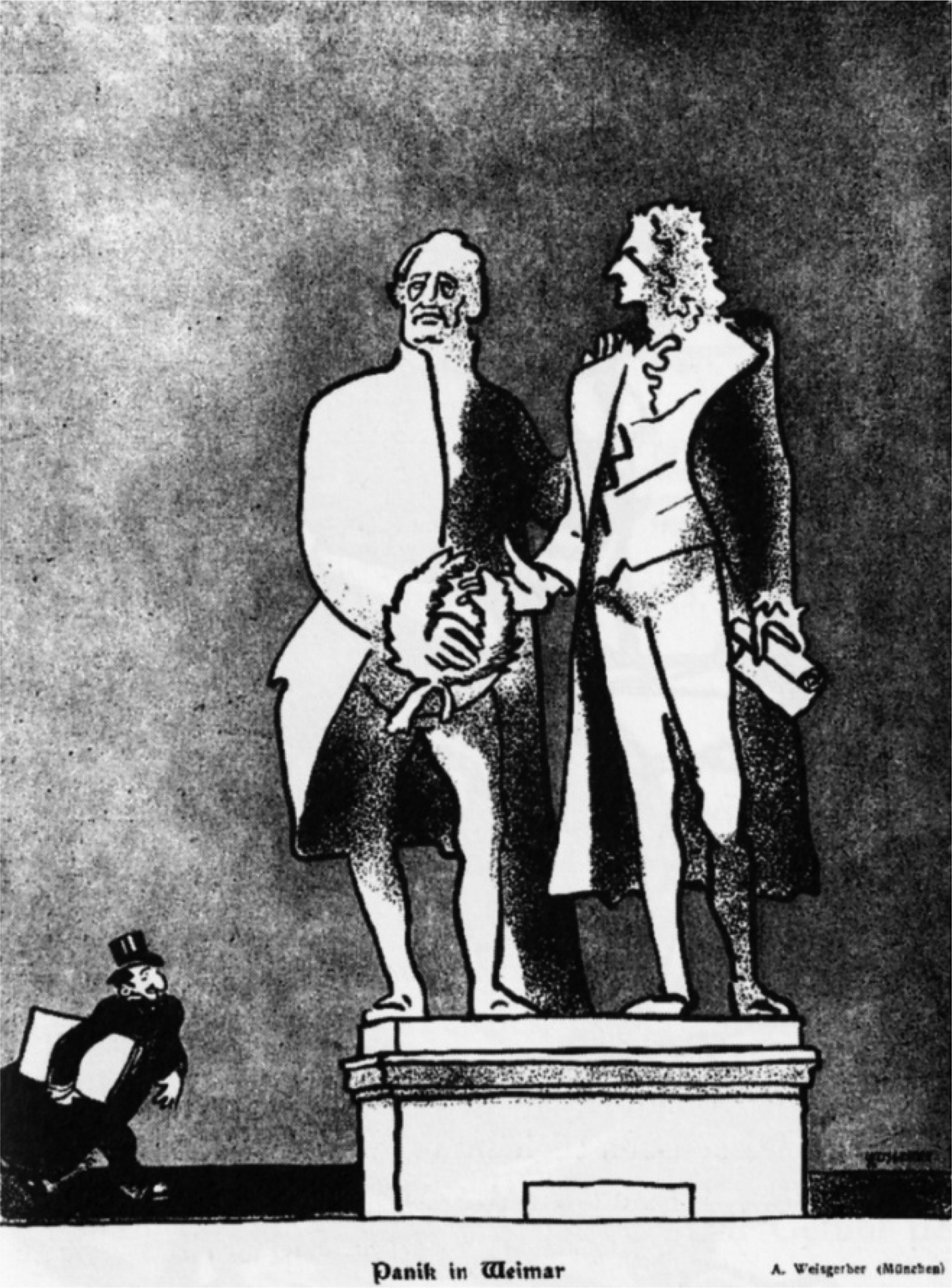
The German public was divided on the subject of these male friendships in the highest circles of the realm. Several journalists who supported the government initially attempted to sublimate the relationship between Eulenburg and Moltke, portraying it as a specifically German friendship (see Image 1). The Vossische Zeitung compared the pet names and other forms of address used by Eulenburg and Moltke to those appearing in the correspondence of German national heroes: Goethe had called Carl Friedrich Zelter his “beloved,” his “only beloved,” and his “adored” and “divine” friend. Richard Wagner had written to his close friend Franz Liszt: “Your effect on me cannot be put in words: everywhere around me I see but luscious spring, sprouting and blooming life. With it comes such lustful pain, such painfully intoxicating lust, such a great joy to be human and to have a beating heart! I have to complain that I can only write all of this to you! If I could only describe my love for you!” But, according to the main newspaper of the educated middle classes, the sexualization of human relations had long since moved beyond such noble and pure expressions of German friendship.Footnote 19 In other words, by the early twentieth century, men who used such expressions were now considered to be more than just “friends.”
“Panic in Weimar: Wolfgang, let's let go of our hands! Dr. Magnus Hirschfeld is coming!” The image highlights the fine line between specific “German friendship” and male love. It also suggests that Jews, who are supposedly materialistic and therefore sexual in “spirit,” do not understand a truly idealist German friendship such as the one that existed between Goethe and Schiller. For Magnus Hirschfeld, cofounder of the sexual sciences and expert for the court during the Eulenburg Scandal, enthusiastic friendship in the “technical-military age” was usually perceived as homosexuality. Source: Jugend, Oct. 1907, p. 1089.

Mainly because of increasingly direct innuendos about the kaiser's own homosexuality, much of the German press was no longer willing to endanger national prestige with poetical, patriotic entreaties of German friendship.Footnote 20 The public's lack of respect for the kaiser had become increasing apparent—so much so that the Catholic journal Germania considered disrespectful references to Wilhelm II as “Liebchen” a cause for great concern; for other observers, it was cause for a trial for lèse majesté.Footnote 21 At the same time, many were convinced by Harden's argument that any German of “normal feeling” (normal empfindend) must take the male friendship between Eulenburg and Moltke for “one with erotic emphasis” and reject it.Footnote 22 In light of the popularity of jokes about the “cult of friendship” in the “highest circles” of the realm, Vorwärts, the leading paper of the Social Democrats, spoke of a typically aristocratic “feminism,” from which the healthy masculinity of the worker and peasant had every right to distinguish itself.Footnote 23
For the cultural history of politics, it is highly significant that the public's moral right of veto in the political sphere was strengthened as a result of the scandal. This became visible in the debates on masculinity that surrounded the Eulenburg Scandal—discussions that can be taken as a discursive form of sovereignty: even if the written constitution of the empire remained unaltered, the actual constitution of how power was exercised—and by whom—did change. Moreover, the power of moral interpretation by journalists proved mightier than the traditional, authoritarian power of the monarchy, to use Max Weber's construct.Footnote 24 With the stalemate of constitutional reform hanging over the German Empire in its final decade, scandals seemed to provide a new and apparently more democratic prerogative of the ruled over their rulers.
An increasing number of contemporaries recognized the power of this democratic trend. “This means,” the Kölnische Zeitung euphorically concluded, “that in Germany, the people are called to determine the measures with which the moral integrity of those men is to be judged: those men whom the people consider worthy to stand at the side of their Emperor.”Footnote 25 This new form of power sustained by scandal was beyond the control of the government, however, and developed its own dynamic. This is a point that can not be stressed enough. “Now we breed Renaissance people of the arts,” complained the Hamburger Nachrichten (one of Bismarck's preferred papers) with respect to the friends of Wilhelm II: “But we need Renaissance people of power.”Footnote 26 Clearly, the press had turned against those refined aristocrats who had set the tone of the Wilhelmine era with their habits, their customs, and their approach to power politics. The traditional power structure in the German Empire had, in short, been turned on its head.
The “Iron Age” of Bourgeois-Imperialist Masculinity
Maximilian Harden used the international publicity from the Eulenburg Scandal to expose the supposedly incredible reasons for the mishaps of Germany's imperialist policies. The threat of a German declaration of war on France—though never made public—had been issued to the French Foreign Ministry during the Morocco Crisis of 1905, and dismissed as a bluff by Harden.Footnote 27 Harden explained that “peace enthusiasts” had been at work, and that their diplomacy had dealt the empire its (Battle of) “Jena.”Footnote 28 This was directed not only at Eulenburg, but also at the top French diplomat Raymond Lecomte, who had been Eulenburg's friend since the 1880s. Lecomte had been transferred to Berlin as embassy counselor at the height of the Morocco Crisis on July 25, 1905.Footnote 29 In November 1906, he was invited to the kaiser's hunt at Eulenburg's Liebenberg Castle. This gave the French envoy an opportunity to speak with Wilhelm confidentially—and not, as it turned out, for the first time. News of these talks drove Harden to blame Lecomte for the German defeat at the Conference at Algeciras earlier that year. The international conference, organized ostensibly as a way for Germany to expand its interests in Morocco and build a trade alliance with France, was actually a German attempt to weaken the bonds between France and Britain. The meeting ultimately brought humiliation to the German Empire and strengthened ties between France and Britain. In addition to looking diplomatically inept, Germany was actually more isolated by the time the conference had ended.Footnote 30
Only the homosexual tandem Eulenburg-Lecomte could have provided this “invaluable service” to French diplomacy, Harden claimed. It was they who had publicly substantiated the kaiser's overriding desire for peace, thus exposing the threats of war issued by Chancellor Bernhard von Bülow and his foreign policy advisor Friedrich von Holstein as mere bluff.Footnote 31 For Harden, this was an unforgivable political error: “Is it wise to emphasize one's desire and need for peace so strongly that the other party begins to consider one weak? And this at a time when affairs in Morocco are reaching a critical edge?” The editor of the Zukunft, which had a wide circulation throughout Europe, believed that in losing the capacity to threaten war—a widely accepted, specifically masculine “act of strength”—Germany had sealed its foreign policy fate and ensured the isolation of the empire.Footnote 32
Harden's theory about the Morocco Crisis elicited a global response. Like many other European newspapers, the Prague Union concluded that the French Foreign Ministry had learned more about the political stance of Kaiser Wilhelm II from the indecent relationship between Eulenburg and Lecomte than it had from the actual government of Bülow and his diplomats.Footnote 33 News of the collaboration between the Kaiser's favorite and a top French diplomat, which the European press learned of in only the vaguest of terms and mainly from Harden's point of view, provoked widely divergent reactions. The French papers, for example, stressed the political responsibility of the Kaiser: as one contributor to the Echo de Paris wrote, “Guillaume II. n'est pas un crétin.” The monarch had evidently intended to reveal to the French government his desire for peace and, therefore, knowingly risked Germany's reputation in international circles. For German journalists, however, both protagonists of the affair, because they were homosexual, had practiced “in Liebenberg a rapprochement franco-allemand of a special kind,” amounting to nothing less than Eulenburg's “treason to the fatherland.”Footnote 34
Remarkably, not one contemporary critic pointed out the shortcomings of Harden's Morocco theory.Footnote 35 Germany had insisted on an international conference as a tribunal for France's Moroccan policy, which had, Berlin claimed, constituted a breach of an international agreement. This entire theory about Germany's supposedly wasted opportunity to start a war against France over Morocco was only a trigger for Harden to depict German foreign policy since the fall of Bismarck—determined as it was by a homosexual peace party—as unmanly in its entirety: “In Germany, our politics are too sweet and soft,” he declared in court. “If we, fully aware of our strength, rejected every advance on the international stage that was contrary to our interests; if we showed that in an emergency, the sword will be drawn as soon as the honor and the future of our nation requires it, then our position in the world would be much improved.”Footnote 36 The editor of the Zukunft was able to present as crown witness none other than Bismarck, whose comments on Eulenburg and his friends affirmed the hegemony of his own bourgeois-bellicose notion of manliness: “Those are disgusting people; so very different from us.” He thus distinguished himself and like-minded supporters from the “other nature” of the refined aristocrats of the Eulenburg circle.Footnote 37
Professional warmongers such as the Pan-Germans saw their radical imperialism confirmed. They eagerly seized upon homosexuality as a new political-moral construct that not only explained the international relations of the past decades, but also aggravated the national and international conflicts of the present. The Leipziger Neueste Nachrichten determined that the Eulenburg camarilla was the “actual carrier of this meager and unmanly policy of reconciliation,” a policy “whose after-effects we still suffer from today.” According to this imperialist journal, their “constant harping on our desire for peace” had encouraged other European nations “to treat us as a quantité négligeable and to consider our occasional brashness more as play than as the expression of decisive will.”Footnote 38 The Neue Bayerische Landeszeitung put it in more drastic terms: “Since 1889, German policy, especially foreign policy, has been under the aegis of the unmanly, effeminate, indecisive soft-soap Eulenburg. This perverse eunuch- and homunculus-policy without backbone, without juice and strength, has greatly reduced Germany's prestige and influence in the world, and has also helped to bring about the setback at Algeciras.”Footnote 39 How was it possible, asked the socially minded imperialist Friedrich Naumann, that feminine types such as Eulenburg and his close friend Count Kuno Moltke were able to obtain the posts they held? “The question unceasingly vexes every soul: that these people were allowed to represent Germany and even hold a commanding post in Berlin!” In the Eulenburg Scandal, German politics was represented as “the product of the more or less sexually abnormal,” noted Richard Linsert, one of the first sexual historians, in a 1931 study.Footnote 40
Because of the the Eulenburg Scandal, the notion of Franco-German reconciliation took on negative connotations, even for sympathetic journalists. This gave way to resignation and ceded the stage to advocates of Realpolitik in the press—evidence for the problematic role of the latter in the years prior to World War I.Footnote 41 More specifically, the dynamic of the scandal emphasizes the link that was established between the discourse of masculinity and imperialist foreign policy from 1906 to 1909. It also connects in a more tangible way the nineteenth-century renaissance of manliness in Europe to the institutions and ideology of empire.Footnote 42 The idea of honorable masculine belligerence and, conversely, of the shameful effeminacy of the predominantly aristocratic government, came to exercise considerable influence on public opinion. The aristocratic form of manliness had widely lost its legitimacy. Bourgeois-imperialist manliness, on the other hand, which had originated in the Wars of Liberation against Napoleon and had gained momentum with the foundation of the nation-state in 1871, became more generally accepted.Footnote 43
The Threat of the “Homosexual International” to the Nation-State
An important characteristic of globalization around 1900 was the creation of institutional but also discursive “internationals.” In the years before World War I, academic conferences transcended national boundaries, and international humanitarian movements such as the Red Cross flourished. In politics, the “red” Socialist international rose to prominence, fostering conspiracy theories of a “golden” Jewish-Zionist international, as well as a “black” ultramontane international.Footnote 44 The focus on homosexuality brought about by the Eulenburg Scandal fostered notions of a homosexual “pink” international as wellFootnote 45—one that “provides a unifying band beyond all walls of faith, states, and social class,” wrote Harden, and unites “the most distant, most disparaging individuals in a brotherhood of protection and defense.”Footnote 46 During the period of highly aggressive nationalism both before and after World War I, those people belonging to the “Fourth International” (as Kurt Tucholsky termed the “homosexual international” in the 1920s) were said to lack national dependability. At the same time, Hans von Tresckow, the former director of the Berlin Police Department for Homosexuals—and also the person who had led the investigations during the Eulenburg Scandal—wrote in his memoirs: “With many homosexuals, I found a regrettable lack of national feeling. They are international in outlook and consider themselves cosmopolitan.”Footnote 47
This cosmopolitan nature of the modern homosexual had to collide, by necessity, with the homosociality of modern citizenship, one of the most important characteristics of the modern nation state.Footnote 48 Other conflicts of loyalty with the sort of heterosexual masculinity exacted by the national state existed as well. During the Eulenburg Scandal, the antisemitic press perceived connections between homosexual and Jewish internationals, just as it had previously between the supposedly Jewish and socialist internationals. The Neue Bayerische Landeszeitung wrote that it could not be a coincidence that the “organs of the Alliance Israélite” continuously called for an abolition of the legal paragraph penalizing homosexuality.Footnote 49 This was an entirely false assumption, but would nevertheless leave a lasting impression on antisemites.Footnote 50
Harden called upon Bismarck once more as a crown witness for the claim that a homosexual international existed, as well as that homosexuals posed a danger to the national interest.Footnote 51 “There are connections and sympathies there that people like us cannot understand,” the former chancellor warned him, speaking of the borderless “camarilla of pederasts,” whose members lack “any sense for the sobriety of political life, without the nerves of courage required by a great nation.”Footnote 52 According to Harden, Bismarck had confided to him in his last years: “You disapprove of the kaiser as a political personality because of many of his main characteristics; so do I. But you can believe me: all, or at least nine-tenths, of these unpleasant traits would not be apparent had not Philipp Eulenburg surrounded him with his tribe.” Eulenburg confirmed these allegations freely in court: Bismarck, in his “volcanic hatred,” wanted to brand him as a homosexual at the Prussian court and in aristocratic circles, thus making him political poison. But the fallen favorite of Wilhelm II interpreted this only as personal revenge for his contribution to the fall of the Iron Chancellor: “the Parthian arrow, carefully chosen, which could not fail in its effect.”Footnote 53
For the majority of the public, the affair was not just about intrigues at the Prussian court, however, but about a serious danger posed to the young nation-state by an international threat. Harden believed that the cosmopolitan character of the homosexuals was determined by the fact that they had “agreed on a mutual life insurance.” Their gender-specific alliance against a number of institutional and social threats was stronger than any national allegiance or patriotism. Their homosexual “community” and “coming together” followed a principle based on the individual, one that did not recognize national boundaries. According to this rule of self-preservation, Eulenburg had “placed homosexual people” in all important political posts, and in this way, he finally managed to introduce Lecomte to Kaiser Wilhelm, thus setting the stage for “a national calamity” in foreign policy and risking “danger to the fatherland.”Footnote 54
This idea of a homosexual international, which supposedly included a significant number of diplomats, enjoyed great resonance in the press. Otherwise critically minded intellectuals such as Friedrich Naumann soon spoke of the “international infection of sin.”Footnote 55 Eulenburg was depicted as “the great pederast,” the center of a homosexual network in the center of Wilhelmine politics. Eulenburg was at the heart of “foolings around in a humid atmosphere,” and he was said to have used “considerable skill to place his creatures, his ‘darlings,’ wherever he wanted.”Footnote 56 Harden had no qualms about describing Wilhelm II as the object of lust for these homosexuals. Since the fall of Bismarck, they had “fought for the person of the kaiser,” as he declared in court, correcting himself ostentatiously: “I mean the struggle, the attempt to secure his favor, their influence over him.”Footnote 57
In this political context, cosmopolitan homosexuality could easily be associated with earlier prejudices toward the court and the diplomatic corps, since neither institution was deemed reliable from a nationalist viewpoint. According to a witticism of the period, diplomats had not learned anything but “to say things in French, to say nothing at all, or to lie.”Footnote 58 The topos of the court as a playground for effeminate, nationally undependable characters had a long tradition. During the scandal, the social democratic press referred to the eighteenth-century letters of Liselotte von der Pfalz, which characterized courts as the “principal breeding grounds of pederasty.” The latent tendency to treason that could be found at the Prussian court, in particular, was expressed in the term les Potsdamists, which had already been used “everywhere in Europe” in the days of Frederick the Great for homosexual courtiers.Footnote 59 Especially in the British press, the term mignon/minion, which had been applied to homosexual courtiers as far back as the Middle Ages, was used for the Eulenburg camarilla. This expression served to emphasize the international character of the homosexual fraternity—the Standard spoke of the “disgraced fraternity of minions”—as well as its propensity for treason: “the intriguers of Berlin were working in co-operation with sympathetic malefactors in Paris.”Footnote 60
Male Gender Crisis: the Longing for the “Real Man” and the Coming of the Great War
A cultural history of politics requires a precise focus on the ambivalences of the Eulenburg Scandal. Around 1900, many European societies assumed that they were caught in a crisis of masculinity. In France, fears and concerns about this had culminated in the recent Dreyfus Affair, which, because of the detailed press coverage of the scandal, then extended to the entire European public.Footnote 61 As for Germany, George Mosse has discussed debates about masturbation and homosexuality as sexual practices that endangered national military strength, and he described war as an “invitation for manliness.”Footnote 62 According to Todd Reeser, it seems to be a general pattern that a desire for one's country to wage war, as well as a justification for war, find expression in a type of masculinity that is channeled into nationalism. People want war, he argues, because they perceive the enemy as effeminate, and because they fear the perception of their own nation as effeminate.Footnote 63
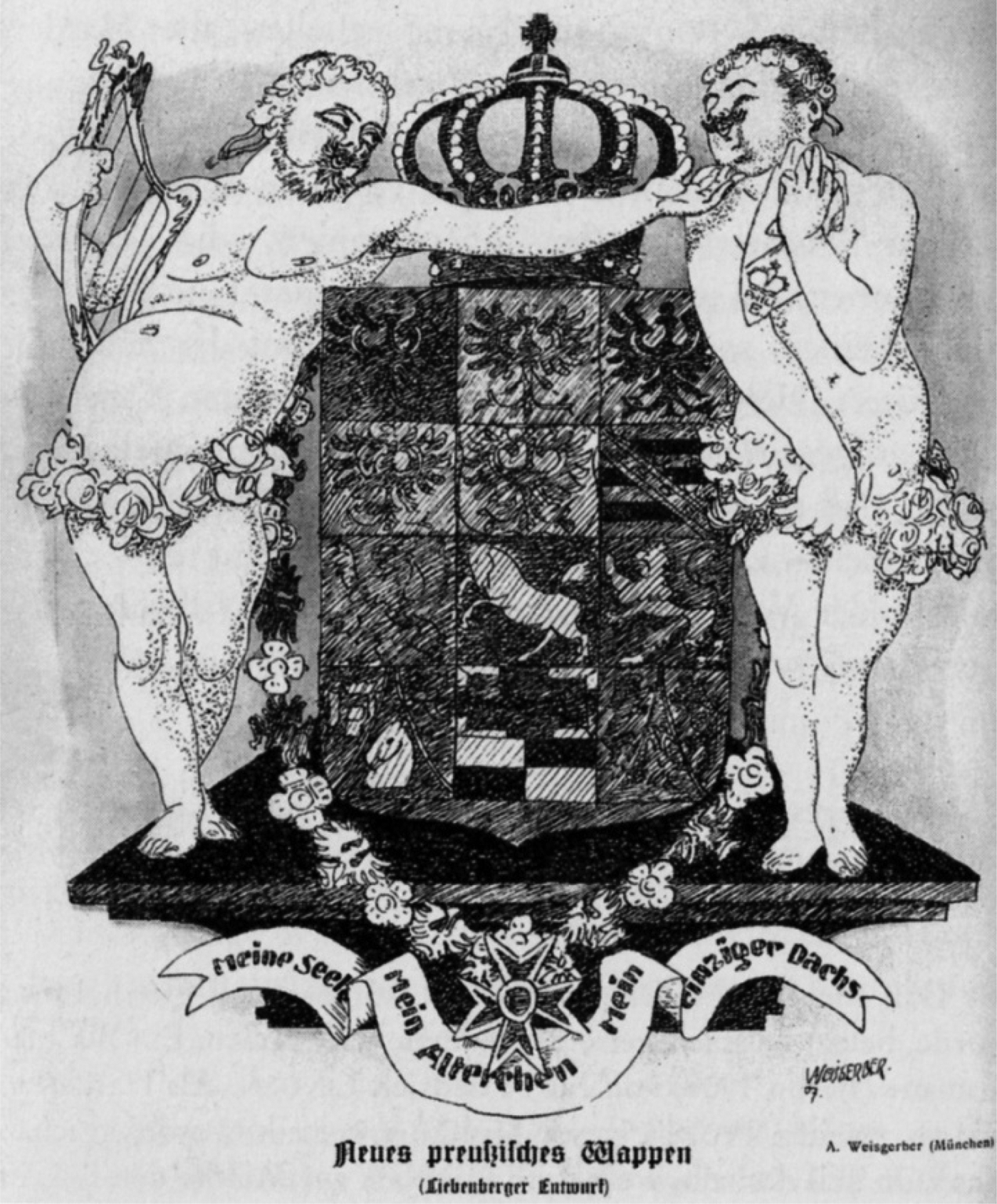
In the course of the Eulenburg Scandal, dissatisfaction with the political elite was vented through the conjuring up of images of masculinity. As Harden's lawyer, Max Bernstein, explained: “The Kaiser must and should be supported by real men.”Footnote 64 The ideal of the “real man” was a true fetish of Wilhelmine policy, and was offered for years as an antidote to the perceived feminization of the modern man.Footnote 65 The homosexual politicians of the Eulenburg camarilla corresponded perfectly to contemporary notions of decadence: “Plenty of good people. Musical, poetic, spiritual; so pious that they expect more healing powers from prayer than from the wisest doctor; and their communication, oral and written, is characterized by a touching degree of kindness.” In their case, however, their unmanliness had political repercussions, according to Harden: “All of this would be their private business if they did not belong to the close circle of the kaiser and had not spun their web from visible and invisible places, which prevents Germany from breathing freely.”Footnote 66 This sexual diagnosis of Wilhelmine policy did not refer merely to the small clique around Eulenburg. As Wolfgang Mommsen argued, this was a challenge to the establishment of the late German Empire (see Image 2).Footnote 67
A new Prussian coat-of-arms following a Liebenberg design, as suggested by the satirical press. Two flirting wildmen have the facial features of Philipp Eulenburg and Kuno Moltke. The motto reads: “My soul, my little old man, my only badger.” The Eulenburg Scandal turned the German military state into the laughing stock of Europe. Source: Jugend, Oct. 28, 1907, p. 1028.
With respect to content and style, Harden's argument resembled that of leading Pan-Germans such as Ernst Graf Reventlow and Heinrich Claß. These men not only wanted to abolish the hereditary monarchy and replace it with a “peoples' emperor,” but also substitute tired and weak aristocrats with “real men.”Footnote 68 It is probable that they were thinking here of themselves first and foremost, for, like Harden, the Pan-Germans failed to define explicitly their conception of the “real masculine” type of politician. Criticism of its opposite, however—the soft, homosexual courtier such as Eulenburg—was irresistible even for exemplary democrats, as was the tendency to apply categories of sexual morality to politics. As Colonel Richard Gädke, a former member of the Prussian army who had become a regular contributor to the liberal Berliner Tageblatt, put it: “We need neither regulations nor cabinet orders, but men, different men, real men!”Footnote 69
In the aftermath of the Morocco Crisis of 1905–1906, a desire for peace was quickly interpreted as unmanly, and unmanliness was equated with pacifism. The German press had perpetuated these notions for several years, caricaturizing Chancellor Bernhard von Bülow as the “fair-weather chancellor,” “handsome Bernhard,” “the man with the dimple in his chin.” Harden intensified this trend even further with his image of the emperor as “Wilhelm the Peaceful” and “Guillaume pacifiste et timide,” in order to write off German foreign policy as unmanly in its entirety.Footnote 70
The effeminization of national symbols was a weak point in the political culture of the late empire, one that could be weakened further by using the battering ram of homophobia.Footnote 71 Harden welcomed the destructive potential offered by political moralizing, endeavoring to achieve the desired effect by teasing out homosexual connotations from words of masculine harshness: “During the long period of peace, with its greenhouse-effect (Treibhausgeschwindigkeit) on the rapid growth of wealth, we have become thin-skinned.” It was widely believed that Germany could only benefit from the removal of homosexuals from politics, from this “cleansing of the blood,” in its future struggles.Footnote 72 To the old fear of effeminacy in politics came the new fear of homosexuality, which aggravated the political crisis caused by the scandal and resulted in calls for a masculinization of politics in whatever form deemed necessary.
This spiral of wounded male pride, which contributed to the coming war, was further nourished by the international desire for prestige that was characteristic of the Belle Epoque. For many suspicious neighboring countries, especially France, German arrogance and craving for status had been dampened by the Eulenburg Scandal. The masculinity of the “highest circles”—the generals, the elite regiment of the Gardes-du-Corps—seemed to be compromised.Footnote 73 And the larger-than-life Moltke myth, which the German Empire had welded together with blood and iron in 1871—and from which it continued to draw strength long after—began to pale.Footnote 74
The revelations of the scandal led other European countries to assume that a general moral decline was occurring; that belief, along with a perceived reduction of strength in the army and the nation as a whole, was reflected in the nationalist desire for prestige. Arthur Meyer, the editor-in-chief of the chauvinist Gaulois, triumphed:
To see the most revered names, some of them linked with the colossal enterprise of founding the Empire, now exposed to general ridicule—thrown to feed the angry mob, so to speak—and to see the monarch's name dragged through the mud: What ignominy and degradation on a single day! Ah! Now no one will dare to speak of the “modern Babylon [Paris],” as the great Richard Wagner did in trivial verses when we lay on the ground [in 1870–1871], humiliated and defeated!Footnote 75
France's warmongering papers, among them Libre Parole and Intransigeant, with their renowned writers Édouard Drumont and Henri Rochefort, specifically attacked the masculinity of the German Empire by comparing its “first officer” Wilhelm II with Napoleon III, who had also been given the name “le bien-aimé”—if only by women who admired him as the hero of victorious battles. The German kaiser, on the other hand, had received his pet name from other men—without ever having been in battle.Footnote 76
The scorn heaped upon the wounded national masculinity of Germany mingled with a bellicose desire for revanche: as the French journalist Arthur Meyer reminded his compatriots, “Sedan ne pas encore vengé.”Footnote 77 The German public had begun to express concern over repeated blows to the empire's reputation, as well as a growing desire for military revenge in France. The Rheinisch-Westfälische Zeitung summed up the pervading mood: “Foreign nations are weighing German military strength triumphantly and skeptically, toying with ideas they had not previously dared to entertain for fear of our strength.”Footnote 78 Up to this point, the people of Germany had maintained confidence in the army, as well as in the officers' corps of Prussia and other German states, assuming they were “admired in the whole world as an example of manly and soldierly skill”—and feared especially by the “hereditary enemy” France. This was why the provocations from France sparked popular support for military radicalization.Footnote 79 The pro-government Kölnische Zeitung warned all “enemies of the Reich” within and outside of Germany that whoever “gives our enemies reason to believe that the German officers' corps is perverse and internally rotten, fouls his own nest and gives rise to falsehoods, which could become fatal for whoever decides to spread them.”Footnote 80
The media became increasingly critical of the German army, calling for it to be “mercilessly” cleansed of homosexuals in order to render it fit for war once more.Footnote 81 The antisemitic press demanded that the scandal be used to purge all Jewish officers from the army as well.Footnote 82 There was general agreement that a homosexual was entirely unfit to be an officer, who “should be an example to the men in arms, who follow his commands and his moral way of life.” One of the central ideologies of the German Empire was thus revitalized by the threat of homosexuality. All of this was accompanied by an increasingly belligerent tone. As large segments of the political right perceived it, the Eulenburg Scandal was the “moral wound inflicted upon the body of the German people.” Their supporters clamored for the restoration of national health by means of a “fresh and merry war.”Footnote 83 In the light of the scandal, ultraconservative journals such as the Deutsche Tageszeitung waxed into a delirious state of apocalyptic Götterdämmerung:
We know where the springs flow from which our people can restore its youth and health, its strength and its juices. . . . Many were probably reminded, in these sultry days, of the old saying that a fresh and merry war can be a blessing for a people. . . . If the Master of fate should place us before such a decision and lead us into bloody combat, the vast majority of the German people would prove, as would the German youth, as would the circles, generally slandered, who are currently being attacked with poisoned darts and stones, that they have learned to die for the fatherland. Then, the dirt would be dispersed and chased away by the winds of the storm.Footnote 84
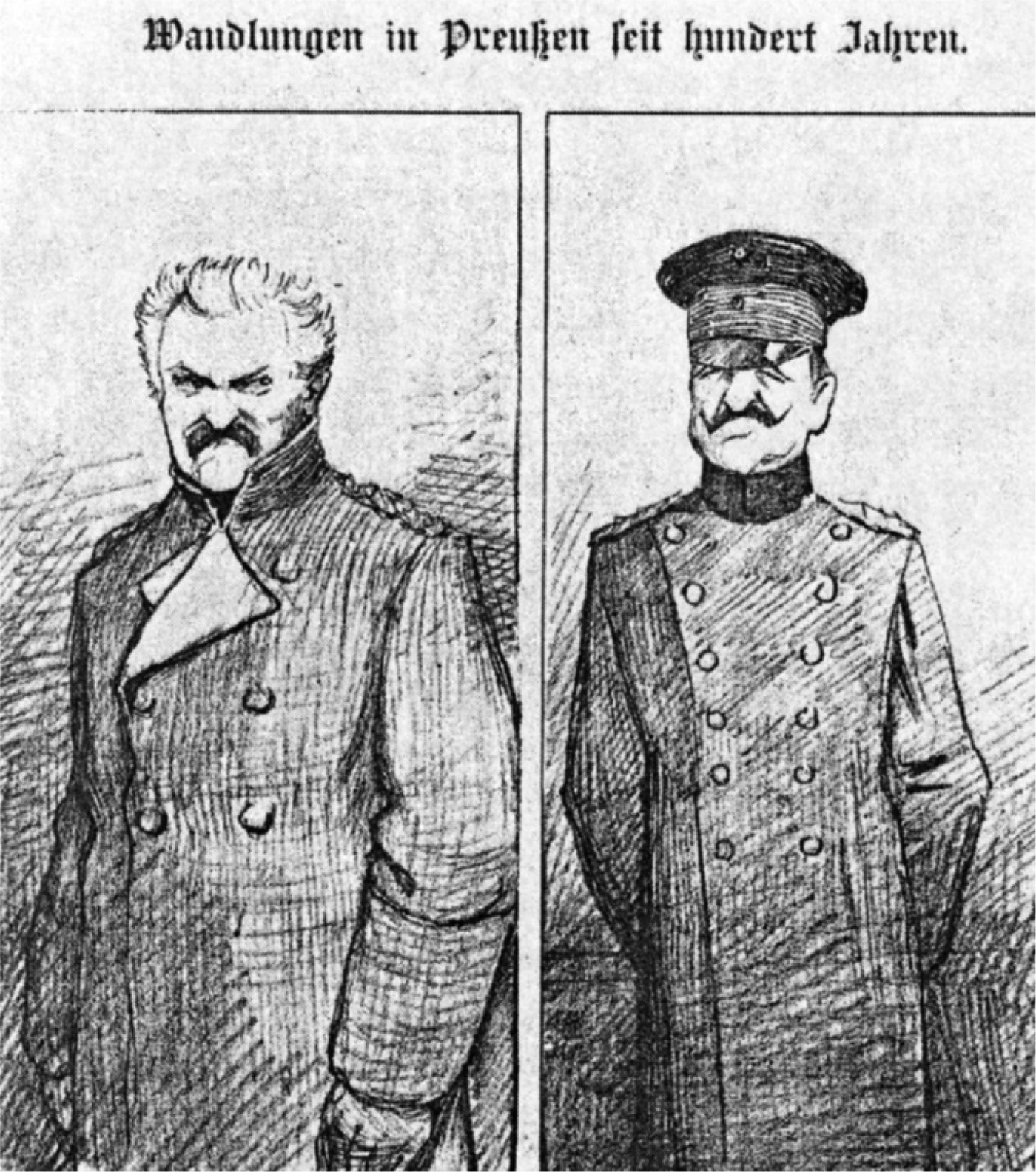
The same agitated tone eventually spread to the leading echelons of the German Empire. Chancellor Bülow called on the kaiser to use fire and sword to burn out “those disgusting boils” that the scandal had uncovered. “The army is healthy enough, and our people are healthy enough in their core, that this cleansing process could be performed very soon.” Even Bülow, whom the warmongering parties called the peace-loving, “fair-weather chancellor,” drew unreasonable conclusions from the public excitement about the Eulenburg Scandal: “The scandalous revelations which now preoccupy the public, a public lusting for sensation,” he wrote to Wilhelm II, “will best be overcome by pursuing a determined and dignified policy at home and abroad, by which this nation will be lifted from the mud to higher aims.”Footnote 85 War was still avoidable, but the Eulenburg Scandal had not only increased the expectations of war and of those interested in it, but also reinforced a worldview in which war was considered a means—even a necessity—for the moral cleansing of a country that had supposedly become as damaged as the masculinity of the nation (see Image 3).Footnote 86
“Marshal Advance and General Retreat!” The decline of military masculinity in Prussia in the course of a century, personified by a comparison between Marshal Gebhard Leberecht von Blücher, the hero of the Wars of Liberation against Napoleon, and General Kuno Moltke. Source: Wiener Caricaturen, Nov. 3, 1907, p. 12.
The Homosexual Scare and the Politics of Sexuality in the Twentieth Century
The Eulenburg Scandal so excited Wilhelmine society precisely because it exemplified the tensions between ancien régime and bourgeois modernity—between official norms and taboos, on the one hand, and the movement for sexual enlightenment and Lebensreform, on the other.Footnote 87 In spite of the tendency toward more liberalized mores at the beginning of the twentieth century, merely being suspected of homosexuality was still enough to leave a person “morally ruined” until he could disprove the accusation and restore his honor. As a contributor to the liberal Münchener Neueste Nachrichten wrote, “No more insulting accusation can be made against a man than that of abnormal sexual inclination. It ruins him psychologically and socially.”Footnote 88 Harden justified his sexual-political campaign by mixing political cynicism with a realistic assessment of the moral preconceptions of the period: “He who is smiled upon or despised because the word ‘warm’ is associated with him, in some way, does not have much [of a masculine] reputation to lose.”Footnote 89
A graver consequence of the media wars fought out in the public sphere was the association of homosexuality with treason.Footnote 90 For French papers such as Le Temps, the reason why Eulenburg and his friends were treated as homosexual traitors was clear: “Because they prevented war with France!”Footnote 91 But as Gaston Calmette reasoned in the Figaro, what was a treasonous intrigue from one perspective was, from another, a service to European peace.Footnote 92
In the pivotal years from 1905 until 1909, many regarded Maximilian Harden as the figure primarily responsible for the failed reconciliation between Germany and France. He clearly maligned any alliance as unmanly, but it would be an exaggeration to hold him entirely responsible for creating the “homosexual enemy of state”—who allegedly worked for international peace and against national interests—without considering the political context and the traditional assumptions of the period.Footnote 93 Before the eyes of an interactive, international public drawing on references to history, sexual science, and criminal anthropology, the Eulenburg Scandal established the connection between the traditional crime of treason and a specifically modern concept: the homosexual international. The figure of the homosexual traitor was thus planted in the German public's consciousness—the beginning of a tradition that continued with Austro-Hungarian Colonel Alfred Redl (1912–1913), SA (Sturmabteilung) chief Ernst Röhm (1934), the Blomberg-Fritsch Affair (1938), NATO General Günter Kießling (1984), and into the present.Footnote 94
It is crucial to note that the connection between foreign policy and homosexuality had a long-term effect not only in Germany, but in other countries as well. In Great Britain at the end of World War I, a sensational trial for slander centered on an accusation that the homosexual camarilla, which, according to British war propaganda, was still in power in Germany, had used agents to turn thousands of men and women in Britain into homosexuals. The victims were then blackmailed into following secret instructions from Berlin.Footnote 95 For the United States, Robert Dean has revealed the fear of a link between the Communist Party and homosexuality during the McCarthy Era—the amalgamation of a Red Scare and a Lavender Scare.Footnote 96
The politics of sexuality in the Wilhelmine era thus endeavored to present non-hegemonic masculinity as a danger to the public peace. In the political discourse of the late monarchy, homosexuality, though only recently discovered by the young discipline of sexual science, came to be considered a relic of decadent, aristocratic rule. Moreover, homosexuality was branded as a threat to the bourgeois nation-state, which could only be conceived of as a heterosexual society. This line of argument was supported, for example, by the New Yorker Staatszeitung. In 1908, this paper, the most important journal for Germans in the United States, similarly recommended a “fresh and merry war” as the best means for ridding the nation of both homosexuality and feudalism, a combination of vices that had compromised Germany in the eyes of the world.Footnote 97
With respect to Germany's increasingly aggressive and unpredictable foreign policy after 1908–1909, the Eulenburg Scandal helped to radicalize the code of social and political values using gender constructs. Journals routinely equated homosexuality with a tendency to give in, a willingness to collaborate, and an inclination toward pacifism. These were old virtues of diplomacy, which were now being targeted specifically by associating them with effeminacy and a general lack of manliness. The Eulenburg Scandal established a bourgeois-imperialist understanding of masculinity as a separate and more dominant standard than the increasingly marginalized aristocratic variants of masculinity. Looking at the homosexual movement in Germany as a subculture, there was also a “masculinist” or “hypervirile” strand that embraced homoeroticism in the spirit of ancient Greece. Homoerotic masculinity was popularized as the Männerbund by authors such as Hans Blüher, a homosexual-rights activist and open antisemite. This kind of masculinity was influential as a concept throughout the Weimar Republic and the early Third Reich, especially in Ernst Röhm's circles. Heinrich Himmler, the head of the SS (Schutzstaffel), was responsible for ridding the Nazi Party of all homosexuals after the Röhm scandal of June 1934. Yet, even he absorbed Blüher's ideas in a strikingly positive way.Footnote 98 Röhm represented a successful, hypervirile model of masculinity, which Adolf Hitler and his movement tolerated for a time. But when Röhm and his SA became a threat to the Nazi leadership, the notions of a “homosexual enemy of the state” and a “homosexual international” were revived, with fatal consequences.Footnote 99
Without adopting a deterministic approach to the outbreak of war in 1914, it could be argued that the Eulenburg Scandal castrated symbols of German imperial prestige, thus reinforcing the idea that a great war would function as a “purifying thunderstorm” for the masculinity of the nation.Footnote 100 Consequently, numerous ideas for a radical “re-virilization” of a supposedly decadent nation became increasingly popular.Footnote 101 This was one of the patterns of thought that—while not making a “world war” inevitable—did increase its likelihood significantly. Germany and the other belligerent nations in Europe did not just sleepwalk into the catastrophe, as Chris Clark has put it.Footnote 102 The events of 1914 had their own dynamic, with many deep-rooted causes, but they were not unavoidable.
Since the Eulenburg Scandal, the history of the twentieth century can no longer be conceived without the sexualization of politics – especially not without the continuous threat by political opponents to use homosexuality as a political weapon.Footnote 103 As the scandal demonstrates, diffuse attributions of effeminacy and clear-cut sexual denunciations were capable of destroying an apparently omnipotent and untouchable political foe. The attempt of the social democratic press in exile to exploit the Röhm Affair in 1934 by using the “homosexual scare” for antifascist politics—still traceable today as an ideological aspect in theories of fascism—is merely one link in this historical chain. Ever since the Eulenburg Scandal, sexual denunciation with homophobic insinuations has become an important and dangerous weapon of the political class—and not just in Germany.Footnote 104