It is an article of faith that organized interests represent members to elected officials through synchronized communication channels. In doing so, their communications need to be flexible in order to adapt to evolving policy issues, audiences, and conditions. This flexible, strategic messaging is thought to compliment their representative role, as effective framing captures the media's attention and augments citizen investment in issue campaigns. Until now, the scholarly community has relied largely upon external messaging (e.g., press releases) to document strategic flexibility. Our research is among the first to systematically compare internal, or ingroup, messaging to more familiar external communications and focuses not on framing, but the rudiments of representation—the agenda. The outcome raises questions about the relationship between strategic messaging and the representative role played by interest groups. Are the various communication channels that groups operate conveying the same working agenda?
Our evidence, taken from nearly 2,500 emails sent from the Family Research Council (FRC) to their constituents over a 10-year period, 603 of their press releases from a 5-year period, and lobbying reports submitted to the Clerk of Congress across this time span, demonstrates that organizations can be flexible in their rhetoric, crafting messages separately to ingroup and external audiences, and presenting, for the most part, independent agendas to these audiences. We then attempt to account for this pattern, looking to parse whether organizational elites are strategic and mark unconstrained flexibility or whether they follow a pattern constrained by the needs of the audience of a particular channel. While much of the evidence is agnostic on this point, we are able to draw on the intervention of the Supreme Court in Obergefell v. Hodges (2015), which radically changed the political environment for the FRC and the meaning of signals sent by taking up the anti-gay rights cause. Our analysis of internal and external communications confirms a sophisticated level of agenda flexibility, but it also raises questions about the potential for agenda flexibility to undermine good faith representation.
DYNAMICS OF FLEXIBILITY
To study organized interests is at least implicitly to study communication. Often that is the prosaic communication of interest to Members of Congress to vote yes or no, but there are several other dimensions to messaging involving, for example, who says what, when, how, and to whom. That communication of an agenda, what steps are to be taken, and what those steps mean is the critical work in defining just what an interest is. It is what links people and their resources to political goals (e.g., Snow et al. Reference Snow, Burke Rochford, Worden and Benford1986). It helps government officials envision the scope of the problem and link it to both principles and constituents. For example, the primary function of rhetoric or the framing of an issue is to manipulate “the public vocabulary to bring about social change” (Andsager Reference Andsager2000, 578). Successful interest group politics depends on a group's ability to define “an issue over time” and to adapt “those definitions to fit the changing political and social climate” (Terkildsen et al. Reference Terkildsen, Schnell and Ling1998, 46). It almost goes without saying that adept coordination and deployment of rhetoric shape activists' ability to inspire and motivate support (e.g., Chong and Druckman Reference Chong and Druckman2008; though see Jerit Reference Jerit2008).
It is important, if obvious, to point out that communication serves many masters. Organized agents are simultaneously trying to maintain relationships with coalition partners (Leifeld and Schneider Reference Leifeld and Schneider2012) and government officials (Bauer, de Sola Poole, and Dexter Reference Bauer, de Sola Pool and Dexter1963; Reference McCrainMcCrain forthcoming; Nownes Reference Nownes1999; Victor and Koger Reference Victor and Koger2016), recruit and meet the expectations of members (Gray and Lowery Reference Gray and Lowery1996; Salisbury Reference Salisbury1969), and adopt novel arguments that will influence the mass media (e.g., Terkildsen et al. Reference Terkildsen, Schnell and Ling1998; Andsager Reference Andsager2000). In addition, the external messages must be palatable and translatable to a wider public. It makes sense that a significant amount of research on interest group rhetoric focuses on two aspects of the relationship between interest groups and the media: the extent to which the media appropriates a group's rhetoric in framing an issue for wider public consumption and the effectiveness of that framing on policy outcomes (Terkildsen et al. Reference Terkildsen, Schnell and Ling1998; Andsager Reference Andsager2000; Baumgartner, Linn and Boydstun Reference Baumgartner, Linn and Boydstun2009; Knutson Reference Knutson2011; Rose and Baumgartner Reference Rose and Baumgartner2013). Studies attest to the difficult balancing act of maintaining these relationships while constrained by conflicting goals, for example, where gaining access to public officials stands in contradistinction to mobilizing the public (e.g., Dür and Mateo Reference Dür and Mateo2013), or maintaining membership is a primary consideration above gaining access to public officials (Gray and Lowery Reference Gray and Lowery1996; Nownes Reference Nownes1999).
However, documenting the competing pressures from multiple audiences has been inhibited since most interest group research on group communication has relied upon publicly available lobbying reports, press releases, media coverage, or public hearings (e.g., Ray Reference Ray2018; though see Godwin's [Reference Godwin1988] use of direct mail). By its nature, this data comes from external-facing narratives attempting to frame an issue for policymakers and the media. Therefore, much of this research has had to assume that, for instance, press releases are representative of the communication the group would provide in “all directions” (Browne Reference Browne, Cigler and Loomis1998). For example, Knutson (Reference Knutson2011, 313, citing Andrews and Edwards Reference Andrews and Edwards2004) argues that groups strategically choose external frames that would appeal to both members and policymakers. Lobbyists, by and large, are conceived as representing interests with “perfect fidelity” (Lowery and Marchetti Reference Lowery and Marchetti2012, 140).
Lowery and Marchetti (Reference Lowery and Marchetti2012) raise important concerns about this very assumption, arguing interest groups are likely rife with principal-agent problems, in part, because “control systems are weak” (141) and interest sets are complex making outcomes ambiguous (Godwin, Godwin, and Ainsworth Reference Godwin, Kenneth Godwin, Ainsworth, Cigler and Loomis2007). Concluding that “renewed attention must be paid to the internal operation of interest organizations,” Lowery and Marchetti express guarded optimism that the “severity of agency problems might well be minimized via the internal decisions of interest organizations” (Lowery and Marchetti Reference Lowery and Marchetti2012, 165).
However, research has not been able to address the dynamics of interest group internal messaging. There is very little evidence about how internal interest group communication may shift over time, in relation to the wider political agenda, or, most importantly, in relation to the organization's other messaging. For example, in their book Democracy for Realists, Achen and Bartels point out that “we need to know more about how interest groups acquire their clout” (Achen and Bartels Reference Achen and Bartels2017, 322). They astutely posit that an interest group's ability to influence members to vote in certain ways probably makes politicians listen to their proposals. Evidence about how, exactly, they do that is “exceedingly rare” and “uncomfortably thin” (Achen and Bartels Reference Achen and Bartels2017, 322). While this may be an overstatement (see, e.g., McFarland Reference McFarland1984; Godwin Reference Godwin1988; Baumgartner et al. Reference Baumgartner, Berry, Hojnacki, Kimball and Leech2009), just how the relationships between the organization, members, and government officials fit together to move interests forward has advanced but is still less than fully understood.
There are only hints in existing research that organizations may focus on quite different portions of their agenda to different constituencies at any one time. We believe the critical neo-pluralist insight is that groups have varied constituencies that force contingent operation (Heinz et al. Reference Heinz, Laumann, Nelson and Salisbury1993; Gray and Lowery Reference Gray and Lowery1996; Lowery and Brasher Reference Lowery and Brasher2004). Communication to members needs to articulate a common set of threatened interests, effectively signaling the need for group advocacy. There are many ways to do this effectively that have been documented across expansive literatures across many disciplines. We can look for the value of outlining a threat (e.g., Moe Reference Moe1980; Sullivan, Piereson, and Marcus Reference Sullivan, Piereson and Marcus1982; Davis and Silver Reference Davis and Silver2004; Miller and Krosnick Reference Miller and Krosnick2004; Huddy et al. Reference Huddy, Feldman, Taber and Lahav2005; Loomis and Cigler Reference Loomis and Cigler2007, 22), identifying an outgroup (e.g., Tajfel Reference Tajfel1970), posing a beleaguered minority status (e.g., Smith Reference Smith1998), drawing out anxiety, fear, and anger (e.g., Godwin Reference Godwin1988; Brader Reference Brader2006; Brader and Marcus Reference Brader, Marcus, Huddy, Sears and Levy2013), and generally highlighting the potential for loss (Kahneman and Tversky Reference Kahneman and Tversky1979).
Alternatively, when working with government officials, organized interests tend to mobilize bias in government in the hopes of deploying advocates to work on their behalf (e.g., Hall and Wayman Reference Hall and Wayman1990; Hojnacki and Kimball Reference Hojnacki and Kimball1998). It makes sense, then, that government officials rely on groups as service providers (Bauer, de Sola Poole, and Dexter Reference Bauer, de Sola Pool and Dexter1963; Leifeld and Schneider Reference Leifeld and Schneider2012), and access to officials spreads along with resources. Powerful groups lobby more broadly (Hojnacki and Kimball Reference Hojnacki and Kimball1998), and officials are willing to grant meetings to individuals from dominant groups (e.g., Reference Carnes and HolbeinCarnes and Holbein nd; Kalla, Rosenbluth, and Teele Reference Kalla, Rosenbluth and Teele2018). Therefore, if communication is used to help maintain relationships with officials and bolster the importance of their voice, the group would not signal minority status, fear, and threat, but majority status, confidence, expertise, agreement, and promise.
Our research suggests that in an effort to navigate these complex waters of communication strategy, interest group elites do not or cannot always act as a transparent link, simple amplifier, or “superconducting transmitter” (Lowery and Marchetti Reference Lowery and Marchetti2012, 140) of members' concerns to policymakers. Therefore, the need for strategic messaging sits uneasily with what one might understand to be at the heart of interest group communication—representation of members' interests. If “the success of lobbyists depends on their ability to act as a communication link between the government and the group's membership” (Ainsworth and Sened Reference Ainsworth and Sened1993), then at some point the flexibility needed to adapt to political events and differentially communicate to internal and external audiences begins to raise concerns about claims to representation.
We already had such concerns generated by the Olsonian theory of joining based on selective incentives (Olson Reference Olson1965), which highlighted the potential disconnect between members and leadership. Joining and retention decisions could be based on considerations alternate to policy representation (though see, e.g., Rothenberg Reference Rothenberg1988). There is some evidence of this in our data, as FRC emails occasionally offer discounts on publications, event tickets, or vacation tours. Therefore, it is an open question of whether leaders' external statements, lobbying members of Congress, for example, are actually representing all members' political interests.
But even if members do join on the basis of resonant political position-taking, democratic dilemmas remain in this principal–agent relationship when viewed from a communication perspective. In modern atomistic membership groups (Putnam Reference Putnam2000; Skocpol Reference Skocpol2004), leaders/entrepreneurs are providing policy (purposive) benefits that effectively only they can communicate. Organizational leaders communicate which issues are important, what positions they take, what they did, and what effect their actions had. It is entirely possible, even quite likely, that this feedback loop is oftentimes incomplete or even misinformed (Lowery and Marchetti Reference Lowery and Marchetti2012). In fact, existing works find that not all organized interests “go public” (Schlozman and Tierney Reference Schlozman and Tierney1983; Hofrenning Reference Hofrenning1995; Kollman Reference Kollman1998; Nownes and Freeman Reference Nownes and Freeman1998), but we have no data on the extent to which groups use techniques to inform and influence the public (except in the sense of social media use—see, e.g., Chalmers and Shotton Reference Chalmers and Shotton2016). And the measures we have from survey data are surely generous to the organization since they are, after all, self-reported. It is a fair assumption that organizations do not tell their members all of what they do. Indeed, our findings will suggest that the group under study does not always tell members about political interventions made on their behalf. Finding discordant agendas presented internally and externally raises serious concerns about representation.
This discussion draws out two competing hypotheses. First, if groups engage in 360 degree communication, then there will be no divergence between communication channels. This follows the classic interest group assumption, that group is interest and interest is group (Bentley Reference Bentley1995[1908]). However, we expect to reject the first hypothesis, which leads to a second. If their communication channels diverge in agendas, the reason for that divergence follows the needs of the audience: groups will emphasize issue agendas to members that highlight threat, while they will emphasize issue agendas to the media and elected representatives that convey strength.
Though clearly speculative at this point, it is worth reflecting briefly on the conditions that might encourage convergence of agendas. Perhaps the right analogy is thinking about why closely-related organizations band together despite segmented constituencies. For instance, like-minded groups collaborate on the same agenda when facing a powerful foe (Gray and Lowery Reference Gray and Lowery1998; see also Hojnacki Reference Hojnacki1997). We suspect that any such policy threat, whether due to the power of the foe or resource deficit of the organization, would encourage a unified response. We would also expect that periods of flux—when equilibria are punctuated and statuses are insecure—would serve as an equivalent force on organizational agendas (e.g., Baumgartner and Jones Reference Baumgartner and Jones1993).
RELIGIOUS INTEREST GROUPS AND FLEXIBLE MESSAGING
Before turning to our data, it is important to address the argument that religious interest groups may be less inclined toward flexibility because they are constrained by their own theologically rigid or moral framework (Hofrenning Reference Hofrenning1995; Rohlinger Reference Rohlinger2002; Knutson Reference Knutson2013). The internal diversity of religious groups can constrain organizational leaders as they construct communication. Clergy, for instance, are pinched between political differences within a congregation or between a congregation and denominational doctrine (Calfano Reference Calfano2010; Hadden Reference Hadden1969; Neiheisel and Djupe Reference Neiheisel and Djupe2008), and denominational lobbies keep at arm's length “bleeding edge” issues—any that do not enjoy widespread support in the denomination (see, e.g., Olson Reference Olson, Wuthnow and Evans2002). Moreover, as the denominational lobbies continue to shrink along with their denominations, coalition advocacy has become much more common and religious lobbies have joined secular groups to form issue advocacy coalitions, such as Interfaith Power and Light and others. This opens up coalitions to the intricacies of pleasing members from different faith traditions that can make generating statements “difficult, time consuming, and slow” (Knutson Reference Knutson2013, 121). Nevertheless, the history of the Christian Right demonstrates a willingness to compromise in order to work with similarly motivated religious groups and to navigate changing political currents (Moen Reference Moen1994; Wilcox Reference Wilcox1994; Shields Reference Shields2009; Williams Reference Williams2012).
Knutson (Reference Knutson2011) challenges the notion that religious interest groups are “unable or unwilling” to compromise on rhetoric due to moral rigidity. Her study of the language in press releases demonstrates that religious lobbying groups reflect an approach to political strategy and sophistication consistent with non-religious groups. Religious groups operate strategically in high-profile debates “issuing a variety of arguments, many of those not based on morality, in hopes of influencing policy outcomes” (2011, 332). This echoes a range of other evidence that religious groups, particularly the Christian Right, which are decidedly not denominational lobbies, are sophisticated political actors with “pragmatic strategies” (Moen Reference Moen1994; Rozell and Wilcox Reference Rozell and Wilcox1996; Green, Rozell and Wilcox Reference Green, Rozell and Wilcox2006; Campbell and Monson Reference Campbell and Quin2008; Calfano and Djupe Reference Calfano and Djupe2009; Wilson and Burack Reference Wilson and Burack2012; Smith Reference Smith2014). Therefore, current research indicates that like secular interest groups, religious interest groups can have significant flexibility in messaging across different channels.
DATA
The data for several communication channels comes from the FRC. Founded originally in the early 1980s by James Dobson as part of his Focus on the Family organization, the FRC stands now as an independent charity and activist group. The lobbying arm is FRCAction. According to their homepage, the FRC vision is “a culture in which all human life is valued, families flourish, and religious liberty thrives.” This vision is most often expressed in shorthand as “faith, family, and freedom” or increasingly as “life, family, and liberty.” FRC has over 120 staff, including policy experts and digital strategists, with an operating budget of around $16 million. FRCAction has an additional budget of around $2.3 million. Tony Perkins, President since 2003, has transformed the organization into a financially secure machine of social conservative policy creation and advocacy.
From the beginning, FRC was well-connected in DC through its first two presidents, Jerry Regier and Gary Bauer, who served in the Reagan administration. FRC continues to be well connected and is arguably now the most powerful Christian Right political organization in America. GOP Senate Leader Mitch McConnell recently appointed Perkins as a U.S. Commissioner on International Religious Freedom. Substantial financial supporters of FRC are the Michigan-based Prince and DeVos families. Betsy (Prince) DeVos has been a longtime friend of FRC and, under the Trump administration, has become the U.S. Secretary of Education.
The data available to test these claims results from a decision the lead author made in 2007 to subscribe to the email list of the FRC. Emails steadily accreted from December, 2007 to mid-2018 to yield a treasure trove of 2,463 emails. They did not arrive in a perfectly steady stream, but varied somewhat from month to month (as shown in Figure A1 in the Supplemental Information Appendix). In a peak month, the FRC sent out nearly 80 emails (e.g., January 2008), while 2011 and 2016 are quite sparsely populated.Footnote 1
It is common for studies of interest group communication to study one communication channel, but our narrative requires examining content from multiple channels at the same time. We are fortunate that the FRC provides an archive of their press releases on their website dating back 5 years, which we scraped into a dataframe of 603 documents covering 2013 to January 2018. It is impossible for us to tell at this point if this archive is comprehensive or not, though we assume it is.
We engage one further data source. The FRC employs registered lobbyists and must file reports with Congress documenting their lobbying efforts, which exist online from 1999 to 2018.Footnote 2 Starting in the 110th Congress, FRC reported lobbying on nearly 850 bills, though most of them were duplicates across quarters and often across congresses as bills were reintroduced. For the purposes of searching FRC communications for bill mentions, we stripped off years (e.g., Stop Enabling Sex Traffickers Act) and searched for shortened 288 “unique” legislative titles.Footnote 3
With the email and press release data, we began by tokenizing the data into discrete words using the tidytext package in R (Silge and Robinson Reference Silge and Robinson2016). We stripped out “stop words,” such as conjunctions and “the” among many others; the emails also contain a variety of html tags that were cleaned out as well. This process leaves us with 1.09 million words for analysis that are linked to their original source email and date in the dataframe.
We aggregate our data to months, providing a maximum of 117 months covering the full set of emails. While date concentrations are arbitrary, months help smooth agendas over what may be jittery issues in emails and press releases.Footnote 4 We focus our attention on four key policy areas that the FRC engaged across this time period: abortion, marriage, liberty, and LGBT rights.
We focus on the agenda, in which a policy issue (sometimes shortened to “issue”) can be considered on an agenda when the organization is acting on it in some way, including engaging in policy debates. Naturally, our research question concerns whether there is a singular agenda or multiple agendas. Policy debates are composed of one or more frames, which may be in competition. We focus on the agenda as our data collection effort attempts to aggregate frames by including the wide variety of terms used in each policy debate. It is a different and important question that remains for future research whether organizations employ different specific frames to different constituencies simultaneously.
Each policy issue agenda space is constructed from the verbiage used by the FRC in combination with well-known word connotations. So, to capture their agenda involving abortion, for instance, we collected mentions of abort, abortion, abortionist, abortions, fetus, baby, babies, unborn, pain-capable, and infanticide. It turns out that a simple definition using versions of abort* has almost a perfect correlation (r = 0.98) with the agenda space captured by a more complex version at the month level (see Figure A4). The FRC has adopted some of the more creative labels from the pro-life lobby like “pain-capable,” but this term is clearly used in conjunction with the more commonly used abort* terms.
The banners from the earliest FRC emails articulate their values as “Faith, Family & Freedom,” which are reflected consistently in their most recent website headings of “Life, Family, & Liberty.” These core values underpin what we believe to be key political issues: abortion, homosexuality, marriage, and liberty. These themes have been identified by scholars working in the field of religion and politics to be of particular political concern to the Christian Right (e.g., Wilcox and Robinson Reference Wilcox and Robinson2010).
We have two goals for examining our data. First, it is worth documenting what the FRC's agenda looked like over time. Therefore, we begin by describing the outcome of tracking each agenda theme over time in the emails and press releases, documenting what is happening when rhetoric spikes. Second, we test whether internal (email) rhetoric tracks the external (press release) rhetoric. We also search for mentions of specific lobbying activity by looking for bills mentioned in emails. This analysis highlights the degree to which efforts to manage relations with office-holders are reflected in communication designed to manage relations with supporters.
DEPICTION OF INTERNAL AND EXTERNAL AGENDA COMMUNICATION
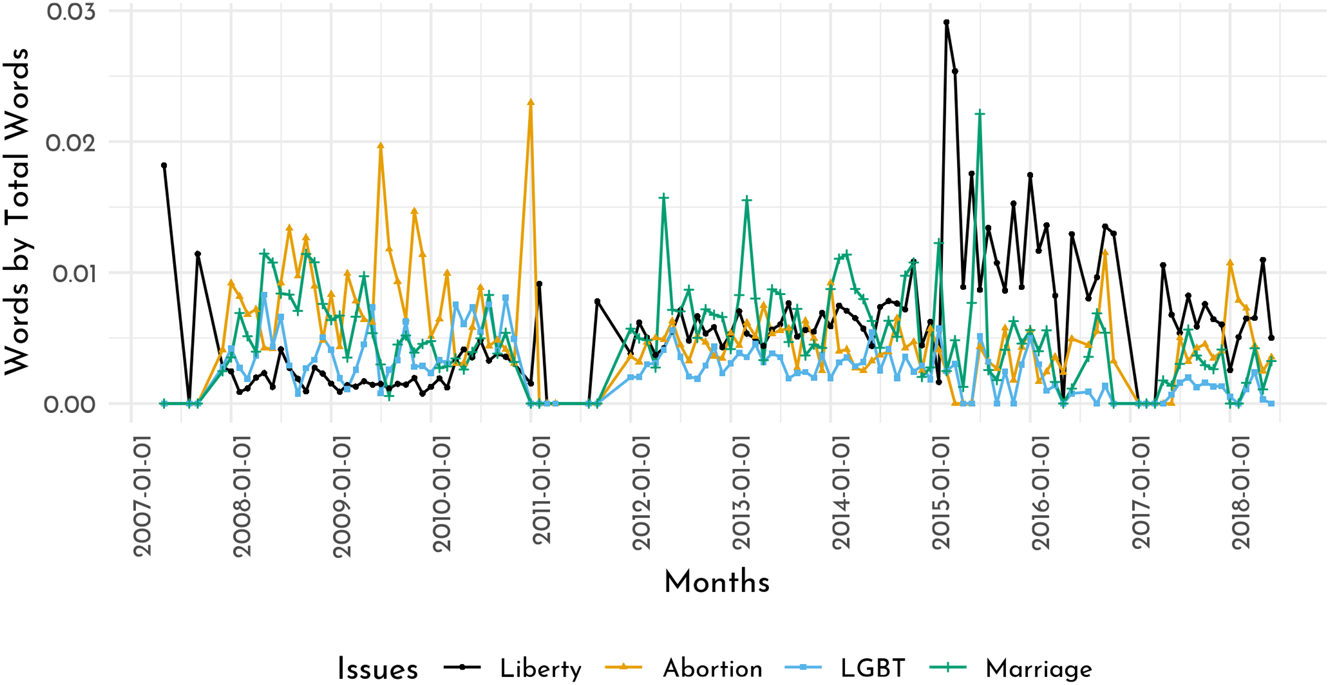
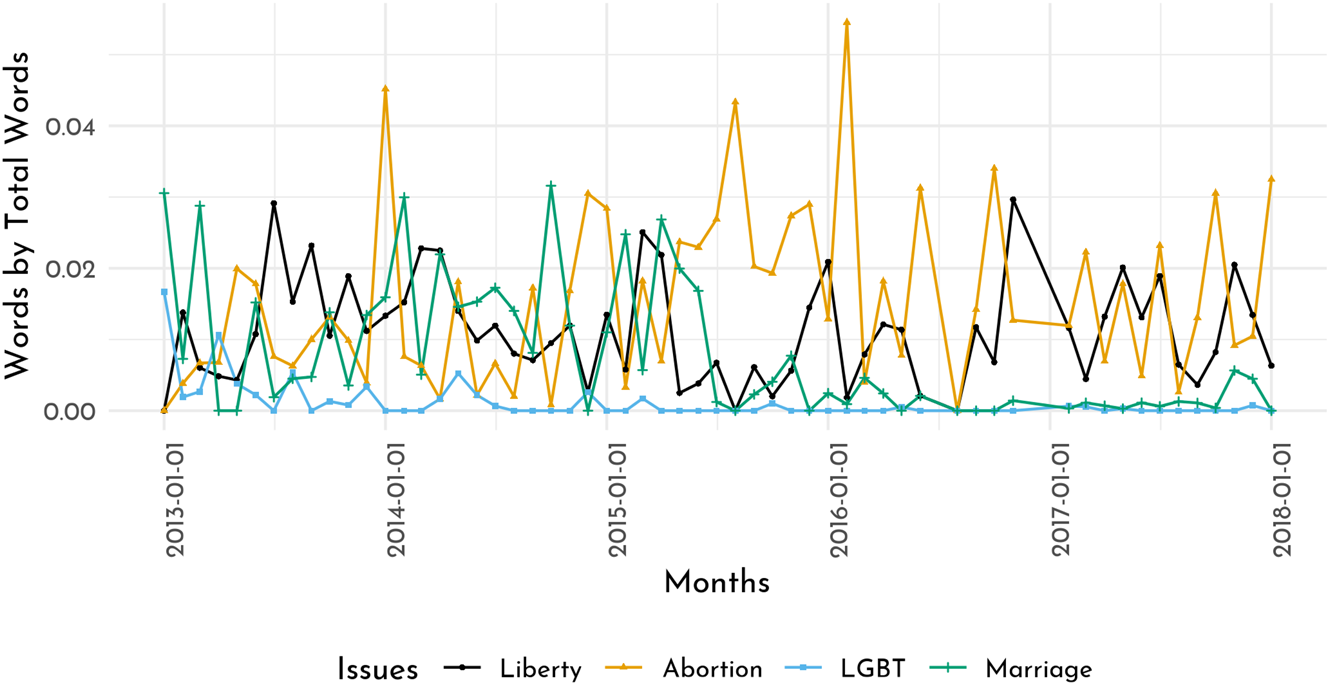
In this section, we consider the frequency of the appearance in the two major communication channels of four themes: abortion, homosexuality, marriage, and liberty. The data demonstrates the responsiveness of internal messaging. In describing the ebb and flow of each theme, we note the correspondence of the political environment with particular spikes in the themes. It is not clear if the FRC deployment of these themes at particular times is proactive or reactive, simply that the themes in emails correlate with events in the wider political environment. Figure 1 shows the distribution of issue communication in emails across time, while Figure 2 shows the press release data. We have three alternate views available in the Appendix—email communication highlighting one issue at a time appears in Figures A5, Figure A6 shows press release communication with one issue highlighted, and Figure A7 shows email and press release communication by issue over time.
(Color online) Core Issue Agenda Email Communication by Month, 2007–2018

(Color online) Core Issue Agenda Press Release Communication by Month, 2013–2018

Abortion
Abortion is arguably the leading issue that motivates Christian Right voters, and at least underlies CR agenda activity (Lewis Reference Lewis2017). The FRC represents the long tradition of anti-abortion perspectives that have been affiliated with the Christian Right since a few years lag after the US Supreme Court decision in Roe v. Wade (1973). Figure 1 tracks the number of times abortion-related terms (described above) appear in emails by month.Footnote 5 Given the centrality of abortion to the FRC, one might assume that this issue would have a regular appearance in emails. However, the frequency of abortion rhetoric is sporadic, though never missing. In the years 2008–2011, there are months in which abortion tops the agenda. These spikes map onto the wider political context, indicating that abortion appears more frequently at times of either U.S. presidential or mid-term Congressional elections. The only other clear spike during this period is during mid-2009 when Congress and society debated Obamacare.
Interestingly, abortion appears less frequently in emails directed to constituents during Obama's second term in office (2012–2016). However, by 2016, general election abortion reappears in significant concentrations. The most recent spike in the abortion rhetoric is in early 2018. This seems to reflect the events marking 45 years since the Roe v. Wade decision on January 22, 1973. For example, FRC emails around this time promoted “Sanctity of Life Sunday” on January 21, supplying local congregations with bulletin inserts explaining their biblical theology on the issue and encouraging individuals to pray, “affirm President Trump for appointing pro-life justices,” “contact your representative and senators,” “educate yourself on pro-life arguments,” and “support a pregnancy care center in your area.”
Given its centrality to the FRC organizational aims, one might expect to see abortion rhetoric appear more consistently in constituent emails. However, the spikes appear at times of potential loss—elections and pending policy change. This may indicate that abortion rhetoric fits a script that should be particularly useful for maintaining support through emphasizing the fear of loss and minority status that demands action.
Figure 2 shows abortion's place on the external, press release agenda and presents what appears to be a quite different story. While it does not cover the same extensive time period as the emails, the press releases show a spike at the beginning of each year (the Roe anniversary), but then much more intense focus on abortion in the last several years. As marriage drops off their external agenda after Obergefell v. Hodges (June 26, 2015), abortion rose to take its place as the dominant concern to external audiences through press releases.Footnote 6 It is notable that this is also a time period when the pro-life movement achieved considerable success in state legislatures rolling back funding and access to abortion facilities (e.g., Nash et al. Reference Nash, Gold, Mohammed, Ansari-Thomas and Cappello2018). In other words, the focus on abortion could also signal power and majority status.
Homosexuality
Another issue associated with the Christian Right is the belief that homosexuality is a sin and that public policy should not incentivize homosexuality by providing equal (often called “special”) rights. From Anita Bryant through the AIDS Crisis and to the legal recognition of same-sex marriage, social conservatives have maintained that homosexuality is against the Bible and against nature. As advocates of complementarianism (men and women have different, complementary roles), FRC is clear that it believes homosexuality is unnatural, will lead to a significant change in American culture, and perhaps threaten the health and well-being of heterosexual Christians. In Figure 1, we track the usage of the words homosexual, homosexuality, gay, lesbian, bisexual, transgender, and transsexual. Again, the apparent centrality of this issue might lead to an assumption that it would make a regular appearance in internal emails.
We find that between 2008 and 2011 LBGT rhetoric factors into the internal messaging less than abortion rhetoric. The spikes in 2008 map onto the wider political discussions around California's Proposition 8 which sought to establish a state constitutional amendment defining marriage as between a man and woman only. Once the ballot initiative passed, the mentions are dialed back. Like abortion, the spike in 2009 seems to map onto the debate over Obamacare. It is noticeable that at the beginning of 2010, the rhetoric begins to increase. There were two key events during this time. First, in February, FRC was active in lobbying against the House of Representatives' condemnation of the Ugandan Anti-Homosexuality Bill (HRes. 1064). Second, on April 14, Obama signed an executive order changing DHHS rules to allow hospital visitation and decision-making rights for gay and lesbian partners. Of course, 2010 was also the mid-term elections, so these combined factors seem to indicate that during that year, FRC believed it was politically strategic to educate, interpret, and motivate constituents on this issue.
Setting aside 2011 (due to low n), the LGBT rhetoric appears significantly less from 2012 onwards. Two related external factors worth noting might have had an impact on this shift in rhetoric. First, the dominant reason why the FRC mentions homosexuality is in the context of same-sex marriage (see Figure A8)—the two trends track closely. Therefore, once Obergefell was decided, mentions of LGBT specifically dwindle to nearly non-existent.Footnote 7
Second, research demonstrated that from 2000 onwards, there was a significant change in attitudes overall in the United States toward lesbians and gay men. For example, fewer Americans had negative attitudes toward gay men and lesbians raising children (Drake Reference Drake2013a); there was more support for gay marriage (Pew 2013); there was more social acceptance of gay men and lesbians (Drake Reference Drake2013b); and by 2011, around 60% of Millennials favored gay marriage (Pew 2011). Specifically, evidence suggests that evangelical young people appear to disagree with anti-homosexuality rhetoric (Putnam and Campbell Reference Putnam and Campbell2010; Farrell Reference Farrell2011; Cooper et al. Reference Cooper, Cox, Lienesch and Jones2016) and are more likely to believe homosexuality should be accepted by society (Diamant and Alper Reference Diamant and Alper2017). The dialing back of identity-specific rhetoric may indicate market awareness and a recognition that identity-specific language resonated less with constituents, particularly younger constituents.Footnote 8
There is some evidence to suggest that these larger social changes have had an impact on Christian Right organizations. In 2011, reparative therapy programs also came to the attention of the wider public through controversial stories about a clinic owned by then presidential candidate Michelle Bachmann's husband, Marcus. In 2012, a key organization of the Christian Right, Exodus International encountered various difficulties and eventually closed in 2013. These events suggest that changing social attitudes did affect some Christian Right organizations. Therefore, it is possible that FRC emails reflect a broader strategic shift away from some forms of identity-specific rhetoric.
Marriage
Figure 1 also tracks the usage of the terms “marriage” and “same-sex marriage.” Between 2008 and 2018, marriage appears far more often than LGBT identity-specific terms and is more akin to the usage of the word abortion in its frequent appearance in emails. As noted above, the 2008 spikes map onto three significant events: in May, the California Supreme Court struck down the ban on same-sex marriages with weddings beginning in June; in July, the U.S. Court of Appeals upheld the “Don't Ask, Don't Tell” policy banning gay men and lesbians from serving openly in the U.S. military; and in November, the presidential election was held during which Republican candidate McCain endorsed a state's right to define marriage as between a man and a woman. The early spike in 2009 reflects a number of state-level policy and legal changes allowing for same-sex marriage—e.g., in AZ, HI, CO, VT, NH, IA, ME, and NY all taking place between February and April. Whereas political discourse in 2008 and early 2009 was centered around “marriage,” after the 2008 election, the rhetoric appears to be dialed back until the mid-term elections.
From 2012 through 2014, marriage rhetoric becomes a much more prominent feature of FRC's internal communication. Marriage and same-sex marriage are deployed more than abortion or identity-based LGBT language. In February 2012, the U.S. Court of Appeals for the Ninth Circuit rules California's Proposition 8 unconstitutional. On May 9, President Obama announced that he believed same-sex couples should be allowed to marry and endorsed civil rights for gay men and lesbians. This corresponds with a significant rise in mentions of marriage in FRC emails. Later in the year, marriage stays on their political radar, though at a lower volume, with ME, WA, and MD becoming the first states to legalize same-sex marriage by popular vote.
In early 2013, the decision by the Pentagon to extend some marriage benefits to same-sex couples maps onto a similarly noticeable rise in FRC marriage rhetoric. In May, RI, DE, and MN all legalize same-sex marriage. Then early in the summer, the U.S. Supreme Court finds parts of DOMA unconstitutional followed by dismissing an appeal regarding Proposition 8. All of this serves to keep marriage central to political discourse.
Marriage rhetoric spikes again in January 2014 as the U.S. Supreme Court halts gay marriages in UT during a state appeals process, only to be followed by the U.S. Supreme Court declining to hear five same-sex marriage appeals in November, which served to allow same-sex marriages to go ahead in five states. The largest spike in marriage rhetoric surrounds the U.S. Supreme Court Obergefell v. Hodges decision in June 2015. Beyond that time, marriage rhetoric plays less of a role in FRC email rhetoric. We are not suggesting that FRC has accepted same-sex marriage; however, the political environment had shifted and they retreated to focus on the fight for exclusions from rights compliance (as in Masterpiece).
Much of the same analysis can be applied to the press release distribution of marriage rhetoric (see Figure 2). Marriage is quite prominent before mid-2015 (Obergefell) and then drops off almost completely thereafter, with only a few aftershocks. It is also much clearer in the press releases that marriage and abortion do not often occupy the FRC's external communication agenda at the same time. That is confirmed in Figure A9, which shows a sharply negative relationship between their concentration in month-aggregated press releases—when one is present, the other is not.
Liberty
Our analysis of the liberty theme includes references to “liberty” and “freedom.” In 2008, some FRC emails had a banner line of “Life, Family, & Liberty.” Therefore, as a core organizational value, it is unsurprising that “liberty” appears regularly, as Figure 1 indicates. However, the theme does not register significantly in emails from 2008 through 2010, though from 2012 until late 2014 “liberty” makes a modest but steady climb with a small spike in the autumn of 2014.
Two events occurred in 2012 that altered the political landscape. In CO, Masterpiece Cakeshop refused on religious grounds to bake a wedding cake for a gay couple. In OK, in response to the requirement of Obamacare that employees are offered a range of contraceptive options, the owners of Hobby Lobby refused on religious grounds to offer the morning after pill as an option in their employee healthcare plan. FRC was actively supportive of both cases starting with emails about the bakery in July 2012 and the Hobby Lobby lawsuit later in November. FRC also wrote amicus briefs for both cases. Over the next few years, both cases moved in and out of public discourse with the Hobby Lobby case decided by the U.S. Supreme Court in 2014 and the bakery case in 2018. Both cases upheld the conservative Christian cause on grounds of religious liberty, though Masterpiece was narrowly decided.
In October 2014, Houston mayor Annise Parker issued a subpoena for sermons believed to violate the city's equal rights ordinance. While that case was dropped in early 2015, the spike in November 2014 coincides with an FRC book launch, The Liberty Threat, written by James Tonkowich that cited the Houston case. Of course, both issues were highlighted around the time of the midterm elections.
In early 2015, the rhetoric changes significantly. Throughout 2015 and 2016, liberty spikes far more than any other theme we consider. In Figure 1, liberty is comparatively the most repeated theme, outscoring abortion, homosexuality, and, other than around the Obergefell decision, marriage. The employ of liberty at the start of 2015 signals a new fight they had begun with Masterpiece and would continue after Obergefell: fighting to limit the application of rights observance to conservative Christians. Many of the emails connect issues of liberty with homosexuality: “the rampant LGBT agenda is a direct assault on our right to freedom of religion” (March 16, 2015). Policies supporting transgender citizens are of particular concern around this time, too.
But “liberty” also continued to be tied to traditional topics of school choice, prayer in school, and a fire fighter who was allegedly fired from his job due to a self-published Bible study booklet. April 2015 sees an increase in the number of emails citing religious liberty, all soliciting donations toward a “Free to Believe” matching grant. Specifically, FRC had a goal of raising $150k by the end of April. Once Trump is elected in 2016, liberty remains a key theme but is more in line with the others.
It is clear that liberty rises and falls as the status of the Christian Right shifts. The most dramatic inflection point is the Obergefell decision where the movement moves from majoritarian to the minority position seeking rights protections. From some perspectives, this follows the long slide toward minority status embodied in abortion politics (Lewis Reference Lewis2017). But it is not static and the FRC is less compelled to use protectionist “liberty” language after Trump is elected.
Liberty does appear in the press releases (Figure 2), but its status relative to abortion is inverted compared to the email pattern—compared to abortion, liberty is much less frequently invoked in press releases. In fact, liberty goes on hiatus in the press releases immediately after the Obergefell decision. Liberty returns to steady usage from late 2015 onward, but its prevalence decouples from marriage, which is now infrequently used. This indicates that religious liberty is not simply a reframing of marriage concerns, but a new agenda item. While liberty and freedom are powerful symbolic terms that have a deep resonance with Americans (e.g., Jelen Reference Jelen2005), they are not indicators of majoritarianism and power.
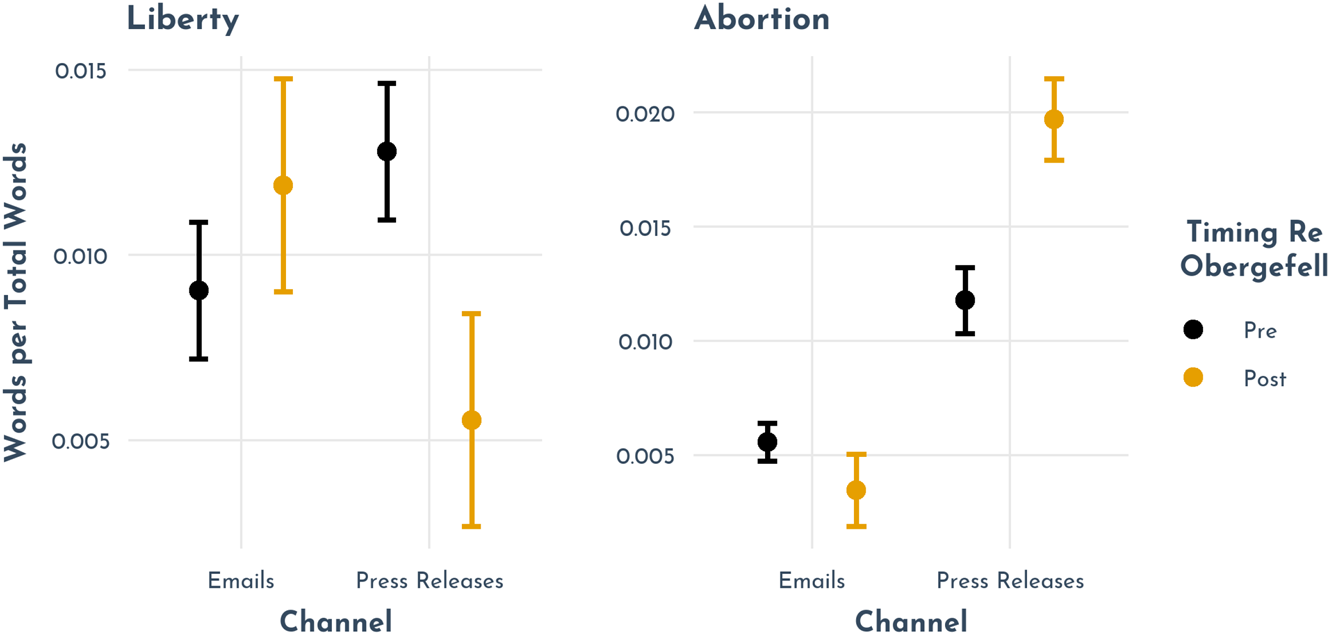
Across the post-Obergefell period, the email concentration on liberty seems to enable FRC to position themselves to their followers as a threatened minority in need of protection, which resonated with the rising populist, anti-federal government narrative of the 2016 elections. To confirm that the language did indeed shift, Figure 3 shows the results of regression models interacting the communication channel and whether the monthly concentration of rhetoric on each theme came before or after the Obergefell decision in June 2015. In the pre-Obergefell era, the press releases featured a higher concentration of liberty rhetoric, while it was significantly less common in the post-Obergefell period (if two lines do not overlap, it is statistically significant at the 90% level). The abortion gap was already present in the pre-period, but grows substantially in the post-period; an abortion focus is even less likely in the emails and more likely in the press releases.
(Color online) How Liberty and Abortion Rhetoric Presence Shifted from Pre to Post Obergefell

THE LINK BETWEEN INTERNAL AND EXTERNAL COMMUNICATION
As discussed earlier, messaging must be flexible to serve many masters, but existing work suggests, in parallel with our first hypothesis, that interest groups will coordinate their communication channels. Interest groups are forced to adopt frames that will appeal to legislators but not offend members (e.g., Beyers Reference Beyers2004; Trapp and Laursen Reference Trapp and Laursen2017). Organized interests employ “all directional advocacy” (Browne Reference Browne, Cigler and Loomis1998), focusing their communicative efforts wherever they will bear fruit. When groups are not able to successfully establish and negotiate insider connections, they take their case to members and to the public (e.g., Schattschneider Reference Schattschneider1960; Kollman Reference Kollman1998; Dür and Mateo Reference Dür and Mateo2013).
But, there are good reasons why communication to different audiences may not correlate. One possibility is simply that different divisions within large organizations handle different communication channels and an organization's message drifts.Footnote 9 In this particular case, FRC indicated that they have separate teams writing emails and press releases, but they coordinate efforts. Our approach focuses on the needs of different audiences—managing access to legislators may not mesh with the needs of managing the membership. Access is granted on the basis of power and agreement, whereas the membership may be motivated by minority status and disagreement with society and current policy directions. The importance attached to issues may differ and the language profile of successful arguments may differ. That is, members may more successfully mobilize on the pain of loss, coupled with doing the Lord's work in the case of religious organizations, rather than gain. On the other hand, legislators are more likely to respond to powerful, successful groups making majoritarian arguments. This is our second hypothesis—that agendas in different channels will not correlate and the pattern in each will follow the needs of advocating with that audience.
One way to gain leverage on the needs of the audience is to examine the focus on issues as the political environment changes. The logics of managing internal and external communications may be motivated by organizational elites recognizing a shift from a majority to minority status on an issue. For example, above we noted the great shift in FRC rhetoric around the Obergefell decision. The judicial and social acceptance of same-sex marriage clearly repositioned FRC in the minority. Given the extent of the threat posed and loss of majority status, one might expect FRC's communication around this issue to align in frequency between the emails and press releases. Alternatively, abortion politics has not changed greatly since the 1970s. Opinion distributions have been stable (e.g., Saad Reference Saad2017) and while legislatures continue to churn out restrictive policies, federal courts have consistently rejected the most restrictive ones. As the press release data suggest, abortion is credible material for the FRC to address, it signals their efficacy, and it may be flexible enough to allow the internal and external communication streams to be independent.
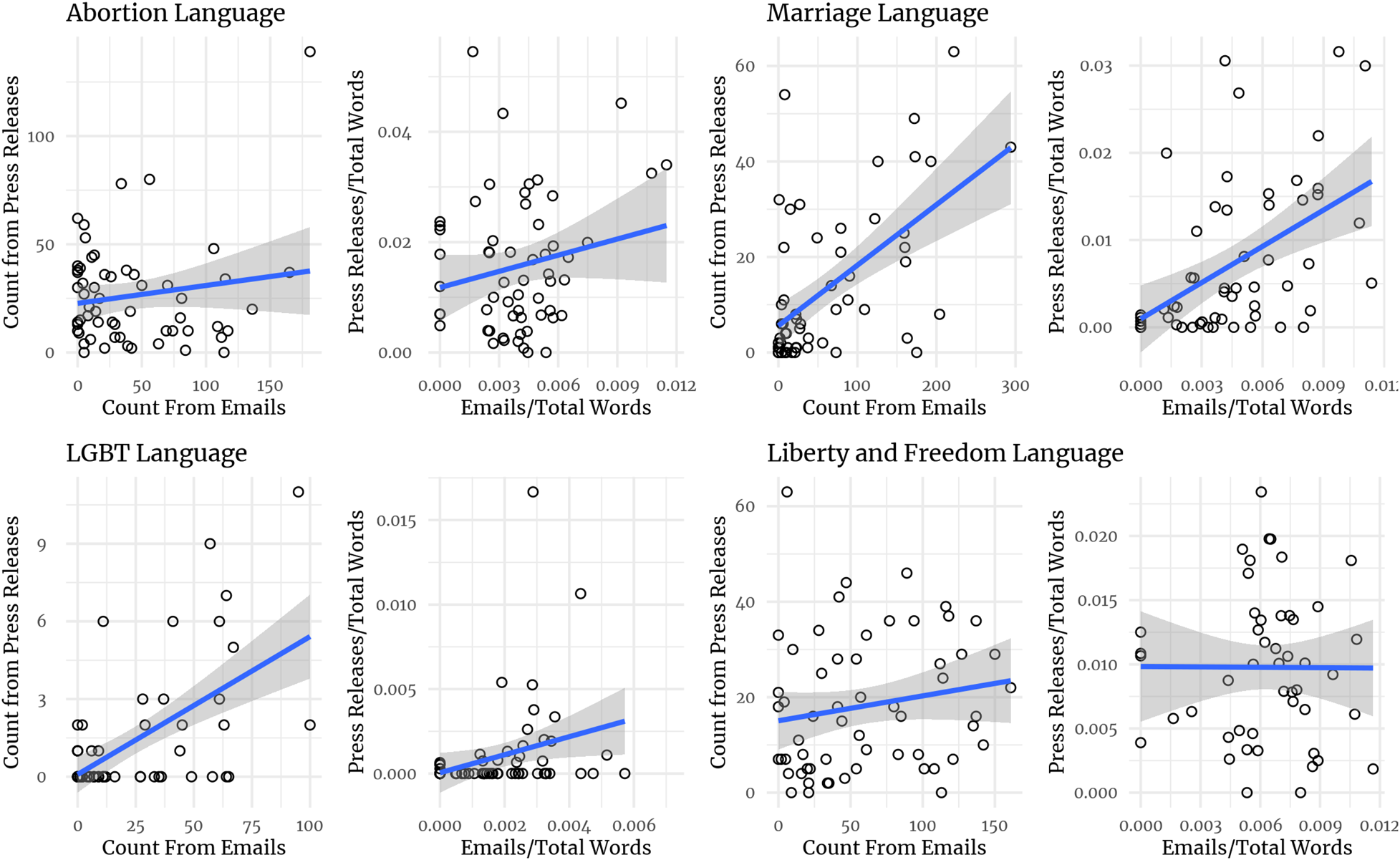
Figure 4 tests just that. It displays the link in monthly concentrations of communication between emails and press releases for the four core issues captured in two flavors—the raw counts of terms and the relative counts (per the total word count that month). Abortion communication from emails and press releases is not significantly correlated (r = 0.16, p = 0.23); neither is the relative content significantly correlated. Strikingly, the communication in emails and press releases about liberty and freedom is not significantly correlated either (r = 0.17, p = 0.20), while the relative counts are almost completely independent (r = 0.01, p = 0.95). We have already seen that the liberty language came to dominate email communication after Obergefell, but it did not feature nearly as prominently in press releases and was quite variable in concentration. These distinct patterns are reflected dramatically in Figure 4.
(Color online) The Link Between Internal (Email) and External (Press Release) Agendas Across Core Issues

The use of LGBT language is significantly linked between the two communication channels, but the counts are so low in the press releases that the link is not particularly meaningful. Surely this pattern is part of the much more extensive campaign of discussing marriage. Seen in the upper right corner of Figure 4, the marriage counts (and relative counts) are strongly correlated between monthly emails and press releases (r = 0.58, p < 0.01 for the raw counts).
Even in the cases of issues that host correlations between the communication channels, it is important to point out how divergent some months are. Focusing on the case of marriage, there is a month with nearly 60 mentions of the word marriage in press releases and zero mentions in their emails; on the flip side, there is a month with just shy of 200 mentions of marriage in email communication and zero mentions in the press releases. These months are not common, obviously, but they do exist and serve to highlight just how flexible the FRC is in its communication programming across channels.
To the extent that previous work has contemplated this question, it suggests that frames are strategically chosen for wide appeal and that their influence hinges on connecting supporters with policymakers to move or halt existing legislation. The disjuncture with the literature could not be greater since our evidence aggregates frames up to the agenda-level. Therefore, in many cases, the state of the political world as read by FRC supporters is considerably different than what the FRC is suggesting to its press release constituency, not just in framing, but in terms of what issues are important at a particular time. These indications of flexibility of messaging across channels undoubtedly reflect sophisticated, strategic communications, but the dissonance also raises questions about representation. Below, we explore this further by assessing what bills lobbied on by FRC are noted as important in emails to FRC supporters.
COMMUNICATIVE LINKS TO LOBBYING
It would be ideal to validate the lack of connection between communication channels with other data. Fortunately, we have another source to examine—the degree to which email subscribers are informed about FRC lobbying. The literature is not united on this point, but the primary assumption is that insider influence depends on a tight feedback loop where groups mobilize members (in the case of membership groups) to communicate their position back to legislators (e.g., Ainsworth and Sened Reference Ainsworth and Sened1993; Lowery and Marchetti Reference Lowery and Marchetti2012). But, since groups tend to lobby allies (Hall and Wayman Reference Hall and Wayman1990; Hojnacki and Kimball Reference Hojnacki and Kimball1998; Baumgartner and Leech Reference Baumgartner and Leech1998) and friendly committees (Holyoke Reference Holyoke2003), member mobilization is not immediately necessary in most cases—allied policymakers know the organization and do not need a thousand postcards to sponsor legislation. This is especially true when groups have a presence in a member of Congress's (MOC) district or state (Langbein and Lotwis Reference Langbein and Lotwis1990; Hojnacki and Kimball Reference Hojnacki and Kimball1998; Reference Hojnacki and Kimball2001). Perhaps only in cases where organized interests need to coordinate MOCs and group members will they talk explicitly about their lobbying efforts to member/supporters. Put differently, we think it unlikely that organizations inform their membership about every legislative effort, but one might assume requirements of representation would lead to identifiable issue resonance across channels.
We searched emails for bills on which the FRC reported lobbying. The bills with the most mentions are presented in Figure A10 and the Employment Non-Discrimination Act (ENDA) tops the chart with 83 mentions, perhaps because it has been “introduced in every Congress since 1994 except the 109th” (Wikipedia 2018). Clearly, the FRC considers establishing the right to non-discrimination based on sexual orientation as a deep and persistent threat. Most of the remainder of the top bills mentioned deal with abortion and contraception.
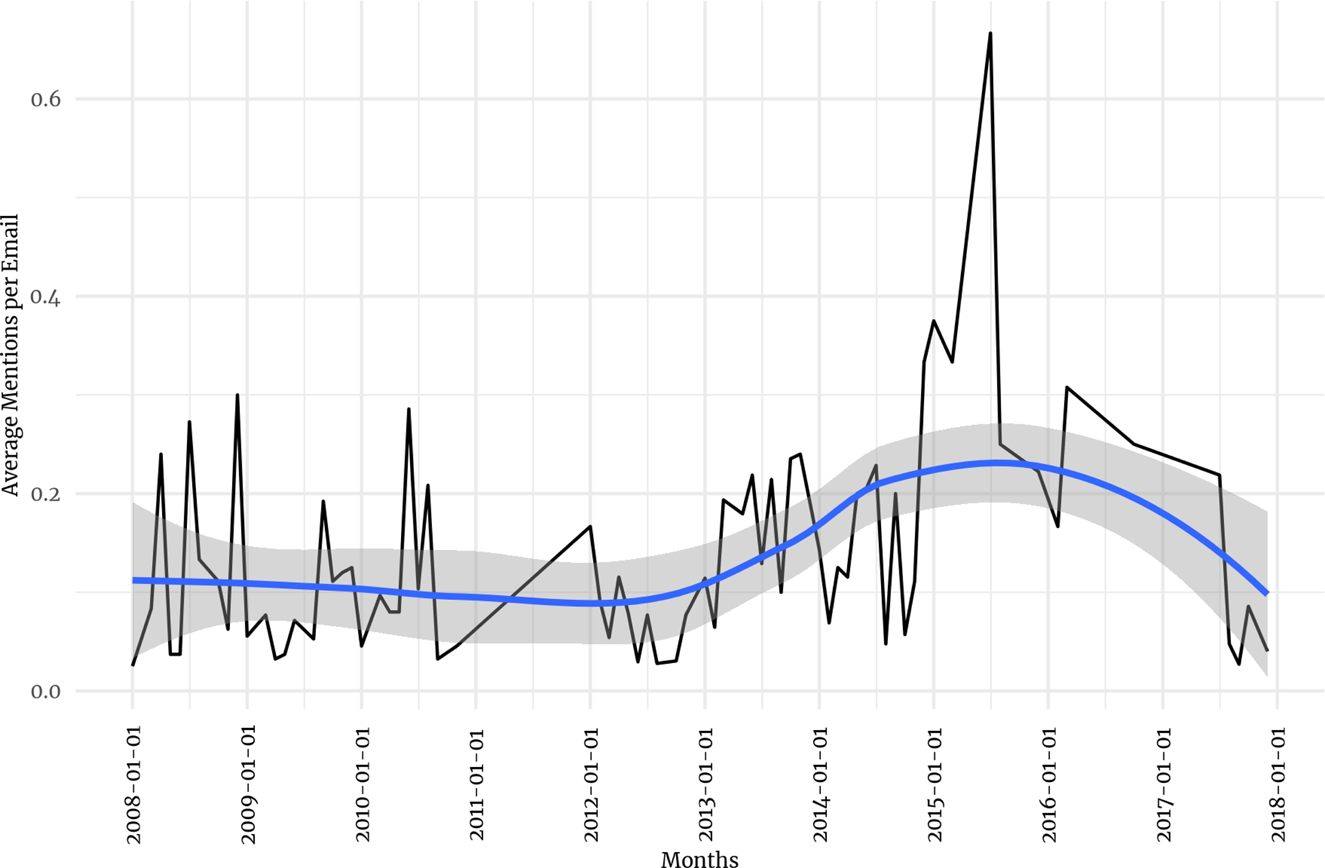
Figure 5 highlights the variation in bill mentions over time. On average, it is not likely that an email to members includes a reference to a bill. The average (0.144 overall) hovers around 0.114 per email through 2013 and then jumps up thereafter to 0.202 per email; on average, 3.1 bills were mentioned each month. There were 234 total bill mentions in the emails, though it is important to note that only 48 bills (of the 288 searched) were mentioned by name at least once in the emails (about 17% of bills).Footnote 10
(Color online) Relative Mentions of FRC-Lobbied Bills in Emails to Members

Of course, this could be a limitation of our inflexible search method that requires the bill's name be mentioned. “ENDA,” for instance, would not be counted by this method. FRC could also talk generally about their efforts to stop employment provisions that would impede Christian religious freedom (to discriminate), but that would not be picked up either. So, this is an admittedly conservative estimate of how much they communicate their lobbying activity. But it is also a useful one since contacting MOCs about an issue would be facilitated by the mention of bill titles.
Putting those objections aside for the moment, the FRC communicates very little about its lobbying activity by this measure. The mentions are sporadic, they are concentrated around a few time periods, and they are focused on a few handfuls of bills. For example, the significant spike in early 2015 reflects the mentions of only four bills: two around abortion and two around religious freedom. The spike in July 2015, just after the Obergefell decision, reflects the mentions of only three bills: one around abortion and two around religious freedom. Once Trump is elected, there is very little mention of legislation lobbied in emails. It is hard to say just how this meshes with expectations since there is no research that provides estimates of the proportions of groups' agendas that are communicated to the public. But, the low level of coordination between the two channels of communication does appear to reinforce the notion that FRC is actively lobbying on a range of legislation that is not mentioned to FRC supporters. This evidence suggests, at the least, a failure of the feedback loop between group leaders and supporters and, potentially, could be taken as an indication of a lack of representational mandate. It does not appear that FRC is lobbying outside of its self-defined mandate, but it is impossible to evaluate the team if there's no public record of wins and losses.
CONCLUSION
The evidence here focuses on the way in which flexibility of messaging, which enables FRC to respond to political events and to target particular audiences through various channels, may raise questions about representation. In doing so, we first consider whether communication channels are coordinated or constrained by the messaging in the other. We acknowledge that organized interests must maintain multiple communication channels simultaneously, and argue that each has its own demand structure. For example, messaging with supporters must demonstrate the possibility and pain of loss, while press releases may focus on articulating the power of the group to incentivize government officials' support. The agendas presented internally and externally can vary significantly to the extent that issues overlap with these status concerns. Nowhere is this seen more clearly than in the agendas represented in the two main communication channels post Obergefell. Email subscribers hear rarely about abortion and often about liberty in this time period, while press release audiences hear extensively about abortion and far less about liberty. We suggest this evidence supports hypothesis 2—communicated agendas will conform to the separate needs of channel audiences.
Secondly, our findings demonstrate independence of interest group communication across channels: flexible in their rhetoric as they adapt to shifting political events, they tailor messages between in-group and external audiences, and often present different agendas to these audiences. Moreover, supporters are told quite selectively about FRC lobbying efforts. FRC exercises a great deal of control over their communications such that separate channels appear to operate independently. Our evidence calls into question the types and extent of constraints previously identified in the analysis of only external messages, especially the need for consistency across constituencies. Given the data resources available to researchers now to handle text, we are just beginning to investigate the critically important feedback loop within organized interests.
Our findings echo others in questioning assumptions that religious interest groups are somehow more constrained in their messaging. We know that, at least since the rise of the Christian Right, such groups have grown in political sophistication (e.g., Moen Reference Moen1994; Wilcox and Robinson Reference Wilcox and Robinson2010). What our findings add to this understanding is that religious interest groups are able to demonstrate a high level of strategic communication with independent, targeted messaging for particular audiences that closely tracks with developing events. This level of flexibility in messaging likely demonstrates strategically sophisticated and politically nuanced interest group engagement.
Importantly, our findings raise some troubling questions about a key democratic problem of organized interests—the disconnect between supporters (principals) and leadership (agents). We know that leaders exercise discretion in their communication with members and gain latitude in their political affairs from successful group maintenance, but we doubt many envisioned the empirical patterns presented in this paper. By examining internal alongside external messages, we can begin to see how flexibility can eventually raise questions about good faith representation. At its worst, organized interests may be playing a shell game with issue representation between members and elected officials. At its best, there are difficult time lags to resolve connecting members to elected officials, though this interpretation does little to help make sense of the orthogonal press release agenda patterns. Pursuing such a research agenda should help us understand disconnects between citizens and government and the associated questions surrounding political trust, engagement, and coalition formation.
Supplementary materials and methods
To view supplementary material for this article, please visit https://doi.org/10.1017/S1755048319000543