INTRODUCTION
Austrominius modestus (Darwin), formerly known as Elminius modestus, is an Australasian barnacle species. It was first recorded in the United Kingdom in 1945 in Chichester Harbour (Bishop, Reference Bishop1947), although it may have been present in Portsmouth since 1943 (Stubbings, Reference Stubbings1950). Its subsequent spread around the British Isles, as far north as Shetland has been well documented (e.g. Crisp, Reference Crisp1958; Crisp & Southward, Reference Crisp and Southward1959; Barnes & Barnes, Reference Barnes and Barnes1961; Barnes & Stone, Reference Barnes and Stone1972; Hiscock et al., Reference Hiscock, Hiscock and Baker1978; McGrath & King, Reference McGrath and King1992; O'Riordan, Reference O'Riordan, Keegan and O'Connor1996, Reference O'Riordan, Moriarty and Murray2002; King et al., Reference King, Keogh and McGrath1997). This species received much scientific interest in the years immediately subsequent to its establishment in the British Isles (e.g. Crisp & Davies, Reference Crisp and Davies1955), but then relatively little, until recent years, when significant increases in its abundance have been observed on a number of shores (see for example Lawson et al., Reference Lawson, Davenport and Whitaker2004; Simkanin et al., Reference Simkanin, Power, Myers, McGrath, Southward, Mieszkowska, Leaper and O'Riordan2005; Allen et al., Reference Allen, Power, O'Riordan, Myers and McGrath2006), including Lough Hyne Marine Nature Reserve, Co. Cork, Ireland. Of interest is that as an invasive species it has been present at low densities, but recently has shown a relatively sudden increase in abundance, while a native species has declined in abundance. These recent changes in relative abundance may be linked to climate change (cf. Occhipinti-Ambrogi & Savini, Reference Occhipinti-Ambrogi and Savini2003). Simkanin et al. (Reference Simkanin, Power, Myers, McGrath, Southward, Mieszkowska, Leaper and O'Riordan2005) suggested that this species may be a classic example of a successful invasive.
A single living specimen of A. modestus was recorded by Connell (Reference Connell1955) on the Isle of Cumbrae, Scotland, at Farland Point, where it must have settled during the previous summer or autumn (1954). After that initial discovery, despite searches, no further specimens were found on the island until two individuals were discovered in September 1959 at Keppel Point, 525 m north-east of Farland Point (Powell, Reference Powell1960), but the specimens were too far apart to allow cross-fertilization, which is obligatory in this species (Crisp, Reference Crisp1958). A recent examination of a number of shores showed the presence of A. modestus and, in the absence of published data on its current distribution and abundance on the isle, a preliminary semi-quantitative study was undertaken prior to embarking on more detailed quantitative ecological studies.
MATERIALS AND METHODS
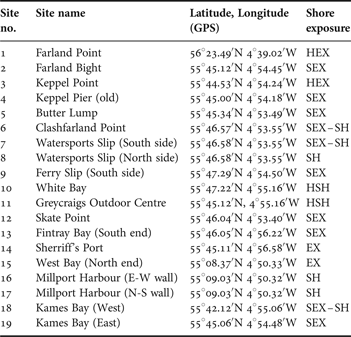
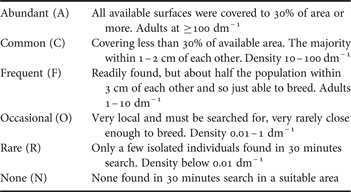
The abundance of Austrominius modestus was examined at nineteen sites (see Table 1) around the Isle of Cumbrae during low water on 6, 7 and 8 October 2007. These sites were chosen to encompass the full range of habitats around the island and included two sites where A. modestus had previously been recorded on the island. The location of each site was recorded using a Magellan eXplorist 300 Global Positioning System. Abundance of A. modestus was assessed at each site using a modification of the abundance scale described by Crisp (Reference Crisp1958) (see Table 2). In order to be able to compare sites, the maximal abundance of A. modestus at each site was used (c.f. Raffaelli & Hawkins, Reference Raffaelli and Hawkins1996). The presence of other species of barnacle was noted, but not categorized. The exposure at each site was subjectively categorized into highly exposed, exposed, semi-exposed, sheltered or highly sheltered, based on the shore aspect and fetch. Data on sunspot frequency and sea surface temperatures at Keppel Pier from 1954–2004 were obtained from the University Marine Biological Station at Millport.
Details of sites examined for Austrominius modestus, including other barnacles species observed. Site numbers are used on Figure 1.

HEX, highly exposed; EX, exposed; SEX, semi-exposed; SH, sheltered; and HSH, highly sheltered.
Scale for scoring abundance of Austrominius modestus, modified from Crisp (Reference Crisp1958).

RESULTS
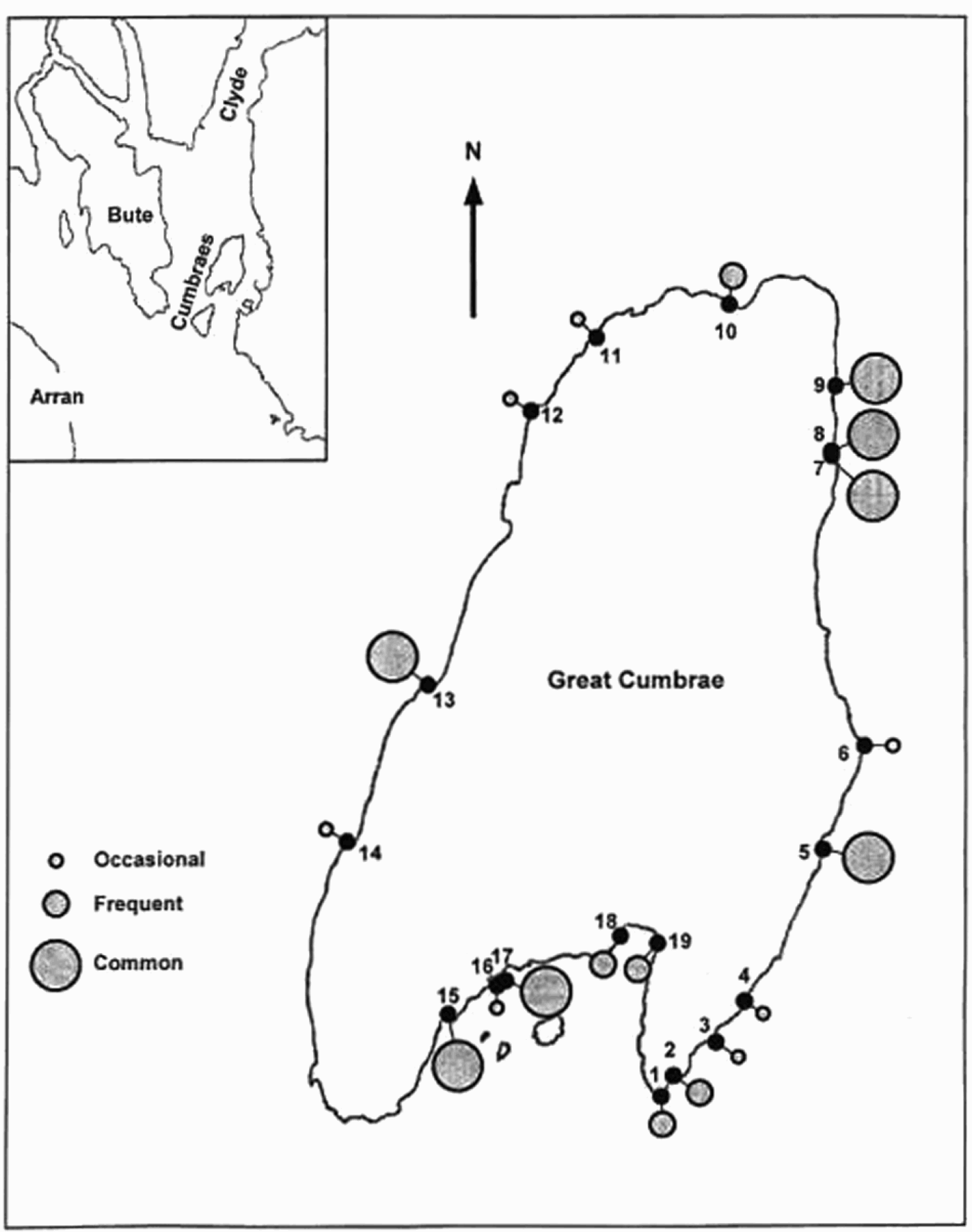
Austrominius modestus was found at all of the nineteen sites examined (see Table 1), which included highly exposed to highly sheltered sites. Its abundance varied from common to occasional (see Figure 1). It was found to be common at seven sites: Butter Lump, Watersports Slip (south side), Watersports Slip (north side), Ferry Slip (south side), Fintray Bay (south end), West Bay (north end) and Millport Harbour (north–south wall). At five sites (Farland Point, Farland Bight, White Bay, Kames Bay (west) and Kames Bay (east)) it was frequent. It was occasional at the remaining seven sites: Keppel Point, Keppel Pier (old), Clashfarland Point, Greycraigs Outdoor Centre, Skate Point, Sherriff's Port and Millport Harbour (east–west wall). The other barnacle species present were Semibalanus balanoides (Linnaeus), Chthamalus montagui Southward, as well as Balanus crenatus Bruguière being found at Butter Lump (see Table 1).

DISCUSSION
More than fifty years after its first recorded presence on the Isle of Cumbrae, Austrominius modestus is now well established, with densities ranging from 0.01–100 dm–1, although at no site was A. modestus found to be ‘abundant’. A number of factors may have contributed to A. modestus increase in abundance on the Isle of Cumbrae, including repeated supply of propagules from shipping as well as significant increases in summer and winter water temperatures over the last fifty years. When the on-going dataset for sunspot frequency and mean monthly sea surface temperatures at Keppel Pier over the fifty-year period from 1954–2004 (T.D.I. Stevenson, personal communication) is examined, it can be seen that the frequency of high summer temperatures has increased since the warm summer of 1959, with surface temperatures above 14°C occurring in a number of years in August/September since 1974 and increasing to 16°C in 2003 and 2004. High summer temperatures are in general sustained for longer periods now than in the 1950s; 14 + °C was only sustained for about 2 weeks in the mid-1950s, whereas in the early years of the present century it has been sustained for about 4 months. Winters have also become milder, particularly in the last decade when mean monthly temperatures have generally been around 7–8°C, versus 6–7°C in the 1950s.
Austrominius modestus is a eurythermal species, being able to tolerate higher temperatures than Semibalanus balanoides and lower temperatures than either Chthamalus montagui or Chthamalus stellatus (Poli), although breeding is most rapid at moderately high temperatures (Barnes & Barnes, Reference Barnes and Barnes1962). According to Harms (Reference Harms1984) the wide temperature range tolerated during larval development has contributed to A. modestus success. It had been suggested initially that low water temperatures in Scotland would restrict A. modestus spread northward and Barnes & Barnes (Reference Barnes and Barnes1960) noted that its abundance in the Clyde Sea area only increased considerably following the warm summer of 1959. Barnes & Barnes (Reference Barnes and Barnes1960) commented that temperatures of 15–20°C favour both growth and breeding of A. modestus (but it can breed as long as water temperature is greater than 6°C, which has been a year-round situation at Cumbrae since the mid-1990s), while high summer water temperatures have been recorded at Keppel Pier in 1973–1978, 1984–1985, 1988–1992 and 1994–2004, which have probably helped its establishment.
On the mainland, just opposite the south-east corner of the Isle of Cumbrae is the Hunterston nuclear power generating station that has complicated the thermal history of the Clyde since the Hunterston A station came on line in 1964. For hydrographic reasons it is likely that thermal enhancement around the Isle of Cumbrae is limited (<1°C) and confined to the eastern and southern shores. However, it is probable that mainland A. modestus (a potential source of propagules for the island) closer to the Hunterston thermal plumes have been subjected to a warmer environment for several decades. In Southampton water, close to Marchwood Power Station, Pannell et al. (Reference Pannell, Johnson and Raymont1962) reported that A. modestus showed an extended breeding period in artificially heated areas. However, O'Riordan & Murphy (Reference O'Riordan and Murphy2000) found that A. modestus living in proximity to the outfall pipe of a power station in southern Ireland showed significantly lower percentages of animals brooding embryos than at another site nearby. It would be interesting to examine A. modestus reproduction and recruitment throughout the year on both the Isle of Cumbrae and adjacent mainland.
Variations in A. modestus abundance amongst the nineteen sites examined on the Isle of Cumbrae may be due, for example, to the exposure of the shore to the prevailing winds, the presence of shipping and perhaps interspecific competition. In general, lowest abundances (‘occasional’) were recorded at the north-west and south-east sides of the island. At the two sites where a few individuals had previously been found (but at that time not close enough to reproduce), Farland Point (Connell, Reference Connell1955) and Keppel Point (Powell, Reference Powell1960), A. modestus is now frequent and occasional respectively. These two shores are some of the most exposed on the island. The highest densities (‘common’) were found at sites that are areas of boat traffic on the south and east sides of the island (e.g. Millport Harbour (north–south wall), the Ferry and Watersports Slips). The east side of the island in particular is sheltered by the mainland and has both small boat and ferry traffic in the Largs Channel. Crisp (Reference Crisp1958) suggested that A. modestus has spread in Europe by both marginal and remote dispersal. With respect to the latter mode, Barnes & Stone (Reference Barnes and Stone1972) had noted that fishing boats and pleasure craft may act as vectors for A. modestus within the Firth of Clyde. It should be noted that A. modestus was also found to be common at one site on the west coast, at the south end of Fintray Bay, which is a semi-exposed shore, but it is north-facing so out of the main prevailing south-westerly winds.
Salinity may also have been a factor in promoting A. modestus establishment, as it is markedly euryhaline by comparison with the native barnacles (Barnes & Barnes, Reference Barnes, Barnes and Barnes1966). The Clyde Sea area around the Isle of Cumbrae normally has a near-fully marine salinity (though see Thomason et al., Reference Thomason, Hills and Bennett1997). However, the bulk of the island's sedimentary rocks consist of highly porous sandstone that results in widespread localized seepage of freshwater into the intertidal zone. In addition, the Great Cumbrae Fault (which runs approximately from site 10 to site 19) delivers substantial quantities of freshwater into Kames Bay during periods of heavy rainfall.
Although A. modestus was found at all nineteen sites, Semibalanus balanoides appeared to be the dominant barnacle at all of them, with Chthamalus montagui confined to a fairly narrow band higher up on the shore, although the abundance of these two species was not quantified. In Connell's classic 1961 paper (Connell, Reference Connell1961), he noted that, at Millport, S. balanoides occupied almost the entire intertidal region, up to the region between M.H.W.N and M.H.W.S. where C. montagui occurred. More recently, Hansson et al. (Reference Hansson, Hudson, Seddon, Shaw and Thomason2003) reported massive recruitment of Semibalanus balanoides in the Clyde Sea in the spring of 2000, including at seven sites on the Isle of Cumbrae. Having established the widespread distribution of A. modestus around the isle, the authors intend now to carry out a detailed quantitative survey examining the zonation and abundance of A. modestus in relation to other barnacle species at these sites on the Isle of Cumbrae, as well as monitoring its spread and any changes in abundance over the next few years.
ACKNOWLEDGEMENT
The authors thank Mr Tom Stevenson (who curates data on sunspot frequency and sea surface temperatures at Keppel Pier for the University Marine Biological Station Millport) for the supply of environmental information.