


Significant outcomes
-
∙ This study demonstrates that the G72 protein levels are significantly increased in patients with schizophrenia.
-
∙ A receiver operating characteristics analysis of the obtained data indicated a cut-off value for the G72 protein levels in patients with schizophrenia.
Limitations
-
∙ The measurement of G72 levels, but not the d-amino acid oxidase enzyme level, oxidative stress parameters or d-serine level weaken the confirmation of the hypothesis.
Introduction
Schizophrenia is a debilitating mental disorder associated with characteristic psychotic symptoms and neurocognitive deficits. As the description of schizophrenia, there have been many hypotheses that have aimed to explain the aetiology of the disease (Reference Insel1). The most accepted hypothesis regarding the aetiology of schizophrenia is based on dopaminergic dysregulation (Reference Arnsten, Wang and Paspalas2). However, it is well established that glutamatergic and serotonergic brain circuits have significant roles in the development and symptomatology of schizophrenia (Reference Javitt3). The treatment of schizophrenia is based on dopaminergic and serotonergic systems; however, efforts have aimed to include alternative treatment options associated with the glutamatergic system (Reference Ellaithy, Younkin, González-Maeso and Logothetis4).
Biomarkers have an important role in supporting the validities and reliabilities of psychiatric disorder diagnoses. Numerous studies in the literature have investigated potential biomarkers of schizophrenia. However, no biomarker that is pathognomonic for schizophrenia has been identified (Reference Razafsha, Khaku, Azari, Alawieh, Behforuzi and Fadlallah5). The d-amino acid oxidase (DAAO) and G72 genes have recently gained attention because of their association with schizophrenia, as well as their potential role in glutamatergic neurotransmission (Reference Boks, Rietkerk and Van DE Beek6). The product of the G72 gene is also referred to as d-amino acid oxidase activator (DAOA) because it acts as an activator of DAAO. DAAO and its activator DAOA have important roles in the metabolism of d-amino acids (Reference Chumakov, Blumenfeld, Guerassimenko, Cavarec, Palicio and Abderrahim7). d-amino acids have roles in neurotransmission. For example, d-serine is a co-agonist of the glutamate receptor [especially the N-methyl-d-aspartate (NMDA) receptor], and it has been suggested to play a role in the pathogenesis of schizophrenia (Reference Labrie, Wong and Roder8). Recent studies have demonstrated that glutamate dysfunction is associated with schizophrenia symptoms (Reference Laruelle9).
In addition to the conventional definition of the role of the G72 protein, in which a decreased d-serine level via DAAO activation has been described, Kvajo et al. (Reference Kvajo, Dhilla, Swor, Karayiorgou and Gogos10) reported that there was no interaction between pLG72 and DAAO, and they first identified the pLG72 location in the mitochondria. The results of Kvajo et al. raised the hypothesis that pLG72 may lead to mitochondrial dysfunction and fragmentation. Moreover, Sachchi et al. (Reference Sacchi, Bernascon and Martineau11) reported that pLG72 inhibited DAAO activity. Recently, Wang et al. (Reference Wang, Chen, Zhang, Li, XİE and Chang12) investigated the role of pLG72 in oxidative stress and concluded that pLG72 may represent an aetiological factor in neurological and psychiatric disorders via the enhancement of mitochondrial reactive oxygen species (ROS).
In addition to genetic studies that have investigated DAAO and G72 gene expression, only one study has compared the G72 protein levels in peripheral blood between patients with medicated schizophrenia and healthy controls (HC) and patients with drug-free schizophrenia and HC (Reference Lin, Chang and Chen13). In this study, Lin et al. reported that both schizophrenia groups had significantly increased plasma G72 protein levels compared with the HC. In the present study, we aimed to compare the serum G72 protein levels between patients with schizophrenia and HC, as well as to retest the results of the previous pilot study.
Materials and methods
Subjects
The present study was conducted in the Department of Psychiatry at Yenimahalle Education and Research Hospital between June 2015 and December 2015. Patients who were diagnosed with schizophrenia according to the Diagnostic and statistical manual of mental disorders 5th edition (14) were included in the study. The diagnosis was made by a senior psychiatrist (E.S.A.). The inclusion criteria were as follows: diagnosed with schizophrenia, between the ages of 18 and 60, adherent to the treatment, in a stable phase of the disorder and willing to participate in the study. The exclusion criteria were determined as follows: diagnosis of a chronic medical condition, such as cardiovascular disease or autoimmune disease, younger than 18 years old or older than 60 years old, presence of a co-morbid psychiatric diagnosis, in an acute psychotic state, non-adherence to treatment and unwilling to participate in the study. All patients were undergoing antipsychotic treatment and had received atypical antipsychotics. According to the inclusion and exclusion criteria, 107 patients were included in the present study. In total, 60 voluntary HC were also included in the study. None of the participants are treated with somatic therapies. The local ethics committee of Yenimahalle Education and Research Hospital approved the present study. All patients had sufficient mental capacity for understanding the study protocol, and they also understood that the present study could not influence their treatment regimens or their disease progression. All participants stated that they understood the protocol of the present study and provided written informed consent.
Instruments
Sociodemographic and clinical form
This form was created by the authors according to the literature. It consists of data regarding age, gender, age of onset, duration of illness, body mass index (BMI), status of nicotine and alcohol usage, and type of antipsychotics.
Scale for the Assessment of Negative Symptoms (SANS)
This scale was created by Andreasen (Reference Andreasen15) to evaluate negative symptoms, such as affective blunting, alogia, avolution–apathy, anhedonia–asociality and attention disturbances. The Turkish version has been demonstrated to be valid and reliable (Reference Erkoç, Arkonaç, Atakli and Ozmen16).
Scale for the Assessment of Positive Symptoms (SAPS)
This scale was developed for positive symptom evaluation in patients with schizophrenia. It assesses the level of hallucinations, delusions, positive formal thought disorder and bizarre behaviour. It was created by Andreasen (Reference Andreasen17) and has been demonstrated to be reliable and valid in the Turkish language (Reference Erkoç, Arkonaç, Atakli and Ozmen18).
Brief Psychiatric Rating Scale (BPRS)
This scale is used to measure psychiatric symptoms, such as negative and positive symptoms, disorganised behaviour, depression and anxiety specifically in schizophrenia and other related disorders. It was created by Overall and Gorham (Reference Overall and Gorham19), and it is widely used in clinical practice in Turkey.
Biochemical procedures
A quantity of 10 ml of blood were collected from all participants after 12 h of fasting at 08:00 a.m. The blood samples were centrifuged for 10 min at 3500 rpm. Following centrifugation, the obtained serum samples were stored at −40°C until analysis. The assessment was made by a technician who was blind to the diagnostic status. The identities of all serum samples were indicated by code numbers. The serum samples were assessed twice, and the exact values were calculated by the arithmetic mean. The G72 protein levels in the serum samples were assessed using a human DAOA ELISA Kit [cat no.: CSB-EL006495HU; CUSABIO Bioscience, Biotek ELx 808 UV, Wuhan, P.R. China]. The sensitivity of the kit was 11.72 pg/ml. The intra-assay precision was <8%, and the inter-assay precision was <10%. Following the completion of the standards and procedures, the samples were assessed via an ELISA (Biotek ELx 808 UV) microplate device at 540 nm. Following this evaluation, an absorbance–concentration graph was created, and the results were expressed as pg/ml.
Statistical methods
The data were analysed using Statistical Package for the Social Sciences, PC version 17.0 (SPSS, Chicago, IL, USA). A confidence interval of 95% and a two-tailed p value ≤0.05 indicated statistical significance. The study was designed to determine the difference in the serum G72 protein levels between the groups. For the primary outcome, allowing a type 1(α) error of 0.05 and a total sample size of 167 resulted in 90% power in this study. The numerical data were analysed via a Shapiro–Wilk test to determine whether they were parametric. The parametric numeric data between the groups were compared with Student’s -test, and all numerical data were noted as the mean±SD. The non-parametric numeric data were evaluated with Mann–Whitney U-tests. The categorical variables were assessed via χ2 tests. Pearson’s tests were used to assess the correlations between the mean serum G72 protein levels and the mean scores of the SANS, SAPS and BPRS. A receiver operating characteristics (ROC) analysis was performed to compare the schizophrenia and HC groups in terms of predicting the sensitivity and specificity of G72 protein.
Results
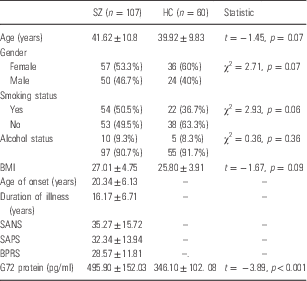
In total, 107 patients with schizophrenia and 60 HC were included in the study. The mean ages were 41.62±10.8 years in the schizophrenia group and 39.92±9.83 years in the HC group. The groups were similar in terms of age (t=−1.45, p=0.07). The HC group consisted of 24 females (40%) and 36 males (60%). The numbers of female and male patients were 50 (46.7%) and 57 (53.3%), respectively. The female/male ratio was similar between the groups (χ2=2.71, p=0.07). The smoking and alcohol consumption rates were also similar between the groups (χ2=2.93, p=0.06 and χ2=0.36, p=0.36, respectively). The mean duration of illness was 16.17±6.71 years, and the mean age of onset was 20.34±6.13 years. The mean SANS, SAPS and BPRS scores were 35.27±15.72, 32.34±13.94 and 28.57±11.81, respectively. The mean BMI values were similar between the groups (t=−1.67, p=0.09) (Table 1). The antipsychotics that were used by the patients were as follows: four patients used clozapine, three patients used clozapine+amisulpiride, five patients used clozapine+risperidone, two patients used clozapine+paliperidone, 10 patients used risperidone, four patients used risperidone+quetapine, eight patients used paliperdione, six patients used paliperidone+quetiapine, 10 patients used aripipirazole, three patients used aripipirazole+quetiapine, three patients used aripipirazole+olanzapine, seven patients used amisulpiride, 19 patients used quetiapine and 27 patients used olanzapine (Table 2).
The demographic and clinical characteristics of participants and comparison of G72 protein levels between groups

BMI, body mass index; BPRS, Brief Psychiatric Rating Scale; HC, healthy controls; SANS, Scale for the Assessment of Negative Symptoms; SAPS, Scale for The Assessment of Positive Symptoms; SZ, schizophrenia. Significant p values predicted in bold character.
The treatment data of patients

A, amisulpiride; Ar, aripipirazole; C, clozapine; O, olanzapine; P, palipeidone; Q, quetiapine; R, risperidone.
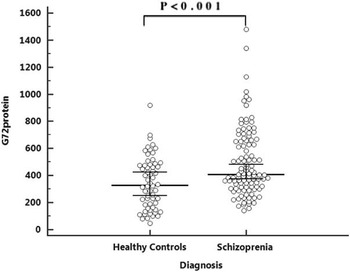
The mean serum G72 protein levels were 495.90±152.03 pg/ml in the schizophrenia group and 346.10±102.08 pg/ml in the HC group (Fig. 1). The mean serum G72 protein levels were significantly increased in the schizophrenia group compared with the HC group (t=−3.89, p<0.001) (Table 1). The median serum G72 protein values were compared according to the smoking status. In the smokers, the median serum G72 protein level was 375.29 pg/ml compared with 408.35 pg/ml in the non-smoker group. There was no significant difference in the serum G72 protein levels between the smoker and non-smoker groups (Z=−1.09, p=0.27).
The distributions of G72 protein in schizophrenia and healthy controls groups, mean±SD and p value.

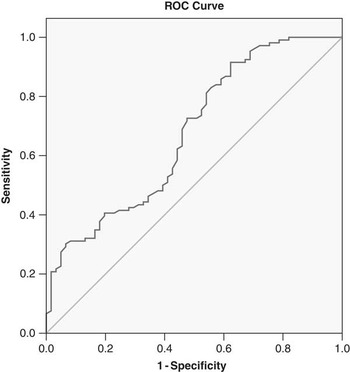
The ROC analysis was performed to compare the schizophrenia and HC groups. The cut-off value was 141.51 pg/ml with a sensitivity of 0.991 and a specificity of 0.821 (area under the curve=0.825) (Fig. 2).
In this figure, receiver operating characteristics (ROC) curve analysis of G72 protein was demonstrated. The cut-off value was 141.51 pg/ml with a sensitivity of 0.991 and a specificity of 0.821. Area under the curve was found as 0.825.

We assessed the correlations between the mean serum G72 protein levels and the SANS, SAPS and BPRS via Pearson’s tests in the schizophrenia group and determined there were no significant correlations (r=0.055, p=0.57; r=0.020, p=0.84; and r=−0.149, p=0.12, respectively).
Discussion
In present study, we demonstrated that the serum G72 protein levels were significantly increased in patients with schizophrenia compared with HC.
The glutamate hypothesis of schizophrenia is more novel than the dopaminergic theory. Antagonists of the NMDA receptor, such as phencyclidine or ketamine, have been demonstrated to induce the symptoms of schizophrenia, including positive, negative and cognitive symptoms (Reference Jvitta20–Reference Coyle23). Furthermore, exposure to an NMDA antagonist worsens the symptoms of schizophrenia (Reference Coyle23–Reference Malhotra, Pinals, Adler, Elman, Clifton and Pickar25). This evidence suggests that disturbed glutamate function is involved in the aetiology of schizophrenia. Following these observations, numerous animal studies have supported the glutamate theory of schizophrenia (Reference Hu, Macdonald, Elswick and Sweet26). In animal studies, the level of d-serine, which is a co-agonist of the NMDA receptor, has been reported to be reduced. The reduction in d-serine may cause a decreased dendritic spine density, reduced hippocampal volume and impaired cognitive functions (Reference Dalmau, Gleichman, Hughes, Rossi, Peng and Lai27–Reference Balu, Li, Puhl, Benneyworth, Basu and Takagi29).
Genetic variations in the G72 gene have been reported to have an important role in the dysregulation of the glutamate system. G72 overexpression in the prefrontal cortex has been reported to be increased in schizophrenia patients compared with healthy subjects (Reference Korostishevsky, Kaganovich, Cholostoy, Ashkenazi, Ratner and Dahary30). The end product of the G72 gene is an important enzyme that plays a critical role in the degradation of d-serine (Reference Mothet, Parent, Wolosker, Brady, Linden and Ferris31). The G72 protein activates the DAAO enzyme, which ultimately results in the hypofunction of NMDA. DAAO hyperfunction causes a reduction in d-serine; thus, NMDA receptor function becomes disturbed (Reference Epstein, Lipton and Rosenberg32–Reference Sehgal, Mannan, Kanwal, Naveed and Mir34). In addition to genetic studies, reduced d-serine levels in cerebrospinal fluid and serum have been reported (Reference Hashimoto, Fukushima, Shimizu, Komatsu, Watanabe and Shinoda35,Reference Mitchell, Paul, Chen, Morris, Payling and Falchi36). Moreover, in addition to the role of G72 protein in glutamate functions, pLG72 has also been considered to play an important role in oxidative stress (Reference Wang, Chen, Zhang, Li, XİE and Chang12). It has been well established that the levels of reactive oxidants were increased in patients with schizophrenia compared with healthy subjects (Reference Akibinu, Ogundahunsi and Ogunyemi37–Reference Jorgensen, Broedbaek and Fink-Jensen43). Regarding the results and conclusion of Wang et al. (Reference Wang, Chen, Zhang, Li, XİE and Chang12), increased serum G72 protein levels may also be associated with increased mitochondrial ROS, which supports the concept of increased reactive oxidants and oxidative stress in patients with schizophrenia.
Substantial efforts have been aimed at the identification of biomarkers in schizophrenia. Genetic, neurophysiological, neuroimaging and neurochemical studies aim to identify a specific biological marker for schizophrenia (Reference Razafsha, Khaku, Azari, Alawieh, Behforuzi and Fadlallah5). In clinical practice, the investigation of a biomarker in the blood may be considered the best way to support the diagnosis. This issue is important for all medical diseases, as well as psychiatric disorders. However, no pathognomonic marker is available to support a schizophrenia diagnosis. The best way to determine the reliability and validity of a marker is to retest it in the same patient group. Lin et al. (Reference Lin, Chang and Chen13) investigated the serum G72 protein levels between patients with medicated schizophrenia and HC and patients with drug-free schizophrenia and HC. They demonstrated that both schizophrenia groups had significantly increased plasma G72 protein levels compared with the HC. They also reported the cut-off values of G72 in both patient groups. Similarly, we retested the plasma G72 protein levels in a larger sample (n=107) of medicated schizophrenic patients and demonstrated that the plasma G72 protein levels were significantly increased compared with the age–sex-matched HC. We also performed an ROC analysis that indicated the cut-off value was 141.51 pg/ml. The results of the present study support the findings of Lin et al., which comprised the only previous study to investigate the serum G72 protein levels in patients with schizophrenia.
There were several limitations in the present study. First, it would be better to compare the serum G72 levels between drug-naïve patients with schizophrenia and healthy subjects to conclude that the serum G72 level is a biomarker. The pilot study of Lin et al. had superiority in terms of this issue. Second, we could not measure the serum d-serine levels and perform group comparisons. Furthermore, the serum G72 level and the products of G72 gene overexpression may be closely associated with oxidative stress, which comprises an important role in neuropsychiatric disorders. Although we found significant difference between groups in terms of G72 protein, there was no significant correlation between serum G72 protein levels and the SANS, SAPS and BPRS. The comparisons of age, gender and smoking status between groups were found to be insignificant, however, the p values of these parameters were close to significance and these can be regarded as a confounding factors and also can be considered as another limitation. We could not investigate oxidative stress parameters in the present study. The role of serum G72 level on cognitive function is unclear and we could not demonstrate any association between serum G72 level and cognitive functions. We suggest that our limitations would be of substantial interest for future studies. In conclusion, we suggest that the serum G72 protein levels may represent a candidate biomarker for schizophrenia. Additional studies with larger sample sizes and the inclusion of first episode schizophrenia patients are required to clarify the reliability and validity of serum G72 protein levels as a biomarker for schizophrenia.
Acknowledgements
Authors’ Contributions: E.S.A. contributed to the research via patient data collection, the application of scales and the design process. Y.A. contributed to data analysis and drafted the results. M.B. and B.Ş. contributed to the research in terms of the conception and design processes and drafted the manuscript. N.A. contributed to the research via serum sample analysis and revision of the results according to the biochemical procedures. M.K. and K.H. critically revised the manuscript and contributed to its content by supporting the discussion of the analysed data.