About two-thirds of the way through George Du Maurier's Trilby (1894), a novel that entranced the reading public with its descriptions of Bohemian Paris and mesmerism, there is a seventeen-page digression on The Origin of Species.Footnote 1 This rumination is sparked by the fact that Little Billee is “reading Mr. Darwin's immortal book for the third time” while he contemplates proposing to the parson's daughter, Alice (180; pt. 5). Ultimately, he cannot bring himself to do so because Alice believes, among other Bible stories, that “[t]he world was made in six days. It is just six thousand years old,” a view debunked in The Origin by Darwin's depiction of the gradual evolution of species over vast periods of time (174; pt. 5).Footnote 2 While the controversy elicited in the second half of the nineteenth century by Darwin's theory of natural selection continues today, the question remains: what is this debate doing in a novel about expatriate artists and the woman they love? I read this seeming digression from the sentimental and sensational plot of the novel as a cue to the importance of Darwinian ideas to reading Trilby.Footnote 3 In this article, I trace Du Maurier's engagement in Trilby and in his cartoons with various permutations of Social Darwinism, notably degeneration (especially its relationship to class), society's moral and cultural evolution, and eugenics. I argue that the novelist negotiates between Darwin and his interpreters as he resists collectivism, or state intervention in questions of social welfare, in favor of individual liberty in matters of sexual selection.
Though set in the late 1850s, the novel, as critics have noted, is saturated with references to the issues of the 1880s and ‘90s, such as the aesthetic movement and anti-Semitism.Footnote 4 However, the novel's concern with degeneration has been largely overlooked.Footnote 5 Fears that the human condition was declining permeated fin-de siècle culture, and its attendant pseudoscientific discourse became, as Stephen Arata explains, part of the realm of “common sense.”Footnote 6 Darwin himself warned in The Descent of Man and Selection in Relation to Sex: “we must remember, progress is no invariable rule” (177). One response to the perceived problem, put forth by Darwin's cousin Francis Galton, was eugenics. In his article “Hereditary Talent and Character” of 1865, Galton began advocating the selective breeding of the more desirable members of the human race in order to promote progress.Footnote 7 The specters of evolution, degeneration, and eugenics circulate in Trilby with conflicting results. While the novel rejects certain discourses of degeneration, especially concerning the working classes, it seems to embrace other commonplaces regarding the deterioration of the aristocracy. For both classes, the text expresses unease with forms of social control that regulate marriage – whether they be eugenics, middle-class mores, or meddling mothers. Ultimately, I will argue that Du Maurier invokes The Origin to remind us of Darwin's earlier, more optimistic prognosis for evolution: “as natural selection works solely by and for the good of each being, all corporeal and mental endowments will tend to progress towards perfection” (395). This was a natural selection unimpeded by nineteenth-century controls or concerns with wealth and status.
Sexual Selection and Degeneration
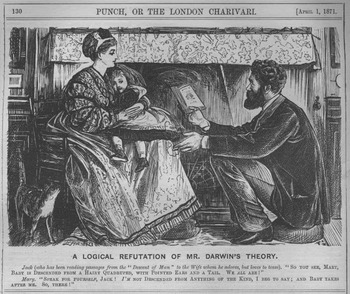
While Trilby referencesThe Origin, and Du Maurier peppered the novel with evolutionary vocabulary, I will turn first to Darwin's later text, The Descent, which clearly influenced the novel and is especially relevant given fin-de siècle concerns about mating and reproduction. Du Maurier created the cartoon “A Logical Refutation of Mr. Darwin's Theory” (Figure 13) in response to The Descent in 1871, shortly after the book's publication. In this cartoon, Jack quotes Darwin's description in the conclusion of The Descent of our human progenitors, while Mary's negative response portrays the reception Darwin's theory received in some quarters.Footnote 8 In Trilby, Du Maurier affirms Darwin's principles of evolution and sexual selection in response to fin-de siècle commentators who adapted Darwin's ideas for various social ends. In The Origin, Darwin states that “Generally, the most vigorous males, those which are best fitted for their places in nature, will leave the most progeny” (73). In The Descent, this maxim becomes codified as the “laws of battle,” in which the strongest men get the women (325).
George du Maurier, “A Logical Refutation of Mr. Darwin's Theory.” Engraving from Punch 60 (1 April 1871): 130.

In his novel, Du Maurier tests these principles through the various characters’ attempts to win the eponymous heroine, Trilby O'Ferrall. Those who wish to marry and propagate the species with her include Taffy, Little Billee, and Svengali. These suitors are described in detail, giving the reader a picture of their “fitness” for advancing the race. Taffy, first introduced to the reader, is called “the Man of Blood” because he is distantly related to a baronet, thereby introducing the issue of bloodlines in the first pages of the novel (4; pt. 1). Taffy is “a very big young man, fair, with kind but choleric blue eyes, and the muscles of his brawny arm were strong as iron bands.” When we first meet this picture of physical prowess, he is “energetically engaged . . . [in] twirling a pair of Indian clubs around his head” (4; pt. 1). This representative of Imperial Might also served as a soldier in the Crimea; he would have died “in the famous charge at Balaklava but for a sprained ankle (caught playing leap frog in the trenches), which kept him in hospital on that momentous day” (4; pt. 1). Taffy is established as a highly masculine figure, muscular, strong, and brave enough in the face of war to amuse himself with physical games in the trenches.Footnote 9 He is the only character to reproduce, thereby ensuring the race will continue, fathering three boys with Little Billee's sister Blanche. Appropriately, the soldier succeeds in the battle for genetic survival.
Trilby's preferred suitor, Little Billee, is not as robust as Taffy, but rather “small and slender” with “delicate, regular features” and “very small hands and feet” (6; pt. 1). He is “so young and tender, so weak of body” and “had always been a highly strung, emotional, over-excitable, over-sensitive, and quite uncontrolled mammy's darling, a cry-baby sort of chap, who had never been to school” (83; pt. 3, 216; pt. 6). Whereas Taffy's masculinity is affirmed though his participation in an all-male organization, the military, Little Billee's masculinity is called into question because he has not has a similar indoctrination, having never been with other boys at school. While Trilby's preference for Little Billee because of his feminine qualities contradicts Darwin's theories of sexual selection, it does reflect the upheaval in gender roles at the end of the century, which Elaine Showalter has termed “sexual anarchy” (Sexual 3). As an effeminate artist, Little Billee might be regarded as an aesthete, an emergent form of masculinity that embraced the feminine (if not women) at the end of the century and soon became associated with homosexuality and degeneration.Footnote 10 Du Maurier certainly engages with aestheticism in this novel, as Jonathon Grossman and Dennis Denisoff have shown, but this is only one angle through which he approaches the issue of degeneration. Moreover, any degeneration signaled by Little Billee's effeminacy is offset by his superior artistic talent and the narrator's persistent reviling of his rival, Svengali.
Trilby's third suitor is marked as degenerate through his Jewishness, his dirtiness, and his macabre sexual fantasies.Footnote 11 A “tall bony individual . . . of Jewish aspect, well-featured but sinister” and “very shabby and dirty,” Svengali is classed by myths of racial degeneracy and by filth (11; pt. 1). The narrator repeatedly brings to the reader's attention Svengali's dirtiness, which is contrasted with the cleanliness of British artists who bathe regularly. His filth, then, marks him as less civilized than the British and raises the possibility of disease as well. The means through which he attempts to woo Trilby further signal his degenerate state: he describes scenarios in which he views her corpse exposed on a slab in the morgue or as a skeleton in a case. Svengali makes love to her by conjuring scenes of her body decaying or wasted away to bones, thereby linking love and sex with death. His necrophiliac imagination indicates theirs would not be a fruitful union. And though his mesmeric influence over Trilby raises the possibility of a sexual liaison between them, they do not procreate.Footnote 12
Critical attention to the racial degeneration imbued in Svengali's character has tended to obscure other forms and sources of corruption in the novel that were of concern during the fin-de siècle, such as the city and the urban poor. Degeneration was believed to be particularly endemic in the urban working classes due to both environmental and hereditary factors. Environmental causes of degeneracy included poor air and water quality and the cramped conditions of working-class areas of cities; poor diet; and the use of narcotics such as alcohol, tobacco, or opium. Following a Lamarckian understanding of inheritance, the results of environmental degeneration were believed to be passed onto the next generation, who continued to deteriorate in the same unhealthy living conditions, such that some believed “a pure Londoner of the fourth generation is not capable of existing.”Footnote 13 During the 1880s and ‘90s, this theory of hereditary urban degeneration “received widespread middle and working class support and was given authoritative backing” by such social observers as Charles Booth, Alfred Marshall, G. B. Longstaff, and H. Llewellyn Smith, who brought the issue to the attention of the reading public (Steadman Jones 128).Footnote 14 This perception was also reflected in and reinforced by fin-de siècle fiction, where the working classes were often represented as a lower “race” (Ledger 81).
According to both social observers and fiction writers, working-class women were a special source of anxiety. According to Darwin, some of women's faculties “are characteristic of the lower races, and therefore of a past and lower state of civilization” (Descent 327). Thus, women already represented a less-evolved state. Galton singled out working-class women for criticism due to their “draggled, drudged, mean look” and worried that urban life was “crushing them into degeneracy” (Hereditary 340). Their reproductive function made them targets of concern, both because they were producing more offspring than middle-class women, and because they were perceived to be a negative influence on their large families.Footnote 15
This concern with urban working-class degeneration signaled middle-class fears of a loss of cultural and political preeminence, as is most evident in proposed solutions to the problem.Footnote 16 Galton, in his many publications on the subject, advocated preserving the middle class through early marriage and procreation. In Hereditary Genius, he urged marriage among the “vigourous” and “prudent” classes, but not among the “weak” and “imprudent” (352, 356). While Galton did not specify that he was referring to the middle- and working-classes by these adjectives, it was the birth rate of the middle and working classes that was declining at this time, as many postponed marriage until they could afford a certain lifestyle. Indeed, in Inquiries into Human Faculty and its Development (1883), he blames “the cost of living in cultured and refined society” for the delayed marriages of “the most gifted” (330). “Cultured and refined” society's doors were, of course, closed to the working classes.
It is Trilby's engagement with these discourses of working-class degeneration and eugenics that I will turn to now. Trilby would seem to be a prime candidate for urban degeneration, as she is subject to both environmental and hereditary risk factors. She has lived all her life in the poorer quarters of Paris; and her parents die of alcoholism and her brother of scarlet fever, both diseases associated with the urban poor. However, Trilby is decidedly fit, described as “young,” “healthy,” “very tall and fully developed,” and with her “nerves and muscles are well in tune” (12, 13; pt. 1). She is also “a very intelligent person, in spite of her woefully neglected education” (62; pt. 2). Contrary to the expectations of some social commentators, she has not suffered bodily or mentally from her parents’ degenerate habits or her urban environment. Her height also distinguishes her from the small frames of “degenerate” urban specimens, some barely five feet tall, discovered by social observers such as Dr. James Cantlie, Alfred Marshall, and G. B. Longstaff.Footnote 17 Additionally, she wears the overcoat of a “French infantry soldier,” which reminds us of the physical health and strength of our other military figure, Taffy.
Following Darwin, one might ascribe Trilby's hardiness to her hybridity, as she is a cross between Irish and Scottish, upper- and working-class parents. According to Darwin, “a cross between different varieties, or between individuals of the same variety but of another strain, gives vigour and fertility to the offspring” (Origin 80). She seems to be a cross between male and female as well, as she initially dresses in a male coat and slippers and, the narrator tells us, “would have made a singularly handsome boy” (13; pt. 1). While effeminacy in men and masculinity in women were often viewed as signs of degeneracy – and were therefore a means of castigating social movements such as aestheticism and the New Woman – they could also be seen as adaptation and variability according to a Darwinian model of social evolution.Footnote 18
One argument in favor of Trilby's regenerative capabilities is that she is also singularly adaptable to her environment. She makes a “strange metamorphosis” from Parisian grisette to domestic Englishwoman, cooking, sewing, and cleaning for the three English artists (87; pt. 3). And after she gives up modeling, her personality and her body change as well:
She was no longer slangy in French . . ., no longer so facetious and droll, and yet she seemed even happier than she had ever seemed before. . . . [S]he grew thinner, especially in the face . . . she lost her freckles as the summer waned and she herself went less into the open air. And she let her hair grow. . . . [H]er mouth, always too large, took on a firmer and sweeter outline. . . . And a new soft brightness came into her eyes that no one had ever seen there before. (84–86; pt. 3)
In response to her evolving relationship with the three artists, she changes both mentally and physically, becoming more “properly” feminine with pale skin, long hair, and more refined conversation. Trilby's ability to adapt to her environment indicates she is prepared to survive in a varied and complex world. In other words, she is a good candidate for both natural and sexual selection. Thus, Du Maurier rejects the Lamarckian view of inheritance, in which characteristics acquired by parents in their lifetime are passed onto their children, in favor of a Darwinian emphasis on variety in offspring, with certain variations contributing to survival.
Far from degenerate, Trilby's “astonishingly beautiful feet” have reached the pinnacle of evolution (15; pt. 1). According to the narrator, “Nothing else [other than the foot] that Mother Nature has to show, not even the human face divine, has more subtle power to suggest high physical distinction, happy evolution, and supreme development; the lordship of man over beast, the lordship of man over man, the lordship of woman over all!” (16; pt. 1). Trilby's feet reveal that she is a product of a progressive evolution that has resulted in both physical perfection and her elevation over beasts and men in the chain of development. This notion follows Darwin to a certain extent in that he argued in The Descent that evolution accounted for humans’ kinship with animals and other, less civilized humans, as well as their superiority to them. However, the narrator's enthusiasm carries Trilby beyond Darwin's theory, as Darwin contended that men were more highly evolved than women due to both natural and sexual selection. Elsewhere, in “A Logical Refutation of Mr. Darwin's Theory” (Figure 13), Du Maurier reflects Darwin's view of the lesser capacities of women with Mary's reason-defying response to her husband's claim about their child's descent. I would suggest that the narrator's exaggeration in Trilby prevents the reader from taking seriously this deviation from Darwin's (and society's) notion of gender difference. However, the hyperbole does effectively distance Trilby from the low position working-class women inhabit on the evolutionary scale according to Victorian sociologists.
Indeed, the narrator suggests that Trilby could have been the salvation of the human race. All three artists “imagin[e] what splendid little Wynnes, or Bagots, or M'Allisters might have been ushered into a decadent world for its regeneration if fate had so willed it that a certain magnificent and singularly gifted grisette, etc., etc., etc.” (223–24; pt. 7). The term “regeneration” indicates replacement of the current generation, but in the context of “a decadent world” it also suggests stemming the tide of degeneration and improving the species with “splendid” progeny. Next, I discuss Zouzou's match with an American millionairess, by which Du Maurier rejects urban working-class degeneration by placing hope for the future in a girl from the streets.
Moral and Cultural Evolution
In addition to figuring Trilby in the context of biological discourses of sexual selection and degeneration, Du Maurier also addresses Social Darwinist discourses about the evolution of human morality and cultural achievement. While Trilby may be at the peak of evolutionary perfection, she is at the bottom of the middle-class scale of morality. But despite the fact that she is a “fallen woman” according to English middle-class standards, the narrator makes it clear that the state of affairs is more complicated than simple delineations of sexual purity and contamination would suggest. Many critics have noted that Alexandre Dumas fils’ Dame aux Camelias was a source for Trilby, and Du Maurier's allusion seemingly reinforces Trilby's fallen state.Footnote 19 However, the allusion highlights the differences between Marguerite and Trilby as well. While Marguerite is ill from an unnamed disease, Trilby is very clearly described as healthy. Moreover, Trilby has “a virginal heart” and is “like an amateur” in love; in other words, she not a professional lover, or prostitute, like Marguerite (36; pt. 1). Rather, Trilby “followed love for love's sake only, now and then,” and not from “pressure of want” or “temptations of greed, or vanity,” as Marguerite does before she falls in love with Armand (36; pt. 1). Thus, while both women lose their lovers to the pressures of middle-class propriety, Trilby is pure and healthy despite her sexual experience, and certainly not a carrier of disease or degeneration like Marguerite.
Trilby's “virginal heart” also allows her to pose “in the altogether” for various artists without qualms: “Truly, she could be naked and unashamed – in this respect an absolute savage” (64; pt. 2). In this sentence, the narrator combines both a biblical and a scientific allusion to explain Trilby's relation to nudity.Footnote 20 She is like Eve in the Garden of Eden before the fall, unaware and “unashamed” of her nakedness. And she is like a “savage” as well, a term invoked in evolutionary discourses to distinguish civilized humans from their progenitors. The narrator, however, undermines the negative connotations of “savage” by going to considerable lengths to explain that, to artists and sculptors, “nothing is as chaste as nudity” (64; pt. 2).
While nudity may not arouse artists, it can serve another purpose. The narrator contends that if everyone went around naked, “there would be no cunning, cruel deceptions, no artful taking in of artless inexperience, no unduly hurried waking-up from Love's young dream, no handing down to posterity of hidden uglinesses and weaknesses, and worse!” (66; pt. 2). Degeneracy (“uglinesses and weakness, and worse”) is understood to be marked on the body and, therefore, can be covered by clothes. However, if everyone were naked, then lovers would be spared the discovery of diseased spouses, and future generations would be spared the curse of hereditary degeneration. While playing on fin-de siècle fears of hidden contamination, this digression on nudity also serves to remind the reader that many have seen Trilby model “in the altogether,” and she has not been found to carry the tale-tell “stigmata” enumerated by social scientists such as B. A. Morel, Cesare Lombroso, and Max Nordau.Footnote 21
Du Maurier returns to his biblical allusion when Trilby's prelapsarian purity is ruined by Little Billee's shocked response to seeing her pose naked at Carrel's studio. Her “new-born feeling of shame was unendurable – its birth a travail that racked and rent every fibre of her moral being, and she suffered agonies beyond anything she had ever felt in her life” (78; pt. 3). Like Eve, who experiences abashment at her own nakedness after the Fall and is condemned to the pains of childbirth on being expelled from the Garden of Eden, Trilby experiences shame and the pain of her own re-birth as she is thrust from blissful ignorance into recognition of proper, “civilized” female behavior by Little Billee's prudery. This is the first indication that middle-class mores are the snake in this bohemian Garden of Eden.
The seeming contradiction between Trilby as a highly evolved physical specimen and her “savage” attitude toward posing in the nude reflects a current of thought at the fin-de siècle that held that degeneration was, in fact, due to modern civilization, whether the growth of urban areas, with overcrowded housing and unsanitary conditions; government aid or private charity, which enabled the survival of the “unfit” through medical and financial assistance; or the current speed of modern life, due to technological advances.Footnote 22 Some discussions also suggested that strict adherence to middle-class mores and the status quo was the problem. Zoologist Edwin Ray Lankester, for example, warned in Degeneration: A Chapter in Darwinism (1880) that “we have to fear lest the prejudices, pre-occupations, and dogmatism of modern civilisation should in any way lead to the atrophy and loss of the valuable mental qualities inherited by our young forms from primaeval man” (61). H. G. Wells develops this notion in his essay, “Zoological Retrogression” (1891), in which he compares upstanding members of the middle class to the Ascidian, or sea squirt, which degenerates from a free moving organism to a stationary parasite during its life cycle:
Every respectable citizen of the professional classes passes through a period of activity and imagination, of “liveliness and eccentricity,” of “Sturm und Drang.” He shocks his aunts. Presently, however, he realizes the sober aspect of things. He becomes dull; he enters a profession; suckers appear on his head; and he studies. Finally, by virtue of these he settles down – he marries. All his wild ambitions and subtle aesthetic perceptions atrophy as needless in the presence of calm domesticity. He secretes a house, or “establishment,” round himself, of inorganic and servile material. His Bohemian tail is discarded. Henceforth his life is a passive receptivity of what chance and the drift of his profession bring along; he lives an almost entirely vegetative excrescence on the side of the street and in the tranquility of his calling finds that colourless contentment that replaces happiness. (Rpt. in Ledger and Luckhurst 9)
Little Billee parallels this trajectory. His time in the Latin Quarter of Paris is “a period of activity and imagination, of ‘liveliness and eccentricity.’” He shocks his mother and uncle, rather than his aunt, by proposing to marry Trilby. He then enters the London art and social world, establishing himself professionally, and contemplates a socially suitable marriage with Alice. But his power of loving has “atroph[ied]” after losing Trilby. When he is deprived of her, he does indeed forfeit his “Bohemian tail,” and has only the “colourless contentment that replaces happiness.”
While Little Billee is condemned to a life without feeling due to social dictates about appropriate marriage partners, Trilby is untainted by “the prejudices, preoccupations, and dogmatism” of the world. She has reached evolutionary perfection perhaps because of her ignorance of “modern civilization.” This is manifested in a variety of ways, not least in her refusal to don footwear. The narrator describes the “gruesome boot-begotten abominations,” the “lamentable deformations, indurations, and discolorations” of feet, from which Trilby is free because she does not wear that product of advanced civilization, the shoe (16; pt. 1). “Civilization” takes on multiple valences in this discussion, suggesting both an advanced state of technological and cultural development, but also manners and polite society. We see this also in Little Billee's attempts to chat with her
just as he would have talked to any young lady at home – about the weather, about Verdi's new opera (which she had never heard), the impressiveness of Notre Dame, and Victor Hugo's beautiful romance (which she had never read), the mysterious charm of Leonardo da Vinci's Lisa Gioconda's smile (which she had never seen). (32; pt. 1)
Trilby's lack of cultivation is evident both in her inability to make polite middle-class small talk and in her ignorance of these pinnacles of cultural achievement in music, architecture, literature, and art. Each reflects her “savagery” in relation to a state of civilization that requires trite conversation based on a lady's education in a smattering of cultural subjects.
Music especially functions this way. Trilby reveals her barbarism when she does not recognize the music that Svengali plays as Schubert's “Rosamonde.” Moreover, she thinks that Schubert is a geographic location rather than a musician and prefers less sophisticated, popular music such as “Messieurs les etudiants” and “Ben Bolt” to art music. This ignorance of cultivated music serves as a benchmark for her final metamorphosis.
Du Maurier reintroduces Trilby into the story line, after her disappearance from Paris and from the text, as “La Svengali” and in the context of high art music. She is mentioned at a party where the great opera singers Antonio Giuglini and Adelina Patti sing Verdi, and Joseph Joachim and Clara Schumann both play Bach. Moreover, fictional musical experts such as Glorioli, the renowned singer; Signor Spartia, “the greatest singing-master in the world”; and Herr Kreutser, “the famous composer,” all laud La Svengali (164; pt. 5). Performers, teachers, and composers extol her abilities in the presence and performance of these actual musical greats, indicating that Trilby has reached the peak of civilization as well as evolution.
However, Du Maurier undermines music as a marker of cultural evolution by satirizing British musical hierarchies. Everyone at the party enjoys the Verdi except “a very few superior ones who had just read Mendelssohn's letters (or misread them) and despised Italian music, and thought cheaply of ‘mere virtuosity,’ either vocal or instrumental” (157; pt. 5). The English considered German music to be intellectual and spiritual and, therefore, superior to Italian and French music, which was thought to be light, theatrical, and over-emotional. Moreover, the audience members take advantage of this artificial distinction in art music to demonstrate their superior cultivation through their reception of the different performances:
If you were [up to Bach] (or wished it to be understood or thought you were), you seized your opportunity and you scored, and by the earnestness of your rapt and tranced immobility, and the stony, gorgon-like intensity of your gaze, you rebuked the frivolous – as you had rebuked them before by the listlessness and carelessness of your bored resignation to Signorina Patti's trills and fioritures, or M. Roucouly's pretty little French mannerisms. (158; pt. 5)
This music appreciation is satirized as a posture one can assume; “tranced immobility” and an “intens[e]” gaze convey disdain for “frivolous” and “manner[ed]” Italian and French music and musicians.Footnote 23 While “scoring” means paying close attention to the printed music as the musicians perform, and would indicate intellectual engagement with the music, it also suggests winning a point in a game or contest. Therefore, what are, in fact, “frivolous” are English musical hierarchies and the audience's concert behavior.
Music as a sign of high civilization also suffers a blow from Du Maurier's invocation of Darwin. In The Descent, Darwin posits that “from the deeply-laid principle of inherited associations, musical tones would be likely to excite in us, in a vague and indefinite manner, the strong emotions of a long-past age” (337). This notion that a listener's reaction to music stems from a primitive inheritance is reinforced by the audience's response to Trilby's performance in Paris. Her singing makes the listeners recall a primal memory: “all the sights and scents and sounds that are the birthright of happy children, happy savages in favoured climes – things within the remembrance and the reach of most of us!” (209; pt. 6). The music takes them back to earlier states of evolution – childhood and savagery. Paradoxically, music is both cultivated and primal, and attempts to employ it to demarcate civilization are necessarily problematic. Thus, both modern civilization and Trilby's cultural ascendancy through music are called into question.
Social Control: Mesmerism, Middle-Class Mores, and Eugenics
Trilby's final metamorphosis, from savage to diva, is achieved by means of Svengali's mesmeric control, a phenomenon which, I argue, stands in for and amplifies other means by which an individual forfeits his or her will to a collective force, be it middle-class mores or eugenic programs. Mesmerism, the apparent power to affect the mind and body of another, was a source of fascination and anxiety for Victorians. One cause for concern was the individual's loss of autonomy under the invisible influence of the mesmerist.Footnote 24 The subject seemingly had no will of her own, and was subject to the direction of another. As the Laird explains to Trilby, “They [mesmerists] get you in their power, and just make you do any blessed thing they please – lie, murder, steal – anything!” (50; pt. 2). His claim that mesmerists could use their power to make people commit morally reprehensible acts reflects the fears incited by this phenomenon. The discrepancies in class and gender often found between mesmerist and subject further highlighted the power relations involved in the experiment (Winter 4).
Critics generally agree that Svengali employs mesmerism to do more than “make [Trilby] do any blessed thing [he] please[s].” Through his manipulation of her voice, he is able to control audiences throughout Europe and gain the acclaim he desires.Footnote 25 I contend that the anxieties about power and mastery over individuals raised by Svengali's mesmerism resonate in other forms of social control touched on in the novel, such as middle-class mores and the eugenic discourses that promote the interests of the middle class. Alison Winter finds that the concepts of mesmerism underpin many nineteenth-century attempts to theorize consensus in large groups of people, including the conductor uniting and leading his orchestra, the sensation novelist affecting the nerves of his or her readership, and public speakers mobilizing crowds to rebellion against or unified support for the existing political structure.Footnote 26 Each of these phenomena involves an agent – the conductor, the author, the political leader – directing the masses and a physical object or event through which the efforts of creating accord are achieved – the baton, the novel, the public speech. With the forms of mass management under investigation in Du Maurier's novel, however, there is not necessarily an obvious agent directing social opinion and no apparent mechanism for effecting agreement. Rather, it is the nebulous entity “society,” or “the world's opinion,” that directs and shapes the lives of the characters. As the Rev. Bagot sums up, “facts are facts, and the world is the world, and we've got to live in it” (124; pt. 4). The agent of control with social management is not always an identifiable individual, but a diffuse, invisible force, tangible only in its effects. Therefore, I am extending Winter's argument by suggesting that Du Maurier employs Svenagali's mesmerism of Trilby as an analogue for the other forms of social governance in the novel.
As Svengali mysteriously manipulates Trilby, so too does Mrs. Bagot prevail upon Trilby to act according to her wishes. Trilby may elude popular perceptions of urban working-class degeneracy, but she is not able to escape this form of middle-class social management. Lest we are in any doubt that Mrs. Bagot is the embodiment of middle-class values, the narrator describes her as “a shrewd little conventional British country matron of the good upper middle-class type, bristling all over with provincial proprieties and respectabilities, a philistine of the philistines” (261; pt. 8). This “conventional” and “provincial” woman does not brook any new ideas that might threaten her class status. The first thing this representative of middle-class “proprieties and respectabilities” does when she arrives in Paris to stop her son's wedding is to interrogate Taffy about Trilby. She wants to know Trilby's nationality (“Is she English?”), her religion (“Is she a Protestant or a Roman Catholic?”), her social position (“Is she a lady, Mr. Wynne?”), her economic status (“An English governess, or something of that sort?” or “Has she independent means of her own then?”), and finally her moral status (“And of unblemished character?”) (118–19; pt. 4). She attempts to comprehend her son's fiancée by locating her within conventional categories of identity. To be an appropriate match for her son, a woman would have to be pious, recognized by society, financially secure, morally pure and, preferably, English. Trilby fits none of these categories perfectly and, therefore, in the eyes of Mrs. Bagot and society, the marriage is not possible. Thus, while Little Billee wins the contest for Trilby's heart, the social mores advanced by his mother thwart his sexual selection.Footnote 27
Du Maurier makes the connection between mesmerism and meddling mothers who enforce social conventions more explicit, and previews many of the themes of Trilby, in “Hypnotism – A Modern Parisian Romance. (In Four Chapters.),” a cartoon which appeared in Punch's Almanack for 1890 (Dec. 5, 1889) (Figure 14) four years before the novel was published.Footnote 28 In this cartoon, a wealthy American matron asks the French doctor to hypnotize the Duc de Sept-Cadrans so that he will propose to her daughter. The duke, a good match because of his title, is “a hunchback, an idiot, and a pauper,” reflecting a perception that aristocratic bloodlines had been exhausted through centuries of intermarriage. The duke's stock has dried up not only physically and mentally, but also financially. We find out in the third panel that “there is no such dukedom as Sept-Cadrans,” suggesting that the duke is morally bankrupt as well, passing himself off as a member of the aristocracy. Moreover, his dukedom, “Sept-Cadrans” translates as “Seven Dials,” which was a notoriously poor and dangerous area of London throughout the nineteenth century. Thus, the duke not only bears the stigmata of degeneracy – his hunchback – but also is associated with the two social groups who were believed to be prone to this state, the aristocracy and the working classes.Footnote 29
George du Maurier, “Hypnotism – A Modern Parisian Romance. (In Four Chapters.)” Engraving from Punch's Almanack for 1890 97 (5 Dec. 1889): n.p.

The daughter refuses to marry the duke due to his physical and mental deformities, which is sound reasoning under the principles of sexual selection; but the mother nonetheless continues her scheming and asks the doctor to hypnotize her daughter. The doctor is the ultimate manipulator, however, as is revealed in the final panels. The matron marries the degenerate duke, and her daughter marries the “great hypnotic scientist.” The juxtaposition of the mother's tactics with the hypnotist's suggests a link between them; her attempts to secure a title for her daughter are no different than his endeavor to engineer an advantageous marriage for himself. Likewise, Mrs. Bagot wants a socially favorable (or at least not disadvantageous) marriage for her child and does not look beyond surface considerations like class station when evaluating suitors. While one mother employs hypnotism to achieve her end, the other invokes social propriety, the parallels indicating an affinity between the two forms of manipulation.
The American mother's maneuvering not only reifies the value of social status above all else, but also has eugenic implications. She pushes the match for the sake of the duke's title, regardless of attraction or future progeny. The doctor's machinations likewise reinforce values of status and wealth as he “becomes an American billionaire” through his marriage, and he and his wife “move in the smartest society in Paris.” While the doctor is not explicitly described as Jewish in the text, he does have the same large nose that Du Maurier will later draw on Svengali, suggesting that the daughter has not escaped marriage to a supposed degenerate after all. Thus, in addition to satirizing wealthy American women husband-hunting in Europe, this cartoon plays on eugenicist concerns, especially Galton's, that wealth and status were replacing physical and mental fitness as marriage criteria to the detriment of the human race. This anxiety is compounded by the way the cartoon highlights the lack of individual will in deciding these matters. The mother tries to override her daughter's will by having her hypnotized, and the doctor thwarts the mother's will – and possibly the daughter's – by apparently hypnotizing everyone.
While Galton and the mothers of the novel and cartoon are at cross-purposes, all are attempting to engineer what they believe are prudent marriages. Indeed, in his calls for “hereditary improvement,” Galton could be seen as the ultimate meddler, attempting to effect a sea change in how the middle class viewed marriage. I would argue that Galton's eugenic program places him on the same plane as the conductor, sensation novelist, or public speaker who attempts to unite a disparate group of individuals into a unified entity with, in this case, the single aim of improving the human race. He positions himself as combating the “social agencies” that are “working towards the degradation of human nature” (Hereditary 1). These “social agencies” promote certain behaviors; specifically they encourage the undesirable, or the working classes, to marry early and the desirable, or middle classes, to marry later in life. According to Galton's statistical calculations, late marriages produce fewer children, resulting in the diminishment of those who, he felt, were best fitted for improving the human race while the unfit multiply. He wished to replace consideration for wealth and status, which encouraged late marriages among the middle classes, with a different set of values – mental and physical fitness. He sought to induce this change by manipulating popular opinion, claiming “it is quite conformable to the customs of this century to employ social considerations to effect what is desirable,” and noting, for example, cultural consensus against marrying cousins.Footnote 30
His plan to employ societal influence to encourage eugenic marriages was to be assisted by state intervention. He proposed “investigations” to collect data and establish pedigrees for certain people. “[T]he mere process of extensive inquiry and publication of results” would encourage the select few to associate and intermarry, thus producing an “exceptional class” (“Hereditary Improvement” 123, 127). According to his collectivist approach, once the state singles out and values these individuals, others would follow.
Galton also attempted to institutionalize his views by aligning them with another prominent social force and arbiter of behavior, religion. He suggests that concern for the future of the race “may come to be looked upon as one of the chief religious obligations” and is, in fact, “a new moral duty.”Footnote 31 Thus Galton attempted to sway the public to his view of how best to advance the race by marshalling social opinion, the state, and religion to his cause.
In attempting to unite disparate individuals under one goal, Galton imagines humanity as a single organism, much the way an orchestra or crowd was thought to come together as a cohesive unit under the direction of a leader. This being the case, he argues that we must consider what is best for the whole rather than for the individual: “We must not permit ourselves to consider each human or other personality as something supernaturally added to the stock of nature, but rather as a segregation of what already existed, under a new shape, and as a regular consequence of previous conditions” (Hereditary 376). Each individual only manifests qualities and traits that are already in existence and, therefore, is not unique. The individual is subsumed under the mass phenomenon of humanity; his or her interests become secondary to the collective interests of the human race. It follows then that individuals should have limited free will in the choice of marriage partner, in the interests of a greater good. The irony, of course is that an individual, Galton, is directing this project, deciding what course humanity should take.
The eugenic dangers of marrying for wealth and status hinted at in “Hypnotism – A Modern Parisian Romance” would seem to suggest Du Maurier's affinity for Galton's proposals. Indeed, a discussion in Trilby among the three artists about a friend's upcoming marriage closely follows the theme as it is introduced in the cartoon. Zouzou, the second son of a poor ducal family, has become the Duc de la Rochemartel toward the end of the novel. As a result of his ascendancy to the title, he must marry a wealthy woman to maintain his family's position in society. According to Dodor, he is “looking out for the biggest heiress he can find, and he's pretty sure to catch her, with such a name as that! In fact, they say he's caught her already – Miss Lavinia Hunks, of Chicago. Twenty million dollars!” (199; pt. 6). This American millionairess may be rich but, as the artists discover, she is not an attractive woman. The narrator describes her as “so lamentably, so pathetically plain that it would be brutal to attempt the cheap and easy task of describing her” (221; pt. 7). Little Billee, however, takes up this task:
“Why, she's deformed – she squints – she's a dwarf, and looks like an idiot! Millions or no millions, the man who marries her is a felon! As long as there are stones to break and a road to break them on, the able-bodied man who marries a woman like that for anything but pity and kindness – and even then – dishonours himself, insults his ancestry, and inflicts on his descendants a wrong that nothing will ever redeem – he nips them in the bud – he blasts them for ever!” (223; pt. 7)
Little Billee expresses his disgust with Miss Hunks in eugenic terms. Her physical deformities – squinting and dwarfism – were considered signs of degeneracy according to Nordau and others, and Little Billee indicates mental degeneration is apparent through some outward sign as well.Footnote 32 This “grotesque” form is contrasted with “the able-bodied man” who contemplates marrying her, and the match between diseased and healthy bodies is certain to have negative consequences for their progeny (223; pt. 7). Her defects will be passed onto the next generation, “nip[ping] them in the bud” and “blast[ing] them for ever,” terms that indicate their offspring either will be blighted or will not live to adulthood.
While Little Billee's rant would seem to indicate that Little Billee is in favor of eugenic programs that prevent the unfit from marrying, I would suggest that it is, instead, a critique of artificial social pressures to maintain or improve status through marriage. The words “nip,” “bud,” and “blast” all have to do with the cultivation of vegetation, indicating that it is human interference in sexual selection that has such potentially disastrous results. Furthermore, Little Billee indicates the rudest labor, breaking stones, is a more honest means of gaining money than through a mercenary marriage like this one.
This point is reinforced by the match Dodor makes. Whereas Zouzou has become a duke, Dodor, of an ancient family and connected to English aristocracy through his sister's marriage, seems to have come down in the world. He is working in a haberdasher's shop and is engaged to the daughter of the owner of that bourgeois establishment. Dodor is also broke, but his is clearly a love-match even though his fiancée “was not beautiful, but healthy, well grown, well brought up” (226; pt. 7). As Taffy points out “Dodor's young woman doesn't marry him for a dukedom – or even his ‘de’. . . and if the Rigolots of the future turn out less nice to look at than their sire, and not quite so amusing, they will probably be a great improvement on him in many other ways” (223; pt. 7). While the aristocracy, represented by Zouzou, will only damage future generations by succumbing to pressures to marry for wealth and to maintain status, Dodor's ancient stock will be improved by marrying into the lower-middle class. While Dodor loses social status through marriage, he benefits his future progeny: “[I]t was felt that Dodor had done better for himself (and his race) and Monsieur le Duc. Little Dodors need have no fear” (226; pt. 7). His marriage may be less respectable than Zouzou's in the eyes of society, but the three artists have strong opinions about the evolutionary and eugenic appropriateness of each. These couples further reinforce the notion that social forces which interfere with love matches like Little Billee and Trilby's and promote others based on wealth and status, like Zouzou and Miss Hunks’, do so to the detriment of the human race.
As we have seen, these social pressures (whether embodied by mothers or not) have been likened to mesmerism. Similarly, Galton's attempt to raise his eugenic views to the status of a social more invoked a collective identity which, in other arenas, was theorized as the result of mesmeric influence. These connections bring us back to Du Maurier's mesmerist. Svengali raises the issue of fears of Jewish incursions into the English race, which selective breeding might be expected to prevent. This racially degenerate figure threatens gentile racial purity through his control of Trilby, an anxiety raised in “Hypnotism – A Modern Parisian Romance” as well. However, Svengali's distastefulness adds to Du Maurier's critique of eugenics. His very degeneration demonizes endeavors to move the masses to act as one, be they by mesmerists, middle-class mores, or Francis Galton. Moreover, we must remember the drop of Jewish blood that Little Billee carries in his veins – “just a tinge of the strong, sturdy, irrepressible, indomitable, indelible blood which is of such priceless value in diluted homeopathic doses” – which seems to be responsible for his artistic talent (6; pt. 1). And, the narrator suggests that we all have Jewish ancestry: “Fortunately for the world, and especially for ourselves, most of us have in our veins at least a minim of that precious fluid, whether we know it or show it or not” (7; pt. 1). Thus, the narrator indicates the pointlessness of efforts to maintain racial purity and, by extension, class purity, through selective breeding, thereby problematizing attempts to treat the social body rather than the individual.
While Galton drew on Darwin's theory of evolution as a premise and support for eugenics, Darwin himself expressed mixed feelings on the subject. In The Descent he wrote that both men and women “ought to refrain from marriage if in any marked degree inferior in body or mind; but such hopes are Utopian and will never be even partially realized until the laws of inheritance are thoroughly known” (403). However, he did not advocate control over reproduction: “Man, like every other animal, has no doubt advanced to his present high condition through a struggle for existence consequent on his rapid multiplication; and if he is to advance still higher he must remain subject to a severe struggle . . . . Hence our natural rate of increase, though leading to many and obvious evils, must not be greatly diminished by any means” (403). Likewise, in Trilby Du Maurier rejects any artificial interference with sexual selection, whether meddling mothers, society's preference for wealth and status, or Galton's plans for preserving the middle class. By focusing on the individuals in the novel's proposed or actual marriage matches, he reveals exceptions to the rule of the world's opinion about class position and fitness. For, Du Maurier, the future of the human race may lie with individual free will and not the kind of mass phenomenon induced by mesmerists and eugenicists. His invocation of The Origin in this novel reminds us of Darwin's more optimistic take on future progress of the human race, that we may “look with some confidence to a secure future of equally appreciable length” as the past (395).