INTRODUCTION
Huntington's disease (HD) is an autosomal-dominant, neurodegenerative disorder resulting from expansion of the trinucleotide CAG repeat in the gene encoding the protein huntingtin. The defect leads to degeneration of basal ganglia structures, primarily the caudate and putamen, although the exact pathophysiologic mechanism is not well understood. HD is diagnosed clinically with the onset of motor symptoms; however, varied and subtle neuropsychological deficits may appear a decade or more prior to diagnosis during the preclinical (pre-HD) phase (Paulsen et al., 2004). These deficits become more pronounced as individuals approach conversion to manifest HD (Paulsen et al., 2001, 2004), as determined by the participants' current age and CAG repeat length (Langbehn et al., 2004).
Measures of timing behaviors could serve as sensitive markers of neurobehavioral dysfunction in pre-HD participants. Impairments on perceptual and motor timing tasks have been noted previously in patients with Parkinson's disease (Elsinger et al., 2003; Harrington et al., 1998) and with manifest HD (Woodruff-Pak & Papka, 1996). The basal ganglia are known to play an important role in timing behaviors based on lesion studies in patients (Harrington & Haaland, 1999) as well functional neuroimaging studies involving healthy adults (Rao et al., 1997, 2001).
In the current study, we administered the paced finger-tapping task (PFT), a measure of motor timing, to pre-HD participants. The PFT requires that participants tap their finger to an auditory metronome and then continue tapping without the benefit of the pacing stimulus. The PFT has not been studied previously in pre-HD participants. Our goal was to correlate PFT performance with the number of estimated years to manifest HD. We hypothesized that PFT performance would show increased disruption as the number of years to manifest HD decreases.
METHODS
A total of 29 pre-HD adults (10 men; mean age = 32.1 years; range, 18–52) participated according to Medical College of Wisconsin Institutional Review Board guidelines. Years from estimated onset (YEO) of motor symptoms was calculated using a survival formula based on chronological age and CAG repeat length (Langbehn et al., 2004). Motor symptoms were assessed using the Motor Assessment portion of the Unified Huntington's Disease Rating Scale (UHDRS; Huntington Study Group, 1996).
The PFT began with a 30-s synchronization phase (Sync), in which participants pressed a key with their index finger in synchrony with an auditory pacing tone (50 ms, 380 Hz). This phase was immediately followed by a 30-s continuation phase (Cont), in which they were asked to continue tapping at the same rate without the pacing tone. Sync and Cont phases were followed by an 18-s Rest phase, each of which was designated using visual cues and together composed a single trial. In a block consisting of five trials, participants performed one of two isochronous pacing intervals (600- or 1200-ms stimulus onset asynchrony; SOA). Each participant performed each pacing interval with each hand, starting with the right (dominant) hand for the first two blocks and with order of pacing interval randomized across participants. The data we report here include only those performed with the right hand. Auditory stimuli were presented and response times collected using custom software. A key-press device recorded participants' responses.
Accuracy was defined as the deviation in the mean inter-response interval (IRI) from the target tapping interval (600 or 1200 ms); variability was defined as the standard deviation (SD) of the IRI. IRIs more than 50% shorter or longer than the target duration were excluded from further analyses. Such exclusions occurred on approximately 3.6% of key presses; however, 91% were explainable by subjects not fully depressing the response key.
A multiple regression analysis was performed between the eight behavioral indices (accuracy and variability for the 600- and 1200-ms Sync and Cont conditions) versus chronological age and YEO. A p value of .05 was used to define statistically significant linear and quadratic relationships. The data had a strong curvilinear effect with years of onset when originally graphed. This effect was modeled with a linear term and a quadratic term that was orthogonal to the linear term; thus, the quadratic term only tested whether there was curvature in addition to the linear trend. The tests of whether age or motor score added to or explained the relationship used a single multiple regression model; this strategy not only tested whether age and motor score added to the factor of YEO, but simultaneously tested whether the linear and quadratic terms of YEO were explained by age or motor score. In addition, a multivariate analyses of the variance (MANCOVA) was used to validate the models taking into account the correlation among the timing outcomes. In every case, the linear and quadratic YEO terms were statistically significant (at p values from .033 to .002). Multiple-testing corrections are sometimes made when large numbers of factors, interactions, and so on are used in a model-building process; however, they are not used when testing hypothesis-driven analyses, such as whether poor motor scores explain the increased motor variability as a function of YEO. Residual analysis was used to evaluate any abnormalities in the modeling of the data.
RESULTS
UHDRS motor scores were obtained for 28 of the 29 participants and are listed in Table 1 with YEO and age for each individual. Motor scores were not correlated with chronological age (y = 0.54x + 30.95, r2 = .02), but they were negatively correlated with YEO (y = −1.58x + 19.86, r2 = .16). Motor scores positively correlated with performance on the 600-ms Sync and 1200-ms Sync conditions (y = 3.47x + 40.08, r2 = .28; and y = 10.78x + 71.86, r2 = .36, respectively), but not with the 600-ms or 1200-ms Cont conditions (r2 = .11 and .08, respectively).
YEO, age, and UHDRS motor score for each of the 28 pre-HD participants

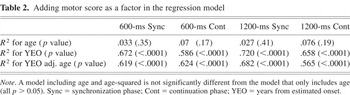
Adding motor score as a factor in the regression model only significantly improved the fit for the 1200-ms Sync condition (p < .01). This effect was carried by the two participants with high motor scores (motor score = 11, YEO = 5.2; motor score = 5, YEO = 19.5; Table 2).
Adding motor score as a factor in the regression model

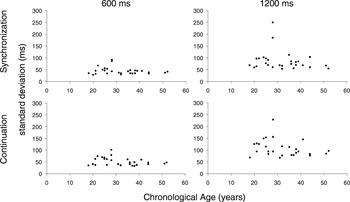
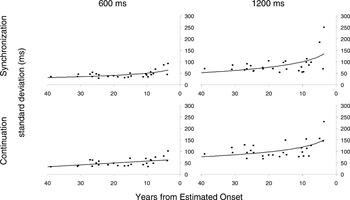
Scatterplots in Figure 1 demonstrate that chronological age did not correlate with measures of variability for the 600-ms Sync, 600-ms Cont, 1200-ms Sync, or 1200-ms Cont conditions. In contrast, Figure 2 demonstrates that variability generally increased as YEO decreased (p < .05). The increases were curvilinear except for the 600-ms Cont condition, in which the increase was linear.

Motor timing variability [standard deviation of the inter-response interval (IRI)] plotted as a function of age. Data are presented for the synchronization and continuation phases for the 600- and 1200-ms interstimulus intervals (ISIs).

Motor timing variability [standard deviation of the inter-response interval (IRI)] plotted as a function of years from estimated onset (YEO) of motor symptoms. Data are presented for the synchronization and continuation phases for the 600- and 1200-ms interstimulus intervals (ISIs). Significant linear and nonlinear regressions are indicated with trend lines (p < .05).
With one exception, no statistically significant correlations were observed between accuracy and either chronological age or YEO. For the 1200-ms Sync condition, participants closer to diagnosis were less accurate, characterized by longer mean IRI, than those farther from diagnosis (r = −0.32, p < .05).
Because the timing outcomes are correlated, a MANCOVA on the variability in the four timing outcomes with YEO was used to test the overall relationship. The MANCOVA was significant both for the linear term (p < .0065) and the quadratic term (p < .016). After adjusting for motor score, both terms were still significant (p < .029 and p < .034, respectively). Residual analysis confirmed the choice of the models as being appropriate because neither abnormal residuals nor abnormal patterns in the residuals were observed.
DISCUSSION
Our data confirmed that chronological age alone is not a strong predictor of PFT performance in pre-HD participants. In contrast, YEO, which incorporates both CAG trinucleotide repeat length and chronological age as predictors (Langbehn et al., 2004), was significantly related to PFT performance. Specifically, we observed increased PFT variability as YEO decreased. This pattern was found for the Sync and Cont phases at both the 600- and 1200-ms tapping intervals. The relationships were mostly curvilinear, suggesting that PFT variability increases at an accelerating rate as YEO decreases. In contrast, PFT accuracy was not strongly related to age or YEO. Motor score was added as a factor to the curvilinear model of performance as a function of YEO. This modification only improved the fit for the 1200-ms Sync condition, suggesting that these effects are more properly characterized as specific timing deficits rather than being attributable to motor difficulties.
Various other studies have examined presymptomatic gene carriers as a group or have examined structural measures as a function of YEO (e.g., Aylward et al., 1996, 2000, 2004; Campodonico et al., 1998). However, to our knowledge, this report is among the first studies to examine behavioral measures in pre-HD as a function of YEO, although another study's findings have suggested this relationship (Paulsen et al., 2001). This study contributes additional evidence that PFT variability can be a sensitive gauge of impaired basal ganglia function. These findings complement our previous study in patients with Parkinson's disease (Elsinger et al., 2003), in which PFT variability was significantly greater than in controls. Our results also provide support for the view that timing behaviors are more generally disrupted in pre-HD participants. In a previous study, we demonstrated that a similar group of pre-HD participants less than 12 YEO were impaired on a time-discrimination task relative to healthy controls (Paulsen et al., 2004).
While the present cross-sectional study has demonstrated that increased PFT variability may serve as a sensitive index of basal ganglia dysfunction, future studies are needed to determine whether PFT variability is also sensitive to longitudinal changes in pre-HD participants. If this connection were to be established, PFT variability could serve as a reliable preclinical marker for determining the optimal time for initiating neuroprotective treatment meant to forestall or prevent clinical HD onset (Hersch & Rosas, 2001) and for measuring therapeutic efficacy in the context of a clinical trial (Paulsen et al., 2006).
ACKNOWLEDGMENTS
This research was supported by National Institutes of Health (NIH) grants NS40068 and MH01579, the Roy and Lucille Carver Trust, High Q Foundation, Howard Hughes Medical Institute (J.S.P.), NIH grant MH51358 (S.M.R.), the Huntington Disease Society of American Center of Excellence (University of Iowa), and NIH General Clinical Research Center grants RR00058 (Medical College of Wisconsin) and RR00059 (University of Iowa).