


The long-term outcome for patients with depression is poor: for adults, recovery rates at 15-18 years are no better than 20% (Reference Kiloh, Andrews and NeilsonKiloh et al, 1988; Reference Lee and MurrayLee & Murray, 1988). In the medium term, the outcome is also poor for the elderly, with recovery rates ranging from 20.9% to 26% (Reference PostPost, 1972; Reference Baldwin and JolleyBaldwin & Jolley, 1986; Reference Brodaty, Harris and PetersBrodaty et al, 1993). Adults do rather better, with recovery at 3.8 years reaching 47.5% (Reference Brodaty, Harris and PetersBrodaty et al, 1993). Many predictors of poor outcome have been suggested. For the elderly these include incomplete recovery from the index illness, its severity, poor physical health, long duration of illness at presentation, severe adverse life events, male gender, early onset, recurrence of episodes and poor premorbid personality (Reference PostPost, 1972; Reference MurphyMurphy, 1983; Reference Godber, Rosenvinge and WilkinsonGodber et al, 1987; Reference Baldwin and JolleyBaldwin & Jolley, 1986; Reference Brodaty, Harris and PetersBrodaty et al, 1993). For adults predictors include incomplete recovery from preceding illness and endogenous depression (Reference Kiloh, Andrews and NeilsonKiloh et al, 1988), female gender, recurrence and psychotic depression (Reference Lee and MurrayLee & Murray, 1988).
This study represents an extended follow-up to one reported earlier (Reference TumaTuma, 1996), to determine changes in outcome between 1 and 4.5 years and to re-examine outcome predictors.
METHOD
Patients who met Feighner's (Reference Feighner, Robins and Guze1972) criteria for major depression and who had received in-patient, out-patient, day patient or home treatment, either during the year 1991 (adults, i.e. under 65) or during 1991 and 1992 (elderly, i.e. 65 or over) were included. All case notes for new referrals were carefully examined. Those who suffered from schizophrenia or a paranoid state, alcohol misuse, or Feighner's criteria for secondary depression were excluded, as were patients with any degree of cognitive dysfunction and patients with severe personality disorder. Melancholic-type depression and its severity were assessed from case notes using DMS-III-R criteria (American Psychiatric Association, 1987). Patients' demographic data, mental health and physical health were recorded at entry, at 1 year and at 4.5 years. The outcome was assessed using Post's (Reference Post1972) criteria: lasting recovery with no relapse; recovered, relapsed and currently recovered; residual symptoms but did not meet criteria for caseness; and chronic depression reaching caseness but with fluctuating severity. In this series, relapse was considered as recurrence of the illness at any time during the follow-up period. All patients were subjected to survival analysis, to determine the pattern of recovery over time. Cox's proportional hazards model analysis was used to examine factors which affected recovery time.
At entry there was a total of 110 patients: 56 adults and 54 elderly, with a ratio of women to men of 2:1. Four and a half years later there were 85 survivors, and 70 of these were interviewed by T.A.T. blind to the one-year assessment, using a semi-structured format. For the 15 remaining, details of mental and physical health were obtained from general practitioners, keyworkers or close relatives (often more than one source); they were not interviewed because of refusal (3), severe physical frailty (7) or forgetfulness (5). Relatives were interviewed when additional information was needed. The Minitab package (1993) was used to analyse discrete and continuous data and the Mathsoft (1998) package for logistical regression, survival analysis and Cox proportional hazards model analysis.
RESULTS
Outcome and its changes between 1 and 4.5 years (Table 1)
The adults did well, with a recovery rate of 42.8% after 4.5 years. If natural deaths (n=6) were excluded, this group did slightly better, with a recovery rate rising to 48%.
Outcome at 1 year and 4.5 years using Post's criteria (Reference PostPost, 1972)

| Outcome | 1 year | 4.5 years | 4.5 years (natural deaths removed) | |||||||||
|---|---|---|---|---|---|---|---|---|---|---|---|---|
| Adults (n = 56) | Elderly (n = 54) | Adults (n = 56) | Elderly (n = 54) | Adults (n = 50) | Elderly (n = 36) | |||||||
| n | % | n | % | n | % | n | % | n | % | n | % | |
| Lasting recovery | 25 | (44.6) | 24 | (44.4) | 24 | (42.8) | 13 | (24) | 24 | (48) | 13 | (36) |
| Relapsed & recovered | 13 | (23.2) | 13 | (24) | 15 | (27.7) | 11 | (19.6) | 15 | (30) | 11 | (30) |
| Residual symptoms | 11 | (19.6) | 7 | (13) | 6 | (10.7) | 2 | (3.7) | 6 | (12) | 2 | (5.5) |
| Chronic | 4 | (7.1) | 3 | (5.5) | 3 | (5.3) | 2 | (3.7) | 3 | (6) | 2 | (5.5) |
| Deaths | ||||||||||||
| Natural | 2 | (3.6) | 5 | (9.2) | 6 | (10.7) | 18 | (33.3) | - | - | - | - |
| Suicide | 1 | (1.7) | 0 | (0) | 1 | (1.7) | 0 | (0) | 1 | (2) | 0 | (0) |
| Dementia | 0 | (0) | 2 | (3.7) | 1 | (1.7) | 8 | (14.8) | 1 | (2) | 8 | (22) |
The elderly were less likely to recover and much more likely to die (33.3%) or to develop dementia (14.8%) than the younger adults. The death rates exceeded those predicted from Office of Population Censuses & Surveys tables: observed death rates=33.3%; expected=22.7% (Office of Population Censuses & Surveys, 1980-1982). However, if the natural deaths were removed from the two groups, the recovery rate for the elderly was still lower than that for the adults (36% v. 48%), but not significantly so (χ2=1.4; d.f.= 1, P=0.2).
Most striking is the decline in the percentage of elderly patients allocated to the best possible outcome category of ‘lasting recovery’. By contrast, the recovery rate shown at one year for the adult group had largely been maintained. The percentages of patients allocated to the ‘residual symptoms’ and ‘chronic’ categories fell in both cohorts, but improvement was confined to the younger patients. Of 15 adults in these categories at year one, three were fully recovered at the date of the extended follow-up, and three were now in the ‘relapse and recovery’ category. None of the elderly had improved in this way. Dementia, when it developed, tended to occur late: at two years the number of cases with dementia had not increased above that seen at one year (two elderly cases only). By 4.5 years, one adult and eight elderly had become demented, the latter being greatly in excess of the figure expected from earlier studies (Reference Bergmann, Kay and FosterBergmann et al, 1971).
Sixteen adults and 19 elderly suffered relapses between the two follow-ups. Of the adults, 10 relapsed with depression, one with obsessional neurosis and the remaining five with two illnesses (albeit not concurrently): three with depression and mania, and two with depression and paranoid psychosis. Of the elderly, 13 relapsed with depression, one with anxiety neurosis, and the remaining five with two illnesses (again not occurring concurrently): two with depression and mania, one with depression and anxiety neurosis, one with depression and paranoid psychosis and one with mania and paranoid psychosis.
Treatments given and the settings
There were no significant differences between the psychiatric treatments received by the two groups (Table 2). When in-patient treatment was necessary, the elderly did not stay significantly longer in hospital (adults: mean length of stay=13.3 weeks; elderly=14.5 weeks). A significant excess of elderly patients was resident in nursing homes at follow-up, and nine had needed in-patient treatment for physical illnesses.
Treatments given and settings1

| Adults (n = 53) | Elderly (n = 49) | |
|---|---|---|
| Treatments for physical illnesses (e.g. antibiotic, analgesic etc.) | 20 | 21 |
| Treatments for psychiatric illnesses | ||
| TCA/SSRI | 19 | 25 |
| MAOI | 3 | 2 |
| Electroconvulsive therapy | 4 | 5 |
| Lithium &/or carbamazepine/sodium valproate | 17 | 12 |
| Minor tranquilliser | 4 | 4 |
| Major tranquilliser | 11 | 8 |
| Hypnotic | 3 | 8 |
| Settings for treatments | ||
| In-patient | 14 | 14 |
| Out-patient | 12 | 19 |
| Out-patient and/or day patient | 27 | 30 |
| Patient resident in nursing home | 1 | 102 |
| Patient needing hospital treatment for physical illnesses | 1 | 93 |
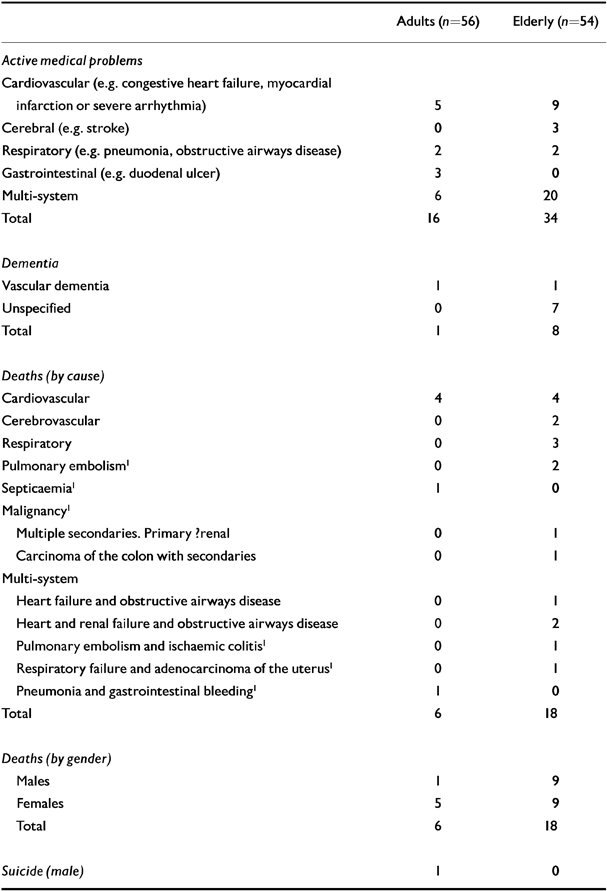
Physical health, causes of death and dementia (Table 3)
Thirty-four elderly patients had medical problems which required active medical treatment, as against 16 in the adult group. Of the 34 elderly, nine needed in-patient medical treatment (three for cardiovascular disease, two for respiratory diseases, two for mini-strokes, one for a fractured left femoral neck and one for a duodenal ulcer). Their mean length of stay in hospital was 14.6 weeks. One adult needed eight weeks' in-patient treatment for Crohn's disease (partial colectomy and ileostomy). When dementia developed it started on average 34.7 months after the start of the index illness (see also Table 2).
Physical illness, dementia and cause of death
| Adults (n = 56) | Elderly (n = 54) | |
|---|---|---|
| Active medical problems | ||
| Cardiovascular (e.g. congestive heart failure, myocardial infarction or severe arrhythmia) | 5 | 9 |
| Cerebral (e.g. stroke) | 0 | 3 |
| Respiratory (e.g. pneumonia, obstructive airways disease) | 2 | 2 |
| Gastrointestinal (e.g. duodenal ulcer) | 3 | 0 |
| Multi-system | 6 | 20 |
| Total | 16 | 34 |
| Dementia | ||
| Vascular dementia | 1 | 1 |
| Unspecified | 0 | 7 |
| Total | 1 | 8 |
| Deaths (by cause) | ||
| Cardiovascular | 4 | 4 |
| Cerebrovascular | 0 | 2 |
| Respiratory | 0 | 3 |
| Pulmonary embolism1 | 0 | 2 |
| Septicaemia1 | 1 | 0 |
| Malignancy1 | ||
| Multiple secondaries. Primary ?renal | 0 | 1 |
| Carcinoma of the colon with secondaries | 0 | 1 |
| Multi-system | ||
| Heart failure and obstructive airways disease | 0 | 1 |
| Heart and renal failure and obstructive airways disease | 0 | 2 |
| Pulmonary embolism and ischaemic colitis1 | 0 | 1 |
| Respiratory failure and adenocarcinoma of the uterus1 | 0 | 1 |
| Pneumonia and gastrointestinal bleeding1 | 1 | 0 |
| Total | 6 | 18 |
| Deaths (by gender) | ||
| Males | 1 | 9 |
| Females | 5 | 9 |
| Total | 6 | 18 |
| Suicide (male) | 1 | 0 |
Recovery time and its predicting factors
Survival analysis and the Cox proportional hazards model were applied to all the 110 patients and zero time was taken as the start of treatment for the index illness. The survival curve showed no difference in the recovery time between the adult and the elderly groups, with over 90% having recovered in 25 weeks. The Cox proportional hazards model was applied and the relationship between recovery time and duration of illness at intake was linearised by using the log (duration) transformation. The factors listed in Table 4 are those which significantly extended the recovery time.
Predictors of recovery time

| Factor | Log odds | 95% Cl | P |
|---|---|---|---|
| Active medical problem | 1.6 | 1.03-2.5 | 0.03 |
| Log. duration of illness | 1.5 | 1.08-2.08 | 0.01 |
| No. of previous episodes | 1.26 | 1.046-1.5 | 0.01 |
| Melancholic illness | 1.99 | 1.36-2.9 | 0.00043 |
Factors associated with failure to recover
In judging factors associated with poor recovery from depression, the high death rate in the elderly (33.3%) was considered to be a confounding factor. Accordingly, natural deaths were removed from each cohort. The outcome variables were dichotomised: complete recovery v. non-recovery (all others). Applying the χ2 test, in the adults non-recovery was associated with melancholic illness (χ2=4.86, d.f.=1, P=0.027), depression of moderate/great severity (χ2=7.5, d.f.=1, P=0.01) and past history of affective illness (χ2=14.1, d.f.=1, P=0.002). In the elderly, only active medical problems were associated with poor recovery (χ2=5.06, d.f.=1, P=0.02). When multivariate logistical regression was applied, melancholic illness was found to be a poor outcome predictor in the adults (odds ratio=3.74, 95% CI=1.12-12.5, P=0.016), but such analysis could not identify a poor outcome predictor in the elderly.
DISCUSSION
Pattern of outcome in the two groups
The most striking findings in the outcome study after one year were the relatively good prognosis for depression in the elderly, and the lack of any major difference in outcome between the adult and elderly cohorts. The extended follow-up reveals a different picture, with the elderly now faring less well. However, an important aspect of the difference between the cohorts is the excess of deaths and cases of dementia among the elderly, rather than an excess of patients with frequent relapses or continuing depression. Nevertheless, it may be significant that while some of the adults with continuing depression at one year had gone on to partial or full recovery 3.5 years later, none of the older patients had done so.
Survival curve for recovered adults and elderly (the curve shows that over 90% of patients achieved lasting recovery within 25 weeks). Dotted lines indicate 95% confidence intervals.

Comparison with other studies
Death rates were higher than would be expected from the Office of Population Censuses & Surveys statistics and from those reported by Brodaty et al (Reference Brodaty, Harris and Peters1993) for their elderly cohort. However, these latter patients were younger (entry age 60 rather than 65), their follow-up interval rather (16%) shorter, and their elderly patients recruited from a specialist affective disorder treatment unit, rather than a psychogeriatric facility which recruits some patients with poor physical health via geriatric liaison. High death rates among the elderly with depression have been widely reported (Reference O'Brien and AmesO'Brien & Ames, 1994), but this present study, like so many others, sheds no light on the question why. In this series cardio-vascular and respiratory diseases, either individually or combined with other system disorders, were important causes of death. Malignant diseases did not feature as a common cause of death, in contrast to other findings (Reference O'Brien and AmesO'Brien & Ames, 1994).
The relatively high incidence of dementia among the elderly will come as little surprise to clinicians, but challenges the view that the major mental disorders of old age represent separate entities with little tendency to overlap - a view frequently expounded by Roth (Reference Roth1955) and based on his seminal studies of outcome. It should be remembered that outcome was measured in those studies at just two years after admission - a longer follow-up might have yielded a result closer to that reported here. The present study was based upon outcome in an admittedly small cohort, but appears to show dementia to be a significant, albeit late, complication arising in the majority of cases in the third year and beyond.
Outcome levels are comparable with those reported by other workers, both for elderly and adult patients, but it must be regarded as disappointing that recovery rates among the elderly (24%) are slightly worse than those reported by Felix Post over a quarter of a century ago (26% at three years; Reference PostPost, 1972).
Factors predicting outcome
Factors which significantly reduce the chances of recovery - melancholic illness, chronicity, severity of index illness, and a past history of affective disorder (especially where previous episodes have been often repeated) - have all been reported before. That the most reliable statistic, that of multivariate logistical regression, denies the significance of all save melancholic illness, both at 1 year and at 4.5 years (in the adult cohort alone), raises the question of whether the other, more traditionally recognised, factors should now be discounted; however, the reduction in numbers in the elderly cohort by death may have reduced the sample size to a level where factors affecting recovery were obscured. Although the fact that it was possible to assess only 80% of the cohort fully must be regarded as a potential weakness in the study, all were traced and the reports from various sources were consistent.
Overall, the findings remind us that although depressive illness is arguably the most treatable of all psychiatric disorders, irrespective of age of onset, if lasting recovery is the aim, it is also one of the most difficult. The fact that some younger patients, chronically ill at one year, can proceed to partial or full recovery 3.5 years later, reminds us of the need to persevere with active treatments, and always to keep in mind Roth's aphorism: “While there is depression, there is hope” (Reference RothRoth, 1955).
Clinical Implications and Limitations
CLINICAL IMPLICATIONS
-
▪ The good prognosis of depression shown by the elderly at one year is not sustained.
-
▪ Deterioration in the elderly is usually in the direction of dementia or premature death.
-
▪ Apparent chronic depression in adults requires continuing active treatment.
LIMITATIONS
-
▪ The relatively small sample size may have obscured some of the findings.
-
▪ Final assessment of the survivors was only carried out personally in 80% of cases.
-
▪ The treatment received by the two groups was not controlled.
ACKNOWLEDGEMENTS
I am most grateful to Dr G. Blessed for his help while conducting the study and drafting the paper and to Dr Ross Darnell for his prompt advice and statistical analyses. I also thank the consultant psychiatrists at Newcastle General Hospital, The Royal Victoria Infirmary and St Nicholas Hospital, Newcastle upon Tyne, for allowing me to interview their patients, and in particular Julie Shaw for her patience and skill in producing and amending drafts.




eLetters
No eLetters have been published for this article.