Flaxseed, a rich source of α-linolenic acid (LNA) contains about 40% fat and 20% crude protein (CP) in the dry matter (DM) (Petit, Reference Petit2003), which makes it a good source of energy and protein for milk production. The proportions of LNA in flax hull and flax oil average, respectively, 52·9 and 53·7% of total fatty acids (FA), which make them good sources of LNA to modify milk FA profile (Kazama et al. Reference Kazama, Côrtes, da Silva, Gagnon, Benchaar, Zeoula, Santos and Petit2010). Feeding flaxseed up to 15% of the DM has been shown to have no effect on milk production or composition and limited effect on DM intake (DMI) in most of the studies (Petit, Reference Petit2010). However, the effects of flax oil supplementation on feed intake and milk production have been variable. For example, adding 4% flax oil in the diet had no effect on DMI but increased milk yield (Bu et al. Reference Bu, Wang, Dhiman and Liu2007) while supplementation at 3% of the DM had no effect on DMI and milk yield (Loor et al. Reference Loor, Ferlay, Ollier, Doreau and Chilliard2005). Similarly, abomasal infusion of 500 g/d of flax oil had no effect on DMI and milk yield of mid-lactating dairy cows (Petit et al. Reference Petit, Dewhurst, Scollan, Proulx, Khalid, Haresign, Twagiramungu and Mann2002). On the other hand, supplementation of flax oil at 5·7% of the DM reduced DMI and milk yield of dairy cows (Martin et al. Reference Martin, Rouel, Jouany, Doreau and Chilliard2008). Moreover, DMI tended to decrease and milk yield was significantly lower when LNA was infused in the abomasum at a rate of 160 g/d as a free FA mixture (Khas-Erdene et al. Reference Khas-Erdene, Wang, Bu, Wang, Drackley, Liu, Yang, Wei and Zhou2010). Lower DMI with flax oil supplementation cannot be fully explained by disturbances in rumen function as digestibility remained unchanged in some cases (Martin et al. Reference Martin, Rouel, Jouany, Doreau and Chilliard2008). According to Chilliard (Reference Chilliard1993), it is possible that the FA intake has a direct inhibitory effect on voluntary intake via the inhibition of ruminoreticular motility.
Flax hull is a co-product obtained from flax processing that contains 24% CP and 30% ether extract in the DM (Gagnon et al. Reference Gagnon, Côrtes, Da Silva, Kazama, Benchaar, Dos Santos, Zeoula and Petit2009), which makes it an interesting feed ingredient for the diet of dairy cows. Indeed, feeding 20% flax hull in the DM had no effect on 4% fat-corrected milk yield although DMI was decreased (Petit et al. Reference Petit, Côrtes, Da Silva, Kazama, Gagnon, Benchaar, Dos Santos and Zeoula2009). Recent results have shown that the site of flax oil and flax hull administration has important effects on DMI and milk yield. Kazama et al. (Reference Kazama, Côrtes, da Silva, Gagnon, Benchaar, Zeoula, Santos and Petit2010) have demonstrated that cows receiving 0·4 kg flax oil and 1·8 kg flax hulls in the abomasum had higher total DMI and 4% fat-corrected milk yield (18·5 and 24·6 kg/d, respectively) than those administered with the same amounts of flax products in the rumen (15·4 and 20·4 kg/d, respectively). As there is little information on the amount of flax oil required to reach the small intestine in order to supply enough LNA in milk fat to meet the recommended dietary intake of LNA for consumers, infusion of flax oil in the abomasum was performed to avoid ruminal biohydrogenation. This may also contribute to better understanding of fat digestion and utilization in dairy cows. Moreover, there is little information on the potential of flax hull as feed ingredient for milk production and data on digestion are scarce. The potential use of flax hull as a feed ingredient for milk production with or without rumen bypass of flax oil supplementation for milk enrichment in LNA remains also to be determined. Therefore, the objective of the present study was to investigate the effects of abomasal infusion of increasing amounts of flax oil on apparent digestibility, DMI, milk production, milk composition, and milk FA profile with emphasis on the proportion of LNA when cows are supplemented or not with another source of LNA such as flax hull.
Materials and Methods
Cows and diets
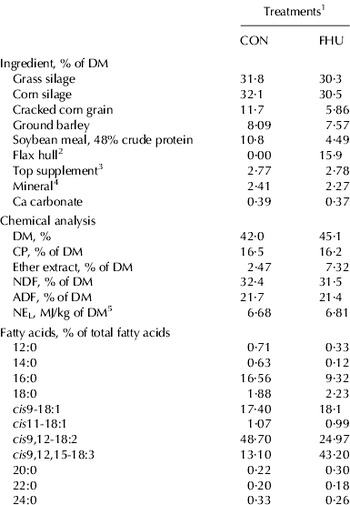
Six multiparous lactating Holstein cows fitted with ruminal cannulas (10 cm, Bar Diamond Inc., Parma, ID) were used in a 2×3 factorial arrangement of treatments and six 21-d periods balanced for residual effect. At the start of the experiment, the cows averaged 95±20 d in milk, 650±36 kg body weight, and 3·00±0·15 body condition score (5-points scale; Edmonson et al. Reference Edmonson, Lean, Weaver, Farver and Webster1989). Cows were kept in individual stalls and had free access to water. Cows were milked twice a day at 0830 and 2000 h. All cows were fed for ad libitum intake (10% refusals on as fed basis) twice a day at 0830 and 1430 h. The diets (Table 1) were formulated to meet requirements for cows producing 35 kg milk/d with 3·8% fat (NRC, 2001). The experimental protocol complied with the Guide to Care and Use of Experimental Animals of the Canadian Council on Animal Care (CCAC, Reference Offert, Cross and McWilliam1993) and was approved by the local animal care committee.
Ingredient, chemical composition and fatty acid profile of total mixed diets of Holstein cows fed no flax hull (CON) or 15·9% flax hull (FHU) in the DM

1 Mean of six samples that were prepared by compositing seven daily samples collected and accumulated during the digestibility trial
2 Contained on DM basis 29·8% ether extract, 23·7% CP, 14·25% ADF, and 19·2% NDF
3 Contained 20% of canola meal, 30% of corn gluten meal, 20% of soybean meal, and 30% of brewer's corn
4 Contained 9·02% Ca, 4·90% P, 4·89% Mg, 1·76% S, 14% Na, 1·43% K, 2068 mg/kg Fe, 2718 mg/kg Zn, 447 mg/kg Cu, 1814 mg Mn, 69 mg/kg I, 7 mg/kg Co, 20 mg/kg Se, 452,000 IU/kg of vitamin A, 58,000 IU/kg of vitamin D3, and 2692 IU/kg of vitamin E
5 Calculated using published values of feed ingredients (NRC, 2001)
Treatments were: 1) control, neither flax hull nor flax oil (CON), 2) diet containing (DM basis) 15·9% flaxseed hull (FHU); 3) CON with abomasal infusion of 250 g flax oil/d; 4) CON with abomasal infusion of 500 g flax oil/d; 5) FHU with abomasal infusion of 250 g flax oil; /d 6) FHU with abomasal infusion of 500 g flax oil/d. During the first seven days of each 21-d period, only 30% of the experimental dose of oil was infused in the abomasum over a 7-h period. From d 8 to d 21, infusion in the abomasum was conducted with 100% of the experimental dose of oil over a 23-h period. The appropriate amount of oil used for infusion was prepared daily for each cow and was weighed into tarred bottles. To perform abomasal infusions, an infusion line was inserted through the rumen cannula and the sulcus omasi into the abomasum as described by Gressley et al. (Reference Gressley, Reynal, Colmenero, Broderick and Armentano2006). Placement of the infusion lines was monitored daily to ensure postruminal delivery. Solutions were pumped into the abomasum by using peristaltic pumps (Masterflex L/S; Cole-Parmer Canada Inc., Montreal, QC, Canada).
Sampling
Cows were weighed on three consecutive days at the beginning and the end of each period after the morning milking. Samples of diets and flax hulls were taken daily from d 14 to d 21 and pooled by cow within period. All samples were frozen at −20°C for subsequent drying at 55°C for 48 h. To predict faecal output and digestibility, a capsule of chromic oxide (Cr2O3) was inserted in the rumen once daily at 0800 h throughout the experiment, supplying a total of 10 g Cr2O3/d. Faecal grab samples were taken twice daily at 0830 and 1630 h from d 15 to d 19. Faecal samples were dried at 55°C for 48 h and pooled on a DM basis by cow within period for further chemical analysis. Faecal and feed samples were ground through a 1-mm screen in a Wiley mill for further analysis. All samples were frozen at −20°C until subsequent chemical analysis.
Milk samples were taken from d 16 to 21 and pooled on a yield basis to obtain one milk sample per cow per period. One sample was kept frozen without preservative for further analyses of fat and FA profile. Another sample was stored at 4°C with bronopol-B2 until analyzed for protein, urea N and lactose.
Chemical analysis
Dry matter of diets was determined in a forced-air oven according to the procedure 934·01 (AOAC, 1990). Total N content of milk, diets and faeces was determined by thermal conductivity (LECO model FP-428 Nitrogen Determinator, LECO, St. Joseph, MI). The concentration of neutral detergent fibre (NDF) in diets and faeces was determined as described by Van Soest et al. (Reference Van Soest, Robertson and Lewis1991) without the use of sodium sulphite and with the inclusion of heat stable α-amylase. The acid detergent fibre (ADF) content in diets and faeces was determined according to AOAC (1990; Method 973·18). The NDF and ADF procedures were adapted for use in an ANKOM200 Fibre Analyzer (ANKOM Technology Corp., Fairport, NY, USA). Concentrations of ether extract in diets and faeces were conducted according to the method No. 7.060 (AOAC, 1990). Lactose and urea N concentrations in milk samples were analyzed by infrared spectrophotometer (System 4000 Milkoscan; Foss Electric of Hillerod, Denmark). Milk fat concentration was determined by the method of Rose-Gottlieb (AOAC, 1990). Fatty acids in diets and flax oil were directly methylated by in situ transesterification according to Park & Goins (Reference Park and Goins1994). The amount of FA in diets and flax hull was not quantified as no internal standard was used (Park & Goins, Reference Park and Goins1994). Milk fat was extracted and FA were methylated according to the methods described by Chouinard et al. (Reference Chouinard, Girard and Brisson1997). Identification of individual FA in milk, diets and flax oil was done by a GLC (Agilent 6890; Agilent Ltd., Mississauga, ON, Canada) equipped with a 100-m Varian (Toronto, ON, Canada) fused silica capillary column fitted with a flame ionization detector using H2 as carrier gas, according to the methods described by Côrtes et al. (Reference Côrtes, da Silva-Kazama, Kazama, Gagnon, Benchaar, Santos, Zeoula and Petit2010).
Statistical analysis
All results were analyzed using the MIXED procedure of SAS (2000) within a 2×3 factorial arrangement of treatments. Data on DMI, digestion, milk production, milk composition and FA profile in milk were analyzed using a 6×6 Latin square design with the following general model:

Where: Yijkl=dependent variable, μ=overall mean, Ci= random effect of cow (i=1 to 6), Pj=fixed effect of period (j=1 to 6), Tk=fixed effect of treatment (l=CON-0, CON-250, CON-500, FHU-0, FHU-250, FHU-500), and eijk=random residual error. The residual effect was initially included in the model but was removed when it was not significant. Treatments were compared to provide factorial contrasts: 1) with vs. without flaxseed hulls, 2) with vs. without abomasal infusion of flax oil, 3) linear and quadratic effects of abomasal infusion of flax oil, and 4) the interaction between flax hulls and abomasal infusion of flax oil. Significance was declared at P⩽0·05 and a trend at 0·05<P⩽0·10, unless otherwise stated. When a significant F-test was detected, multiple comparisons were done using a Tukey's adjustment for the probability.
Results and Discussion
Dry matter intake and diet apparent digestibility
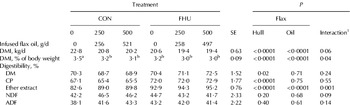
The actual amounts of oil administered in the abomasum averaged, respectively, 256, 258, 521, and 497 g/d for treatments CON-250, FHU-250, CON-500, and FHU-500. There was a trend (P=0·06) for a significant interaction between flax hull and flax oil for DMI, expressed in kg/d (Table 2). When DMI was expressed as a percentage of body weight, there was a significant interaction (P=0·04) between hull and oil: DMI was decreased with flax hull supplementation as previously reported for cows fed 20% flax hull (Petit et al. Reference Petit, Côrtes, Da Silva, Kazama, Gagnon, Benchaar, Dos Santos and Zeoula2009) and there was a negative effect of oil infusion on DMI. Some authors have reported that abomasal infusion of unsaturated long-chain FA decreased DMI of dairy cows (Benson & Reynolds, Reference Benson and Reynolds2001; Litherland et al. Reference Litherland, Thire, Beaulieu, Reynolds, Benson and Drackley2005; Martin et al. Reference Martin, Rouel, Jouany, Doreau and Chilliard2008) while dietary supplementation with 0·63 (Bu et al. Reference Bu, Wang, Dhiman and Liu2007) and 0·86 kg/d (Bu et al. Reference Bu, Wang, Dhiman and Liu2007; Loor et al. Reference Loor, Ferlay, Ollier, Doreau and Chilliard2005) had no effect. In the present experiment, the total amount of oil supplied by the diet and infusion was higher than those fed in other experiments, with averages of 0·56, 0·77, 1·02, 1·51, 1·77, and 1·92 kg/d for treatments CON-0, CON-250, CON-500, FHU-0, FHU-250, and FHU-500, respectively. The more pronounce decrease in DMI with flax oil infusion and flax hull supplementation observed in the present experiment may therefore result of a greater amount of oil supplied in the present experiment than in previous ones. Choi & Palmquist (Reference Choi and Palmquist1996) and Litherland et al. (Reference Litherland, Thire, Beaulieu, Reynolds, Benson and Drackley2005), reported that increased concentrations of triglycerides and free FA in the small intestine are correlated with increased concentrations of gut hormones such as cholecystokinin and glucagon-like peptide-1 in the plasma, which may result in satiety and reduction of gut motility and decreased DMI. This is corroborated by the results of Relling & Reynolds (Reference Relling and Reynolds2007) who found that DMI was the lowest and concentration of glucagon-like peptide-1 in plasma of dairy cows was the highest when fats with high proportions of monounsaturated and polyunsaturated FA were fed. Moreover, Benson et al. (Reference Benson, Reynolds, Humphries, Rutter and Beever2001) hypothesized that long chain FA are utilized differently in early, compared with mid-lactation cows, suggesting that the negative effect of lipid supplementation on DMI becomes more important as lactation progresses. As cows were in mid-lactation in the present experiment, cow DMI may have been more negatively affected by the level of fat in the diet compared with other studies using early lactation cows where the effect of dietary fat on DMI is less important (Gagliostro & Chilliard, Reference Gagliostro and Chilliard1991).
Dry matter intake (DMI) and apparent digestibility of Holstein cows fed total mixed diets containing no flax hull or 15·9% flax hull and infused with increased amounts of flax oil in the abomasum

a,b Values in a same row with a different superscript are significantly different (P⩽0·05)
1 Interaction Flax hull×Flax oil supplementation
There was no significant interaction between hull and oil for apparent digestibilities of DM, CP, NDF, and ADF. Oil infusion had no effect on digestibility of DM, CP, NDF, and ADF (Table 2). As digestibility of fibre depends mainly on ruminal microbial digestion, it is expected that rumen bypass of oil will have little effect on it as observed in the present study. This result agrees with the similar total tract digestibility of DM, CP, and ADF reported for dairy cows fed 2·6% (Doreau et al. Reference Doreau, Aurousseau and Martin2009), 3% (Ueda et al. 2003) or 0, 2, 3, and 4% flax oil in a diet based on a mixture of 24% grass silage and 24% corn silage (Benchaar et al. Reference Benchaar, Eugène, Côrtes, Chaves, Petit, McAllister, Iwaasa and Chouinard2008), which is similar to the type of forages used in the present experiment. Flax oil infusion had no effect on digestibility of DM and CP but flax hull supplementation enhanced it probably due to partial replacement of less digestible feed ingredients, such as cracked corn grain and soybean meal by flax hulls (Table 1). There was a significant interaction for apparent digestibility of ether extract due to lower digestibility for cows fed CON than for those fed the other diets. Flax oil infused in the abomasum may have increased the proportion of easily digestible lipids, which may have contributed to higher ether extract apparent digestibility. Moreover, the CON diet contained more non-nutritive lipid, such as waxes compared with the flax hull based diets, which would have contributed to lower digestibility of ether extract. Compared with diets with flaxseed hulls, those without flaxseed hulls contained more saturated FA, which are less digestible than unsaturated FA (Byers & Schelling, Reference Byers and Schelling1993), such as those present in flax hulls.
Milk production and composition
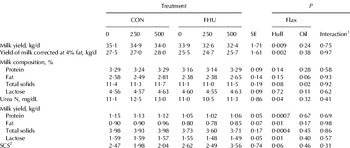
There was no interaction (P >0·05) between hull and oil for milk production and milk composition (Table 3). Supplementation of flax hull in the diet reduced milk yield with no effect on milk concentrations of protein, fat, total solids, and lactose, thus resulting in decreased yields of milk corrected for 4% fat and milk components. Lower milk yields for cows supplemented with flax hull are likely the result of decreased DMI, which is in agreement with the depression in DMI and milk yield previously reported for cows fed 20% flax hull in the diet (Petit et al. Reference Petit, Côrtes, Da Silva, Kazama, Gagnon, Benchaar, Dos Santos and Zeoula2009). Milk urea N concentration was lower (P<0·04) for cows supplemented with flax hull compared with those fed the control diets, suggesting that N utilization by cows fed the flax hulls based-diet was more efficient than that of cows fed the control diets.
Milk production and composition of Holstein cows fed total mixed diets containing no flax hull or 15·9% flax hull and infused with increased amounts of flax oil in the abomasum

1 Interaction Flax hull×Flax oil supplementation
2 Somatic cell score=log10(somatic cell count)
Abomasal infusion of flax oil had no effect on milk production, 4% fat-corrected milk yield, milk concentrations of protein, lactose and urea and yields of milk components (Table 3). However, greater amounts of flax oil infused in the abomasum tended (P=0·06) to increase milk fat concentration and significantly increased concentration of total solids in milk. Similar increases in milk concentrations of fat and total solids have been reported by Drackley et al. (Reference Drackley, Overton, Ortiz-Gonzalez, Beaulieu, Barbano, Lynch and Perkinst2007) who infused increasing amounts (0, 250, 500, 750, and 1,000 g/d) of high oleic sunflower FA in the abomasum of dairy cows. The lack of effect of flax oil supplementation on milk yield has been previously reported at 5·2% incorporation of the dietary DM for cows fed a high forage diet with 64·2% grass hay (Roy et al. Reference Roy, Ferlay, Shingfield and Chilliard2006) and for cows fed 2·2 and 4·4% flax oil (Dhiman et al. Reference Dhiman, Satter, Pariza, Galli, Albright and Tolosa2000; Roy et al. Reference Roy, Ferlay, Shingfield and Chilliard2006). On the other hand, a linear increase in milk production has been reported for cows fed 0, 2, 3, and 4% flax oil in the DM (Benchaar et al. Reference Benchaar, Eugène, Côrtes, Chaves, Petit, McAllister, Iwaasa and Chouinard2008) and higher milk yield for cows supplemented with 4% flax oil in the DM compared with those fed a no fat diet (Bu et al. Reference Bu, Wang, Dhiman and Liu2007).
Milk fatty acid profile
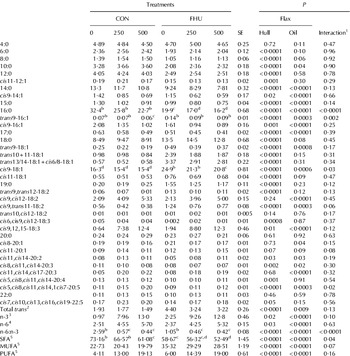
There were significant interactions, between flax hull and flax oil for milk fat proportions of 16:0 (P<0·0001), trans9-16:1 (P=0·002), cis9-18:1 (P=0·03), cis5,cis8,cis11,cis14,cis17-20:5 (P=0·02; Table 4). Milk FA profile of cows fed CON-0 was similar to that of typical milk fat, which contains approximately 4% polyunsaturated, 72% saturated, and 24% monounsaturated FA (Bu et al. Reference Bu, Wang, Dhiman and Liu2007). However, abomasal infusion of flax oil and dietary supplementation with flax hulls had important effects on FA profile of milk fat. Flax hull supplementation decreased proportions of most saturated FA and increased monounsaturated and polyunsaturated FA in milk fat (Table 4), which agrees with the precedent modifications observed following dietary supplementation with long-chain FA (Glasser et al. Reference Glasser, Ferlay and Chilliard2008). Flax oil infusion decreased proportions of saturated FA and monounsaturated FA in milk fat and increased those of polyunsaturated FA.
Percentage of selected fatty acids (g/100 g of total fatty acids) in milk fat of Holstein cows fed total mixed diets containing no flax hull or 15·9% flax hull and increased amounts of flax oil infused in the abomasum

a,b,c,d Values in a same row with a different superscript are different (P⩽0·05)
1 Interaction Flax hull×Flax oil supplementation
2 Sum of trans9-16:1, tran-9-18:1, trans11-18:1, and trans9,trans12-18:2
3 cis9,12,15-18:3+cis11,14,17-20:3+cis5,8,11,14,17-20:5+cis7,10,13,16,19-22-5
4 cis9,12-18:2+cis6,9,12-18:3+cis11,14-20:2+cis8,11,14-20:3+cis5,8,11,14-20:4+cis13,16-22:2
5 SFA=saturated fatty acids; MUFA=monounsaturated fatty acids; PUFA=polyunsaturated fatty acids
Cows fed flax hull had greater proportions of 18:0, 18:1 isomers (cis9-18:1, trans9-18:1 and trans10+11-18:1), non-conjugated 18:2 (trans9,trans12-18:2) and total trans FA in milk fat than those fed the control diets. Cows fed flax hull also had greater proportions of cis9,trans11-18:2 in milk fat than those fed the control diets. Higher intakes of oleic acid (cis9-18:1), linoleic acid (cis9,cis12-18:2) and LNA with flax hull supplementation probably led to greater amounts of these FA in the rumen, and so to a greater production of intermediates (cis9,trans11-18:2, trans10+11-18:1 and 18:0) of ruminal biohydrogenation of unsaturated FA and higher total proportions of trans FA in milk fat. As demonstrated by Chilliard et al. (Reference Chilliard, Ferlay, Mansbridge and Doreau2000), amounts of biohydrogenation intermediates produced in the rumen influence their concentrations in milk and Silva-Kazama et al. (Reference Silva-Kazama, Côrtes, Kazama, Gagnon, Benchaar, Santos, Zeoula and Petit2011) have shown that flax hull supplementation at 19·8% of the DM increased concentrations of trans-18:1 isomers (trans9,trans11,trans13/14+6/8) and cis9,cis12,cis15-18:3 in ruminal fluid. On the other hand, increased amounts of flax oil infused in the abomasum provided post-rumen fat delivery, thus avoiding ruminal biohydrogenation of polyunsaturated FA. As a result, there was a reduction in proportions of cis9,trans11-18:2 conjugated linoleic acid and total trans FA and an increase in those of cis9,cis12-18:2 and cis9,cis12,cis15-18:3 in milk fat (Table 4). Milk fat concentrations of monounsaturated and saturated FA were decreased and those of long-chain FA were increased with abomasal infusion of flax oil probably as a result of enhanced transfer of these FA from the diet into milk due to rumen bypass.
There was a significant interaction (P<0·0001) between flax hull and flax oil for the n-6:n-3 FA ratio in milk fat (Table 4). Cows infused with flax oil in the abomasum had similar and lower ratios of n-6:n-3 FA in milk fat compared with those not infused with oil. The highest n-6:n-3 FA ratio in milk fat was obtained with the CON-0 diet as a result of a lower supply of LNA in the diet and the small intestine. However, all treatments resulted in a n-6:n-3 FA ratio less than 4:1, which is the ideal ratio to reduce potential risk of coronary heart diseases and improve human health (Sim, Reference Sim1998).
There is no recognized requirement for LNA but the recommended adequate dietary intake of LNA was set at 1·6 g LNA/d for men and 1·1 g/d for women (Food and Nutrition Board, 2002). Considering milk standardized at 2% fat that contains a proportion of 7·38% LNA as observed for cows fed CON-250, this means that each 250 ml portion will result in an intake of 369 mg LNA. Using the same concept for cows fed CON-500 (milk at 2% fat and 12·4% LNA), a 250 ml portion of milk will result in an intake of 620 mg LNA. Consumption of 1000 ml and 500 ml milk/d from cows fed CON-250 and CON-500, respectively, may then be enough to meet the recommended dietary intake of LNA for women. Therefore, post-ruminal flow of LNA is very important to increase LNA proportion in milk fat at a level important enough to meet the recommended dietary intake of LNA for consumers. Although this can not be achieved by infusion of flax oil in the abomasum on commercial farms, this demonstrates the importance of finding ways to prevent ruminal biohydrogenation of LNA to increase its transfer in milk fat.
In conclusion, flax hull supplementation at 15·9% of the diet and abomasal infusion of flax oil at a daily rate of 521 g decreased dry matter intake of cows. However, infusion of flax oil in the abomasum had no effect on milk production but cows fed the flax hull based diets had lower milk yield. Abomasal infusion of flax oil had little effect on apparent digestibility of the diet but flax hull supplementation increased apparent digestibility of DM and CP. Flax hull and flax oil increased proportions of polyunsaturated fatty acids and decreased those of saturated fatty acids and the n-6:n-3 ratio in milk fat. Moreover, 1000 ml milk standardized at 2% fat and containing 7·38% LNA produced from cows fed a control diet and infused with 250 ml flax oil in the abomasum can provide 30% of the recommended dietary intake of LNA for women. Therefore, more research is required to prevent ruminal biohydrogenation of LNA to increase its transfer in milk fat.
The authors would like to express their gratitude to the staff of the Dairy & Swine Research & Development Centre for their contribution to the present study. The authors thank V. Roy, S. Dallaire and L. Veilleux at Sherbrooke for technical assistance and Steve Méthot for his help in the statistical analyses. D. da Silva, R. Kazama and G.T. dos Santos received a fellowship from the Conselho Nacional de Desenvolvimento Científico e Tecnológico and Fundação Araucária do Paraná from Brazil and C Côrtes was a recipient of a fellowship from the National Science and Engineering Research Council of Canada. This project was sponsored by Agriculture and Agri-Food Canada.