INTRODUCTION
When cancer is diagnosed in one member of a couple, both individuals' lives change dramatically, and both almost inevitably feel some loss of control (Maliski et al., Reference Maliski, Heilemann and McCorkle2002). Healthy partners often take on new roles in the household (Ben-Zur et al., Reference Ben-Zur, Gilbar and Lev2001) and may face additional complex tasks (Given et al., Reference Given, Given and Kozachik2001) in addition to their efforts to provide physical and emotional support to their ill partner. As a consequence, healthy partners frequently feel overburdened (Ussher & Sandoval, Reference Ussher and Sandoval2008), resulting in psychological distress (Hagedoorn et al., Reference Hagedoorn, Buunk and Kuijer2000) and sometimes even psychiatric disease (Pitceathly & Maguire, Reference Pitceathly and Maguire2003). The prevalence of psychological distress has been reported as roughly 35% in patients, depending on the type (Zabora et al., Reference Zabora, BrintzenhofeSzoc and Curbow2001) and stage of the disease (Holland & Alici, Reference Holland and Alici2010), while among partners approximately 20–30% experience such distress (Compas et al., Reference Compas, Worsham and Eppingjordan1994). Regardless of their role as patient or partner, women are generally more distressed than their male counterparts (Hagedoorn et al., Reference Hagedoorn, Buunk and Kuijer2000). It has been shown not only that patient and partner distress are correlated (Hagedoorn et al., Reference Hagedoorn, Buunk and Kuijer2000; Hodges et al., Reference Hodges, Humphris and Macfarlane2005) but that distress in one can predict the other's future distress (Segrin et al., Reference Segrin, Badger and Harrington2012; Reference Segrin, Badger and Dorros2007). On the other hand, mutual patient/partner support offers the best protection against high-level distress (Douglass, Reference Douglass1997) and enhances relationship satisfaction (Cammack Taylor et al., Reference Cammack Taylor, Badr and Lee2008).
The possibility of impending death encourages some couples to revalue their time spent together, thereby enriching their relationship. More specifically, it is in line with previous reports of reprioritized (Germino et al., Reference Germino, Fife and Funk1995) or strengthened relationships (Badr & Cammack Taylor, Reference Badr and Cammack Taylor2006), increased closeness (Sinding, Reference Sinding2003, Dorval et al., Reference Dorval, Guay and Mondor2005), having more time to explore things within the relationship (Grbich et al., Reference Grbich, Parker and Maddocks2001), and greater appreciation of relationships with others (Kim et al., Reference Kim, Schulz and Carver2007) following the onset of cancer (Ussher et al., Reference Ussher, Tim Wong and Perz2011). One possible explanation is the experience of greater intimacy (Manne et al., Reference Manne, Ostroff and Rini2004). Compared to other contributions to the field, qualitative studies of relationship changes in cancer couples have provided more complex and detailed descriptions of couples' experiences. One strength of qualitative research is that it helps to reveal a topic's complexity through the triangulation of perspectives and methods (Greenhalgh & Taylor, Reference Greenhalgh and Taylor1997).
To date, no published studies have explored relationship changes in those with newly diagnosed advanced-stage malignant melanoma, in whom therapy is either surgery plus systemic therapy (stage III) or systemic therapy alone (stage IV) (Dummer et al., Reference Dummer, Hauschild and Guggenheim2012). The aim of our qualitative study was to gain a deeper understanding about couples' relationship changes over time (over the first six months) after one partner is diagnosed with an incurable advanced melanoma.
The following two research issues were of primary interest:
-
(1) How do couples experience their relationship after the diagnosis of metastatic cancer? Does their relationship change, and, if yes, how?
-
(2) Do the topics of interest change during interviews between baseline and six months postdiagnosis?
In qualitative semistructured interviews, we asked the same open-ended questions regarding possible relationship changes at two points in time: two months (t1) and six months (t2) postdiagnosis. We chose a qualitative study design to gather personal information about subject experiences. We included patients with newly diagnosed advanced-stage malignant melanoma, since advanced malignant melanoma is associated with a poor prognosis and, therefore, high levels of existential distress in patients and their spouses (Hamama-Raz, Reference Hamama-Raz2012, Hamama-Raz et al., Reference Hamama-Raz, Solomon and Schachter2007).
METHODS
The study was approved by the Ethics Committee of the Canton of Zürich. All participants provided their written informed consent prior to inclusion according to the Helsinki Declaration.
Participants
Patients and their partners were recruited from the Department of Dermatology at University Hospital Zürich between April of 2009 and May of 2010. The inclusion criteria for the study were:
-
1. A new diagnosis of advanced melanoma (i.e., stage III or IV, according to the UICC 2009 classification system) made within the previous two months.
-
2. Living in a committed relationship that had been ongoing for a minimum of two years prior to the diagnosis of advanced melanoma.
-
3. Sufficient knowledge of German to be able to converse well in it.
-
4. Sufficient health and cognitive states to allow the patient and partner to complete the interview independently.
-
5. A minimum age of 18 years.
In the timespan mentioned above, a total of 52 eligible patients were contacted and asked to participate in the study, each approached either by phone or in person during one of their visits to the dermatology department. Eventually, 15 couples agreed to participate. The reasons for nonparticipation included: not answering the questionnaire and/or not being available by phone (28; 54% of all 52 patients deemed eligible); not feeling psychologically or physiologically well enough (7; 13%); not having enough time (1; 2%); and being mentally ill (1; 2%). Two patients from the 15 couples who initially agreed to take part in the study died before a date could be scheduled for the initial interview. Two additional couples did not want to participate in the follow-up interview, and the partner in one couple did not want to be interviewed. Ultimately, 10 couples took part in the initial interview. After six months, all first-interview participants were contacted for a follow-up interview, but two of these couples refused to give a second interview because they thought that they had already said everything that was important. The remaining eight couples completed the follow-up interviews and are the focus of the current analysis.
Interviews
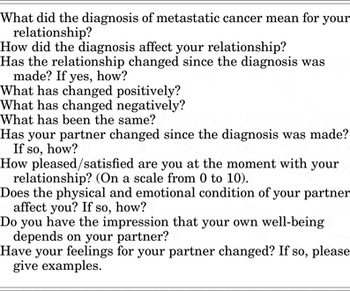
The qualitative semistructured interviews took place either at University Hospital Zürich or at the patient's home. During the interviews, patients and partners were separately asked open-ended questions about their psychological and physical well-being, about their relationship with their partner, about their religious and/or spiritual beliefs, and about resilience factors. In the data presented here, we focus on relationship changes. The questions that were asked in this context are shown in Table 1. During the follow-up interview four to six months later, the same questions were asked, but with the focus shifted toward changes since the first interview. Besides also evaluating sociodemographic data, we further asked patients and partners at both timepoints about satisfaction in their relationship currently and prior to diagnosis, using a numeric rating scale (0 = very happy to 10 very = unhappy), as well as current closeness to the partner (0 = very close to 10 = very distanced).
Interview questions

Qualitative Data Analysis
All interviews were audiotaped, transcribed, and analyzed applying qualitative content analysis as per P. Mayring (Reference Mayring2008), whose qualitative research approach is one of the most established qualitative methodologies in social research in the German-speaking countries of Europe. Content analysis aims to draw meaning from content using either a theory-guided deductive approach or a data-guided inductive approach, the latter of which we chose for our study codes. The inductive approach is usually appropriate when existing theories or research papers are limited. Data analysis starts with a word-by-word reading of the text to define analytical units, the codes that emerge from the data, and the resultant coding rules. Completing this, we then organized and summarized the codes into three different categories (changes in close relationships, changes in social roles, and changes with respect to the outside world) with eight subcategories (communication, closeness/distance, appreciation, intimacy, caring, sharing tasks, relationship with others, plans) as defined from responses by two initial coders (N.D, D.G). To test reliability, a third coder (S.W.) rated the whole text, applying the same codes as per the coding rules. In cases of disagreement between the coders, the rules were discussed and adjusted, respectively. All coders were trained in qualitative analysis techniques. The degree of interrater agreement was assessed using Cohen's kappa (Cohen, Reference Cohen1960). Patients' and partners' satisfaction in their relationship currently and prior to diagnosis was measured by means and standard deviations; paired-sample t tests were performed with respect to changes over time (t1 to t2), with p < 0.05 set as the threshold for statistical significance. Pairwise analysis of every couple and all 32 interviews was done to identify possible interdependencies.
RESULTS
Sample Characteristics
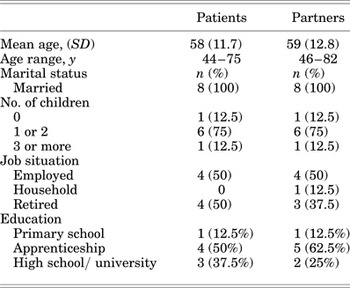
The demographic characteristics of the six male and two female patients and their spouses are summarized in Table 2. The mean time since the initial diagnosis of cancer was 3.7 years (range 0.5–7 years), but all patients had had a newly diagnosed relapse or an initial diagnosis of stage III or IV melanoma within the preceding two months. All participating couples were married. All but one couple had children (2–3), all of whom were teenagers or older. All eight couples were in longlasting relationships, with a mean duration of 32.4 years (range 18–52 years). Couples, patients, and partners reported a high level of relationship satisfaction before as well as after diagnosis (Table 3).
Sociodemographic characteristics of patients and their partners (N = 8 couples)

Current relationship satisfaction, closeness toward partner, and relationship satisfaction prior to diagnosis (N = 8 couples)

Values of a numeric analog scale with M = mean, SD = standard deviation.
*Paired-sample t test concerning changes over time (t1 to t2) revealed significant differences (p < 0.05).
Results of Qualitative Content Analysis
The collected replies of the eight patients and eight spouses at baseline (t1) and follow-up (t2) (for a total of 32 interviews) resulted in a combined 1217 analytical units, of which 277 were applicable to the content of relationship changes. Interrater reliability with regard to the assigning of individual analytical units to the eight codes was substantial, with a value of kappa equal to 0.71. The three main categories encompassing the eight subcategories are now described herein.
Changes in Close Relationships
“Changes in close relationships” was the category most often mentioned by both patients and partners at the two data collection points. A total of 122 analytical units were assigned to this category, including comments related to communication changes, changes in closeness or distance between the couple, changes with respect to appreciation of the counterpart, and changes in sexuality and/or intimacy.
Communication (41 analytical units; t1: patients: 8; partners: 14; t2: patients: 11; partners: 8). This subcategory included all statements regarding couples' changes in communication patterns to adapt to and deal with the disease. One male patient reported that he spoke more about the disease and his related feelings and emotional well-being with his wife, though his wife perceived the opposite to be true. All other patients and partners stated that they did not speak about their disease experience or their feelings with each other. Some even actively avoided speaking about these issues. For example, one patient said,
So it would be wrong if I turned to my partner at that point, because each of us would make the other feel worse. I mentioned that before. That is something I've learned: If I'm sad, I can somehow distract myself. Then I know: I have an appointment, or I still have to take the dog for a walk … that helps a lot. Or I look forward to a book, or my pipe, or a glass of wine. Talking to my wife at that moment would be wrong, because my wife has anxieties.
We asked patients and partners why they avoid communicating about the illness, and “caring” was the main reason, followed by different coping styles that already preexisted and did not change over the course of the disease: “He can't talk about it so openly, you know, the way we can” (female partner). Compared to t1, half of the patients and most partners even reported that communication about the disease had declined at t2:
Well, we did talk about it. But then pretty soon, we stopped talking about it. It felt to me as if—and she probably felt the same way—it wasn't necessarily helpful to discuss it all the time.
On the other hand, two patients reported that they still talked a lot about their disease, which was judged positively by one male patient and negatively by the other.
Closeness/Distance (35 analytical units; t1: patients: 9; partners: 5; t2: patients: 16; partners: 5). This subcategory included all statements about coming closer or withdrawing from each other during the cancer experience. Patients and partners generally reported that they had drawn closer to each other since the diagnosis of metastatic cancer had been made:
I think we have gotten somewhat closer to each other.
Patients explained that they coped better together than separately with the difficulties of their disease. Getting closer was also related to spending more time together, because of the patient's reduced ability to work or deliberately planned spare time and holidays. While most patients reported that they were closer to their partner than before, two female partners now found their husbands more distant:
Those are the moments when I have no idea what it looks like from inside of him.
They attributed the perceived distance to the partner not being ready to communicate or to the ill partner's general emotional retraction. However, both arguments were reported only in a male patient/female partner constellation.
Half a year later, most patients repeated that their relationship had become more intimate and that they now felt closer to one another. Only one male patient reported having withdrawn somewhat from his wife, though his wife felt the opposite. This picture was different and more colorful in partners. While one female partner reported greater distance in her relationship, another felt more sensitive and open toward the needs of her husband regarding closeness/distance. A final male partner felt closer to his wife, despite not necessarily spending any additional time together.
Appreciation (38 analytical units; t1: patients: 5; partners: 6; t2: patients: 6; partners: 21). Changes in how either the partner or the relationship was appreciated were summed up in the subcategory “appreciation.” Patients and partners reported that they appreciated their partner much more since the diagnosis of metastatic cancer had been made:
It's just … I think more about my perspective on life. I think I have a greater sensitivity towards and greater appreciation of my partner … maybe I'm more caring … or more mindful.
Patients and partners also described being more mindful about their relationship at t2:
R.: The only effect the disease has had: we have been married for 18 years, and known each other for 19 years, so there's a certain routine. Suddenly, this illness has shown us what we used to take for granted. That leads to a different perspective.
W.: The disease has the function of shaking you up?
R.: It's like meditation. Others go meditate, searching for an inner approach. The illness does that automatically. You learn to appreciate what you have, what used to be so normal. You suddenly realize that it's precious.
Intimacy (8 analytical units; t1: patients: 2; partners: 1; t2: patients: 2; partners: 3). Another topic, albeit rarely mentioned, was about changes in couples' intimacy, which was foremost related to sexuality. One male patient complained about a decline in his intimacy at t1 and t2:
Perhaps one thing, I don't know if it is age-related, is the intimacy thing—there I have a barrier—I don't know why that is. I don't know if I … I must say, concerning this, I'm going through a crisis.
However, his wife did not endorse the same feeling until t2:
Well, in bed, nothing is happening. I don't know. … He's not the kind of guy who can talk about these things. Maybe he has a problem with sexual arousal, but he doesn't tell me these things. Maybe he's ashamed … maybe he feels it would be a burden on me. Quite to the contrary, I would understand that. I don't know. Right now there's nothing going on.
Besides sexuality, “cuddling” was mentioned as an intimacy issue. At t1, for example, a male partner reported that his wife was especially seeking physical closeness when problems occurred. In such situations, he would “cuddle up” with her.
Changes in Social Roles
This category included statements about caring and sharing tasks. Caring was the most often mentioned subcategory in our sample, with a total of 91 analytic units. Partners rather than patients reported changes in caring. With respect to time, changes in caring were more frequently reported at t1 (40 analytic units in partners and 22 in patients) than at t2 (16 analytic units in partners and 13 in patients). Changes with respect to sharing tasks (11 analytical units) seemed to be more prevalent in partners six months after the initial diagnosis was made.
Caring (91 analytical units; t1: patients: 22; partners: 40; t2: patients: 13; partners: 16). At t1, all patients talked about their partners caring more for them since the new diagnosis had been made, which was mirrored in the statements of their partners. In patients, caring was something rather emotional, and mainly entailed hiding negative emotions from their partner, while all six female partners also talked about physical care and organizing tasks. Physical care also meant being cautious about eventual physical changes:
Then I just told him that if anything started throbbing or hurting, he really has to let them know.
Concerning organizing tasks, the wives especially mentioned organizing and accompanying their ill husbands to medical appointments:
I took over and made the appointments for him, and I said to him that this is the way it is; there are no alternatives; you have to be there, there and then.
Coming back to the topic at t2, patients still perceived their counterparts to be more caring toward them, and their partners reported caring more for their counterparts. Similarly to t1, caring was related to paying more attention to the partner's moods and not burdening them with one's own sorrows and sadness:
When I can't sleep at night, he then says: “If you're sad or you can't sleep, then just wake me up.” Then I think, “Why should I wake him? There is nothing he can do.” I just have to have my sad times. Of course, he can hold me in his arms; but he does that at other times, too. So I think, “Why should I wake him up for that?” Frequently, he notices when my mood changes; then we talk about it for a while, and he says, “If you can't sleep, wake me up.” But then I don't wake him up, because I think, “He is carrying this burden, too.” It isn't great for him either.
Regarding gender differences in couples, comments about caring were mainly offered by the females, being perceived as mutual in only two of the eight couples.
Sharing Tasks (11 analytical units; t1: patients: 3; partners: 1; t2: patients: 6; partners: 1). Shortly after the diagnosis of an incurable disease, patients and partners reported changes in how they shared tasks. This subcategory was mentioned by two male patients and one partner at t1 and emerged in patients over time, but not in partners. One change in sharing tasks was ill partners' attempts to relieve healthy partners of household chores:
And now, for instance, I do all the cooking when my wife is at work. That's possible; that's not a problem. Those are the kinds of thing I do now. It's not as if I just lie around at home and feel like I'm not doing anything. Instead, I try to invest time at home and take over some chores, so my wife doesn't have to do everything, now that she has to work. And that works out alright.
On the flip side, by handing over tasks, ill partners sought to prepare their surviving spouse for life after their death:
Actually, it's a problem for those who are left behind. They have to figure out how to cope. My wife, for instance: now she does the bills on the computer. She found out that she has to be more self-sufficient with today's technology. Otherwise, she will be helpless without me.
Since in older couples one partner sometimes assumes custodial responsibility for the other, taking on this responsibility can be hindered by the diagnosis of terminal illness in the formerly healthy one.
Changes with Respect to the Outside World
The category “changes with respect to the outside world” included the following codes: (1) relationships with others, referring to changes in relationships with people outside the intimate relationship (e.g., children, friends, neighbors, colleagues, and psychotherapists); and (2) plans, related to limitations on planning spare time or holidays due to the disease's uncertainty, as well as limitations caused by waiting for results and scheduled appointments. A total of 45 analytical units were assigned to this category.
Relationships with Others. (35 analytical units; t1: patients: 3; partners: 10; t2: patients: 12; partners: 10). At t1, some patients reported changes in their relationships toward persons outside their intimate relationship, particularly family, friends, and colleagues. Changes were observed with respect to communication, closeness, and social support. Being asked about their health, their feelings and their experiences with the disease were appreciated by both male patients, but not by one female patient who also mentioned that topic. This woman reported that people became more distant after they heard about her diagnosis. The remaining five patients did not mention anything regarding relationships with others beyond their intimate partner.
At t2, changes in relationships with others became more relevant for patients. Constantly facing illness and death, patients attempted to return to a more normal life, including talking about things aside from their illness (e.g., politics). Besides that, family issues, especially one's own children, emerged as a more central interest among patients. For example, one patient spoke about his worried children and being unable to address this:
The oldest boy had an especially intense emotional reaction. The other boy seems cooler, but I think he is preoccupied as well. Everybody is preoccupied. Of course, my daughter is. That's for sure. She shows it more. But as I said, she's in Basel. … I don't talk about it, but I wish it were otherwise.
In addition, one patient described how his parents were suffering with the prospect of the potential death of their child.
In partners, the picture was slightly different. In addition to reporting greater closeness, greater distance also was observed. While three female partners reported changes in their relationships with others at t1, over time this topic became more relevant for most partners, although the total number of comments did not change. In a nutshell, the reported changes referred to greater closeness and mindfulness of others on one hand but greater distance and less communication about the disease and its consequences on the other:
I never thought this would happen, but one withdraws from the outside world.
Some partners also reported that they were viewed by others as cancer experts, with whom different issues related to cancer and its treatment could be discussed.
Plans (18 analytical units; t1: patients: 1; partners: 1; t2: patients: 6; partners: 10). Limitations in planning spare time or holidays due to the uncertainty of the disease and having to wait for results and scheduled appointments were mentioned but rarely reported changes at t1. Over time, these topics became increasingly relevant for both patients and partners:
But I continuously notice that, when I plan something, there is a limitation—I can't plan over a longer timespan—or at least it feels that way. There is always something at the back of my mind, with me thinking, “Hmm, can I even do that anymore?” You just take it as it comes, one step at a time.
Patients and partners perceived limitations regarding spare time as a reduction in their quality of life. The disease forced them to plan their holidays in agreement with their treatment plan, not knowing if they would be physically able to go on vacation or otherwise participate in holiday activities. Furthermore, knowing that their remaining lifespan was limited, shared time became more valuable for both patients and partners.
Pairwise Analysis
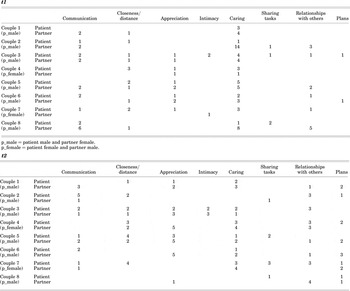
Pairwise analysis presented a more complex picture about relationship changes over time (Table 4, t1 and t2). Some themes were reported, more or less, by both members of the couple (e.g., appreciation and caring at t1), while other themes were mentioned only by one member, suggesting that most of the themes were not only couples' issues (i.e., independent of the couple). For instance, the theme “communication” was mentioned by seven couples at t1, but only mentioned by one member of four of these seven couples. At t2, this same issue was mentioned by six couples, among whom it was mentioned by both members of four couples and just by a single member of two couples. In general over time, most themes either were mentioned by fewer couples (e.g., communication, closeness/distance, and caring) and therefore appeared to become less relevant, while others were mentioned by more couples and seemed to become more relevant over time (e.g., appreciation, sharing tasks, relationship with others, and plans). One important exception was the category “intimacy,” which was mentioned by only two couples and which, therefore, might not be relevant to all couples. From a couple's perspective, there were some for whom most themes were perceived as congruent (mentioned by both couple members; e.g., couples 3, 4, and 5), while in other couples there was more incongruency, with most themes being mentioned by just one member.
Pairwise analysis of all themes for t1 and t2 (N = 8 couples)

p_male = patient male and partner female,
p_female = patient female and partner male.
DISCUSSION
To our knowledge, this is the first qualitative study investigating relationship changes in a sample of patients and spouses facing an advanced stage of melanoma. As proclaimed by the current president of the International Society of Psycho-Oncology (IPOS), Professor Barry D. Bultz, at the 2014 Annual World Congress in Lisbon, qualitative studies are clinically relevant to increasing our understanding of the different burdens that cancer patients and their families must carry (Bultz, Reference Bultz2014). Having already performed quantitative studies regarding relationship changes (Drabe et al., Reference Drabe, Wittmann and Zwahlen2013), dyadic coping (Drabe et al., Reference Drabe, Klaghofer and Weidt2014), and posttraumatic growth (Zwahlen et al., Reference Zwahlen, Hagenbuch and Carley2010) in couples facing cancer, we returned to a qualitative approach to describe and better understand the modalities of relationship change and their importance over the course of a terminal disease.
Relationship changes were perceived by all eight patients confronted by advanced perceived-to-be-terminal melanoma and all eight of their partners. These changes mainly referred to the perception of greater closeness, including spending more time together and shifting one's values to appreciate the relationship more. This is consistent with prior qualitative research at other cancer sites (Ussher et al., Reference Ussher, Tim Wong and Perz2011), as well as with our data from a quantitative cross-sectional study of 209 couples with different forms of cancer (Drabe et al., Reference Drabe, Wittmann and Zwahlen2013) and a longitudinal study conducted by Dorval et al. (Reference Dorval, Guay and Mondor2005) on breast cancer patients and their partners. Interestingly, in our sample, greater closeness was more often reported by patients than partners, and it increased over time.
Reported by all eight of our patients and six of eight partners, caring was the most frequently mentioned relationship change in patients as well as in partners within two months of advanced melanoma being diagnosed. Over time, this topic was mentioned slightly less often by both patients and partners, but it still remained a major issue for both. Unexpectedly, instead of revealing negative emotions and sorrows to their partners, 50% of all patients and partners actively hid their negative emotions and sorrows, mostly to spare the other from worry. More females than males related to this topic. Similar gender differences in couples' communication (e.g., cancer survivorship) have recently been reported by Lim et al. (Reference Lim, Paek and Shon2014). These findings probably explain why women are generally more distressed than their male counterparts, regardless of their role as a patient or partner, as also reported by Hagedoorn and colleagues (Reference Hagedoorn, Sanderman and Bolks2008; Reference Hagedoorn, Buunk and Kuijer2000), assumed by Pitceathly and Maguire (Reference Pitceathly and Maguire2003), and recently published by our group (Drabe et al., Reference Drabe, Klaghofer and Weidt2014). Moreover, we assume that there is a related burden of care that strains their daily lives and relationships (Ussher et al., Reference Ussher, Tim Wong and Perz2011). On the other hand, communicating openly by, for example, sharing one's deeper feelings and mindfully considering the other's current needs and moods, has consistently been shown to facilitate adaptation to cancer (Skerett, Reference Skerett1998). Highlighting the importance of bridging the gap between the perceived need to spare one's partner worry and the benefits of open communication is one potential clinical implication of the current study.
A further interesting finding is that providing medical care and accompanying patients to medical appointments were offered only by female partners and not by males. This difference may be explained by sociological characteristics, as previously reported by Ussher (Reference Ussher, Tim Wong and Perz2011):
Multiple caring responsibilities are socially constructed as a central component of women's gendered role, which can lead to self-renunciation and over-responsibility (Strickling, Reference Strickling1988).
However, in our study, the gender difference may more likely be explained by the imbalanced gender distribution of patients and, therefore, also of partners.
In couples, statements about coming closer or withdrawing from each other during the cancer experience were reported as frequently at baseline as six months later. However, during the t2 follow-up interviews, changes in closeness/distance became more important, being mentioned by all patients. While seven patients felt closer to their partner, one male patient felt the opposite. Reduced spare time due to physical limitations and the unpredictable course of the disease and, therefore, difficulties making plans emerged as an important topic, mainly in partners but also in patients over time. Living on a schedule with recurrent interruptions in plans had already been reported as a daily concern among older couples facing prostate cancer (Harden et al., Reference Harden, Northouse and Mood2006). Unfortunately, the authors did not differentiate whether this burden was mentioned more by the patients themselves or by their partners, as we observed.
Patients and partners also reported changes in the sharing of tasks. Ill patients sought to relieve their healthy partners of household chores but also tried to prepare their soon-to-be-bereaved partner for life after their own impending death. This task became increasingly important among partners over time. The literature reveals similar changes in household roles, noted especially by partners, among breast cancer couples (Ben-Zur et al., Reference Ben-Zur, Gilbar and Lev2001). Unexpectedly, however, patients and partners rarely mentioned relationship changes dealing with intimacy and sexuality in our sample. This finding is consistent with that reported among older prostate cancer couples (Harden et al., Reference Harden, Northouse and Mood2006) but not in breast cancer couples (Antoine et al., Reference Antoine, Vanlemmens and Fournier2013). Here, coping with altered sexuality caused by stress from the illness and the side effects of treatment presented a major challenge (Fergus & Gray, Reference Fergus and Gray2009). Aside from the fact that we did not specifically ask about changes in intimacy and sexuality, as was done in the previously reported breast cancer study, the mean age of our sample was closer to that of the prostate cancer than breast cancer samples. Younger generations might raise this issue more frequently.
Study Limitations
The results presented here should be interpreted in the light of study limitations. Due to their reduced size, samples in qualitative studies are virtually never representative and, as such, are prone to selection bias. Another potential sampling bias is that patients and partners who were not in good physical or psychological condition might have refused to participate in our study. Six of the eight patients who participated were men, which is a clear gender imbalance. Our findings could therefore be biased by gender since, for example, both coping strategies and the distribution of distress have been found to be influenced by gender (Hagedoorn et al., Reference Hagedoorn, Sanderman and Bolks2008; Baider & Bengel, Reference Baider and Bengel2001).
Clinical Implications and Future Directions for Research:
When confronted with the diagnosis of advanced melanoma, most couples in this study reported growing closer and appreciating their relationships more. Nevertheless, most couples (and especially the patient's partner) reported a significant increase in caring after the diagnosis and over the next six months. In addition, 50% of patients and partners reported actively hiding their negative emotions and sorrows from their counterpart to spare them worry. These findings support the “we-experience” of a cancer disease and the concept of “psychosocial metastasis” of distress in a couple, which further supports the concept of routinely integrating the partner into psycho-oncological counseling and interventions. The implication of this is that it makes sense to train psycho-oncologists in couples' therapy skills to specifically enhance patient–partner relationships by establishing communication skills, as this would help couples to tap into the resources they need to meet the challenges of this highly stressful life situation. Another implication is that it is important to sensitize medical staff, nurses, and doctors to the “we-experience” of cancer and to relationship themes, which might then make it easier for them to establish space for couples in routine hospital care and retain and support relationship closeness, while also unburdening patient partners.
Future investigations should entail longer observation periods than the current study, because issues related to relationship change might emerge more frequently at a later, more advanced stage of disease. Furthermore, relationship changes should be analyzed in samples with cancers involving other sites and of different stages, so as to determine if specific challenges exist depending on disease stage, site, and treatment. Investigators should also evaluate couples' communication culture prior to diagnosis within a larger sample using a mixed-methods approach, comprised of both qualitative and quantitative research methods. This approach would allow investigators to assess different subgroups of communication style, which could impact couples' psychological well-being and adaptation to disease (Baider et al., Reference Baider, Ever-Hadani and Goldzweig2003), as well as either directly or indirectly exerting an impact upon relationship change. Pairwise analyses of any themes identified for each couple might shed light on potential interdependencies between patients' and spouses' experiences of relationship change. Last, but not least, enhancing questions concerning intimacy and sexuality, primarily regarding potential changes in sexuality and its consequences for the relationship during the course of advanced disease, should be added as well and integrated into couples' support programs.
CONFLICTS OF INTEREST
The authors state that they have no conflicts of interest to declare.
ACKNOWLEDGMENTS
We would like to deeply thank Charlotte Perry for her tremendous assistance with translating patient and partner statements.