Introduction
Italy was the first European country affected by the coronavirus disease 2019 (COVID-19) epidemic, Reference Signorelli, Odone and Gianfredi1,Reference Signorelli, Odone and Stirparo2 and the Emergency Medical System (EMS) and hospital network experienced profound change. Reference Stirparo, Bellini and Ristagno3–Reference Giuseppe, Bellini and Fagoni6
The COVID-19 pandemic caused highly significant levels of psychological distress in several clinically relevant cases, and further research needs to be improved for a thorough understanding of the social illness. During the first phase of the COVID-19 pandemic in 2020, visitation rates of mental illness, suicide attempts, drug and opioid overdoses, intimate partner violence, child abuse, and neglect increased compared to the same period in 2019. Reference Holland, Jones and Vivolo-Kantor7
In addition, due to forced social isolation from lockdowns and stay-at-home orders, there has been an increase in domestic abuse and partner violence in families, negatively impacting physical and mental health. Work-related stress, blockades, social isolation, and quarantine in response to COVID-19 containment have affected the mental health of large populations, regardless of age. Public health emergencies affected individuals and communities, causing emotional reactions and unhealthy behaviors. The COVID-19 pandemic dramatically exacerbated mental health conditions’ already significant health and socioeconomic consequences. In addition, the needs and modes of mental health service delivery have changed. Reference Pandey, Thurman and Johnson8,9
Minimizing the dangerous effects of COVID-19 on mental health is an international public health concern. Reference Xiong, Lipsitz and Nasri10
Past research Reference Neria, Nandi and Galea11–Reference Grattan, Roberts, Mahan, McLaughlin, Otwell and Morris13 on large-scale natural and artificial disasters indicates that such events can cause an increase in mental health problems, substance use, intimate partner violence, and child abuse. Reference Chevallard, Veronese and Giudici14–Reference Roberts, Rogers and Mason18
On the other hand, more scientific evidence is needed on how the trend of these events has settled after the last few pandemic years and what is their current impact on health services.
Lombardy is the most populated Italian region with ten million inhabitants and has been the most affected by the pandemic, especially in the early stages. The territorial emergency is managed by a single regional agency, the Agenzia Regionale Emergenza Urgenza (Regional Agency for Emergency and Urgency - AREU). The 120 emergency departments (EDs) of the Lombardy Region are integrated into a single data collection software called Emergency Urgency OnLine (EUOL). Data from all types of EDs, general, obstetrics-gynecology, pediatric, and immediate care are recorded by EUOL. Reference Botteri, Celi and Perone19,Reference Fagoni, Perone and Villa20
The study highlights possible differences in ED access for five phenomena: psychiatric disorders, self-harm, substance abuse, social disadvantage, and violence. The objective is to assess how the frequency of these phenomena and the use of emergency room services have changed due to the pandemic, comparing the year 2019 with the same period in 2022.
Methods
The study is a retrospective observational cohort study. It was conducted according to the Declaration of Helsinki and was approved by the AREU Data Protection Officer in February 2022, document code 2.2022.
All accesses in emergency rooms in the Lombardy region registered in the EUOL portal made from January 1, 2019 through June 30, 2019, compared with January 1, 2022 through June 30, 2022, were analyzed.
The EUOL is a regional database to which all hospitals in Lombardy are connected. Data of all patients accessing the ED are recorded. The EUOL records patient demographics, diagnostic tests performed and outcomes, such as admission or discharge, and principal diagnosis according to International Classification of Diseases, Ninth Revision, Clinical Modification (ICD-9-CM) code. The database was created to report the activity of EDs and hospital admissions. The database is also used for epidemiological studies.
All data were selected according to ICD-9-CM codes 290 through 319 and E950 through E959 for substance abuse and psychiatric disorders. For social disadvantage, all patients were selected with the main reason for access attributable to social disadvantage according to local health protocols. For other diagnoses, all data were selected with the main motive of Trauma and motive detail Violence by others and Self-Harm.
This study investigated all accesses having as main causes: psychiatric disorders, self-harm, substance abuse, social disadvantage, and violence. This group of core reasons could be labelled as social illness. For this main reason, the number of diagnoses made by the ED, ED destination and principal diagnosis, and demographic characteristics were highlighted.
Categorical variables are presented as numbers and percentages, and continuous variables as median and standard deviation (SD). Categorical variables were analyzed using Odds Ratio (OR), and ANOVA tested incidence. Differences were considered significant when P <.05; otherwise, they were considered nonsignificant (NS). Prism 8.0.1 statistical software (GraphPad Software LLC; San Diego, California USA) was used for this purpose.
Results
Over the study period, the number of ED accesses in 2022 decreased by 10% compared to 2019.
There was a slight increase in the total number of patients with social problems in the two periods, from 14,176 in 2019 to 15,821 in 2022 (0.8% versus 1.0%; P <.05).
Regarding demographic characteristics, there was no significant difference between the percentages of males (54% versus 54%; P = NS) and age; in fact, the percentage of patients in the 15-65-year-old range was the highest, but there was no difference in the two periods (84% versus 84%; P = NS).
There was a significant difference in the number of all major causes of social illness except for psychiatric disorders (Table 1).
Number of Accesses for Different Social Problems

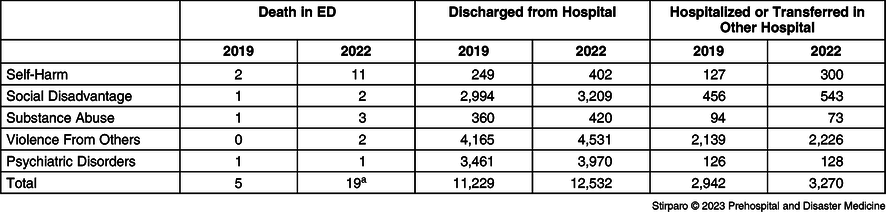
Compared with 2019, the probability of death in 2022 increased (OR = 3.40; 95% CI, 1.27-9.12; P = .02), while there was no difference in the number of patients discharged (OR = 1.0; 95% CI, 0.94-1.05; P = .86) or patients admitted or transferred to another facility (OR = 1.0; 95% CI, 0.93-1.05; P = .79). The percentage of patients discharged from the hospital did not change over the two years (79.3% versus 79.2%; P = NS); Table 2.
Outcomes from Emergency Department (ED)

Abbreviation: ED, emergency department.
a OR = 3.40; 95% CI, 1.27-9.12; P = .015.
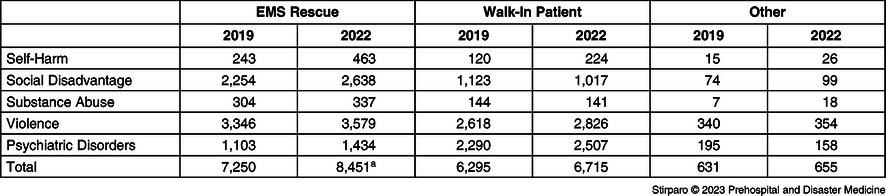
There was a slight increase in the total number of accesses, as in 2022, 54% used EMS, while in 2019, 51% used EMS. The probability of arriving at the hospital by EMS increased in the post-COVID-19 era (OR = 1.1; 95% CI, 1.0-1.2; P <.001); Table 3.
Way of Patient Arrival

Abbreviation: EMS: Emergency Medical Services.
a OR = 1.1; 95% CI, 1.0-1.2; P < .001.
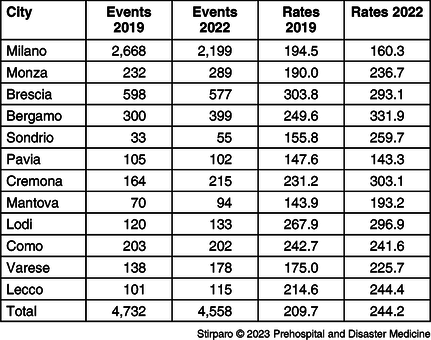
The average incidence of social problems in the provincial city of Lombardy Region increased in 2022 compared to 2019, but there was not a statistically significant difference—the incident raised from 209.7 to 244.2; P = .13. The number of events recorded in towns and rural areas increased from 9,477 in 2019 to 11,574 in 2022, with a significant increase in probability (OR = 1.3; 95% CI, 1.2-1.4; P <.001); Table 4.
Incidence of Social Illness for 100,000 Inhabitants in the Lombardy Provincial Cities

Discussion
The study shows a change in the epidemiology of social illness. In fact, there was an increase in self-harm events (OR = 2.1; 95% CI, 1.8-2.6; P <.0001), substance abuse (OR = 1.2; 95% CI, 1.1-1.3; P <.0001), violence by others (OR = 1.3; 95% CI, 1.2-1.4; P <.0001), and social disadvantage (OR = 1.2: 95% CI, 1.1-1.4; P = .0045). It might be interesting that psychiatric disorders did not change, probably because the pandemic did not so much cause an increase in psychiatric diseases but more generally in social problems (OR = 1.0; 95% CI, 0.9-1.1; P = .11). Restrictive measures may have facilitated the relapse of an already existing mental health condition. Perhaps more time is needed to register an increase in psychiatric pathology. Psychiatric disorders may be related to a longer time-to-onset after increased stress and mental disorders related to COVID -19 lockdown, as analyzed by Abba-Aji A, et al. Reference Abba-Aji, Li and Hrabok21
The fear of self-isolation could exacerbate the likely negative effects of the pandemic on people with mental disorders and the physical removal dictated by containment measures. During the pandemic, according to analyses by Roberts, et al, Reference Roberts, Rogers and Mason18 there was an increase in the need for treatment for problems related to alcohol and other substance use. Even in the post-pandemic period, individualized, evidence-based interventions will be essential to improve the quality of life for individuals and families and to prevent additional costs to society and health systems.
The main finding of this study is the significant increase in the probability of dying from social problems compared to 2019 (OR = 3.40; 95% CI, 1.27-9.12; P = .02). Death is a disconcerting event, so even small increases deserve to be highlighted and brought to light.
The number of patients using EMS increased (OR = 1.1; 95% CI, 1.0-1.2; P <.001). Out of the total number of accesses, however, during the observation period, 50% arrived by EMS, which leads to the question of whether there was a need for an ambulance or social rescue service.
In this study, it was shown that 79.3% of patients in 2022 and 79.2% in 2019 were discharged home after ED access. Therefore, a large percentage of patients could be managed at home.
This phenomenon could be related to a reduced number of services or support points in the territorial part. This percentage did not change significantly in the two years, 2019 versus 2022 (79.3% versus 79.2%; P = NS).
Analysis of discharge diagnoses indicated that many were medical or traumatic. It is worth considering that during the lockdown, the number of trauma-related suicide attempts increased compared to previous years in Lombardy, according to the study by Chevallard G, et al. Reference Chevallard, Veronese and Giudici14 However, patients with social illness, considered in the analysis, may require access to the ED not for reasons related to their pain but for clinical reasons.
In Lombardy provincial cities, the rate of such events per 100,000 inhabitants was calculated; the range varies from 143.9-303.8 in 2019 to 143.3-331.9 in 2022. There is critical variability among cities that reflects different local realities. Many social factors influence social illness. However, overall in cities, the incidence increased from 2019 to 2022 but was not significant (209.7 versus 244.2; P = .13). Thus, social problems may have increased in towns and rural areas. The probability of social illness increased in towns and rural areas (OR = 1.3; 95% CI, 1.2-1.4; P < .001). Perhaps in towns and rural areas, the population was less resistant to significant blocking: this is an interesting point. Improving the new policy might be essential to understand the correct distribution of the event.
After the COVID-19 pandemic, one of the major challenges for public health policymakers is to improve new policies, in terms of organization and training, such as those published in other research, Reference Stirparo, Oradini-Alacreu, Signorelli, Sechi, Zoli and Fagoni22–Reference Stirparo, Pireddu and Kacerik25 and the health care system to restart the social system.
The significance of this study is to highlight the importance of improving social services for people with social problems as soon as possible, and the need for economic investment in mental health prevention systems, such as public access to psychiatry and increasing the number of psychologists.
Limitations
The limitations of the study are that the changes recorded may not be due to the pandemic only, but may be related to a trend that has already begun in Lombardy. Records of deaths are few and may not be accurate. The main reason for access depends on the care provider, as the nurse on duty enters it, and some external factors may have changed the way records are reported. Another limitation of this study is the definition of social disadvantage. According to the methods of the study, the ED nurse or physician defines social disadvantage during the first interview with the patient. This is correlated with some biases; it is not an objective definition, and other aspects might change the number of diagnoses in the study period. For other definitions, ICD-9-CM remained unchanged in the study year.
Conclusion
The analysis showed that in the post-pandemic phase, the epidemiology of the phenomenon defined as a social illness has changed. Deaths and the number of diagnoses for all primary reasons have increased. Such a marked increase prompts the hypothesis of a reorganization of the territorial health care system, and it is necessary to increase territorial services to cope with these problems. Another element is the high percentage of admissions to emergency rooms that do not generate hospitalization. This phenomenon has remained unchanged for two years.
Conflicts of interest
The authors Giuseppe Stirparo, Roberta Pireddu, Aida Andreassi, Giuseppe Maria Sechi, and Carlo Signorelli declare none.