


The creation of publicly funded primary education systems in most of the world's independent states in the nineteenth and early twentieth centuries was a critical event in the development of the modern state. It typically preceded the introduction of social insurance systems by several decades, and created, for the first time, a direct relationship between states and masses. But the institutions that states used to exercise political control over primary education varied greatly, both across countries and over time. Surprisingly, considering the unique importance of primary education for socialization and nation-building, social scientists know little about the causes of this variation. There is a rich comparative literature on the introduction of compulsory schooling (Soysal and Strang Reference Soysal and Strang1989), the development of curricula (Benavot et al., Reference Benavot, Cha, Kamens, Meyer and Wong1991), and the expansion of enrollment and public education spending (Benavot and Riddle Reference Benavot and Riddle1988; Lindert Reference Lindert2004, chapter 5; Meyer, Ramirez, and Soysal Reference Meyer, Ramirez and Soysal1992), but what we know about patterns of authority and responsibility is largely based on historical case studies, few of which are explicitly comparative.
This article examines the comparative institutional development of primary education in 27 countries between 1870 and 1939, concentrating on 19 countries in Western Europe, North America, Oceania, and East Asia. Identifying three particularly important sources of institutional variation—centralization, secularization, and subsidization—we address three basic questions: Why did some states create centralized primary education systems when others were content to leave schools to municipalities or parishes? Why were some school systems controlled by religious institutions when others were entirely secular? And why did some states but not others provide public funding for private schools?
To answer these questions, we have compiled and analyzed new data on primary education systems. Some of our findings confirm long-held beliefs about the development of mass education. Others provide new insights into the history of this important social institution. Our main arguments are based on the observation that once we turn from enrollment and spending to institutional variables such as centralization and secularization, the macroeconomic and macrosociological explanations that scholars of primary education have so far relied on become less convincing. Politics mattered greatly when mass schooling was introduced. Throughout the late nineteenth and early twentieth centuries, liberals, Catholics, conservatives, and socialists fought with uncommon intensity and bitterness over the governance of primary education. These struggles, as we will show, shaped national education regimes. Through their powerful effects on social cleavages, party systems, and political institutions—documented in such social science classics as Lipset and Rokkan (Reference Lipset and Rokkan1967) and Lijphart (Reference Lijphart1968)—they also shaped twentieth-century politics.
We find that there were two paths to centralization: schooling was typically centralized either by liberal and social democratic parties in democracies or by right-wing authoritarian parties in dictatorships. We find that secularization was less likely in countries with established churches, but more likely in countries with liberal and social democratic governments. When it comes to the subsidization of private schools, finally, we demonstrate that Lijphart's (Reference Lijphart1968) analysis of the Netherlands—where the provision of public funding for private schools is treated as a solution to the problem of endemic religious conflict—can be generalized to other countries: with the single exception of Denmark, private schools only received public funding in countries where Catholicism was a significant but not entirely dominant religion.
The article begins in the next section with a discussion of our theoretical expectations regarding the politics of primary education, concentrating on the three key dimensions of centralization, secularization, and subsidization. The following section introduces the data used in the empirical analyses. Next we examine how the 19 countries in our main sample configure across the three key dimensions that we have identified, revealing five main types of primary education systems in these states in the late nineteenth and early twentieth centuries. Following this we use panel data models to estimate the relationship between economic, political, and demographic variables and centralization, secularization, and subsidization in the countries in the main sample. Finally, we extend this analysis to a larger sample of countries (adding the three most developed Latin American states, two countries in Southern Europe, and three countries in Central Europe). We conclude with a discussion of the implications of our argument for the general literature on education and the welfare state.
INSTITUTIONS, PARTIES, AND CHURCHES
The Politics of Primary Education
In the past two decades, scholars of comparative politics have taken great interest in the development of national education systems. In particular, comparative political economists have taken seriously the historical development of country-level “skills regimes” (Thelen Reference Thelen2004), providing clear and persuasive accounts of the relationship between education systems, welfare regimes, and national economic strategies (Estevez-Abe, Iversen, and Soskice Reference Estevez-Abe, Iversen, Soskice, Hall and Soskice2001; Hall and Soskice Reference Hall and Soskice2001; Iversen and Stephens Reference Iversen and Stephens2008). So far, however, this emerging literature has mainly been concerned with secondary education, tertiary education, and vocational training (and therefore with the connection between the education system and the labor market), not with primary education. Yet primary education is a uniquely important social institution. In the period that concerns us here—the late nineteenth and early twentieth centuries—postprimary enrollment was low (even in the rich democracies, few citizens received postprimary education until quite recently, most of the expansion occurring after the Second World War). But primary school enrollment was already high, and the extension of the state's powers into the domain of mass education was crucial for nation-building.
Economists and sociologists have had more to say about the development of mass education systems in the late nineteenth and early twentieth centuries, but they have typically been concerned with enrollment or public spending, not institutions. They have therefore, in most cases, proposed functionalist or otherwise apolitical explanations. Ernst Gellner (Reference Gellner1964, chapter 7; Reference Gellner1983, chapter 3) famously argued that national primary education systems provided industrializing, capitalist states with a mobile and flexible labor force. Meyer, Ramirez, and Soysal's well-known study of the expansion of mass education (Reference Meyer, Ramirez and Soysal1992), on the other hand, attributed the same outcome to institutional isomorphism: in their analysis, countries adopted compulsory primary education since they wished to mimic other countries that they saw as exemplars of modern nation states. More recently, Lindert (Reference Lindert2004, chapter 5) did take political regimes into account, but his rich discussion of the expansion of primary education emphasizes aggregate indicators of spending and enrollment, not institutions, and the only political variables that enter the equation are a measure of “voice” (the proportion of the adult population actually voting) and a measure of the decentralization of education funding. Organized political actors, such as parties and religious groups, are only implicitly a part of the analysis.
Since the existing literature on the development of primary education systems is mainly concerned with socioeconomic and macropolitical modernization, it does not examine the relationship between political cleavages on the one hand and patterns of authority and responsibility on the other. This is unfortunate, for the most divisive political conflicts over public schooling in the late nineteenth and early twentieth centuries—such as the Dutch schoolstrijd and the Belgian and French guerres scolaires—were struggles over institutions. They resulted in enduring patterns of authority and responsibility. Their aftershocks are still felt.
Accordingly, we analyze political cleavages and their impact on institutional design, as opposed to recounting a linear process of modernization. In choosing to examine institutions rather than spending or enrollment, we follow the lead of Esping-Andersen (Reference Esping-Andersen1990), who showed that data on public spending tend to give an incomplete and possibly distorted picture of how social policies vary among countries. In choosing to consider the role not just of economic conflict but also of cleavages such as geography and religion, we follow the lead of Lipset and Rokkan (Reference Lipset and Rokkan1967) and Rokkan (Reference Rokkan1973), who showed that any analysis of the politics of mass education must move beyond the economic dimension since the most important political conflicts over the organization, funding, and governance of primary education centered on noneconomic issues such as the conflict between religious education and secularism and the conflict between core modernizing elites and traditional and peripheral cultures. We wish to discover how political regimes, party politics, and religious conflict combined to shape one of the defining social institutions of our age.
Centralization, Secularization, and Subsidization
Primary education systems varied (indeed, they still vary) in the manner in which they assign authority and responsibility among institutions and education providers, be they national or local, secular or religious. These patterns of authority and responsibility can be condensed into three key dimensions.
The first dimension is centralization: the distribution of power between nation states, regions (subnational governments), and local authorities. In the middle of the nineteenth century, primary schooling was everywhere a local affair. Schools were either controlled by municipalities or by the parishes of the majority church. Beginning in the 1870s, however, national governments sought to increase their influence over primary education. All countries took some steps in this direction, but in the late nineteenth century and the first third of the twentieth, considerable cross-country variation emerged: some countries established highly centralized school systems; others retained a high degree of local control.
The second dimension is secularization: the extent to which the public school system was operated by secular authorities rather than parishes or religious orders. (When we use the term “secularization,” we refer to the transfer of control from ecclesiastical to civil authorities, not to the decline of religiosity or church attendance.) As Lipset and Rokkan noted, schooling and religious instruction had for centuries been the prerogative of churches. When the idea of mass education spread across the world in the nineteenth century, the balance between temporal and religious authorities within school systems developed into a political issue of first importance (see, for example, Kalyvas Reference Kalyvas1996).
The third dimension is subsidization: the provision of public funding for private schools. In some countries, all public education spending went to public schools, which meant that private schools were few and expensive, only educating the children of a small elite. In other countries, private schools—which, in this period, almost always meant religious schools—received enough public funding to make them a viable alternative to public education for significant parts of the population.
There are several ways for authority and responsibility to be distributed within school systems, leading to different combinations of centralization, secularization, and subsidization. It is therefore entirely possible for school systems with similar levels of enrollment and spending to privilege different social groups—just as different welfare regimes are associated with different systems of social stratification and, consequently, supported by different political coalitions (Esping-Andersen Reference Esping-Andersen1990; cf. van Kersbergen and Manow Reference van Kersbergen and Manow2009).
Actors, Interests, and Institutions
Late-nineteenth-century education reformers were typically confronted with a piecemeal, decentralized system of schools that were controlled by local elites and funded through a ramshackle mix of fees, property taxes (“rates”), and religious contributions. Governments that sought to develop more uniform mass education systems therefore had to make crucial decisions about the allocation of authority and responsibility.
The question of centralization—whether the central state should exercise direct control over schools and teachers, or whether such authority should remain at the local level—separated local religious and economic elites from reformers who wished to use mass education to change the social order that local elites wished to preserve. The political parties that defended the old order typically identified as conservative or Catholic. The advocates of interventionist central government typically identified as liberal or social democratic or—later, and for very different reasons—as fascist.
The questions of secularization and subsidization separated the representatives of the majority faith (conservative and Christian political parties as well as the church itself) from secular liberals and social democrats on the one hand and religious nonconformists on the other. The prospect of education reform turned struggles over the role of the church that had previously been resolved locally—town by town, parish by parish—into prominent national issues.
The main actors in our analysis are therefore conservative and Christian political parties, liberals, social democrats, churches, and religious minorities. But we must also consider political institutions, which mattered greatly to the balance of power between these groups. We identify three crucial institutions in the period that concerns us here: democracy, federalism, and established religion. Democracy facilitated or impeded the ability of liberal and social democratic reformers to gain office and to achieve their dual aims of wresting control from local elites and promoting secular education. Federalism, by contrast, served to protect the political interests of local actors from centralizing forces. The establishment of a state church or national church, finally, meant that the church was fused with the state bureaucracy, which changed the dynamic of religious conflict and provided the majority church with institutionalized authority over local service provision, including education.
Having identified the main explanatory factors—party politics, religious heterogeneity, and political institutions—we are now ready to formulate our main hypotheses, beginning with centralization. Why did some countries establish centralized control over their school systems in the last third of the nineteenth century and the first third of the twentieth? Our answer is that there were two radically different paths to centralization: primary education was either centralized in democracies with liberal and social democratic governments or in right-wing dictatorships.Footnote 1
These were all anticonservative movements, but for very different reasons (cf. Berman Reference Berman2006). Liberals and social democrats, empowered by democratization, sought to nationalize education since they saw the creation of a national education system, staffed by a cadre of professional teachers, as a way to break down the old social order, with its patchwork of parochial schools, eliminating old privileges and hierarchies. Moreover, as we will show in our empirical analysis, all countries that nationalized education also reduced the influence of the church, and it is likely that centralization was viewed by at least some liberal and social democratic governments as a means to secularization. For fascists, on the other hand, the centralization of education was motivated by the ideology of transcendent nationalism that defined this political ideology (Mann Reference Mann2004, 13–17). By controlling schooling, fascist parties sought to reshape society in their own image, and to promote a new national consciousness.
Hypothesis 1. Centralization is more common in right-wing dictatorships and in democratic systems with liberal and social democratic governments than in partially democratized countries and democratic countries dominated by conservative and Catholic parties.
Whereas we expect centralization to be driven by partisan politics and political institutions, we expect religion and religious institutions to matter more to secularization. Specifically, we expect secularization to be less common in countries with established churches. As Lipset and Rokkan (Reference Lipset and Rokkan1967, 15) noted, there was little controversy about the role of established churches in the education systems of Protestant countries in the nineteenth century. On the one hand, it was natural for countries with established churches to leave primary education to the church since the parishes had the necessary organizational capacity; on the other hand, the church-state conflict was less pronounced since the church was incorporated in the state bureaucracy (Rokkan Reference Rokkan1973, 81–83). In Catholic countries without state churches, by contrast, the creation of national school systems represented a challenge to the authority of the church (Morgan Reference Morgan2002).
Hypothesis 2. Secularization is less common in countries with established churches.
Although we expect religious factors to be most important for secularization, we also expect liberal and social democratic governments to be associated with a higher likelihood of secularization, since, as we noted earlier, these parties typically sought to reduce the political and social influence of the church.
Hypothesis 3. Secularization is more common in countries with liberal or social democratic governments.
With respect to the third dimension—subsidization—it is important to remember that there is not one religious dimension, but two: on the one hand, the conflict between religion and secular anticlericalism (this is what Lijphart Reference Lijphart1979, 446 called “Religious Dimension II”); on the other hand, the conflict between denominations—most importantly the conflict between Protestantism and Catholicism (“Religious Dimension I” in Lijphart's terminology). Religious minorities thus faced two threats. On the one hand, they were threatened by the ambitions of secular liberals and socialists; on the other hand, they were threatened by majority religions.
One solution to this problem, from the point of view of minorities, was to allow them to operate their own publicly funded but autonomous schools. Where religious minorities were sufficiently large and powerful to push for public funding to private schools, we therefore expect them to have done so. In other words, we expect the subsidization of private schools to be most likely in religiously heterogeneous societies. The inspiration for this argument is Arend Lijphart's work on the emergence of the Dutch pillarized political structure. As Lijphart shows, one element of the 1917 political agreement that established democracy in the Netherlands was equal funding for Catholic, Reformed Protestant, and secular schools (see also Knippenberg and van der Wusten Reference Knippenberg and Herman1984, 178). We argue that the “Dutch solution” can be generalized to a larger sample of countries: the provision of public funding for private schools was used, we will show, as a solution to the problem of religious conflict in many parts of the world.
Hypothesis 4. Subsidization is more common in religiously mixed societies.
The period that we investigate empirically—the late nineteenth and early twentieth centuries—was defined by intense social and political changes, providing us with good opportunities to assess the role that all these explanatory variables played. Three changes are particularly relevant for our argument. First of all, this was when the “first wave” of democratization occurred (Huntington Reference Huntington1991). Second, this was when national party systems formed and were consolidated (Caramani Reference Caramani2004; Lipset and Rokkan Reference Lipset and Rokkan1967) and new political parties gained prominence—notably liberals, social democrats, and fascists. Third, and finally, this was when Christian churches lost much of their once-overwhelming influence through the combined forces of religious nonconformism, secularization, and the rise of the modern professional classes (McLeod Reference McLeod2007, 20–28; cf. McLeod Reference McLeod1997).
Alternative Explanations
When we proceed to test these hypotheses empirically in the next three sections of the article, we pay close attention to two types of alternative explanations. First of all, many authors, and particularly Gellner (Reference Gellner1964, Reference Gellner1983), have argued that the creation of mass education systems should be seen as a response to the needs of industrial economies (as opposed to the predominantly agrarian societies from which they developed). We believe that the link between industrialization and the expansion of primary education is likely to be stronger and more direct than the link between industrialization and the institutional form that mass education systems took, but we nevertheless think it relevant and important to include measures of urbanization or economic development (measured by gross domestic product, or GDP, per capita) in all our models. Apart from the fact that urbanization is closely related to industrialization, scholars of the political sociology of the late nineteenth and early twentieth centuries have long emphasized the crucial role of urbanization in generating not only the urban-rural cleavage but also in influencing the center-periphery and class cleavages. As for GDP per capita, another reason to include this variable is the long-standing idea that the early development of social policy systems was strongly related to the growth of national income (Wilensky Reference Wilensky1974).
Second, it is important to take into account that the administrative structure of government varied substantially across the countries in our sample. In the empirical analyses, we concentrate on the institution of federalism, since we are examining a period of state formation, when the question of the relationship between central governments and subnational political units was being resolved (Ziblatt 2008). As we will show, federalism (unlike urbanization and GDP per capita) does matter to the structure of education systems, but our main results hold up under control for this important explanatory variable.
As we explain in the empirical sections, we also consider the role of international factors. Meyer, Ramirez, and Soysal (Reference Meyer, Ramirez and Soysal1992) argue that primary education expanded through a process of mimetic diffusion, as countries adopted the education policies of early modernizers. We show, however, that there was substantial institutional variation early on among the core states in the international system, which meant that there was no single “model” regime to aspire to (this makes institutions different from enrollment and spending). Other scholars emphasize national security and the experience of war, since the late nineteenth and early twentieth centuries was not only a period of democratization and secularization but also a period of great international tension, especially in Europe. Our views concerning this alternative explanation are similar to our views concerning the role of industrialization and economic development, however: the need for a well-trained military may well help to explain the expansion of education and primary education enrollment, as Aghion, Persson, and Rouzet (Reference Aghion, Persson and Rouzet2012) have argued in a recent article, but it is not clear that it should similarly affect the structure of the education system. It is interesting to note, for example, that in the three cases that Aghion, Persson, and Rouzet pay closest attention to—France, Japan, and Prussia—governments chose different institutional forms even if all of them increased spending and enrollment.
RESEARCH DESIGN AND DATA
To test the hypotheses that we discussed in the previous section, we have developed a new dataset that describes the development of primary education systems in Australia, Austria, Belgium, Canada, Denmark, Finland, France, Germany, Ireland, Italy, Japan, the Netherlands, New Zealand, Norway, Spain, Sweden, Switzerland, the United Kingdom, and the United States from 1870 to 1939. Our coding of school systems is based on a wide range of country-specific secondary sources, which are detailed in Ansell et al. (Reference Ansell, Erman, Gahnberg, Lindvall and Thomson2013).Footnote 2
We concentrate on these particular countries since we wish to compare the development of primary schooling to that of social policy, and much of the comparative literatures on the welfare state and the origins of political institutions is concerned with these 19 states. For example, these are essentially the same countries examined in Cusack, Iversen, and Soskice (Reference Cusack, Iversen and Soskice2007), which explores the connections between economic interests and the origin of electoral systems (excluding Iceland), those examined in Esping-Andersen's (Reference Esping-Andersen1990) foundational analysis of the welfare state (adding Spain), and those covered in Martin and Swank's (Reference Martin and Swank2012) analysis of the origins of employer coordination (adding Japan, Ireland, and Spain). To examine how well our arguments hold up when extended to a broader set of countries, we later add eight more cases from Latin America and Central and Southern Europe, selected among countries that had a relatively high level of economic development in the late nineteenth and early twentieth centuries (although they are less comparable in other ways, which is why we begin by focusing on the main sample).
We begin in 1870 for two reasons. First of all, the political systems of many of the countries in our sample underwent important changes around that time (for example, Germany and Italy were unified, the Third Republic was established in France, the Second Reform Act was passed in Britain, the Tokugawa Shogunate ended in Japan, the Civil War ended in the United States, Sweden abolished the old estates parliament, and Canada and New Zealand became independent). Second, the 1870s was a period when industrialization accelerated in most of the countries in our sample, making this decade a watershed in the history of government (Finer Reference Finer1997, volume III, chapter 12).
Concerning centralization, the first of the three institutional dimensions that we consider, it is important to keep in mind that governments had many different instruments at their disposal if they wished to increase national control over primary education, including examinations, curricula, grading standards, earmarked grants, teacher training, school inspectorates, and central regulation of teacher salaries and employment conditions. We rely primarily on evidence of whether teachers were state, regional, or municipal employees, and on the influence that national school inspectors and other national agencies had over hiring, promotions, salaries, and other employment conditions. The idea behind this coding convention is that the loyalties of teachers were a crucial factor in the distribution of authority within the education system. Our analysis results in a binary variable that separates highly centralized national education systems—where teachers were state employees or local and regional institutions had little influence over hiring decisions, promotions, salaries, and employment conditions—from those controlled at the local or regional level.
With respect to the secularization of public primary education, we distinguish between countries with fully secular public education systems and countries where the church was involved in operating public schools (as in the Scandinavian countries before the secularization of their education systems, with primary schools operated by the established church, or in Belgium, where municipalities were allowed to “adopt” Catholic schools). There were religious schools in all countries, but where these schools were severed from the public system (although they sometimes received government funding, which is captured by the subsidization variable), we code the system as secular. Some systems had a mixed character; we code those as nonsecular.
When it comes to subsidization, finally, we include all systems where private schools received some funding in this category. We should note that there were important distinctions within the private sector. In nineteenth century England, for example, most private school students attended private confessional schools, which did receive public funding. However, a small elite also attended “public schools”—fees-based schools such as Eton, Harrow, and Westminster. Such schools existed in small numbers in most of the countries that we study, but although they were important institutions for elite training, they only represented a small proportion of overall enrollments. We therefore concentrate on the more common private confessional schools.
Our main hypotheses involve four explanatory variables (see our theoretical analysis above): democracy, the ideological orientation of the incumbent government, religious heterogeneity (measured here as the proportion of Catholics in the population), and church establishment. For our measure of democracy, we rely on data from the Polity project (Marshall and Jaggers Reference Marshall and Jaggers2011), using the combined Polity Score—which ranges from −10 to 10—as our indicator. −10 represents a fully authoritarian government, 10 a fully democratic one. Remarkably, given the wealth of data available for the postwar era, we are not aware of any datasets that describe the ideological orientation of governments in the pre–Second World War period. We have therefore created our own dataset of the ideological orientation of heads of government (prime ministers, chancellors, and presidents). The underlying dataset distinguishes between six ideological categories (conservative or monarchist, liberal—including republican, social liberal, and agrarian—social democratic or socialist, Catholic or Christian democratic, fascist, and nonparty affiliated, including caretaker governments), but in the article, we rely on a simple binary variable that distinguishes between liberal and social democratic heads of government on the one hand and all other categories on the other. Concerning the proportion of Catholics in the population, we rely on data from Lindert (Reference Lindert2004), but Lindert does not have data on the Catholic population in Ireland, so for Ireland we use census data from Kennedy (Reference Kennedy1973, 112). Finally, we have created our own indicator of established churches. The countries with established churches in our sample are Denmark, Finland (until independence from Russia in 1918, when the Evangelical Lutheran Church of Finland was disestablished), Germany (until the abdication of the Emperor in 1918), Norway, Sweden, and the United Kingdom (England).
We also include a series of control variables. As we noted earlier, we include measures of urbanization and GDP per capita in our empirical analyses. When it comes to urbanization, we rely on data on the percentage of population living in cities with a population of more than 50,000 from Lindert (Reference Lindert2004). Our data on real GDP per capita, in thousands of US dollars (1990 baseline), are from Lindert (Reference Lindert2004) and Maddison (Reference Maddison2011). Finally, we control for federalism, coding Australia, Canada, Switzerland, and the United States as federal for the entire period (as well as Argentina in the extended sample used in Section 5). We code Germany as federal from 1871 to 1932, following Confino (Reference Confino2002) and Noakes (Reference Noakes1980), and we code Spain as federal during the First Republic.
PRIMARY EDUCATION SYSTEMS, 1870–1939
In this section, we describe the most common combinations of centralization, secularization, and subsidization in the countries in our main sample between 1870 and 1939. Here, we simply describe the general patterns that emerge and provide a preliminary interpretation of these patterns. We leave the statistical analysis to the next section.
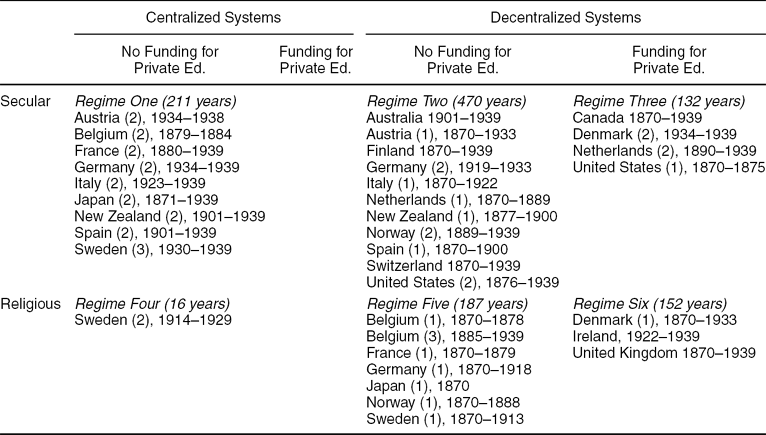
In the period that concerns us here, only six of the eight possible combinations of our dependent variables ever existed in the nineteen countries in our main sample—and one of these combinations only existed for a few years, for with the exception of Sweden in the mid-1910s and 1920s, all centralized school systems were secular and provided no public funding for private schools (see Table 1). The fact that where political control of primary education was centralized, it was also secular (excepting 1910s and 1920s Sweden), with no public funding for private schools, is the most striking pattern in Table 1. Also striking is the fact that primary education was originally controlled locally in all countries.
Primary Education Systems in 19 Countries, 1870–1939
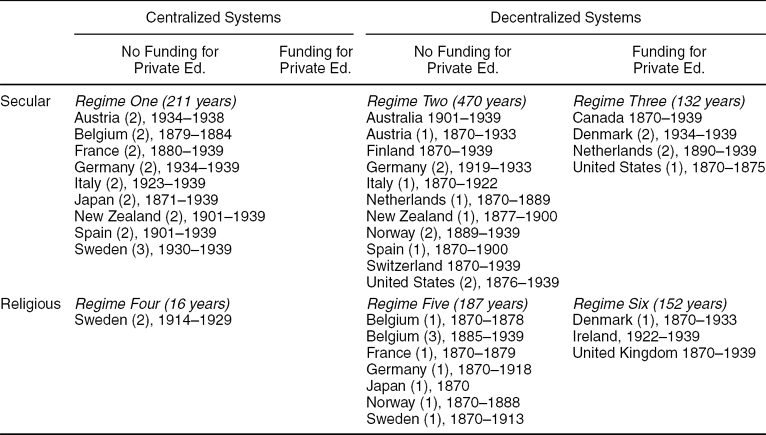
Note: The numbers in parentheses describe the sequence of education systems in each country (for example, “Belgium (1)” is the Belgian education system in the beginning of the time period, “Belgium (2)” is the second system in place in Belgium, and so on). We suppress these numbers for countries whose education systems do not change during the period under observation.
The list of countries and periods in the upper left-hand corner of the table gives an early indication of the two “paths” to centralization that we will document in the next section: centralizing reforms were adopted by governments in autocracies (Japan in the 1870s, Italy in the 1920s, Austria and Nazi Germany in the 1930s) or by liberal or social democratic governments in more democratic countries (Belgium in the 1870s, France in the 1880s, New Zealand and Spain in the 1900s, Sweden in the 1930s).
Among decentralized educational systems, there is more institutional variation. The most common combination of institutions in our sample is one where secular local authorities control education, with no funding for private schools (called “Regime Two” in the table). Below Regime Two, we find a regime where education is controlled by parishes or religious orders, also with no funding for private schools (called Regime Five in the table). Interestingly, this was the least stable model, for only Belgium remained at the end of the period we consider, and Belgium briefly centralized and secularized its education system in the 1870s and 1880s.
Regime Three is identical to Regime Two except for the fact that private (mainly confessional) schools received some measure of public funding. That is a trait that this regime shares with Regime Six, where parishes or religious orders control education, but operate side by side with private, publicly funded schools. It is immediately apparent that with the exception of Denmark, the countries in the column furthest to the right—that is, countries where private schools received public subsidies—are religiously mixed societies, just as we hypothesized in the theory section.Footnote 3
EMPIRICAL ANALYSIS
In this section, we turn to statistical analysis and brief discussions of illustrative cases to assess the relative roles of political, economic, and demographic variables in underpinning the choices that governments made about centralization, secularization, and subsidization.
Given that the number of changes in educational systems are relatively few, whereas the number of potential years under analysis is large (1870 to 1939 for most of the countries that we examine), we collapse the data from Table 1 into decade averages. The way we generate the country-decade data depends on the variable under analysis. For continuous and semicontinuous variables—such as democracy, partisanship, the proportion of Catholics in the population, urbanization, and GDP per capita—we take the country average for each decade. For the dependent variables, which are categorical in nature, this procedure does not make sense—for one thing, there is no score of, say, 0.5 on the centralization dimension—and since these are outcome variables we want to make sure that we are not predicting, for example, the position in the centralization dimension in 1871 with effects of democracy that occur in 1879. Accordingly, for the dependent variables, we take each country's score in the last year of each decade (1879, 1889, . . ., 1939).Footnote 4 We do the same for the established church variable, and for federalism.
We run a series of binary probit estimations, with country-clustered standard errors, where the dependent variables are, in turn, centralization, secularization, and subsidization.Footnote 5 In each case we present the following series of models: (1) a baseline analysis with core independent variables and urbanization; (2) the same replacing urbanization with GDP per capita; (3) an extended analysis with further controls and urbanization; (4) an extended analysis with further controls and GDP per capita; (5) the extended analysis with decade dummies and urbanization; and finally, (6) the extended analysis with decade dummies and GDP per capita.Footnote 6 For each estimation, while we present tables of coefficients, we focus our attention on the substantive effects of political and religious variables by examining predicted probabilities. In this type of model, it is important to take into account that marginal effects are functions of all the other variables in the model. In order to calculate the “average” marginal effects of the main explanatory variables, we have calculated predicted probabilities for each observation in the dataset, varying the main explanatory variables but holding the control variables at their observed values, and then we report the means of those predicted probabilities.Footnote 7
Centralization
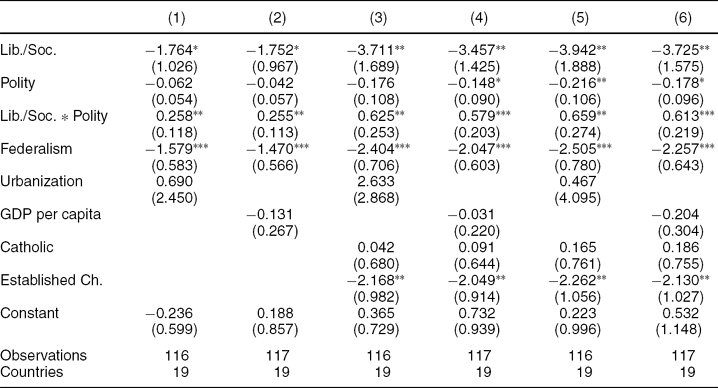
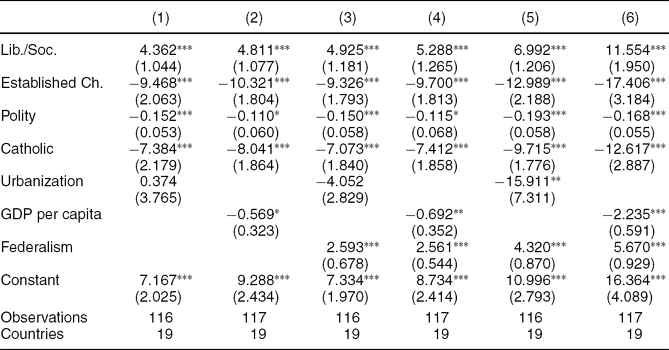
We begin by examining Table 2, where centralization is the dependent variable. A few quick points are worth making before we move on to examining predicted probabilities. First, there appears to be a positive interactive effect of democracy and partisanship, statistically significant across all the models. Moreover, where countries have a Polity score of zero (“anocracies”), liberalism and social democracy appears to be associated with a reduced likelihood of centralization (compared to other ideologies). We also find the expected negative impact of federalism on centralization in all the models, as well as a significant negative relationship between church establishment and centralization. Somewhat surprisingly, we find no indication that either urbanization or GDP per capita had a relationship to centralization, at least when controlling for political and religious variables. This implies that a simple functionalist story of centralization that ignores political and religious cleavages is unlikely to provide a satisfactory account of the growth in the educational authority of the nation state.
The Centralization of Primary Education, 1870–1939
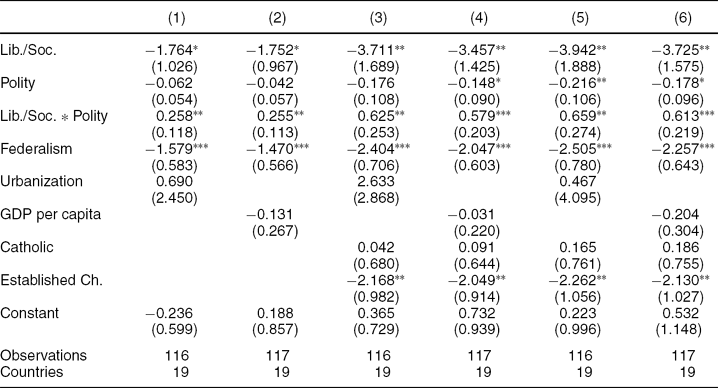
Notes: Probit estimates. Country-clustered standard errors in parentheses. Models 5 and 6 contain decade dummies.
*p < 0.10, **p < 0.05, ***p < 0.01.
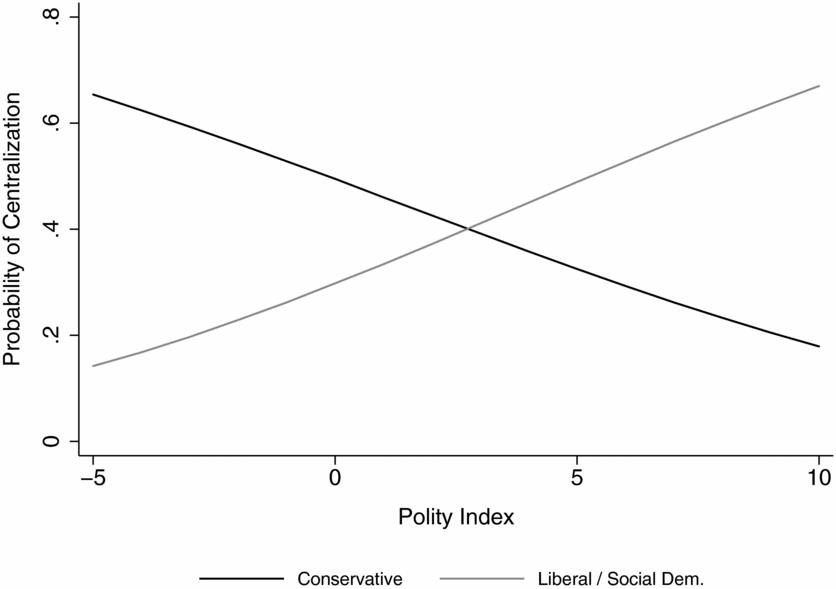
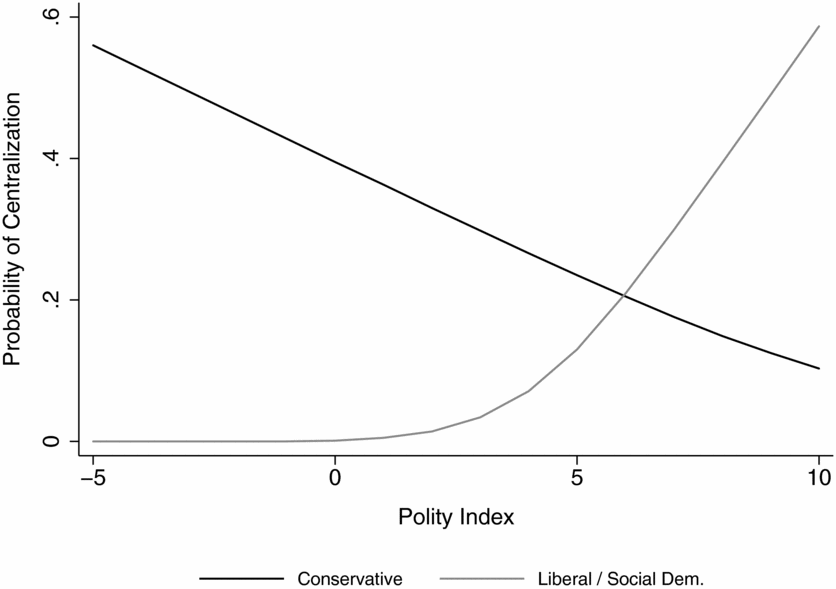
To interpret the substantive meanings of these coefficients, and to provide an explicit test of Hypothesis 1, we now turn to a discussion of predicted probabilities. Figure 1 shows the predicted probabilities of having centralized education for liberal versus conservative governments across the within-sample range on the Polity index (apart from a single observation of a country that was fully authoritarian during an entire decade: Fascist Italy in the 1930s), using the coefficients from Model 4 of Table 2.Footnote 8 We noted earlier that centralizing reforms appeared to occur either under dictatorship or under democratic liberalism or social democracy. This pattern is immediately apparent in Figure 1. In authoritarian regimes run by right-wing governments, the predicted probability of centralization is 0.56. For democracies run by liberal governments, the associated predicted probability is an almost identical 0.59. However, for fully democratic regimes that are run by conservatives or for partially democratic regimes run by liberals the probabilities are substantially lower. For the former, the predicted probability of centralization is just 0.10 and for the latter (at a Polity score of 5) the predicted probability of centralization is 0.13. The difference between liberal-run partial democracies and liberal-run full democracies is significant at the p < 0.001 level, that between conservative-run and liberal-run full democracies is also significant at the p < 0.001 level, and that between conservative-run autocracies and conservative-run democracies is significant at the p < 0.05 level. By contrast, the difference between a conservative autocracy and a liberal democracy is negligible.
Democracy, Partisanship, and Centralization

Accordingly we see two paths to centralization: the first is observable among dictatorships and the second among democracies with liberal or social democratic governments. By contrast, elite conservative governments were very unlikely to centralize education in democratic countries.
It is worth noting that the estimated effects of political institutions emerge even as we control for federalism—that is, they are not epiphenomenal to the underlying state structure. The effect of federalism is indeed substantial—whereas unitary states had a 0.35 predicted probability of centralizing their primary education systems, this reduces to a 0.03 predicted probability for federal states—but it is noteworthy that the interactive effect of democracy and government partisanship is slightly larger in substantive magnitude than the direct effect of federalism.Footnote 9
Having an established church is also associated with a sizable decrease in the predicted probability of having a centralized primary education system: countries without established churches had a predicted probability of 0.39 of centralizing, whereas those with established churches had a predicted probability of just 0.05. We argue that this effect results from the extent to which central governments relied on long-standing traditions of church control over schooling in countries where the church was fused with the state. Accordingly, governments had fewer reasons to nationalize their primary education system as a means of countervailing church and local power.
As we have already mentioned, there are many cases in our dataset that help to illustrate the interactive relationship between democracy, partisanship, and centralization that Figure 1 describes. At the right-wing authoritarian end of the spectrum, the Fascist regimes in interwar Europe provide particularly clear examples: in both Italy (through the 1923 Gentile reforms), Austria (in 1934), and Germany (also in 1934), new fascist governments centralized education within one or two years of taking power. Nagel (Reference Nagel2012), a recently published case study of the new education ministry created by the National Socialist government in Germany—the Reichsministerium für Wissenschaft, Erziehung und Volksbildung—demonstrates that the centralization of education was a key goal for the Nazis, and one that they sought to achieve soon after taking power in 1933. In the days of the Weimar Republic, the Social Democrats had also tried to centralize education, suggesting that these political movements did indeed have similar preferences over centralization, as we have argued. But where the Social Democrats failed because of opposition from the regions, the Nazis, who abolished federalism and democracy, were more successful.
At the other end of the political spectrum—that is, where we find a high prevalence of liberal or social democratic governments combined with more democratic regimes—Third-Republic France is an illustrative case. Just a few years after the creation of the Third Republic and France's gradual democratization in the 1870s, after the Second Empire, the Chamber of Deputies adopted the so-called “Ferry Laws,” named after the republican politician Jules Ferry. These laws both centralized and secularized France's primary education system (Grew and Harrigan Reference Grew and Harrigan1991; Saville Muzzey Reference Saville Muzzey1911). Another good example of how the combination of democracy and center-left politics facilitated centralizing reforms is Sweden in the first third of the twentieth century. In this period—when Sweden became fully democratic and was increasingly dominated by centrist and social democratic parties—there was a series of centralizing reforms, involving national funding, control over curricula, the expansion of school inspectorates, and training and wage setting for teachers (Jägerskiöld Reference Jägerskiöld1959; Tegborg Reference Tegborg1969).
Secularization
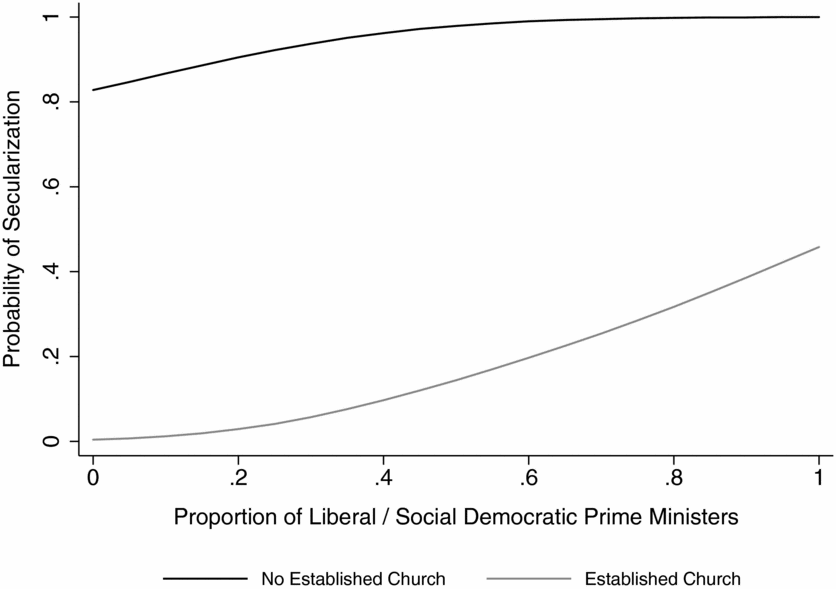
We now move to examining whether states permitted religious authorities to operate public schools or only permitted secular bureaucracies to do so—the secularization dimension (Table 3). Here we find that our hypothesized forces of church establishment (Hypothesis 2) and liberalism and social democracy (Hypothesis 3) are indeed the key explanatory factors. Figure 2 demonstrates the effects of both. The estimated impact of church establishment can be seen in the large gap between the grey line (countries with established churches) and the black line (countries without established churches), at both low levels of liberal and social democratic government (0.01 predicted probability versus 0.83) and at high levels (0.46 versus 1.00 predicted probability). Liberal and social democratic government has a positive relationship with the predicted probability of secularization both in the presence and absence of an established church, but the substantive impact is clearly much higher in the former.Footnote 10
The Secularization of Primary Education, 1870–1939
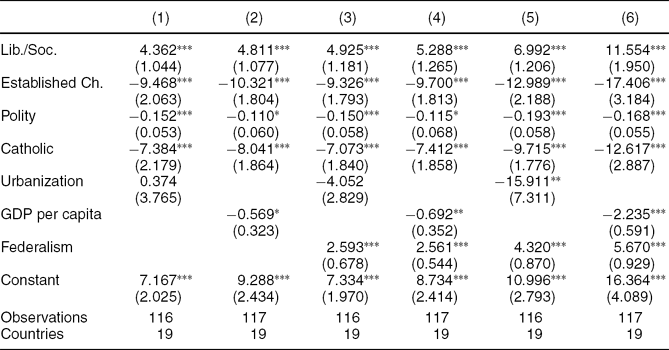
Notes: Probit estimates. Country-clustered standard errors in parentheses. Models 5 and 6 contain decade dummies.
*p < 0.10, **p < 0.05, ***p < 0.01.
State Churches, Partisanship, and Secularization

Why is church establishment so crucial to secularization? And in particular, why did countries without an established church almost always secularize their schools? In our analysis, this occurs for two reasons. First, in many countries with Catholic majorities, conflicts emerged between secularists and the church, as in France in the late nineteenth century, that were resolved by the state taking over responsibility for schooling. Second, in multidenominational states such as Canada, the Netherlands, Switzerland, and the United States, competition among religious groups meant that religious control of expressly public schools was deeply controversial (by contrast, as we shall see shortly, subsidization of confessional private schools did occur in some of these countries).
Why did liberal and social democratic government matter more in countries with an established church than in those without? Here we argue that only where the church already had control over public schooling did partisanship play a major role. In states without established churches, church control of schooling was already largely anathema. In countries with established churches, liberals and social democrats were facing a more uphill battle to extract the church from such control, since the legitimacy of church control of public schooling was strong.
Finally, we note that religious demographics and the presence of federalism also appear to have affected secularization. Holding church establishment constant, an increase in the number of Catholics in the population from 10 to 20 percent would reduce the predicted probability of secularization by around 8 percentage points. As for federalism, its existence appears to increase the predicted probability of secularization by 20 percentage points. Both effects, however, only appear in the context of having an established church.
Belgium in the 1870s and 1880s is a good example of how liberalism led to the secularization of education in a country with no established church. In Belgium, which is one of the few countries in our sample that were democratic (Polity >5) without interruption from 1870, the second premiership of Walthère Frère-Orban in 1878–1884 was the only significant liberal premiership in the late nineteenth and early twentieth centuries (the country was otherwise dominated by Catholic parties). During Frère-Orban's time in office, there was a great showdown between the Catholic Church and the secular state. Immediately after winning office, the liberals nationalized primary education and banned the practice of letting municipalities “adopt” Catholic schools instead of creating their own, secular schools (the Belgian reform was in many ways similar to the Ferry reforms in France a few years later). The church was no longer allowed to involve itself in school affairs (Mallinson Reference Mallinson1963, 85–86, 96). The Catholics rebeled against the new law, and within months, 30 percent of pupils and 20 percent of teachers had left the public schools in favor of private religious schools. Moreover, as Kalyvas (Reference Kalyvas1996, Reference Kalyvas1998) has documented, the liberal education reforms were met with an unprecedented Catholic political mobilization. The Catholics won the 1884 elections and soon proceeded to undo the previous government's policies (Mallinson Reference Mallinson1963, 101).
In countries with established churches, liberal and social democratic parties took much longer to secularize education. In both Denmark and Sweden, for instance, liberal and social democratic parties were dominant from the 1900s (Denmark) and the 1910s (Sweden); yet, the secularization of education was slow and gradual, for by our reckoning, these systems were not secularized until the 1930s. In Denmark, a Social Democratic–Social Liberal coalition government cut the bond between the national church and the public school system in 1933 (Bugge Reference Bugge, Montgomery and Larsen1982, 69; Korsgaard Reference Korsgaard2004, 423). In Sweden, the school reforms of 1927 and 1929 moved the responsibility for schools from church municipalities to secular municipalities, and through the municipal reform of 1930, parish priests lost their permanent status as members of school councils (Jägerskiöld Reference Jägerskiöld1959, 62–63, 83). But the church retained a formal role; in both countries, vestiges of the church's old power remained until long after the Second World War.
Subsidization
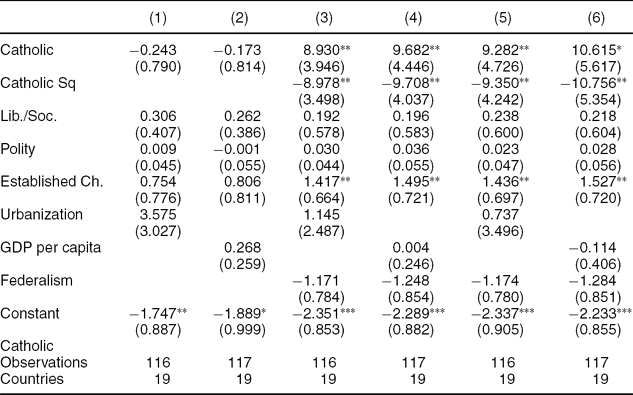
We conclude with an empirical analysis of the state subsidization of private schools, which for the most part meant private confessional schools. As we noted in the theory section, we believe that this choice should be related to Lijphart's first dimension of religious conflict—that between denominations—and that subsidization should be empirically associated with religious heterogeneity (Hypothesis 4). Accordingly, in Table 4, we include both linear and quadratic terms for the percentage of Catholics in the population. We expect that at intermediate levels of Catholicism, the pressure will be greatest to resolve religious conflict through the “Dutch solution” of channeling public funds to private confessional schools.
Subsidization of Private Primary Education, 1870–1939
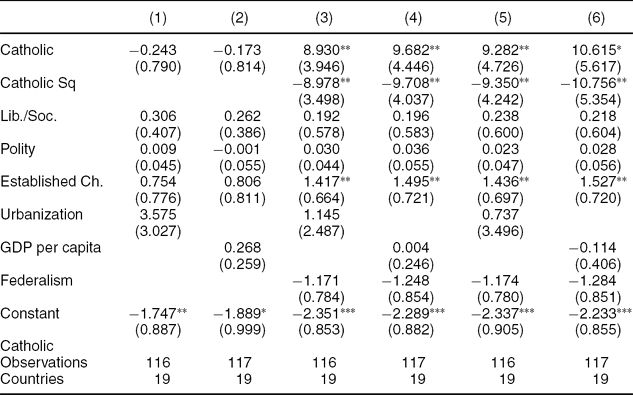
Notes: Probit estimates. Country-clustered standard errors in parentheses. Models 5 and 6 contain decade dummies.
* p < 0.10, **p < 0.05, ***p < 0.01.
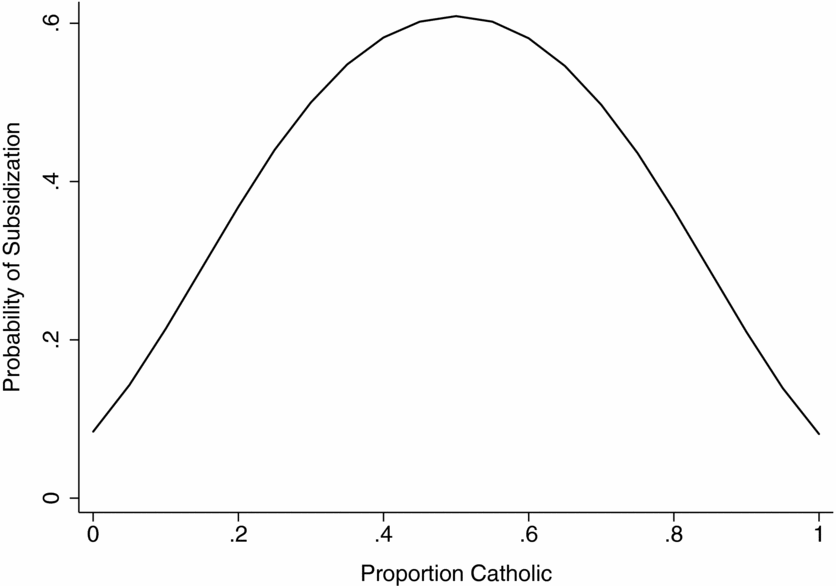
In Table 4, we begin, in columns 1 and 2, by excluding the quadratic term. In these models, where the effect of Catholicism is not allowed to take a curvilinear form, religious demographics appear to have no statistically significant relationship to subsidization. Models 3 through 6 introduce the quadratic Catholic population term (as well as a control for federalism). Here we do see strong evidence for the conjecture of a hump-shaped relationship—the coefficient of the linear term is positive and that of the quadratic term is negative. We also see that Church establishment, at least in Models 3 through 6, is positively associated with subsidization.
Figure 3 demonstrates the pronounced hump-shaped pattern for the effects of Catholic population. When the Catholic population is negligible, state subsidization of private schools appears relatively unlikely—a predicted probability of only 0.08. As the proportion of Catholics in the population rises to 25 percent, however, the predicted probability of subsidization increases to 0.44, reaching a maximum of 0.61 at 50 percent enrollment, before falling once more to a predicted probability of subsidization of 0.44 at 75 percent Catholic, and 0.08 for fully Catholic countries. These changes are all statistically significant at the 10-percent level and the difference between 0 and 25 percent, and 75 and 100 percent, are significant at the 1-percent level. By contrast, there is no statistically significant difference in the probability of subsidization between countries without Catholics and uniformly Catholic countries.
Religious Heterogeneity and Subsidization

What are the implications of this nonlinear finding? We argue that only in countries where the interdenominational cleavage is important—that is, in religiously heterogenous countries—will there both be a general absence of trust in the public school system among religious minorities and religious minorities politically powerful enough to demand and receive state subsidization of their privately run schools. This “Dutch solution” is not limited to the Netherlands. Its importance can also be seen in countries as diverse as Canada, Denmark, and the United Kingdom—that is, both in countries where religious authorities were prohibited from running schools and where they were permitted to do so (in other words, at both ends of the secularization dimension).Footnote 11
The other control variable that appears to be positively related to subsidization at statistically significant levels is church establishment—the average predicted probability of subsidization increases from 0.15 to 0.54 when we move from a state without an established church to one with one. This effect may appear surprising, but we argue that in countries with sizable Catholic populations but an established Church, such as the United Kingdom, granting subsidization to religious minorities may be less threatening to majority groups, given the legal and political dominance of the established church within the public school system (as we saw in the earlier empirical analyses). However, we should be cautious about drawing further conclusions given the relatively limited variation under analysis—no country with an established church had more than 40 percent Catholics.
The Netherlands is the paradigmatic case for our argument about the relationship between religious heterogeneity and subsidization. The constitution of 1848 guaranteed the freedom to provide education, enabling Catholics and Protestants to start their own schools, but there was not, at this time, any public funding for private schools. Since religious schools had to secure their own funding, many of them were unable to meet new education standards that were introduced by a liberal government in 1878, and many religious schools had to close. In the 1887 elections, an antiliberal coalition came to power, and passed the School Act of 1889, which ruled that private schools would receive state subsidies that covered approximately one-third of their costs. This was only the first step, however; the so called “school dispute” (schoolstrijd) was finally resolved through the Pacificatie van 1917, or “Pacification of 1917,” when the constitution was amended and all primary schools, public or private, were guaranteed equal financial support (Knippenberg and van der Wusten Reference Knippenberg and Herman1984, 179). As Lijphart (Reference Lijphart1968) and many others have described, this was a crucial event not only in the democratization of the Netherlands but also in the emergence of that country's “consociational” politics.
The example of England and Wales provides an intriguing contrast to the Netherlands. Support for Anglican schools—which was in place from 1834 onward—pre-dated the creation of state schools and local school boards through the 1870 Education Act. Nonconformist and Catholic schools also received state support, although their subsidies were less generous. As in many other European countries in this period, state support for religious institutions was politically contentious. Nonconformists and secularists lobbied hard during the passage of the 1870 Act to remove state support for denominational teaching and to essentially secularize primary education. Their efforts were not successful, however. The government did create new, nominally secular, schools to be controlled by local school boards. But the government also permitted the established Anglican church and other religious organizations to found new schools eligible for government subsidization during a “grace period.” The Church of England rapidly established subsidized church schools throughout England, and in many rural areas such schools in fact monopolized local education provision (Cruickshank Reference Cruickshank1963). Indeed, state schools ended up filling a somewhat residual role—as Arthur (Reference Arthur1995, 18) notes, “The Act set up School Boards which were to supply elementary education where voluntary provision was deficient, and this is why in some areas School Boards were not set up as a result of the strength of denominational provision in those districts.”
In the British case, there was thus some subsidization for denominational schools, recognizing in part the demands of religious minorities for non-Anglican control, but all within a system that maintained the traditional role of the Church of England. As Loss (Reference Loss2013, 10) notes, “While the 1870 act did establish the first state-funded schools under government control, it also formalized the parallel system of church and state schools that still survives.” As in the Netherlands, subsidization was used to bridge conflicts between majority and minority religions. Unlike the Netherlands, however, where different religious denominations were treated equally from 1917, this was done in a way that privileged the majority religion at least until the Second World War.Footnote 12
THE WIDER WORLD OF PRIMARY EDUCATION
We conclude our empirical analysis by extending our sample to include eight more countries, representing three regions (Central Europe, Southern Europe, and Latin America): Argentina, Chile, Czechoslovakia, Greece, Hungary, Poland, Portugal, and Uruguay. This extension of the sample brings both advantages and disadvantages. On the positive side of the ledger, it allows us to ascertain the degree to which our theoretical expectations hold up in countries that are more peripheral to the set of contemporary advanced industrial nations that we include in our baseline sample. This matters for two reasons. First, most of the theoretical expectations we have about the defining political cleavages of the age come from a literature that draws inspiration from the experience of the Western European and Anglo-American “core.” It is intriguing to know how well our arguments extend outside of this group of states. Second, focusing solely on those states that are wealthiest today occludes the fact that in the period that we are investigating, a number of modern-day “middle-income” states counted among the world's wealthiest—this is true, for example, for Czechoslovakia and the three Latin American cases.
There are, however, a number of disadvantages that come with the extension of the sample. First, in many of the states that we add, primary education was far more limited in scope than it was in most of the countries in the baseline sample. In Latin America and Southern Europe, illiteracy rates were high and the state's chief concern was the establishment of any primary education, as opposed to engaging in conflicts over how a universal system ought to be governed. This means the politics of education in such states centered around the development of the most basic forms of state capacity (Soifer Reference Soifer2006, Reference Soifer2009). Our concept of “subsidization” in particular depends on pre-existing rivalry between public and private systems of primary education. In some of the states that we now add, both public and private education had little scope.
Second, we face the dilemma of conceptual stretching when we extend our basic independent variables to these new cases—in particular, “liberal” government was quite compatible with quasi-authoritarian political systems in countries ranging from Chile to Greece to Portugal, but not in Western Europe or English-speaking former colonies. We have endeavored to code such regimes consistently with the baseline sample, but arguably any coding of “partisanship” in the late nineteenth century runs up against serious consistency issues as we expand the sample outside of Western Europe. Third, some of these countries, for example Greece, have substantially fewer available sources detailing the structure of primary education governance. Hence we are likely to have greater measurement error in our dependent variables in this broader analysis.
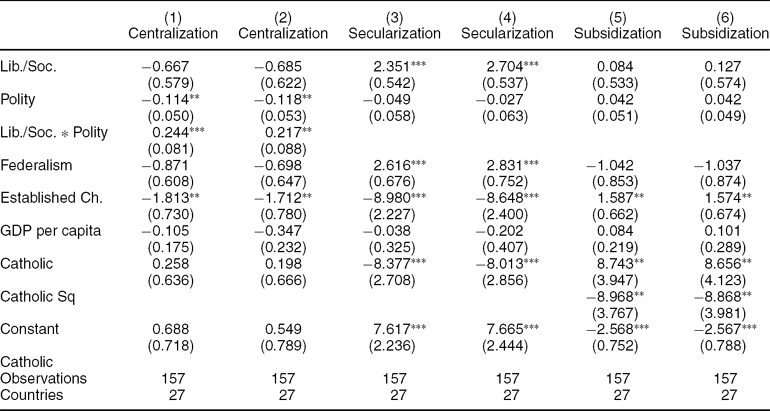
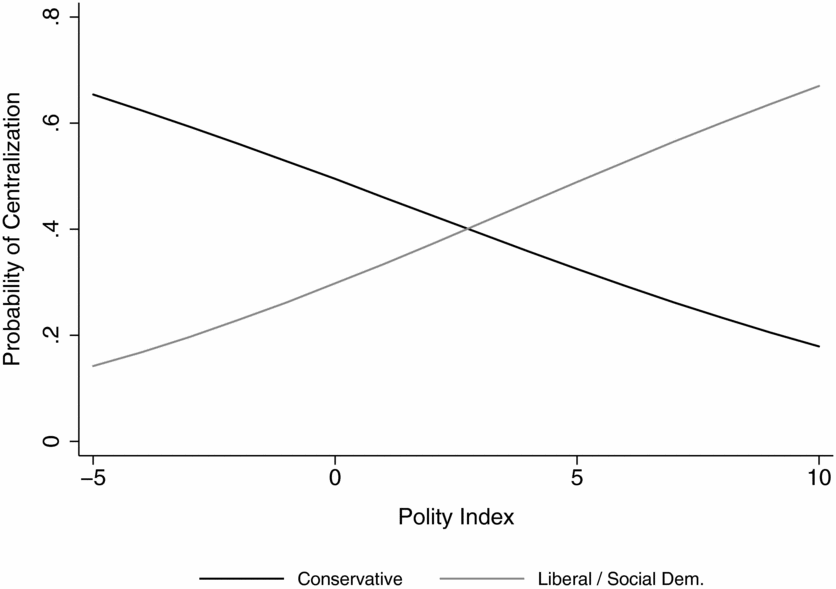
These caveats aside, we replicate Models Four and Six from the previous three tables, including the eight additional countries. The results, which are displayed in Table 5, are close to those found in the baseline sample. Models 1 and 2 (Model 2 contains decade dummies) show the same interactive effect between liberal and social democratic government on the one hand and the level of democracy on the other: centralization is more likely in conservative authoritarian regimes or in democracies with liberal or social democratic governments. However, the pattern is slightly different from that seen in Table 2 and Figure 1, for in the larger sample, authoritarian and partially democratic countries with “liberal” governments appear to be at least somewhat likely to centralize their school systems (albeit less so than their conservative authoritarian and liberal democratic peers). Figure 4 demonstrates this changed result—the predicted probability for liberal governments is climbing linearly in democracy rather than in the near-exponential form seen in Figure 1.
Primary Education Governance across 27 Countries, 1870–1939
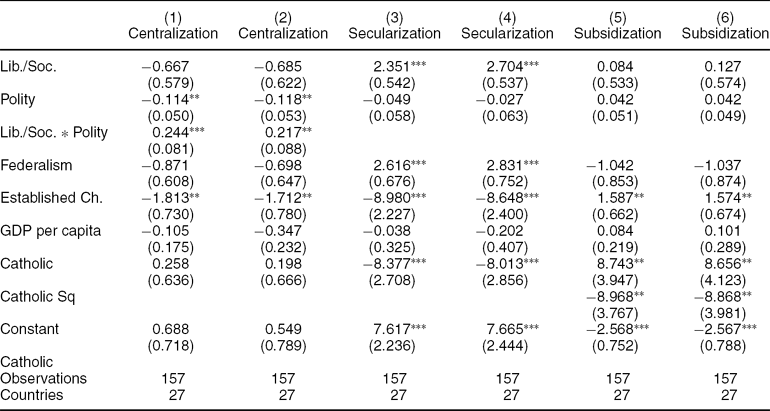
Notes: Probit estimates. Country-clustered standard errors in parentheses. Models 2, 4, and 6 contain decade dummies.
* p < 0.10, **p < 0.05, ***p < 0.01.
Centralization in the Wider Dataset
This result is driven largely by the Latin American cases. Excluding those three cases from the sample reduces the probability of centralization under partial authoritarianism (Polity = −5) combined with liberal government from 0.14 to 0.02. In the late-nineteenth and early twentieth centuries, the Polity scores of Argentina, Chile, and Uruguay were typically below +3, but oftentimes the head of government represented strongly liberal and anticlerical parties—a rare combination in the Europe of that era.Footnote 13 This suggests that democratic institutions are not a necessary condition for the liberal centralizing impulse that we have identified—particularly not in the context of high illiteracy and weakly developed local primary education provision that we find in Latin America in this period.
Models 3 and 4 (secularization) and 5 and 6 (subsidization) yield results that are similar to our earlier findings. As before, liberal and social democratic governments are associated with secularization whereas established churches are associated with its absence, and subsidization is most likely at high levels of religious heterogeneity and in the presence of an established church. One particularly surprising finding is that even when we introduce a new range of countries that include some of the wealthiest (Argentina) and poorest (Greece and Portugal) of the era, income per head has no discernible empirical association with any of our measures of the structure of mass schooling. Politics, not economic development, best explains the decisions leaders made when establishing primary education institutions.
International factors also appear to have had little impact, compared to the effects of political variables. In additional analyses that are not reported here (but included in supplementary tables), we have added controls for the previous adoption of reforms by other countries—a diffusion mechanism—as well as dummies for major power status and the experience of interstate wars in the previous decade. These variables have small and unstable effects, and their inclusion does not alter the main findings of this article. Our conclusion is that domestic politics explains why primary education systems were structured differently, with economic and international factors playing at best a secondary role—despite the obvious importance of education for economic development, nation-building, and national security in the late nineteenth and early twentieth centuries.
CONCLUSIONS
To conclude, we would like to return to the three key findings from the analyses in the previous sections. First, there appear to have been two paths to centralization. On the one hand, liberal and social democratic governments in democratic systems were associated with higher centralization, but on the other hand, so too were the fascist parties of authoritarian states. Second, the existence of an established church had, as expected, an important role in structuring whether religious authorities were permitted to run schools (countries with established churches almost always permitted religious control of schools, essentially a state-sanctioned form of “subsidiarity”), but the ideological orientation of governments also mattered, with liberal and social democratic governments more likely to secularize. Finally, we found that in states with high levels of religious heterogeneity, the “Dutch solution” of state-subsidized private schools dominated (both in secular and nonsecular systems). By contrast, where the Catholic population was either very small or very large, we do not find a high likelihood of state subsidization of private schools, since the interdenominational cleavage was less pronounced. In other words, dominant religions meant that confessional schools would be taken under public control whereas a mixed religious population retained private status for such schools.
Our investigation of the origins of primary education institutions has important implications for comparative research on the welfare state, vocational training, and education policy in general. A key conclusion of many studies of the origins of the modern welfare state is that political cleavages along class-based, religious and regional lines—much like those analyzed in this article—shaped the structure and generosity of social policy (Esping-Andersen Reference Esping-Andersen1990; Morgan Reference Morgan2002; van Kersbergen and Manow Reference van Kersbergen and Manow2009). While struggles over the origins of primary education often pre-dated struggles over the welfare state, the political compromises that emerged often foreshadowed compromises over social welfare. As an example, in most of the states that did adopt some form of subsidization of private schools as a solution to religious heterogeneity, later welfare regimes tended to involve a large private producer sector (as in Canada, the Netherlands, and the United Kingdom; see Gingrich (Reference Gingrich2011)). Other connections are less obvious. For example, it may seem surprising that so few of the states that centralized primary education ended up with generous, universal welfare states (Sweden is the exception, but it is worth noting that centralization was more gradual and pragmatic in Sweden than in the other centralizing countries). The explanation is probably that the centralization of education was motivated not by a tradeoff between state and market but by a tradeoff between state and traditional society. Future research on the interaction between the origins of primary education institutions and the development of nation-specific welfare regimes would further our understanding of the modern state's initial forays into social policy.
Potential connections also exist between primary education institutions and other domains of education policy. The state's early role in regulating apprenticeships and vocational training provides an important example, for centralization in primary education was often associated with centralization in training regimes—for example, Thelen (Reference Thelen2004, 221) notes that the period of National Socialist government in Germany was characterized by “massive moves toward standardization and uniformity in training in both the handicraft and the industry sectors.” Secularization and subsidization did not affect vocational training to this extent, since the role of religion in vocational training was negligible. But the resolution of religious conflicts is likely to have mattered for education in general by shaping the overall capacity of primary and secondary education systems. Although we have focused on institutional structure and not overall state effort in this article, we note that in some cases the resolution of conflicts around the former appear to have spurred increases in the latter. The Ferry reforms in France in the early 1880s did not only resolve the question of laïcité; they also helped boost the primary education enrollment rate from 52 percent in 1870 to 80 percent by 1890 (Lindert Reference Lindert2004). Similarly, the 1917 “Pacification” in the Netherlands was associated with an increase from 44 percent to 74 percent in enrollment rates between 1913 and 1923.
It is worth concluding by noting that this article's broadest contribution is to remind us that education policy “regimes” are not solely products of the growth of the modern welfare state but in fact predate it by several decades. Arguably, save for the development of the modern military, the expansion of primary education in the late nineteenth century marked the first profound extension of the state's powers to the mass of civilians. Yet, even at this early stage, considerable variation in how institutions were structured existed. That variation was in large part a product of the political and religious cleavages that existed at the end of the nineteenth century, but it continues to structure education today. Modern primary education systems—like cross-national patterns of redistribution (Iversen and Soskice Reference Iversen and Soskice2009) and systems of corporate governance (Martin and Swank Reference Martin and Swank2011)—remain shrouded in the shadows of the nineteenth century.



Comments
No Comments have been published for this article.