Introduction
Stroke can be broadly defined as the sudden onset of neurological symptoms due to a disruption in blood supply to the brain, often resulting in tissue death (Australian Institue of Health and Welfare, 2013; Kolb & Whishaw, Reference Kolb and Whishaw2009). According to the World Health Organisation (Reference Mackay and Mensah2004), 15 million people worldwide suffer a stroke each year. Of these, 5 million do not survive and another 5 million are left permanently disabled. Dependent on the size and location of infarction or haemorrhage, stroke often causes impairments in a range of physical, communication, behavioural and cognitive functions, which can impact on an individual's daily functioning and ability to live independently (Caplan, Reference Caplan2006; Lincoln, Kneebone, & Macniven, Reference Lincoln, Kneebone and Macniven2012).
Individuals who have had a stroke are often left with apparent physical and language impairments, and rehabilitation in general aims at using restorative and/or compensatory strategies to treat these. Cognitive impairments are also common after stroke and can influence daily functioning (Caplan, Reference Caplan2006). These include impairment of attention and executive functioning, specifically in the areas of planning, integration of actions, judgement and the performance of complex behaviours (i.e., integrating behaviours together to cook a complex meal; Andrews, Halford, Chappell, Maujean, & Shum, Reference Andrews, Halford, Chappell, Maujean and Shum2014; Ownsworth & Shum, Reference Ownsworth and Shum2008). People with stroke and their families also commonly report impairments in general memory function poststroke (Andrews, Halford, Shum et al., Reference Andrews, Halford, Shum, Maujean, Chappell and Birney2014; De Haan, Nys, & Van Zandvoort, Reference De Haan, Nys and Van Zandvoort2006; Kalashnikova, Zueva, Pugacheva, & Korsakova, Reference Kalashnikova, Zueva, Pugacheva and Korsakova2005). The previous literature has often focused on Retrospective Memory (RM) or the recall of previously learnt information, rather than another type termed Prospective Memory (PM).
Research focusing on PM is relatively new compared to other forms of memory (i.e., retrospective and working memory), only gaining interest in the experimental and clinical literature in the last 20 to 30 years (Kliegel, McDaniel, & Einstein, Reference Kliegel, McDaniel and Einstein2008). PM is defined as the encoding, storage and delayed retrieval of intended actions (Shum, Levin, & Chan, Reference Shum, Levin and Chan2011). Furthermore, PM encapsulates an interaction of multiple cognitive processes, broken down into five stages: (a) intention formation; (b) intention retention; (c) intention initiation; (d) intention execution; and (e) evaluation of outcomes (Ellis & Milne, Reference Ellis and Milne1996). If any of these stages are compromised, PM failure could occur.
PM is considered to have both a retrospective and prospective component (Einstein, McDaniel, Richardson, Guynn, & Cunfer, Reference Einstein, McDaniel, Richardson, Guynn and Cunfer1995). The retrospective component is remembering both the action and the time that the action needs to be performed, whereas the prospective component is remembering to perform the action when it is either the appropriate time or when an appropriate event has occurred. Thus, retrospective memory is important for PM performance because if an individual can remember that they had to do something (prospective component) but not remember what it was (retrospective component), a PM failure could still occur.
Three types of PM task have been outlined within the literature: time-, event- and activity-based. Time-based tasks include those that require an action to be completed at a certain time, or after a certain amount of time has elapsed (i.e., making a phone call at a specific pre-determined time, or turning the oven off after 30 minutes), whereas event-based tasks require an action to be completed when a specific target event occurs in the individual's environment (i.e., completing an ongoing daily task and when you see your colleague, stopping the ongoing task and relaying a message to them; Smith, Reference Smith, Kliegel, McDaniel and Einstein2008). Activity-based tasks are similar to event-based in that they require a cue from the environment; however, the action is to be completed after or during an activity (e.g., turning off the oven after cooking; Kvavilashvili & Ellis, Reference Kvavilashvili, Ellis, Brandimonte, Einstein and McDaniel1996). Each PM type (event-, time- and activity-based) requires different levels of cognitive demand, dependent on the monitoring strategies used.
Many models of PM have been developed, including the Multiprocess Framework of PM (McDaniel & Einstein, Reference McDaniel and Einstein2000), which posits that prospective remembering can occur due to either monitoring (keeping the PM task in mind and searching the environment for PM cues while completing an ongoing task) or spontaneous retrieval (spontaneously remembering to complete a PM action, as if the intention popped into mind). The more recent Dynamic Multiprocess Framework (Scullin, McDaniel, & Shelton, Reference Scullin, McDaniel and Shelton2013), on the other hand, proposes that both monitoring and spontaneous retrieval are inter-connected and work together to support PM performance. This model suggests that individuals utilise strategic monitoring when environmental PM cues are expected, in time-based PM for instance, and this requires higher levels of cognitive resources for PM task completion. However, when environmental cues are not expected, generally in event- and activity-based PM tasks, individuals disengage from monitoring and instead rely on spontaneous retrieval mechanisms to support PM performance.
Intact PM skills are required to complete many everyday activities (e.g., remembering to pick up milk on the way home from work, or remembering to take medication at a certain time), thus impairments in PM functioning can have detrimental effects on the individual and those surrounding them, as well impacting the ability to live independently (Groot, Wilson, Evans, & Watson, Reference Groot, Wilson, Evans and Watson2002). Individuals with stroke have previously been included in many studies assessing PM, when the focus has been on the broader acquired brain-injury (ABI) group (Fish, Manly, Emslie, Evans, & Wilson, Reference Fish, Manly, Emslie, Evans and Wilson2008; Fish, Wilson, & Manly, Reference Fish, Wilson and Manly2010; Groot et al., Reference Groot, Wilson, Evans and Watson2002; Lemoncello, Sohlberg, Fickas, & Prideaux, Reference Lemoncello, Sohlberg, Fickas and Prideaux2011), as opposed to examining the stroke population specifically. PM failure has also been identified and reviewed in other clinical and neurological populations such as schizophrenia (Ordemann, Opper, & Davalos, Reference Ordemann, Opper and Davalos2014; Shum, Ungvari, Tang, & Leung, Reference Shum, Ungvari, Tang and Leung2004), traumatic brain injury (Banville & Nolin, Reference Banville and Nolin2012; Canty et al., Reference Canty, Fleming, Patterson, Green, Man and Shum2014; Clune-Ryberg et al., Reference Clune-Ryberg, Blanco-Campal, Carton, Pender, O'Brien, Phillips and Burke2011; Shum, Fleming, & Neulinger, Reference Shum, Fleming and Neulinger2002; Shum et al., Reference Shum, Levin and Chan2011), mild cognitive impairment and dementia (Costa, Caltagirone, & Carlesimo, Reference Costa, Caltagirone and Carlesimo2011; Costa, Carlesimo, & Caltagirone, Reference Costa, Carlesimo and Caltagirone2012; van den Berg, Kant, & Postma, Reference van den Berg, Kant and Postma2006), and Parkinson's disease (Costa et al., Reference Costa, Carlesimo and Caltagirone2012; Kliegel, Altgassen, Hering, & Rose, Reference Kliegel, Altgassen, Hering and Rose2011; Pirogovsky, Woods, Filoteo, & Gilbert, Reference Pirogovsky, Woods, Filoteo and Gilbert2012). Of the seven reviews conducted with diverse clinical populations (outlined above), four focused on only observational measures of PM, and three reviewed both observational and intervention studies. The body of literature focusing on rehabilitative techniques to help improve PM in these populations is growing.
Localisation of PM functions within the brain has been undertaken in recent times using functional neuroimaging. These interventions have included both healthy individuals and those with brain injury (Burgess, Gonen-Yaacovi, & Volle, Reference Burgess, Gonen-Yaacovi and Volle2011). The review identified the brain regions commonly involved in PM were the rostral prefrontal cortex (Rostral PFC), otherwise known as the frontal pole or Brodmann area 10 (BA10). This brain region is commonly activated during PM performance with co-activation of BA7 (precuneus) and BA40 (parietal cortex). Another region often associated with PM performance was the anterior cingulate cortex (ACC, BA32), however, the relation of the ACC with PM performance was not as strong as the rostral PFC or parietal regions, and therefore more research has been recommended to determine its specific role in PM functioning.
Volle, Gonen-Yaacovi, de Lacy Costello, Gilbert, and Burgess (Reference Volle, Gonen-Yaacovi, de Lacy Costello, Gilbert and Burgess2011) conducted a voxel-based lesion study to examine both event- and time-based PM. Lesions were the result of either brain tumour or stroke and it was found that those with lesions in the BA10 showed impairments in time-based PM, but not event-based PM. Given that the frontal and parietal areas of the brain are heavily involved in PM functioning, it would be expected that those with stroke, especially occurring in the anterior part of the brain would show a higher prevalence of PM deficits than those with damage to posterior regions.
Purpose and Objectives
Few studies have been conducted examining PM after stroke compared to studies related to RM and other cognitive functions. This is surprising, considering PM ability is often related to daily functioning and independent living, however, given the relative infancy of research on this topic, this is understandable. The primary aim of the current paper was to summarise and critically review the limited, yet growing literature on PM following stroke to determine if PM is impaired after stroke, and whether PM interventions can improve prospective remembering poststroke.
Methods
A scoping methodological framework (Levac, Colquhoun, & O'Brien, Reference Levac, Colquhoun and O'Brien2010) was used to identify, categorise and summarise the findings of relevant studies, as well as analyse the methodological quality of each study. The following review consisted of five steps: (1) identifying the research question; (2) identifying relevant studies; (3) study selection; (4) charting the data; and (5) collating, summarizing and reporting the results. In order to guide the structure of the review strategy, a research question was formulated, ‘what does existing research literature present about PM performance after a stroke?’ Following the practice of more contemporary reviews, the current review will also provide an analysis of methodological quality for each study. Given the limited amount of literature and varied methodological approaches assessing PM after stroke, a scoping review was considered more appropriate than a systematic review given that the aim was to broadly examine the literature on the topic. A scoping study methodology allows for the summary of previous findings, identification of gaps in the literature and directions for future research.
Identifying Relevant Studies
The second step involved identification of relevant studies for the current review and followed two steps. First, SCOPUS, PsycINFO and Web of Science were searched using specific terms and with the time period set from the earliest year available to April 2015 in all databases. Multiple terms for both PM (prospective memory OR memory for future intention*) and stroke (stroke OR cerebrovascular accident OR ischemia OR haemorrhage) were combined in the search to ensure no articles of relevance were missed. Second, the reference lists of the resulting articles were perused for relevant additional articles. As PM is a relatively new area of interest, one research dissertation was also included for review.
Study Selection
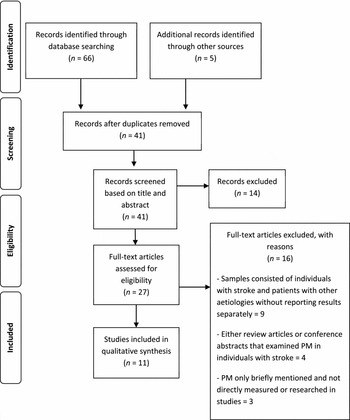
Potentially relevant studies were identified in the initial search. After the removal of duplicates, abstracts were reviewed using the following criteria. Studies were excluded if (i) PM was only briefly mentioned and not directly measured or researched in studies; (ii) the samples consisted of participants with mixed aetiologies without reporting the stroke group results separately; (iii) they were either review articles or conference abstracts that examined PM in individuals with stroke; and (iv) they were written in languages other than English.
Data Extraction, Review and Rating of Articles
The studies that met criteria for review were then categorized into either observational or intervention studies. The observational studies were further categorised by methodology, either self-report, behavioural or a combination of both. The studies were entered into a spreadsheet according to data including author(s), publication year, aims, research question(s), sample, measures, procedure, main findings and limitations. Finally, analysis was performed to identify recurrent themes as well as gaps in the literature. Studies were reviewed and rated by a single rater using the STROBE statement (a 22-item scale reviewing observational studies; von Elm et al., Reference von Elm, Altman, Egger, Pocock, Gøtzsche and Vandenbroucke2007), SCED scale (an 11-item scale reviewing single-case experimental designs; Tate et al., Reference Tate, Mcdonald, Perdices, Togher, Schultz and Savage2008) and the PEDro-P Scale (an 11-item scale reviewing clinical trials; Murray et al., Reference Murray, Power, Togher, McCabe, Munro and Smith2013), dependent on the design of the study being reviewed. These scales were chosen as they are recommended for ensuring high quality of research in populations with brain impairment (Tate & Douglas, Reference Tate and Douglas2011). Effect sizes were either extracted from the studies or calculated, where appropriate. Effect sizes were calculated manually and checked for accuracy, using either Cohen's d, phi (φ) or partial-eta squared (ηp 2 ) dependent on the statistical analysis of each study.
Results
Of the 71 articles found, 11 studies met criteria for inclusion in the current review. Figure 1 outlines the flow of study selection. After studies were identified they were grouped into two broad categories: observational studies (n = 7) and intervention studies (n = 4).
PRISMA flow-chart of study selection for current review.

Observational Studies
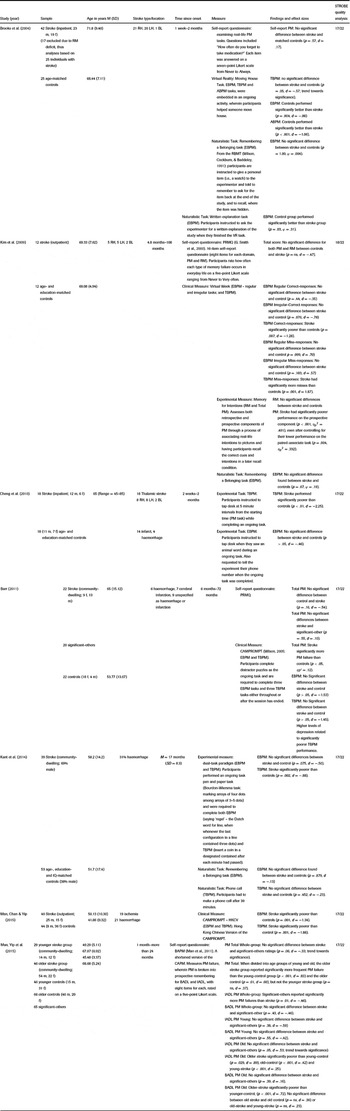
All seven studies in this category utilised observational methods to measure PM performance after stroke, and were further categorised into self-report and behavioural observations (some studies utilised multiple methods of assessment and are included in both self-report and behavioural subcategories). The methods of assessment varied, with measures used representing the different types of PM (e.g., event-, time- and activity-based PM) and different methods for evaluating PM (e.g., self-report, behavioural, clinical, experimental measures, virtual reality [VR]). The methodological quality of these studies was rated as reasonably high (i.e., ratings of 17–18 out of 22) according to the STROBE checklist. The assessment used and corresponding findings, effect sizes and quality analysis can be found in Table 1.
Observational Studies

m = male; f = female; LH = left hemisphere; RH = right hemisphere; BL = bilateral damage; PRMQ = Prospective and Retrospective Memory Questionnaire; CAMPROMPT = Cambridge Prospective Memory Test; CAMPROMPT – HKCV = Cambridge Prospective Memory Test – Hong Kong Chinese Version; RPA-ProMem = Royal Prince Alfred Prospective Memory Test; BAPM = Brief Assessment of Prospective Memory. TBPM = Time-based PM; EBPM = event-based PM; ABPM = activity-based PM. Effect sizes (Hu, Reference Hu and Salkind2010) measured using Cohen's d are interpreted using the following criteria: .2; medium = .5; or large = .8. Cohen (Reference Cohen1988) suggested effect sizes be interpreted in term of small (.1), medium (.3) and large (.5) when calculated using phi (φ), and small (.01), medium (.09) and large (.25) when calculated using partial-eta squared (ηp2).
Self-report PM Performance
Five of the studies utilised self-report methods, wherein participants completed questionnaires about their everyday memory functioning. The methodological quality of these studies was rated as reasonably high (i.e., ratings of 17–18 out of 22) according to the STROBE checklist. These questionnaires resulted in a total PM score which was then compared, in some studies (n = 4), to scores from a control group without stroke to determine if individuals with stroke experienced more frequent PM failures. In other studies (n = 2), the self-reports of participants with stroke were compared with significant-others’ reports.
Three of the studies that compared participants with stroke to controls reported that self-reported PM failures were not significantly different between the two groups (Barr, Reference Barr2011; Brooks, Rose, Potter, Jayawardena, & Morling, Reference Brooks, Rose, Potter, Jayawardena and Morling2004; Kim, Craik, Luo, & Ween, Reference Kim, Craik, Luo and Ween2009). One study, however, reported differing results, concluding that individuals with stroke reported significantly more PM failures than controls (Man, Yip, Lee, Fleming & Shum, Reference Man, Yip, Lee, Fleming and Shum2015). However, this finding was dependent on age, with older individuals with stroke, reporting more frequent PM failure than the younger control and older control groups. Specifically, the older stroke group reported significantly more frequent PM failure for Basic Activities of Daily Living (BADL) than the younger control group only and more frequent PM failure for Instrumental Activities of Daily Living (IADL) than both younger and older controls.
Two studies compared self-reported PM failure of individuals with stroke to a significant-others’ report (Barr, Reference Barr2011; Man, Yip et al., Reference Man, Yip, Lee, Fleming and Shum2015). Both found no significant differences between the report of significant-others and participants with stroke for total PM. However, when one of the studies (Man, Yip et al., Reference Man, Yip, Lee, Fleming and Shum2015) examined the BADL and IADL subscales separately for both old- and young-stroke groups combined, a significant difference was found between scores for IADL PM, with significant-others reporting significantly more frequent PM failures for IADL (i.e., more non-routine) activities than the individuals with stroke.
Behavioural Measurement of PM Performance
Six of the studies utilised behavioural measures of PM. These studies either used experimental paradigms (n = 3), VR platforms (n = 1), standardised clinical measures (n = 3) or naturalistic measures of PM (n = 3) to examine impairments in PM poststroke, often comparing the performance of individuals with stroke to non-stroke control groups. The methodological quality of these studies was rated as reasonably high (i.e., ratings of 17–18 out of 22) according to the STROBE checklist. The behavioural measures targeted different types of PM including time-, event- or activity-based PM, or a combination reflected in a total PM score (e.g., Kim et al., Reference Kim, Craik, Luo and Ween2009).
While one study measured activity-based PM (Brooks et al., Reference Brooks, Rose, Potter, Jayawardena and Morling2004) finding that individuals with stroke performed significantly worse than controls, the majority focused on event- and time-based PM performance. The studies examining event-based PM resulted in mixed findings, with two of the studies reporting significantly poorer event-based PM performance for participants with stroke compared to controls (Brooks et al., Reference Brooks, Rose, Potter, Jayawardena and Morling2004; Man, Chan & Yip, Reference Man, Chan and Yip2015), and the other four reporting no significant differences between the individuals with stroke and controls (Barr, Reference Barr2011; Cheng, Tian, Hu, Wang, & Wang, Reference Cheng, Tian, Hu, Wang and Wang2010; Kant et al., Reference Kant, van den Berg, van Zandvoort, Frijns, Kappelle and Postma2014; Kim et al., Reference Kim, Craik, Luo and Ween2009). Results seemed to be dependent on the type of measure used. Significant findings were found when utilising a VR paradigm (Brooks et al., Reference Brooks, Rose, Potter, Jayawardena and Morling2004), a naturalistic task (remembering to ask for a written explanation at the end; Brooks et al., Reference Brooks, Rose, Potter, Jayawardena and Morling2004) and the Cambridge Prospective Memory Task – Hong Kong Chinese Version (CAMPROMPT – HKCV; Man, Chan & Yip, Reference Man, Chan and Yip2015). No significant differences were found when using another naturalistic task (remembering to ask for a belonging back; Brooks et al., Reference Brooks, Rose, Potter, Jayawardena and Morling2004; Kant et al., Reference Kant, van den Berg, van Zandvoort, Frijns, Kappelle and Postma2014; Kim et al., Reference Kim, Craik, Luo and Ween2009), the Virtual Week (Kim et al., Reference Kim, Craik, Luo and Ween2009), the original version of the CAMPROMPT (Barr, Reference Barr2011) or experimental/laboratory measures (Cheng et al., Reference Cheng, Tian, Hu, Wang and Wang2010; Kant et al., Reference Kant, van den Berg, van Zandvoort, Frijns, Kappelle and Postma2014).
Three studies examining time-based PM reported significantly poorer performance for individuals with stroke compared to controls (Cheng et al., Reference Cheng, Tian, Hu, Wang and Wang2010; Kim et al., Reference Kim, Craik, Luo and Ween2009; Man, Chan & Yip, Reference Man, Chan and Yip2015). Another two studies reported no significant differences between the groups’ PM performances (Barr, Reference Barr2011; Brooks et al., Reference Brooks, Rose, Potter, Jayawardena and Morling2004), and one reported mixed findings dependent on the measure used (Kant et al., Reference Kant, van den Berg, van Zandvoort, Frijns, Kappelle and Postma2014). As with the event-based PM, findings were dependent on the type of measure utilised. Significant differences were found when using the CAMPROMPT – HKCV (Man, Chan & Yip, Reference Man, Chan and Yip2015), Virtual Week (Kim et al., Reference Kim, Craik, Luo and Ween2009) and experimental/laboratory measures PM (Cheng et al., Reference Cheng, Tian, Hu, Wang and Wang2010; Kant et al., Reference Kant, van den Berg, van Zandvoort, Frijns, Kappelle and Postma2014), however, no significant differences were found when utilising a VR platform (Brooks et al., Reference Brooks, Rose, Potter, Jayawardena and Morling2004), the original version of the CAMPROMPT (Barr, Reference Barr2011) and a naturalistic task (making a phone call after 30 minutes; Kant et al., Reference Kant, van den Berg, van Zandvoort, Frijns, Kappelle and Postma2014).
Intervention Studies
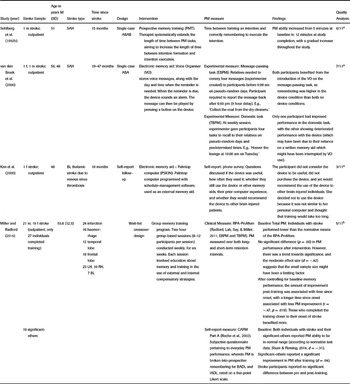
Four studies aimed to assess the efficacy of treatment on PM impairments in individuals with stroke. Details of the intervention studies are summarised in Table 2. A combination of external and internal compensatory strategy training was used by Miller and Radford (Reference Miller and Radford2014) to evaluate the impact of a group-based memory intervention on PM performance. While significant-others reported a significant improvement in PM after training using self-report methods, no such differences were reported by individuals with stroke. This was the only group studied, examining an intervention on PM; however, the methodical quality rated by the PEDro-P Scale (Murray et al., Reference Murray, Power, Togher, McCabe, Munro and Smith2013) was moderate (5/11). The study was limited by the high drop-out rate, and the use of pseudo-random allocation rather than true random allocation of participants to intervention groups. It was also not clear whether both participants and assessors were blind to the condition that participants had been placed in.
Intervention Studies

m = male; f = female; SAH = subarachnoid haemorrhage; LH = left hemisphere; RH = right hemisphere; BL = bilateral damage; a = SCED; b = PEDro-P Scale.
Three studies used a single-case design. Sohlberg, White, Evans and Mateer (Reference Sohlberg, White, Evans and Mateer1992b) examined Prospective Memory Training (PMT; Sohlberg, White, Evans, & Mateer, Reference Sohlberg, White, Evans and Mateer1992a) as a remedial technique for PM impairment in one participant poststroke. It was found that the participant's PM ability gradually increased over the course of the intervention. The methodological quality rated by the SCED scale (Tate et al., Reference Tate, Mcdonald, Perdices, Togher, Schultz and Savage2008) was moderate (6/11). Using external compensatory rehabilitation strategies, van den Broek, Downs, Johnson, Dayus, and Hilton (Reference van den Broek, Downes, Johnson, Dayus and Hilton2000) evaluated an electronic memory aid for PM performance poststroke. It was concluded that a Voice organiser (VO) device could improve PM ability after stroke; however, results were highly dependent on individual differences in the two participants. The methodological quality rated by the SCED scale was moderate (7/11). Kim, Burke, Dowds, Robinson Boone, and Park (Reference Kim, Burke, Dowds, Robinson Boone and Park2000) conducted a questionnaire which assessed participants’ satisfaction with a palmtop computer which aimed at improving PM performance. One single stroke participant reported that the palmtop computer was not beneficial, primarily due to a lack of interest and prior technological experience; however, the methodology of this study was rated as poor (3/11).
Other Features of the Studies (n = 11)
Other features which were addressed in the previous studies included time poststroke, the study setting, depression, the prevalence and neuropathology of PM impairment poststroke and the effect sizes. The studies included in the current review assessed the PM abilities of individuals with stroke from one week poststroke to 47 years poststroke; however, only one study (Miller & Radford, Reference Miller and Radford2014) explored the relationship of time poststroke to PM performance, finding that individuals who had a longer time since stroke onset showed less improvement after an intervention when PM was measured using the RPA-ProMem. The study settings also varied with two studies recruiting inpatients, six studies recruiting outpatients and three studies recruiting community-dwelling individuals with stroke. Level of depression was only investigated by Barr (Reference Barr2011), who found that higher levels of depression were related to significantly poorer performance on time-based tasks.
Little is known about the prevalence of PM impairment poststroke. One study (Kant et al., Reference Kant, van den Berg, van Zandvoort, Frijns, Kappelle and Postma2014) reported the prevalence of PM failure in the stroke group to be 41%. This percentage suggests that PM failure is a problem for a substantial proportion of people with stroke. No other studies reported data relating the prevalence of PM impairment in the stroke samples.
The effect sizes varied from small to large, dependent on the type of study. Majority of the effect sizes calculated for self-reported PM were small (63.2%, n = 12; medium = 26.3%, n = 5; and large = 10.5%, n = 2). However, when calculated for observational measures of PM, the majority were large (50%, n = 12; medium = 25%, n = 6; and small = 25%, n = 6). Only two effect sizes were calculated for the intervention studies because the studies did not report enough information for them to be calculated. The effect sizes that were calculated were small and large.
Kant et al. (Reference Kant, van den Berg, van Zandvoort, Frijns, Kappelle and Postma2014) also explored the impact of lesion location on PM performance poststroke. It was found that lesions in the right superior temporal gyrus (STG) were more prevalent in individuals with selective PM failure (time-based or event-based, not both) in comparison to those without PM impairment. These findings, however, warrant further investigation as the methods used in the study to explore anatomical correlates were somewhat coarse. One observational study previously mentioned examined the impact of thalamic lesions on PM impairment poststroke (Cheng et al., Reference Cheng, Tian, Hu, Wang and Wang2010). Cheng et al. (Reference Cheng, Tian, Hu, Wang and Wang2010) concluded that individuals with thalamic lesions due to stroke had impaired time-based PM (p < .01) but not event-based PM when compared to non-stroke controls, with no differences being found between right and left thalamic lesions. Additionally, it was found that the volume of thalamic lesion was negatively correlated with time-based PM performance (r = −.86, p = .000). Other than Kant et al. (Reference Kant, van den Berg, van Zandvoort, Frijns, Kappelle and Postma2014) and Cheng et al. (Reference Cheng, Tian, Hu, Wang and Wang2010), no other observational studies examined the patterns of neuropathology associated with PM impairment following stroke.
Discussion
It is apparent that the literature is limited when examining the impact stroke has on PM functioning. The investigation of PM abilities in stroke populations is a relatively new area of memory research, and more research is needed within this growing area. The literature reviewed here, while narrow, suggests that stroke has a significant impact on PM performance, specifically time-based PM, in that when measured using behavioural measures of PM, individuals with stroke often show impairments in their PM abilities compared to control groups. The majority of the effect sizes are large, suggesting a significant impairment after stroke; however, it must be noted that results are mixed and variables which impact on PM and limitations of the reviewed studies need to be considered when interpreting the results.
While the rehabilitative research is limited, and three out of the four studies used single-case experimental designs, it provides avenues and directions for future PM rehabilitation. PMT training (Sohlberg, Reference Sohlberg, White, Evans and Mateer1992a), while offering promising results for the improvement of PM poststroke, is intensive and requires a lot of time commitment from both the client and therapist. Additionally, single-case experimental designs limit the generalisation of results to wider populations and can have carry-over and order effects. While Miller and Radford's (Reference Miller and Radford2014) group intervention study reported a trend towards significance, no significant difference was found in PM performance after the intervention. This trend towards significance accompanied by the moderate effect size suggests that the small sample size might have been a limiting factor. The studies examining technological devices to better PM performance (Kim et al., Reference Kim, Burke, Dowds, Robinson Boone and Park2000; van den Broek et al., Reference van den Broek, Downes, Johnson, Dayus and Hilton2000), found improvements to be highly dependent on the individuals’ preference and experience with technology. Limitations aside, these studies offer broad direction for future research. More rehabilitative techniques and interventions need to be developed, conducted and assessed with larger stroke samples, wherein PM is assessed using reliable, standardised measures to provide more evidence for rehabilitative interventions and tools.
There are a number of possible reasons for the varied findings regarding whether PM impairment is a problem after stroke. First, different types of PM measures have different strengths and limitations. While many studies used reliable and validated self-report measurements, such as the Prospective and Retrospective Memory Questionnaire (PRMQ; G. Smith, Del Sala, Logie, & Maylor, Reference Smith, Del Sala, Logie and Maylor2000), Comprehensive Assessment of Prospective Memory (CAPM; Roche, Fleming, & Shum, Reference Roche, Fleming and Shum2002) and the Brief Assessment of Prospective Memory (BAPM; Man, Fleming, Hohaus, & Shum, Reference Man, Fleming, Hohaus and Shum2011), results from self-report measures which have not been evaluated for reliability or validity may result in unreliable findings (i.e., the 10-item questionnaire used by Brooks et al., Reference Brooks, Rose, Potter, Jayawardena and Morling2004). Additionally, when using validated measures it is helpful if the results for each subscale are reported separately. For example, Barr (Reference Barr2011), using the PRMQ, summed the retrospective and prospective components to form a measure of everyday memory function total. Thus, when interpreting the results in relation to PM function, there is no delineation of PM from RM failure limiting conclusions about self-reported PM poststroke.
One possible reason as to why PM impairment was not found in individuals with stroke when using self-report methods is the sample size. While Barr (Reference Barr2011), Brooks et al. (Reference Brooks, Rose, Potter, Jayawardena and Morling2004) and Kim et al. (Reference Kim, Craik, Luo and Ween2009) found no such impairment, Man, Yip et al. (Reference Man, Yip, Lee, Fleming and Shum2015) did. These contrasting findings to previous research may have been due to the larger sample size (n = 75) and hence greater power, as compared to the other studies with smaller sample sizes (range = 12–25). Furthermore, while self-report methods are easy to administer in both clinical and experimental settings, impairments in self-awareness following neurological injury can impact the reliability of the results (Roche et al., Reference Roche, Fleming and Shum2002). So while majority of the studies found no significant differences between the self-rating of PM for participants with stroke and controls (Barr, Reference Barr2011; Brooks et al., Reference Brooks, Rose, Potter, Jayawardena and Morling2004; Kim et al., Reference Kim, Craik, Luo and Ween2009), this does not necessarily mean that PM is not impaired poststroke. In fact, this method of assessment may be measuring self-awareness of PM failure rather than PM failure itself. As suggested by Barr (Reference Barr2011), Brooks et al. (Reference Brooks, Rose, Potter, Jayawardena and Morling2004), Kim et al. (Reference Kim, Craik, Luo and Ween2009) and Man, Yip et al. (Reference Man, Yip, Lee, Fleming and Shum2015), self-reports should be interpreted with caution as impairments in self-awareness are highly probable and participants with stroke may be reporting their pre rather than poststroke abilities.
As PM performance is reliant on a multitude of cognitive functions, it is important to examine and control for any cognitive impairments participants may have to ensure a true measure of PM performance is attained. One such function is RM, where RM performance has been found to be a significant predictor of experimental event-based PM (Kant et al., Reference Kant, van den Berg, van Zandvoort, Frijns, Kappelle and Postma2014; Kinch & McDonald, Reference Kinch and McDonald2001). When comparing PM to other cognitive functions, Kant et al. (Reference Kant, van den Berg, van Zandvoort, Frijns, Kappelle and Postma2014) found that PM failure occurred in 41% of individuals with stroke and was significantly higher than the prevalence of impairments in processing speed, and attention/executive functioning, but not significantly different from the frequencies of RM failure. A significant limitation of this study, as well as previous studies (Man, Chan & Yip, Reference Man, Chan and Yip2015) was not screening for RM impairment before running the experiment. Prospective remembering has both a prospective and retrospective component, and if a person cannot remember what the task is, he or she cannot be expected to perform it.
Another cognitive function which has been said to impact on PM performance is monitoring ability, specifically time-based. While the laboratory measures of PM reviewed consistently found significant deficits in time-based PM, it is concluded that this finding may not be due to monitoring abilities, as the difference in the amount of clock checks, between participants with stroke and controls was not significant (Cheng et al., Reference Cheng, Tian, Hu, Wang and Wang2010; Kant et al., Reference Kant, van den Berg, van Zandvoort, Frijns, Kappelle and Postma2014; Kim et al., Reference Kim, Craik, Luo and Ween2009). If monitoring ability is not significantly impaired after stroke, further research is needed to examine why individuals with stroke have specific difficulties with time-based tasks. It may simply be due to the belief that time-based PM tasks are believed to require more cognitive resources for completion than event-based tasks, as performance relies on higher levels of initiation, monitoring and executive control (McDaniel & Einstein, Reference McDaniel and Einstein2007), and often these cognitive functions are left impaired after stroke.
Many additional factors pertaining to the participants themselves, could have impacted PM performance and were not necessarily controlled for or addressed by all the studies. There was considerable heterogeneity in the stroke populations studied, in terms of time since stroke onset, stroke severity and lesion location, and these factors are likely to impact on the presence and extent of PM impairment.
The studies included in the current review assessed the PM abilities of individuals with stroke from one week poststroke to 47 years poststroke. The large variation in time from one week to many decades poststroke could have an impact on PM abilities in multiple ways. Neurological function starts to recover within the first few days after stroke, with rapid gains realised in the first three months, followed by slower gains in the following six to twelve months, with some individuals still showing gains one to two years poststroke (Hankey, Reference Hankey2007). Thus, time since onset of stroke can greatly impact on the level of impairment, especially when recovery patterns differ for each individual patient (Langhorne, Bernhardt, & Kwakkel, Reference Langhorne, Bernhardt and Kwakkel2011). Not just in terms of natural recovery, but those in different stages of rehabilitation could be expected to show different results, as found by Miller and Radford (Reference Miller and Radford2014), who reported greater PM improvement for those who accessed rehabilitation closer to the onset of stroke. This finding is promising for researchers and clinicians working with people who have had a stroke and PM.
Study settings and an individual's opportunity to experience PM failure can also play a role in how individuals with stroke report PM impairment, particularly on self-report measures. This is because level of independence and different testing environments may see significant-others or nurses/carer completing daily PM tasks for individuals with stroke. This could impact how participants and their significant-others self-report PM failures which focus on BADL and IADL PM.
Additionally, factors such as damage location and level of depression were not always addressed. While most studies outline the type of stroke and lateralisation, only Kim et al. (Reference Kim, Craik, Luo and Ween2009) reported which lobes were damaged, providing a clear outline of the location of damage to the brain. This is important as individuals with damage to brain regions not related to PM function would not be expected to show PM impairment. Level of depression was only investigated by Barr (Reference Barr2011), who found that higher levels of depression were related to significantly poorer performance on time-based tasks. As depression has been found to negatively impact on PM performance, it is also imperative to control for, especially as depression is quite common poststroke (Hoffmann, Ownsworth, Eames, & Shum, Reference Hoffmann, Ownsworth, Eames and Shum2015).
The methodological quality of the studies ranged from high to low, dependent on the study and measure used. Observational studies, rated using the STROBE statement resulted in a narrow range of scores. While this may suggest that the methodological quality of the observational studies was high, it is not necessarily the case. Rather, the narrow range of scores outlines the limitations of the STROBE as a quality analysis tool. This is most likely because it was primarily designed to be used more as a reporting guideline, rather than an evaluation tool (von Elm et al., Reference von Elm, Altman, Egger, Pocock, Gøtzsche and Vandenbroucke2007). The main reasons why studies were rated moderate to low in quality when using the SCED scale was because observer bias, independence of assessors, statistical analysis and evidence for generalisation were not addressed. These studies could be improved by addressing these simple factors. Additionally, the group intervention study received a moderate quality rating when assessed with the PEDro-P scale because pseudo-random allocation was used rather than random allocation. It was also not mentioned whether allocation was concealed; whether blinding of participants, therapists and assessors took place; and there was a high level of drop out meaning that the measures of at least one key outcome were not obtained from more than 85% of the subjects initially allocated to groups. Study quality could be improved by addressing these factors and improving the rate of drop out.
Limitations of the Study
This review would have been strengthened by using two raters instead of one and incorporating inter-rater reliability tests into the procedure. The evaluation of studies was also limited by the tools chosen to rate methodology. The STROBE statement was used for the purposes of evaluating methodological quality; however, it generated a narrow range of scores. Thus, it is recommended that future reviews utilise a tool which has been designed to rate the methodological quality of observational studies such as a Risk of Bias measure.
Recommendations for Future Research
Overall, future research should focus on using reliable and valid PM measures, control for or stratify individuals of stroke into groups based on factors which have previously been found to impact PM performance (i.e., RM performance, monitoring ability, time-since stroke onset, location of testing, location of damage to the brain, level of depression and level of self-awareness) and develop and evaluate rehabilitative techniques to help improve PM performance poststroke. Future research could be conducted to examine the utility of other external (e.g., smart phone applications) and internal compensatory rehabilitative strategies. It is suggested that training programs take into consideration the personal preferences of individuals with stroke, specifically in relation to any technology that is introduced.
Implementation intentions (a simple goal-setting strategy) have been used previously to improve PM performance in non-stroke adult populations (Chen et al., Reference Chen, Wang, Liu, Cui, Gan, Shum and Chan2015), as well as other clinical populations like early psychosis (Khoyratty et al., Reference Khoyratty, Wang, O'Gorman, Lloyd, Williams, Chan and Shum2015). It is suggested that future rehabilitation research can consider utilising this simple, yet effective internal strategy to assess the effect on PM functioning poststroke.
Overall, PM impairment exists after stroke, particularly when examined using behavioural measures. As PM is linked with abilities in everyday functioning, it is imperative that future research is conducted to help examine both the extent and nature of PM impairment after stroke.
Financial Support
This research received no specific grant from any funding agency, commercial or not-for-profit sectors.
Conflict of Interest
None.