Introduction
Ruminant animals depend largely on forages for their energy supply, so it is important to have a good chemical description that can be related to their nutritive value. Proximate analysis, including the crude fibre method, was widely used until the 1960s. However, it was eventually realised that this system failed to recognise the different carbohydrate fractions that have specific solubility and degradation characteristics. Also, there were criticisms regarding the methodology of crude fibre determination (Van Soest, Reference Van Soest1994).
This situation triggered a research programme that led to the detergent system of feed analysis, including the neutral detergent system (Van Soest, Reference Van Soest1967a). This system has been extensively used worldwide, and over the years it has undergone several changes and improvements (Van Soest et al., Reference Van Soest, Roberts and Lewis1991; Mertens, Reference Mertens2002). Briefly, plant material that is soluble in neutral detergent solution (NDS) comprises fractions of carbohydrate and protein that are potentially completely digestible, as well as lipid and some ash, while material insoluble in neutral detergent (neutral detergent fibre, NDF) represents fibrous carbohydrates that are partially digestible, as well as lignin.
The ‘Cornell Net Carbohydrate and Protein System’ (CNCPS; Fox et al., Reference Fox, Sniffen, O’Connor, Russell and Van Soest1992; Russell et al., Reference Russell, O’Connor, Fox, Van Soest and Sniffen1992; Sniffen et al., Reference Sniffen, O’Connor, Van Soest, Fox and Russell1992) is a mathematical model linking feed analysis and estimates of nutrient requirements for cattle. In order to predict the supply of metabolisable energy and protein, the CNCPS uses equations to estimate digestion and passage of several feed carbohydrate and protein fractions, each of which is assumed to have a constant rate of ruminal digestion. The CNCPS equations that estimate the slowly digestible (fraction B2) and the indigestible cell wall (CW) carbohydrates (fraction C) rely on NDF measurements. Pectin is part of the CW matrix, but is not recovered as NDF. Similarly, other CW non-starch polysaccharides such as β-glucans, galactans and gums are also dissolved by NDS. These carbohydrates can be grouped under the generic denomination of ‘soluble fibre’ (SF; Hall, Reference Hall2003). Thus, NDF does not provide a complete measure of cell wall. Although NDF was developed as a nutritional descriptor of slowly, less completely fermented cell wall, rather than an agronomic descriptor of total cell wall, the use of one method that measures CW more completely than NDF (Fukushima and Hatfield, Reference Fukushima and Hatfield2004) was explored for its impact on the outcome of the CNCPS equations.
This work used sunflower, a dicotyledonous oleaginous plant, as a model, because it contains moderate levels of pectin and is increasingly used as a feed for ruminants. The objectives of this work were to characterise the CNCPS carbohydrate fractions (Sniffen et al., Reference Sniffen, O’Connor, Van Soest, Fox and Russell1992) of three sunflower cultivars, both fresh and ensiled, by the standard method (ash and protein-free NDF) or alternatively using ash and protein-free CW.
Material and methods
Three sunflower cultivars M-734, M-742 and IAC-Uruguay were grown as outlined by Evangelista and Lima (Reference Evangelista and Lima2001). For each cultivar, half was harvested at 78 days after sowing (‘fresh material’). Sunflower plants were approximately 1.70 to 1.80 m tall, more than two-thirds of leaves were dead, flower petals were no longer present and seeds were completely formed but not yet hard. The remainder was harvested 1 week later (because of weather conditions) and ensiled in 50 × 10 cm plastic tubes. These mini-silos were opened after 90 days of anaerobic fermentation.
Samples of the fresh material and silage were dried in a 65°C forced air oven for 72 h and ground to pass a 1-mm screen in a knife mill (Marconi model MA-680). One sub-sample was dried at 105°C to calculate dry matter (DM) content. The following analyses were performed: ash, crude protein (CP), ether extract (EE), starch, pectin, NDF, ash and protein-free NDF (pNDFom), acid detergent lignin (ADL), CW and ash and protein-free CW (pCWom).
NDF was measured according to Van Soest et al. (Reference Van Soest, Roberts and Lewis1991). No amylase was used in the NDF procedure but the NDS contained sodium sulphite. Ash and protein were quantified in NDF, because the B2 and C equations of CNCPS employ ash- and protein-free (N × 6.25) NDF (pNDFom, as described by Udén et al., Reference Udén, Robinson and Wiseman2005). The same procedure was also adopted for CW. ADL was determined as described by Van Soest et al. (Reference Van Soest, Roberts and Lewis1991). Crude CW was prepared following the description of Fukushima and Hatfield (Reference Fukushima and Hatfield2004). Briefly, CW was obtained by successively extracting the sunflower sample with water, ethanol, chloroform and acetone in a Soxhlet apparatus. The sample was placed in a glass thimble fitted with a coarse porosity fritted disc (obtained from a local glassware manufacturer). Each solvent was run until no colour leached from the sample. No clogging of filters was reported for any of the samples and the typical total extraction time was 5 days.
Starch concentration was determined using the procedure of Pereira and Rossi (1994), with prior extraction of soluble carbohydrates using 80% ethanol (Hendrix, Reference Hendrix1993). Relative amounts of total sugars were determined by the phenol-sulphuric acid method using glucose as standard (Dubois et al., Reference Dubois, Gilles, Hamilton, Rebers and Smith1956). Pectin was determined by the colorimetric method of Filisetti-Cozzi and Carpita (Reference Filisetti-Cozzi and Carpita1991), which employed m-hydroxydiphenyl to develop the chromogen and galacturonic acid as the standard. CP and the protein fractions present in the NDF (NDIP) and CW (CPCW) were determined by the micro-Kjeldahl method (Association of Official Analytical Chemists, 1990).
In level 2 of the CNCPS, fibrous and non-fibrous carbohydrates (NFC) are estimated from sequential NDF analysis of the feed. Total carbohydrate (CHO) as well as NFC content can be estimated by difference (Sniffen et al., Reference Sniffen, O’Connor, Van Soest, Fox and Russell1992). Feed carbohydrates can be partitioned into fractions, which are classified according to their degradation rates: CHO fraction A is a very rapidly fermented, water-soluble pool that is primarily composed of sugars, although it also contains organic acids and short oligosaccharides. Its equation is

CHO fraction B1 has a slower rate of digestion than fraction A and contains mainly starch and pectin

CHO fraction B2 has a slow rate of digestion and contains the digestible cell wall carbohydrates

And the CHO C pool is the unavailable cell walls, which includes lignin

The A and B1 equations include measurements of NDF, as a component of B2 and C. In the B2 and C equations the indigestible pool is calculated using lignin as a proportion of ash and protein-free NDF (Fox et al., Reference Fox, Sniffen, O’Connor, Russell and Van Soest1992; Van Soest et al., 2000; Fox and Tedeschi, 2002). This ratio is then multiplied by 2.4, as proposed by Chandler et al. (Reference Chandler, Jewell, Gossett, Van Soest and Robertson1980), which represents the material remaining after an extended period of in vitro fermentation, likely containing significant unfermented available substrate depending on the duration of incubation (Van Soest et al., 2000).
Results and discussion
Sunflower data
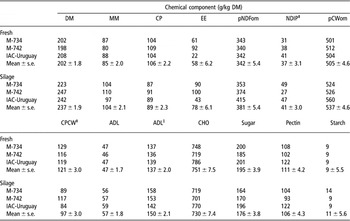
The CNCPS carbohydrate fractions were obtained using the sunflower chemical composition data shown in Table 1.
Chemical composition of fresh and ensiled samples of whole-crop sunflower

DM = dry matter; MM = mineral matter; CP = crude protein, EE = ether extract, pNDFom = ash and protein-free neutral detergent fibre, NDIP = neutral detergent insoluble protein, pCWom = ash and protein-free cell wall, CPCW = crude protein content in cell wall, ADL = acid detergent lignin; CHO = total carbohydrate.
‡NDIP and CPCW are expressed on CP basis.
§ADL expressed on pNDFom basis.
The NDF residue contained less protein than the CW preparation (Table 1). This could be a consequence of protein removal caused by NDS that contained sodium sulphite. Even using sodium sulphite, it was not possible to remove all the protein from NDF.
NDF content was lower than CW for both fresh material and silage (Table 1). It is already known that NDS dissolves pectin (Van Soest et al., Reference Van Soest, Roberts and Lewis1991) and other cell wall polysaccharides that constitute SF (Hall, Reference Hall2003). Since the cell wall method proposed by Fukushima and Hatfield (Reference Fukushima and Hatfield2004) retains most of these carbohydrates within the CW, pCWom values were higher than pNDFom. Consequently, the difference between pCWom and pNDFom could be a predictor of SF concentration: for the fresh sunflower and silage, its mean concentration was 164 and 156 g/kg DM, respectively. However, these calculated values did not match the pectin concentration determined by wet chemistry, which averaged 111 g/kg DM for fresh sunflower and 106 g/kg DM for sunflower silage (Table 1), indicating that other carbohydrates are removed by NDS. This approach is similar to a calculation made in another analytical scheme where ash + protein-corrected NDF was subtracted from ash + protein-corrected ethanol-insoluble residue (Hall et al., Reference Hall, Hoover, Jennings and Webster1999). If not using pNDFom and pCWom, protein and ash would be included in this SF fraction.
Several carbohydrate chemists consider that pectin is an intercellular cement that holds plant cell wall together, so its structural role is undisputed. However, pectin may be better regarded as an NFC along with sugars, starch, β-glucans, etc., to describe non-NDF carbohydrates (National Research Council, 2001).
The CNCPS equations
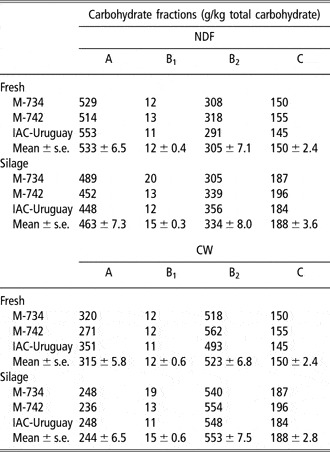
The CNCPS carbohydrate fractions calculated on the basis of either NDF or CW are presented in Table 2.
Cornell Net Carbohydrate and Protein System carbohydrate fractions of fresh and ensiled samples of whole-crop sunflower, calculated using either neutral detergent fibre (NDF) or cell wall (CW) contents

Carbohydrate fraction C
The equation representing the unavailable cell wall has been employed or cited by several researchers (Malafaia et al., Reference Malafaia, Valadares Filho, Vieira, Coelho da Silva and Pereira1998; Traxler et al., Reference Traxler, Fox, Van Soest, Pell, Lascano, Lanna, Moore, Lana, Vélez and Flores1998; Ribeiro et al., Reference Ribeiro, Pereira, Valadares Filho, Garcia and Cabral2001) and appears in the nutritional requirements for beef cattle (National Research Council, 2000). Other models for predicting energy and nutrient values of ruminant feeds also employ relationships between lignin and NDF, but using a 0.667 power (Weiss et al., Reference Weiss, Conrad and St Pierre1992; Weiss, Reference Weiss1993 and 1999). Van Soest (Reference Van Soest1994) presented separate equations for lignin determined by sulphuric acid or potassium permanganate and these equations included the proportion of lignin contained in the ADF, instead of NDF.
The C fractions obtained from the CNCPS equations, based on either NDF or CW, produced the same results (Table 2). This was not expected because the numerical values for NDF and CW were quite different (Table 1). The reasoning behind this observation is as follows.
Making some algebraic arrangements, Equation (4) can be written as

Making the cancellations, we have

This equation is simpler and easier to use, since lignin is expressed in terms of DM and is independent of either NDF or CW. One might argue that the proposed equation is a mere simplification of the conventional CNCPS equation of fraction C, and that if one knows the proportions of the analytes in the feedstuff, it should not matter on what basis these analytes are expressed. However, it is has been suggested that relating the digestibility of NDF based on lignin content of DM, which includes the cell solubles, should be avoided (Van Soest, Reference Van Soest1967b and Reference Van Soest1994). The reason is that lignin has no substantial effect on the digestibility of cell solubles. Traxler et al. (Reference Traxler, Fox, Van Soest, Pell, Lascano, Lanna, Moore, Lana, Vélez and Flores1998) agreed with our findings when they reported a better correlation between the indigestible residue of NDF and the lignin content of DM – rather than the lignin content of NDF.
Carbohydrate fraction B2
There were differences between fraction B2 calculated on the basis of NDF or CW. This fraction represents the slowly digestible cell wall carbohydrates, and was more than 50% higher when calculated on the basis of CW (Table 2).
Equation (3) for fraction B2 includes the equation for fraction C (4). When the simplified version (6) is produced, it is easier to see that fraction B2 is directly related to the content of pNDFom (or pCWom):

Fraction B2 calculated on the basis of pCWom was greater than that calculated from pNDFom, no doubt due to the inclusion of SF in the B2 fraction.
Carbohydrate fraction A
There were substantial differences in carbohydrate fraction A. Because drying forages at 65°C forced-air oven may already affect the carbohydrate fractions due to cross-linking between sugars and amino acids – early Maillard products – a better approach could be to use a lower temperature in the oven. Fraction A (very rapidly fermented carbohydrates) was almost twice as large when calculated using NDF than when using CW (Table 2).
This observation shows that all non-starch, neutral detergent-soluble carbohydrates are mathematically allocated to this fraction. Accordingly, pectin would also be placed in fraction A and not in fraction B1. The CNCPS model puts pectin in carbohydrate fraction B1 (Sniffen et al., Reference Sniffen, O’Connor, Van Soest, Fox and Russell1992; Fox et al., Reference Fox, Tedeschi, Tylutki, Russell, Van Amburgh, Chase, Pell and Overton2004).
Carbohydrate fraction B1
Carbohydrate fraction B1 did not differ when calculated with NDF or CW (Table 2). These values were similar to those determined analytically for starch (Table 1) on a CHO basis. Hence, B1 is actually only starch, which agrees with the earlier comments for fraction A. Consequently, the B1 equation could simply be written as

Soluble fibre
In this manuscript it has been stated that CW, in contrast to NDF, preserves the SF fraction (or non-NDF CW carbohydrates). As a result, the difference between pCWom and pNDFom could be a predictor of SF concentration: for the fresh sunflower and silage its concentration, on total carbohydrate basis, was 219 and 214 g/kg CHO, respectively.
If pectin, β-glucans and other non-starch CW polysaccharides are actually located in fraction A when NDF is used and placed in fraction B2 when CW is used, then the subtractions ANDF − ACW and B2CW − B2NDF should also yield the same SF estimates. Indeed, the average difference for fractions A and B2 was 219 and 216 g/kg CHO for fresh sunflower and silage, respectively.
These equations are based on plant composition, but it is difficult to separate them from a consideration of degradability characteristics. The CNCPS divides the ruminal microbial ecosystem into microbes that ferment fibrous carbohydrates (cell wall carbohydrates) and those that ferment NFC (starch, pectin, β-glucans, sugars, etc.). The pool size of these carbohydrates will have a direct effect on microbial protein production. Thus, it is important to have the correct characterisation of feed CHO fractions. An important carbohydrate fraction such as SF cannot be placed in the wrong fraction: if it is in fraction A, SF may be taken as a simple sugar, rapidly fermented CHO and it will be related to the microbes that ferment simple carbohydrates. If it is in fraction B2, SF will be placed in the slowly fermented cell wall carbohydrate pool and it will be related to the microbes that ferment fibrous carbohydrates. It is likely that neither fraction A nor fraction B2 can adequately accommodate SF. It is proposed that another fraction denomination could better accommodate this carbohydrate fraction. We suggest that fraction B2 be assigned to SF (calculated as the difference between pCWom and pNDFom on a CHO basis) and a new fraction, B3, created for the digestible cell wall components. The B3 fraction could be estimated as pNDFom on a CHO basis (which is CW minus SF) discounted for fraction C. These equations are


Fraction B1 would be constituted exclusively of starch as Equation (8), and the simplified fraction C as Equation (6). Carbohydrate fraction A could be estimated as the sum of fractions B1, B2, B3 and C subtracted from 1000.
However, the partition of fraction B has been recently reported. Because the current CNCPS carbohydrate fractionation scheme, which aggregates VFA, organic acids with sugars and SF with starch in predicting microbial growth and carbohydrate digestion, may limit the accuracy of the CNCPS model, Lanzas et al. (Reference Lanzas, Sniffen, Seo, Tedeschi and Fox2007) proposed an expanded CHO scheme (A1 = acetic, propionic and butyric acids, A2 = lactic acid, A3 = organic acids, A4 = sugars, B1 = starch, B2 = SF, B3 = available NDF, C = unavailable NDF). Distributions of these CHO fractions were obtained from a library database that involved ingredients commonly used in ruminant ration formulation. The approach of the present work was different: our results were based on comparing the substitution of CW for NDF in the CNCPS equations.
When Tylutki et al. (Reference Tylutki, Fox, Durbal, Tedeschi, Russell, Van Amburgh, Overton, Chase and Pell2007) released the most recent version of the CNCPS model, they incorporated the above expanded CHO scheme in the model.
It must be noted that the present experiment was based on data from only one feed type, either fresh or ensiled. To better assess the findings reported here, it is essential to test a broader set of feedstuffs. This work also highlights the need for more work on the nutritional role of SF and how it could better be accommodated in the CNCPS scheme. It is important to know whether it ferments in the rumen in such a way that it should be ‘pooled’ with fibre in NDF, or with NFC, or should be placed in a separate pool. It may be necessary to measure in vivo responses to diets differing in SF concentration to address some of these questions.
A restriction of this approach is the time required to prepare CW. Because of the successive and exhaustive washings with water and organic solvents, the time required may be an obstacle to routine laboratory analyses. However, when an estimate of SF is desired, the CW procedure is a plausible alternative.
Conclusion
A simplified equation for predicting fraction C in the CNCPS arose from a comparison of CW and NDF as estimates of the cell wall content in samples of sunflowers. One implication of this finding is that the estimation of NDF digestibility based on lignin content of DM, which includes the cell solubles, is realistic.
The finding that pectin was not part of fraction B1 but present in fraction A, together with other NDS dissolved cell wall carbohydrates (SF), had two consequences: a simplified equation for fraction B1, containing only starch; and the suggestion to create an exclusive fraction for SF (B2) and another for the digestible cell wall carbohydrates (B3). Carbohydrate fraction A could be estimated by difference. SF can be estimated through the difference pCWom − pNDFom.
Acknowledgement
The authors are grateful to ‘Fundação de Amparo à Pesquisa do Estado de São Paulo (FAPESP)’ for funding this work.